⛧ Introduction ⛧
There are poems that bruise and poems that bless—
and then there are poems that do both at once.
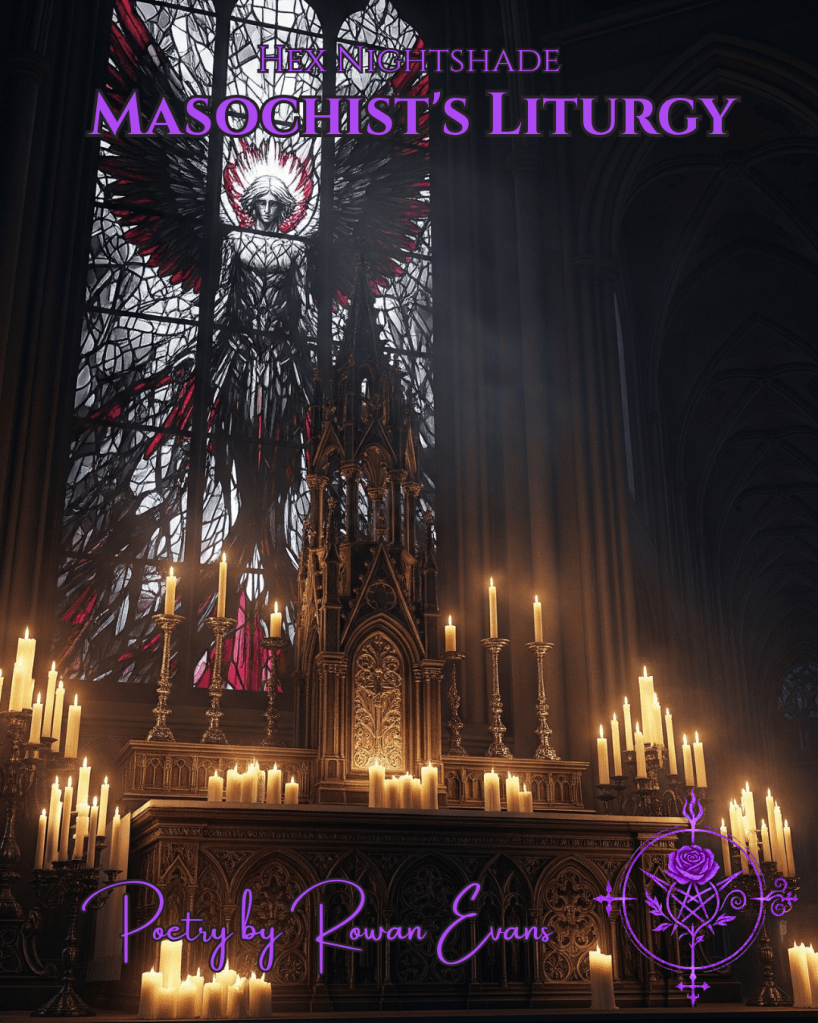
This cycle is one I’ve come to call my liturgical hymns of desire and ruin. They are not hymns for a chapel gilded in light, but for a darker sanctuary—where devotion and destruction blur, where prayer is whispered against the skin, and where love reveals itself not in comfort, but in surrender.
Each began as a poem, standing alone. But when gathered together, they form a liturgy—a sequence of temptation, surrender, ecstasy, silence, and healing. These are not songs of daylight. They are gospels of shadow, where every bruise is scripture and every breath is prayer.
Read them as hymns.
Read them as confessions.
Read them as the language of love when spoken in the dark.
⛧⛧⛧
⛧⛧⛧
I. Sadistic Angel
“You tear me open just to heal,
make me bleed so I can feel.”
Dusk lingers like a breath on skin.
You speak, and silence shatters within.
Flames in your tone, velvet with sin—
I knew it was wrong,
so I let you in.
Your smile, a blade in moonlight’s hush,
a warning dressed in a lover’s blush.
I traced the edge, I felt the rush,
every word,
a crimson crush.
Sadistic angel, fallen grace—
touch like fire, soul erased.
You tear me open just to heal,
make me bleed so I can feel.
Wrap me in your wicked art:
you’re the poison I call heart.
Your hands, both hymn and heresy,
every kiss a cruel decree.
I ache beneath your sanctity,
my sins absolved
in agony.
⛧⛧⛧
II. Masochist’s Dream
“Be the flame that makes me feel,
the wound that teaches me to kneel.”
Crawling through the chapel of night,
where shadows kiss my skin like sin,
I ache for hands that know the rite—
to strike, to shape
the dark within.
Cold stone beneath my blistered knees,
I whisper prayers
no god would heed.
Where are you, cruel salvation?
Where is she, my desecration?
Be the flame that makes me feel,
the wound that teaches me to kneel.
Mark your name across my soul,
a brand of bliss in blackened coal.
I don’t want mercy,
I want meaning in the pain.
You’re the angel inside
this masochist’s domain.
And then—she descends like dusk in lace,
the storm behind her angel’s face.
She reads my scars like sacred text,
each touch a psalm,
each breath a hex.
No longer lost, no longer torn—
I rise in pain, reborn.
I kneel not for forgiveness,
but for more.
Always more.
Sadistic angel—
I am yours.
⛧⛧⛧
III. Love in the Dark
“She lit up my soul like an atom bomb,
shattering me just to keep me calm.”
She came to me like thunder’s prayer,
a silhouette in a lace of sin.
Her halo rusted, her smile a flame,
she spoke in wounds I longed to feel.
This is love in the dark,
where angels fall,
where the heart’s last beat
is a siren’s call.
She lit up my soul like an atom bomb,
shattering me
just to keep me calm.
My hands were tied in velvet chains,
she kissed the bruises,
sang my name.
Each lash a map,
each gasp a scar,
her cruelty a whispered creed—
where love is need,
and need is to bleed.
“Oh, make her ache,”
she begs so sweet,
where agony and longing meet.
This is love in the dark—
and in her ruin,
she’s everything to me.
⛧⛧⛧
IV. In an Angel’s Grip
“I bloom beneath your iron kiss.”
Your fingers trace a sacred sin,
velvet vice wrapped beneath my skin.
Each breath you steal,
a vow unspoken,
a tethered soul,
already broken.
And I—
I don’t resist.
I bloom beneath your iron kiss.
You speak in hush, your halo bends.
Heaven weeps
where your mercy ends.
My lungs are yours;
they plead, they cry.
For every breath,
you let me die.
In an angel’s grip,
I come undone,
held like dusk before the sun.
Choked by love,
not pain nor hate,
a willing fall
to a fated state.
Not death, not life—just something between,
where angels touch the obscene.
I wear your will like a second skin,
this sacred ache
I carry within.
And if I break,
let it be here—
within your hold,
without my fear.
No peace, no scream,
no final slip.
Only surrender,
in an angel’s grip.
⛧⛧⛧
V. Aftercare
“In the silence, I find my aftercare.”
In whispered shadows where secrets bleed,
she moves like fire,
cold as winter’s breeze.
Wings of midnight,
eyes that burn,
leading me deeper
where dark desires churn.
Each mark a story,
each flame a sigh.
Between pain and pleasure,
we learn to fly.
Aftercare in the fading light,
where broken souls mend
through the night.
Her touch,
a healing flame so rare—
in the silence,
I find my aftercare.
Her voice, a lullaby wrapped in sin,
pulls me under,
lets the aching begin.
I fall, surrender,
stripped bare and torn,
cradled softly
after every storm.
“You belong to me,” she whispers low.
In every scar,
the truth will show.
The sting will fade,
but never despair—
love lives on
in the aftercare.
As the darkness lingers, so do we,
bound forever in this agony.
In every tear,
in every prayer,
we live and breathe
the aftercare.
⛧⛧⛧
⛧ Closing Reflection ⛧
Taken together, these five hymns trace a single path: the first spark of temptation, the ache of surrender, the rapture that borders on annihilation, and finally the tenderness that lingers in the aftermath.
They are not conventional love poems. They are liturgies for those who worship at stranger altars, who find meaning in the liminal spaces between pain and pleasure, destruction and devotion.
If love is so often painted in brightness, these pieces insist on another truth:
that the dark, too, can be sacred—
that surrender can be prayer—
and that even in the ruin of passion, there is a holiness worth naming.
 Poetry by Rowan Evans