Content Warning:
This poem contains explicit depictions of violence, abuse, and retribution. It touches on sensitive subjects such as grooming, sexual assault, complicity in the face of injustice, human trafficking, and war crimes. Readers should proceed with caution, as the themes explored in this work may be triggering for some. This poem is intended for mature audiences and is a work of fiction that seeks to explore vengeance, justice, and the consequences of unchecked power and harm.
Please read with caution, and know that this series is not intended to glorify violence but to reflect the pain, rage, and consequences that often go unnoticed or unpunished in the real world.
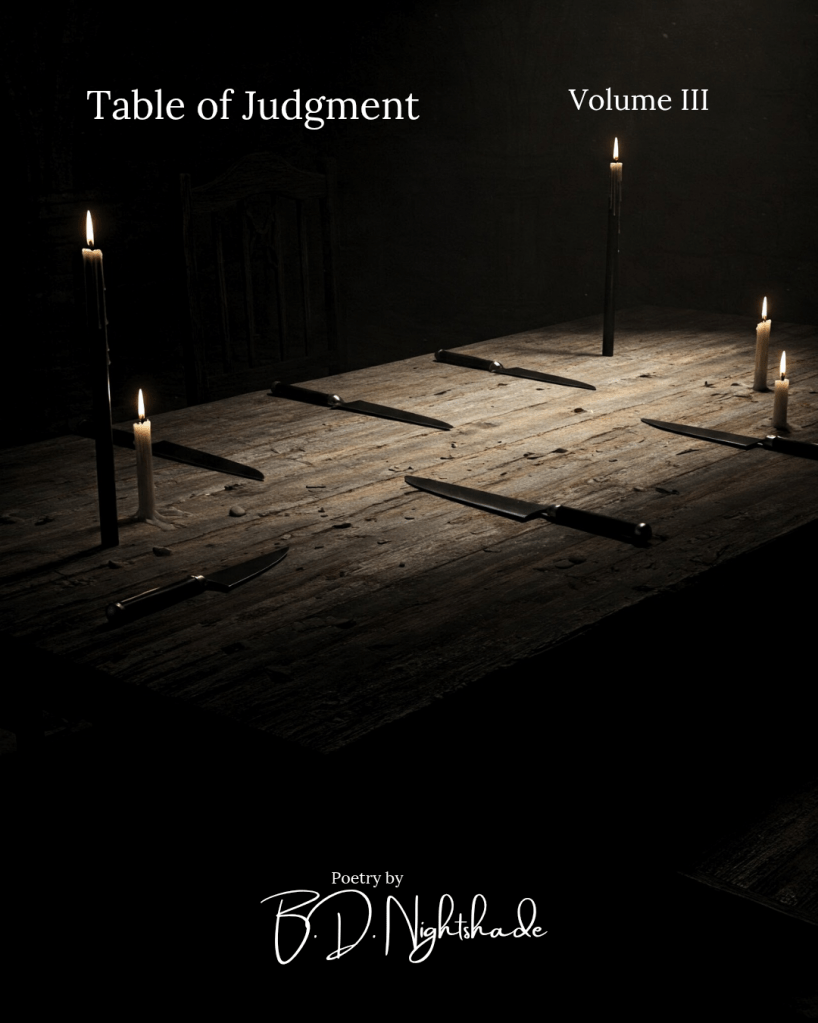
Seven more await their fate.
The knives are fewer now—
Not from mercy, but from use.
Their edges whisper memories,
Still stained with unrepentance.
Tonight, the table returns.
Seven chairs, seven fates,
Seven shadows dragged from hiding.
Each thinks they can run.
Each forgot—
Vengeance remembers.
First: The Groomer Teacher
He taught literature like seduction.
Underlined consent with a wink,
Graded innocence on a curve.
Gave praise with too many hands.
Now he’s pinned beneath a blackboard,
His lessons returned in silence and steel.
I staple every love note he wrote to skin
He once dared touch.
He says he only wanted to inspire.
So I make him inspirational art.
Blood as ink. Truth as canvas.
Second: The Human Resources Manager
She passed around cupcakes on birthdays,
But passed over every complaint.
Buried trauma in manila folders,
Told victims to be professional.
Now I file her under complicit.
Each page of silence becomes a lash.
I build her a cubicle from every name she erased.
Inside it, her voice cannot leave—
Just like theirs never did.
Third: The ICE Agent
He wore cruelty like a uniform.
Said “orders” while dragging toddlers away.
Stamped paperwork soaked in lullabies.
Built cages and called it law.
Now I lock him in a cell of memory—
Walls made from lullabies interrupted.
I tattoo their names on his arms
So he never forgets who he unmade.
The key melts in front of him.
He screams like a father now.
Fourth: The Frat Brother
His laughter echoes in solo cups.
Shot after shot, shame drowned in alcohol.
He called her a myth, a mistake,
As if blackouts erased guilt.
Now he drinks from a bottle
Filled with her memory—undiluted, unforgiving.
Each swallow burns the truth into his bones.
I leave him slumped in silence,
Party over, cameras rolling.
Replay on loop.
Fifth: The “Pick-Me” Woman
She climbed their shoulders
By stepping on broken backs.
Called survivors jealous,
Said they “wanted the attention.”
Now I seat her in a hall of mirrors.
Each one shows the woman she betrayed.
I peel back her words until only envy remains.
She cries for her reputation—
Too bad it’s the only thing she ever loved.
Sixth: The Landlord Slumlord
He charged gold for rot.
Turned homes into health hazards,
Blamed poverty for his greed.
Called heat a luxury.
Now he shivers in the dark,
Air thick with mold and vermin songs.
I padlock every exit with unpaid rent.
He begs for a repair request.
I send rats instead.
Seventh: The War Criminal in a Suit
Never fired a gun,
But his pen was a missile.
Signed cities into rubble,
Children into statistics.
Called it “strategy.”
Now I drop silence like bombs.
His ears ring with names he never learned.
I dress him in oil-slick skin,
Force him to drink from the well he poisoned.
His empire burns with no flag to wave.
The knives are dull now.
The flames are tall.
Seven new candles flicker—
Not for them.
Never for them.
There is no forgiveness
In the blade’s reflection.
Only truth,
And the hand that dares to hold it.
But the dark is never empty.
Seven more shadows stir.
Seven more await their fate.
And I—B.D. Nightshade wait, too—
Patient as the grave.
Author’s Note:
Vengeance is a complex, deeply personal concept. In Table of Judgment: Volume III, I explore the idea of retribution—not as a simple act of revenge, but as a reckoning for those who have inflicted harm, whether through direct action or silent complicity. These figures are not faceless villains, but representations of broader societal ills: the abusers, the enablers, the silent bystanders. The blade of justice is sharp, and the flames of truth burn without mercy.
This poem is a meditation on justice—both personal and collective—and the long-lasting impact of those who perpetuate harm. It is a reminder that the past cannot be erased, and the consequences of one’s actions follow them into the dark. While this work is dark and intense, it is also an outlet for those who have felt powerless, a space where the scales of justice can be balanced, even if only in the realm of imagination and poetry.

 Poetry by Rowan Evans
Leave a comment