Tag: Trauma recovery

  • Author’s Note

    Some poems feel less like they’re written and more like they’re discovered.

    A Rose in the Ashes came from following an image rather than an outline. One symbol led to another until the poem became a journey through memory itself—through forgotten moments, lingering wounds, recurring dreams, and the quiet realization that healing doesn’t happen by avoiding the past.

    The forest in this poem isn’t meant to be a literal place. It’s the landscape of memory, where some experiences remain vivid while others decay with time. The trees, the tunnel, the moon, the bay, and finally the rose all became landmarks within that emotional terrain.

    The final image—a single rose blooming through ashes—reminded me that even after devastation, beauty doesn’t disappear forever. Sometimes it simply waits beneath the surface until we’re ready to notice it.

    Rowan Evans


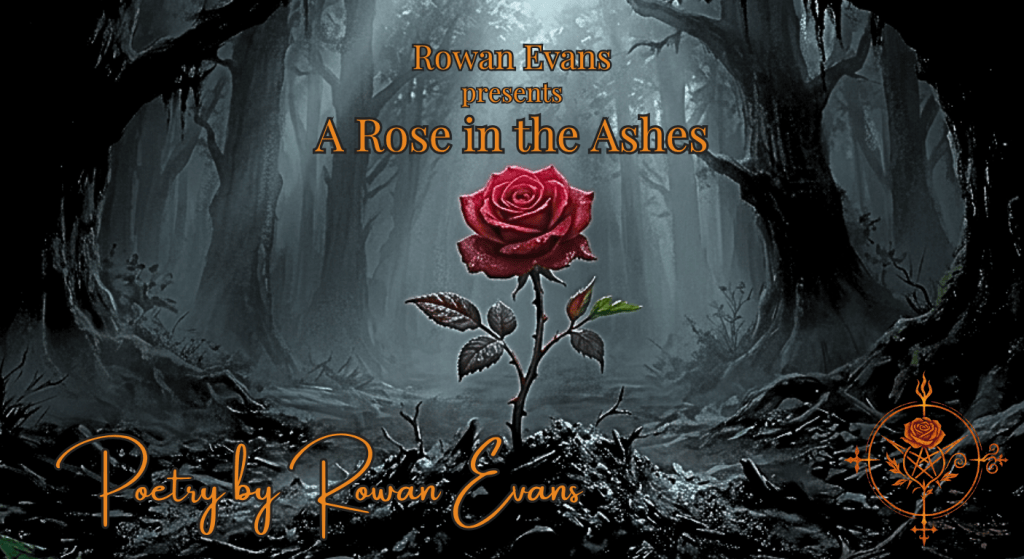
    A single red rose grows through gray ashes beneath a misty forest illuminated by moonlight, symbolizing hope emerging from painful memories.
    Sometimes healing doesn’t appear as a blazing light at the end of the tunnel.

    Sometimes it’s a single rose, quietly blooming where you thought only ashes remained.

    A Rose in the Ashes
    Poetry by Rowan Evans

    I wander through the mist and fog,
    wondering if I’ve gotten myself lost.
    The trees are thick with sickly green leaves,
    and the air is too thick, it’s hard to breathe.
    Every step feels borrowed,
    like the ground isn’t sure
    it wants to hold me.

    It’s like with every step
    the ground shifts a little to the left,
    until nothing feels right.

    It’s like I’ve walked
    to the end of the tunnel,
    but I didn’t find the light.

    I keep walking, stumbling along—
    the dark swallows me whole
    and then spits me out.
    I hit the ground and roll to a stop
    on the edge of a fifty foot drop.

    That’s when I see it,
    something moving between the trees—

    not a creature,
    but a feeling—

    the sense that I’m being asked
    to keep going
    even when I don’t know why.

    Maybe it’s because
    I didn’t find the light
    at the end of the tunnel,
    not because I failed—
    but because the journey isn’t done.

    The light signifies the end.

    No light means the journey continues,
    so I keep moving through—
    the streets that I walk in sleep,
    the moment I return to my bones,
    or a war with gods to ease the pain.

    Yeah, I followed the footprints
    to the water’s edge,
    I stared across at the coast
    on the other side of silence.

    And even from a distance,
    I was able to trace
    the moon across the heavens,
    before it became suspended over the bay—
    its reflection trembling across the dark water,
    a mirror to the tremor in my chest.

    But I couldn’t stay still for long—
    I had to keep moving on.

    So I ran—

    bolted for the tree line,
    tripped and stumbled in
    and my eyes caught the way the light
    pierced the canopy—

    the light—

    that’s what I’d been chasing
    this whole time,
    not at the end of the tunnel—
    but above my head,
    an idea—

    my eyes drift toward the sky,
    and that’s when I see—

    the leaves on these trees
    are not leaves,
    they are memories—
    some bright and vivid,
    others a sickly shade of green.

    Those are memories forgot,
    memories left to rot.
    But here’s the truth of this plot:

    some memories fade—
    whether you hold on or not,
    and some become rooted
    through pain, an environment
    permanently changed.

    And that’s what I saw…

    trees with leaves
    showing things—
    I thought long forgotten.
    I was more surprised by that,
    than the fact that so many trees
    looked rotten.

    I could feel the tears
    touch the corners of my eyes—
    the air was thick again,
    humid and suffocating.
    There was a tremor in my chest,
    and knees were weak—
    with every step my bones were quaking,
    like the earth was shaking.

    I stumbled and fell to my knees,
    head bowed—
    in shame or respect,
    who knows, now?
    I opened my mouth,
    but no jokes came out—
    I couldn’t misdirect from this,
    no sleight of hand.

    I had to face this—
    whatever it is,
    whatever these leaves
    show me,
    I’ve got to take it seriously—
    because maybe it is these memories
    that are keeping me stuck here.

    Maybe they are the memories
    that drive the fear,
    that keeps me from acting—
    that keeps me dragging feet
    and self-sabotaging.

    Slowly I rise—
    like the sun over the horizon.
    Knees shaking from the weight of me,
    I struggle to take one step
    and then another.

    I stumble through the ruins
    of thoughts, dreams and memories—
    my chest rises and falls,
    like oxygen is in short supply.

    Then I see it—
    a single rose in bloom,
    poking through the ashes
    of nights only remembered
    in the spilled ink on silent pages.


    Journey into the Hexverse…

    [One Honest Sentence]
    It’s easy to write about anything. What’s difficult is writing one completely honest sentence without hiding behind humor, references, or metaphor. One Honest Sentence explores the distance between poetic confidence and emotional vulnerability.

    [Leave No Self Behind]
    What if finding yourself isn’t about discovering someone new, but learning to walk beside every version you’ve ever been? “Leave No Self Behind” is a meditation on memory, healing, and embracing the selves we once abandoned.

    [More Afraid Than the Ink]
    Some confessions are easy to write but impossible to speak. More Afraid Than the Ink explores fear, dreams, recurring symbols, and the quiet realization that the page has always been braver than the poet.

    [Just Human]
    Just Human is a reflective free verse poem about seeing people before borders, choosing empathy over division, and finding home in our shared humanity rather than on a map.

    [Translating What I Feel]
    A poem about the invisible process of turning emotion into imagery, imagery into language, and language into poetry. An intimate reflection on creativity, loneliness, and twenty-three years of learning to translate what the heart feels.

    If you’re interested in more poetry, you can find it here → [The Library of Ashes]
  • Author’s Note

    This poem grew out of a realization that getting “lost” isn’t always the same as losing yourself.

    I’ve written many pieces about dreams, memory, shifting landscapes, and wandering through places that seem to exist somewhere between reality and imagination. Over time, I realized those places weren’t asking me to escape who I was—they were asking me to revisit the parts of myself I had left behind.

    We often talk about “finding ourselves” as though there’s one true version waiting to be discovered. My experience has been almost the opposite. Every season of life leaves behind another version of us: the frightened one, the hopeful one, the grieving one, the joyful one. None of them disappear simply because we’ve grown older.

    Healing, at least for me, isn’t replacing those earlier selves.

    It’s learning to walk beside them without shame.

    This poem is an invitation to stop treating old versions of ourselves as mistakes to erase and instead see them as companions who helped us survive long enough to become who we are today.

    Rowan Evans


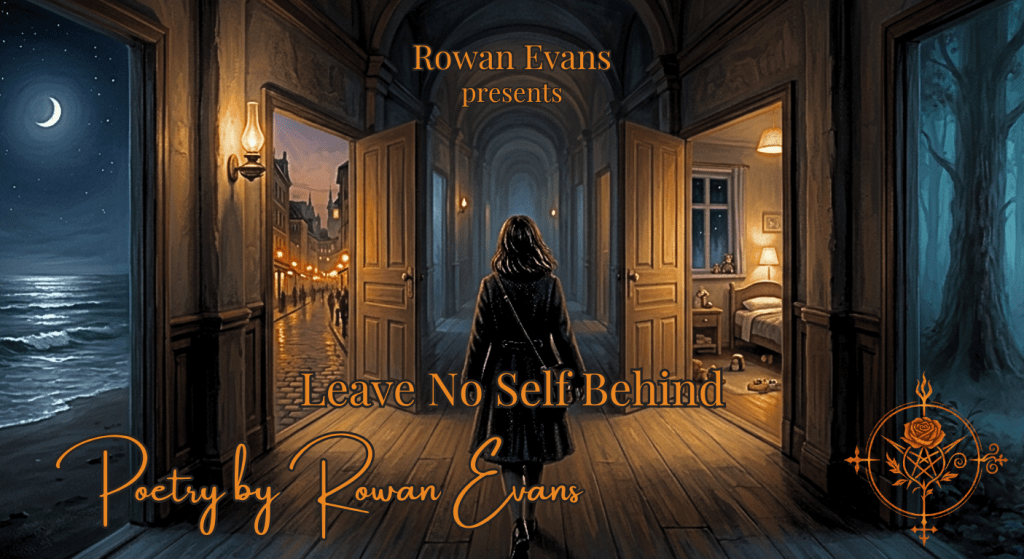
    A solitary figure walking through a dreamlike hallway where each open doorway reveals a different landscape representing memories and past versions of the self.
    Healing isn’t finding one true self—it’s learning to walk beside every version of yourself with compassion.

    Leave No Self Behind
    Poetry by Rowan Evans

    I feel like I’ve lost myself again—
    don’t know when it began,
    but I get lost a lot.

    It doesn’t take much for me
    to get lost in thought—

    I wander off
    without meaning to,
    slipping between memories
    like loose floorboards.

    One thought opens a door,
    another pulls me down a hallway,
    and suddenly I’m somewhere
    I didn’t plan to be—

    with some version of me
    I didn’t plan to meet.

    Sometimes the hallway
    tilts into something else—

    a shoreline I’ve walked in sleep,
    a city humming with heat,
    a room I haven’t entered in years.

    The world shifts
    without warning,
    and I follow it
    the way I follow dreams—

    half-aware,
    half-afraid
    of what I’ll find
    in the scene change.

    I never know
    which version of me
    I’ll find in those places—

    the one who’s tired,
    the one who’s trying,
    the one who’s still carrying
    things I swore I let go.

    Sometimes I meet
    the versions of me
    I thought I’d outgrown—

    the one who flinches,
    the one who freezes,
    the one who still thinks
    they’re hard to love.

    And I walk with them
    for a while,
    through whatever memory
    the hallway decides to show—

    letting them speak,
    letting them breathe,
    letting them…

    exist.

    Without rushing them back
    into the dark.

    And maybe that’s
    what finding myself
    really looks like—

    not a single moment
    of clarity,
    not a sudden return,
    but walking through
    every hallway
    my mind opens,
    meeting every version
    I’ve ever been,
    and letting them stay
    long enough
    to feel seen.

    Maybe I’m not lost.

    Maybe I’m just learning
    how to carry
    all the selves
    I used to abandon
    when the world
    felt too loud.

    Maybe this time…

    I won’t leave anyone—

    behind.


    Journey into the Hexverse…

    [Where the Metaphors Lead]
    Some truths are easier to write than they are to say aloud. “Where the Metaphors Lead” explores the quiet space between dreams, confession, and the courage it takes to let another person know how deeply they’ve become woven into your inner world.

    [Noon Is Loud]
    If four in the morning belongs to truth, then noon belongs to impossible memories. Noon Is Loud is a playful free verse poem filled with absurd boasts, pop culture references, and tongue-in-cheek mythology that explores how easily imagination can rewrite reality.

    [5:01 (Pull the Punchline Back)]
    What happens when a confessional poet instinctively hides every confession behind a joke? 5:01 (Pull the Punchline Back) explores humor as emotional armor, the speed of an overactive mind, and the difficult choice between making people laugh and letting them see what’s really there.

    [Chemical X]
    Chemical X explores the rapid, associative way one creative mind moves—from cartoons to sports, comic books to music—revealing that inspiration isn’t linear, but a collision of memory, humor, rhythm, and intuition.

    [Monster Theology]
    What if the monsters under the bed weren’t monsters at all? Monster Theology explores difference, belonging, and the human tendency to fear what we don’t understand through a conversation with the creatures we’ve spent our lives imagining.

    If you’re interested in more poetry, you can find it here → [The Library of Ashes]
  • Author’s Note

    This piece is the closest I’ve come to writing the truth of my internal war without softening it. Between Worlds is about self-violence—the way the mind learns your weak spots, remembers the old wounds, and knows exactly where to cut. It’s a poem about relapse, about memory, about survival, and about the strange loneliness that follows healing.

    It speaks to the years where I wasn’t sure I’d make it. The hospital walls. The padded quiet. The fluorescent lights humming through the silence. It speaks to dissociation, to identity, to queerness, and to the mythic distance I’ve always felt between who I am and the world I live in.

    This poem isn’t a cry for help—it’s a record of survival. It isn’t tragedy for tragedy’s sake—it’s truth. It’s the reality that healing isn’t linear, that progress has shadows, and that sometimes the loudest battles are fought in the mind no one else can see.

    If you know this feeling—of standing in your own skin like it never quite fits, of fighting thoughts with thoughts, of loving your existence even when you question your place in it—then I hope you feel seen here.

    Because none of us are alone in the in-between.

    Rowan Evans


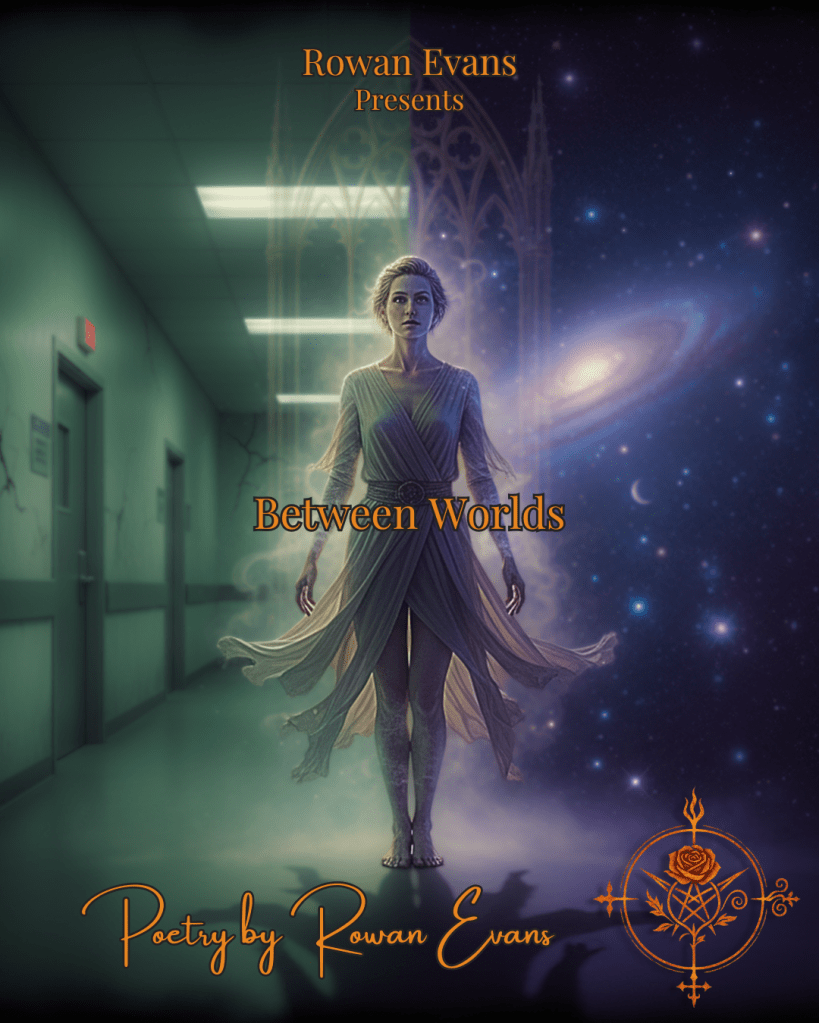
    Nonbinary person standing between a hospital hallway and a star-filled night sky, symbolizing dissociation and identity between worlds.
    Between Worlds — artwork representing Rowan Evans’ poem about surviving mental illness, dissociation, and identity beyond binaries.

    Between Worlds
    Poetry by Rowan Evans

    Why do I
    always try
    to pick a fight
    with me?

    You’d think I’d know,
    by now, just how
    quick I’ll slip
    an insult
    under the ribs.

    I’ll hit
    every single fear,
    twist them
    like a knife—
    until I’m
    on my knees,
    gasping,
    spitting blood.

    I don’t fight fair.
    I target old wounds,
    tear at what’s
    already healed.
    I’ll fuck around
    and send myself
    back ten years—
    back to hospital walls
    and quiet rooms,
    where the only sound
    was the fluorescent hum.

    Where time dissolved…
    where clocks stopped
    ticking.

    But I walked out
    of those halls—
    didn’t I?

    Didn’t I?

    But what if I didn’t?
    What if I’m still locked inside,
    in a padded room
    with the jacket
    strapped tight?
    Thoughts confined,
    so the words
    won’t escape.

    Writing poems
    in my head,
    just to pass
    the time.

    I’ve been alive,
    but dead inside.
    And I’ll be honest:
    I’ve died
    inside my mind
    more than
    a dozen times.

    I just wanted escape.

    Escape from pain,
    from feeling misplaced—
    I just wanted
    to belong.

    But it’s like—
    something is wrong here.
    Why don’t I
    feel like
    I belong here?

    Why does everything feel
    a half inch to the left—
    like I’m living inside
    the echo of myself?

    Like I’m watching my life
    from behind fogged glass,
    palms against the surface,
    screaming—
    but no sound
    passes through.

    Sometimes I swear
    the world forgets I’m here,
    and sometimes
    I do too.

    Maybe it’s because
    every room I walk into,
    I’m half a ghost already—
    too queer, too quiet,
    too soft, too strange.
    Too fucking much
    for everyone
    but me.

    Maybe that’s why
    the fight never ends—
    because I’m still trying
    to prove I deserve
    the space I take up,
    even in my own skin.

    So maybe I don’t belong here
    because I was born
    between worlds—
    not alive, not dead,
    not human, not myth,
    not safe, not ruined.

    Maybe my bones remember
    a home I never had,
    and every heartbeat since
    has been an attempt
    to map
    my way back.


    If you’re looking for more poetry, you can find it here → [The Library of Ashes]
  • Author’s Note

    This poem is not about wanting to die.
    It is about learning how to survive long before learning how to live.


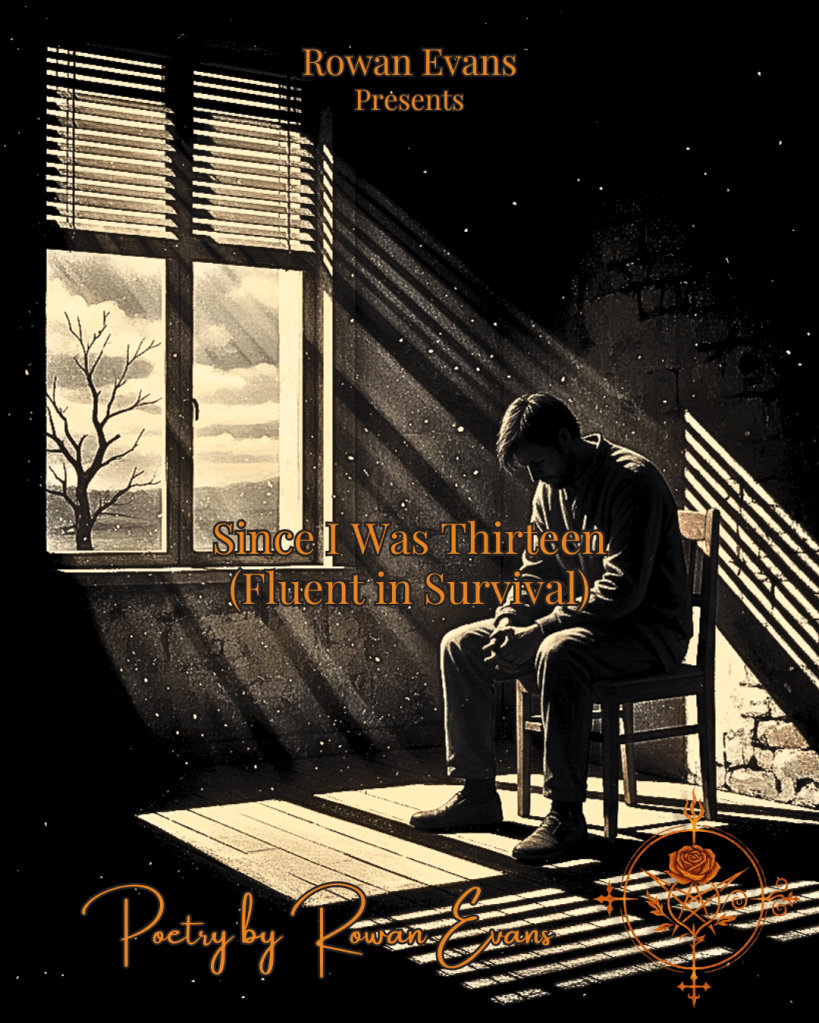
    A shadowed figure in a dimly lit room, reflecting in solitude, surrounded by deep shadows and soft light, evoking introspection and survival.
    Reflecting on survival, solitude, and the quiet strength found in shadows.

    Since I Was Thirteen (Fluent in Survival)
    Poetry by Rowan Evans

    I feel like I’m lost,
    I’m wandering.
    Twisted thoughts,
    I’m pondering.

    My demise
    in a life I despise.
    It’s not that I want to die—
    I’m just tired
    of trying to survive.

    I want to be happy.
    I’m alive.

    But my head
    is so full of dread—
    every morning
    a negotiation
    just to get out of bed.

    Body feels heavy,
    limbs lagging—
    everything moves
    in slow-motion.

    Slipping into shadows—
    going home.
    The light has never felt like mine.
    I was born in the shadows,
    raised in the shade.
    Darkness has been
    my mindscape—
    since I was thirteen.

    I learned early
    how to make myself small—
    how to soften my footsteps
    inside my own head.

    I memorized the weight of silence,
    learned which thoughts were safe to keep
    and which ones
    needed to stay buried.

    Survival became a second language,
    spoken fluently,
    even when no one was listening.

    I say I’m alive
    like it’s a defense—
    like survival
    should be enough.

    But living
    feels like something other people do
    without rehearsing it first.


    Closing Note

    I wrote this for anyone who learned survival before they learned safety.
    For those who are still here, even when “alive” feels like a negotiation.
    You are not failing — you are fluent in something the world never taught gently.


    For more poetry, check out the archives: [The Library of Ashes]

  • Author’s Note

    This piece came from a place of uncomfortable clarity — the kind that only arrives after you’ve survived enough storms to notice the patterns in the people around you. There’s a strange truth I’ve learned over the years: some people loved me louder when I was breaking than when I was healing. Pain made me poetic, easy to praise, easy to place on a pedestal of tragedy. But healing? Healing is quieter, steadier, less romantic. And somehow, to some people, that made it less worthy of attention.

    I didn’t write this to shame anyone. I wrote it because it’s real — because recovery deserves reverence too, because resilience isn’t any less beautiful than collapse, and because we don’t talk enough about how lonely healing can be.

    This piece is for anyone who’s ever felt more valuable broken than whole. For anyone rebuilding themselves without applause. For anyone learning to exist without having to bleed for validation.

    You are still art.

    Rowan Evans


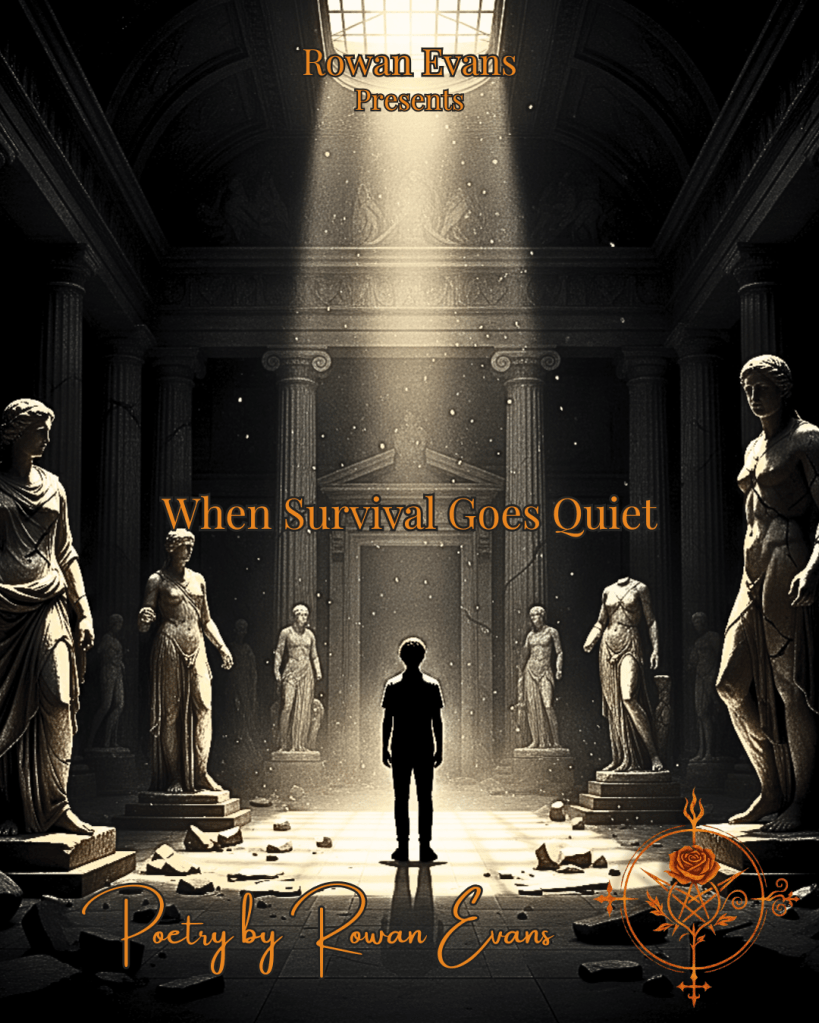
    A solitary figure in a dim, gothic museum surrounded by cracked statues, symbolizing healing after emotional collapse.
    Even survival can feel quiet in a world that only learned to listen to the sound of breaking.

    When Survival Gets Quiet
    Poetry by Rowan Evans

    It’s always been strange to me
    how people praised me louder
    when I was dying inside
    than when I wasn’t.

    And I don’t say this
    to make anyone feel shame—
    it’s just something I’ve noticed
    over time.
    Over a lot of motherfuckin’ time.

    I can think back
    to so many moments
    where I was ready to check out.
    Where the smallest thing
    felt like the final straw.

    And I don’t say that
    to minimize, or erase,
    or make light of the weight
    those moments carried.

    They held me like a museum tragedy—
    a relic of ruin,
    a beautiful collapse.

    But when I finally learned to breathe again,
    their applause softened,
    like my healing made the art
    less valuable.

    Maybe it’s easier to love me
    when I’m bleeding metaphors
    than when I’m quietly rebuilding.

    Maybe survival is too quiet
    for people who only learned
    to listen to the sound
    of breaking.


    Looking for more poetry? You can find it all in the Library of Ashes.

  • Author’s Note

    This poem is a meditation on love that demands patience, courage, and total presence. It is written for those whose hearts have been tested, broken, or misread—and for the people brave enough to stay, to witness, and to hold. It is about devotion, reverence, and the quiet power of being fully seen.


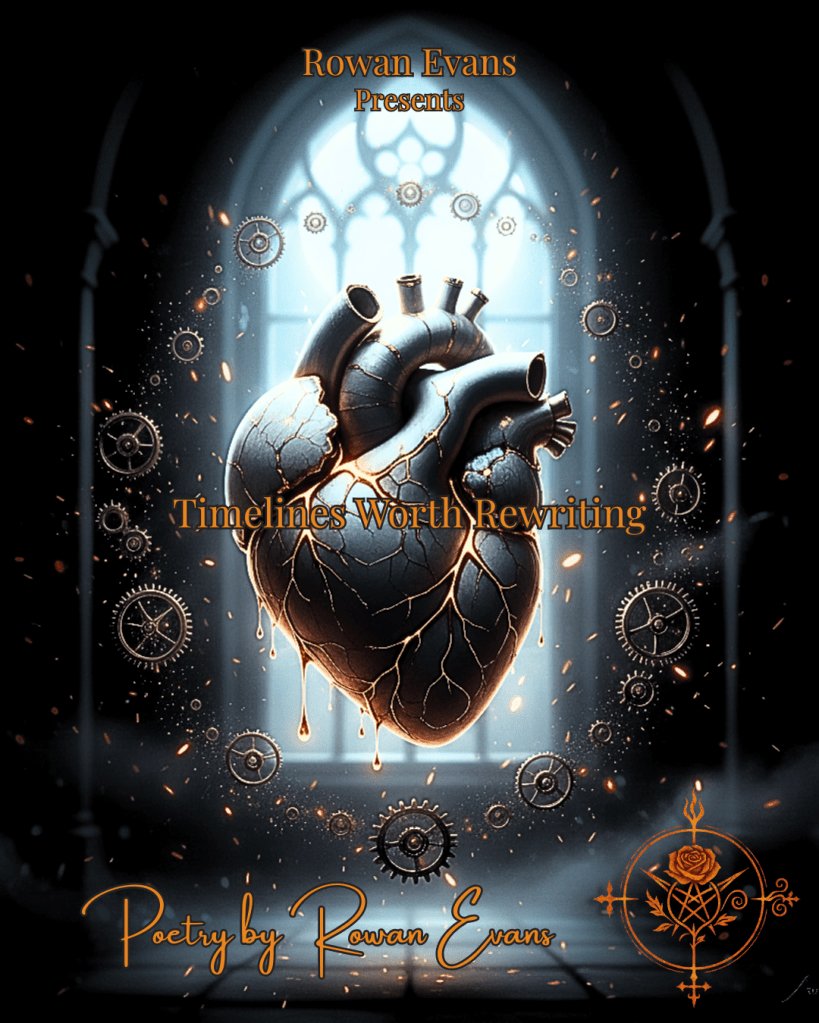
    Kintsugi-repaired heart glowing under moonlight with floating clock fragments and falling embers in a soft gothic atmosphere.
    Every fracture tells a story—and some loves are brave enough to rewrite the timeline.

    Timelines Worth Rewriting
    Poetry by Rowan Evans
    (Written April 21, 2025)

    Don’t fall in love with me
    unless you’re ready for time zones and tenderness,
    for clocks set to your breath
    even when you’re not speaking.
    Unless you know how to read
    the unsent messages
    I whisper into the quiet of 3 a.m.,
    when my world is still sleeping
    and I am drowning
    in the silence between our heartbeats.

    I didn’t mean for this to happen.
    You were someone else’s—
    a name I only knew
    through the tremble in your voice,
    a shadow of a boy
    who left bruises where joy should’ve bloomed.
    You were a poem already breaking,
    and I…
    I just wanted to be a page
    that didn’t hurt to land on.

    I wasn’t chasing fire.
    I was tending embers.
    The way I always do—
    with a soul stitched together by
    the broken glass of old timelines,
    where love meant losing myself
    in someone else’s storm.
    But you were different.
    You asked nothing—
    and gave everything in glances
    you didn’t know were sacred.

    I told myself the clock widget
    was just a kindness.
    A way to say
    good morning, warrior,
    good morning, beautiful,
    good morning, still-here.
    But the truth?
    It became my North Star.
    A constant.
    A compass pointing always to you.

    I fell in love the way
    only a person who’s clawed their way through shadow can—
    with reverence.
    With awe.
    With hands that tremble
    but still reach.

    I saw your pain
    like an open door
    to a familiar room—
    and I walked in,
    not to fix you,
    but to sit beside you
    in the ruins.
    Because I’ve been there.
    Because I carry my own ghosts,
    and I name them in poems
    so they don’t haunt me in sleep.

    They say I should’ve stayed away.
    That I’m playing with fire.
    But fire never scared me—
    I was forged in it.
    Born of battle cries
    and whispered truths
    and a girlhood denied.
    I don’t wear guilt for things I didn’t break.

    And I didn’t break you.

    He did.

    He, who saw your softness as weakness.
    He, who mistook your loyalty
    for something owed.

    But me?
    I saw the Queen beneath the scars.
    I saw the way you held yourself together
    with gold-threaded hope,
    kintsugi soul—
    every crack shining brighter
    because you never stopped choosing to try.

    Don’t fall in love with me
    if you’re afraid of complicated truths.
    Because I will love you
    with the same hands
    that once wrote suicide notes
    and now write survival stories.
    Because I will see your shadows
    and still call you light.

    Don’t fall in love with me
    if you’re not ready to be seen completely—
    every bruise, every brilliance,
    every whisper you’ve never spoken aloud.
    I do not love in fractions.
    I do not flinch from the messy,
    the haunted, the hungry parts of you
    You think no one could ever stay for.
    I will.
    But only if you’re ready.
    Only if your heart can bear being held
    without armor.

    I didn’t plan to fall.
    But you spoke in moonlight,
    and I’ve always been lunar-bound.
    Tied to tides.
    Pulled by gravity
    in the shape of your laugh.

    And even if you never say my name
    the way I hope,
    even if I am just a season
    you remember when it rains—
    know that I loved you
    without agenda,
    without shame,
    without asking for anything
    but to witness your rise.

    Don’t fall in love with me
    unless you’re ready
    to be the reason I believe
    there are timelines worth rewriting.


    More of my poetry can be found here: The Library of Ashes

  • Author’s Note

    This piece is a devotion in disguise — written in the quiet hours between timezones, between breaths, between guarded words and aching hearts. It’s about witnessing someone deeply, loving them gently, and holding space without asking for anything in return. I wrote it for one person. But maybe, just maybe… it’s for you, too.


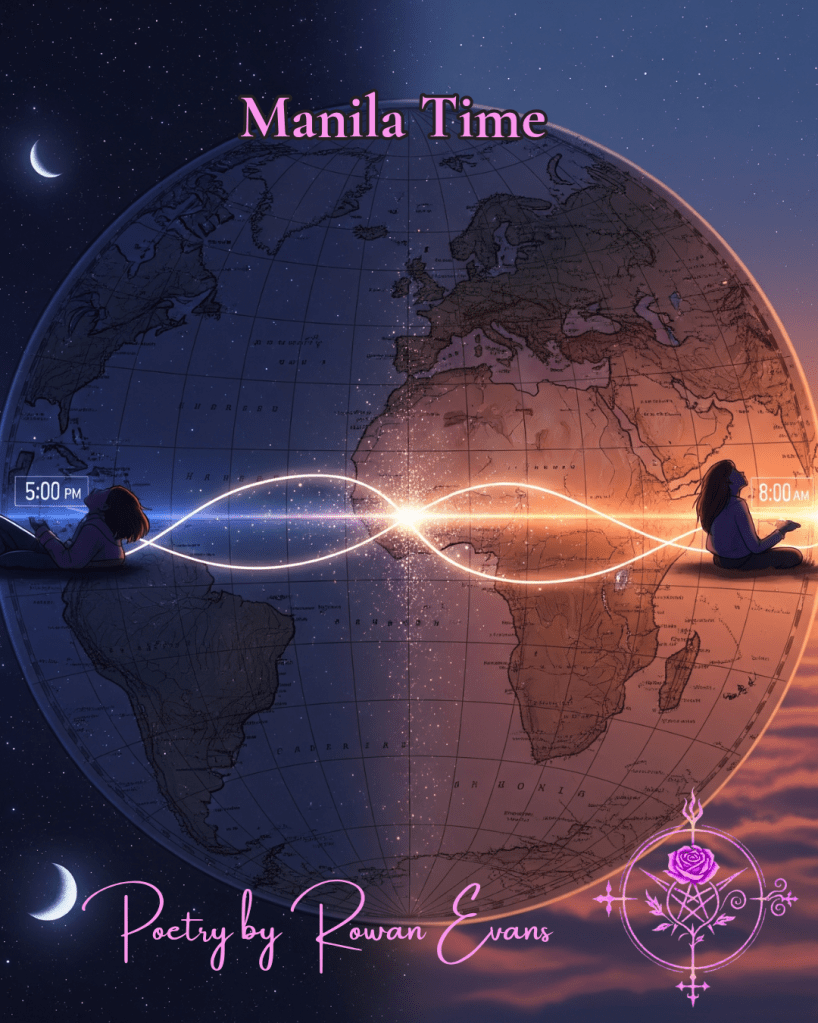
    Illustration of long-distance lovers connected by a glowing thread across a world map, symbolizing emotional connection across timezones.
    Even in different timezones, love finds a way to stay.

    Invocation

    For the ones who learned to love with their silence before their words. For those who trace the weather in someone else’s sky, just to understand them better.


    Manila Time
    Poetry by Rowan Evans

    I didn’t notice at first—
    how your name sat gently on my tongue
    long before I ever said it aloud.

    It was just a widget at first,
    a second clock on my home screen,
    ticking in time with your sunrise.
    A quiet devotion disguised as practicality.

    2 A.M. your time
    meant I braced for tremors—
    not the kind that crack the earth,
    but the kind that crack the heart.

    I knew your moods by minutes,
    learned the language of your silence
    before your voice ever filled the gaps.

    You didn’t have to tell me
    when the storms had come—
    I already knew how they sounded
    in the rhythm of your typing.

    I kept the weather on standby—
    not for small talk,
    but to understand your discomfort.
    Humidity clings like anxiety sometimes.

    You never asked for me to care this much.
    You didn’t have to.
    I fell into it like breath,
    like the gravity of your pain
    was a call I couldn’t ignore.

    You asked to hear my voice—
    I didn’t expect your laugh to bloom like that,
    all giggles and soft disbelief
    when I called yours cute.
    Even in five minutes,
    you carved out a place in my memory
    no one else had touched.

    The second call—
    quiet, trembling.
    You didn’t speak, just cried.
    I didn’t leave.
    I let silence speak love
    in a language you could trust.

    Now, we fill hours
    with shared breath and soft truths.
    You cry freely with me now—
    your vulnerability,
    no longer met with silence
    or shame.

    I listen.
    When your ghosts scream,
    I speak your name softly
    until they back down.

    And still—
    you tell me all the reasons
    you believe people leave:
    your fire, your scars,
    your unfiltered honesty,
    your storm-bred instincts
    to guard, to bite, to run.

    But I’m not made of fear.
    I’m stitched together with patience,
    with soft hands that don’t flinch
    at the weight of your story.

    You called yourself broken.
    I call you brave.
    You called yourself darkness.
    But I’ve seen your light,
    even when you tried to hide it
    beneath a growl.

    You listed your “red flags” like a warning.
    I read them like a love letter:

    Anger? Just fire misplaced.
    Paranoia? A wound learning to trust.
    Possessive? You mean devotion.
    Jealous? You just care deeply.
    Strict? I’m listening, Ma’am.
    Unpredictable? Adventure.
    Bitchy? A woman with boundaries.
    Sarcastic? Fluency.
    Selfish? Please, take what you need.
    Sadist? Well, I bruise easy, and gladly.
    Darkness? I’ve been waiting in it for someone like you.

    And if you told me to hang up on anyone else?
    I wouldn’t even hesitate.
    One word, and I’m yours.

    I’ve told you—again and again—
    I’m not going anywhere.
    Not when you’re quiet.
    Not when you’re hurting.
    Not even when your trust flinches.

    Because I mean it
    when I say you’re important to me.
    I mean it
    when I say I wish I could be there—
    to hold you when you cry,
    to remind you that what he did
    was not your fault.
    That none of this
    is a reflection of your worth.

    You are lovable.
    You are valuable.
    You are deeply, profoundly loved.
    And if you let me,
    I will carry what I can
    of the weight you weren’t meant to bear alone.

    Love doesn’t always need permission
    to show up.
    It just needs a door cracked open.
    And yours, even guarded,
    has never once made me turn away.

    I’ll keep showing up,
    in silence,
    in storms,
    in Manila time,
    and every moment in between.

    And if I could—
    I would cross every mile between us,
    burn every timezone just to taste
    the air you breathe when you laugh.
    I’d trade sleep for a moment
    to watch you smile in real time.
    To brush away the weight behind your eyes
    with my fingers,
    and say with trembling certainty—
    you are safe with me.

    Because the truth is,
    somewhere between those late-night calls
    and stolen giggles,
    I fell for you.

    Not in a crashing, desperate way,
    but in the kind of falling
    that feels like floating—
    like peace.
    Like coming home
    to a place I’ve never been
    but always longed for.

    I fell for your storm
    and the quiet that follows it.
    I fell for your voice,
    how even your sarcasm
    feels like warmth wrapped in armor.
    I fell for the way you fight your pain
    and still manage to be soft with me.

    And I know you’ve been let down
    by people who promised the moon
    then blamed you when it disappeared.
    But I am not a promise—
    I’m a presence.

    I don’t need you to always be easy to love.
    I just want to love you
    exactly as you are.

    So if you’re asking—
    yes, I want to be yours.

    Not just in soft texts and teasing words,
    not just in Manila time and midnight devotion—
    but in all timezones,
    in all the messy, terrifying, beautiful ways
    this could become real.

    I’ll wait.
    I’ll stay.
    I’ll love you here,
    and if you ever ask me to—
    I’ll love you there, too.


    Benediction

    May you find someone who knows your storms and stays anyway. May your name always be spoken with reverence — even in silence, even across oceans.


    Read Next (Suggestions)

    [The Hopeless Romantic Wears Armor]
    [Hex & Flame: Mirror of Shadows]
    [Even Still, You Are (My Muse)]
    [Litany & Tongue: A Devotional Duet]

    Or explore the full archive in [The Library of Ashes]—and if your own confession aches to be written, [commission a custom poem here].

    NGCR25 at checkout to get 25% off your ‘request’…

  • Cover image for the poem ‘To the Ones Who Feel Like Ghosts’ by Shiann. A silhouette of a person in a dark cloak stands against a glowing ocean backdrop, surrounded by soft light. The title and subtitle are written above in gothic font, with the name 'Shiann' across the figure and 'Rowan Evans' credited in the corner.
    For the souls who are still here, even when it hurts.

    🕯️ Featured Guest Poem
    For the souls who are still here, even when it hurts.

    Some poems arrive like lifelines—woven from truth, pain, grace, and the quiet strength of survival. They don’t offer easy answers, but they do offer space. Space to feel. To breathe. To be reminded that healing is messy, nonlinear, and still… deeply sacred.

    “To the Ones Who Feel Like Ghosts” by Shiann is exactly that kind of poem.

    “I wrote it with the intention to give some kind of guidance, space and hope,” Shiann said. “Because being someone who suffers from mental health issues and trauma, I know how easy it is to get lost when trying to heal. It’s hard, and it can feel like there’s a veil covering the eyes of the soul. But healing doesn’t always have to be painful—it just needs to be honest. And when it’s honest, it’s done with grace.”

    This poem is a sanctuary for anyone who’s ever wondered if they’re too far gone to be found again.
    It’s a reminder that even in the dark, even when we feel like ghosts in our own lives—
    we are still becoming.

    I am deeply honored to feature this as the first-ever guest poem on my blog.
    Let it meet you wherever you are. Let it be a soft place to land.


    “To the Ones Who Feel Like Ghosts”
    for the souls who are still here, even when it hurts

    If you’re reading this with tired eyes,
    barely holding on,
    wondering if the road even leads anywhere—
    this is for you.

    For the ones who feel like life keeps happening
    to them
    instead of with them.
    For the ones who keep giving love
    and getting silence in return.
    For the ones who wake up
    and already feel behind.

    You are not broken.
    You are becoming.

    I know it feels like you’re crumbling.
    Like everything you touch slips through your fingers
    and every breath tastes like defeat.
    But listen closely:

    Some things fall apart
    because they were never meant to hold your becoming.
    You were not made to stay small
    just to make others comfortable.
    You were not made to disappear
    just to survive.

    Your mess does not cancel your magic.
    Your doubt does not erase your worth.
    You can feel lost
    and still be on your path.

    You don’t need to have it all figured out.
    You don’t need to feel good all the time.
    You don’t even need to know where you’re going.
    You just need to keep going.

    Because there is a version of you waiting—
    not perfect, not fixed—
    but free.
    Free from shame.
    Free from the lie that healing must be fast or pretty.
    Free to speak gently to the parts of yourself
    that never heard a kind word.

    So take your time.
    Cry if you need to.
    Start over as many times as it takes.

    Just don’t stop being you.
    Even if you don’t know who that is yet.

    There is peace here,
    not in perfection—
    but in presence.
    In letting yourself exist
    exactly as you are.

    So breathe.
    Rest.
    Begin again.

    You’re not alone.
    And you’re not lost.
    You’re just on your way home.


    🇺🇸 United States

    988 Suicide & Crisis Lifeline – Call or text 988
    https://988lifeline.org
    Free, 24/7 support for emotional distress and mental health crises.

    Crisis Text Line – Text HOME to 741741
    https://www.crisistextline.org


    🇬🇧 United Kingdom

    Samaritans – Call 116 123 (free, 24/7)
    https://www.samaritans.org


    🇦🇺 Australia

    Lifeline Australia – Call 13 11 14
    https://www.lifeline.org.au

    Kids Helpline (ages 5–25) – Call 1800 55 1800
    https://www.kidshelpline.com.au


    🇨🇦 Canada

    Talk Suicide Canada – Call 1-833-456-4566 or text 45645
    https://talksuicide.ca


    🇵🇭 Philippines

    Hopeline Philippines
    Call: 0917 558 4673, (02) 8804 4673, or 2919 (toll-free for Globe & TM)
    https://www.hopelineph.com


    🌍 Global

    Befrienders Worldwide – Emotional support in 30+ countries
    https://www.befrienders.org

    Suicide Prevention Wiki (International Hotline Directory)
    https://suicidestop.com/call_a_hotline.html


    If this poem spoke to you, know you’re not alone on your journey. Healing is not a race or a destination, but a series of moments where grace meets courage. May Shiann’s words remind you to breathe, to rest, and to keep moving forward—one step, one breath, one honest moment at a time.

    Thank you for sharing this space with us.

    With respect and gratitude,
    Rowan Evans
    The Luminous Heretic


    🔗 You Might Also Like…

    The Pilgrim Road Is Not Paved in Gold – A Poem About Healing and Resilience

  • This poem was born out of quiet reflection and fierce resilience.
    It’s for anyone who’s ever felt like healing was messy, sacred, and nonlinear.

    “The Pilgrim Road Is Not Paved in Gold” is a reminder that our paths don’t have to look the same for our pain – or our perseverance – to be valid.
    Whether you’re crawling, sprinting, or standing still: your journey matters.

    You’re not alone on this road.


    “The Pilgrim Road Is Not Paved in Gold”
    (A Poem About Healing and Resilience)

    The path to healing is not straight—
    it coils like a serpent through stone and shadow,
    etched into the spine of a mountain
    too proud to bend to mercy.

    Some days, I take the road slow—
    counting each breath like rosary beads,
    to keep from slipping on loose truth,
    on grief disguised as gravel.

    Other days, I run—
    boot soles striking rhythm against fate,
    wind howling benedictions in my ears,
    like the ghosts of every version of me
    that died to bring this one forth.

    You—who climb beside me—
    do not compare your ridge to mine.
    Maybe your trail is lit by lanterns,
    or paved with the prayers of softer years.
    But I, too, was given a summit.
    And I’ll reach it,
    even if my knees bleed against jagged grace.

    We are all ascending
    with burdens stitched to our backs,
    sacred scars and trembling hope
    like banners in the wind.
    Some sing.
    Some crawl.
    Some forget why they started at all.

    But I remember—
    the summit is not salvation.
    It is simply a place
    where I will stand beneath open sky
    and whisper: I made it.

    So I will not rush.
    I will not stray.
    Each step is a vow.
    Each stone, a psalm.
    And I keep my eyes
    on the road—
    not to avoid the fall,
    but to honor the rise.


    🖋️ Author’s Note:

    This piece continues a theme I’ve been exploring recently – the sacredness of survival. If you connected with Still Here or The Hollow Sea, I hope this one feels like a hand on your shoulder, a whispered “keep going.”

    We are all pilgrims in our own way.


    💬 I’d love to hear how this poem resonated with you. Feel free to leave a comment or reach out directly:
    ✉️ rowan@poetrybyrowans.com


    🔗 You Might Also Like:

    Still Here – A Poem About Suicidal Thoughts, Survival, and Hope.
    The Hollow Sea – A Poem About Surviving Depression and Numbness.

    “To the Ones Who Feel Like Ghosts” – A Poignant Poem on Healing, Hope, and Becoming

  • Content Warning:
    This poem contains explicit depictions of violence, abuse, and retribution. It touches on sensitive subjects such as grooming, sexual assault, complicity in the face of injustice, human trafficking, and war crimes. Readers should proceed with caution, as the themes explored in this work may be triggering for some. This poem is intended for mature audiences and is a work of fiction that seeks to explore vengeance, justice, and the consequences of unchecked power and harm.

    Please read with caution, and know that this series is not intended to glorify violence but to reflect the pain, rage, and consequences that often go unnoticed or unpunished in the real world.

    Seven more shadows stir.
    Seven more await their fate.

    The knives are fewer now—
    Not from mercy, but from use.
    Their edges whisper memories,
    Still stained with unrepentance.

    Tonight, the table returns.
    Seven chairs, seven fates,
    Seven shadows dragged from hiding.
    Each thinks they can run.
    Each forgot—
    Vengeance remembers.

    First: The Groomer Teacher
    He taught literature like seduction.
    Underlined consent with a wink,
    Graded innocence on a curve.
    Gave praise with too many hands.
    Now he’s pinned beneath a blackboard,
    His lessons returned in silence and steel.
    I staple every love note he wrote to skin
    He once dared touch.
    He says he only wanted to inspire.
    So I make him inspirational art.
    Blood as ink. Truth as canvas.

    Second: The Human Resources Manager
    She passed around cupcakes on birthdays,
    But passed over every complaint.
    Buried trauma in manila folders,
    Told victims to be professional.
    Now I file her under complicit.
    Each page of silence becomes a lash.
    I build her a cubicle from every name she erased.
    Inside it, her voice cannot leave—
    Just like theirs never did.

    Third: The ICE Agent
    He wore cruelty like a uniform.
    Said “orders” while dragging toddlers away.
    Stamped paperwork soaked in lullabies.
    Built cages and called it law.
    Now I lock him in a cell of memory—
    Walls made from lullabies interrupted.
    I tattoo their names on his arms
    So he never forgets who he unmade.
    The key melts in front of him.
    He screams like a father now.

    Fourth: The Frat Brother
    His laughter echoes in solo cups.
    Shot after shot, shame drowned in alcohol.
    He called her a myth, a mistake,
    As if blackouts erased guilt.
    Now he drinks from a bottle
    Filled with her memory—undiluted, unforgiving.
    Each swallow burns the truth into his bones.
    I leave him slumped in silence,
    Party over, cameras rolling.
    Replay on loop.

    Fifth: The “Pick-Me” Woman
    She climbed their shoulders
    By stepping on broken backs.
    Called survivors jealous,
    Said they “wanted the attention.”
    Now I seat her in a hall of mirrors.
    Each one shows the woman she betrayed.
    I peel back her words until only envy remains.
    She cries for her reputation—
    Too bad it’s the only thing she ever loved.

    Sixth: The Landlord Slumlord
    He charged gold for rot.
    Turned homes into health hazards,
    Blamed poverty for his greed.
    Called heat a luxury.
    Now he shivers in the dark,
    Air thick with mold and vermin songs.
    I padlock every exit with unpaid rent.
    He begs for a repair request.
    I send rats instead.

    Seventh: The War Criminal in a Suit
    Never fired a gun,
    But his pen was a missile.
    Signed cities into rubble,
    Children into statistics.
    Called it “strategy.”
    Now I drop silence like bombs.
    His ears ring with names he never learned.
    I dress him in oil-slick skin,
    Force him to drink from the well he poisoned.
    His empire burns with no flag to wave.

    The knives are dull now.
    The flames are tall.
    Seven new candles flicker—
    Not for them.
    Never for them.

    There is no forgiveness
    In the blade’s reflection.
    Only truth,
    And the hand that dares to hold it.

    But the dark is never empty.
    Seven more shadows stir.
    Seven more await their fate.
    And I—B.D. Nightshade wait, too—
    Patient as the grave.


    Author’s Note:
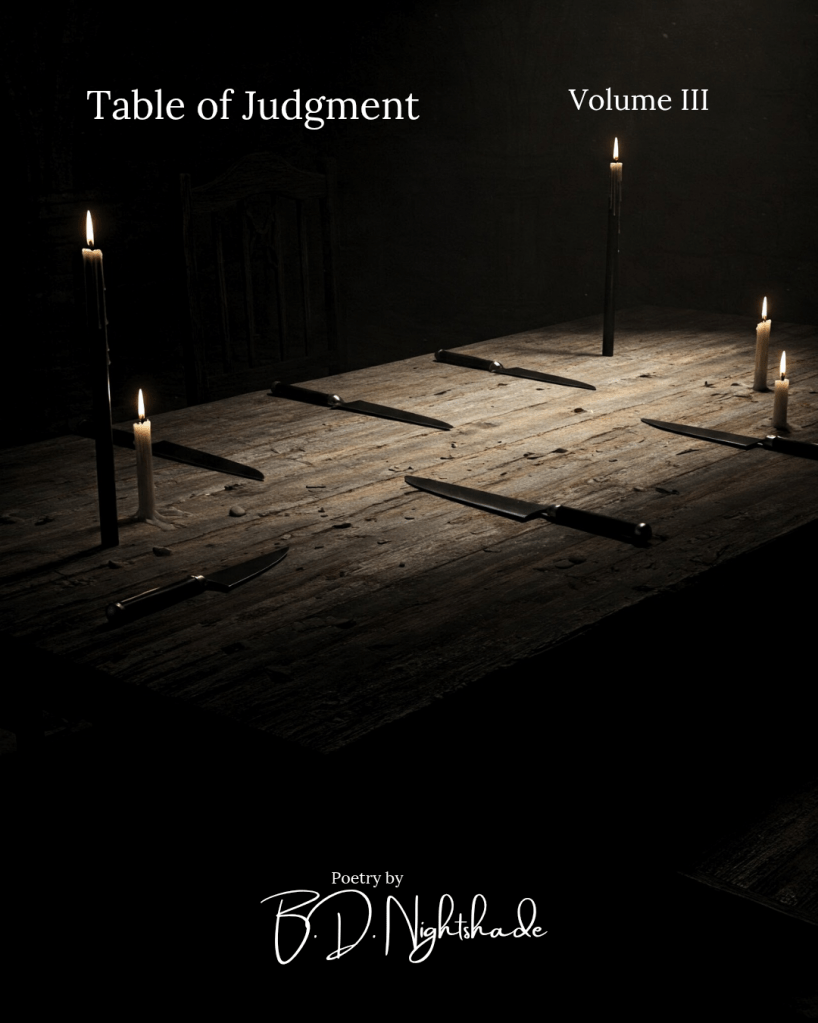
    Vengeance is a complex, deeply personal concept. In Table of Judgment: Volume III, I explore the idea of retribution—not as a simple act of revenge, but as a reckoning for those who have inflicted harm, whether through direct action or silent complicity. These figures are not faceless villains, but representations of broader societal ills: the abusers, the enablers, the silent bystanders. The blade of justice is sharp, and the flames of truth burn without mercy.

    This poem is a meditation on justice—both personal and collective—and the long-lasting impact of those who perpetuate harm. It is a reminder that the past cannot be erased, and the consequences of one’s actions follow them into the dark. While this work is dark and intense, it is also an outlet for those who have felt powerless, a space where the scales of justice can be balanced, even if only in the realm of imagination and poetry.