Author’s Note
People ask me what kind of writer I am fairly often.
Usually they’re looking for a category.
Poet. Romantic. Confessional writer. Storyteller. Surrealist. Humorist.
Something simple.
The problem is that none of those answers feel complete.
I’ve spent more than two decades writing, and one of the biggest lessons I’ve learned is that creativity rarely thrives inside a single box. Some days I want to write something tender. Some days I want to write something absurd. Some days I want to write mythology, philosophy, romance, comedy, or pure nonsense about raccoons riding llamas through space.
The older I get, the less interested I become in choosing one lane.
This poem emerged from that realization.
It’s a self-portrait, but not in the traditional sense. Instead of describing who I am through facts, it describes me through the roles my writing occupies. Mythmaker. Confessor. Comedian. Romantic. Storyteller. Dream-architect. All of them are true. None of them are complete on their own.
The final line is intentionally simple because sometimes the simplest answer is the most honest one.
If you ask what kind of writer I am, the answer depends entirely on which poem you’ve just read.
And if you’ve read enough of them?
The answer is probably:
Yes.
— Rowan Evans
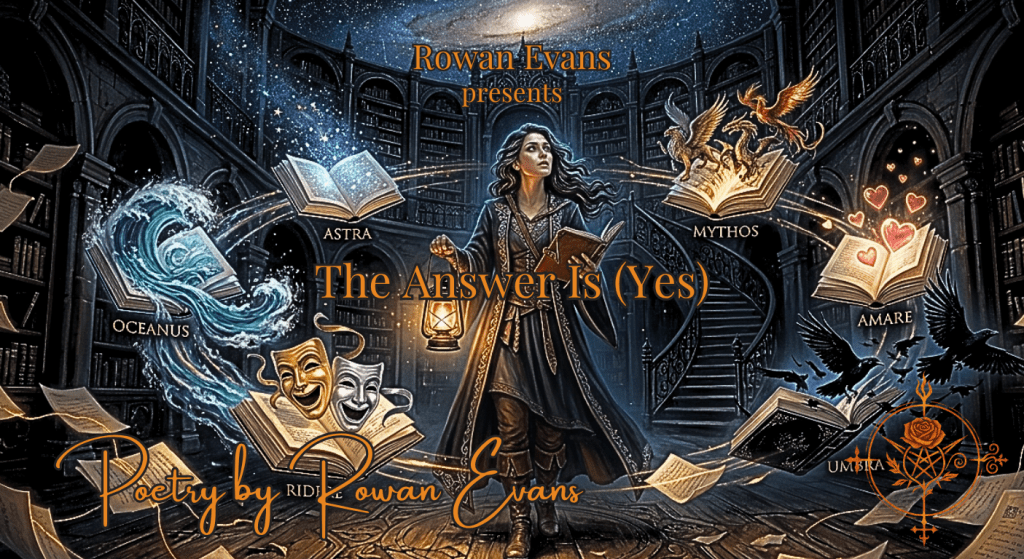
The Answer Is (Yes)
Poetry by Rowan Evans
There are times
when people ask
what kind of writer I am—
what I’m like,
what I write.
But there isn’t
one answer.
There never has been.
I am a mythmaker,
confessor comedian—
I turn truth into story
and story into survival.
A philosopher,
dream‑architect,
pop‑culture alchemist—
I stitch the sacred
to the absurd
and call it a heartbeat.
I am not one lane,
not one voice,
not one version of myself.
I write worlds
into existence.
A cosmic storyteller,
meta‑narrator—
I pull back the curtain
and show the mechanism.
I’m a surrealist.
A romantic.
A diss‑poet.
I am every version
of the truth
my pen has ever touched.
So if you ask
what kind of writer I am—
the answer is:
yes.
Journey into the Hexverse…
[Copy of a Copy]
A sharp, self-aware poem about originality, imitation, and the search for an authentic creative voice. What begins as a diss gradually reveals itself as a meditation on authorship, influence, and the things that can never truly be copied.
[Lone Wolf Theology]
A philosophical pop-culture poem exploring freedom, identity, and self-authorship through the lens of superheroes, antiheroes, mythic archetypes, and personal rebellion. A declaration of autonomy in a world determined to write your story for you.
[L Words & Heart]
A playful, self-aware poem about love, longing, loyalty, and the quiet ways another person can reshape our inner world. What begins as humor slowly reveals a heartfelt confession about affection, imagination, and the faces that linger in our dreams.
[Just Beyond Waking]
A street that feels familiar. A life that hasn’t happened yet. Just Beyond Waking explores the fragile space between dreams, memory, longing, and the quiet feeling that some futures are already waiting for us.
[Twin Suns, Sister Moons]
A poem about distance, longing, and the quiet pull of someone who lives beneath a different sky. Between twin suns and sister moons, the heart keeps reaching for home.
[I’ll Be There to See Your Sunrise]
Love has never come easily to me. This poem explores the fear, vulnerability, and quiet courage required to stay emotionally present when connection begins to matter deeply. “I’ll Be There to See Your Sunrise” is about choosing love despite the risk of heartbreak—and promising to remain long enough to witness someone fully.
[Before We Created the Labels]
Ancient gods return to a fractured world shaped by borders, identities, and separation. “Before We Created the Labels” explores humanity’s divisions through mythic imagery, sacred ritual, and symbolic collapse—asking what remains when we learn to see one another beyond labels.
If you’re interested in more poetry, you can find it here → [The Library of Ashes]

 Poetry by Rowan Evans
Leave a comment