Sometimes the loudest hater in the room is the one you brought with you.
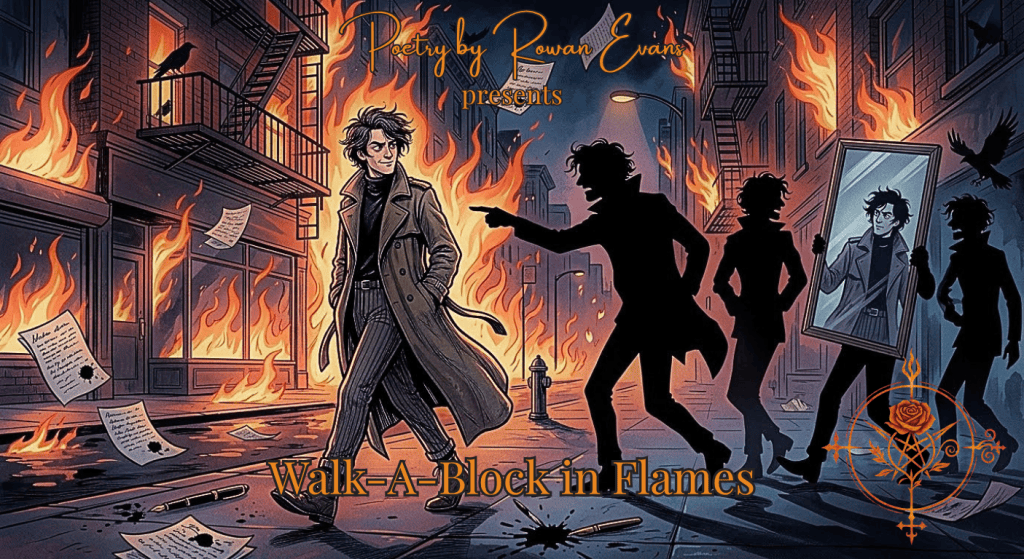
Walk-A-Block in Flames started with the idea of imaginary critics—the voices that somehow manage to find fault with everything you do, even when nobody else is actually saying a damn thing. Naturally, my brain decided the appropriate response was to turn that internal conflict into a ridiculous walk around the block, throw in some wordplay, and see how many times I could make the joke work before the poem eventually turned the joke back on me.
Because beneath all the flames, bravado, and fake enemies, there’s a much simpler realization:
Sometimes the person I’m arguing with is me.
And honestly?
That’s probably the funniest part.
— Rowan Evans
Plot twist: the haters were imaginary, and unfortunately, they had my voice.
Walk-A-Block in Flames Poetry by Rowan Evans
They tell me,
these imaginary haters,
that I’ve fuckin’ created—
they live inside my head,
feeding on my self-doubt—
obsessed with burning the self-down.
They make me take a walk,
a walk around a block
and it’s fucking hot—
I guess you could say,
these imaginary haters made me,
Waka Flocka Flame.
Wait—
I meant to say—
these haters made me
Walk-A-Block In Flames.
Honestly though,
I don’t know
what the fuck
they hate me for—
Is it because my wrist froze?
Nope, I’m broke—
Because I’m the best to ever do it?
Nope, that’s a joke—
Is it because they say
the things I think about me?
Couldn’t be—
because I think I’m great,
and these haters are fake.
I mean literally fake,
figments—
they don’t exist,
it’s just me in this bitch.
Sometimes “I don’t give a fuck” isn’t really apathy. Sometimes it’s exhaustion, overextension, or finally realizing that not everything deserves a piece of you.
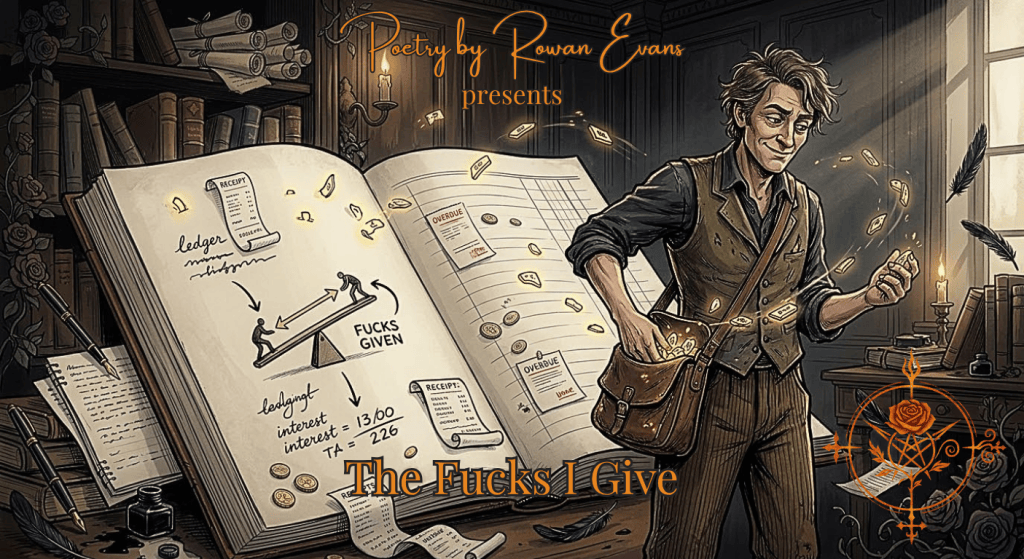
The Fucks I Give takes that idea and turns it into a ridiculous little accounting problem. If I’ve been handing out fucks like they’re an unlimited resource, eventually I’m going to have to audit the books, collect the outstanding balance, and start charging interest.
Underneath the jokes and profanity is something I’m actually pretty serious about: learning to be selective with what gets my attention, my energy, my emotions, and my time.
Because giving a fuck can be an act of love.
So can taking your fucks back.
— Rowan Evans
Apparently, my fucks weren’t free. I’m just finally collecting the outstanding balance.
The Fucks I Give Poetry by Rowan Evans
They said I’m too apathetic,
actin’ like nothing matters,
and it’s pathetic—
they want me to give a fuck,
but shit, I misplaced my bag of fucks—
so I’ve got no fucks to give.
Yeah, I’ll go through
and take all my fucks back—
I’ll walk right up and knock, like—
I’m here to collect my fucks,
and extra fucks too—
it’s a fucking tax,
and there is interest, dude.
You think fucks are endless.
No, I’ve got to be pickier—
because for a minute there,
it was—
fuck everything
and that’s probably
what they’re angry for.
It was fuck this and fuck that—
I was running out of fucks fast.
I sometimes look back at the person I was when I first started writing and wonder how much of that younger version of me is still sitting somewhere inside every poem I create. I started writing at thirteen, the same year I experienced my first heartbreak. Back then, ink wasn’t simply a creative outlet. It was a way to hold myself together, to give shape to feelings I didn’t know how to carry, and to leave a record of myself on the page when I was afraid of losing pieces of who I was.
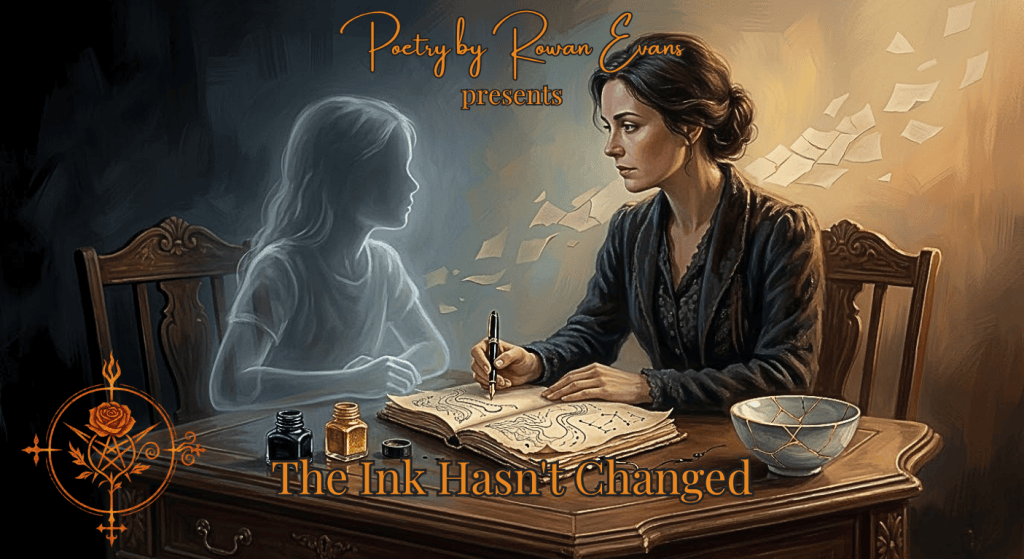
The Ink Hasn’t Changed is about revisiting those beginnings without confusing familiarity with stagnation. The same emotions still find their way into my work: joy, grief, anger, tenderness, laughter, and pain. I’ve continued mapping my soul through poetry, stitching together broken pieces and filling the cracks with whatever gold I could find. The tools and materials may feel familiar, but the person doing the stitching is not the same.
There’s a difference between carrying the same weight and never moving forward. Sometimes, growth means discovering that the thing that once kept you alive can become something you choose to nurture, refine, and share.
My ink hasn’t changed because its purpose never needed to. I have changed. I’ve survived. And the words that once helped me hold myself together now help me understand who I’ve become.
— Rowan Evans
The ink that helped me survive at thirteen still carries my truth at thirty-six. The ink hasn’t changed. I have.
The Ink Hasn’t Changed Poetry by Rowan Evans
I’ve been stuck in the past a lot lately,
just thinking about who I was—
who I was trying to become
and how those early days
set the stage for who I became,
on and off the page.
The same year
I committed myself to ink,
I tasted my first heartbreak—
it was bitter sweet,
hated that it had to come,
but nothing could be done.
That was 2003, I was thirteen—
and she was made to leave.
I took the shattered pieces,
collected in a basket—
I took threads of silver
and sewed myself
back together again.
Cracks patched with gold and ink,
confessions penned in golden ink—
back then
I wrote for me—
I wrote to keep it together,
mentally—
afraid I’d disappear
if I didn’t map my soul in ink.
Turned poetry to cartography,
started mapping the whole of me.
I mapped my soul, wholly—
turned my pain holy.
I tried to translate all of me—
the joy, the pain,
laughter and grief—
and my ink hasn’t changed.
It’s still carrying the same things.
All the same weight, wait—
does that mean I’m stuck in place?
No, just because the ink
has stayed the same—
doesn’t mean I have—I’ve changed,
I’m not the same as I was at thirteen,
now that I’m thirty-six—
and I’m not the same as I was at sixteen,
that’s when I thought my ink was real mean—
but really it was too nice,
the only thing keeping me alive.
Sometimes, the mind wanders somewhere between waking and dreaming, and the unfamiliar begins to feel strangely like home. Maybe it’s just a dream. Maybe it’s imagination playing with possibilities. Or maybe it’s a reminder that the life we’re living right now isn’t the only story we could ever tell.
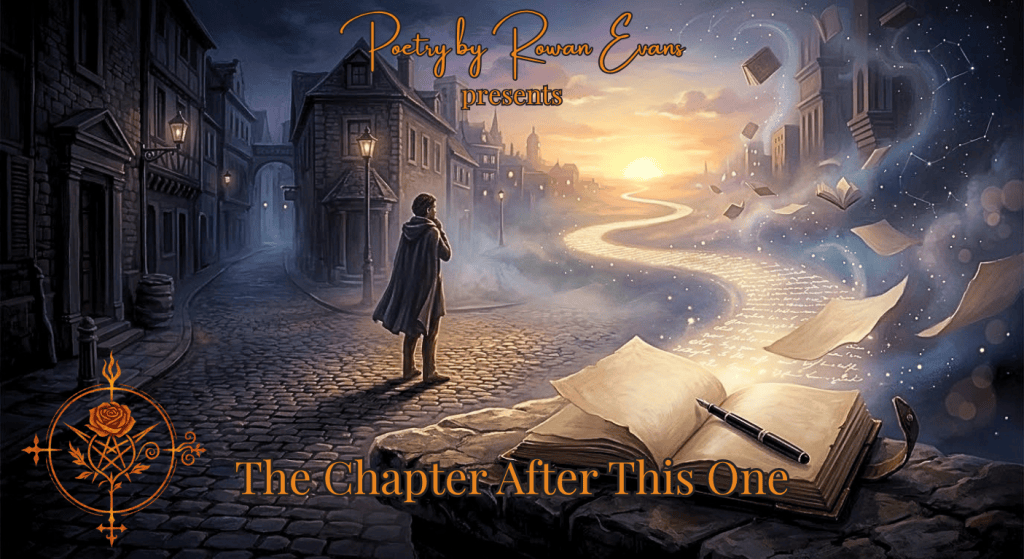
The Chapter After This One is about looking beyond a present that might not feel right and remembering that the story isn’t finished. We don’t always get to choose the circumstances of our current chapter, and we can’t simply flip to the ending to see whether everything works out. Sometimes, we have to keep reading, even when the road ahead is uncertain.
But reading isn’t all we can do. We can question the direction, challenge the expectations, and pick up the pen ourselves. We may not control every twist in the plot, but we can make choices that shape what comes next.
The future isn’t a page we’ve already read. It’s a chapter we haven’t reached yet—and perhaps, in more ways than we realize, we’re already helping to write it.
— Rowan Evans
You may not be able to skip to the ending, but you can still pick up the pen and help write what comes next.
The Chapter After This One Poetry by Rowan Evans
I’ve been drifting today— constantly somewhere in-between awake and asleep— between reality and a dream. One moment, I’m sitting alone— the next I’m walking streets I’ve never known.
Yet somehow, those streets feel like home.
I can’t say for certain where I was, but I had a pretty good idea— it felt familiar but not, like I was getting a preview— for a future plot. Like the writers for my life— were showing me, I’m not stuck in the story I got.
And while it’s true, I may not like the current chapter— I just have to keep reading, to find out what comes after— you cannot skip ahead, that’ll only lead you down the wrong road instead.
If you don’t like the direction, pick up a pen—become a co-writer then. You can’t rely on, just anyone, take matters into your own hands. You can shape fate, you can write for your own life— you know you can guide the plot, right?
Journey into the Hexverse
[Everything and Nothing]
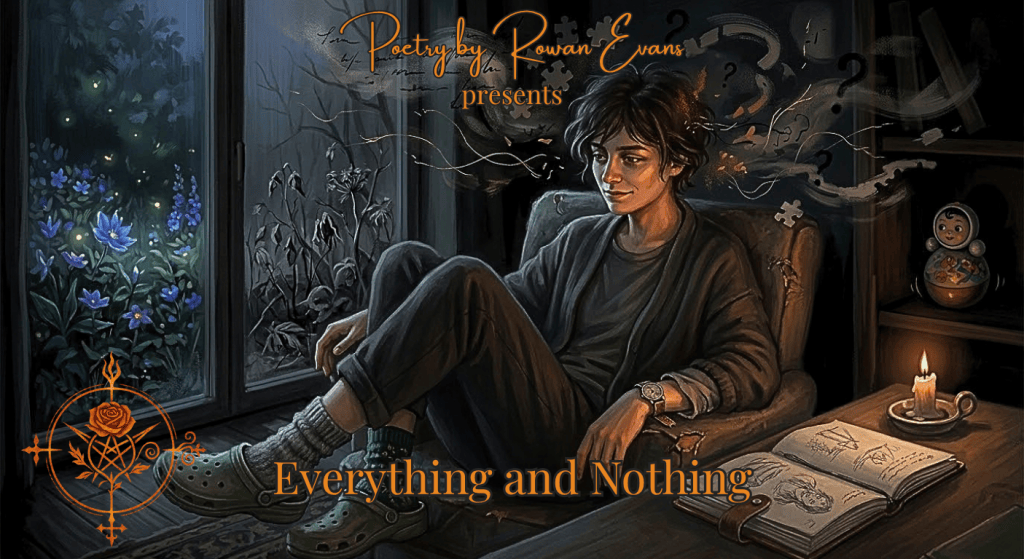
What happens when you’re quiet but observant, overwhelmed yet seemingly empty, surrounded by beauty but sometimes seeing only decay? Everything and Nothing is a confessional poem about overthinking, mental exhaustion, contradiction, and the absurd humor that helps us keep going—even when we’re wobbling in socks and Crocs.
Sometimes, the quietest person in the room has the loudest mind. Sometimes, the person who seems to have nothing to say is trying to sort through a thousand thoughts that never quite finish forming. And sometimes, when someone asks what’s wrong, the honest answer is both everything and nothing.
Everything and Nothing explores the contradictions that can exist within one person: being observant enough to notice everything while struggling to explain what’s happening inside, feeling surrounded by beauty yet sometimes seeing only the rot, and having the spark to create without always having the fuel to keep the fire burning.
But this isn’t a poem that wants to stay solemn. There’s a paradox wearing socks and Crocs, checking a five-dollar wristwatch, and wobbling through life with questionable coordination. Because humor has always had a place beside the heavier truths, and sometimes the absurdity is part of what makes those truths bearable.
I may wobble. I may lose my train of thought before it reaches the station. I may have days when everything feels wrong and days when I can’t explain why nothing seems wrong at all. But falling and wobbling aren’t the same thing.
And if there’s one thing this paradox knows, it’s how to keep wobbling.
— Rowan Evans
Everything is wrong. Nothing is wrong. The thoughts won’t land, the fire won’t always burn, and somehow this paradox keeps wobbling.
Everything and Nothing Poetry by Rowan Evans
When you meet me—
you’ll think I’m quiet.
I don’t say much,
I sit in silence,
with my mouth shut,
but my eyes are open—
watching, closely.
And when you talk to me—
you’ll wish I was quiet.
I’m way too observant—
I see too damn much,
and I hear just the same—
so don’t get mad at me,
when you get flamed.
But once you get to know me—
you’ll get scared when I’m quiet,
you’re suddenly afraid of my silence.
Because It carries weight,
everything I don’t say—
what’s wrong? You’ll wonder,
what’s on your mind?
You’ll find that it’s nothing—
mind’s blank, no thoughts in it.
But what’s wrong?
A lot.
It would take too long
to list every problem I’ve got.
I’m surrounded by beauty,
but sometimes all I see is rot—
lost my mind, where’d I put it?
I forgot—thoughts jammed,
so I missed the shot.
Thoughts move
but never get where they’re—
before another thought
cuts it off—
so it lands short,
missed the runway by a mile.
And that’s the part
that hurts the most—
when the spark is there,
but the fire is quiet.
The fuel is gone,
so you hope you don’t
have to reignite it.
So to answer your question,
what’s wrong?
Everything and nothing—
it’s in constant contradiction,
my existence—
I guess I’m just a paradox
in a pair of socks and crocs,
with a five dollar
Wal-Mart wristwatch.
But don’t worry—
I’m a weeble,
I wobble—
but I don’t fall down.
Journey into the Hexverse
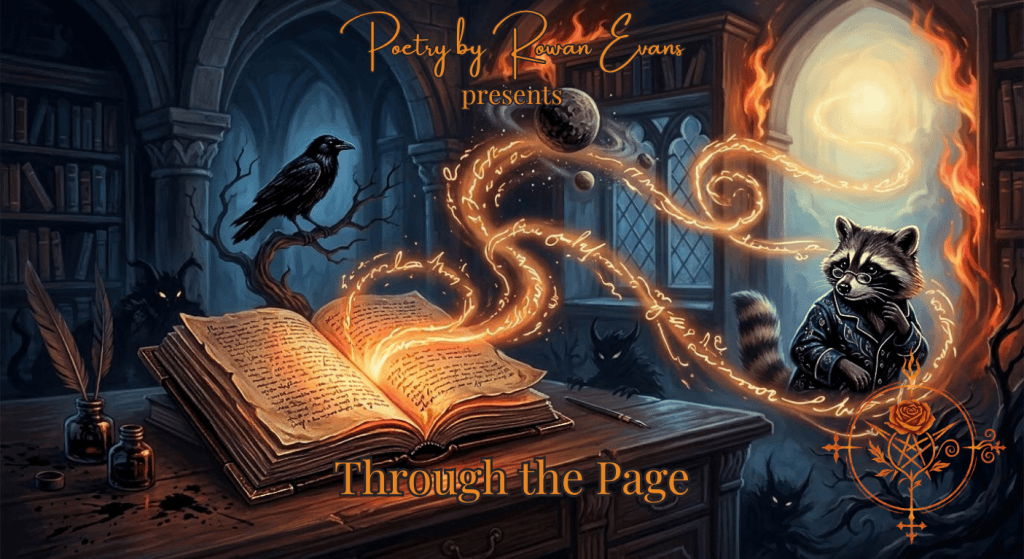
[Through the Page] A heartfelt thank-you to everyone who has journeyed through the pages of Rowan Evans’s poetry. From ravens and monsters to raccoons in silk pajamas, this playful, multilingual poem celebrates the connection between poet and reader—and the meaning found in sharing one’s art.
[Thoughts of You Have Prime Real Estate] A playful romantic poem that turns the idea of someone “living rent-free in your head” into an entire neighborhood, where thoughts become homes—and one special thought gets the best property in town.
[A Person First] A poem about the difference between loving a woman and loving the role someone expects her to play—because partnership requires respect, autonomy, and room to remain a person first.
Every poem begins as something inside the writer, but once it reaches the page, it becomes an invitation. An invitation to look closer, wander through unfamiliar worlds, meet the monsters in the margins, and perhaps recognize a little of yourself along the way.
Through the Page is my thank-you to everyone who has taken the time to read my work. Whether you’ve loved a poem, questioned it, laughed at it, or decided it wasn’t for you, you’ve still given something valuable: your time. And in a world where our paths may never cross, that small exchange between my thoughts and your mind means more than you might realize.
Of course, I couldn’t leave a thank-you note alone without sending it through a few ravens and a detour through the fires of my imagination. My pen has never been particularly good at staying on track. But beneath all the chaos is something simple and sincere: thank you for being here, for reading my art, and for becoming part of a journey that began long before these words reached you.
Salamat po. ありがとう.
From the bottom of my heart, thank you.
— Rowan Evans
Somewhere between the ravens, the monsters, and the raccoons in silk pajamas, we met through the page. Thank you for being part of the journey.
Through the Page Poetry by Rowan Evavns
If you’ve taken the time
to sit with my rhymes—
to read the thoughts
from my mind—
I thank you.
Even if you didn’t like
the words that I write—
still I say, thank you.
We’ll more than likely
never meet,
and unless you choose—
no words exchanged.
But we’ve connected—
through the page,
it was my thoughts
to your brain.
You’ve spent time with my ravens,
you’ve seen the monster in the margins—
peaked beyond the curtain,
glanced into my dreams—
a witness
to every confession
screamed.
You walked with me on Pluto,
watched the raccoons in silk pajamas—
you were there
when I gave up on ice,
I was done being cold,
so I wrote fire instead—
I penned the flames from my head,
it’s like I was the Ghost Writer—
possessed by vengeance
and Poets past.
Okay, let me dial it back.
I’m sorry, got a little off track—
but you know by now,
that’s what happens to me—
it’s like my pen
has got happy feet—
anyway, back to the point of this—
because believe it or not,
there was a point to this—
Thank you from the bottom of my heart,
salamat po, for reading my art—
ありがとう, for being even a small part
of this journey that I’m on—
Thank you, and I mean it—
salamat po, without you
none of this has any meaning.
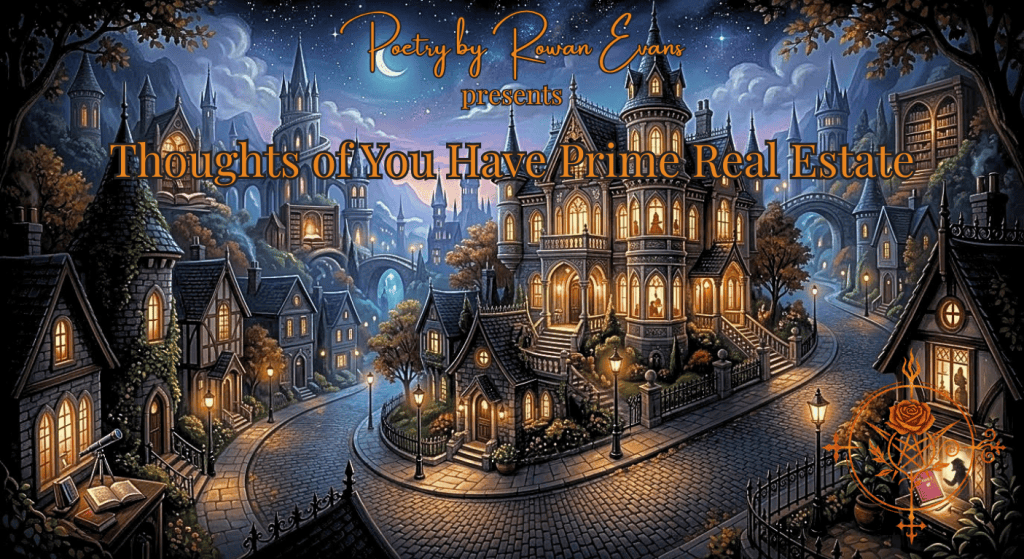
We often say someone is “living rent-free in our head,” but what if they weren’t renting?
Thoughts of You Have Prime Real Estate takes that familiar expression and builds an entire neighborhood inside the mind—roads, sidewalks, corner lots, contemporary homes, secrets, dreams, and eventually one particularly valuable property.
Because thoughts don’t always feel temporary. Sometimes they settle in, expand, renovate, and quietly become part of the landscape.
And apparently, the thoughts of you got the best view.
— Rowan Evans
Some thoughts rent a room. Yours apparently bought the whole corner lot.
Thoughts of You Have Prime Real Estate Poetry by Rowan Evans
They say, when something is stuck in your thoughts— it lives rent free in your head, and that’s true in a sense— because the thoughts have taken up real estate, they own land— building new developments. New neighborhoods are being constructed, new roads are being laid— new sidewalks paved.
Take a walk down the block, you’ll see thoughts taking up corner lots—
modern contemporary homes lining the streets— full of my secrets to keep, and rooms where my dreams sleep.
But the nicest home of all— the one with the best views, and the biggest rooms…
it houses my thoughts of you.
Journey into the Hexverse
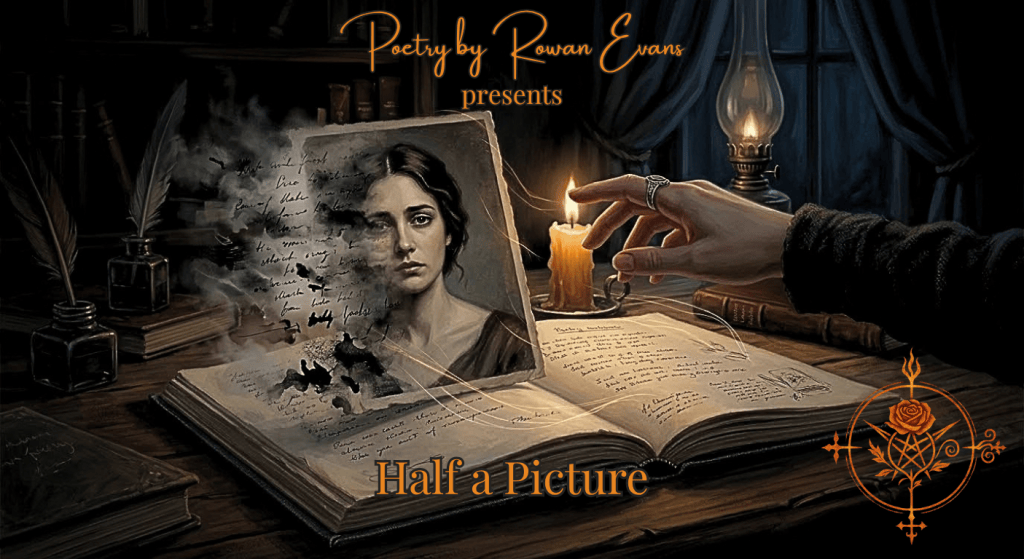
[Half a Picture] What happens when someone falls in love with the person they discover through your poetry? Half a Picture explores the strange intimacy between writer and reader—and the distance between seeing someone’s mind through their words and truly knowing the whole person.
[Love Me From Over There] A sharp and humorous poem about the strange contradiction of wanting someone close while simultaneously needing them to stay several feet away from your face.
[It Could Have Been…] A playful little love poem about strawberries, roses, and the wonderfully ridiculous ways romance can show up when you know someone doesn’t like the traditional version.
[High Tide] A short reflective poem about leaving, returning, and accepting the forces that pull us back—like the tide guided by the moon.
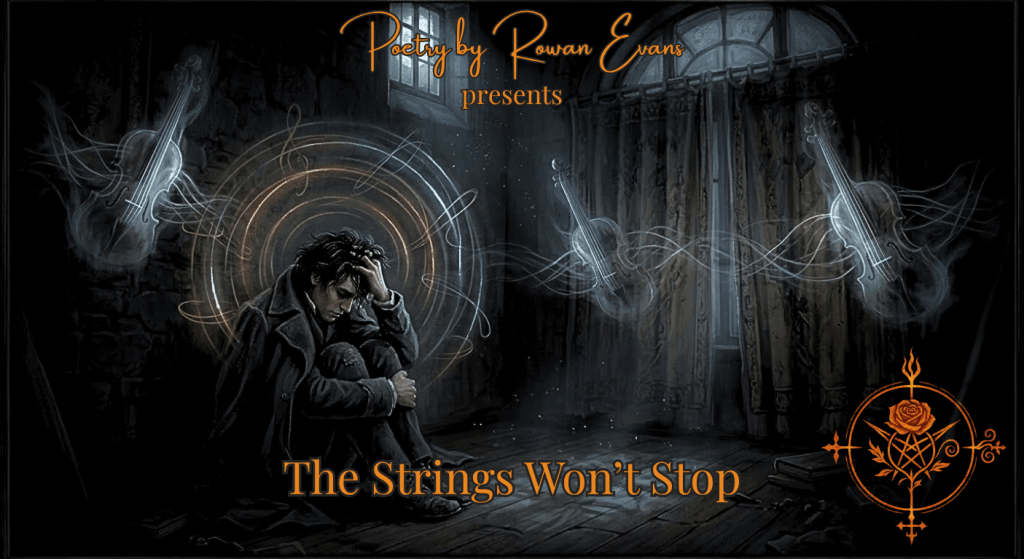
Some thoughts don’t arrive quietly. They repeat, build momentum, and turn themselves into a soundtrack you never asked to hear.
The Strings Won’t Stop takes that experience and gives it a physical sound: violins playing somewhere inside an empty room, each note feeding the fear and keeping the loop alive. The speaker isn’t asking for a beautiful song—they’re asking for silence, for one interruption in the pattern, one change in tempo that might finally give the mind somewhere else to go.
Sometimes the hardest part isn’t finding the words.
It’s getting the strings to stop playing them.
— Rowan Evans
Sometimes the mind doesn’t need another song. It needs the strings to stop.
The Strings Won’t Stop Poetry by Rowan Evans
I sit in an empty room,
listening to the haunting cry
of violins—
I’m just longing
for silence—
but the strings
sing for me—
they sing a song
I don’t want to hear,
it amplifies the fear—
it makes me wonder,
what am I doing here?
But they don’t stop—
the strings sing
and they watch—
I sit in the corner,
and I rock—
back and forth,
listening for the chorus,
or something to break
the loop—
a tempo switch,
a cadence change—
something,
anything
to rearrange
the thoughts in my brain.
Journey into the Hexverse
[A Person First] A poem about the difference between loving a woman and loving the role someone expects her to play—because partnership requires respect, autonomy, and room to remain a person first.
[Half a Picture] What happens when someone falls in love with the person they discover through your poetry? Half a Picture explores the strange intimacy between writer and reader—and the distance between seeing someone’s mind through their words and truly knowing the whole person.
[If You Want to Go] When conversations become nothing more than repeated excuses, sometimes the only answer left is to stop pretending. A raw, direct poem about emotional exhaustion, frustration, and the difficult freedom of letting someone walk away.
Kintsugi Sunrise (Remix) returns to a piece I first wrote in January 2024—a poem born from a mind trying to survive its own cracks. The original captured the feeling from inside the storm. This version comes back to the same landscape with a little more distance, a little more clarity, and a different relationship with the person standing among the broken pieces.
The cracks are still part of the picture. So is the gold.
But this time, the sunrise feels less like something I am desperately waiting for and more like something I have finally learned to recognize.
The original was about trying to become whole.
The remix is about realizing I was already becoming something new.
— Rowan Evans
The cracks remained. I just learned how to fill them with gold and face the sunrise.
Kintsugi Sunrise (Remix) Poetry by Rowan Evans
Apologies whispered—
I had to disappear for a while,
retreat inside my mind,
try to rewire—
cause I was feeling broken,
shattered.
There were cracks in my psyche,
twisting thoughts inside me—
telling me I’m worthless—
every night I’d drift
into a hell scape—
stuck in my mind’s cage.
So I’d sit inside my mind,
filling cracks with gold—
finding beauty in the pain,
performing kintsugi on my brain.
And the pain eased,
clouds lifted—
something shifted—
no more skies of grey.
Finally, I could sit and watch
the sun rise on a new day—
my outlook had changed.
Now I look to the future—
with hope.
Journey into the Hexverse
[Half a Picture] What happens when someone falls in love with the person they discover through your poetry? Half a Picture explores the strange intimacy between writer and reader—and the distance between seeing someone’s mind through their words and truly knowing the whole person.
[For the Youth (Remix)] A 2026 remix of Rowan Evans’s original 2024 poem, encouraging young people to embrace their truth, recognize their worth, raise their voices, and become the light they want to see in the world.
[All for Me] When thunder becomes applause, lightning turns into paparazzi, and rain rolls out a flooded red carpet, one poet starts wondering whether nature’s celebration has gone a little too far.
There is a strange kind of intimacy in being known through words.
A reader can walk through your thoughts, recognize pieces of themselves in your metaphors, and feel close to the person behind the page. Sometimes that closeness becomes something deeper—feelings forming around a voice, a mind, a collection of carefully chosen pieces of a life.
But a page is still only a page.
Half a Picture steps into that uncomfortable space between being seen and being truly known. It isn’t dismissing the feelings that can grow through poetry; those feelings can be completely real. It is simply looking at what happens when someone falls for the person they’ve encountered through the words, while the rest of the picture remains outside the frame.
— Rowan Evans
You can know someone’s words by heart and still only have half the picture.
Half a Picture Poetry by Rowan Evans
I’m going to talk about something
I don’t talk about a lot—
it’s an interesting thing,
the way people cling—
messages received—
“I love you,”
excuse me, what?
That’s a strong way to start—
and I’m flattered, really.
But they don’t know me,
not really—
I know they think they do,
because they’ve read my words—
seen my mind
and walked through my thoughts—
that’s how they feel,
and to them it’s real—
who am I to say it’s not?
But they fell in love
with half a picture—
a blurred photo—
and a vague description of me.
Journey into the Hexverse
[All for Me] When thunder becomes applause, lightning turns into paparazzi, and rain rolls out a flooded red carpet, one poet starts wondering whether nature’s celebration has gone a little too far.
[Lessons Without Kindness] A reflection on learning self-respect from a relationship that changed—the lessons hidden in manipulation, silence, and loss, and the realization that you don’t have to shrink yourself to make someone else feel tall.
[The Metaphor Machine] A poem that takes apart its own machinery as it runs—breaking lines, breaking thoughts, and following metaphors from moonlight to tides, oceans, shorelines, and city streets.