Author’s Note
This piece started as a diss.
Or at least that’s what I told myself when I began writing it.
The voice arrived first: irritated, dismissive, sharp around the edges. The kind of voice that has grown tired of watching imitation mistake itself for originality.
But as the poem developed, I realized it wasn’t really about a specific person.
It was about authorship.
About the difference between influence and imitation.
Every writer begins by borrowing something. We absorb voices we admire. We study techniques. We experiment with styles that resonate with us. That’s part of learning.
The problem isn’t influence.
The problem is stopping there.
Because eventually every artist reaches a point where imitation becomes a limitation. A point where the question shifts from “Who do I sound like?” to “What do I actually have to say?”
That’s the tension at the center of this piece.
The speaker isn’t claiming ownership over Gothic imagery, confession, darkness, anxiety, or any of the themes referenced in the poem. Those things belong to countless writers across generations.
What can’t be copied is the life underneath them.
The experiences.
The scars.
The specific reasons a person reaches for certain images, metaphors, and obsessions.
Someone can reproduce the shape of a voice.
But shape is not source.
That’s why the final lines matter to me.
The joke is that the speaker becomes so frustrated with imitation that they offer to write the copy themselves.
But underneath the sarcasm is a quieter observation:
If you spend all your time trying to become someone else, you’ll never discover what only you could have written.
And that’s where the most interesting work usually begins.
— Rowan Evans
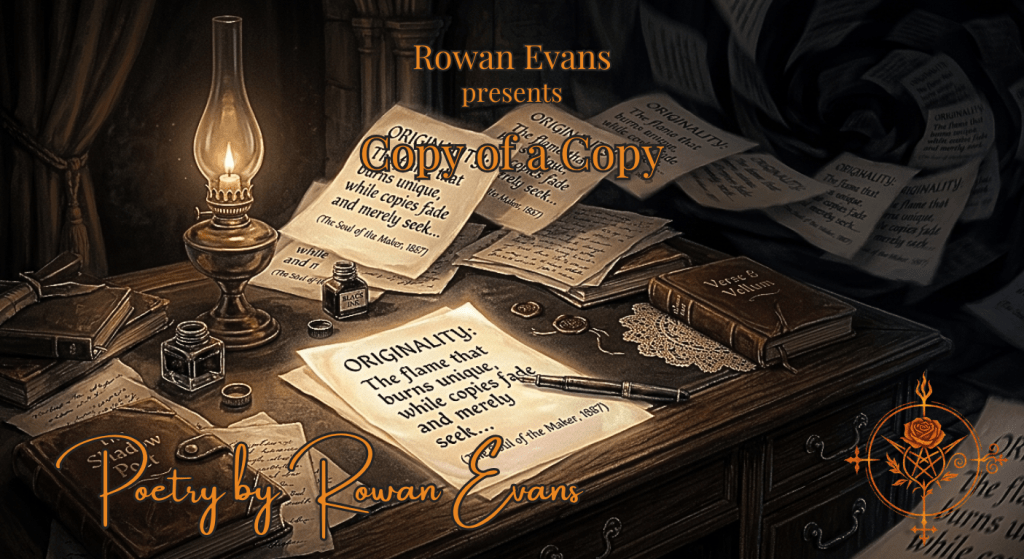
Copy of a Copy
Poetry by Rowan Evans
You carry yourself like a killer.
Yeah, of vibes—
You think you’re intimidating?
You’re not. Just stop.
You’re embarrassing.
You’ve had
zero original thoughts,
you just parrot me.
You’re a parody.
A copy of a copy,
copied a second time—
it’s obvious in the rhyme,
you can see it
in the quality decline.
Take your pen
and try to write like me.
Gothic lace and confession,
tinted with depression—
written by an anxious mind.
You can copy me
line for line, rhyme for rhyme
and I’m sure you’ll find
it still won’t land right.
Here—
let me write for you.
It’s not like
that’s not something
I already do.
But this time,
I’ll give the lines to you.
Journey into the Hexverse…
[Lone Wolf Theology]
A philosophical pop-culture poem exploring freedom, identity, and self-authorship through the lens of superheroes, antiheroes, mythic archetypes, and personal rebellion. A declaration of autonomy in a world determined to write your story for you.
[L Words & Heart]
A playful, self-aware poem about love, longing, loyalty, and the quiet ways another person can reshape our inner world. What begins as humor slowly reveals a heartfelt confession about affection, imagination, and the faces that linger in our dreams.
[Just Beyond Waking]
A street that feels familiar. A life that hasn’t happened yet. Just Beyond Waking explores the fragile space between dreams, memory, longing, and the quiet feeling that some futures are already waiting for us.
[Twin Suns, Sister Moons]
A poem about distance, longing, and the quiet pull of someone who lives beneath a different sky. Between twin suns and sister moons, the heart keeps reaching for home.
[It’s You I Choose]
A poem about devotion, vulnerability, and the quiet decision to stay. Sometimes love isn’t certainty—it is choosing someone anyway.
If you’re interested in more poetry, you can find it here → [The Library of Ashes]


Leave a Reply