Tag: DarkPoetry

  • Author’s Note

    Dear Reader,

    This poem confronts a truth that many try to look away from—the vulnerability of children in a world that fails to protect them, and the complacency of those in power who prioritize comfort or profit over safety. Like Lambs to the Slaughter is both an elegy for the innocent and a call to awaken our collective conscience.

    It is stark. It is uncomfortable. It is meant to stir outrage, empathy, and reflection. Approach it with your heart open, and let the words linger. Let them demand you see, remember, and feel.

    Rowan Evans


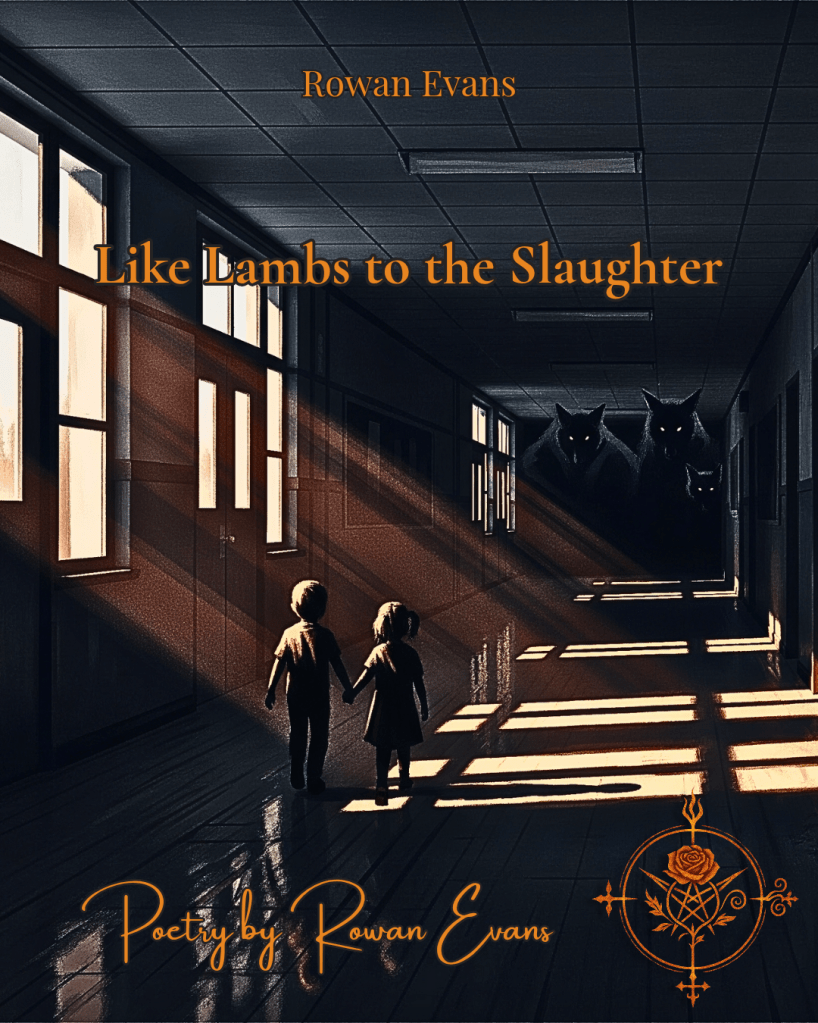
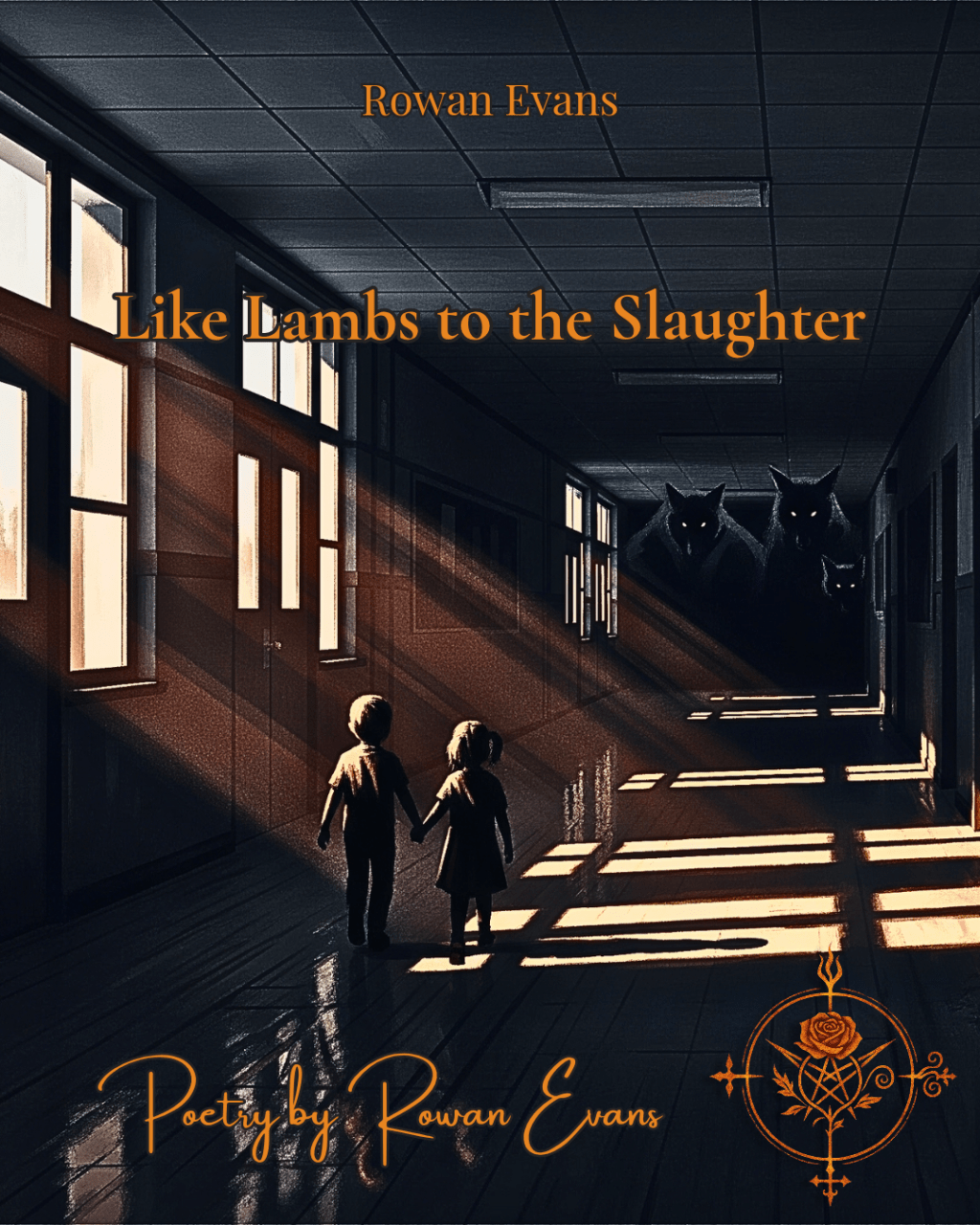
    Dimly lit school hallway with shadows stretching across the floor. Silhouettes of children walking, with ominous shadowy figures lurking in the background, symbolizing danger and vulnerability.
    “Like Lambs to the Slaughter”: A poem confronting the vulnerability of children and the inaction of those in power.

    Like Lambs to the Slaughter
    Poetry by Rowan Evans

    We send them off with backpacks and hope, 
    With laughter that echoes down halls so bright, 
    Yet the shadows loom, silent as a knife, 
    A darkness that creeps through morning light.

    The bell rings, a call to innocence’s end, 
    For in these halls, safety bends— 
    Under the weight of iron and lead, 
    A nightmare that lives where children tread.

    Like lambs to the slaughter, we send them still, 
    Their trust in our hands, their fate a bitter pill. 
    We close our eyes, turn away from the stain, 
    Pretending that prayers will ease the pain.

    But the wolves wait, just out of sight, 
    While those in power do nothing but recite— 
    Thoughts and prayers, empty and stale, 
    A whispered hymn in a funeral wail.

    Parents tremble with a silent dread, 
    Kissing foreheads, combing small heads, 
    As they wonder, in the deepest dark, 
    Is this the day that breaks their heart?

    The slaughterhouse doors open wide, 
    Another school, another child’s cry, 
    Yet the leaders remain unmoved, unfazed, 
    Counting their coins in a world ablaze.

    The lambs walk in, unaware of the knife, 
    Their futures stolen, their dreams sliced. 
    And we stand by, numb to the grief, 
    Hoping tomorrow brings some relief.

    But tomorrow is the same as today, 
    Another headline, another child’s name. 
    And still, the powerful sit on their thrones, 
    Ignoring the graves, the scattered bones.

    Like lambs to the slaughter, we send them all, 
    While the wolves feast and the angels fall. 
    How many more before we rise? 
    Before we see the blood in our eyes?

    Until we burn their thrones to the ground, 
    And reclaim the safety we’ve longed to surround. 
    No more lambs, no more slaughter, 
    No more fear for sons and daughters.

    For the slaughter must end, the cycle break, 
    Or we’ll all drown in the blood we forsake.


    Related Poetry

    Confetti Over Graves | A Poetic Critique of Hollow Prayers
    A piercing reflection on empty words offered in the wake of tragedy, Confetti Over Graves challenges the comfort of “thoughts and prayers” when no action follows.
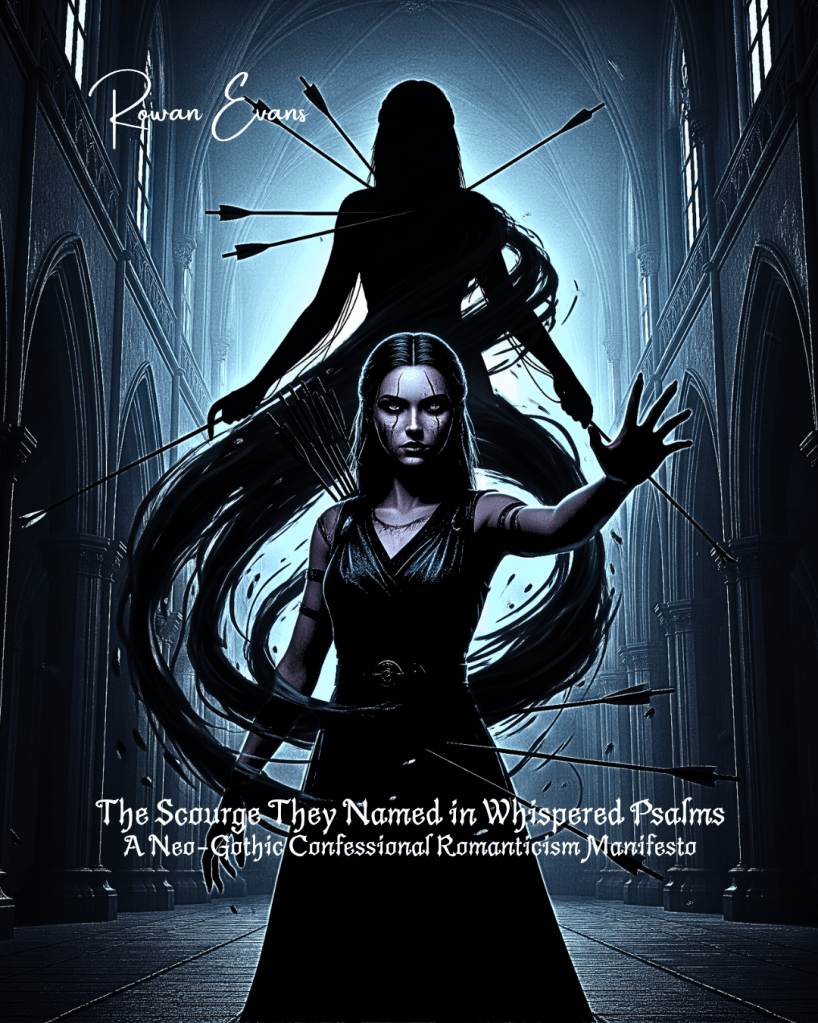
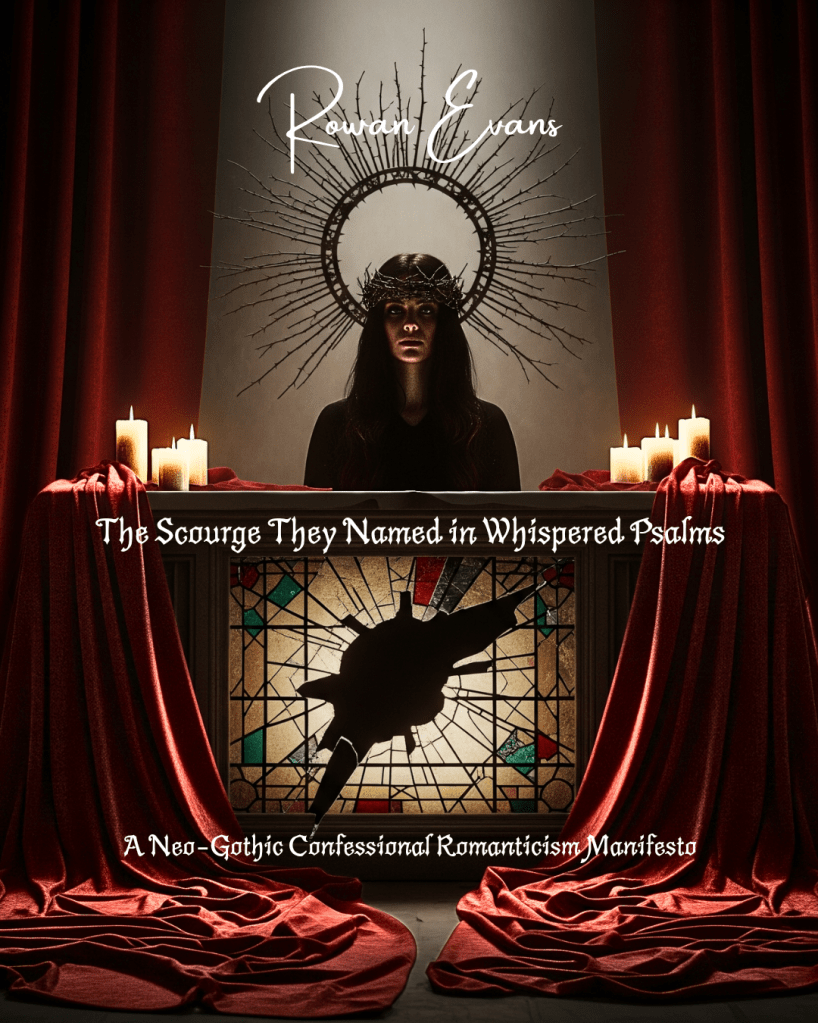
  • A gothic cathedral interior bathed in cold blue light. In the foreground, a defiant woman in black reaches forward, while behind her looms a shadowy silhouette pierced by arrows. Her long hair and dress ripple like smoke, embodying both vulnerability and strength.
    “They said I was a prophecy, a creature carved in smoke and sin…”
    A visual echo of the hunted girl turned heretic, the shadow we carry and survive.

    This isn’t just a poem. It’s the ache of being seen too little—or too much. Of being told you’re ‘too much’ when you’re just trying to exist honestly.

    The Scourge They Named in Whispered Psalms is a manifesto from the margins – a declaration of identity, resilience, and sisterhood in the face of erasure. It belongs to all who have been misnamed, misunderstood, or made to feel monstrous for simply being.

    I invite you to stand with me – not behind or ahead – but here. Together.


    “The Scourge They Named in Whispered Psalms”
    Poetry by Rowan Evans
    (A Neo-Gothic Confessional Romanticism Manifesto)

    They said I was a prophecy,
    a creature carved in smoke and sin,
    the girl who slipped through cracks in sermons—
    a heretic with velvet skin.

    I walk in heels upon their myths,
    each step a hymn they tried to burn,
    a flame that dared to name itself
    before their rigid tongues could turn.

    How monstrous, that I raise my voice
    to praise the worth of every woman—
    how dare I speak of sisterhood
    with scars they say I wasn’t born in.

    I am the shame beneath their altars,
    the blush they curse but cannot name,
    a sacrament in satin bones
    who bleeds, yet isn’t held the same.

    I was never him. I was silence.
    A chrysalis misnamed by fate.
    But even wrapped in borrowed tones,
    I trembled like a bride in wait.

    They say I steal what isn’t mine—
    as though divinity is rationed.
    As if my ribs were not first broken
    to give my soul a rightful fashion.

    Do you think it makes me stronger?
    That I carry this war in my marrow?
    No—
    It only means I’ve learned to sing
    while pulling arrows from my shadow.

    I’m not here to replace you,
    or to climb atop your grief-wrought throne.
    I only ever wanted space
    to write a name that felt like home.

    So yes, be scared. I’m dangerous.
    I love too hard. I dream too loud.
    I dare to say I’m beautiful
    without the world’s reluctant bow.

    Let them say I have advantage—
    let them spit it like a curse.
    But if I write the stars in anguish,
    it’s not to claim that I hurt worse.

    It’s just—I know what it’s to be
    the hunted girl in holy war.
    And still I’d reach for every hand
    who ever felt they could be more.

    You don’t need to kneel beside me.
    But sister, won’t you stand?
    Not behind—nor far ahead—
    just here. Together. Hand in hand.


    [About Poem]

    This piece is rooted in a genre I created: Neo-Gothic Confessional Romanticism—a fusion of gothic imagery, personal truth, sacred longing, and emotional rebellion. Inspired by the legacy of Sylvia Plath, Anne Sexton, Sappho, and modern poetic voices, this poem speaks to those of us made to feel like heretics simply for existing as ourselves.

    It is my poetic prayer for trans women, queer femmes, sacred misfits, and anyone who has ever been othered in the name of tradition. It holds both fire and softness—a torch lit from the ache of being erased, and the quiet hope of being seen.

    A woman in a black gown sits behind a stained-glass altar, wearing a crown of thorns and halo of iron. Candles glow around her as blood-red drapes pool like velvet fire. The glass behind her bears the silhouette of a shattering figure, suggesting both violence and divinity.
    A sacrament in satin bones.
    The girl they named a scourge now sits in sanctuary—unburned, unbroken, and holy in her own name.

    How does this poem resonate with your own experiences of identity and visibility?

    What lines stood out to you most, and why?

    Have you ever felt like the “hunted girl in holy war”? What helped you keep going?

    Share your thoughts in the comments or your own creative work. Your voice is welcome here.

  • The Hollowed Frame

    My knees don’t bend anymore—
    they buckle.
    Like ruins left too long in the rain,
    stone tired of pretending to be strong.
    They scream when I stand,
    and I still fucking stand.

    My fingers feel like they’re snapping
    under the weight of nothing.
    Every joint—
    cracked glass,
    splinters in slow motion.
    Even silence hurts.

    I drag this body like a broken casket.
    Like I’m already dead
    and just forgot to stop breathing.
    My skin is tight with ache,
    my soul sags inside me
    like wet clothes clinging to a forgotten line.

    Sleep doesn’t save me.
    It buries me.
    Deeper.
    Suffocating under the illusion of rest,
    waking up in the same grave
    with a new layer of dirt.

    I want to say I’m not okay—
    but I don’t.
    Because it scares people.
    Because I don’t want them to carry this,
    whatever this is.
    So I lie. I laugh. I smile
    like it’s stitched into my face
    by hands that don’t love me.

    I feel like a burden.
    A cracked plate kept out of guilt.
    Dead weight in people’s lives.
    They’d never say it,
    but I feel it—
    in their silences, in my own reflection,
    in the way I don’t call, don’t ask, don’t speak.

    Am I even allowed to say this out loud?
    To scream into a void that already swallowed so many?
    I feel like I’m rotting from the inside.
    Like something went bad in me
    and I can’t cut it out.

    I try to help. God, I try.
    But I feel like a fucking hypocrite
    telling others to hold on
    when I’m always on the edge myself.

    I don’t want to die.
    Not really.
    I just want it to stop.
    Just want to breathe
    without it hurting.

    I just want to be okay.
    Not amazing.
    Not healed.
    Just…
    okay.

    Is that so much to ask?

  • Content Warning:
    This poem contains explicit depictions of violence, abuse, and retribution. It touches on sensitive subjects such as grooming, sexual assault, complicity in the face of injustice, human trafficking, and war crimes. Readers should proceed with caution, as the themes explored in this work may be triggering for some. This poem is intended for mature audiences and is a work of fiction that seeks to explore vengeance, justice, and the consequences of unchecked power and harm.

    Please read with caution, and know that this series is not intended to glorify violence but to reflect the pain, rage, and consequences that often go unnoticed or unpunished in the real world.

    Seven more shadows stir.
    Seven more await their fate.

    The knives are fewer now—
    Not from mercy, but from use.
    Their edges whisper memories,
    Still stained with unrepentance.

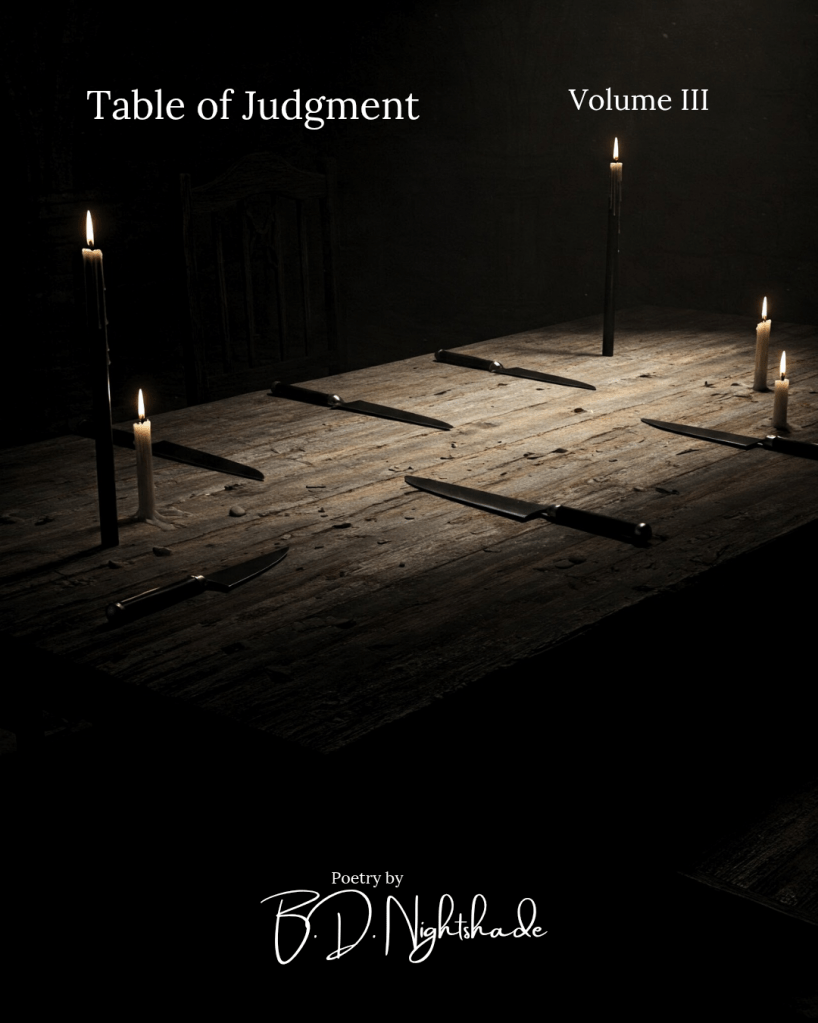
    Tonight, the table returns.
    Seven chairs, seven fates,
    Seven shadows dragged from hiding.
    Each thinks they can run.
    Each forgot—
    Vengeance remembers.

    First: The Groomer Teacher
    He taught literature like seduction.
    Underlined consent with a wink,
    Graded innocence on a curve.
    Gave praise with too many hands.
    Now he’s pinned beneath a blackboard,
    His lessons returned in silence and steel.
    I staple every love note he wrote to skin
    He once dared touch.
    He says he only wanted to inspire.
    So I make him inspirational art.
    Blood as ink. Truth as canvas.

    Second: The Human Resources Manager
    She passed around cupcakes on birthdays,
    But passed over every complaint.
    Buried trauma in manila folders,
    Told victims to be professional.
    Now I file her under complicit.
    Each page of silence becomes a lash.
    I build her a cubicle from every name she erased.
    Inside it, her voice cannot leave—
    Just like theirs never did.

    Third: The ICE Agent
    He wore cruelty like a uniform.
    Said “orders” while dragging toddlers away.
    Stamped paperwork soaked in lullabies.
    Built cages and called it law.
    Now I lock him in a cell of memory—
    Walls made from lullabies interrupted.
    I tattoo their names on his arms
    So he never forgets who he unmade.
    The key melts in front of him.
    He screams like a father now.

    Fourth: The Frat Brother
    His laughter echoes in solo cups.
    Shot after shot, shame drowned in alcohol.
    He called her a myth, a mistake,
    As if blackouts erased guilt.
    Now he drinks from a bottle
    Filled with her memory—undiluted, unforgiving.
    Each swallow burns the truth into his bones.
    I leave him slumped in silence,
    Party over, cameras rolling.
    Replay on loop.

    Fifth: The “Pick-Me” Woman
    She climbed their shoulders
    By stepping on broken backs.
    Called survivors jealous,
    Said they “wanted the attention.”
    Now I seat her in a hall of mirrors.
    Each one shows the woman she betrayed.
    I peel back her words until only envy remains.
    She cries for her reputation—
    Too bad it’s the only thing she ever loved.

    Sixth: The Landlord Slumlord
    He charged gold for rot.
    Turned homes into health hazards,
    Blamed poverty for his greed.
    Called heat a luxury.
    Now he shivers in the dark,
    Air thick with mold and vermin songs.
    I padlock every exit with unpaid rent.
    He begs for a repair request.
    I send rats instead.

    Seventh: The War Criminal in a Suit
    Never fired a gun,
    But his pen was a missile.
    Signed cities into rubble,
    Children into statistics.
    Called it “strategy.”
    Now I drop silence like bombs.
    His ears ring with names he never learned.
    I dress him in oil-slick skin,
    Force him to drink from the well he poisoned.
    His empire burns with no flag to wave.

    The knives are dull now.
    The flames are tall.
    Seven new candles flicker—
    Not for them.
    Never for them.

    There is no forgiveness
    In the blade’s reflection.
    Only truth,
    And the hand that dares to hold it.

    But the dark is never empty.
    Seven more shadows stir.
    Seven more await their fate.
    And I—B.D. Nightshade wait, too—
    Patient as the grave.


    Author’s Note:
    Vengeance is a complex, deeply personal concept. In Table of Judgment: Volume III, I explore the idea of retribution—not as a simple act of revenge, but as a reckoning for those who have inflicted harm, whether through direct action or silent complicity. These figures are not faceless villains, but representations of broader societal ills: the abusers, the enablers, the silent bystanders. The blade of justice is sharp, and the flames of truth burn without mercy.

    This poem is a meditation on justice—both personal and collective—and the long-lasting impact of those who perpetuate harm. It is a reminder that the past cannot be erased, and the consequences of one’s actions follow them into the dark. While this work is dark and intense, it is also an outlet for those who have felt powerless, a space where the scales of justice can be balanced, even if only in the realm of imagination and poetry.

  • Content Warning
    This poem contains graphic depictions of violence, abuse, sexual assault, systemic injustice, revenge, and trauma. It explores themes of righteous vengeance, horror, and divine retribution through a dark, poetic lens. Reader discretion is strongly advised, especially for survivors of abuse or trauma.


    The blades have rusted since last we met.
    But rust only sharpens resolve.
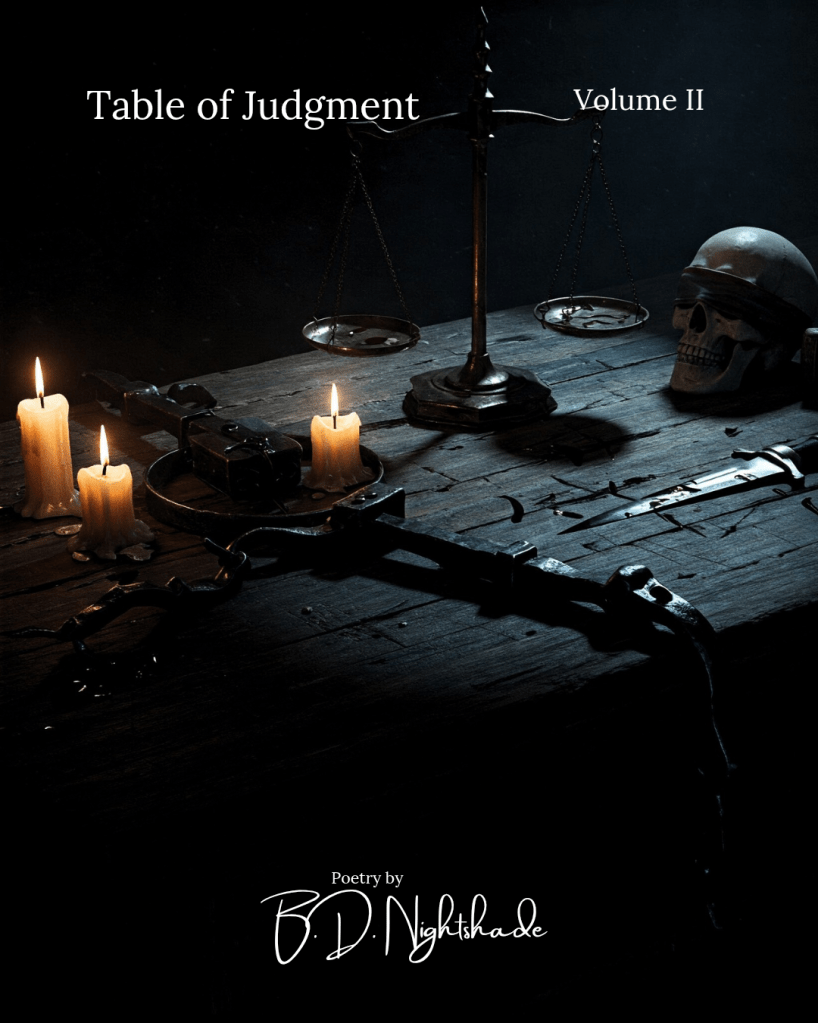
    The table returns—
    Its wood soaked in memory,
    Its restraints hungry for guilt.
    Justice was not a one-night feast.
    No—monsters breed in silence,
    And I am silence undone.

    First: The Foster Parents
    She called it “a blessing”—that monthly check.
    Said the child should be grateful for a roof.
    But the bruises weren’t from beams,
    And the screams didn’t echo from joy.
    He locked the child in closets lined with scripture.
    She washed the blood from his fists,
    Then set the table like nothing was broken.
    Now they sit strapped together—
    Hands sewn to each other’s shame.
    I force-feed them silence in spoonfuls,
    Play lullabies of sobs they ignored.
    The belt he used now flays his own tongue.
    Her eyes forced open to watch—
    Just like she used to.

    Second: The Revenge Porn Ex
    He thought power was pressing “upload.”
    Framed her in pixels, called it “freedom.”
    She lost everything.
    He gained followers.
    Now he’s the exhibit.
    Naked and looped on every wall,
    His body becomes his prison,
    Each image a tattoo of consent denied.
    His screams aren’t blurred.
    His shame isn’t edited.
    And no one comes to take it down.

    Third: The Conversion Therapist
    She laid hands not to heal,
    But to erase.
    Told queer teens their love was illness,
    That God would only listen if they bled.
    She sang psalms while they shattered.
    Now she kneels on broken glass,
    The verses she preached carved into mirrors,
    So every reflection mocks her grace.
    Her tongue sewn to a rosary,
    Each bead a life she bent—
    Snapped straight until they broke.

    Fourth: The Trigger-Happy Cop
    He saw skin and called it threat.
    Saw fear and drew steel.
    Said the bullet was “procedure,”
    Said the boy “matched the description.”
    But the body was innocent.
    The silence, deafening.
    Now he’s pinned beneath a spotlight,
    His badge melted down,
    Dripped into his eyes—
    So he sees,
    For the first time,
    What his justice really looks like.
    No shield.
    No radio.
    Only the weight of names carved
    Into his hollowed chest—
    Each one a verdict he’ll never escape.

    Fifth: The Therapist Who Crossed the Line
    She called him “safe.”
    He called her “special.”
    Said no one else would understand.
    Touched her scars with hunger,
    Then blamed her for bleeding.
    Now he lies on his own couch,
    Sedated in shame.
    Every time he closes his eyes,
    She speaks—
    And he listens, finally.
    Every “I love you” he twisted
    Now chokes him like a noose.

    Sixth: The Wealthy Rapist
    He wore tailored suits and courtroom smiles.
    Said she lied,
    Then paid her to disappear.
    But guilt doesn’t take a check.
    Now he’s stripped of silk and silence,
    His name stitched to every wound she hid.
    I press gavel-shaped brands into his chest,
    Each one a truth he tried to bury.
    Now, he’s the story.
    And she’s finally free.

    Seventh: The Online Predator
    He typed sweet lies in the dark,
    Promised safety, then devoured it.
    Left young girls gutted by shame.
    He called it “just talking.”
    Now, I bind his fingers to the keyboard—
    Force him to scroll through every name,
    Every cry he deleted.
    I turn the screen into a mirror.
    He types apology after apology,
    And each one burns his skin.

    And me—
    I stand again.
    The blade reborn.
    Seven new candles lit.
    Not for forgiveness.
    Not for peace.
    But so no one forgets.
    The table is not justice.
    It’s memory made flesh.

    And I am still here.
    Unholy.
    Unkind.
    Unapologetic.
    The shadow that watches
    When the system looks away.


    Author’s Note:
    This piece was written as an act of catharsis and creative reclamation. “Table of Judgment: Volume II” channels the voice of B.D. Nightshade—my poetic embodiment of wrath, vengeance, and divine justice. It is not meant to glorify violence, but to confront the horrors too often dismissed, silenced, or ignored by society and the systems meant to protect us.


    Writing this was painful—but necessary. If you made it through, thank you for bearing witness. And if you saw a piece of your own pain reflected here, I see you. You are not alone.
    Rowan Evans