Tag: mental-health

  • Author’s Note

    Some poems are meant to be complicated. This isn’t one of them.

    I wrote You Are Perfect as a reminder that our flaws don’t cancel our worth. We spend so much time measuring ourselves against impossible standards or letting other people decide what we’re worth that we forget something simple: being imperfect is part of being human.

    This poem isn’t saying you’ll never struggle or never doubt yourself. It’s saying those struggles don’t make you less deserving of love, respect, or compassion.

    If these words found you on a difficult day, I hope you borrow them until you can believe them for yourself.

    Rowan Evans


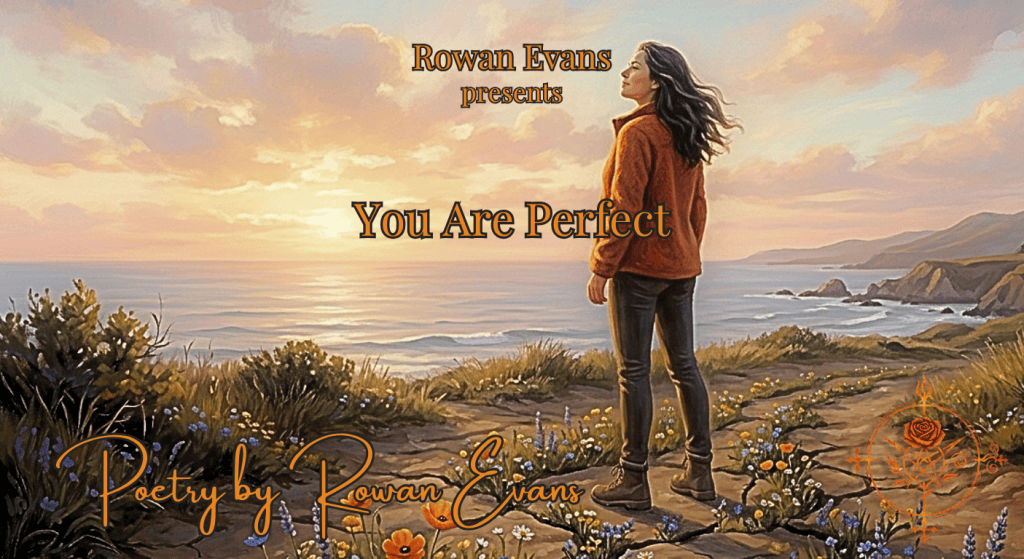
    A person standing confidently at sunrise as flowers bloom around them, symbolizing self-worth and resilience.
    Your flaws don’t diminish your worth—they’re part of the story that makes you uniquely you.

    You Are Perfect
    Poetry by Rowan Evans

    Dear,
    whoever needs
    to hear this—

    you’re worth it,
    flaws and all—
    you’re perfect.

    So don’t let others
    tear you down,
    and tell you
    what your worth is.

    Keep your chin up—
    even when it’s hard.

    Don’t let the spectators
    see you sweat.
    Don’t let them see the tears,
    or the weight on your neck.

    Because not everyone
    knows how to be a witness—
    sometimes they don’t
    have your best in mind.

    They want to see you fail,
    they want to see you small.
    So keep your chin up,
    and stand tall—

    because it’s like I said
    in lines three through six:

    Hear this—

    you are worth it,
    with your flaws and all—


    Journey into the Hexverse…

    [Human Rorschach]
    Sometimes we’re less a fixed person than an inkblot—our meaning changing with every set of eyes that looks at us. Human Rorschach explores perception, identity, and the ways our own experiences shape what we believe we see in others.

    [A Rose in the Ashes]
    Lost within a forest where every leaf becomes a memory, the speaker follows darkness instead of fleeing from it, discovering that healing isn’t found at the end of the tunnel—but in facing the past long enough to notice a single rose blooming through the ashes.

    [Where the Metaphors Lead]
    Some truths are easier to write than they are to say aloud. “Where the Metaphors Lead” explores the quiet space between dreams, confession, and the courage it takes to let another person know how deeply they’ve become woven into your inner world.

    [Through My View]
    No two people experience the world the same way. Through My View is a reflective free verse poem exploring perspective, imagination, and the impossibility of fully seeing through another person’s eyes.

    [Just Human]
    Just Human is a reflective free verse poem about seeing people before borders, choosing empathy over division, and finding home in our shared humanity rather than on a map.

    If you’re interested in more poetry, you can find it here → [The Library of Ashes]
  • Author’s Note

    This poem grew out of a realization that getting “lost” isn’t always the same as losing yourself.

    I’ve written many pieces about dreams, memory, shifting landscapes, and wandering through places that seem to exist somewhere between reality and imagination. Over time, I realized those places weren’t asking me to escape who I was—they were asking me to revisit the parts of myself I had left behind.

    We often talk about “finding ourselves” as though there’s one true version waiting to be discovered. My experience has been almost the opposite. Every season of life leaves behind another version of us: the frightened one, the hopeful one, the grieving one, the joyful one. None of them disappear simply because we’ve grown older.

    Healing, at least for me, isn’t replacing those earlier selves.

    It’s learning to walk beside them without shame.

    This poem is an invitation to stop treating old versions of ourselves as mistakes to erase and instead see them as companions who helped us survive long enough to become who we are today.

    Rowan Evans


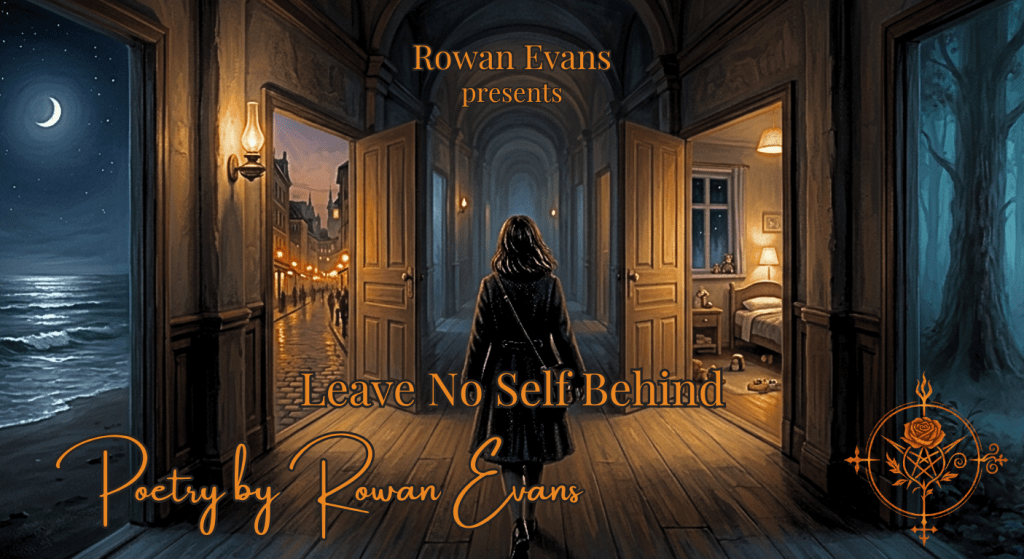
    A solitary figure walking through a dreamlike hallway where each open doorway reveals a different landscape representing memories and past versions of the self.
    Healing isn’t finding one true self—it’s learning to walk beside every version of yourself with compassion.

    Leave No Self Behind
    Poetry by Rowan Evans

    I feel like I’ve lost myself again—
    don’t know when it began,
    but I get lost a lot.

    It doesn’t take much for me
    to get lost in thought—

    I wander off
    without meaning to,
    slipping between memories
    like loose floorboards.

    One thought opens a door,
    another pulls me down a hallway,
    and suddenly I’m somewhere
    I didn’t plan to be—

    with some version of me
    I didn’t plan to meet.

    Sometimes the hallway
    tilts into something else—

    a shoreline I’ve walked in sleep,
    a city humming with heat,
    a room I haven’t entered in years.

    The world shifts
    without warning,
    and I follow it
    the way I follow dreams—

    half-aware,
    half-afraid
    of what I’ll find
    in the scene change.

    I never know
    which version of me
    I’ll find in those places—

    the one who’s tired,
    the one who’s trying,
    the one who’s still carrying
    things I swore I let go.

    Sometimes I meet
    the versions of me
    I thought I’d outgrown—

    the one who flinches,
    the one who freezes,
    the one who still thinks
    they’re hard to love.

    And I walk with them
    for a while,
    through whatever memory
    the hallway decides to show—

    letting them speak,
    letting them breathe,
    letting them…

    exist.

    Without rushing them back
    into the dark.

    And maybe that’s
    what finding myself
    really looks like—

    not a single moment
    of clarity,
    not a sudden return,
    but walking through
    every hallway
    my mind opens,
    meeting every version
    I’ve ever been,
    and letting them stay
    long enough
    to feel seen.

    Maybe I’m not lost.

    Maybe I’m just learning
    how to carry
    all the selves
    I used to abandon
    when the world
    felt too loud.

    Maybe this time…

    I won’t leave anyone—

    behind.


    Journey into the Hexverse…

    [Where the Metaphors Lead]
    Some truths are easier to write than they are to say aloud. “Where the Metaphors Lead” explores the quiet space between dreams, confession, and the courage it takes to let another person know how deeply they’ve become woven into your inner world.

    [Noon Is Loud]
    If four in the morning belongs to truth, then noon belongs to impossible memories. Noon Is Loud is a playful free verse poem filled with absurd boasts, pop culture references, and tongue-in-cheek mythology that explores how easily imagination can rewrite reality.

    [5:01 (Pull the Punchline Back)]
    What happens when a confessional poet instinctively hides every confession behind a joke? 5:01 (Pull the Punchline Back) explores humor as emotional armor, the speed of an overactive mind, and the difficult choice between making people laugh and letting them see what’s really there.

    [Chemical X]
    Chemical X explores the rapid, associative way one creative mind moves—from cartoons to sports, comic books to music—revealing that inspiration isn’t linear, but a collision of memory, humor, rhythm, and intuition.

    [Monster Theology]
    What if the monsters under the bed weren’t monsters at all? Monster Theology explores difference, belonging, and the human tendency to fear what we don’t understand through a conversation with the creatures we’ve spent our lives imagining.

    If you’re interested in more poetry, you can find it here → [The Library of Ashes]
  • Author’s Note

    Some people assume that because I write confessional poetry, vulnerability comes naturally to me.

    It doesn’t.

    My first instinct is almost always to make a joke.

    If something hurts, I’ll reach for humor. If something feels too exposed, I’ll bury it beneath a cartoon reference, a comic book nod, or a punchline that arrives just before the truth does.

    This poem is about that instinct.

    It explores the strange contradiction at the center of my writing: I’m willing to confess almost anything—as long as I can disguise it first.

    The title, 5:01, marks another early morning when my thoughts were moving faster than I could organize them. And “Pull the Punchline Back” became my way of describing what happens when I realize I’ve hidden behind humor for just a second too long.

    Sometimes the joke protects me.

    Sometimes it prevents me from saying what I actually mean.

    This poem lives somewhere between those two realities.

    Rowan Evans


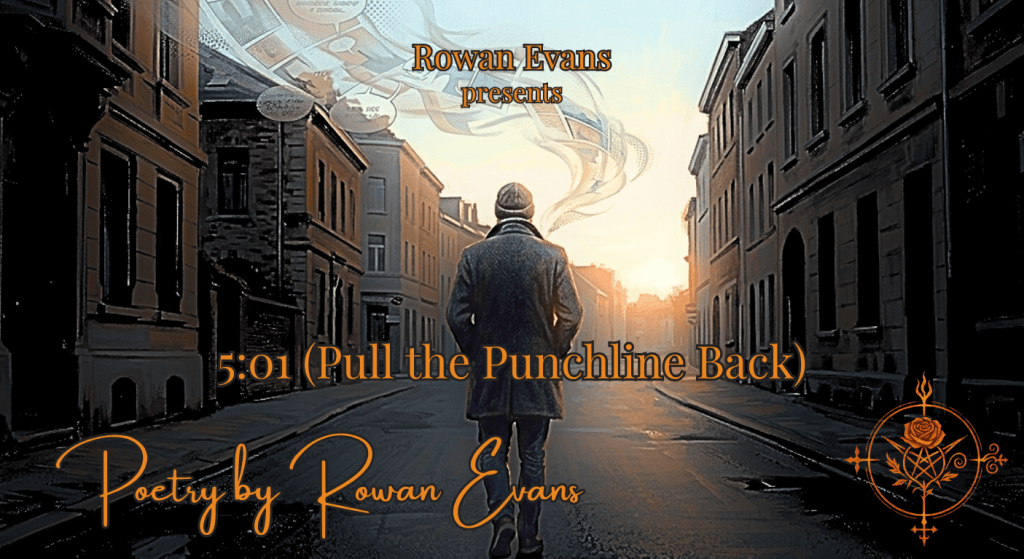
    A lone person walking through an empty street at sunrise while faded comic book imagery dissolves into the morning light, symbolizing humor giving way to emotional honesty.
    Sometimes the hardest part of confession isn’t finding the words—it’s resisting the joke that tries to replace them.

    5:01 (Pull the Punchline Back)
    Poetry by Rowan Evans

    5:01—
    the morning comes
    and my thoughts run,
    like a marathon.

    You see—
    most the time
    my thoughts move quick,
    like a sprint—
    Usain?

    No, insane.

    I bolt when I feel
    I care too much—

    here the vulnerability comes,
    so where’s the joke at?
    I got to hide that—
    pull the punchline back.

    I put a brave face on—
    they call me Courage,
    even though
    I’m a cowardly dog.

    Isn’t it funny?
    I’m a confessional poet,
    but I hide the confession
    behind a wall of jokes—

    and cartoon references—
    can’t forget the comic books.

    The page is a phone booth,
    I go into to change—
    but I’m not trying to be a hero here,
    there’s no S on my chest.

    I’m just here for those
    that are stressed and struggling.

    And this is my problem,
    I’ve got my own problems,
    then I take mo’ problems,
    they were yo’ problems—

    now I’m juggling.

    The sad thing is—
    the whole time
    this is what my mind
    has been running from.

    It’s incredible—
    how fast I Dash,
    gone in a Flash,
    like I ran to the past
    to escape—

    everything I want.

    Connection.
    Reflection.

    So I keep my feet moving
    until I get where I’m going,
    and I’m not showin’—
    no signs of slowin’.


    Journey into the Hexverse…

    [I’d Rather Try]
    Anyone can promise they’d die for someone. But love isn’t built on one dramatic moment—it’s built on showing up, trying again tomorrow, and proving your words through consistent action.

    [Tots, Rocks and All]
    What begins as a surreal collection of tater tots, rocks, comic book references, and runaway thoughts slowly reveals something much quieter: a poem about creativity, vulnerability, and the simple hope of finding someone willing to hold your heart.

    [Ocean Waves (1, 4, 3)]
    What begins as a surreal collection of tater tots, rocks, comic book references, and runaway thoughts slowly reveals something much quieter: a poem about creativity, vulnerability, and the simple hope of finding someone willing to hold your heart.

    [L Words & Heart]
    A playful, self-aware poem about love, longing, loyalty, and the quiet ways another person can reshape our inner world. What begins as humor slowly reveals a heartfelt confession about affection, imagination, and the faces that linger in our dreams.

    [No You and I, Only Us]
    A hopeful free verse poem about empathy, borders, and imagining a world where humanity matters more than division.

    If you’re interested in more poetry, you can find it here → [The Library of Ashes]
  • Author’s Note

    This poem began with a cartoon.

    Or rather, it began with a metaphor borrowed from one.

    I’ve always been drawn to characters who exist between worlds—people who don’t fully belong in one place or another, who spend their lives navigating the space between identities, expectations, realities, and possibilities.

    When I thought about Danny Phantom, I realized the metaphor fit more than I expected.

    Not because I feel haunted.

    Not because I feel supernatural.

    But because I understand what it feels like to exist in two places at once.

    Part of me lives in the present moment—the practical world of obligations, routines, limitations, and survival.

    Another part lives somewhere else.

    A quieter place built from hope, imagination, memory, longing, possibility, and the belief that life can become more than what it currently is.

    For a long time, much of my writing has existed in the tension between those two worlds.

    The opening sections of this poem lean into that tension. They acknowledge exhaustion, frustration, and the feeling of carrying more weight than you’d like. But the poem isn’t interested in staying there.

    What matters to me is where it ends.

    Because this isn’t a poem about giving up.

    It’s a poem about wanting more from life than survival.

    About wanting a future that feels inviting instead of merely manageable.

    About believing that the light inside us isn’t meant to spend its entire existence fighting to stay alive.

    Sometimes it deserves the chance to burn because it’s excited.

    Excited about tomorrow.

    Excited about possibility.

    Excited about whatever comes next.

    Maybe that’s the real theology hidden inside the title:

    Not that we exist between worlds.

    But that we keep moving toward the one where we finally get to live.

    Rowan Evans


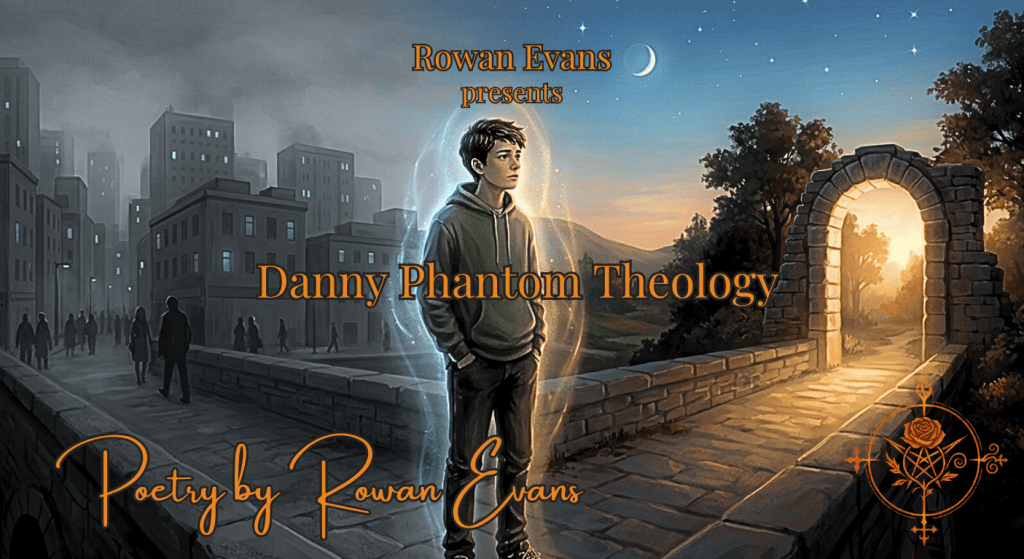
    A solitary figure stands between a gray city and a glowing world of light and possibility, symbolizing living between survival and hope.
    Somewhere between the life we endure and the life we imagine, hope keeps the light alive.

    Danny Phantom Theology
    Poetry by Rowan Evan1s

    Sometimes I feel
    like Danny Phantom,
    a boy between worlds—
    one alive, the other
    a quiet place inside me
    where the light flickers
    but never fully goes out.

    I exist in both.
    But I do not thrive,
    most the time
    it barely feels like I’ll survive.
    I know that’s a little dramatic—
    it’s a bad habit.
    I know my words feel heavy,
    more than intended most the time.
    I know what it sounds like—
    it sounds like I don’t like life.

    But that’s not true—
    I’m a lover of life,
    a hater of the conditions.
    I want a change—
    in environment,
    in circumstance.

    I want a world
    where I don’t have to split myself
    to make it through the day,
    where the light inside me
    doesn’t flicker
    from exhaustion
    but from possibility.

    I want a life
    where survival
    isn’t the main objective.
    Where waking up
    isn’t an act of endurance,
    but anticipation.
    Where the light inside me
    doesn’t flicker
    because it’s fighting to stay alive—

    but because…

    it’s excited
    for what’s next.


    Journey into the Hexverse…

    [Frankenstein’s Monster]
    Some poems are built to make a point. Others are built to reveal the mechanism. Frankenstein’s Monster (and I’m the Doctor) explores associative thinking, creative chaos, and the strange process of stitching disconnected ideas into something alive.

    [Lone Wolf Theology]
    A philosophical pop-culture poem exploring freedom, identity, and self-authorship through the lens of superheroes, antiheroes, mythic archetypes, and personal rebellion. A declaration of autonomy in a world determined to write your story for you.

    [Before We Created the Labels]
    Ancient gods return to a fractured world shaped by borders, identities, and separation. “Before We Created the Labels” explores humanity’s divisions through mythic imagery, sacred ritual, and symbolic collapse—asking what remains when we learn to see one another beyond labels.

    [A Heart That Echoes in Another Language]
    A poetic journey through music across Japan, Korea, China, and the Philippines, exploring how sound becomes identity, memory, and emotional geography.

    If you’re interested in more poetry, you can find it here → [The Library of Ashes]
  • Author’s Note

    This poem started as play.

    I wasn’t trying to be deep or careful — I was letting my brain sprint, letting pop culture, mythology, and intrusive thoughts collide on the page. Comics, villains, alter egos, masks — all the familiar metaphors we use when our minds feel too loud to live in quietly.

    What surprised me wasn’t the darkness, but the balance. This isn’t a descent — it’s a return with awareness. Standing in the light doesn’t mean pretending the shadows don’t exist. It means no longer fearing them.

    This is what it feels like when poetry stops being a tool and starts being a force — when the ink takes over, and you let it.


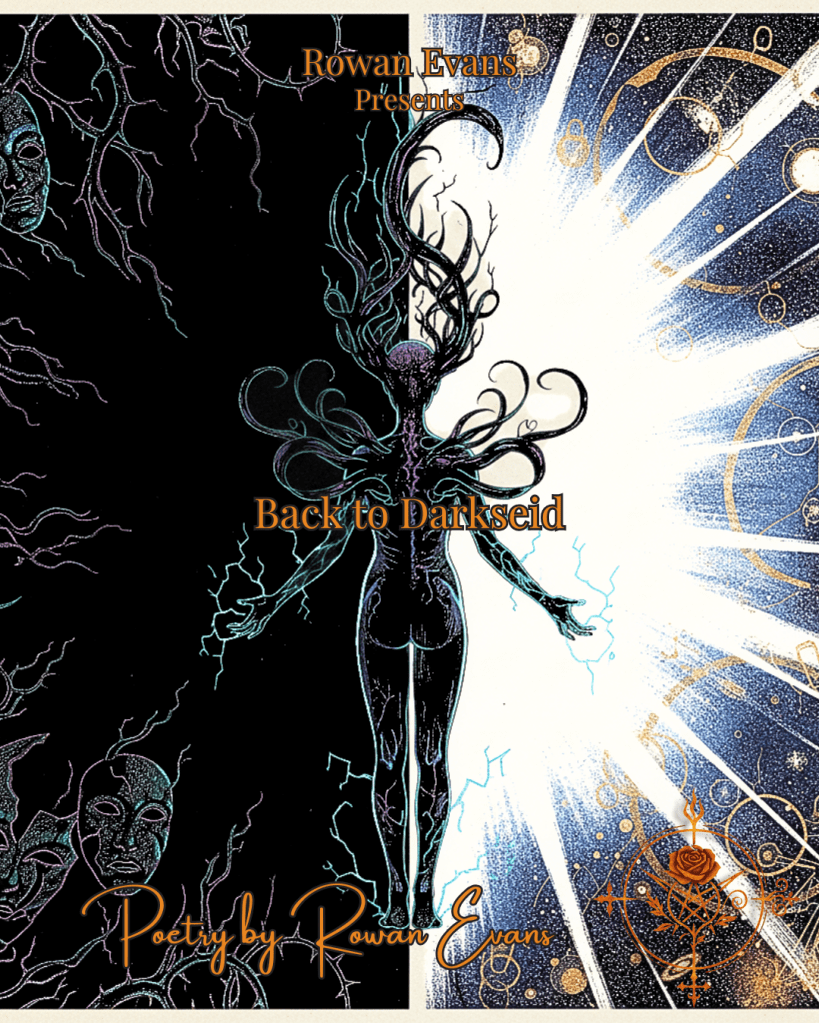
    Surreal illustration of a figure in shadow with ink tendrils rising up their spine, symbolizing chaos, identity, and creative obsession.
    Where chaos, identity, and ink collide.

    Back to Darkseid
    Poetry by Rowan Evans

    I walk in,
    ready to rock
    like a shock
    to the system.

    Watch me
    ghost ride the whip,
    hit you with the
    penance stare.

    Watch as you become
    hyper aware
    of every misdeed,
    and every sin seeps
    into the veins.

    It circulates
    until it hits
    the brain.

    Lights out.

    Silence.

    My noggin’s
    an asylum,
    I’m sick in the head.
    Coin flip of fate,
    I’m two-faced
    with my joker’s thoughts.

    I’m a dark knight,
    on a dark night—
    fighting the monsters
    that my mind creates.

    Don’t try to figure me out.
    I’m an enigma, a riddle
    with no answer.

    A twisted harlequin
    in a garden
    made by Ivy.
    Each petal unfurls,
    guiding—
    leading me back
    from the edge.

    Now I’m standing in the light,
    back to Darkseid—
    I no longer fear
    Apocalypse.

    Watch my ink
    twist into tendrils.
    Watch as they
    wrap around,
    and creep up
    my spine like venom.
    Watch as poetry
    slowly,
    takes over
    my mind.


    If you’re interested in more poetry, you can find it here → [The Library of Ashes]

  • Sometimes the world feels loud in ways we can’t explain.
    This was written as a soft place to land—
    for kids, for anxious hearts, for anyone who needs a reminder
    that calm is something you can learn, not something you have to earn.


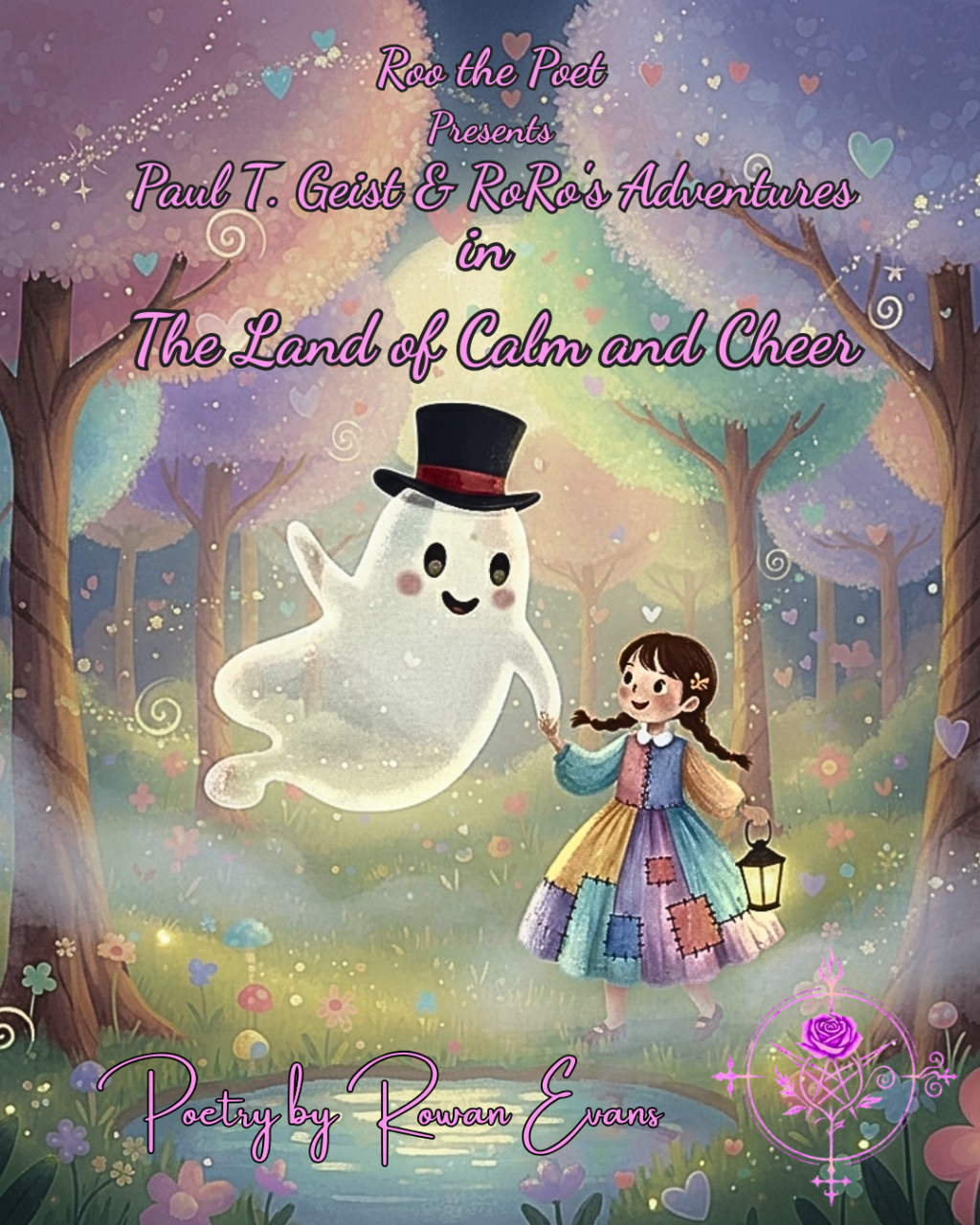
    A friendly glowing ghost and a child drifting through a peaceful, magical landscape of moonlight, flowers, and calm waters.
    Paul T. Geist guiding RoRo through the Land of Calm and Cheer, where big feelings learn how to breathe.

    Paul T. Geist & RoRo’s Adventures in the Land of Calm and Cheer
    Poetry by Roo the Poet
    Written September 13th, 2024

    In a cozy little town where moonbeams play,
    Lived a ghost named Paul T. Geist who loved to sway.
    With a gentle laugh and a shimmer so light,
    He brought comfort and joy on a soft, starry night.

    RoRo was a girl full of bright, happy beams,
    But sometimes her feelings were wild, it seems.
    One day she felt frazzled, her emotions a storm,
    And her mood became chilly, her smile not so warm.

    Paul T. Geist floated by with a friendly glow,
    “Dear RoRo,” he said, “there’s something you should know.
    Let’s visit a land where calmness takes flight,
    And find peace for your heart on this magical night.”

    They drifted through fog that was soft and serene,
    To the Land of Calm and Cheer, where joy was seen.
    “Welcome,” said Paul, “to a place so profound,
    Where finding your calm is the treasure you’ve found.”

    They met a wise owl with feathers of blue,
    Who spoke of deep breaths and feelings anew.
    “Sometimes,” said the owl, “our minds race so fast,
    But finding still moments can make calmness last.”

    RoRo watched as the owl closed her eyes tight,
    And took gentle breaths to feel peaceful delight.
    She saw how stillness could quiet the storm,
    And how feelings could settle, transforming the norm.

    Paul T. Geist then showed her a pond so clear,
    Where ripples of peace danced near and dear.
    “When you’re feeling stormy, take a deep breath,
    Like ripples that spread, it helps calm the depths.”

    They visited a meadow where colors would sway,
    In hues that brought calm to each passing day.
    RoRo learned to breathe deeply and slow,
    Finding calm in the feelings that ebb and flow.

    As they floated back home, RoRo felt light,
    Her heart now at peace, her emotions just right.
    She learned to embrace her feelings with care,
    And find calm in the storm, floating light as air.

    Paul T. Geist waved with a glow soft and bright,
    “Remember, dear RoRo, your feelings are light.
    In the Land of Calm and Cheer, you’ve learned so much,
    To find peace and calm with a gentle touch.”

    So children, remember, as you grow and play,
    Find calm in your heart at the end of the day.
    For in the Land of Calm and Cheer so near,
    Peace can be found, and your heart will be clear.


    If you’re interested in more poetry, you can find it here → [The Library of Ashes]

  • Author’s Note

    Some poems are confessions.
    Some are exorcisms.

    This one is alchemy.

    Alchemist of Ink (All Sixes) came from that familiar edge—when the weight presses in, when the mind contracts, when the darkness feels like it might finally win. But instead of letting it consume me, I let it become something. I let it turn into ink.

    This poem is about that moment of reclamation.
    About taking what hurts and making it mine.
    About refusing to be only what the darkness names me.

    If you’ve ever felt yourself folding inward—this is for you.
    If you’ve ever made art out of survival—this is yours too.


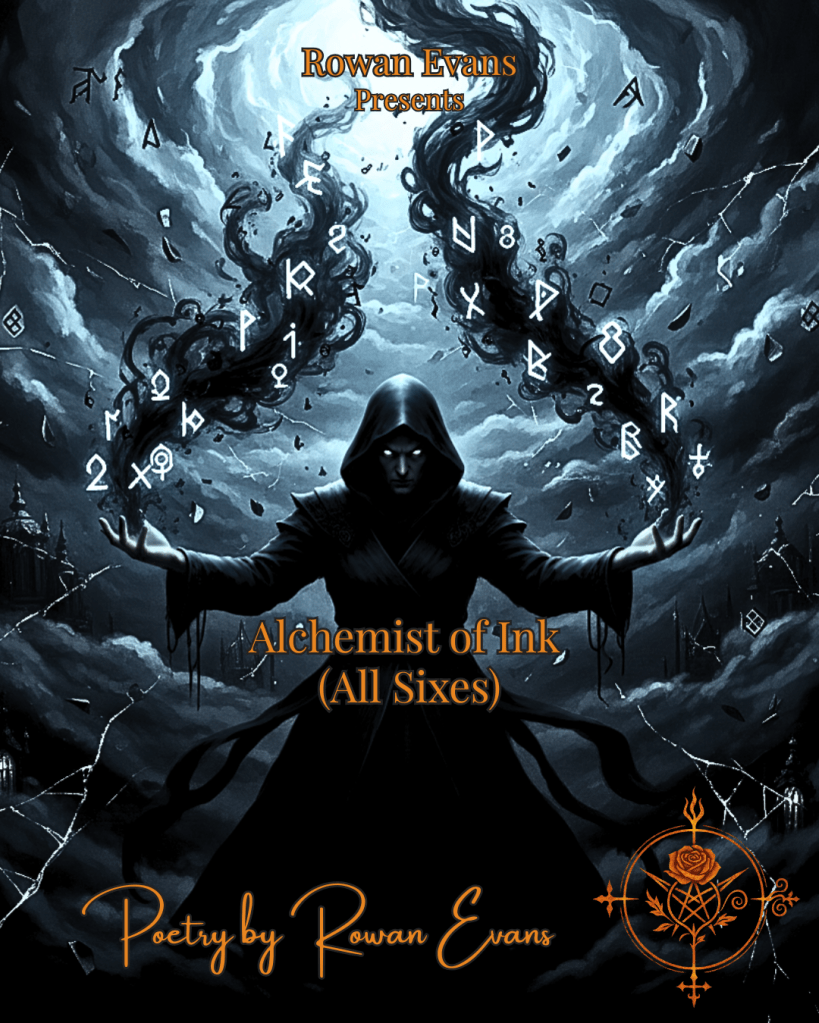
    A shadowed poet with glowing eyes as black ink pours from their hands, transforming into swirling symbols of power in a dark, gothic setting.
    Turning darkness into language. Pain into power. Ink into alchemy.

    Alchemist of Ink (All Sixes)
    Poetry by Rowan Evans

    I am all sixes when its needed,
    this darkness,
    your hatred feeds it.

    I can feel it—
    crawling up my spine,
    that creeping feeling.
    It twists around my mind,
    contracting.

    I can feel it squeeze,
    as I fall to knees.

    My eyes flicker and flash,
    fade to black—
    as you see
    my face distort.
    Twisted reflection.
    Personified depression.

    Can you see—
    as I begin to bleed ink?
    It pours from me,
    covering fingers,
    hands and arms.

    It twists,
    never relents.


    I’m a motherfucking
    alchemist,
    the way I take my pain
    and change it.
    I’ll write like hell,
    to subtly rearrange it.


    If you’re interested in more poetry, you can find it here → [The Library of Ashes]
  • Author’s Note

    This piece is the closest I’ve come to writing the truth of my internal war without softening it. Between Worlds is about self-violence—the way the mind learns your weak spots, remembers the old wounds, and knows exactly where to cut. It’s a poem about relapse, about memory, about survival, and about the strange loneliness that follows healing.

    It speaks to the years where I wasn’t sure I’d make it. The hospital walls. The padded quiet. The fluorescent lights humming through the silence. It speaks to dissociation, to identity, to queerness, and to the mythic distance I’ve always felt between who I am and the world I live in.

    This poem isn’t a cry for help—it’s a record of survival. It isn’t tragedy for tragedy’s sake—it’s truth. It’s the reality that healing isn’t linear, that progress has shadows, and that sometimes the loudest battles are fought in the mind no one else can see.

    If you know this feeling—of standing in your own skin like it never quite fits, of fighting thoughts with thoughts, of loving your existence even when you question your place in it—then I hope you feel seen here.

    Because none of us are alone in the in-between.

    Rowan Evans


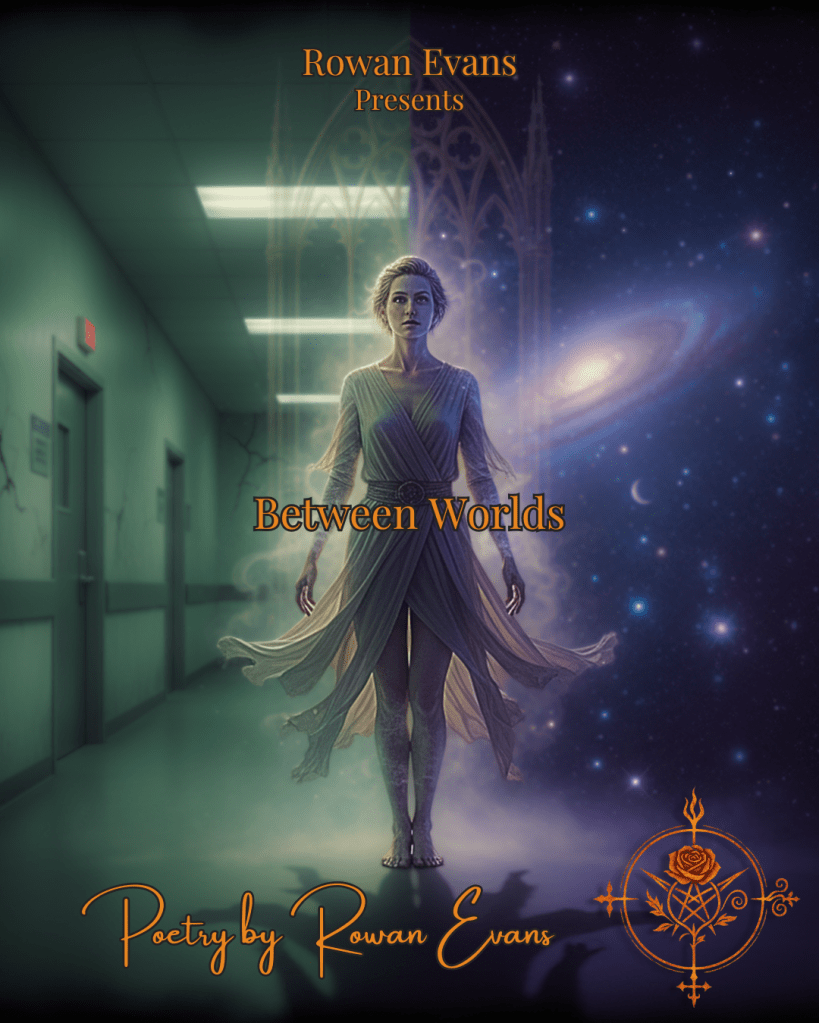
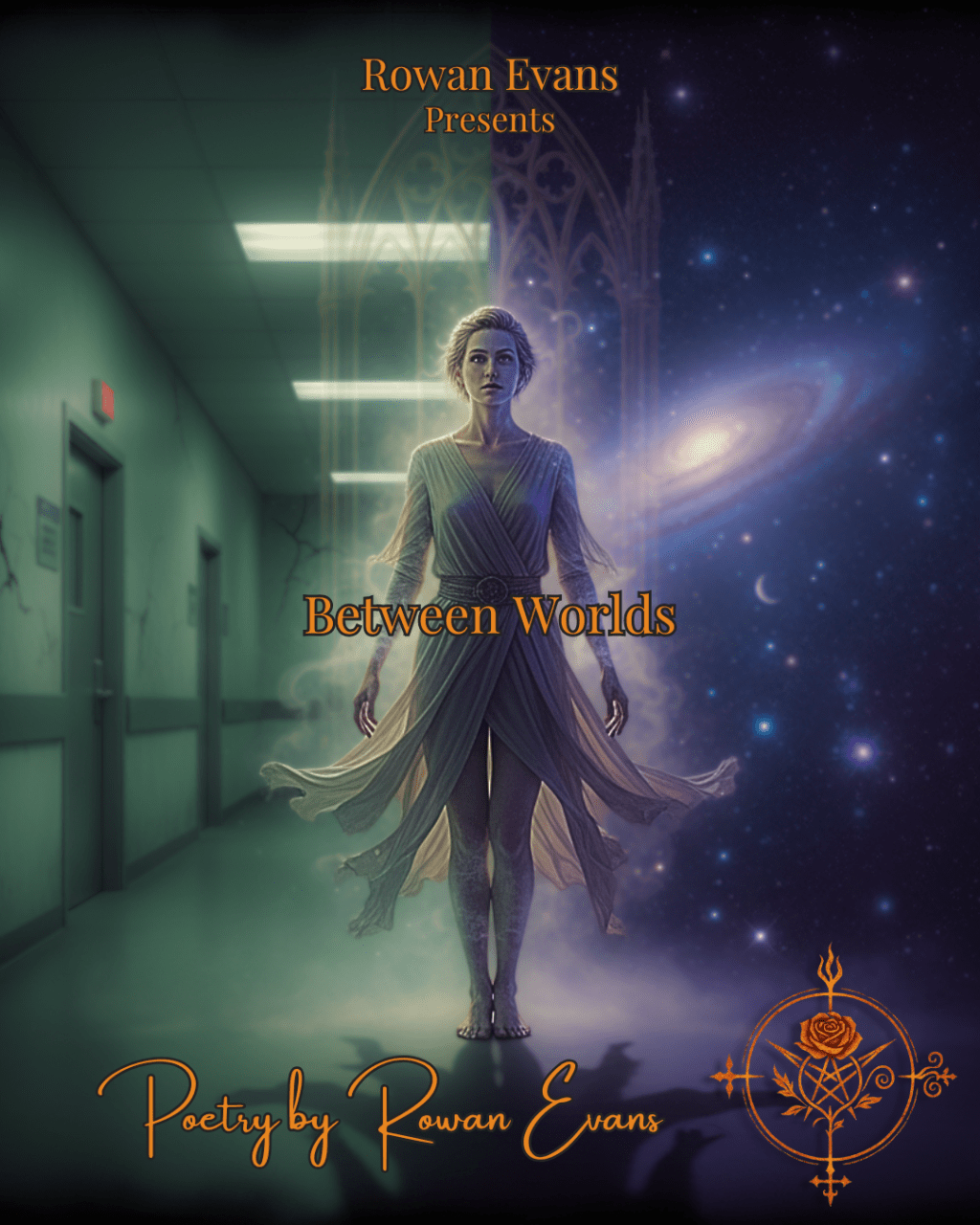
    Nonbinary person standing between a hospital hallway and a star-filled night sky, symbolizing dissociation and identity between worlds.
    Between Worlds — artwork representing Rowan Evans’ poem about surviving mental illness, dissociation, and identity beyond binaries.

    Between Worlds
    Poetry by Rowan Evans

    Why do I
    always try
    to pick a fight
    with me?

    You’d think I’d know,
    by now, just how
    quick I’ll slip
    an insult
    under the ribs.

    I’ll hit
    every single fear,
    twist them
    like a knife—
    until I’m
    on my knees,
    gasping,
    spitting blood.

    I don’t fight fair.
    I target old wounds,
    tear at what’s
    already healed.
    I’ll fuck around
    and send myself
    back ten years—
    back to hospital walls
    and quiet rooms,
    where the only sound
    was the fluorescent hum.

    Where time dissolved…
    where clocks stopped
    ticking.

    But I walked out
    of those halls—
    didn’t I?

    Didn’t I?

    But what if I didn’t?
    What if I’m still locked inside,
    in a padded room
    with the jacket
    strapped tight?
    Thoughts confined,
    so the words
    won’t escape.

    Writing poems
    in my head,
    just to pass
    the time.

    I’ve been alive,
    but dead inside.
    And I’ll be honest:
    I’ve died
    inside my mind
    more than
    a dozen times.

    I just wanted escape.

    Escape from pain,
    from feeling misplaced—
    I just wanted
    to belong.

    But it’s like—
    something is wrong here.
    Why don’t I
    feel like
    I belong here?

    Why does everything feel
    a half inch to the left—
    like I’m living inside
    the echo of myself?

    Like I’m watching my life
    from behind fogged glass,
    palms against the surface,
    screaming—
    but no sound
    passes through.

    Sometimes I swear
    the world forgets I’m here,
    and sometimes
    I do too.

    Maybe it’s because
    every room I walk into,
    I’m half a ghost already—
    too queer, too quiet,
    too soft, too strange.
    Too fucking much
    for everyone
    but me.

    Maybe that’s why
    the fight never ends—
    because I’m still trying
    to prove I deserve
    the space I take up,
    even in my own skin.

    So maybe I don’t belong here
    because I was born
    between worlds—
    not alive, not dead,
    not human, not myth,
    not safe, not ruined.

    Maybe my bones remember
    a home I never had,
    and every heartbeat since
    has been an attempt
    to map
    my way back.


    If you’re looking for more poetry, you can find it here → [The Library of Ashes]
  • Introduction

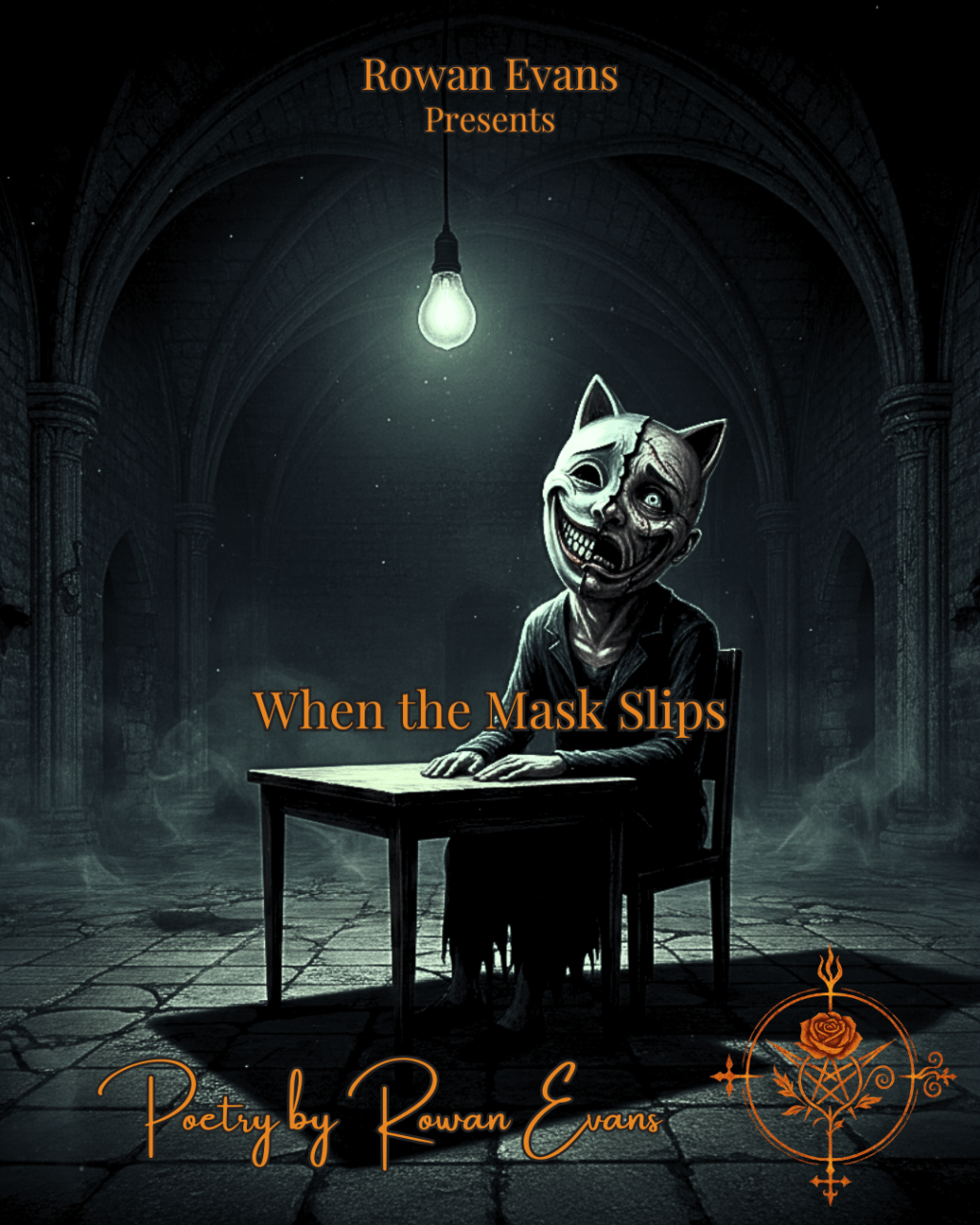
    When the Mask Slips explores the fragile boundary between performed sanity and inner unraveling. Through vivid imagery, surreal metaphor, and a self-aware voice, Rowan Evans captures the terror and beauty of identity under pressure, where the mask may be all that stands between perception and emptiness.


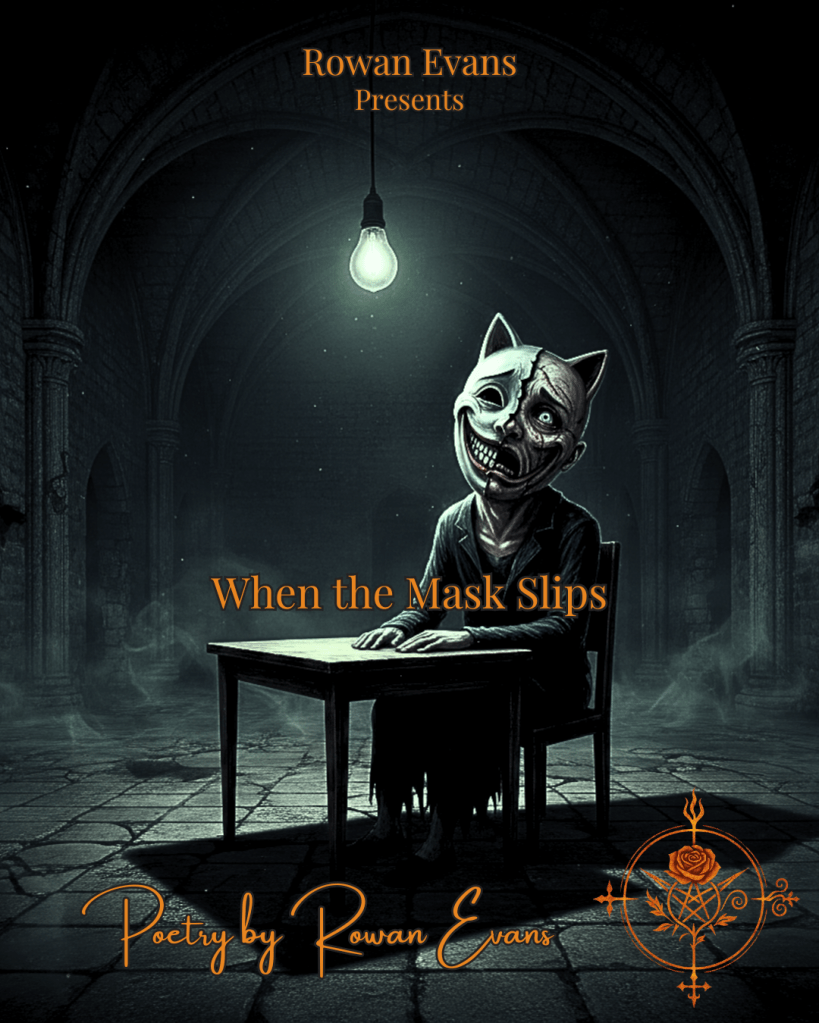
    Neo-Gothic digital illustration of a solitary figure with a Cheshire grin sitting at a flickering-lit table, representing the fragility of identity and performed sanity.
    When the Mask Slips visualized: a lone figure navigating the fragile line between performance and inner self.

    When the Mask Slips
    Poetry by Rowan Evans

    I am going to be honest—

    I think I’ve lost my mind,
    I’ve been drifting in this mental fog.
    Wandering. Lost.
    Not sure what I was trying to find,
    not sure what was the cost.

    But I’ve been—
    orbiting annihilation,
    facing Armageddon
    in phases—
    the moon isn’t the only thing
    that disappears piece by piece.

    I keep losing track of my thoughts
    like loose teeth—
    wiggling them
    just to feel something give.
    I’m just a Mad Hatter,
    with a Cheshire grin—
    screaming “Off with their heads!”
    just to hear the echo—
    make sure the room and I are still real.

    Sometimes—
    I cosplay sanity,
    like I have a grasp on reality.
    Like I know the meaning of stability—
    mentally.
    I dress up, pretend that I’m normal—
    but it feels too boring and formal,
    too exposed.
    Too much light, not enough shade,
    too many eyes on my face.

    And underneath it all,
    I’m terrified there’s nothing there—
    when the world stops being a stage,
    when existence stops being a performance.
    When the mask slips…
    and it’s just me.

    (God, what if that’s worse?)


    Author’s Note

    This poem sits at the edge between humor and unraveling—between the persona we show the world and the version of ourselves we hope no one ever sees. It isn’t about insanity; it’s about the fear that sanity might be nothing more than costume, choreography, and survival instinct.

    It uses absurdity as honesty, because sometimes the surreal is the only language for a fraying mind. The Wonderland imagery isn’t playful fantasy—it’s metaphorical dissociation. The poem is meant to feel unsteady, spiraling, self-aware, and a little unhinged. It asks:

    What if the mask isn’t hiding anything?
    What if the performance is the person?

    This piece reflects the quiet terror of identity erosion—the dread that beneath the jokes, the aesthetics, the manic charm, and the polished poetry… there may be nothing solid to hold onto.


    If you’re looking for more poetry, you can find it here → [The Library of Ashes]
  • Author’s Note

    This piece is a reflection on persistence, inspiration, and the threads that connect my work over the past year. Each italicized title is a window into the poems that shaped this journey—moments of love, desire, trauma, healing, and devotion.

    At its heart, this is about process as much as outcome: the daily practice of writing, the sparks of muse, and the quiet work done in the late hours when the world is still. It’s also a tribute to those who witness these words—across screens, pages, and hearts—you are part of this ongoing journey too.

    Consider this piece a bridge: between poems, between moments, between the past and the work yet to come.


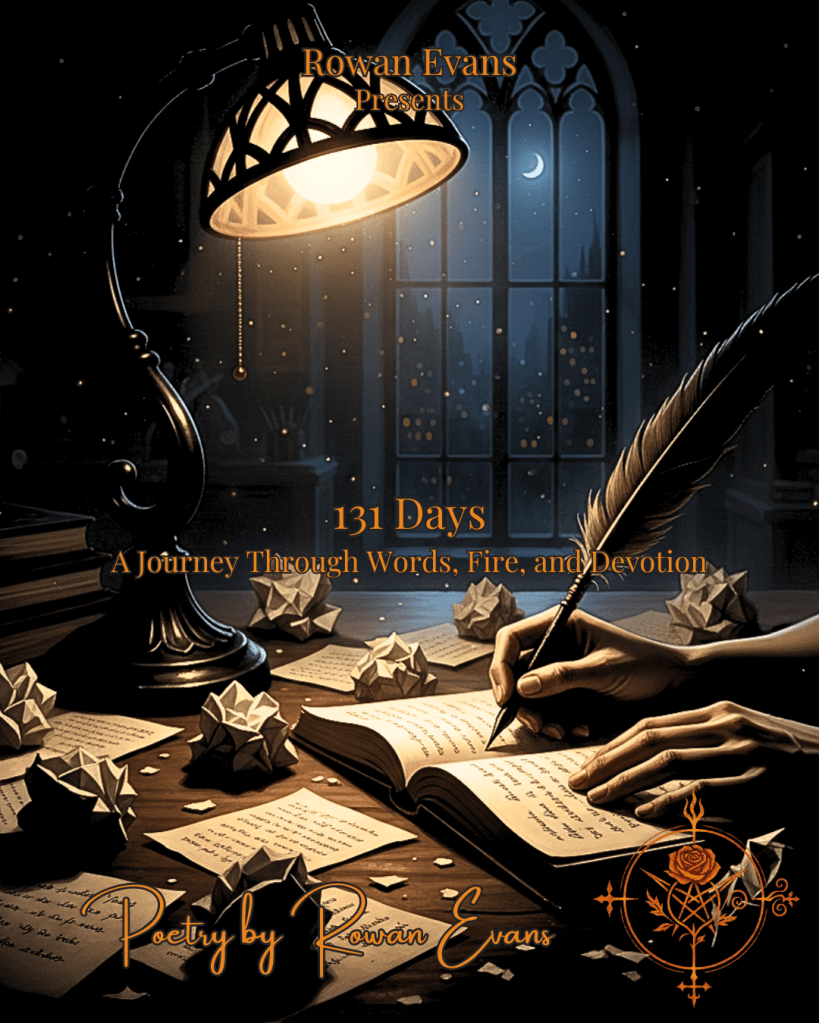
    A writer’s hands holding a pen over scattered pages of poetry, lit by a warm lamp, evoking quiet inspiration and devotion.
    Late nights, ink-stained fingers, and the quiet companionship of words—where every poem begins.

    131 Days
    (A Journey Through Words, Fire, and Devotion)
    Poetry by Rowan Evans

    I’ve been
    so focused—
    over-focused, some say.
    One hundred thirty-one days
    and counting.

    I’ve written with range:
    love, desire, mental health,
    trauma, recovery.
    There’s more, of course,
    but that’s the core.

    I write like
    A Heart Unveiled,
    witnessing the
    Colors of Your Soul.
    My pen
    revealing,
    the Infinity Within.
    As my mind
    drifts free
    in The Hallow Sea.

    My muse,
    my inspiration is—
    A-Woman.
    The vision of beauty,
    an angel on earth—
    a Filipina,
    with fire in her eyes.
    When the world tries
    to put her fire out,
    that is when I
    Cry to the Quiet.
    And why
    I Am
    offering myself
    to her, fully.
    Freely.
    For you see,
    she—
    is Perfectly Imperfect,
    which means…
    she is perfect for me.

    She has shown me,
    that there are
    Timelines Worth Rewriting.
    And your essence,
    I will never forget—
    because
    I Am the Storm That Remembers.

    Late nights, ink-stained fingers,
    the quiet my closest companion.
    For those who witness, across pages and screens,
    you carry a piece of this journey too.
    And still, I write on.


    If you enjoyed this piece and want to check out more of my work, you can click one of the many links scattered throughout the poem itself. They take you to my highest viewed pieces of the year. I am not saying they are my best pieces, just the ones that got the most views. Anyway, you can find more of my work here: [The Library of Ashes]