Tag: spoken word style poetry

  • Author’s Note

    This piece started because of a single lyric in a song.

    A line about EBT that made me laugh a little because my immediate reaction was: “Do you know who listens to your music? We know exactly what that means.”

    And that memory spiral hit instantly.

    This poem isn’t really about poverty in the dramatic sense. It’s about environmental memory. The small things that stay with you long after you leave certain stages of your life behind.

    Dry ramen because there wasn’t money for extras. Hot concrete in triple-digit summers. Waiting for sprinklers to turn on just so the neighborhood kids could cool off. The strange rhythm of knowing exactly when EBT would hit every month because that date mattered.

    I grew up in California’s Central Valley, and people who haven’t lived there sometimes underestimate how much the environment shapes you. The heat feels physical in memory. The dryness becomes part of your emotional vocabulary.

    That’s where the title comes from.

    “Drought resistant” isn’t just about the land. It’s about the people too.

    And while this piece carries humor and regional slang intentionally, there’s something sincere underneath it: a complicated kind of affection for the place that raised me.

    Not because it was easy. Not because it was glamorous.

    But because it’s part of me anyway.

    Rowan Evans


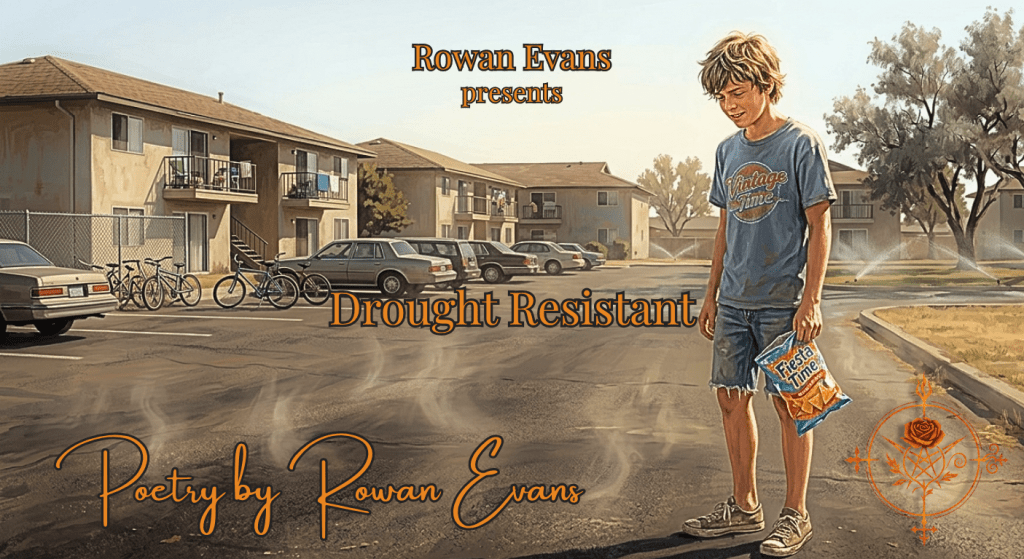
    A teenager standing on hot California pavement during a dry summer day in the Central Valley.
    The Central Valley teaches you how to survive long before you realize survival is what you’re learning.

    Drought Resistant
    Poetry by Rowan Evans

    I grew up poor-poor,
    couldn’t even afford
    water for my ramen.
    Ate it dry—
    standing on hot concrete
    cooking my feet.

    It was that
    Central Valley heat—

    Back when
    kids were askin’—

    is it our turn today,
    to let the water spray?
    We just wanted to be
    kids in play—

    Do you know
    what it’s like
    to ride a bike
    through a
    convection oven?

    That was my
    environment.

    The Central Valley,
    where even our
    trees are hard—

    drought resistant,
    like we wish our
    pockets are.

    The 5th of every month
    EBT hit—

    no brand names,
    couldn’t afford it.
    We shopped for
    Great Value—

    Glacier Ranch
    Tortilla Chips.

    Go ahead
    and diss me,
    dismiss me.

    But your diss is
    Peter Pan,
    it will Neverland.

    California in my blood,
    California in my DNA—
    it’s hella tight,
    it’s hella cool.

    Yea’ dude.


    Journey into the Hexverse…

    [Escaped to the Page]
    “Escaped to the Page” is a confessional meta-poem about individuality, artistic identity, and surviving through writing. Blending sharp confidence with emotional vulnerability, the poem explores the difference between shared labels and lived experience—and the ways art becomes inseparable from the life behind it.

    [Ink as a Second Mouth]
    “Ink as a Second Mouth” explores the distance between thought and speech, and the ways writing can become a form of survival, continuity, and self-translation. Through confessional imagery and reflections on growth, identity, and articulation, the poem examines what it means to keep becoming through language.

    If you’re interested in more poetry, you can find it here → [The Library of Ashes]
  • Author’s Note

    This piece feels like a conversation with every version of myself that survived long enough to become this one.

    The angry versions. The grieving versions. The lonely versions. The hopeful ones too.

    For a long time, I thought pain would eventually turn me cold. That heartbreak, betrayal, abandonment—all of it—would harden me into someone bitter.

    But somewhere along the way, I realized something:

    I don’t want to become what hurt me.

    So this poem became less about suffering, and more about what comes after it. About the kind of love I believe in now—not performative, not transactional, not built on fantasy.

    Real love is presence. Attention. Safety. Memory. Patience.

    It’s showing up.

    And maybe that sounds simple. But I think simple things are often the hardest to do consistently.

    Rowan Evans


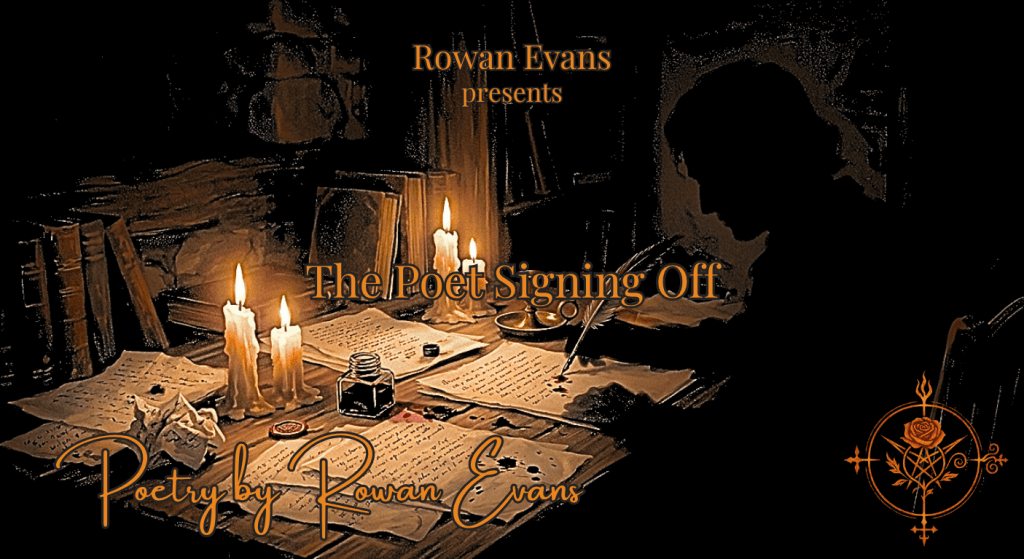
    Candlelit desk with handwritten poetry symbolizing heartbreak and emotional healing
    Love is not perfection. It’s presence.

    The Poet Signing Off
    Poetry by Rowan Evans

    Hello—
    let me introduce myself.

    I am Rowan
    and no one else.

    The fire in my eyes
    may have faded—
    but I never let the world
    turn me jaded.

    I’m not bitter,
    even though
    maybe I should be.

    I’ve been through shit—
    yeah,
    I’ve really been through it.

    I’ve seen friends
    turn to strangers—

    and worse,
    turn to haters.

    Friends
    to enemies.

    Lovers
    to ghosts.

    Raise your glass—
    time for a toast.

    I thank you
    for the lessons,
    the pleasure
    and the pain.

    I turned heartbreak
    into ink,
    and bled across
    the page.

    You taught me
    what love is not.

    It’s not grand gestures
    or fancy gifts.

    It’s time
    and presence—
    not just presents.

    It’s stormy weather
    and sunny days.

    It’s seeing the weight
    someone carries,
    realizing
    they’re being buried.

    It’s listening
    and learning
    their stories.

    It’s seeing beneath
    the surface,
    lifting them up—

    that’s the purpose.

    Remember
    the little things.

    How she likes her coffee.
    The way she wakes up,
    randomly.

    And be there.

    If she wakes
    shaken,
    and needs somewhere
    safe—

    be there.

    That’s the rule
    I try to live by.

    I’ve been hurt before,
    and I don’t want
    to pass that hurt forward.

    I want to ease the ache.

    I know I can’t
    fix the breaks—

    but maybe
    we can mend
    the cracks with gold,
    showing people
    the beauty
    damage makes.

    Because cracks
    are not flaws—

    they’re stories written
    in a language
    older than spoken tongues.

    It’s love—

    older than empires,
    older than cavemen
    lighting the first fires.

    Romantic or platonic,
    it matters not.

    Love is the cure
    to the rot.

    I scribble on the page
    as the lights begin to fade.

    Candles flicker.
    Flames dance.

    And the poet’s pen
    finds its cadence.

    The poet
    signing off.

    Goodbye.


    If you’re interested in more poetry, you can find it here → [The Library of Ashes]
  • Author’s Note

    War is often framed through numbers – casualty counts, budgets, troop movements, strategic gains. But behind every statistic is a life, a family, a story that rarely gets told. Calculating Profits (Ledger of Lives) is a response to that reduction of humanity into arithmetic.

    This poem confronts the uncomfortable truth that while war is frequently portrayed as a contest of nations, the consequences are carried by ordinary people. Civilians lose homes, children lose futures, and entire communities are reshaped by decisions made far from the battlefield.

    The poem’s title references the cold language of accounting–ledgers, calculations, profits–to highlight how easily human suffering can be reframed as strategy or necessity. I wrote this piece to challenge the normalization of war as spectacle and to remind readers that the cost is never abstract. Every loss echoes through generations.

    Sometimes poetry must be gentle.
    Other times, it must speak plainly.

    This poem chooses the latter.

    Rowan Evans


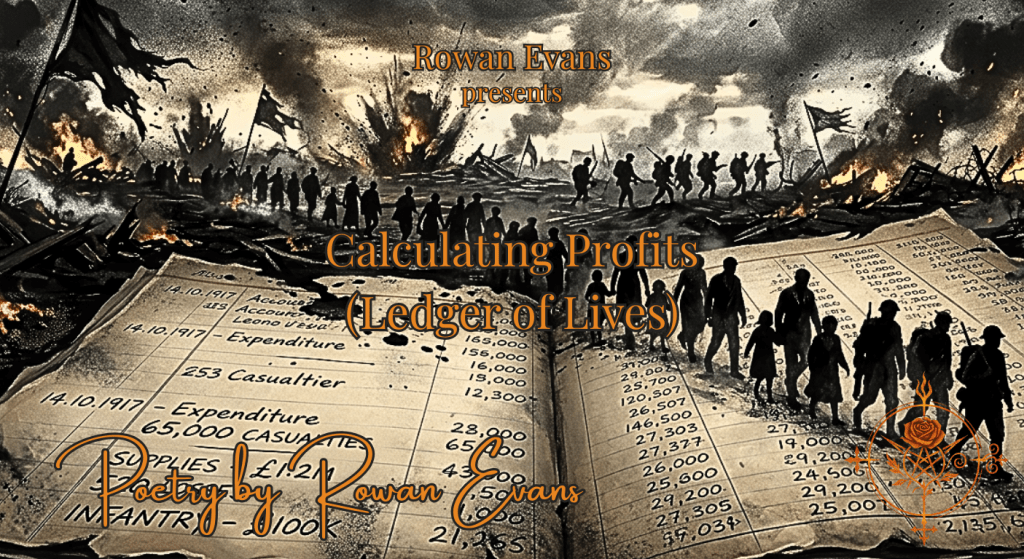
    Conceptual illustration of a battlefield fading into an accounting ledger, symbolizing the human cost of war being reduced to numbers.
    When lives become numbers, the ledger of war never truly balances.

    Calculating Profits (Ledger of Lives)
    Poetry by Rowan Evans

    I’m so sick of this, it’s ridiculous,
    the way we glorify war like a sports game—fictitious.
    Us vs Them, who’s gonna win?
    While kids in rubble pray their lives begin.

    Flags wave, bombs blaze, headlines spin,
    nobody wins, but governments grin.
    Life lost, life changed, families torn apart,
    yet they call it “strategy,” cold as a heart.

    Soldiers march, leaders sit in their chairs,
    calculating profits while ignoring prayers.
    Civilians flee, the streets taste of ash,
    diplomacy dies in the bureaucratic clash.

    Every life a number in a ledger they hide,
    every tear a story the textbooks won’t write.
    We cheer heroes in videos, oblivious, blind,
    never realizing the price war leaves behind.

    Us vs Them—what a childish game,
    but it’s blood they gamble with, never their name.
    I spit this truth, raw, without disguise,
    because war is a lie, and I see through…

    the why—
    lies.


    If you’re interested in more poetry, you can find it here → [The Library of Ashes]
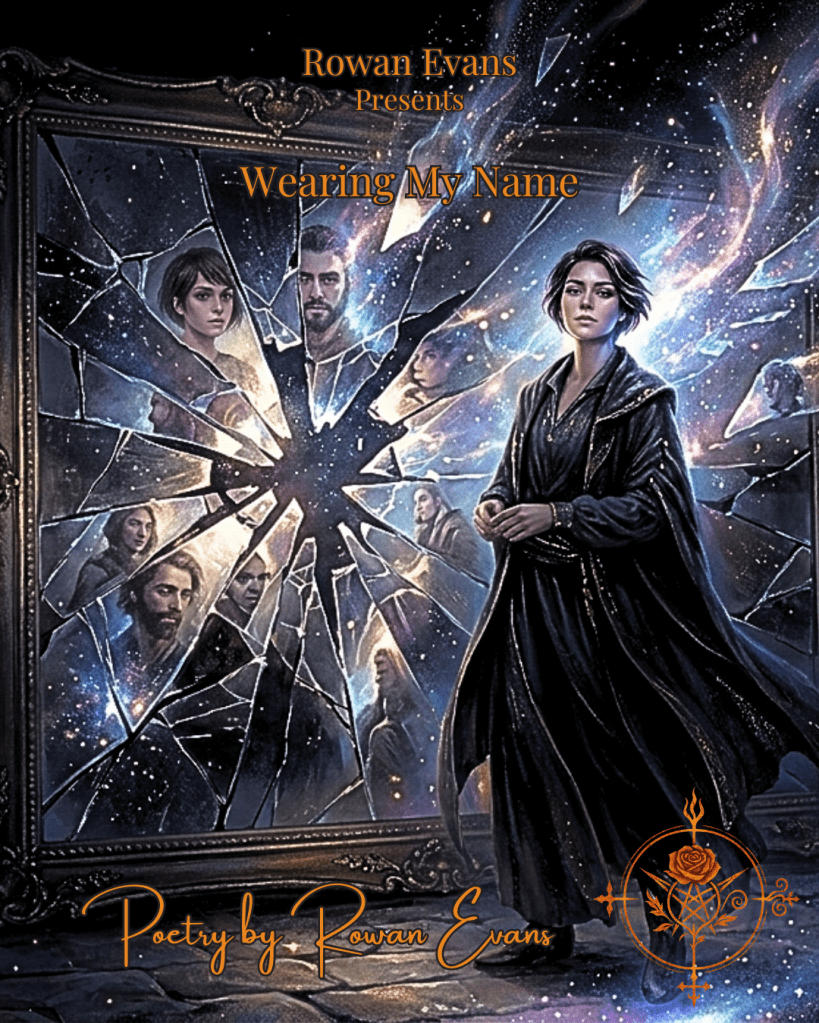
  • Author’s Note

    People often decide who you are before you have the chance to speak. They carve a version of you that makes them comfortable, then hold it up like a mirror and expect you to recognize your own face.

    This poem is about rejecting that reflection and reclaiming the right to define myself.

    Rowan Evans


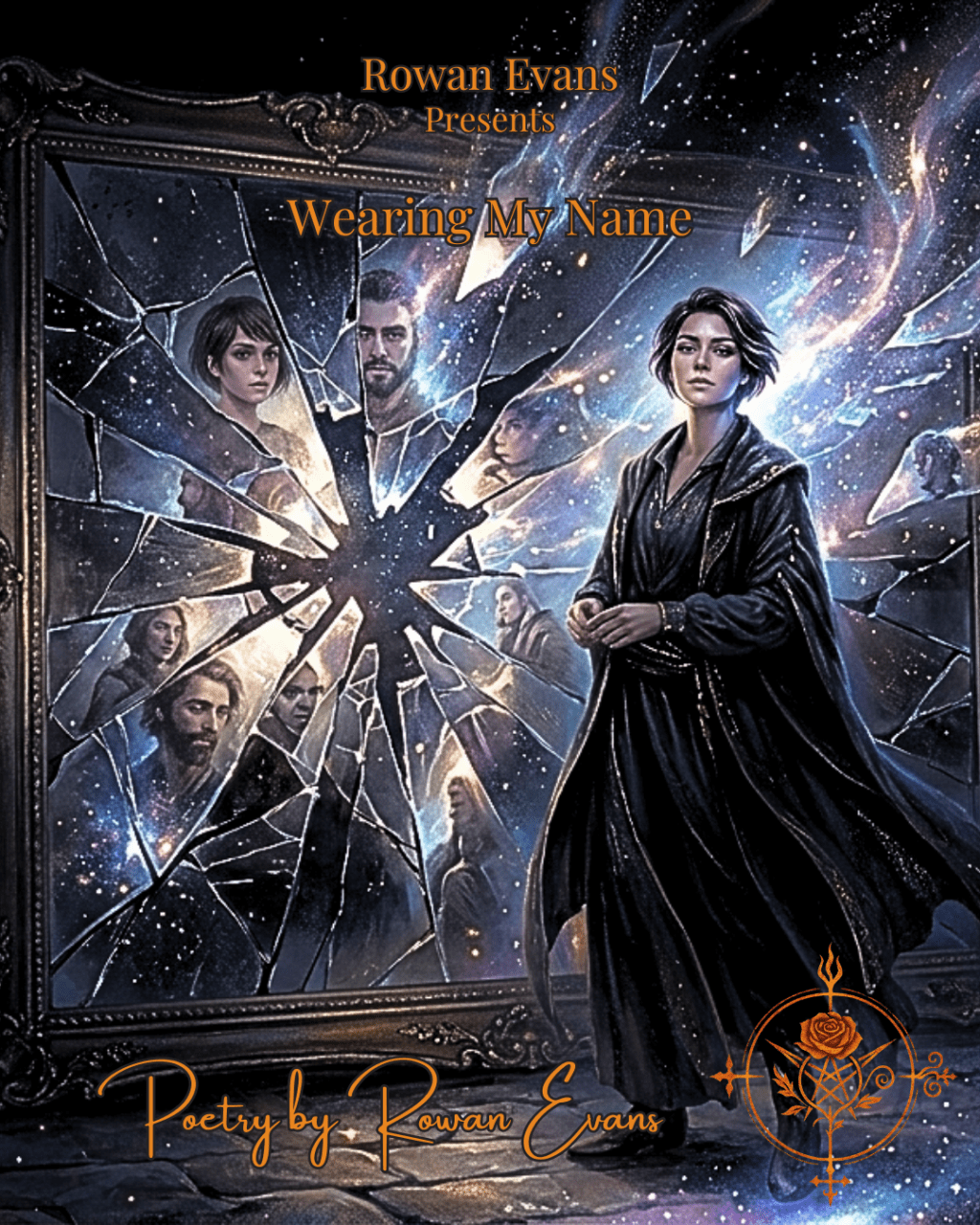
    Androgynous person standing before a cracked mirror with fragmented reflections symbolizing identity and self-definition.
    Sometimes the reflection others give you isn’t really yours. This poem is about reclaiming the right to define yourself.

    Wearing My Name
    Poetry by Rowan Evans

    They say I’m just like them,
    but I’m not like them—
    swear I’m nothing like them.
    They say I protest too much,
    a double-edged sword, I guess.
    Can’t stand up, can’t sit down—
    can’t speak up, can’t make a sound.

    They carve a version of me
    that fits their comfort,
    then hand it back
    like a mirror.
    But it’s not my face—
    just their fear
    wearing my name.

    They say I’m just like men,
    but I’m not like them.
    So I distance myself
    from who I used to be.
    Now I’ll tell you
    how I see myself,
    truthfully.

    I’m not the man they imagine,
    not the echo they expect.
    I’m the version I built
    after breaking the mold
    they tried to fit me in.

    I’m not a man,
    not a woman,
    something in between,
    King nor Queen—
    I’m still royalty.
    Master of emotion,
    deity of poetry.
    A precious soul
    trying to keep hold
    of my humanity.

    Adorable, yeah—I’m cute,
    and I know you know it too.
    It’s okay.
    You don’t have to say
    a thing.

    Of course you’re looking.
    Why wouldn’t you?


    If you’re interested in more poetry, you can find it here → [The Library of Ashes]