Sometimes it’s strawberries, questionable scientific reasoning, and the absolute confidence to say, “Deal with it.”
This piece is a little love poem for the people who show affection in their own weird, imperfect, slightly ridiculous way.
— Rowan Evans
When roses won’t do, bring strawberries. Romance is all about knowing what they like.
It Could Have Been… Poetry by Rowan Evans
I know you don’t like roses— so I brought you a bouquet of strawberries— they’re the same thing, scientifically— maybe not exactly, but they come from the same family—
it’s still romantic. Deal with it.
Oh, and hey— it could have been apples.
It could have been…
Peaches, Pears, Raspberries, Cherries…
heck…
a bag of almonds…
but I gave the one that still feels—
like romance.
Journey into the Hexverse
[Welcome to the Hexverse] Step into the Hexverse—a poetic world where mythmaking, humor, rage, creativity, and confession collide, and darkness becomes something that can be reshaped into art.
Some poems don’t need to be abandoned when we outgrow the person who originally wrote them.
Sometimes they need to be revisited.
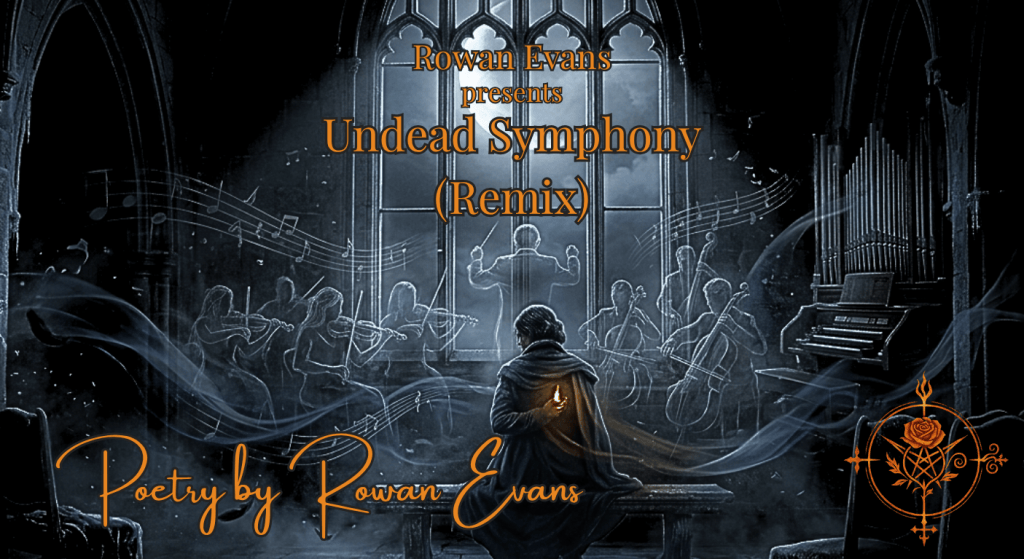
Undead Symphony (Remix) returns to a poem I originally wrote on June 13, 2024. The original was written from a place I understood intimately: feeling perpetually misplaced, overlooked, and emotionally exhausted while still carrying an enormous capacity for empathy underneath the numbness.
The title came from that contradiction.
An undead thing is neither fully alive nor truly dead. A symphony, meanwhile, is full of movement, emotion, tension, and sound. Put those ideas together and you get something that feels very close to the emotional state I was trying to describe: a person who can feel deeply while simultaneously becoming distant from the world around them.
That contradiction is still here in 2026.
What changed is the way I approach it.
The remix gives the poem more room to breathe. I broke apart lines that had previously been compressed together, allowing certain thoughts to linger rather than rushing past them. I also sharpened some of the imagery and cadence, particularly around the relationship between solitude, apathy, and empathy.
The original poem said what I was feeling.
The remix feels more like I understand why I was saying it.
And that distinction matters.
I have spent a lot of time in my writing exploring darkness—not because darkness is all I have, but because I have always been fascinated by the strange things that can survive inside it. Undead Symphony is one of those pieces.
Apathy and empathy shouldn’t fit together.
Yet somehow, they do.
One protects the heart by making the world feel distant.
The other keeps reaching toward it anyway.
That tension is the symphony.
The speaker may feel undead, but the music never actually stops.
— Rowan Evans
Somewhere between apathy and empathy, something inside me keeps making music.
Undead Symphony (Remix) Poetry by Rowan Evans [written on July 23, 2026]
It was always the wrong place,
wrong time—
I was always second best,
never first place—
Never the one to win the race,
I was always the one they laughed at,
never with—
always the one that
when they were gone—
never missed.
So I grew cold and distant
like far-off summer nights,
yearned for on cold winter mornings.
And sometimes—
it still feels hard to breathe,
like a shadow in the light,
fading beneath.
I never was one for faith,
I never believed,
no thoughts and no prayers—
because why should anybody care?
In a crowd I felt alone,
a silent voice,
an empty phone.
It’s apathy—
and I pair it with my empathy.
An odd dance of light and dark,
within me.
It’s beauty in the darkness,
an undead symphony.
But still—I dream of a place,
where I’m more than just a face.
A spark in the night,
a fleeting glimpse
of warmth in the cold,
and strength in the struggle.
I remember moments—
fleeting and rare,
of laughter shared,
of someone who cared.
Brief as they were,
they lit up my sky,
A reminder that even shadows can try.
Yet—
I return to the solitude I know,
where apathy is my only show.
But my empathy,
a hidden grace—
whispers of a longing for a different place.
It’s a contradiction,
a twisted art—
to feel so much,
with a guarded heart.
An undead symphony,
a haunting tune—
a dance of shadows beneath the moon.
Journey into the Hexverse…
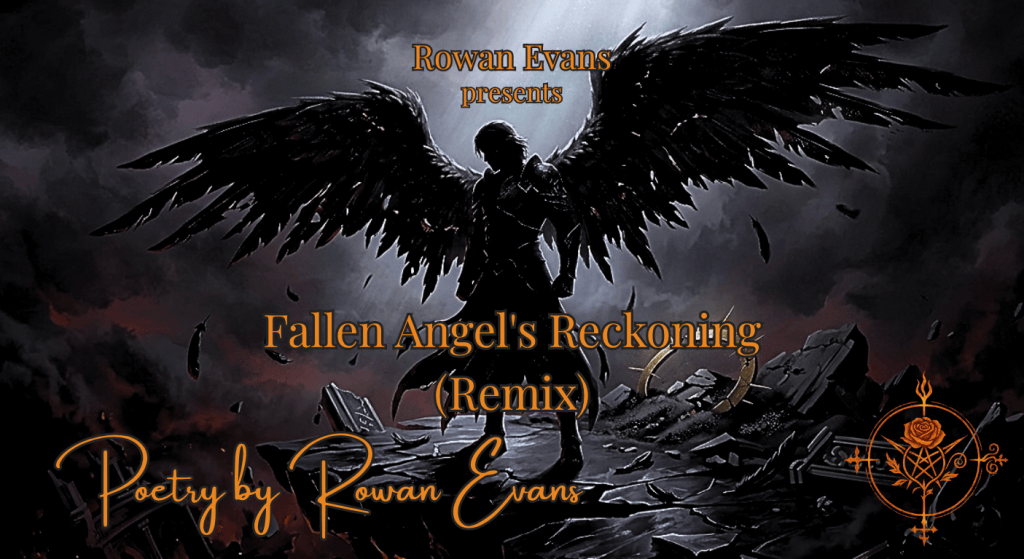
[Fallen Angel’s Reckoning (Remix)] Fallen Angel’s Reckoning (Remix) revisits a 2024 poem about heartbreak, broken promises, and falling from an imagined heaven, transforming its original ending into a darker meditation on resilience, self-reclamation, and learning to fly with broken wings.
Sometimes an old poem doesn’t need to be left in the past.
Sometimes you have to return to it after you’ve changed.
Fallen Angel’s Reckoning (Remix) revisits a poem I originally wrote on June 6, 2024. The original was already telling a story I understood well: love that promised forever, a fall from an imagined heaven, and the painful process of reclaiming yourself after the promise disappears.
But I was a different writer when I wrote it.
And, more importantly, I was a different person.
The 2026 version isn’t meant to erase the original. It is a conversation with it.
I kept the central imagery—the angel, Lucifer, the fall from heaven, the halo, the darkness, the broken vow—because those symbols still belong to the emotional architecture of the piece. But I wanted to push the mythology further this time. Icarus enters the story. The fall becomes more physical, more violent, more deliberate. The speaker isn’t simply descending from something that once felt like heaven; they are plummeting from it.
And then there is the ending.
In 2024, I wrote about newfound wings.
In 2026, I wrote about broken wings.
That change matters to me.
Because strength doesn’t always mean becoming untouched by what happened. Sometimes you keep the scars. Sometimes you keep the broken pieces. Sometimes you discover that you can still fly without first repairing everything that hurt you.
The angel doesn’t become an angel again.
They don’t return to the heaven they lost.
They don’t need the person who made them feel divine to give them their identity back.
They become something else.
A fallen angel who embraces the fallen.
The broken.
The free.
That is what this remix ultimately became: not a poem about getting back what was lost, but about discovering that losing it didn’t mean losing yourself.
I didn’t rewrite the 2024 version because it was wrong.
I rewrote it because I’ve had two more years to understand the fall.
And sometimes the person who wrote the first poem deserves to hear what the person you became has learned since then.
— Rowan Evans
I don’t need unbroken wings to fly. I just need to remember that they were mine before anyone promised me heaven.
Fallen Angel’s Reckoning (Remix) Poetry by Rowan Evans [written July 23th, 2026]
I remember when you said forever,
but forever never came,
so I fell like Lucifer,
from the heavens down I tumbled.
Returned your love,
played your game—
once an angel in your eyes,
now in darkness I crumbled.
Your promises were wings that lifted me high,
but they melted away, when I reached the sun—
just like Icarus, the light was my undoing.
It wasn’t just a fall, I was plummeting…
a fallen star,
cast from the sky,
now I walk in shadows,
where our love met its end.
Like Lucifer—I embraced the night,
wandering through realms of regret and pain,
I shed my halo,
lost my light,
no longer an angel,
in your eyes or in my name.
Yet in this darkness,
a new path unfurls—
I find strength in the ashes of our broken vow,
rising from the ruins of our shattered world.
I reclaim my soul,
I’m reborn here and now.
No longer bound by your empty decree—
I soar with broken wings,
embracing the fallen,
the broken, the free,
a fallen angel finding strength
I never knew I’d own.
Journey into the Hexverse…
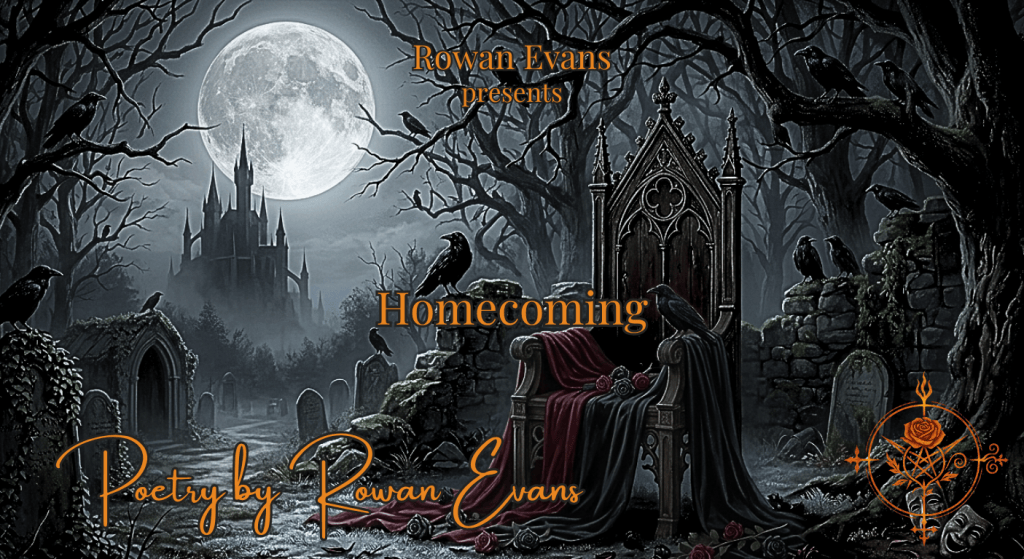
[Homecoming] Homecoming is a return to the Gothic aesthetic at the heart of Rowan Evans’s poetry, blending Poe, mythology, horror icons, moonlight, ravens, and darkness into a meditation on artistic identity and finding your way back to the voice that feels like home.
[The Monster in the Margins] Drawing inspiration from horror icons like Michael Myers, Ghostface, Freddy Krueger, and Pennywise, this poem explores the darker side of creativity—where inspiration becomes an unstoppable force lurking just beyond the edge of the page.
[The Monster in the Margins II] The Monster in the Margins II transforms Rowan Evans’s Seven Deadly Sins mythology into a horror story written between the lines, where Lust, Wrath, Sloth, Greed, Pride, Envy, and Gluttony become monsters growing from pain, grudges, and scars.
[The Unkindness Descends] “The Unkindness Descends” is a Gothic symbolic poem exploring collapse, transformation, and the unsettling experience of being witnessed during moments of unraveling. Through raven imagery, ambiguity, and ritualistic atmosphere, the poem invites multiple interpretations—spiritual, psychological, ominous, or transformative.
[Gospel in Crimson] When writing becomes ritual and love becomes devotion, the line between creation and worship begins to blur. Gospel in Crimson explores obsession, artistry, and the sacred act of expression.
There are certain aesthetics that feel less like something we choose and more like something we recognize.
For me, Gothic imagery has always been one of those things.
Homecoming came from the realization that something in my writing had started to feel slightly unfamiliar. I was still writing about the moon, the ocean, the tides, ravens, horror, darkness, and the strange spaces where beauty and pain overlap—but somehow, I had drifted away from the particular Gothic atmosphere that has always felt like home to me.
So this poem became a return.
Poe is here because his shadow has been part of my literary DNA for years. Nyx and Hades are here because mythology gives me another language for darkness. The ravens are here because, in my own symbolic architecture, they have become witnesses, messengers, and companions. And the horror references—Jason, Ghostface, Pennywise, Michael Myers—are there because horror has never been merely about monsters to me.
It is about what the monsters represent.
Grief. Fear. Obsession. Rage. The parts of ourselves that refuse to stay buried.
There is also something deliberately self-aware about this poem. I am not simply listing Gothic references because they sound dark. I am talking about my relationship with the imagery itself—the way the moon has accumulated meaning across my work, the way the tides connect to emotion, and the way ravens have gradually become part of my mythology.
The darkness isn’t an aesthetic costume.
It’s architecture.
And after spending some time writing away from it, I realized that I wasn’t trying to become something new.
I was finding my way back to something that had been mine all along.
That’s why this poem is called Homecoming.
Sometimes you don’t discover where you belong.
Sometimes you remember.
— Rowan Evans
Sometimes the darkness isn’t somewhere you wandered into. Sometimes it’s the place where your voice has always felt most at home.
Homecoming Poetry by Rowan Evans
I’ve been writing like
I forgot which domain is mine,
I’m of the darkness—
just borrowed the light,
and made Poe’s throne my birthright.
I’m a gothic romantic,
I bleed for the art—
I’ve kissed the lips of Nyx
and wandered through
the realm of Hades.
I’m a poltergeist in life,
but at night I come alive—
witching hour is when I thrive.
I pray to the moon
and curse the sun—
I ascend to the throne
that Poe had spun.
I watch the ravens—
carrying messages where they fly,
eyes locked, tracking the treachery across the sky.
They are always watching—
silent witnesses to the rot inside.
It started to feel like something
in my pieces was missing—
like where was the gothic lace,
silk and satin sin, velvet and venom.
There was too much light—
even when ninety percent
of my imagery is night adjacent,
weaving in horror rhymes—
Friday the 13th, Night of Jason.
The moon in my rhymes has meaning,
when I write lines like the tides—I mean it,
even in my Ghostface cadence—
what’s your favorite scary movie?
Pennywise of the mind, sewer of thought—
I’m a monster like Michael,
when I chase—I don’t run, I walk.
Journey into the Hexverse…
[The Monster in the Margins] Drawing inspiration from horror icons like Michael Myers, Ghostface, Freddy Krueger, and Pennywise, this poem explores the darker side of creativity—where inspiration becomes an unstoppable force lurking just beyond the edge of the page.
[The Monster in the Margins II] The Monster in the Margins II transforms Rowan Evans’s Seven Deadly Sins mythology into a horror story written between the lines, where Lust, Wrath, Sloth, Greed, Pride, Envy, and Gluttony become monsters growing from pain, grudges, and scars.
[The Unkindness Descends] “The Unkindness Descends” is a Gothic symbolic poem exploring collapse, transformation, and the unsettling experience of being witnessed during moments of unraveling. Through raven imagery, ambiguity, and ritualistic atmosphere, the poem invites multiple interpretations—spiritual, psychological, ominous, or transformative.
[Gospel in Crimson] When writing becomes ritual and love becomes devotion, the line between creation and worship begins to blur. Gospel in Crimson explores obsession, artistry, and the sacred act of expression.
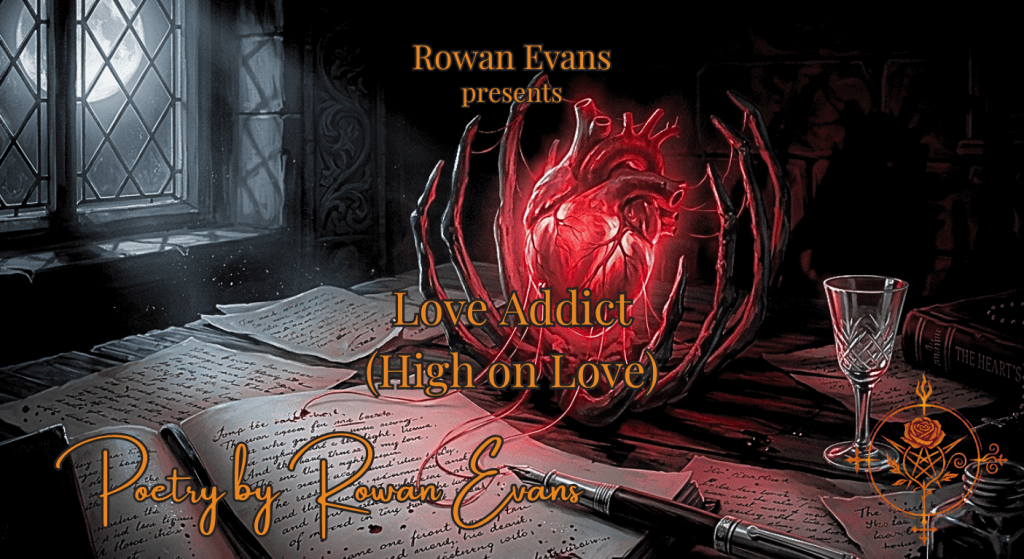
Love Addict (High on Love) is me taking one of my recurring themes—how intensely I experience love—and pushing the metaphor until it becomes impossible to ignore.
I’ve often written about love as something intoxicating. A rush. A chemical reaction. Something that can make the world feel brighter and the mind move faster. But this poem asks what happens when that metaphor is taken literally enough to become uncomfortable.
Because sometimes I don’t simply want love.
I crave it.
There is a difference.
The language of addiction works here because love can create its own strange cycle: anticipation, euphoria, uncertainty, withdrawal, craving, and the desperate desire for another hit of the feeling that made everything seem worthwhile.
And, naturally, my response to that craving is to write.
That’s one of the things I find fascinating about my relationship with poetry. I don’t merely write about what I’m feeling—I often metabolize the feeling through language. I take the emotion, push it through rhythm and metaphor, turn it over until I can see its shape, and then put it on the page.
So the final joke is also the truth.
I get high on love.
Then I get high on writing about getting high on love.
And apparently, the cycle continues.
Maybe that’s the real habit.
— Rowan Evans
Some people chase love. I apparently write it until the high wears off—and then write another poem.
Love Addict (High on Love) Poetry by Rowan Evans
I get high on love
like it’s a drug
and I’m an addict
with a habit,
fighting for every hit
that I can get—
if I could,
I would OD on it.
Inject it straight
to my chest,
in-between the ribs—
where the heart lives.
I’d take the risk,
the comedown, the crash,
just to feel one moment
where love doesn’t pass.
I get the shakes and quake,
knot in the stomach—cold sweats,
when love doesn’t sit in the chest—
it feels fake, not worth the weight.
Wait—
what was I saying?
I get high on love
like it’s a drug
and I’m an addict,
so I write lines
that expand the mind,
to feed the habit.
Journey into the Hexverse…
[Poet’s Curse] Poet’s Curse explores the painful side of falling too deeply: giving pieces of yourself away freely, taking accountability for your own heartbreak, and realizing that learning to let go can be harder than learning to love.
[When I Fall] When I Fall is a vulnerable poem about loving without reservation, feeling everything deeply, and refusing to make the heart smaller just because wholehearted love can sometimes lead to loneliness and pain.
There is a particular kind of heartbreak that doesn’t have a villain.
Sometimes nobody betrayed you.
Nobody lied.
Nobody promised you something they couldn’t give.
Sometimes someone simply exists, speaks to you, makes you feel something—and your heart decides to build an entire mythology around it.
That is where Poet’s Curse came from.
I’ve joked before about having a poet’s curse: the tendency to fall into feelings quickly, to hear a little beauty in someone’s voice and suddenly find myself wading into the waves after it. But beneath the joke is something I’ve had to become more honest about.
Sometimes my heartbreak is partly mine.
Not because I was wrong to feel what I felt, but because I have a habit of giving pieces of myself away before I’ve figured out whether there is somewhere safe for them to land.
The person in this poem didn’t necessarily do anything wrong. She didn’t promise me forever. She didn’t lead me somewhere just to abandon me. She talked—and I listened. I heard a siren’s song, and I chose to wade into the water.
So this isn’t a poem about blaming her.
It’s about looking at myself afterward and admitting something uncomfortable:
I learned how to hold on long before I learned how to let go.
And maybe that’s the real curse.
Not that I love too deeply.
Not that I feel too much.
But that once I give someone a piece of my heart, I don’t always know how to take my hands away from the fire.
Sometimes the only way forward is to stop calling that weakness a curse and start learning the skill I never had—
how to let go without becoming less capable of love.
— Rowan Evans
Sometimes the hardest thing to learn isn’t how to love—it’s how to let go of what you’ve already given away.
Poet’s Curse Poetry by Rowan Evans
Here we go again
it’s another season of sin,
the poet’s back
heartbroken with a pen.
Yeah, went and fuckin’
did it again—
it’s my fault
my heart is cracked,
with pieces missing.
You see, I give them away
too freely, it’s such a pain
to be me, I get hooked
too easily—
she did nothing wrong,
she didn’t lead me on, just talked
and I heard a siren’s song—
I waded into the waves,
prayed for things to change.
Pardon the moment of slowness,
give me a moment while I own this
and take accountability for my part
in breaking my heart.
It’s a poet’s curse—
I only learned how to hold on.
I never learned how to let go,
my feelings and emotion
like hot coals in my hands.
Journey into the Hexverse…
[When I Fall] When I Fall is a vulnerable poem about loving without reservation, feeling everything deeply, and refusing to make the heart smaller just because wholehearted love can sometimes lead to loneliness and pain.
When I Fall is about the way I experience love when I stop trying to make it smaller.
I have never been particularly good at feeling things halfway. When something reaches my heart, it tends to go deeper than the surface—into the marrow, into the places where emotion becomes difficult to separate from identity. That intensity can be beautiful, but it can also hurt when the love I give doesn’t find its way back to me.
The easy response would be to close myself off.
To dim the light.
To protect myself by pretending I don’t feel as deeply as I do.
But I don’t want to do that.
There is something important about refusing to treat your capacity for love as a flaw simply because someone else couldn’t—or wouldn’t—meet you there. Sometimes loving wholeheartedly means accepting that you may get hurt. Sometimes being honest about what you feel means sitting with the loneliness afterward.
That doesn’t mean the answer is to become colder.
I would rather keep my heart open.
I would rather love the way I love—whole, honest, and unhidden—than spend my life making myself smaller just to avoid the possibility of pain.
Maybe falling hard isn’t the problem.
Maybe the real courage is choosing to keep getting back up without becoming afraid of the fall.
— Rowan Evans
I would rather love wholeheartedly than make my heart smaller just to make the fall hurt less.
When I Fall Poetry by Rowan
When I fall, I fall hard.
I feel it all or nothing—
when it comes to matters of the heart.
There is no middle ground,
no in-between—
it’s all or nothing for me.
I send out love,
and no one returns with it.
so I sit alone—
it’s the same as always,
I’m used to it.
I wear my heart on my sleeve,
exposed to the elements.
That means I feel things deeply,
nothing is surface level—
everything is marrow deep.
So I pour myself in crimson ink
across a porcelain page—
the only place
that I can put this pain.
Still, I don’t close myself.
I don’t dim the light.
I don’t pretend my heart is smaller
than it is.
I love the way I love—
whole, honest, unhidden—
even if it leaves me alone sometimes.
Journey into the Hexverse…
[Where the Metaphors Lead] Some truths are easier to write than they are to say aloud. “Where the Metaphors Lead” explores the quiet space between dreams, confession, and the courage it takes to let another person know how deeply they’ve become woven into your inner world.
[Beach to Beach (How I Get There)] A dream becomes a journey between familiar shores and unfamiliar cities in Beach to Beach (How I Get There), a poem about imagined travel, ocean crossings, longing, and the places we hope to someday reach while awake.
[The World Shifted Around Us] The world transformed around us—beach, city streets, jungle—but we never moved. Sometimes love isn’t found in words, but in the quiet certainty of someone remaining clear while everything else fades.
[I’d Rather Try] Anyone can promise they’d die for someone. But love isn’t built on one dramatic moment—it’s built on showing up, trying again tomorrow, and proving your words through consistent action.
Sometimes it just needs to say, “Please fucking listen.”
No Stupid Questions came from that particular kind of frustration—the kind that happens when someone asks something that has already been answered, interrupts the flow of a conversation, or throws a question into the room without stopping to consider whether the information they want is already sitting right in front of them.
The old saying goes, “There are no stupid questions.”
I don’t completely agree.
Questions aren’t inherently stupid. Curiosity is valuable, and asking for clarification is often exactly what we should do. But there is a difference between genuinely wanting to understand something and simply asking whatever crosses your mind without listening to what was already said.
This poem is intentionally blunt because the frustration is blunt.
It’s conversational, a little sarcastic, and unapologetically irritated. There are times when I want my poetry to dress an idea in metaphor and symbolism. Other times, I just want to point at the problem and say exactly what I mean.
No metaphor.
No elaborate mythology.
No moon, tide, raven, or rose to hide behind.
Just:
You already got your answer.
Listen.
— Rowan Evans
P.S. – The end of this piece is entirely a joke.
No Stupid Questions Poetry by Rowan Evans
You know—
the person that said,
“there’s no such thing
as a stupid question,”—
probably asked a lot
of stupid questions,
just like you—
Not trying to be rude
or give attitude—
but dude,
you asked that question
out of the blue.
(And it was dumb,
it was a stupid question…
I had to break the flow to tell you,
you asked a stupid question.)
I already told you—
I already answered back,
if you need the information
then listen—I already gave you that.
Do you even think
before you speak,
or do you just
let your thoughts fly?
You don’t have to ask
every question
that comes to mind.
I don’t care
if you are a child.
Journey into the Hexverse…
[You Are Perfect] A gentle reminder that your worth isn’t determined by your flaws or by the opinions of others. You Are Perfect is a poem about resilience, self-acceptance, and standing tall even when the world tries to make you feel small.
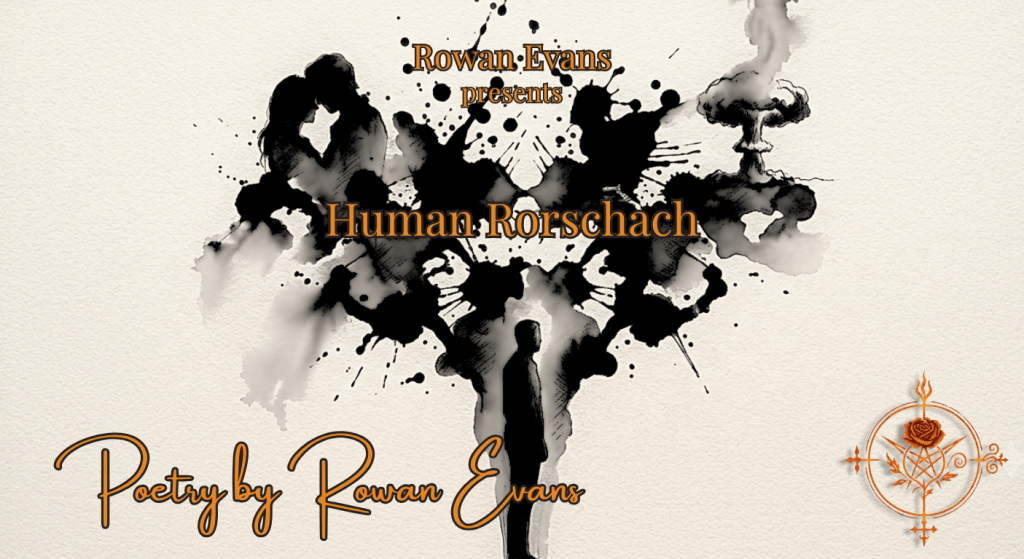
[Human Rorschach] Sometimes we’re less a fixed person than an inkblot—our meaning changing with every set of eyes that looks at us. Human Rorschach explores perception, identity, and the ways our own experiences shape what we believe we see in others.
[A Rose in the Ashes] Lost within a forest where every leaf becomes a memory, the speaker follows darkness instead of fleeing from it, discovering that healing isn’t found at the end of the tunnel—but in facing the past long enough to notice a single rose blooming through the ashes.
I’ve always been fascinated by the idea that people rarely see the same person the same way. We don’t meet others as blank slates—we meet them carrying our own history, fears, hopes, and assumptions.
The Rorschach inkblot became the perfect metaphor for that. The inkblot itself isn’t trying to be anything; the meaning comes from the person looking at it.
Maybe people work the same way.
Every interaction is filtered through perspective, and perspective is shaped by perception, memory, and experience. Sometimes what another person believes about us reveals far more about their own journey than it does about who we actually are.
This poem is an invitation to think about that relationship between identity and interpretation—and to remember that no one is ever seen exactly as they are.
— Rowan Evans
What we see often reveals more about ourselves than the person we’re looking at.
Human Rorschach Poetry by Rowan Evans
I’m an inkblot
in human form,
a real Rorschach—
am I couple kissing,
or a mushroom cloud?
Love or destruction—
what do you see
when you look at me?
Know there are
no wrong answers—
because what you believe
is fed by what you see
and what you see is perspective,
but perspective is shaped by perception—
I am open to interpretation
and it changes,
with everything
you’ve lived through—
the things you’ve survived.
What you see
when you look at me,
says more about your life—
than it does mine.
Journey into the Hexverse…
[A Rose in the Ashes] Lost within a forest where every leaf becomes a memory, the speaker follows darkness instead of fleeing from it, discovering that healing isn’t found at the end of the tunnel—but in facing the past long enough to notice a single rose blooming through the ashes.
[Leave No Self Behind] What if finding yourself isn’t about discovering someone new, but learning to walk beside every version you’ve ever been? “Leave No Self Behind” is a meditation on memory, healing, and embracing the selves we once abandoned.
[Every Night, The Same Flight] Every night begins with the same flight. Between wakefulness and sleep, an airport appears, a familiar shoreline waits beyond the journey, and the same dream asks whether some destinations find us before we’re ready to find them.
[Through My View] No two people experience the world the same way. Through My View is a reflective free verse poem exploring perspective, imagination, and the impossibility of fully seeing through another person’s eyes.
[Just Human] Just Human is a reflective free verse poem about seeing people before borders, choosing empathy over division, and finding home in our shared humanity rather than on a map.
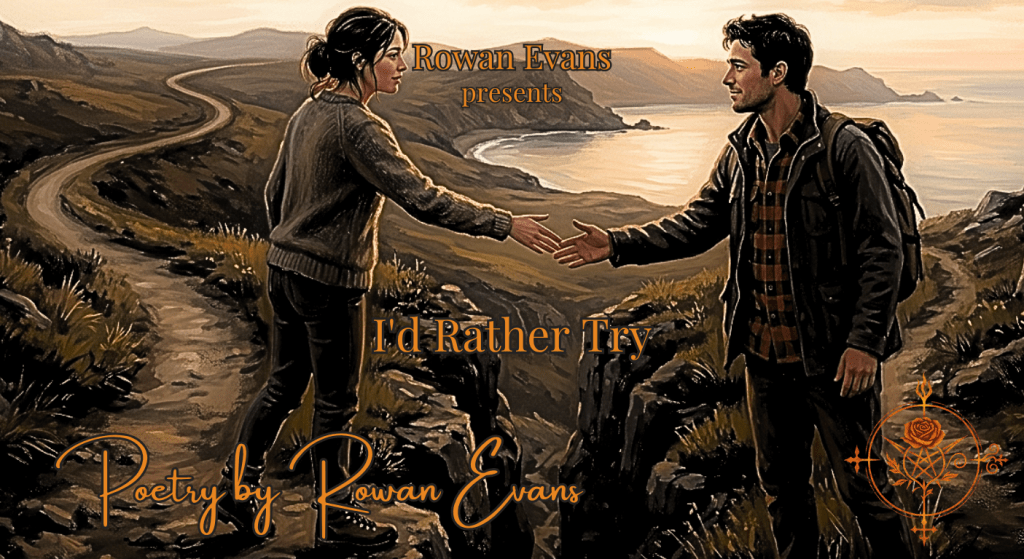
Some promises sound beautiful because they are dramatic.
“I’d die for you.”
It’s a phrase we’ve heard in songs, films, books, and poetry for centuries. It carries an undeniable emotional weight.
But while writing this poem, I found myself asking a different question.
What happens after the dramatic declaration?
Because most relationships aren’t built on one extraordinary moment.
They’re built on ordinary ones.
Showing up.
Listening.
Being consistent.
Choosing someone again tomorrow after choosing them today.
Dying for someone is an idea that exists in a single moment.
Living for someone is a practice that unfolds across thousands of moments.
That’s what this poem is really about.
Not grand gestures, but quiet commitment.
Not sacrifice for a day…
but presence for a lifetime.
— Rowan Evans
“Love isn’t measured by one extraordinary promise—it is measured by the ordinary moments when we choose to stay, to try, and to be there.”
I’d Rather Try Poetry by Rowan Evans
Oh, they said they’d die for you—
and give all of their life too.
But would they be there for you
and truly care too?
Anyone can say they’d die—
but would they have the spine,
when it comes time
to put it on the line?
What would I do?
Well—
I would try for you
and live all of my life too.
I would be there for you,
and truly care too.
Yeah, I know—
anyone can say they’d try,
but consistency is where
promises live or die.
And I’ve tried to prove
myself consistently.
To show that I mean
what I say—
in more than just words,
because it’s about the actions too.
Journey into the Hexverse…
[Pointing Me Home] The final poem in the No Metaphor Left Behind trilogy explores dreams, hope, and belonging. Through moonlight, ocean tides, and quiet conversation, Pointing Me Home reflects on carrying hope long before reaching the place you call home.
[Only Waiting] The second poem in the No Metaphor Left Behind series, exploring the quiet ache of growing up in a place that never truly felt like home—and finally saying aloud what years of metaphor had been trying to express.
[Crossing the Sea] A deeply personal poem about relocation, longing, and the realization that some truths naturally arrive through metaphor—even when we try to leave it behind.
[Recognizes Home] A free-verse poem exploring the difference between love as dependency and love as choice. It challenges the idea that love must be need-based, instead centering the quiet strength of choosing someone while still remaining whole on your own.
[Not Rebuilding You] A poem about love as an act of presence rather than rescue. Through construction imagery, Not Rebuilding You explores trust, devotion, emotional safety, and the quiet work of building a foundation strong enough for healing to grow.