Some poems arrive carrying trauma, existential questions, complicated metaphors, and enough symbolism to fill a cathedral.
This one showed up carrying a fucking pun.
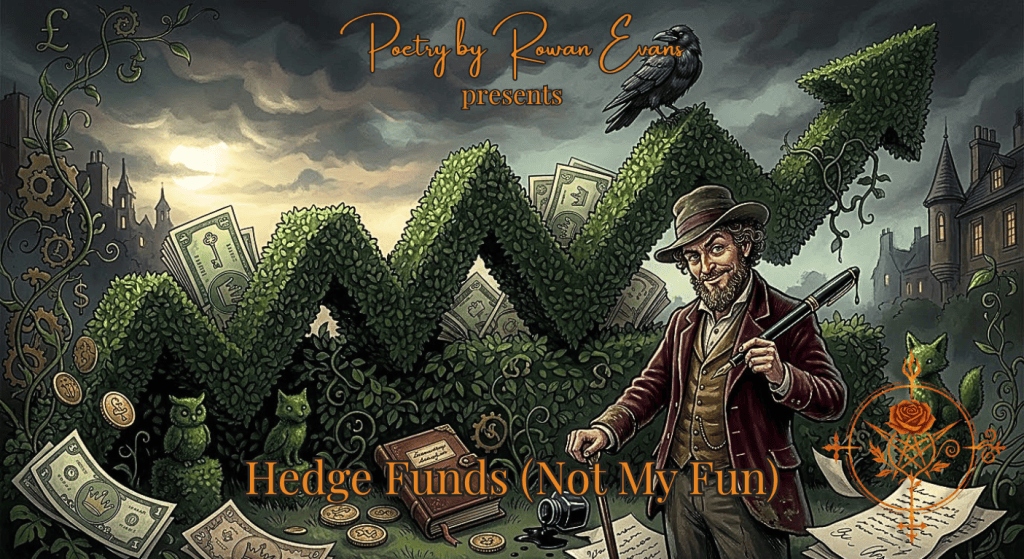
Hedge Funds (Not My Fun) is deliberately stupid. I wanted to play with sound, names, word associations, and the increasingly questionable logic of a joke that refuses to die. Sometimes the page doesn’t need another emotional excavation—it just needs to have a little fun.
So yes, this is a poem about hedge funds.
No, I don’t actually have any.
And apparently, neither does my fun.
— Rowan Evans
The hedge has funds. The funds aren’t mine. Therefore, the fun remains tragically unfunded.
Hedge Funds (Not My Fun) Poetry by Rowan Evans
I think I’m so fucking funny—
I’ll make a Big Pun,
while lookin’ like a Pimp
C—but you can’t see me,
like my name is John
and my time is now—
or at least, I hope it is.
Because I’m trying to get my funds up,
yeah, I want to get my fun up—
so I stack my funds
as high as my hedges—
get it?
Hedge Fund.
That means the money isn’t mine—
so I’m stacking some funds high,
they’re just not my funds, and—
because they’re not my funds,
they do not fund my fun, man.
Sometimes the loudest hater in the room is the one you brought with you.
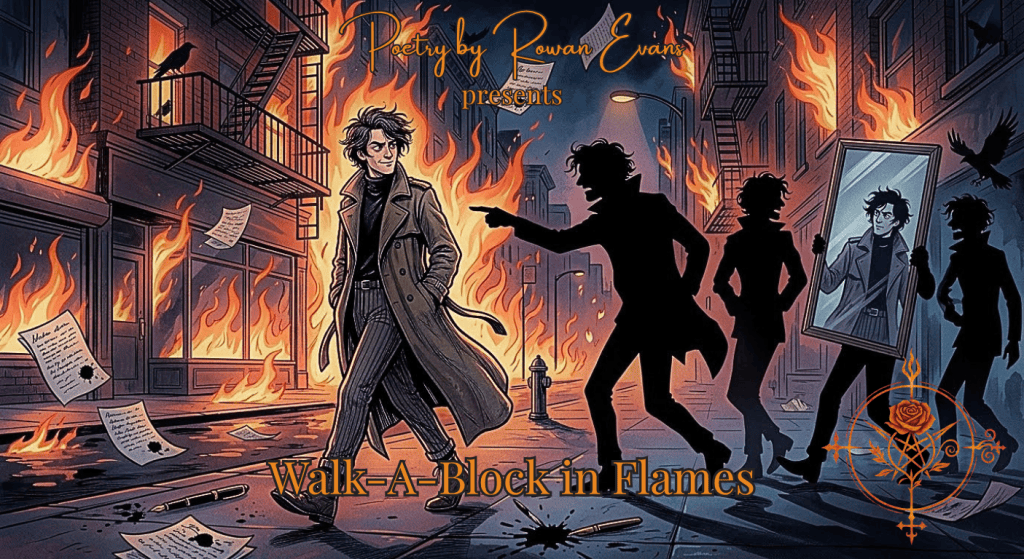
Walk-A-Block in Flames started with the idea of imaginary critics—the voices that somehow manage to find fault with everything you do, even when nobody else is actually saying a damn thing. Naturally, my brain decided the appropriate response was to turn that internal conflict into a ridiculous walk around the block, throw in some wordplay, and see how many times I could make the joke work before the poem eventually turned the joke back on me.
Because beneath all the flames, bravado, and fake enemies, there’s a much simpler realization:
Sometimes the person I’m arguing with is me.
And honestly?
That’s probably the funniest part.
— Rowan Evans
Plot twist: the haters were imaginary, and unfortunately, they had my voice.
Walk-A-Block in Flames Poetry by Rowan Evans
They tell me,
these imaginary haters,
that I’ve fuckin’ created—
they live inside my head,
feeding on my self-doubt—
obsessed with burning the self-down.
They make me take a walk,
a walk around a block
and it’s fucking hot—
I guess you could say,
these imaginary haters made me,
Waka Flocka Flame.
Wait—
I meant to say—
these haters made me
Walk-A-Block In Flames.
Honestly though,
I don’t know
what the fuck
they hate me for—
Is it because my wrist froze?
Nope, I’m broke—
Because I’m the best to ever do it?
Nope, that’s a joke—
Is it because they say
the things I think about me?
Couldn’t be—
because I think I’m great,
and these haters are fake.
I mean literally fake,
figments—
they don’t exist,
it’s just me in this bitch.
Sometimes “I don’t give a fuck” isn’t really apathy. Sometimes it’s exhaustion, overextension, or finally realizing that not everything deserves a piece of you.
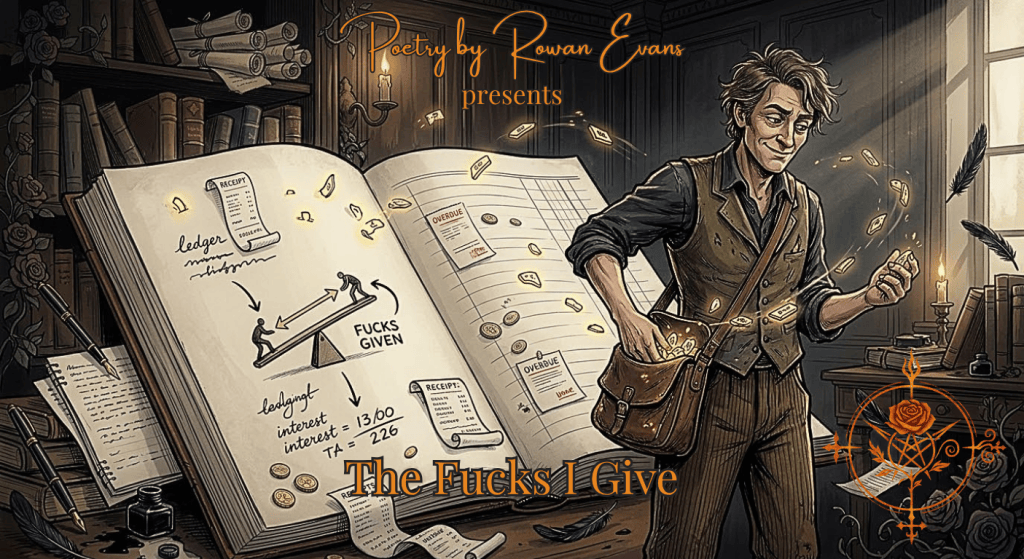
The Fucks I Give takes that idea and turns it into a ridiculous little accounting problem. If I’ve been handing out fucks like they’re an unlimited resource, eventually I’m going to have to audit the books, collect the outstanding balance, and start charging interest.
Underneath the jokes and profanity is something I’m actually pretty serious about: learning to be selective with what gets my attention, my energy, my emotions, and my time.
Because giving a fuck can be an act of love.
So can taking your fucks back.
— Rowan Evans
Apparently, my fucks weren’t free. I’m just finally collecting the outstanding balance.
The Fucks I Give Poetry by Rowan Evans
They said I’m too apathetic,
actin’ like nothing matters,
and it’s pathetic—
they want me to give a fuck,
but shit, I misplaced my bag of fucks—
so I’ve got no fucks to give.
Yeah, I’ll go through
and take all my fucks back—
I’ll walk right up and knock, like—
I’m here to collect my fucks,
and extra fucks too—
it’s a fucking tax,
and there is interest, dude.
You think fucks are endless.
No, I’ve got to be pickier—
because for a minute there,
it was—
fuck everything
and that’s probably
what they’re angry for.
It was fuck this and fuck that—
I was running out of fucks fast.
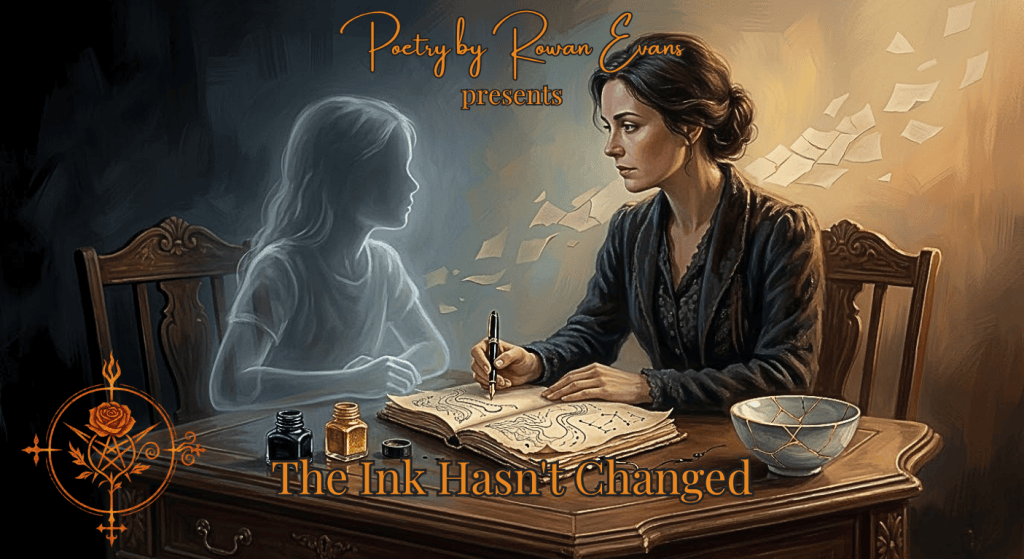
I sometimes look back at the person I was when I first started writing and wonder how much of that younger version of me is still sitting somewhere inside every poem I create. I started writing at thirteen, the same year I experienced my first heartbreak. Back then, ink wasn’t simply a creative outlet. It was a way to hold myself together, to give shape to feelings I didn’t know how to carry, and to leave a record of myself on the page when I was afraid of losing pieces of who I was.
The Ink Hasn’t Changed is about revisiting those beginnings without confusing familiarity with stagnation. The same emotions still find their way into my work: joy, grief, anger, tenderness, laughter, and pain. I’ve continued mapping my soul through poetry, stitching together broken pieces and filling the cracks with whatever gold I could find. The tools and materials may feel familiar, but the person doing the stitching is not the same.
There’s a difference between carrying the same weight and never moving forward. Sometimes, growth means discovering that the thing that once kept you alive can become something you choose to nurture, refine, and share.
My ink hasn’t changed because its purpose never needed to. I have changed. I’ve survived. And the words that once helped me hold myself together now help me understand who I’ve become.
— Rowan Evans
The ink that helped me survive at thirteen still carries my truth at thirty-six. The ink hasn’t changed. I have.
The Ink Hasn’t Changed Poetry by Rowan Evans
I’ve been stuck in the past a lot lately,
just thinking about who I was—
who I was trying to become
and how those early days
set the stage for who I became,
on and off the page.
The same year
I committed myself to ink,
I tasted my first heartbreak—
it was bitter sweet,
hated that it had to come,
but nothing could be done.
That was 2003, I was thirteen—
and she was made to leave.
I took the shattered pieces,
collected in a basket—
I took threads of silver
and sewed myself
back together again.
Cracks patched with gold and ink,
confessions penned in golden ink—
back then
I wrote for me—
I wrote to keep it together,
mentally—
afraid I’d disappear
if I didn’t map my soul in ink.
Turned poetry to cartography,
started mapping the whole of me.
I mapped my soul, wholly—
turned my pain holy.
I tried to translate all of me—
the joy, the pain,
laughter and grief—
and my ink hasn’t changed.
It’s still carrying the same things.
All the same weight, wait—
does that mean I’m stuck in place?
No, just because the ink
has stayed the same—
doesn’t mean I have—I’ve changed,
I’m not the same as I was at thirteen,
now that I’m thirty-six—
and I’m not the same as I was at sixteen,
that’s when I thought my ink was real mean—
but really it was too nice,
the only thing keeping me alive.
This piece came from noticing something I’ve always lived with rather than consciously examined.
My mind does not move in straight lines.
It wanders, it loops, it returns with things I didn’t ask for, and it sometimes disappears long enough that I start to notice the absence more than the presence. I used to frame that as inconsistency or distraction, but over time I’ve come to understand it less as a flaw and more as a kind of behavior—unpredictable, but not unkind.
The metaphor of a dog off leash wasn’t planned. It just appeared, which feels accurate to how most of my writing actually happens. I don’t usually “decide” on metaphors so much as I notice what my thoughts are already doing and try to follow them closely enough to write it down before they change direction.
What I like about this piece is that it doesn’t try to correct the mind.
It doesn’t punish it for wandering, or romanticize it into something effortless and poetic. It just observes it as something alive—sometimes useful, sometimes disruptive, always moving.
There’s a strange honesty in accepting that not every thought arrives politely, and not every idea shows up when invited. Some of them run ahead. Some of them dig things up that were better left buried. Some of them come back with exactly what I needed without me knowing I needed it.
And I think part of growing up, creatively and otherwise, is learning not just how to control that process—but how to live alongside it without turning it into an enemy.
So this piece is, in a way, an act of recognition.
Not mastery.
Just recognition.
— Rowan Evans
“Some thoughts were never meant to stay leashed.”
Off Leash Thought Poetry by Rowan Evans
I like to let my mind wander sometimes— like a dog off leash. It chases thoughts like cars, and makes a mess wherever it goes.
Sometimes it comes back with ideas like sticks. Sometimes it’s problems I can’t dismiss.
It returns to me panting, proud of whatever it found. I always forgive it. It’s only doing what it knows.
Last week it ran off and didn’t come back for hours. Sometimes it digs holes in places I didn’t want to revisit.
But—
Most days it behaves. Some days it bites. Some days I wish I could leash it. Most days I’m glad I can’t.
Sometimes it likes to play fetch, I throw away an idea— it brings it right back, like I have to write that.
Journey into the Hexverse…
[Monster Theology] What if the monsters under the bed weren’t monsters at all? Monster Theology explores difference, belonging, and the human tendency to fear what we don’t understand through a conversation with the creatures we’ve spent our lives imagining.
[Danny Phantom Theology] What begins as a metaphor borrowed from a childhood cartoon becomes something deeper: a reflection on existing between survival and possibility, exhaustion and hope, the life we have and the life we long for. Danny Phantom Theology explores what it means to keep moving toward a future that feels worth living.
[Lone Wolf Theology] A philosophical pop-culture poem exploring freedom, identity, and self-authorship through the lens of superheroes, antiheroes, mythic archetypes, and personal rebellion. A declaration of autonomy in a world determined to write your story for you.
[I Write Cathedrals] “I Write Cathedrals” explores faith, doubt, belonging, and the search for meaning beyond certainty. Through Gothic spiritual imagery and confessional reflection, the poem examines how writing can become a sacred space for questioning, wonder, and the people who feel displaced by traditional structures of belief.
[The Needle Doesn’t Point North] “The Needle Doesn’t Point North” is a deeply personal free verse poem about displacement, identity, and spending a lifetime feeling emotionally disconnected from the place you were born while being drawn toward distant shores.
This piece started as me messing around while listening to Ez Mil.
At first, I was just playing with rhyme patterns and cadence—thinking about internal rhyme, implied rhyme, layered phrasing, all the little mechanics that make writing feel musical.
But somewhere in the middle, it shifted.
Because the more I write, the more I realize my poetry isn’t just expression anymore. It’s architecture.
Over time, they stopped feeling like random aesthetics and started feeling like a language of their own.
And beneath all the gothic imagery and dramatic metaphors, there’s something surprisingly simple holding it together:
care.
Not grand gestures. Not fantasy.
Just wanting to make someone’s day softer in small ways.
This piece became about both sides of that: the mythic voice, and the human one underneath it.
— Rowan Evans
Beneath every cathedral of metaphor, there is still a human hand reaching gently toward someone else.
Altars and Roses Poetry by Rowan Evans
What I do
with a pen is sick—
the way I
weave rhymes
inside lines,
with implied rhymes,
inside rhymes.
And don’t get me started
on the imagery—
I took Poe’s ravens
and made them
a centerpiece.
I’ve built—
cathedrals in my rhymes,
altars to devotion,
worship in reverence.
I’ve sculpted
roses from the ruin—
I’ve painted pictures
with words—
a real gothic Bob Ross.
I’ve talked to my grave
in mausoleums—
with ravens as my witness.
I’ve sat with my silence
and I’ve spoken with ghosts
not my own.
I carry the weight
of everyone I’ve witnessed.
And to the certain someone
that occupies my mind—
you still hold a special place.
Even when my mind
closes me off—
it’s you
that keeps me holding on.
I’d open the fan for you—
if you asked me to—
because I want to do the little things
that’ll make you smile.
No questions asked.
No sweat off my back—
I’d do it.
Journey into the Hexverse…
[Finish What You Started] A dark introspective poem about confronting the past, carrying old versions of yourself, and realizing that the only way forward is through the fire.
[The Shadow and the Spark] A psychologically charged free verse poem using Mortal Kombat imagery to explore anxiety, depression, identity, and the realization that survival matters more than victory.
[Out of Sync] A reflective free verse poem about emotional displacement, shifting sleep cycles, and feeling spiritually drawn toward another side of the world.
For a long time, I treated parts of myself like enemies.
The anger. The depression. The anxiety. The numbness. The intensity.
I thought healing meant defeating those parts—silencing them, overpowering them, forcing them out of existence.
But that mindset turns your own mind into a battleground.
This piece uses the language and imagery of Mortal Kombat because fighting games have always fascinated me symbolically. Every character feels like an exaggerated emotional state: rage, grief, control, fear, vengeance, power, identity.
And sometimes living with mental illness feels exactly like that: constant internal matches, different versions of yourself stepping into the arena one after another.
But the ending became something unexpected while I was writing it.
Because eventually I realized: the goal isn’t to destroy the shadow.
The shadow is still part of me.
This piece stopped being about conflict halfway through writing it.
It became about coexistence.
— Rowan Evans
Every fighter shared the same player.
The Shadow and the Spark Poetry by Rowan Evans
Sometimes I lose sight of me,
and honestly,
I don’t like this side of me.
When darkness takes over
inside of me—
it seeps out, Noob Saibot,
shadow right beside me.
I’ve weathered storms,
in Netherrealm—
trapped in Mortal Kombat
with a version of myself.
Bi-Han
versus
Kuai Liang
And that’s just one side of me,
I’ve got the fire of Hanzo Hasashi—
it burns deep inside, smoldering.
Shirai Ryu and Lin Kuei,
fire and ice, inside of me.
It’s a feeling, I can’t escape—
Sindel screams inside my brain.
Skull rattles, skeleton shakes,
it’s a fatality that shakes me awake.
The shadows
try to silence—
screams,
fire and
ice collide—
steam.
It’s pressure
released.
But it’s still a war inside,
even when I can’t see.
Shadows move.
Screams echo.
Kindling ignites.
Water freeze.
Each takes its place
center stage,
face to face—
round one.
Round two.
Flawless victory.
The shadow
beat the scream,
silenced the noise.
And the next battle
takes place—
two elements step in,
who’s going to win?
Fire and ice,
passion and apathy—
I say “get over here,”
to those in need.
So passion takes the lead,
but the shadow creeps—
it seems to come from
anywhere and nowhere,
above, below—
from where it’ll strike,
no one knows.
Pause.
Select fighter.
Shit’s about to get
electric,
Raiden is on the move—
Noob gets a shock to the system.
Shadow shocked.
Uppercut. (Toasty!)
Stage shift.
New arena
but the fight
continues.
The shadow
and the spark—
the light
and the dark—
—but neither side
can truly win.
Finish him?
No.
I’m tired
of fighting myself.
So I lower my fists,
let the arena lights dim—
and for the first time,
the shadow
stands beside me
instead of against me.
Because the shadow
is still me.
The fire
is still me.
The scream,
the silence,
the ice,
the lightning—
every fighter
shares the same
player.
Controller shaking
in my hands,
I finally understand—
this was never
about victory.
Only survival.
Journey into the Hexverse…
Previous: [East Knows My Name] A deeply introspective poem about emotional displacement, cultural disconnect, and feeling spiritually drawn toward a place far from where you were born.
[Out of Sync] A reflective free verse poem about emotional displacement, shifting sleep cycles, and feeling spiritually drawn toward another side of the world.
[The Waves That Call Me] A reflective free verse poem about doubt, perseverance, and learning to trust the pull toward the life you truly want.
Upcoming: [Finish What You Started] A dark introspective poem about confronting the past, carrying old versions of yourself, and realizing that the only way forward is through the fire.
[Altars and Roses] A gothic free verse poem about poetic identity, recurring symbolism, devotion, and the quiet humanity beneath dramatic imagery.
Sometimes anger doesn’t arrive in long speeches–it shows up in fragments, sharp and sudden.
Alphabet Attitudeplays with language the way frustration plays with the mind: out of order, sarcastic, and biting. What begins as a playful twist on the alphabet quickly unravels into something more honest–a confession that sometimes rage hides inside humor and wordplay.
Every letter becomes a weapon. Every syllable carries a feeling that refuses to stay quiet.
— Rowan Evans
Sometimes the alphabet isn’t for spelling—it’s for attitude.
Alphabet Attitude Poetry by Rowan Evans
Alphabet Attitude Poetry by Rowan Evans
I got an attitude like the alphabet— A, B, D, C, E, F— You.
Aye, B— Did you C the way I feel? Every line, every letter, everything’s unreal.
Fucked up, messed up, twisted through and through, and yeah—it’s all because of you.
Every syllable, sharp like a knife, spitting letters, spitting rage, this is my life.
This poem was written on February 19th as a quiet reflection on duality within the self. We are often told to choose between parts of who we are – light or shadow, reason or imagination, strength or softness. But real wholeness comes from learning both can exist at once.
A Balance Found is about accepting the full spectrum of who we are. The dreamer and the observer. The light and the shade. Not as opposing forces, but as pieces of the same soul that finally learns to stand whole.
— Rowan Evans
Finding harmony between light and shadow within the self.
A Balance Found Poetry by Rowan Evans (written February 19th, 2025)
Ink and shadow, light and shade,
Both have their place, both were made.
One to dream, one to see,
And I stand whole—both parts of me.