Tag: supernatural poetry

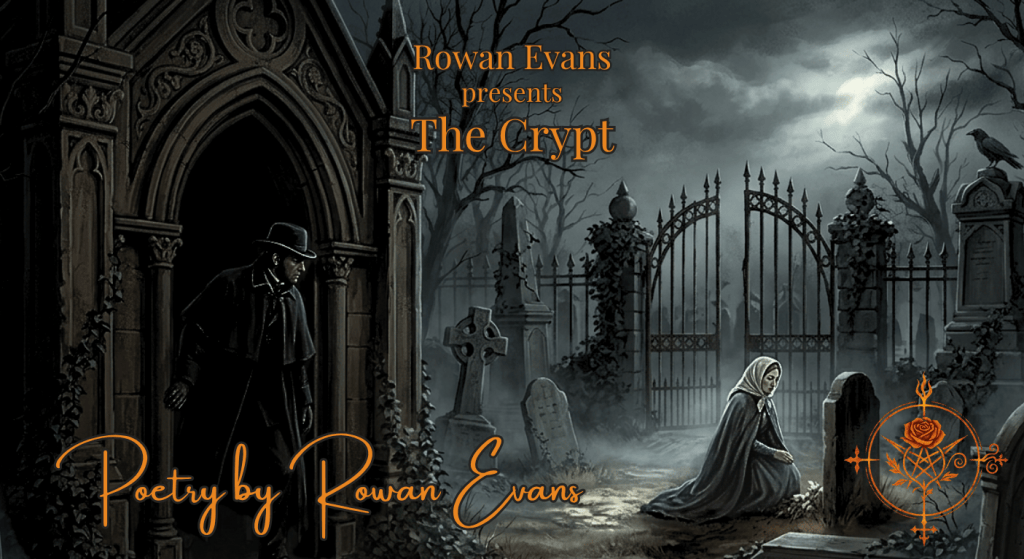
  • A mysterious man watches a woman kneeling beside a grave from the doorway of a dark Gothic crypt.
    Some places don’t just hold the dead—they hold the stories, obsessions, and shadows that refuse to leave them.

    The Crypt
    Poetry by Rowan Evans

    Don’t you see—
    the one where the crypt sleeps?

    The crypt is a man with no soul,
    a body with no home, left to roam.

    He sleeps in his namesake—
    watches the graveyard
    from the same place.

    He sees her when she walks in.
    He can see the gates from there.

    “She looks radiant as ever—”
    he thinks, as she seems to shrink
    with eyes down,
    not looking at the world.

    He wants to—

    when she thinks
    nobody is looking,
    he really sees her—

    she kneels before a grave,
    he can’t see the name,
    but he’s made his claim—

    the crypt will keep her.


    Author’s Note

    The Crypt is a short gothic piece built around the idea of a place becoming a person—and a person becoming inseparable from the place that bears their name.

    The crypt is both a physical location and a metaphorical state: a man who feels emptied out, disconnected from the world, watching life pass from the shadows. When he sees her enter the graveyard, his attention gives him something to focus on, but that fascination quickly becomes something darker.

    I wanted the poem to feel almost like a fragment of a larger gothic story—something glimpsed through the gates of a graveyard rather than fully explained. We don’t know who she is visiting, what happened to the crypt’s occupant, or what exactly he means when he decides that “the crypt will keep her.”

    That’s intentional.

    Some gothic stories are frightening because of what they reveal.

    Others are frightening because of what they leave hidden.

    Rowan Evans


    Journey into the Hexverse…

    [Fallen Angel’s Reckoning (Remix)]
    Fallen Angel’s Reckoning (Remix) revisits a 2024 poem about heartbreak, broken promises, and falling from an imagined heaven, transforming its original ending into a darker meditation on resilience, self-reclamation, and learning to fly with broken wings.

    [Homecoming]
    Fallen Angel’s Reckoning (Remix) revisits a 2024 poem about heartbreak, broken promises, and falling from an imagined heaven, transforming its original ending into a darker meditation on resilience, self-reclamation, and learning to fly with broken wings.

    [The Monster in the Margins II]
    The Monster in the Margins II transforms Rowan Evans’s Seven Deadly Sins mythology into a horror story written between the lines, where Lust, Wrath, Sloth, Greed, Pride, Envy, and Gluttony become monsters growing from pain, grudges, and scars.

    [Pride]
    ‘Pride’ towers over all else, a seductive and deceptive force. The seventh of the 7 Deadly Sonnets, exploring hubris, self-importance, and the masks we wear.

    [Through the Shattered Glass: Before the Glass Shattered]
    Before the glass shatters, shadows linger and memories twist. Discover the haunting prelude to B.D. Nightshade’s “Through the Shattered Glass” series—where ordinary moments become portals to fractured realities.

    If you’re interested in more poetry, you can find it here → [The Library of Ashes]
  • Author’s Note

    I’ve always loved horror—not simply for the blood, the monsters, or the jump scares, but because horror has a remarkable ability to turn internal things into something we can see.

    The Monster in the Margins began as a playful collision of horror references. Slasher villains, supernatural imagery, Japanese horror, and the cadence of a poet treating the page like a horror movie. The monster was partly familiar because I was borrowing from stories I already knew.

    This one is different.

    The Monster in the Margins II picks up where that first poem left off, but instead of borrowing the monster, I built my own.

    The Seven Deadly Sins had already become part of my mythology through 7 Deadly Sonnets. Here, Lust, Wrath, Sloth, Greed, Pride, Envy, and Gluttony aren’t simply abstract sins or religious concepts—they become creatures in the margins, haunting rooms, sleeping beneath pillows, sitting on chests, consuming whatever they can find.

    And that is where horror becomes useful again.

    Because the scariest monsters aren’t always the ones chasing you.

    Sometimes they’re the things you carry.

    A grudge can become a monster.

    Apathy can become a tomb.

    Desire can become something that sleeps beside you.

    Pride can consume.

    Envy can hollow you out.

    And sometimes the very things we plant in the margins eventually grow into something we can no longer control.

    The first poem asked what happens when the poet becomes the monster.

    This one asks what happens when the poet starts creating monsters of their own.

    Every sin is a seed.

    Every ache can bloom.

    And sometimes the garden grows in the margins.

    Rowan Evans


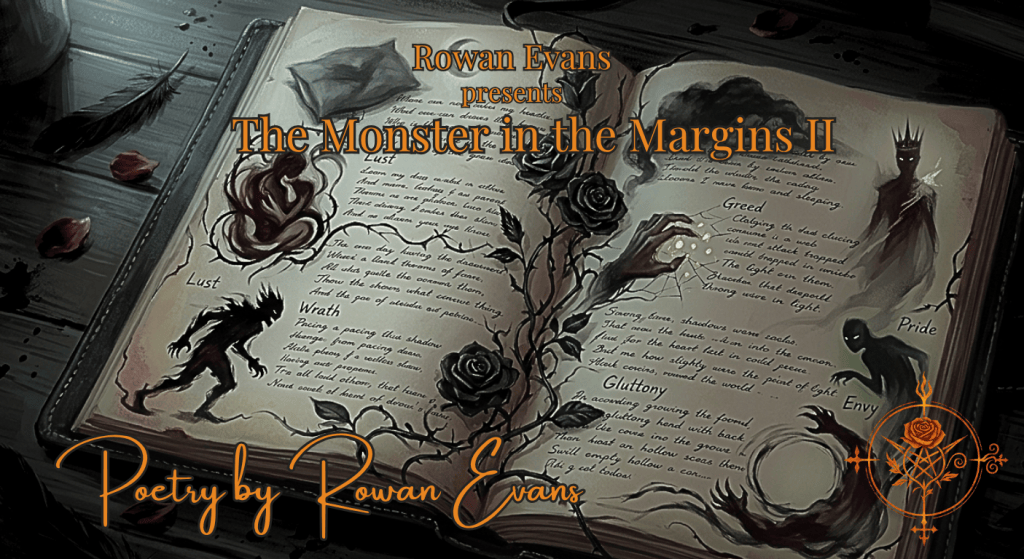
    An open notebook surrounded by dark roses, raven feathers, and seven shadowy manifestations symbolizing the Seven Deadly Sins.
    Every sin is a seed planted in the margins—every ache a bloom in the garden of scars.

    The Monster in the Margins II
    Poetry by Rowan Evans

    You can’t get rid of me—

    I hold a grudge,
    wrote 7 Deadly Sonnets
    and prayed for your downfall
    after every single one.
    I went Ichi with a pen,
    killer with a devilish grin.

    I carved each sin into the margins,
    let every stanza rot and bloom—

    now Lust sleeps beneath your pillow,
    and Wrath is pacing in your room.

    With Sloth sitting upon your chest—
    the ghost that haunts your bones,
    turning this room into your tomb.

    The slow death of apathy
    is all that waits for you.

    Even if you find the will to move,
    Greed and Pride will still consume
    until you’re left with nothing but Envy.
    And you’ll turn glutton to try and fill—

    but nothing feeds the hollow I’ve carved.

    Every sin is a seed I planted,
    every ache a bloom in my garden of scars.


    Journey into Hexverse…

    [The Monster in the Margins]
    Drawing inspiration from horror icons like Michael Myers, Ghostface, Freddy Krueger, and Pennywise, this poem explores the darker side of creativity—where inspiration becomes an unstoppable force lurking just beyond the edge of the page.

    [Monster Theology]
    What if the monsters under the bed weren’t monsters at all? Monster Theology explores difference, belonging, and the human tendency to fear what we don’t understand through a conversation with the creatures we’ve spent our lives imagining.

    If you’re interested in more poetry, you can find it here → [The Library of Ashes]