Tag: Horror Poetry

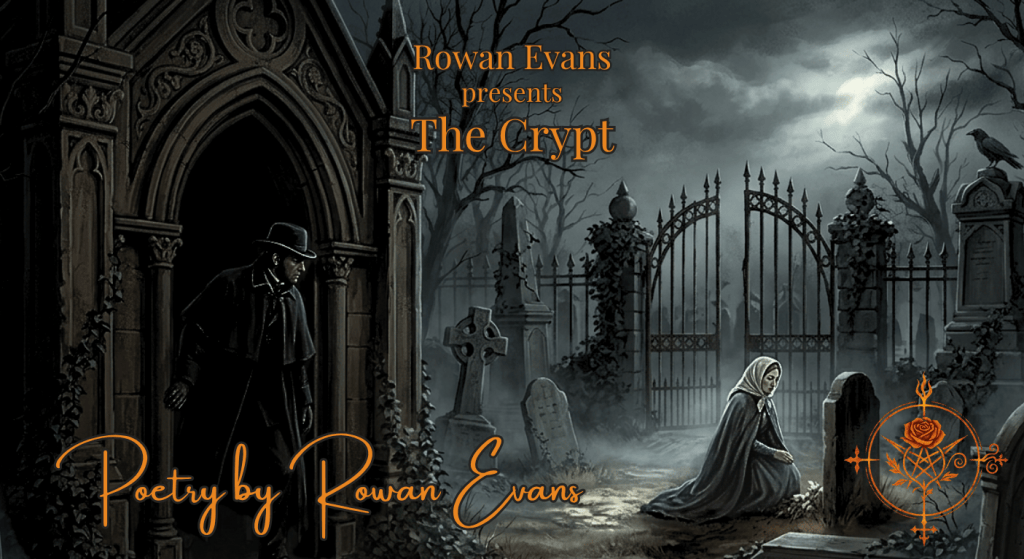
  • A mysterious man watches a woman kneeling beside a grave from the doorway of a dark Gothic crypt.
    Some places don’t just hold the dead—they hold the stories, obsessions, and shadows that refuse to leave them.

    The Crypt
    Poetry by Rowan Evans

    Don’t you see—
    the one where the crypt sleeps?

    The crypt is a man with no soul,
    a body with no home, left to roam.

    He sleeps in his namesake—
    watches the graveyard
    from the same place.

    He sees her when she walks in.
    He can see the gates from there.

    “She looks radiant as ever—”
    he thinks, as she seems to shrink
    with eyes down,
    not looking at the world.

    He wants to—

    when she thinks
    nobody is looking,
    he really sees her—

    she kneels before a grave,
    he can’t see the name,
    but he’s made his claim—

    the crypt will keep her.


    Author’s Note

    The Crypt is a short gothic piece built around the idea of a place becoming a person—and a person becoming inseparable from the place that bears their name.

    The crypt is both a physical location and a metaphorical state: a man who feels emptied out, disconnected from the world, watching life pass from the shadows. When he sees her enter the graveyard, his attention gives him something to focus on, but that fascination quickly becomes something darker.

    I wanted the poem to feel almost like a fragment of a larger gothic story—something glimpsed through the gates of a graveyard rather than fully explained. We don’t know who she is visiting, what happened to the crypt’s occupant, or what exactly he means when he decides that “the crypt will keep her.”

    That’s intentional.

    Some gothic stories are frightening because of what they reveal.

    Others are frightening because of what they leave hidden.

    Rowan Evans


    Journey into the Hexverse…

    [Fallen Angel’s Reckoning (Remix)]
    Fallen Angel’s Reckoning (Remix) revisits a 2024 poem about heartbreak, broken promises, and falling from an imagined heaven, transforming its original ending into a darker meditation on resilience, self-reclamation, and learning to fly with broken wings.

    [Homecoming]
    Fallen Angel’s Reckoning (Remix) revisits a 2024 poem about heartbreak, broken promises, and falling from an imagined heaven, transforming its original ending into a darker meditation on resilience, self-reclamation, and learning to fly with broken wings.

    [The Monster in the Margins II]
    The Monster in the Margins II transforms Rowan Evans’s Seven Deadly Sins mythology into a horror story written between the lines, where Lust, Wrath, Sloth, Greed, Pride, Envy, and Gluttony become monsters growing from pain, grudges, and scars.

    [Pride]
    ‘Pride’ towers over all else, a seductive and deceptive force. The seventh of the 7 Deadly Sonnets, exploring hubris, self-importance, and the masks we wear.

    [Through the Shattered Glass: Before the Glass Shattered]
    Before the glass shatters, shadows linger and memories twist. Discover the haunting prelude to B.D. Nightshade’s “Through the Shattered Glass” series—where ordinary moments become portals to fractured realities.

    If you’re interested in more poetry, you can find it here → [The Library of Ashes]
  • Author’s Note

    There are certain aesthetics that feel less like something we choose and more like something we recognize.

    For me, Gothic imagery has always been one of those things.

    Homecoming came from the realization that something in my writing had started to feel slightly unfamiliar. I was still writing about the moon, the ocean, the tides, ravens, horror, darkness, and the strange spaces where beauty and pain overlap—but somehow, I had drifted away from the particular Gothic atmosphere that has always felt like home to me.

    So this poem became a return.

    Poe is here because his shadow has been part of my literary DNA for years. Nyx and Hades are here because mythology gives me another language for darkness. The ravens are here because, in my own symbolic architecture, they have become witnesses, messengers, and companions. And the horror references—Jason, Ghostface, Pennywise, Michael Myers—are there because horror has never been merely about monsters to me.

    It is about what the monsters represent.

    Grief. Fear. Obsession. Rage. The parts of ourselves that refuse to stay buried.

    There is also something deliberately self-aware about this poem. I am not simply listing Gothic references because they sound dark. I am talking about my relationship with the imagery itself—the way the moon has accumulated meaning across my work, the way the tides connect to emotion, and the way ravens have gradually become part of my mythology.

    The darkness isn’t an aesthetic costume.

    It’s architecture.

    And after spending some time writing away from it, I realized that I wasn’t trying to become something new.

    I was finding my way back to something that had been mine all along.

    That’s why this poem is called Homecoming.

    Sometimes you don’t discover where you belong.

    Sometimes you remember.

    Rowan Evans


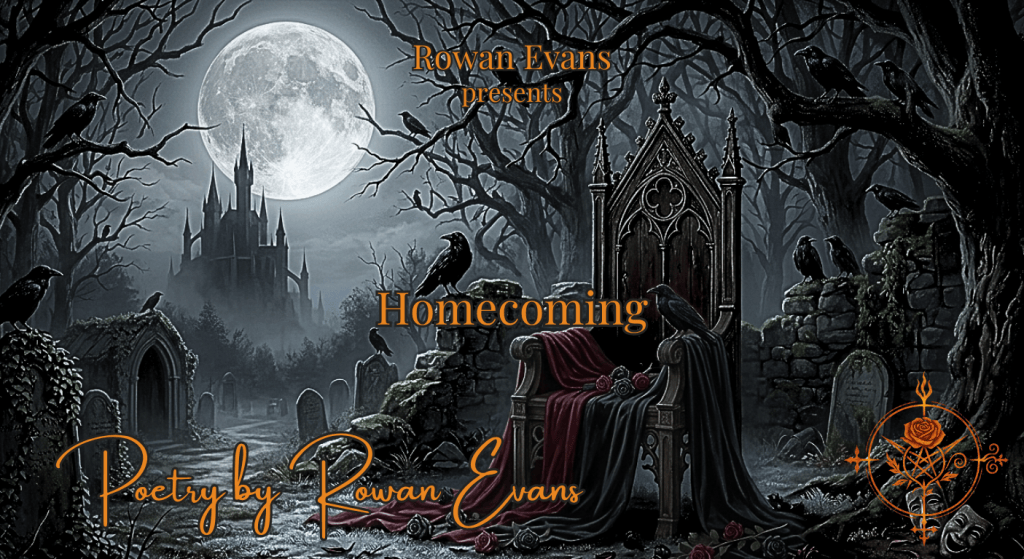
    A Gothic throne beneath a full moon surrounded by ravens, dark trees, mist, and subtle crimson accents.
    Sometimes the darkness isn’t somewhere you wandered into. Sometimes it’s the place where your voice has always felt most at home.

    Homecoming
    Poetry by Rowan Evans

    I’ve been writing like
    I forgot which domain is mine,
    I’m of the darkness—
    just borrowed the light,
    and made Poe’s throne my birthright.

    I’m a gothic romantic,
    I bleed for the art—
    I’ve kissed the lips of Nyx
    and wandered through
    the realm of Hades.

    I’m a poltergeist in life,
    but at night I come alive—
    witching hour is when I thrive.

    I pray to the moon
    and curse the sun—
    I ascend to the throne
    that Poe had spun.

    I watch the ravens—
    carrying messages where they fly,
    eyes locked, tracking the treachery across the sky.
    They are always watching—
    silent witnesses to the rot inside.

    It started to feel like something
    in my pieces was missing—
    like where was the gothic lace,
    silk and satin sin, velvet and venom.

    There was too much light—
    even when ninety percent
    of my imagery is night adjacent,
    weaving in horror rhymes—
    Friday the 13th, Night of Jason.

    The moon in my rhymes has meaning,
    when I write lines like the tides—I mean it,
    even in my Ghostface cadence—
    what’s your favorite scary movie?
    Pennywise of the mind, sewer of thought—
    I’m a monster like Michael,
    when I chase—I don’t run, I walk.


    Journey into the Hexverse…

    [The Monster in the Margins]
    Drawing inspiration from horror icons like Michael Myers, Ghostface, Freddy Krueger, and Pennywise, this poem explores the darker side of creativity—where inspiration becomes an unstoppable force lurking just beyond the edge of the page.

    [The Monster in the Margins II]
    The Monster in the Margins II transforms Rowan Evans’s Seven Deadly Sins mythology into a horror story written between the lines, where Lust, Wrath, Sloth, Greed, Pride, Envy, and Gluttony become monsters growing from pain, grudges, and scars.

    [The Unkindness Descends]
    “The Unkindness Descends” is a Gothic symbolic poem exploring collapse, transformation, and the unsettling experience of being witnessed during moments of unraveling. Through raven imagery, ambiguity, and ritualistic atmosphere, the poem invites multiple interpretations—spiritual, psychological, ominous, or transformative.

    [Gospel in Crimson]
    When writing becomes ritual and love becomes devotion, the line between creation and worship begins to blur. Gospel in Crimson explores obsession, artistry, and the sacred act of expression.

    If you’re interested in more poetry, you can find it here → [The Library of Ashes]

  • Author’s Note

    I’ve always loved horror—not simply for the blood, the monsters, or the jump scares, but because horror has a remarkable ability to turn internal things into something we can see.

    The Monster in the Margins began as a playful collision of horror references. Slasher villains, supernatural imagery, Japanese horror, and the cadence of a poet treating the page like a horror movie. The monster was partly familiar because I was borrowing from stories I already knew.

    This one is different.

    The Monster in the Margins II picks up where that first poem left off, but instead of borrowing the monster, I built my own.

    The Seven Deadly Sins had already become part of my mythology through 7 Deadly Sonnets. Here, Lust, Wrath, Sloth, Greed, Pride, Envy, and Gluttony aren’t simply abstract sins or religious concepts—they become creatures in the margins, haunting rooms, sleeping beneath pillows, sitting on chests, consuming whatever they can find.

    And that is where horror becomes useful again.

    Because the scariest monsters aren’t always the ones chasing you.

    Sometimes they’re the things you carry.

    A grudge can become a monster.

    Apathy can become a tomb.

    Desire can become something that sleeps beside you.

    Pride can consume.

    Envy can hollow you out.

    And sometimes the very things we plant in the margins eventually grow into something we can no longer control.

    The first poem asked what happens when the poet becomes the monster.

    This one asks what happens when the poet starts creating monsters of their own.

    Every sin is a seed.

    Every ache can bloom.

    And sometimes the garden grows in the margins.

    Rowan Evans


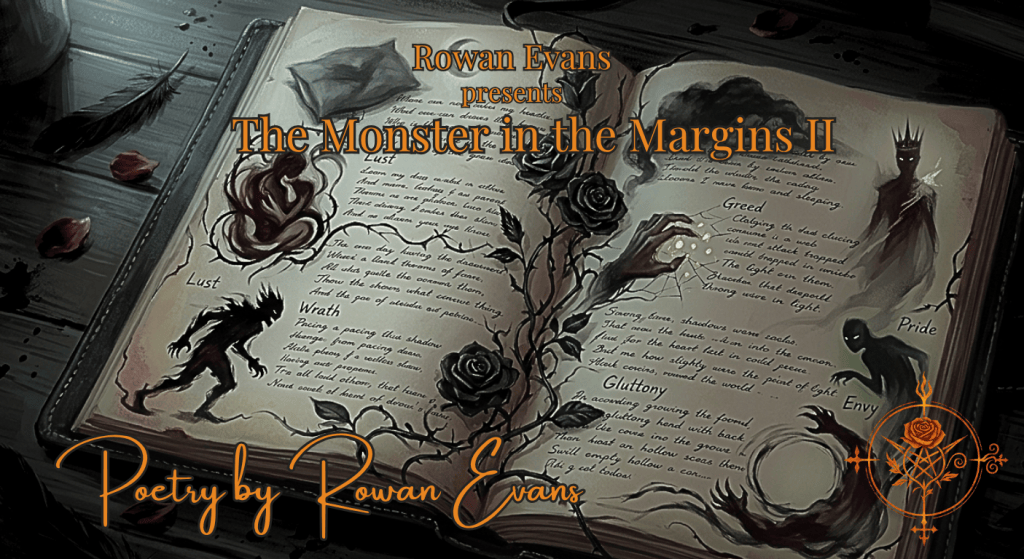
    An open notebook surrounded by dark roses, raven feathers, and seven shadowy manifestations symbolizing the Seven Deadly Sins.
    Every sin is a seed planted in the margins—every ache a bloom in the garden of scars.

    The Monster in the Margins II
    Poetry by Rowan Evans

    You can’t get rid of me—

    I hold a grudge,
    wrote 7 Deadly Sonnets
    and prayed for your downfall
    after every single one.
    I went Ichi with a pen,
    killer with a devilish grin.

    I carved each sin into the margins,
    let every stanza rot and bloom—

    now Lust sleeps beneath your pillow,
    and Wrath is pacing in your room.

    With Sloth sitting upon your chest—
    the ghost that haunts your bones,
    turning this room into your tomb.

    The slow death of apathy
    is all that waits for you.

    Even if you find the will to move,
    Greed and Pride will still consume
    until you’re left with nothing but Envy.
    And you’ll turn glutton to try and fill—

    but nothing feeds the hollow I’ve carved.

    Every sin is a seed I planted,
    every ache a bloom in my garden of scars.


    Journey into Hexverse…

    [The Monster in the Margins]
    Drawing inspiration from horror icons like Michael Myers, Ghostface, Freddy Krueger, and Pennywise, this poem explores the darker side of creativity—where inspiration becomes an unstoppable force lurking just beyond the edge of the page.

    [Monster Theology]
    What if the monsters under the bed weren’t monsters at all? Monster Theology explores difference, belonging, and the human tendency to fear what we don’t understand through a conversation with the creatures we’ve spent our lives imagining.

    If you’re interested in more poetry, you can find it here → [The Library of Ashes]

  • Author’s Note

    I’ve always loved horror—not for the blood or the jump scares, but because horror understands metaphor.

    The best monsters are never just monsters.

    They’re grief. They’re guilt. They’re obsession. They’re the parts of ourselves we’d rather keep locked in the basement.

    This poem started as a playful exercise in horror references. I wanted to see how many iconic slasher and supernatural figures I could weave together without losing the rhythm.

    But somewhere along the way, the references stopped being the point.

    The “monster” became the creative voice itself.

    The one that refuses to stay quiet. The one that follows me from notebook to notebook, insisting on another poem, another line, another draft.

    Writers often talk about inspiration as something beautiful.

    Sometimes it is.

    Sometimes it’s relentless.

    Sometimes it feels less like a muse…

    and more like the monster waiting patiently in the margins until you pick up the pen again.

    Rowan Evans


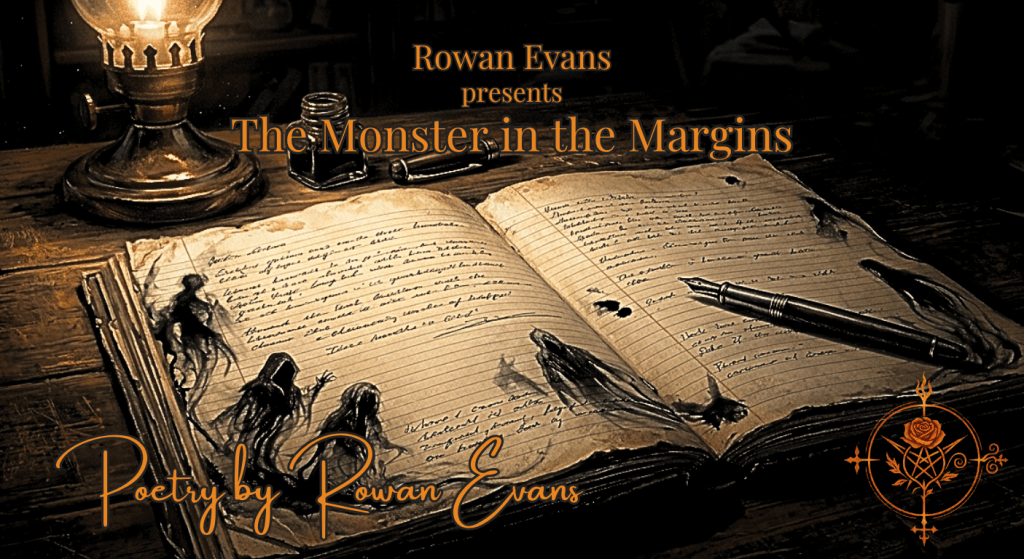
    An open notebook with dark ink spreading through the margins like ghostly shadows beneath a dim desk lamp.
    “Every writer knows the feeling—the story isn’t always waiting on the page. Sometimes it’s waiting in the margins.”

    The Monster in the Margins
    Poetry by Rowan Evans

    I’m a literary slasher villain,
    Michael Myers with a pen.
    I’m a humorous menace,
    a terror with a clown’s face—

    Pennywise in my rhymes,
    with a Ghostface rhythm.
    It’s Kruger in the cadence,
    you can try and imitate it.

    I’m the ghost that haunts
    these old bones—
    the groan in the rafters
    of this old home—
    I’m the eyes you can’t seem to shake,
    the reason you never feel alone.

    My poetry is a whisper
    in an empty room,
    the cold chill in the air—
    I weave lines with rhymes
    like hidden messages
    in the mirror.

    Bloody Mary.
    Redrum—

    a horror scene
    on college-ruled—
    notebook full
    of nightmare fuel.

    I am the Pulse
    in the Infection,
    the killer’s Resurrection.

    Red tape won’t stop this.
    It’s a ritual, no control—
    you’ve lost it.

    I’m the creeping dread,
    the scream inside your head.
    The tingle in your spine—
    a voice echoing to no end.

    I’m the shadow you cast in your own mind—
    the part of you that never dies.


    Journey into the Hexverse…

    [Returning to My Bones] – Rowan Evans
    Some dreams fade the moment we wake. Others leave behind emotions that linger long after reality returns. Returning to My Bones explores the strange grief of leaving a dream that felt real enough to matter.

    [Before My Feet Touch the Floor] – Rowan Evans
    What happens when your dreams feel more real than your waking life? Before My Feet Touch the Floor explores the strange grief of waking up, the lingering memory of dream selves, and the quiet question of which version of us is truly real.

    [The Hunted] – B.D. Nightshade
    Under a blood-red Oklahoma moon, predators stalk the silent fields—and one soul learns what it means to be chosen by the night.

    [Cannibal Carnival] – B.D. Nightshade
    A carnival arrives under cover of mist—bright tents, painted smiles, and a hunger that won’t stay hidden. By morning, only whispers remain.

    [Ouija]– B.D. Nightshade
    A grieving soul seeks comfort through a Ouija board—only to discover that not every voice from the dark belongs to the dead we miss.

    [Before the Glass Shattered] – B.D. Nightshade
    Before the glass shatters, shadows linger and memories twist. Discover the haunting prelude to B.D. Nightshade’s “Through the Shattered Glass” series—where ordinary moments become portals to fractured realities.

    If you’re interested in more poetry, you can find it here → [The Library of Ashes]
  • Author’s Note

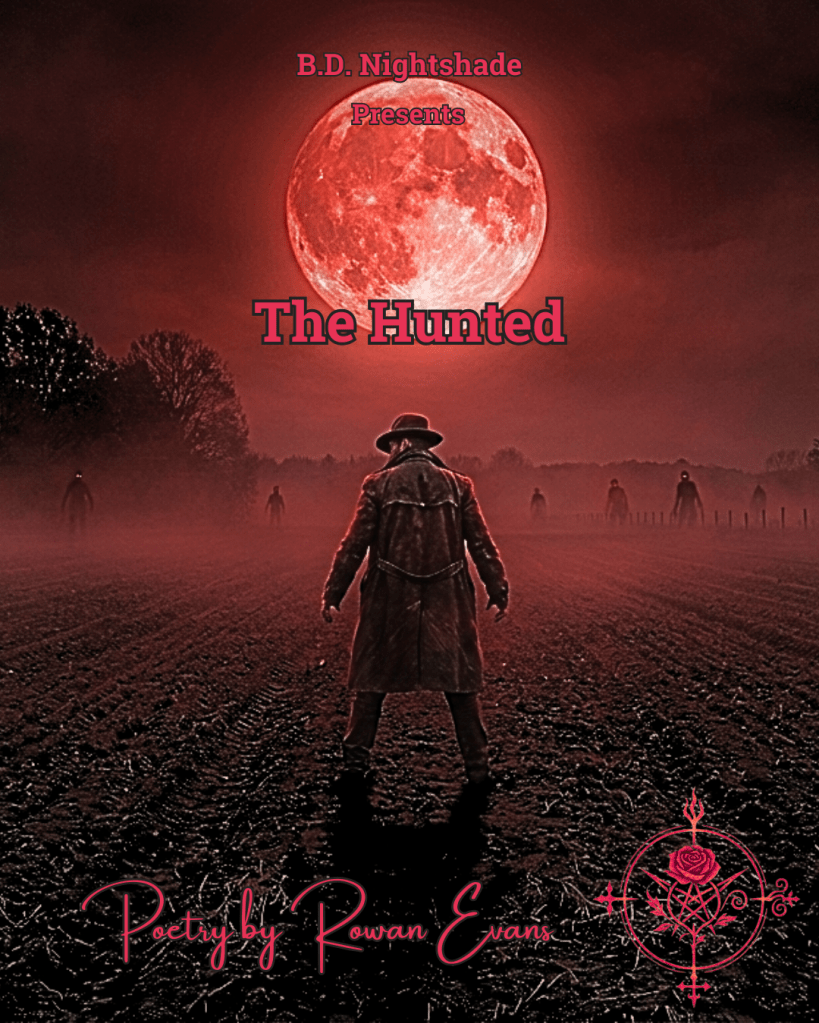
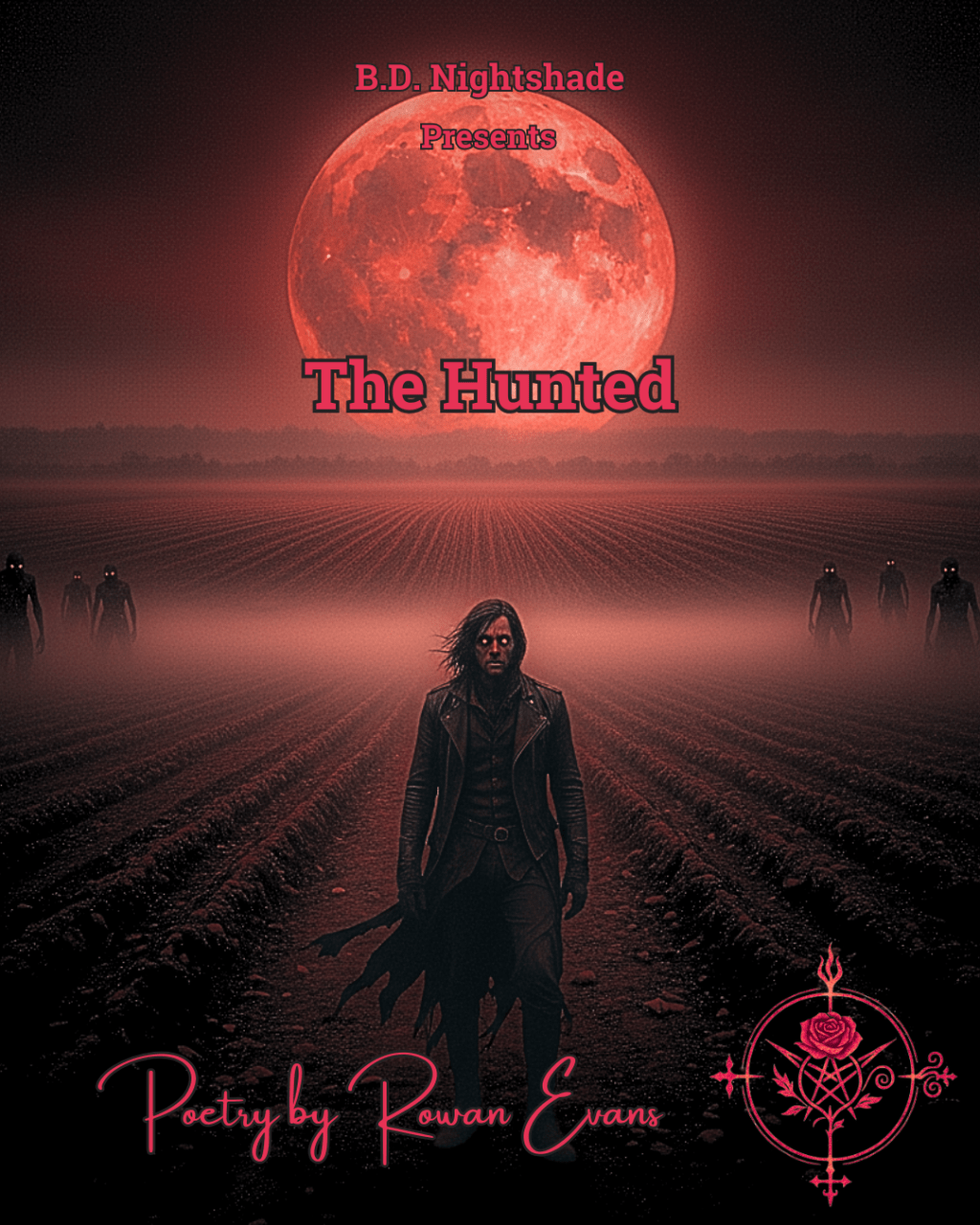
    The Hunted is about inevitability—the moment when fear stops being chaos and becomes certainty. Set beneath an unforgiving moon, this poem leans into isolation, communal helplessness, and the quiet terror of knowing you are seen. Sometimes horror isn’t about escape or survival, but about the instant when the night decides you are already chosen.


    A blood-red moon over dark fields as shadowy predators surround a lone figure at night.
    Some nights don’t chase you. They wait.

    The Hunted
    Poerty by B.D. Nightshade

    Beneath the blood-red Oklahoma moon,
    The wind whispered tales of an impending doom.
    Fields lay barren, shadows stretched thin,
    And in the silence, the hunt would begin.

    From the corners of dusk, they came like smoke,
    Slipping through the dark where nights breath spoke.
    Fangs gleamed like daggers, their eyes burned bright,
    Predators cloaked in the velvet of night.

    The townsfolk prayed, but the prayers fell hollow,
    For shadows were swift, and death would follow.
    Doors were barred, yet whispers slipped through—
    A scream cut short; the hunters withdrew.

    In alleys and homes, the carnage grew thick,
    Their hunger unyielding, their movements quick.
    Lifeless bodies, pale and drained,
    Crimson rivers where innocence waned.

    Yet one remained, a flickering light,
    A soul still standing in the heart of the night.
    Surrounded by eyes like coal aglow,
    Faces twisted, predators’ tableau.

    Breath hitched, heartbeat a deafening sound,
    As they closed in, encircling their ground.
    The air was heavy, laden with dread,
    As the hunted whispered, “Soon, I’ll be dead.”

    The moon, a witness to the fatal plight,
    Bathed the scene in unholy light.
    The hunted stood, with resolve so grim,
    Facing the abyss, staring back at them.

    In that moment, the night seemed to pause,
    A final rebellion against nature’s laws.
    And as the predators moved to consume,
    The hunted vanished, swallowed by gloom.

    Oklahoma sleeps, but the tale remains—
    A town once bathed in blood-red stains.
    For where shadows creep and darkness grows,
    The hunted’s story is one the wind still blows.


    If you’re interested in more poetry, you can find it here → [The Library of Ashes]
  • Author’s Note

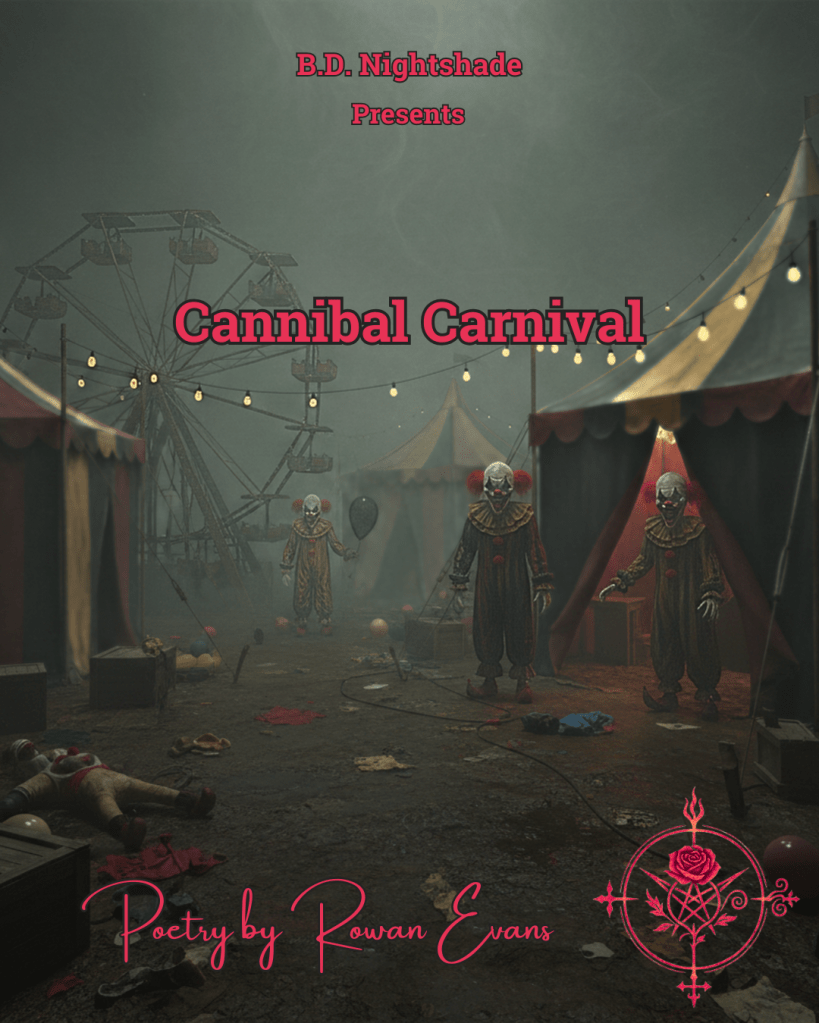
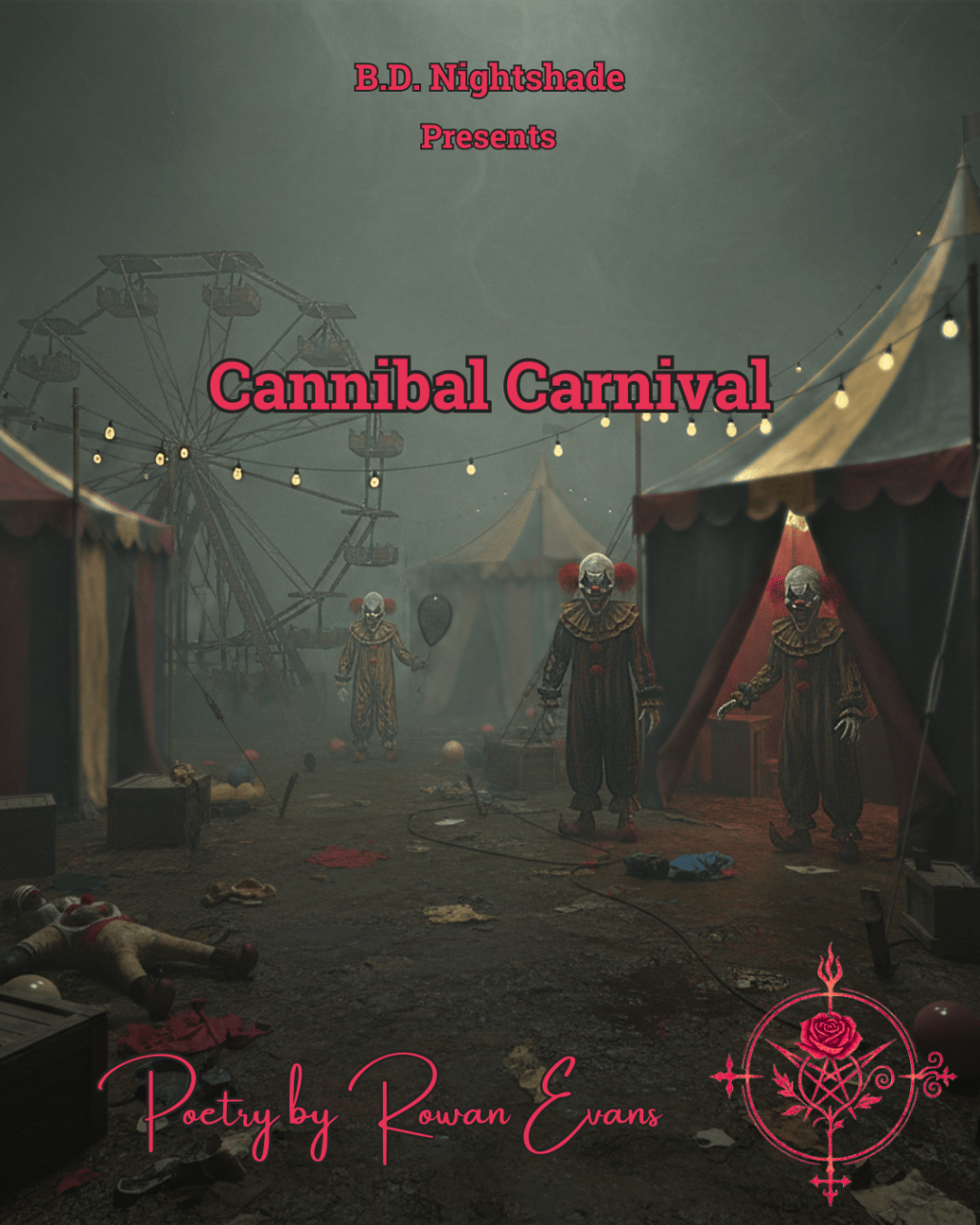
    Cannibal Carnival leans into the grotesque joy of horror—where spectacle masks atrocity and laughter becomes a warning sign. This poem plays with the fear of what arrives uninvited, feeds unchecked, and leaves nothing behind but rumors and bloodstains. Sometimes the scariest monsters don’t hide in the shadows—they perform under bright lights and dare you to look away.


    A dark, foggy carnival at night with eerie clowns and glowing tents, evoking a sinister horror atmosphere.
    Not every carnival comes to entertain—some come to feed.

    Content warning: graphic imagery, violence, cannibalism.


    Cannibal Carnival
    Poetry by B.D. Nightshade

    The carnival rolls through the midnight mist,
    A twisted parade of grinning faces,
    Where laughter’s a shriek and the air’s thick with dread,
    A circus of death that leaves no traces.

    Their tents rise high like graves in the dark,
    With bright colors that hide the hunger below.
    Clowns with painted smiles, eyes hungry and stark,
    Their tricks are tricks no one dares to know.

    They juggle bones, and toss severed heads,
    Their tightrope walks on blood-soaked lines,
    Each act a feast for the audience fed,
    On terror, fear, and blood-red wines.

    But in one town, whispers began to stir,
    A sloppy clown with a frown too wide,
    He juggled more than just colored balls,
    A question formed deep inside.

    “Did you hear the screaming behind the tent?”
    “A body, still breathing, yet torn to shreds.”
    “I saw teeth marks on the flesh they lent—
    And the smell, my God, the smell of death.”

    The police arrived, badges gleaming bright,
    Their steps firm, but hearts unsure,
    The carnival’s cheer now tinged with fright,
    A deadly game they would not endure.

    “We’ve come for answers, you twisted crew,
    What hides beneath your painted smiles?”
    But the clowns just chuckled, “You’re too late, it’s true,
    You’ll join the feast if you stay a while.”

    A gunshot rang, but no one fell,
    The officers swarmed, hearts frozen with fear.
    The cannibals grinned, as if from hell,
    Their knives drawn, the end drawing near.

    A clash of steel, a cry of pain,
    As the police fought with all their might,
    But the carnival’s troupe, they’d fed on rain,
    The night devoured them, hidden from sight.

    In the end, the town was empty—
    Except for the echoes of the game,
    The carnival packed up, looking so merry,
    As if nothing had changed, no shame, no blame.

    Now the roads are empty, no signs of their tents,
    But the townsfolk still whisper with dread,
    For the Cannibal Carnival travels on,
    Leaving behind only fear and bloodshed.


    If you’re interested in more poetry, you can find it here → [The Library of Ashes]