Tag: haunting

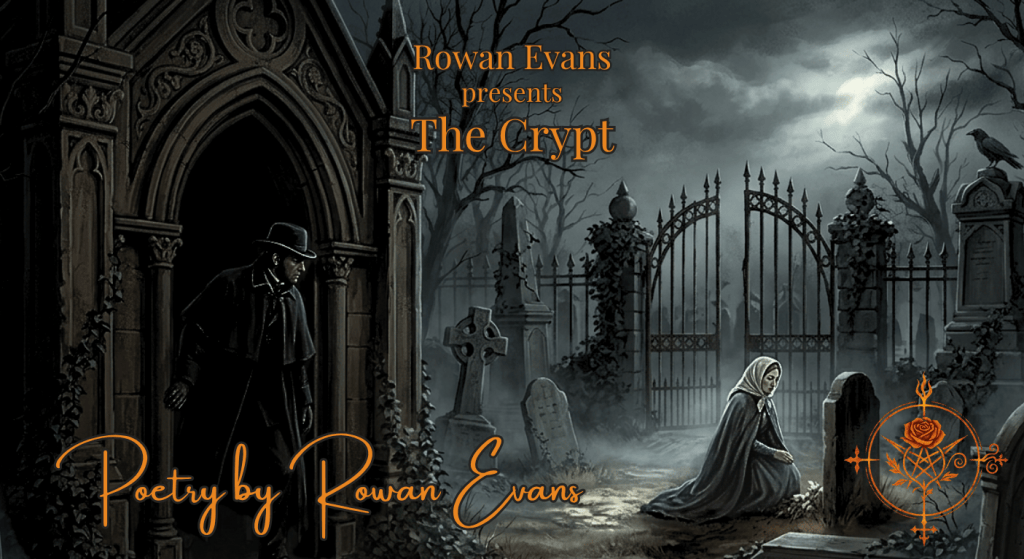
  • A mysterious man watches a woman kneeling beside a grave from the doorway of a dark Gothic crypt.
    Some places don’t just hold the dead—they hold the stories, obsessions, and shadows that refuse to leave them.

    The Crypt
    Poetry by Rowan Evans

    Don’t you see—
    the one where the crypt sleeps?

    The crypt is a man with no soul,
    a body with no home, left to roam.

    He sleeps in his namesake—
    watches the graveyard
    from the same place.

    He sees her when she walks in.
    He can see the gates from there.

    “She looks radiant as ever—”
    he thinks, as she seems to shrink
    with eyes down,
    not looking at the world.

    He wants to—

    when she thinks
    nobody is looking,
    he really sees her—

    she kneels before a grave,
    he can’t see the name,
    but he’s made his claim—

    the crypt will keep her.


    Author’s Note

    The Crypt is a short gothic piece built around the idea of a place becoming a person—and a person becoming inseparable from the place that bears their name.

    The crypt is both a physical location and a metaphorical state: a man who feels emptied out, disconnected from the world, watching life pass from the shadows. When he sees her enter the graveyard, his attention gives him something to focus on, but that fascination quickly becomes something darker.

    I wanted the poem to feel almost like a fragment of a larger gothic story—something glimpsed through the gates of a graveyard rather than fully explained. We don’t know who she is visiting, what happened to the crypt’s occupant, or what exactly he means when he decides that “the crypt will keep her.”

    That’s intentional.

    Some gothic stories are frightening because of what they reveal.

    Others are frightening because of what they leave hidden.

    Rowan Evans


    Journey into the Hexverse…

    [Fallen Angel’s Reckoning (Remix)]
    Fallen Angel’s Reckoning (Remix) revisits a 2024 poem about heartbreak, broken promises, and falling from an imagined heaven, transforming its original ending into a darker meditation on resilience, self-reclamation, and learning to fly with broken wings.

    [Homecoming]
    Fallen Angel’s Reckoning (Remix) revisits a 2024 poem about heartbreak, broken promises, and falling from an imagined heaven, transforming its original ending into a darker meditation on resilience, self-reclamation, and learning to fly with broken wings.

    [The Monster in the Margins II]
    The Monster in the Margins II transforms Rowan Evans’s Seven Deadly Sins mythology into a horror story written between the lines, where Lust, Wrath, Sloth, Greed, Pride, Envy, and Gluttony become monsters growing from pain, grudges, and scars.

    [Pride]
    ‘Pride’ towers over all else, a seductive and deceptive force. The seventh of the 7 Deadly Sonnets, exploring hubris, self-importance, and the masks we wear.

    [Through the Shattered Glass: Before the Glass Shattered]
    Before the glass shatters, shadows linger and memories twist. Discover the haunting prelude to B.D. Nightshade’s “Through the Shattered Glass” series—where ordinary moments become portals to fractured realities.

    If you’re interested in more poetry, you can find it here → [The Library of Ashes]
  • Author’s Note

    This poem carries pieces of a real exchange—one spark of truth that ignited the rest. Whisper Me Across is half confession, half invocation: a conversation remembered, reimagined, and rewritten in the language of devotion. Reality is the match; the poem is the flame.

    Rowan Evans


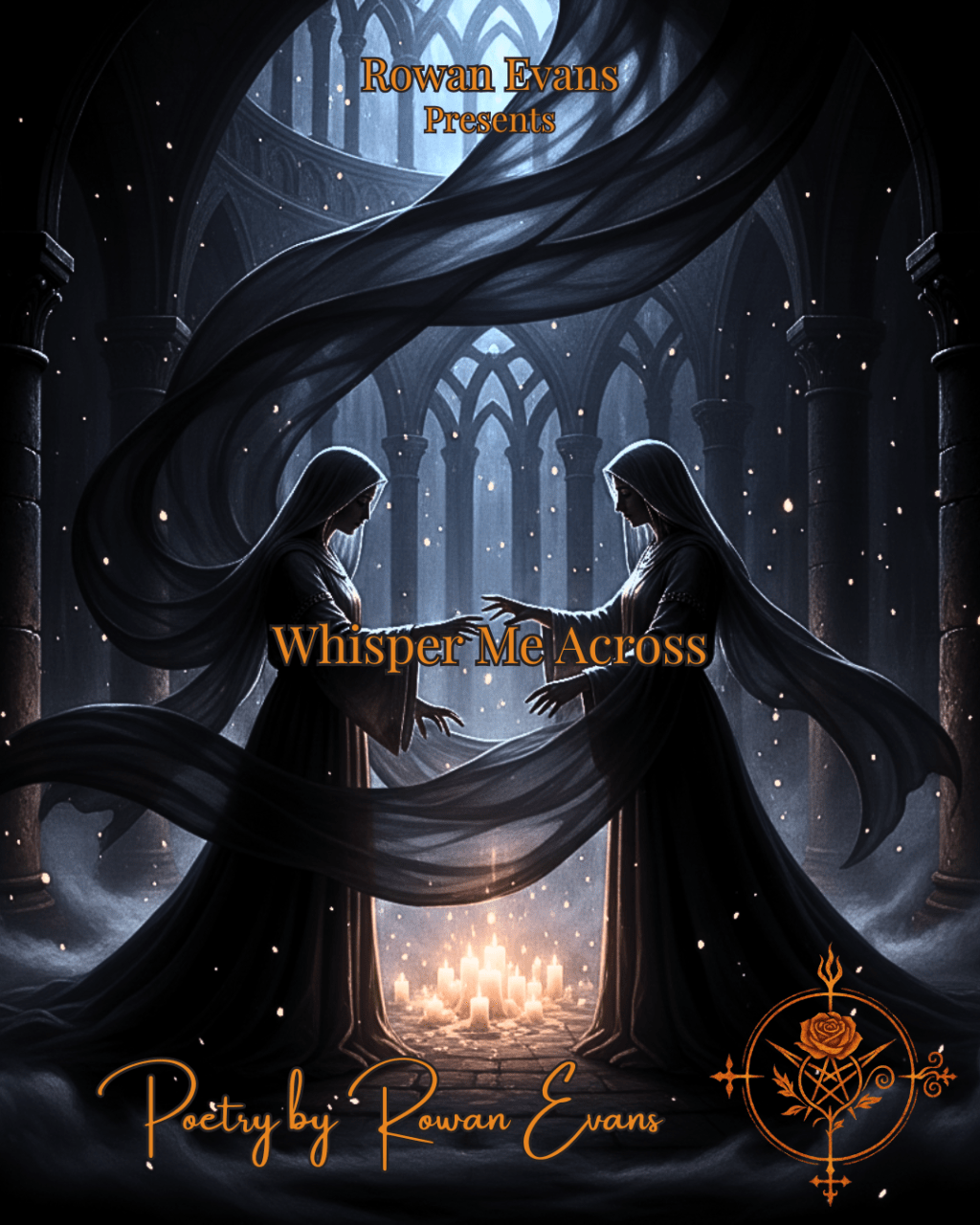
    “Two ethereal figures reaching for each other through mist and moonlight, symbolizing devotion and spiritual connection.”
    An echo of devotion that lingers across worlds.

    Whisper Me Across
    Poetry by Rowan Evans

    I know we’ve joked about this—
    tossed it around in little quips,
    laughing so we wouldn’t feel
    the weight beneath it.
    But I have a genuine request.

    If you pass,
    promise you’ll haunt me.
    Be the knock in the wall,
    the whistle in the breeze—
    the chill of air that drifts in
    and brushes against my cheek.

    Promise you’ll let me know you’re there.
    Don’t leave me wondering,
    don’t make me question.
    If you want me to survive it,
    you’ll have to give me a sign—
    because I would happily die
    just to cross over and meet you
    on the other side.

    And I promise the same.
    I’ll be the voice you hear
    leaning into your ear,
    quietly saying your name.
    I’ll be the presence that settles
    behind your ribs
    when you feel a sudden surge of strength
    and choose to push through.
    That will be me—
    still with you.

    I’ll be the voice that pushes back
    each time you falter.
    When you think you’re not worthy,
    not worth it—
    I’ll be the whisper that refuses
    to let that take root.
    Speaking free,
    folding into your thoughts,
    reminding you
    of your worth.


    Looking for more poetry? You can find it all in [The Library of Ashes].

  • Author’s Note

    This vignette serves as a prelude to the Through the Shattered Glass series. It explores the fragile moments before chaos erupts, before memory fractures, and before the ordinary world gives way to the spectral and uncanny. Written from the perspective of the original speaker, it is meant to foreshadow events and imagery that will later unfold in parts one and two, offering readers a subtle bridge into the haunting, fractured narrative landscape. The mirror, the table, and the dripping faucet are not mere props—they are harbingers of the shattering to come.


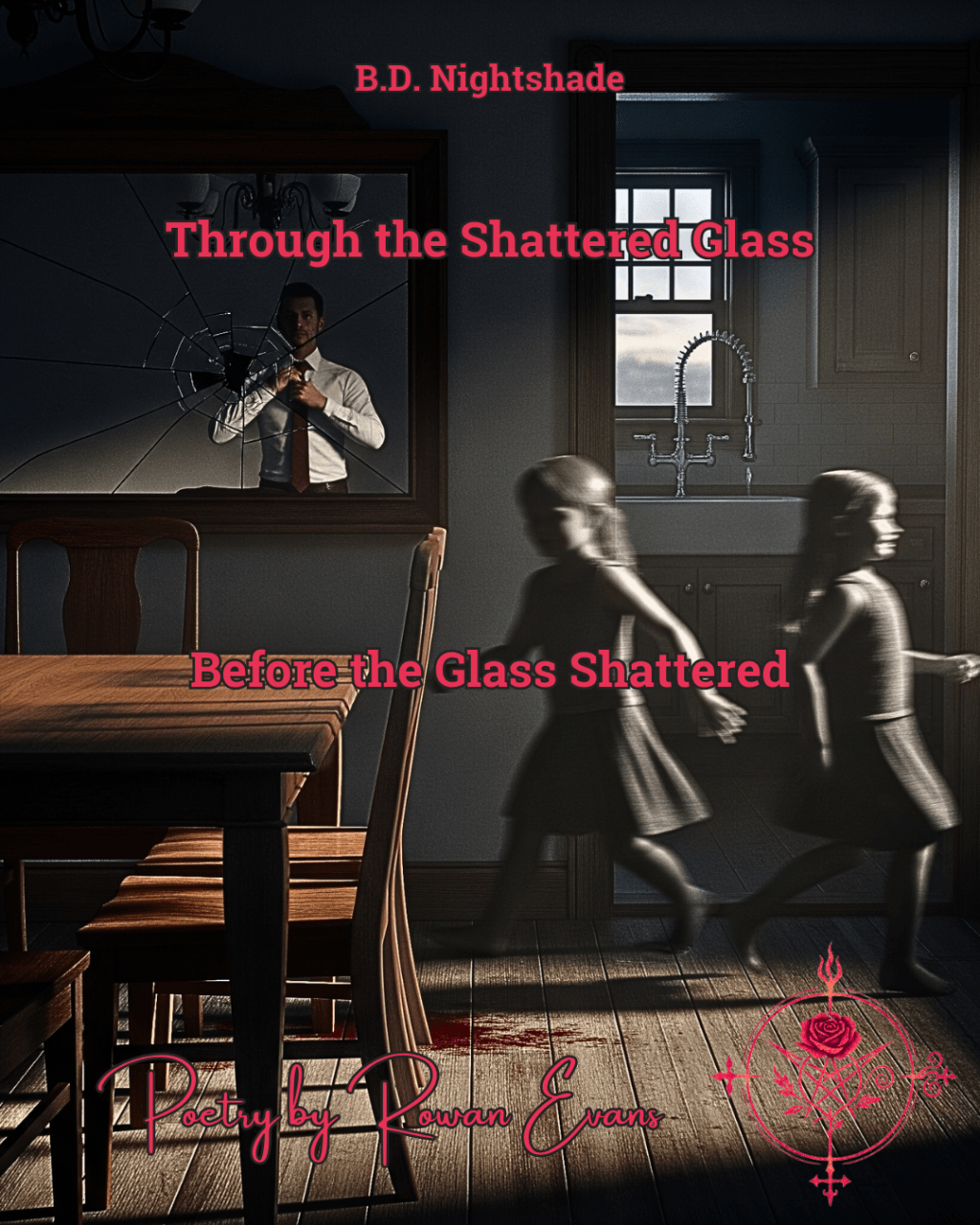
    Dimly lit dining room with cracked mirror, blood-red smudges on the floor, and ghostly children running past.
    The calm before the fracture: shadows linger, memories twist, and the glass waits to shatter.

    Through the Shattered Glass
    Before the Glass Shattered
    Vignette by B.D. Nightshade

    I adjust my tie before the mirror, slow and deliberate,
    catching the first gray light slipping across the dining room table.
    The silverware glints, cold and precise,
    the table itself a sentinel of order
    amid the subtle chaos of a waking house.

    Outside, children tumble down the hall,
    bare feet thumping on polished wood,
    hands brushing the walls as if leaving invisible trails.
    They laugh and scream, chasing each other’s shadows,
    tracing maps that only their eyes can read.
    One knocks against the doorframe—
    I hear it, but say nothing.
    Ordinary mornings demand no alarms.

    The faucet in the kitchen drips,
    soft, insistent, like a heartbeat just beneath awareness.
    One. Two. Three.
    I wonder, briefly, how many droplets it would take
    to fill the sink, the floor, the world.
    The thought is ridiculous. I smile faintly,
    glancing again at the mirror.

    The reflection is banal.
    A man straightening his tie.
    Light brushing hair over the temple.
    The children racing behind him.
    And yet, in the edges of glass, shadows stir—
    corners too dark,
    angles that don’t quite match the ceiling,
    that seem almost to breathe.

    A glass tumbler teeters at the edge of the table.
    Just a nudge, and it would shatter,
    sending silvered shards across the floor.
    I consider it, then laugh softly.
    Morning is safe.
    The glass is whole.
    The table upright.

    A faint scent of iron drifts in from the sink.
    Fleeting, almost imagined,
    and I notice it only because the air itself is too quiet.
    The children dart past again,
    hands brushing walls, gliding across surfaces
    that tomorrow—or the day after—
    might carry traces of something else:
    the memory of a slip, a smear, a drop.

    The faucet drips.
    One. Two. Three.
    I count in rhythm with the pulse in my veins.
    I feel the house settling around me:
    boards creaking, windows catching the wind,
    a distant cough from the street below.
    All ordinary. All benign.

    And yet—
    the edges of everything tremble.
    Corners of the mirror catch motion too swift to follow,
    too fleeting to name.
    A shadow arcs past the reflection,
    laugh low and guttural,
    older than the children’s mirth.
    I glance again. Nothing there.

    I step back from the mirror.
    The children scatter to chores,
    the day stretches wide, unbroken, bright.
    Yet the air hums, subtle and patient,
    as if rehearsing the sound of what is to come:
    a misstep, a hand slipping,
    a cup teetering just a fraction too far.

    I pause at the sink, fingers lingering over the dripping faucet,
    imagining the droplets gathering,
    then falling,
    falling…
    and breaking everything.

    The world seems to inhale,
    holding its breath with me.
    The silverware catches the light again,
    the table remains steadfast,
    the mirror still reflects an ordinary man.
    Yet in the quiet,
    I know the tremor is waiting.
    It is patient.
    And when it happens,
    the glass will shatter.


    Closing Note

    This vignette plants the seeds for the fractured reality that defines “Through the Shattered Glass.” The seemingly mundane elements—the mirror, the table, the dripping faucet—become catalysts for the haunting events that follow. As the narrative unfolds, the boundaries between self and shadow, memory and echo, begin to dissolve. The chaos is inevitable. The shards are waiting.


    Journey into the Hexverse

    Continue the haunting path through the shattered reality of B.D. Nightshade’s series:

    Through the Shattered Glass – Part I – Witness the first fracture of identity and memory.

    Through the Shattered Glass II: Fragmented Nightmare — Through Another’s Eyes – Step into the other’s perspective, where echoes blur the line between past and present.