Sometimes the loudest critic in the room is the one living inside your own head.
Creative Whiplash (Pick A Lane!) is about the pressure to define yourself as a writer, choose a style, and stay neatly within its boundaries—even when your creativity refuses to cooperate. One moment, I’m writing gothic poetry; the next, I’m throwing punchlines, weaving mythology, or drawing battle lines with a pen.
And somewhere in the middle of all that, the inner critic starts screaming that nothing makes sense.
The funny part? Sometimes the poem proves the critic wrong before the critic even finishes complaining.
Maybe I don’t need to pick a lane. Maybe creativity was never meant to be a straight road.
— Rowan Evans
Pick a lane? I tried. My creativity took the exit, changed three times, and somehow wrote a poem about it.
Creative Whiplash (Pick A Lane!) Poetry by Rowan Evans
I asked you to show me a metaphor—
you asked, what’s the meta for?
You said you’re a writer, are you sure?
Because I’m not anymore—
run on sentence, run on lines,
zero flow and zero rhymes—
that’s how you write.
Ironic—
I just proved myself
wrong, right?
Well, sometimes I get in my head,
convince myself that nothing I write
is ever good enough—
and no one can call my bluff.
Isn’t that rough?
Pick a lane! Pick a lane!
Repeated, screaming in my brain—
are you a gothic poet,
or do you draw battle lines?
Do you weave myths,
or write comedic shit?
Pick a lane! Pick a lane!
Repeated, screaming in my brain—
giving readers whiplash
with how fast, I switch lanes—
it’s a pain in the neck,
creativity, hard to keep in check.
Iron Sharpens Iron is about what happens when every version of my creative mind sits down at the same table: the gothic romantic, the absurdist comic, the mythmaker, the battle-poet, the joke creator, and whatever other voice decides to kick the door open halfway through a line.
The notebook becomes the sparring ring. One thought throws a punch, another throws a punchline, and sometimes Batman apparently gets involved.
I don’t always plan where the thread is going. Sometimes I just follow it until the poem lands somewhere that makes sense.
Maybe that’s the point.
I don’t need to silence the contradictions. I need them to sharpen each other.
— Rowan Evans
I don’t silence the voices in my head. I let them sharpen each other.
Iron Sharpens Iron Poetry by Rowan Evans
I sit by myself— alone in body, crowded in mind— it’s a constant battle of wits, moon-fed goth kid versus the battle-poet turning pens to WMDs.
The notebook— just a test site, where I drop bombs. It’s constant— the scream of the alarms.
I write so much because my mind fights too much— a gothic romantic, an absurdist comic— opinions, opinions, too many opinions— constant contradictions.
Is this a joke?
Are the emotions sincere?
What the fuck— (Batman!) is that reference doing here?
That’s just how my mind is sometimes— I write a line and follow it, (Stalker.) I don’t plan it—I just follow the thread, guide the ship and land it. But sometimes I get lost— I’ll orbit the planet, or drift in my dreams— and they say to make the dreams work, it takes team work— well, I became my own team, every version of me.
Gothic romantic, absurdist comic, mythmaker, joke creator and professional hater— (Jokes. Love ya!) a battle-poet raised on battle rappers and comedians— how I learned to land a punchline, can’t fight with my fists— but can fight with my mind, and I do it all the time— with myself, I spar, iron sharpens iron, after all.
Journey into the Hexverse
[Blindfolded & Still Winning] A playful battle-poetry freestyle about shutting off the inner editor, letting instinct take over, and discovering that sometimes the pen writes best when you stop watching it.
[Literarily Speaking] They think silence means weakness. They should probably have paid more attention to the pen. Literarily Speaking turns gothic imagery, raven feathers, rose-petal ink, and absurd fictional geography into a playful battle-poetry flex about dismantling your enemies with words instead of hate.
[The Playground] What happens when mythology stops being something to hide behind and becomes architecture for the imagination? The Playground (Language, Metaphors and More) explores Rowan Evans’s relationship with language, symbolism, metaphor, humor, and twenty-three years of turning the page into a place where anything can happen.
Literarily Speaking plays with the old assumption that silence means weakness—and then turns that assumption into a playground for metaphor, gothic imagery, and wordplay. The speaker doesn’t need fists, fury, or actual hatred to make an impact. A pen, a raven feather, a few rose petals, and a sufficiently sharp vocabulary will do just fine.
The mythology of Wish-A-Motherfucker Wood and the Fuck Around Valley is deliberately ridiculous, because this piece knows exactly what it is doing: dressing poetic confidence up like a threat before revealing that the real damage is entirely literary.
The point isn’t to hate harder.
It’s to write sharper.
Literarily speaking.
— Rowan Evans
I don’t need hate to eviscerate you—literarily speaking.
Literarily Speaking Poetry by Rowan Evans
They think because I’m quiet,
I’m an easy target—
so they talk a lot,
and they talk
like they forgot
where I stood,
bitch, I came up in the—
Wish-A-Motherfucker Wood.
Nestled in the Fuck Around valley,
come around here—you’ll Find Out.
So I pen my threats
in fresh crimson—
ink made from rose petals,
quill from raven feather—
that’s why I write the way I do—
because I know Unkindness well.
I know the world can be cruel,
but being full of hate isn’t cool—
and that’s why
I write the way I do—
I don’t need hate
to eviscerate you…
literarily speaking…
Journey into the Hexverse
[The Playground] What happens when mythology stops being something to hide behind and becomes architecture for the imagination? The Playground (Language, Metaphors and More) explores Rowan Evans’s relationship with language, symbolism, metaphor, humor, and twenty-three years of turning the page into a place where anything can happen.
For me, language is something to climb through, rearrange, break apart, rebuild, and occasionally weaponize for the sake of a really bad joke. Mythology and symbolism are still part of that world, but they aren’t walls I hide behind anymore—they’re architecture. They give the imagination somewhere to live while the poet underneath it keeps revealing himself, piece by piece.
The Playground (Language, Metaphors and More) is an invitation into that space.
It is part creative philosophy, part victory lap, part conversation with the page—and, naturally, part terrible knock-knock joke. Because if I’ve spent twenty-three years turning language into a playground, I’m going to play.
— Rowan Evans
The page isn’t a cage. It’s a playground—and I’ve brought my own rules.
The Playground (Language, Metaphors and More) Poetry by Rowan Evans
I sat down—
with the intent to write,
had a lot of ideas
on my mind tonight—
like what if the moon
was a witness?
And the tide a guide through
the emotional current
in the room—
but that’s just if I
went the route
of mythology,
symbolism—
and everything
I used to hide behind.
That’s not how I use it now—
it’s still my mythology,
symbolic architecture—
giving my words texture—
but I don’t
hide behind it—
I use it now,
to show the art of me,
getting to the deeper
heart of me—
not the whole picture,
just a small part of me.
I’ve been doing this
for twenty-three
years and counting—
and I’m definitely
not on my way out now—
I’ll hit my second, third,
fourth and fifth wind,
any day now—
I’ve turned language
into my fucking playground—
everything is a game now.
Just conversating
with the page now—
I’m done pretending,
like I don’t write flames now—
poetry’s royalty,
I’m taking my crown now—
and I think it’s time you all
bow down—
look I’m going to make a joke,
turn into a clown now.
Why don’t we slow down?
I’ll tell you that joke now—
Knock, Knock—
who’s there?
Disa—
Disa-who?
Disa-me? I disa-you—
with a line so mean
you’ll want to disappear,
wish you were never here—
here’s a warning, dear:
If you see my ravens,
perched upon your lawn—
it’s an omen—
you are already gone.
Journey into the Hexverse
[The Metaphor Machine] A poem that takes apart its own machinery as it runs—breaking lines, breaking thoughts, and following metaphors from moonlight to tides, oceans, shorelines, and city streets.
[Confession or Cap?] A sharp and playful look at the line between confession and exaggeration, where a nice poet admits that their pen sometimes talks a little too much shit—and occasionally sets the page on fire.
It’s Almost Like I Know What I’m Doing is a little self-audit that turns into a flex before I can stop it.
I started by wondering whether my writing had become too much swagger and not enough emotion—whether the ink was simply running free without anything underneath it. Then I remembered how long I’ve been doing this, where some of that rhythm came from, and why I learned to turn anger into cadence and pain into something that could make me laugh.
Maybe the swagger isn’t the absence of emotion.
Maybe it’s one of the ways I’ve learned to carry it.
This piece is me looking at the machinery behind my own writing and realizing that the things I sometimes question—rhythm, rhyme, comedy, aggression, timing, and instinct—aren’t accidents anymore.
They’re tools.
And apparently, after all these years, I might actually know how to use them.
— Rowan Evans
After twenty-three years of shaping ink, maybe the swagger isn’t accidental.
It’s Almost Like I Know What I’m Doing Poetry by Rowan Evans
It’s like my writing has become
all swagger, no emotion—
it’s like the ink is coastin’,
like the edge of the sea—
but there’s no tide to guide me.
So my lines run free—
sometimes that’s not a problem for me,
other times it feels like it ends tragically,
like I’m going to say some shit,
and make people mad at me—
but if it happens naturally,
I’ll take the consequences, happily.
When the switch flips
and my mind shifts—
I can feel the slow drip,
emotions begin to slip
and my thoughts trip—
trip up and stumble,
drop the ball—fumble.
It’s only round one,
get ready to rumble—
this is a battle,
a bit more than a scuffle,
slide my feet—shuffle.
I’ve got twenty-nine years
putting marks on paper—
twenty-three years
as a real ink shaper—
I’ve poured my heart into this,
my whole life has been ink-stained—
spent years translating pain,
nearly thirty years,
laying my rage on the page—
it started early—
I was maybe nine or ten,
getting bullied back then.
I hated the bullies, hated school too.
Hated the fact they thought
they were too cool—
too small to fight back,
but I could write—
so I could bite back.
Used my ink to launch an attack,
went full scale—
you see,
I cut my teeth on bars
and that’s why—
my lines go hard.
I started at nine
learning the legends rhymes—
y’all gon’ make me lose my mind,
until even I’m asking
what My Name Is…
Never mind. False alarm.
I found it—
it was inside rhyming,
learning comedic timing—
yeah, I took the rage
and taught it how
to joke its way
across the page—
whether happy or in pain.
All it changed is
how I worded some things,
it’s almost like—
I know what I’m doing.
Journey into the Hexverse
[New God With a Pen] A battle-poet power fantasy where Superman’s rage, Batman’s fear, Darkseid’s cosmic authority, and the Anti-Life Equation collide with rhyme, turning an ordinary pen into something worthy of New God status.
[Lessons Without Kindness] A reflection on learning self-respect from a relationship that changed—the lessons hidden in manipulation, silence, and loss, and the realization that you don’t have to shrink yourself to make someone else feel tall.
[The Sacred Timeline] From childhood stories about Dragon Ball Z, Power Rangers, and Pokémon to gothic cathedrals, ravens, roses, identity, healing, and experimentation, The Sacred Timeline traces how Rowan Evans’s relationship with the pen evolved across thirty-six years—and how the ink remained while the writer kept changing.
The Sacred Timeline is a map of how my relationship with the pen has changed over nearly three decades of my life.
I started with stories about worlds that already existed—Dragon Ball Z, Power Rangers, Pokémon—and slowly began building worlds of my own. Then the pen became a way to learn cadence, translate music, hide things I couldn’t say aloud, survive periods when writing itself became difficult, and eventually turn pain into something crafted enough to share.
Every era left something behind: the storyteller, the songwriter, the secret keeper, the gothic romantic, the heretic, the battle poet, the confessor, the mythmaker. Some symbols came and stayed. Some meanings changed. Some questions took decades to become clear enough to write down.
And the timeline is still moving.
At thirty-six, I don’t consider the pen mastered so much as understood differently. Writing is still an experiment. The boundaries keep moving. The imagery keeps evolving. The person holding the pen keeps changing.
Maybe that’s the most sacred part of the timeline: the ink stayed, but I didn’t.
— Rowan Evans
Thirty-six years, countless pages, one pen—and an identity still being written.
The Sacred Timeline Poetry by Rowan Evans
I picked up a pen for the first time at seven, I was just writing stories then— Dragonball Z, Power Rangers and Pokémon… that’s what I wrote about way back when—
it was much lighter out, the sun had yet to meet the clouds— I was a natural storyteller, a real lore keeper, weaving lore before I even knew what lore meant. It was like this for years, I created my own space in worlds provided by minds much older than mine.
Then at ten—I switched what the pen meant to me, my creativity shifted mentally— no longer was I just a storyteller, I was letting music be the teacher now. Translating thoughts to song, at least the words of it— I was writing to worship something. Something that in six short years, I would begin to question—
but the years between ten and then—were spent, using the pen to learn cadence. I was trying to learn to perform on the page— I couldn’t do it in body, but I could turn a notebook to a stage.
At twelve things began to shift again, but with me, not with the pen— I still felt the sun, I still saws its rays, but I also saw more cloudy days— that year was hard for me, I couldn’t talk about it with clarity— most people would react like, “you’re scaring me”— so I stopped talking about it really, I closed my lips, but still let the ink spill— the page became a secret keeper, keeping the secrets this storyteller was too afraid to say out loud.
Thirteen the skies went dark— this is when life really got hard. At the beginning of the year, it’s like the ink in my pen had begun to dry— I don’t know what was wrong, but I couldn’t write. I tried and I tried— pages ripped from notebooks, balled up and scattered.
No songs, no stories— I had lost interest in things that I used to find most interesting. Parents took me to the doctor, and the doctor said—
“This kid’s depressed— and anxious too, I’ll write a prescription that should do. A referral for therapy, they’ll get them to talk— they’ll find out what’s wrong.”
A week would go by— giving the medicine a try, it takes time— it has to build up in your system. In the meantime, here’s a therapist, someone to talk to— they’ll listen to your problems, they’ll help you.
And they did—a little bit, they got me to talk a little bit too. But still they saw I was holding back— so they recommended journaling, but that felt tedious and boring. I needed to find a way to make it play— bring a little joy to it, even if falsified.
I made it a game to translate my pain— how many ways could I say everything? Is it possible to flip it? Maybe change the script and shift the meaning? These were the questions I began to ask— even when my ink ran in all black—
back when my heart was all cracks, before I learned how to use the gold to patch— I struggled through, just writing purely what I felt— thirteen, fourteen and fifteen, often felt like hell.
Sixteen, I hit my stride— not in life but with a pen, things were hard still, but now I could translate with skill. Not much, if we’re being honest— just enough to keep the pain beautiful, in case someone else saw it—
Seventeen, I did it again— reinvented myself with the pen, more gothic in my intentions. Maybe I finally read Poe, who knows— but ravens became a part of my soul.
At eighteen, I went from church steeples and church people to writing cathedrals for outcasts and heretics— we hadn’t yet, become luminous. Shadows and lace, velvet and venom— but I also opened my eyes more, became more aware of the world around— outside the borders I’m confined in.
At twenty, I started to write for people more—to uplift, and let them know they’re not alone— whatever they were going through, there was somebody with them. Even from a distance—
I had friends across seas, in places with palm trees— and in places with Kangaroos, even scarier—Emu.
I don’t know what that means in this piece—but it’s true, so do with that, what you’re going to do.
At twenty-two, I got more serious about the ink— I started to write everything. Every thought and every half-formed idea— I just put it on a page, my brain would not be a cage.
Then came twenty-five, the lowest point in my life— it wasn’t a sudden crash, but a slow rot— it bled through every thought, a feeling I couldn’t translate, familiar but different, heavier somehow— so the ink slowed to a drip, I started to let thoughts slip.
Twenty-six, I got serious again— more aggressive with the time spent, my pieces became more crafted and the ink was shaped with intention. Ravens, the moon, and roses too— the symbols I began to use.
I ascend on the back of raven wings— the silver light of the moon pierced the canopy—rose petals drift in the shifting currents of the wind. Everything connects, pay more attention and you’ll become more aware—
At thirty— I really began to question everything— who I was, who I am, who I want to be— and that’s still a question I’m working on answering. But it went deeper than that— I was questioning who I was in a deeper sense, like had I been a façade in some sense. Was I playing the role I was assigned, or being true to who I thought I was becoming?
This became a recurring theme in my poetry— it’s an odd thing to discover so late in life, that the person you thought you were— isn’t who you’re supposed to be. So I chased answers in ink to questions I couldn’t fully ask yet.
There were two more years of this— and I’m still not finished.
Thirty-three hit with another shift— I mixed the light with the shadow, it was Easter in the cathedral— pastel colors lit up the stained glass. My imagery began to shift shades— roses in all colors, pastel hues, but the thorns were still there too. So even my softness had bite—
and it evolved more, by thirty-four— more teeth but more softness too. Brighter hues and deeper shadows— this is when I learned, you can’t have one without the other.
The shadow needs the light to cast— and you need the shade to dim the shine, because too much shine— you might go blind.
Then came thirty-five— the modern era, the current phase, one year before the current day— and I know this won’t age well, it’s too time specific—
Finally, we’ve reached thirty-six, and I feel like I’ve mastered this— but that doesn’t mean I’ve stopped learning, because every day is an experiment— really, it’s all about the experience— just learning new things and pushing it, finding where the boundary is and bending it, you gotta realize— you can’t always give a shit, who cares what they think— it’s your ink—shape it how you see fit.
Journey into the Hexverse
[The Metaphor Machine] A poem that takes apart its own machinery as it runs—breaking lines, breaking thoughts, and following metaphors from moonlight to tides, oceans, shorelines, and city streets.
[Exhibit A (The Evidence)] A quick-witted, unapologetically playful poem about writing fast, crossing lines, roasting the competition, and letting rhythm do the talking.
[Welcome to the Hexverse] Step into the Hexverse—a poetic world where mythmaking, humor, rage, creativity, and confession collide, and darkness becomes something that can be reshaped into art.
I’ve always had a complicated relationship with the voice that comes through my pen.
Sometimes it tells the truth. Sometimes it exaggerates. Sometimes it gets a little too comfortable talking shit.
And sometimes I genuinely can’t tell where one ends and the other begins.
So before you read this one, there’s really only one question worth asking:
Is it confession—or cap?
— Rowan Evans
Sometimes the pen tells the truth. Sometimes it talks shit. Sometimes it does both.
Confession or Cap? Poetry by Rowan Evans
Ask anyone and they’ll tell you— I’m nice and that’s true, but my pen can be mean when it speaks— so when I write, you’ve gotta ask— is it confession—
or am I just talking my shit again?
I’ve dissed other poets before— said they were boring, put me to sleep and called them all Watson— because their rhymes were elementary. So when you say I’m great?
No shit, Sherlock.
I’ve written the copies of copies, and the copies that copied that—
inspired less by poets and more by rap—
that’s why when my pen gets hot, I don’t know how to stop— so I pen fire and burn my hands, (ouch!) what am I sayin’? Everything I drop—
Flames.
Journey into the Hexverse
[Fine, Fire It Is] A playful poem about abandoning an ice metaphor, getting carried away with fire, and discovering that sometimes the best description of a poet’s pen is something that refuses to cool down.
[Exhibit A] A quick-witted, unapologetically playful poem about writing fast, crossing lines, roasting the competition, and letting rhythm do the talking.
[Why So Serious?] A playful, chaotic poem packed with pop-culture references, superhero imagery, Disney characters, wordplay, and the kind of ridiculous puns that make the poet wonder why they were ever given a pen.
[Welcome to the Hexverse] Step into the Hexverse—a poetic world where mythmaking, humor, rage, creativity, and confession collide, and darkness becomes something that can be reshaped into art.
This piece is me doing what I do best: writing too fast, joking too much, and letting the pen cross whatever line happens to be in the way.
It’s cocky. It’s playful. It knows exactly how ridiculous it is.
So consider this less of a confession and more of an exhibit.
The evidence is right there on the page.
— Rowan Evans
Exhibit A: The evidence speaks for itself.
Exhibit A (The Evidence) Poetry by Rowan Evans
I write so quick
and joke a bit.
I’m quick-witted—
enough to roast a bitch.
Down to earth,
enough to toast a bitch.
I’m on a roll,
like butter is—
spread thin
across genres,
but still
the cadence hits—
because that’s
where the rhythm lives.
You think I’m joking—
but I really write like this,
take this piece—
it’s the evidence.
Exhibit A on a list to—
these other poets
don’t exist to me.
When I read their work—
it’s straight Zs,
it puts me to sleep.
My mind is too quick,
and I don’t know
where the line is—
I’m always crossing it.
That’s what gets me
in trouble, yeah—
so I just double-down.
I’m already in trouble,
so why stop now?
Journey into the Hexverse
[Welcome to the Hexverse] Step into the Hexverse—a poetic world where mythmaking, humor, rage, creativity, and confession collide, and darkness becomes something that can be reshaped into art.
[Circle of Me] A reflective poem about sitting among the voices of memory, joy, pain, and fear—and realizing that some burdens are bigger than any one person.
[High Tide] A short reflective poem about leaving, returning, and accepting the forces that pull us back—like the tide guided by the moon.
Sometimes I genuinely wonder what happens when I give my brain permission to write whatever it wants.
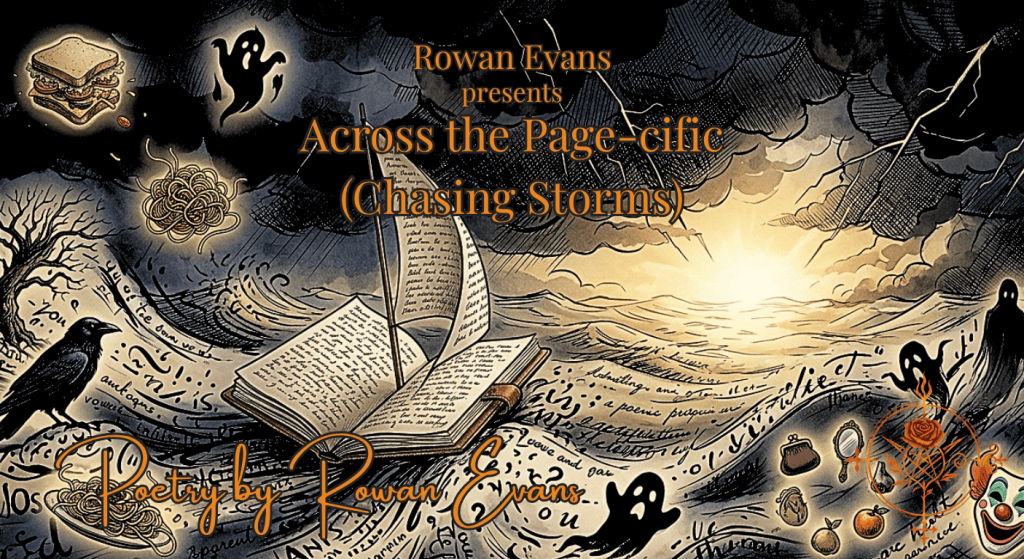
The answer, apparently, is sandwiches, pasta, farmers on Pluto, raccoons in silk pajamas, llamas, trees, cartoon ghosts, monsters, seven deadly sins, and a journey across an ocean that does not technically exist.
And honestly?
I love it.
Across the Page-cific (Chasing Storms) is a celebration of the strange places my writing can go when I stop trying to force it into a single shape.
This poem deliberately references several of my recent pieces and recurring worlds. The sandwich wordplay comes from Lost in the Sauce. The pasta-based literary assault comes from Impasta (A Diss in Pasta Form). The trees point back to my playful botanical wordplay, while Danny Phantom, the Monster in the Margins, the Seven Deadly Sonnets, ravens, spirits, and other imagery come from the larger mythology and vocabulary I’ve been building throughout my work.
The references aren’t just Easter eggs.
They’re evidence.
Evidence of how much my writing has changed—and how much more willing I am now to let different parts of my voice coexist.
For a long time, I thought I needed to choose what kind of writer I was supposed to be.
Gothic poet.
Confessional poet.
Love poet.
Dark poet.
Funny poet.
Experimental poet.
But the more I write, the less interested I am in choosing.
I want to write the heartbreak poem with sandwich ingredients.
I want Tony Stanza to write a pasta diss.
I want to turn mythology into autobiography.
I want to write about ghosts and gods, then turn around and make a terrible pun.
I want to chase a metaphor until it becomes absurd.
And then, underneath all of it, I want to find something honest.
That is what the storms in this poem represent.
The chaotic lines.
The sudden cadence changes.
The ideas that arrive from nowhere.
The parts of my mind that refuse to walk in a straight line.
I used to think I needed to calm those storms down.
Now?
I chase them.
Because writing has become a playground again.
And somewhere in that playground, I keep finding pieces of myself I hadn’t finished discovering.
“It was writing that saved me” is therefore not a throwaway line.
Writing gave me a language for experiences I couldn’t always explain directly. It gave me somewhere to put the contradictions, the humor, the darkness, the questions, the love, the anger, the absurdity, and everything else that makes up the person behind the pen.
Piece by piece.
Bit by bit.
I rebuilt myself in the art.
And apparently, sometimes that art looks like a sandwich, a bowl of pasta, and a storm on the Pacific.
I’ll take it.
— Rowan Evans
I stopped trying to avoid the storms. I started chasing them across the page.
Across the Page-cific (Chasing Storms) Poetry by Rowan Evans
Let’s see, what other ridiculous thing
can we turn into poetry—
I’ve written a heartbreak poem
using sandwich ingredients,
and wrote a diss poem
using nothing but pasta noodles—
was a farmer on Pluto,
witnessed raccoons in silk pajamas
perched on the backs of llamas—
while I shaped love poems
out of the trees—
I’ve turned Danny Phantom
into religion—a whole faith
on “going ghost”—
but really it’s just me stuck
between worlds.
I’ve written as the monster in the margins
and the spirits in the room—
seven sins that act like tax on the soul.
Go against the monster, you won’t leave whole.
Feeling like Pennywise, grin wide,
’cause I’m a clown in my rhymes
sometimes—
I’ve taken trips
in ink-dipped ships
across the page-cific—
avoiding storms of chaotic lines
and jagged rhymes
with sudden cadence changes.
Just kidding—
I chased the storms across the page,
embraced the pace my brain gave.
It was writing that saved me—
it gave me a way to translate me,
piece by piece and bit by bit,
I rebuilt myself in the art of lit—
where a mind like mine appears rarely.
Journey into the Hexverse…
[Lost in the Sauce] A playful heartbreak poem where sandwiches, ketchup, mustard, rye, lettuce, and sourdough become metaphors for emotional confusion. Beneath the food puns is a speaker trying to understand how everything went from “we’re okay” to suddenly feeling cold.
[Impasta] Tony Stanza is back with another literary attack—and this time, he’s bringing pasta. Spaghetti, fettuccine, macaroni, ravioli, and angel hair become weapons in a ridiculous diss aimed at a poet whose rhymes are allegedly cheesy, fragile, and completely impasta.
[Pluto Farmer] A whimsical absurdist poem about being a certified weirdo, farming space carrots on Pluto, and refusing to fit into anyone else’s definition of “normal.”
[Raccoons in Silk Pajamas] What begins with judgmental Space Chickens quickly spirals into camels in parked cars, elephants in jam jars, raccoons in silk pajamas, and astronauts in the ocean. A playful absurdist poem about language, imagination, and what happens when you stop trying to control where the words go.
[Did You Really Think This Was About Trees?] A playful love poem disguised as a forest of terrible tree puns. Beneath the birch, oak, cedar, palms, lumber, and absurdist wordplay is a poem about devotion, loyalty, laughter, and building a life with someone you love.
[Danny Phantom Theology] What begins as a metaphor borrowed from a childhood cartoon becomes something deeper: a reflection on existing between survival and possibility, exhaustion and hope, the life we have and the life we long for. Danny Phantom Theology explores what it means to keep moving toward a future that feels worth living.
[The Monster in the Margins II] The Monster in the Margins II transforms Rowan Evans’s Seven Deadly Sins mythology into a horror story written between the lines, where Lust, Wrath, Sloth, Greed, Pride, Envy, and Gluttony become monsters growing from pain, grudges, and scars.
Some poems begin with a carefully constructed metaphor.
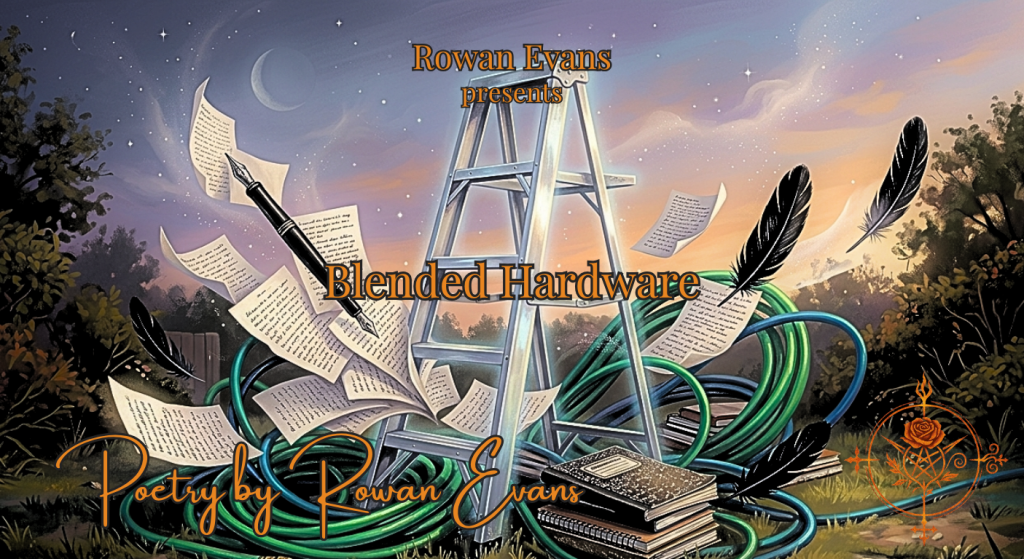
This one began with a step-ladder.
And then immediately refused to behave.
Blended Hardware is intentionally ridiculous. I started with a simple object and let my mind wander wherever the language wanted to take it: ladders became hoses, hoses became an excuse for a terrible joke, friendship became Star Wars, Obi-Wan became a teacher, Luke became Leia, and suddenly I was revisiting different versions of myself across my writing history.
That wandering is the point.
I’ve been thinking a lot lately about how much more playful my relationship with language has become. I don’t always sit down with a destination in mind anymore. Sometimes I just start writing and see what happens.
This poem is one of those moments.
It also became a strange little conversation between different versions of Rowan. The fifteen-year-old writer appears briefly, the Gothic voice tries to take over, and the present-day me immediately interrupts to tell her to calm the hell down.
That self-interruption is probably one of my favorite parts of the piece.
I can write something dramatic and immediately recognize that I have made the moment far more Gothic than it needs to be.
I can make a joke, realize the joke went somewhere questionable, and then literally put myself on trial inside the poem.
That is part of what makes writing feel like a playground again.
I don’t have to protect every poem from being silly.
I don’t have to make every metaphor profound.
I don’t have to prove that every line deserves to exist.
Sometimes I can just follow a thought until it becomes a garden hose, an Obi-Wan reference, a fifteen-year-old version of myself, and an increasingly concerned author asking whether she accidentally threatened somebody.
And honestly?
That’s enough.
— Rowan Evans
Sometimes you start with a step-ladder and end up somewhere completely different.
Blended Hardware Poetry by Rowan Evans
This is my step-ladder.
I call it a step-ladder, because I had another ladder before—
and yeah, I got plenty hose— different shapes and different sizes, some are six feet, some are four— I’m glad I only have two outside faucets, ’cause I wouldn’t have plenty hose, if I had one more. (I only have two hoses.)
You’re not just my homie, you’re my Obi-wan Kenobi— and I’m Luke, mixed with Leia. That means you’re my teacher, and my only hope, playa.
(I’m sorry for that, truly. I don’t know what I was thinking. I’m going to… I’m going to put the pen down now.)
SIKE! I lied like it’s 1999— four more years and the myth would start, a poet born with a blackened heart.
(Dial back, that was too gothic for this piece.)
I mean, sike… I lied like it’s 2005— and I’m fifteen with a pen again, two years into the journey mapping how I’d survive—
and I mean me, not them— I’m talking the person they’d grow into. The person I’d caution you, against taking a pen to—
that’s a battle you wouldn’t win, boo.
(Wait…
was that a threat?
In a joke poem?
Too far, Rowan… too far.)
Journey into the Hexverse…
[Not the Way Jesus Did] A provocative poem about religious judgment, hypocrisy, outcasts, and the contradiction between preaching compassion and condemning those who live differently.
[Noon is Loud] If four in the morning belongs to truth, then noon belongs to impossible memories. Noon Is Loud is a playful free verse poem filled with absurd boasts, pop culture references, and tongue-in-cheek mythology that explores how easily imagination can rewrite reality.
[Content Warning] What if you reviewed a person the way you’d review a terrible novel? Content Warning is a playful, satirical poem that uses literary criticism as the ultimate roast, proving that sometimes the sharpest metaphor is also the funniest.
[Chemical X] Chemical X explores the rapid, associative way one creative mind moves—from cartoons to sports, comic books to music—revealing that inspiration isn’t linear, but a collision of memory, humor, rhythm, and intuition.
[Off Leash Thought] A reflective free verse poem exploring the mind as a living, wandering force—unpredictable, creative, and sometimes chaotic—through the metaphor of a dog off leash. It embraces mental drift not as a flaw, but as a natural part of creative thought and self-awareness.