Sometimes the loudest hater in the room is the one you brought with you.
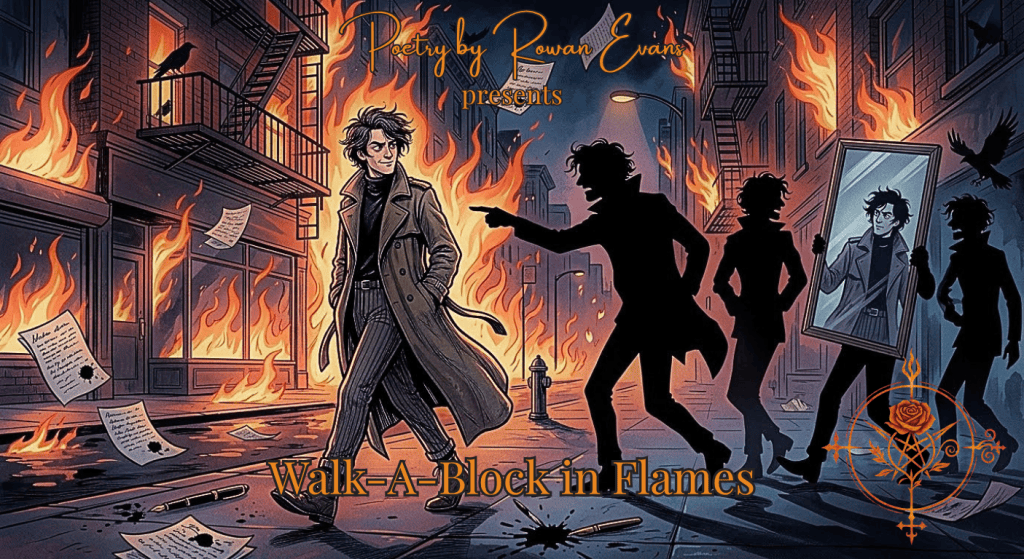
Walk-A-Block in Flames started with the idea of imaginary critics—the voices that somehow manage to find fault with everything you do, even when nobody else is actually saying a damn thing. Naturally, my brain decided the appropriate response was to turn that internal conflict into a ridiculous walk around the block, throw in some wordplay, and see how many times I could make the joke work before the poem eventually turned the joke back on me.
Because beneath all the flames, bravado, and fake enemies, there’s a much simpler realization:
Sometimes the person I’m arguing with is me.
And honestly?
That’s probably the funniest part.
— Rowan Evans
Plot twist: the haters were imaginary, and unfortunately, they had my voice.
Walk-A-Block in Flames Poetry by Rowan Evans
They tell me,
these imaginary haters,
that I’ve fuckin’ created—
they live inside my head,
feeding on my self-doubt—
obsessed with burning the self-down.
They make me take a walk,
a walk around a block
and it’s fucking hot—
I guess you could say,
these imaginary haters made me,
Waka Flocka Flame.
Wait—
I meant to say—
these haters made me
Walk-A-Block In Flames.
Honestly though,
I don’t know
what the fuck
they hate me for—
Is it because my wrist froze?
Nope, I’m broke—
Because I’m the best to ever do it?
Nope, that’s a joke—
Is it because they say
the things I think about me?
Couldn’t be—
because I think I’m great,
and these haters are fake.
I mean literally fake,
figments—
they don’t exist,
it’s just me in this bitch.
Sometimes “I don’t give a fuck” isn’t really apathy. Sometimes it’s exhaustion, overextension, or finally realizing that not everything deserves a piece of you.
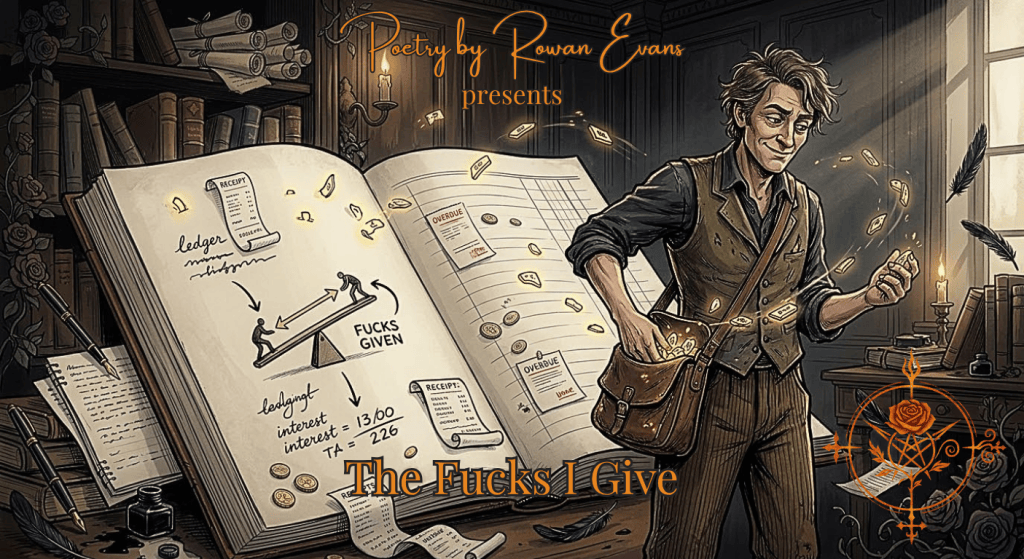
The Fucks I Give takes that idea and turns it into a ridiculous little accounting problem. If I’ve been handing out fucks like they’re an unlimited resource, eventually I’m going to have to audit the books, collect the outstanding balance, and start charging interest.
Underneath the jokes and profanity is something I’m actually pretty serious about: learning to be selective with what gets my attention, my energy, my emotions, and my time.
Because giving a fuck can be an act of love.
So can taking your fucks back.
— Rowan Evans
Apparently, my fucks weren’t free. I’m just finally collecting the outstanding balance.
The Fucks I Give Poetry by Rowan Evans
They said I’m too apathetic,
actin’ like nothing matters,
and it’s pathetic—
they want me to give a fuck,
but shit, I misplaced my bag of fucks—
so I’ve got no fucks to give.
Yeah, I’ll go through
and take all my fucks back—
I’ll walk right up and knock, like—
I’m here to collect my fucks,
and extra fucks too—
it’s a fucking tax,
and there is interest, dude.
You think fucks are endless.
No, I’ve got to be pickier—
because for a minute there,
it was—
fuck everything
and that’s probably
what they’re angry for.
It was fuck this and fuck that—
I was running out of fucks fast.
I sometimes look back at the person I was when I first started writing and wonder how much of that younger version of me is still sitting somewhere inside every poem I create. I started writing at thirteen, the same year I experienced my first heartbreak. Back then, ink wasn’t simply a creative outlet. It was a way to hold myself together, to give shape to feelings I didn’t know how to carry, and to leave a record of myself on the page when I was afraid of losing pieces of who I was.
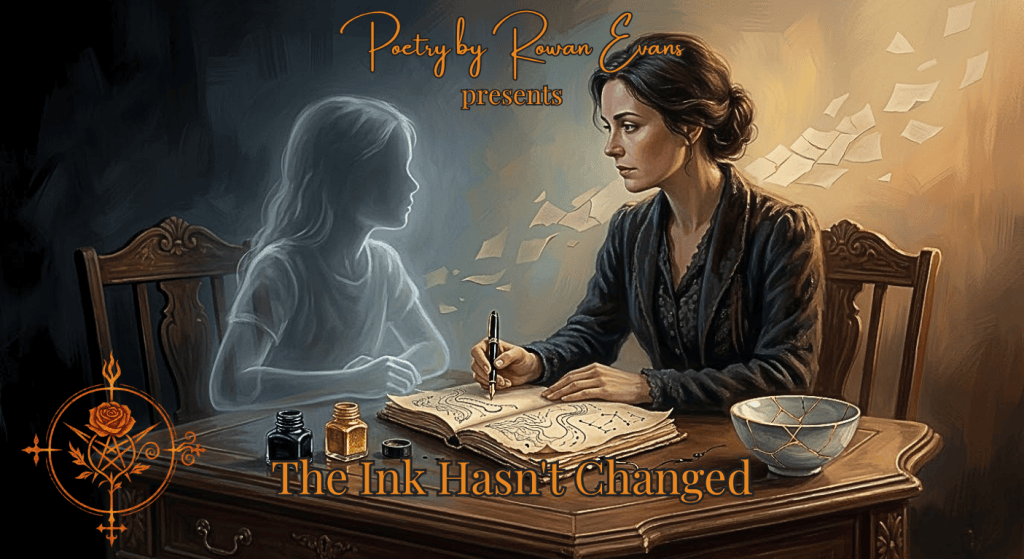
The Ink Hasn’t Changed is about revisiting those beginnings without confusing familiarity with stagnation. The same emotions still find their way into my work: joy, grief, anger, tenderness, laughter, and pain. I’ve continued mapping my soul through poetry, stitching together broken pieces and filling the cracks with whatever gold I could find. The tools and materials may feel familiar, but the person doing the stitching is not the same.
There’s a difference between carrying the same weight and never moving forward. Sometimes, growth means discovering that the thing that once kept you alive can become something you choose to nurture, refine, and share.
My ink hasn’t changed because its purpose never needed to. I have changed. I’ve survived. And the words that once helped me hold myself together now help me understand who I’ve become.
— Rowan Evans
The ink that helped me survive at thirteen still carries my truth at thirty-six. The ink hasn’t changed. I have.
The Ink Hasn’t Changed Poetry by Rowan Evans
I’ve been stuck in the past a lot lately,
just thinking about who I was—
who I was trying to become
and how those early days
set the stage for who I became,
on and off the page.
The same year
I committed myself to ink,
I tasted my first heartbreak—
it was bitter sweet,
hated that it had to come,
but nothing could be done.
That was 2003, I was thirteen—
and she was made to leave.
I took the shattered pieces,
collected in a basket—
I took threads of silver
and sewed myself
back together again.
Cracks patched with gold and ink,
confessions penned in golden ink—
back then
I wrote for me—
I wrote to keep it together,
mentally—
afraid I’d disappear
if I didn’t map my soul in ink.
Turned poetry to cartography,
started mapping the whole of me.
I mapped my soul, wholly—
turned my pain holy.
I tried to translate all of me—
the joy, the pain,
laughter and grief—
and my ink hasn’t changed.
It’s still carrying the same things.
All the same weight, wait—
does that mean I’m stuck in place?
No, just because the ink
has stayed the same—
doesn’t mean I have—I’ve changed,
I’m not the same as I was at thirteen,
now that I’m thirty-six—
and I’m not the same as I was at sixteen,
that’s when I thought my ink was real mean—
but really it was too nice,
the only thing keeping me alive.
Sometimes, the mind wanders somewhere between waking and dreaming, and the unfamiliar begins to feel strangely like home. Maybe it’s just a dream. Maybe it’s imagination playing with possibilities. Or maybe it’s a reminder that the life we’re living right now isn’t the only story we could ever tell.
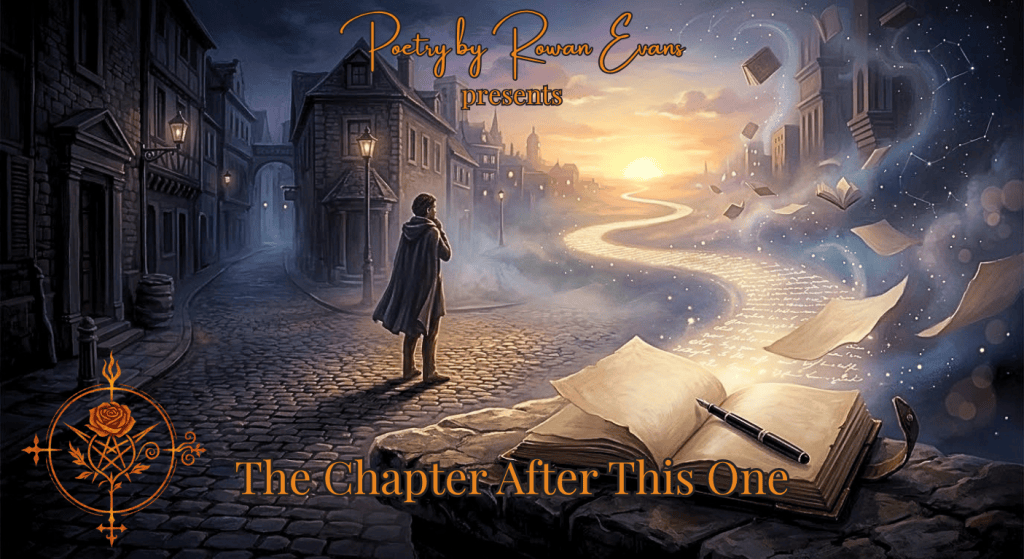
The Chapter After This One is about looking beyond a present that might not feel right and remembering that the story isn’t finished. We don’t always get to choose the circumstances of our current chapter, and we can’t simply flip to the ending to see whether everything works out. Sometimes, we have to keep reading, even when the road ahead is uncertain.
But reading isn’t all we can do. We can question the direction, challenge the expectations, and pick up the pen ourselves. We may not control every twist in the plot, but we can make choices that shape what comes next.
The future isn’t a page we’ve already read. It’s a chapter we haven’t reached yet—and perhaps, in more ways than we realize, we’re already helping to write it.
— Rowan Evans
You may not be able to skip to the ending, but you can still pick up the pen and help write what comes next.
The Chapter After This One Poetry by Rowan Evans
I’ve been drifting today— constantly somewhere in-between awake and asleep— between reality and a dream. One moment, I’m sitting alone— the next I’m walking streets I’ve never known.
Yet somehow, those streets feel like home.
I can’t say for certain where I was, but I had a pretty good idea— it felt familiar but not, like I was getting a preview— for a future plot. Like the writers for my life— were showing me, I’m not stuck in the story I got.
And while it’s true, I may not like the current chapter— I just have to keep reading, to find out what comes after— you cannot skip ahead, that’ll only lead you down the wrong road instead.
If you don’t like the direction, pick up a pen—become a co-writer then. You can’t rely on, just anyone, take matters into your own hands. You can shape fate, you can write for your own life— you know you can guide the plot, right?
Journey into the Hexverse
[Everything and Nothing]
What happens when you’re quiet but observant, overwhelmed yet seemingly empty, surrounded by beauty but sometimes seeing only decay? Everything and Nothing is a confessional poem about overthinking, mental exhaustion, contradiction, and the absurd humor that helps us keep going—even when we’re wobbling in socks and Crocs.
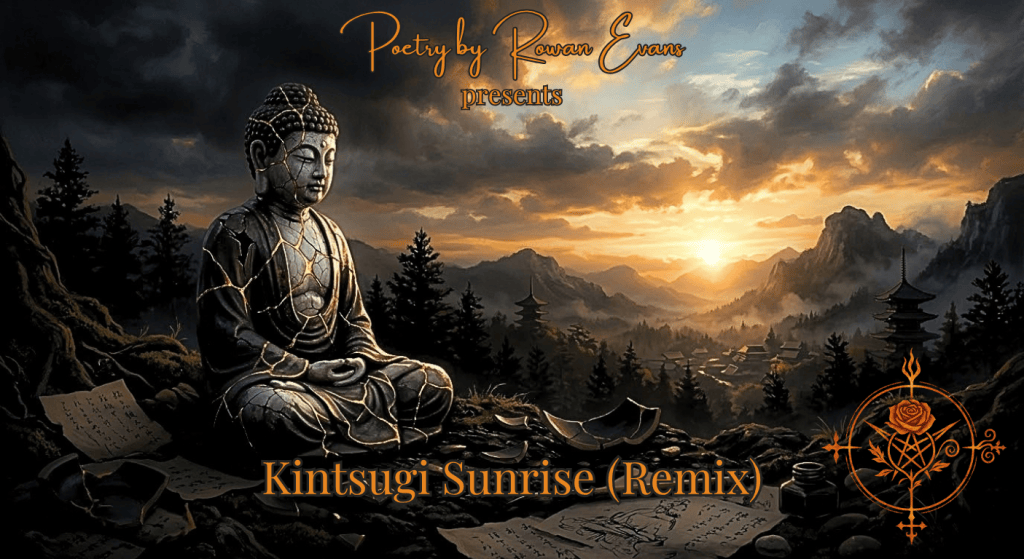
Kintsugi Sunrise (Remix) returns to a piece I first wrote in January 2024—a poem born from a mind trying to survive its own cracks. The original captured the feeling from inside the storm. This version comes back to the same landscape with a little more distance, a little more clarity, and a different relationship with the person standing among the broken pieces.
The cracks are still part of the picture. So is the gold.
But this time, the sunrise feels less like something I am desperately waiting for and more like something I have finally learned to recognize.
The original was about trying to become whole.
The remix is about realizing I was already becoming something new.
— Rowan Evans
The cracks remained. I just learned how to fill them with gold and face the sunrise.
Kintsugi Sunrise (Remix) Poetry by Rowan Evans
Apologies whispered—
I had to disappear for a while,
retreat inside my mind,
try to rewire—
cause I was feeling broken,
shattered.
There were cracks in my psyche,
twisting thoughts inside me—
telling me I’m worthless—
every night I’d drift
into a hell scape—
stuck in my mind’s cage.
So I’d sit inside my mind,
filling cracks with gold—
finding beauty in the pain,
performing kintsugi on my brain.
And the pain eased,
clouds lifted—
something shifted—
no more skies of grey.
Finally, I could sit and watch
the sun rise on a new day—
my outlook had changed.
Now I look to the future—
with hope.
Journey into the Hexverse
[Half a Picture] What happens when someone falls in love with the person they discover through your poetry? Half a Picture explores the strange intimacy between writer and reader—and the distance between seeing someone’s mind through their words and truly knowing the whole person.
[For the Youth (Remix)] A 2026 remix of Rowan Evans’s original 2024 poem, encouraging young people to embrace their truth, recognize their worth, raise their voices, and become the light they want to see in the world.
[All for Me] When thunder becomes applause, lightning turns into paparazzi, and rain rolls out a flooded red carpet, one poet starts wondering whether nature’s celebration has gone a little too far.
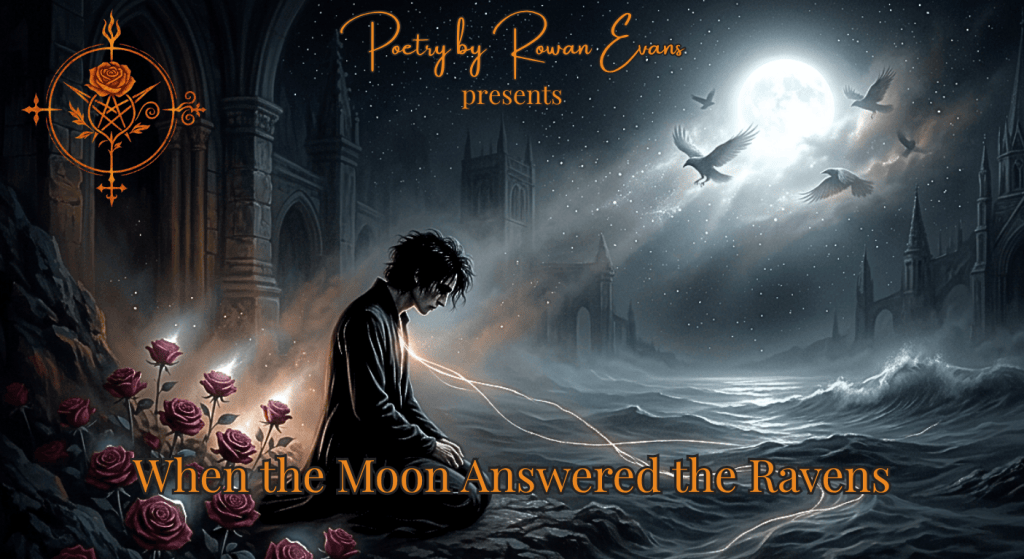
Some dreams begin in darkness, but not all darkness is empty. Sometimes, the things we recognize by instinct—ravens calling, roses blooming, the pull of the tide, the quiet presence of the moon—become the only landmarks we need.
This poem wanders through an abyss where absence becomes invitation, where questions lead deeper than answers, and where the familiar waits beyond the silence. It is a journey through the spaces between fear and comfort, memory and discovery, nothingness and belonging.
And perhaps the moon was never truly missing. Perhaps some forms of light simply require us to keep walking until we’re ready to see them.
— Rowan Evans
Even in the deepest abyss, some light knows how to find you.
When the Moon Answered the Ravens Poetry by Rowan Evans
I had a dream last night—
a line I’ve written too many times,
but this one was different—
there was no moon, no tide—
no shoreline—it was pitch black,
an abyss—just me and nothingness.
Then I heard the raven’s calls—
and it didn’t feel bizarre at all.
It felt oddly—
calming—
I stumbled further into the dark,
listening to raven after raven call—
it was weird, this unkindness
didn’t feel very unkind at all—
I tripped on something,
which was odd—
because there was nothing
to trip on.
I fell—
hit the ground—
the ravens didn’t make a sound.
Slowly, I rose to my feet—
surprised to see, a rose at my feet.
Illuminated by a single sliver
of silver light—
it caught my eye,
so I knelt down—
as my eyes scanned
the surrounding abyss—
I saw them.
Roses,
a dozen of them—
each lit by its own sliver
of dedicated lunar light—
which told me,
it was night—
but something didn’t feel right—
where was the moon at?
What was the source of this light?
The questions didn’t stop me—
I kept walking—moving further,
deeper into the abyss—
when suddenly the taste of salt
hit my lips—
and the ground begin to shift,
it moved like waves—
now I couldn’t stop,
something was pulling me—
something I couldn’t see,
but could feel it—
a thread tied to my heart,
pulling me along.
It was guiding me—
but at the same time,
there was something
pushing me—
and I dropped a hint
five lines back—
what could that be?
And as I let the thread
pull me along—
I began to notice
the light—
an image trembling—
it was shimmering,
across the top of the abyss—
eyes lifted, I saw it,
the thing I missed—
hanging high above,
it was my favorite witness—
the one I could always sit with.
Finally—
after what felt like
an eternity of silence—
the ravens started
to speak again—
and the moon
answered them—
that’s when the world came alive.
I could hear the ocean waves,
feel the mist on my face—
taste the salt on my lips,
ocean kissed—
the smell of roses
perfumed the air—
it’s like the world
suddenly became aware
that I was even there—
I was on my knees,
watching the waves—
smile on my face—
because in the back of my mind,
I knew…
the moon would never abandon—
the tide would never
refuse to guide—
the ravens
would never leave my side,
while everything I feel—
an ocean deep, an ocean wide—
the roses grow in a garden shaped by
all the beauty and pain in my life.
Journey into the Hexverse
[You Still Pop Into My Brain] Sometimes, someone from your past still wanders into your thoughts—not because you want them back, but because they once held a place in your everyday life. A reflective poem about disappointment, growth, and the strange persistence of memory after moving on.
[Louder Than the Rain] A short confessional poem about the overwhelming noise of anxious thoughts, the strange silence of feeling alone in a crowded room, and finding a way to translate pain into words.
[Let Me Be Pacific] A lyrical poem about sitting beside the Pacific Ocean and discovering that an enormous body of water can become a bridge between distant hearts. Through ocean imagery, wordplay, and reflections on California and the Philippines, Let Me Be Pacific explores how love and poetry can cross even the greatest distances.
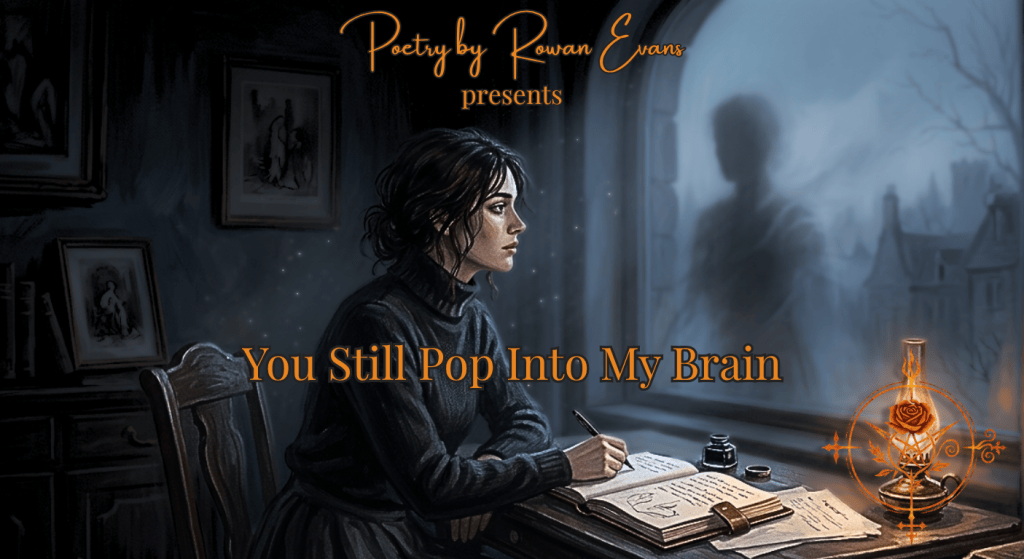
Some people leave your life in a single, dramatic moment. Others fade through a series of small decisions, subtle disappointments, and lessons you never asked to learn. And sometimes, long after you’ve moved forward, a familiar name still wanders through your thoughts—not because you want them back, but because they once occupied a place in your everyday life.
This piece sits in that strange space between moving on and remembering. It doesn’t reach backward with longing or anger. It simply acknowledges that even when someone no longer belongs in your life, the mind may occasionally forget to stop looking for them.
— Rowan Evans
Some memories still visit. They just don’t feel like home anymore.
You Still Pop Into My Brain Poetry by Rowan Evans
You look at me now,
and see—
someone better than
who I used to be—
but that’s all
thanks to you—
if I hadn’t learned the lessons,
if you hadn’t switched up
and made me see—
you were never the one for me.
It didn’t come all at once,
it came in steps for me,
you began to pull away, gradually—
it was little things at first,
you’d do things you thought would hurt—
introduced me to him,
just so you could flirt—
thinking I’d see it,
and feel like dirt—
but it didn’t work.
Because for me,
it was whatever—
we weren’t officially together.
We never talked, exclusive—
so who would I be
to be mad to begin with?
No, I wasn’t mad—
I was more like your parents,
just disappointed
in who you had become.
You used to be someone
in my life—
I used to reach for my phone
every time something happened—
wanting to tell you,
and sometimes I still do.
It’s a strange feeling
because it’s been so long—
and it feels so wrong,
that you sometimes—
still pop into my brain.
But it’s not the same—
it’s not how it used to be.
Journey into the Hexverse
[Lessons Without Kindness] A reflection on learning self-respect from a relationship that changed—the lessons hidden in manipulation, silence, and loss, and the realization that you don’t have to shrink yourself to make someone else feel tall.
[Circle of Me] A reflective poem about sitting among the voices of memory, joy, pain, and fear—and realizing that some burdens are bigger than any one person.
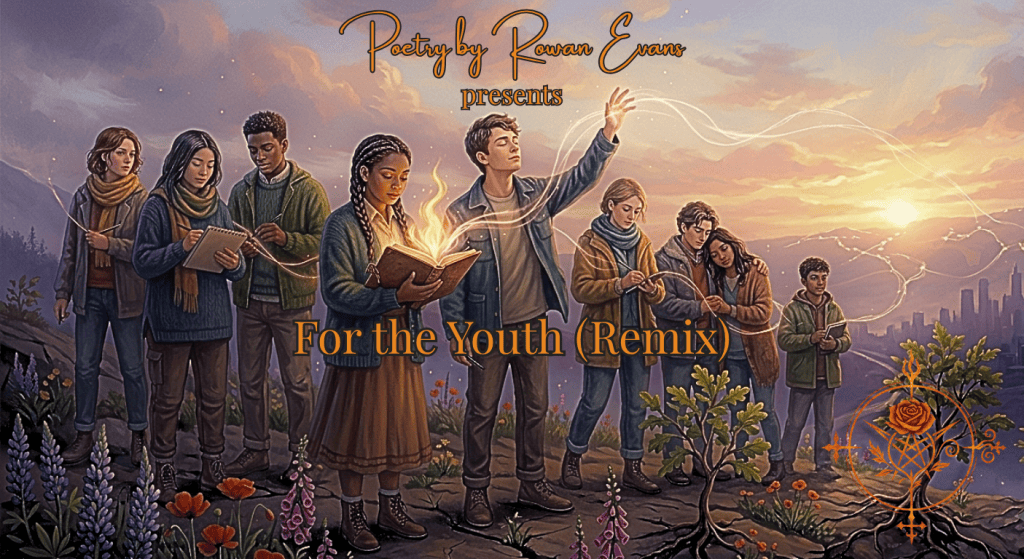
For the Youth (Remix) is a return to a message I first wrote in October 2024: a reminder to young people that their voices matter, their identities deserve space, and their futures do not have to be defined by the darkness around them.
Revisiting this poem in 2026 gave me the opportunity to reshape its language, adjust its rhythm, and give certain ideas more room to breathe. The heart of the piece remains the same, but the pen has continued to evolve since the original was written.
This is not a replacement for the poem that came before it. It is a conversation with that earlier version—a chance to revisit the same hope with a little more experience, intention, and perspective.
To the youth, the dreamers, the poets, and everyone still learning how to stand in their own light:
Rise. Shine. Ignite.
— Rowan Evans
Rise. Shine. Ignite. Your voice has always belonged in the light.
For the Youth (Remix) Poetry by Rowan Evans
To the youth of the world,
hear this whispering call—
you are the dawn breaking,
the rise after the fall.
Embrace your truth—
let it shimmer, let it show,
rise, shine, ignite—
your spirit divine.
Stand tall like mountains—
unyielding and grand,
let your voices ring out—
a wild, fierce band.
Be loud, be proud,
let your colors unfurl,
rise, shine, ignite—
the dreamers of the world.
Your light is a beacon
in shadows so stark,
A flame in the darkness—
igniting the spark.
Don’t let whispers of doubt
cast their pall,
rise, shine, ignite—
you will not fall.
In gardens of chaos,
you bloom and you fight,
with petals of courage
dispelling the night.
See your worth—
young hearts,
let it echo and soar,
rise, shine, ignite—
the poets,
the dreamers, and more.
Know there’s room for growth,
like trees reaching high,
roots deep in the earth,
branches in the sky.
Your journey is sacred,
each step is your song,
rise, shine, ignite—
you’ve always belonged.
So rise from the ashes,
let your dreams take flight,
illuminate the world
with your radiant light.
You are the change,
the revolution’s embrace,
rise, shine, ignite—
a fearless face.
To the youth of the world—
this message I send:
your hearts are the compass,
your voices the trend.
Embrace your own truth,
let it blaze and burn bright,
rise, shine, ignite—
turn darkness to light.
Journey into the Hexverse
[For the Youth] A lyrical call to the youth of the world to embrace their truth, ignite their passions, and illuminate the world with courage, creativity, and hope.
[Caged Birds Don’t Bow] A defiant remix of Rowan Evans’ “Caged Birds Don’t Bow,” confronting control, possession, and insecurity through the imagery of a bird breaking free from its cage and reclaiming its wings.
[Hell’s Protégé] Rowan Evans revisits Hell’s Protégé, originally written in 2024, and reshapes the dark, infernal persona through a newer voice. The remix keeps the fire, darkness, and diabolic ambition of the original while allowing the poem to breathe differently.
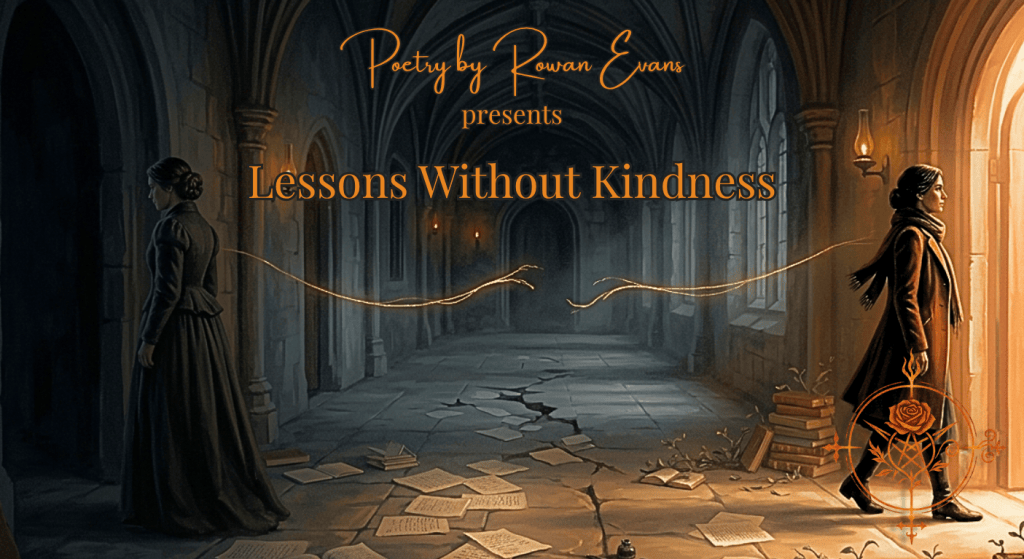
Lessons Without Kindness is about the strange education that can come from losing someone who once felt like your entire world.
This isn’t really a poem about getting even. It’s about looking back at a relationship that changed, recognizing the games, the silence, and the ways I allowed myself to become smaller just to keep someone else comfortable—and realizing that I don’t live that way anymore.
The person who taught me these lessons never intended to be my teacher. They didn’t sit me down and explain what I needed to learn. They simply gave me an experience harsh enough that I eventually learned it myself.
Sometimes the most important lessons don’t come from kindness, wisdom, or good intentions.
Sometimes they come from realizing what you will never allow yourself to become again.
— Rowan Evans
Not every teacher is kind. Not every lesson is wasted.
Lessons Without Kindness Poetry by Rowan Evans
There was a time when
you were my world,
everything was fine and
we really did love each other,
or so I thought—
yeah, we’d always talk—constantly,
I was always thinking of you,
and I thought
you thought about me too.
Maybe you did—once,
then you changed
and started playing games—
you tried to get under my skin,
pit me against him.
But here’s the thing—
he was never gonna win.
I mean, truly,
the only real loser was you—
because in doing what you did,
you lost me too.
And I’m not saying I was a prize,
but I really was a catch for you—
I put up with too much,
and spoke up too little.
But I don’t do that anymore.
I don’t shrink so someone else can feel tall.
I don’t bend so someone else can feel right.
I don’t stay quiet so someone else can stay comfortable.
You taught me that.
Not intentionally—
but lessons don’t need kindness
to be true,
just a student and a teacher—
that was me and you.
Journey into the Hexverse
[The Sacred Timeline] From childhood stories about Dragon Ball Z, Power Rangers, and Pokémon to gothic cathedrals, ravens, roses, identity, healing, and experimentation, The Sacred Timeline traces how Rowan Evans’s relationship with the pen evolved across thirty-six years—and how the ink remained while the writer kept changing.
[The Metaphor Machine] A poem that takes apart its own machinery as it runs—breaking lines, breaking thoughts, and following metaphors from moonlight to tides, oceans, shorelines, and city streets.
[Louder Than the Rain] A short confessional poem about the overwhelming noise of anxious thoughts, the strange silence of feeling alone in a crowded room, and finding a way to translate pain into words.
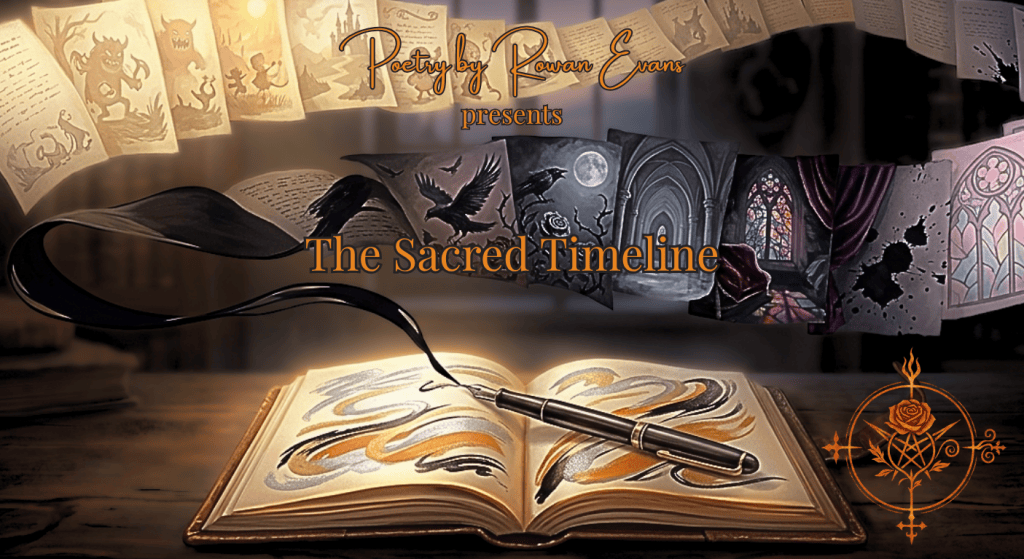
The Sacred Timeline is a map of how my relationship with the pen has changed over nearly three decades of my life.
I started with stories about worlds that already existed—Dragon Ball Z, Power Rangers, Pokémon—and slowly began building worlds of my own. Then the pen became a way to learn cadence, translate music, hide things I couldn’t say aloud, survive periods when writing itself became difficult, and eventually turn pain into something crafted enough to share.
Every era left something behind: the storyteller, the songwriter, the secret keeper, the gothic romantic, the heretic, the battle poet, the confessor, the mythmaker. Some symbols came and stayed. Some meanings changed. Some questions took decades to become clear enough to write down.
And the timeline is still moving.
At thirty-six, I don’t consider the pen mastered so much as understood differently. Writing is still an experiment. The boundaries keep moving. The imagery keeps evolving. The person holding the pen keeps changing.
Maybe that’s the most sacred part of the timeline: the ink stayed, but I didn’t.
— Rowan Evans
Thirty-six years, countless pages, one pen—and an identity still being written.
The Sacred Timeline Poetry by Rowan Evans
I picked up a pen for the first time at seven, I was just writing stories then— Dragonball Z, Power Rangers and Pokémon… that’s what I wrote about way back when—
it was much lighter out, the sun had yet to meet the clouds— I was a natural storyteller, a real lore keeper, weaving lore before I even knew what lore meant. It was like this for years, I created my own space in worlds provided by minds much older than mine.
Then at ten—I switched what the pen meant to me, my creativity shifted mentally— no longer was I just a storyteller, I was letting music be the teacher now. Translating thoughts to song, at least the words of it— I was writing to worship something. Something that in six short years, I would begin to question—
but the years between ten and then—were spent, using the pen to learn cadence. I was trying to learn to perform on the page— I couldn’t do it in body, but I could turn a notebook to a stage.
At twelve things began to shift again, but with me, not with the pen— I still felt the sun, I still saws its rays, but I also saw more cloudy days— that year was hard for me, I couldn’t talk about it with clarity— most people would react like, “you’re scaring me”— so I stopped talking about it really, I closed my lips, but still let the ink spill— the page became a secret keeper, keeping the secrets this storyteller was too afraid to say out loud.
Thirteen the skies went dark— this is when life really got hard. At the beginning of the year, it’s like the ink in my pen had begun to dry— I don’t know what was wrong, but I couldn’t write. I tried and I tried— pages ripped from notebooks, balled up and scattered.
No songs, no stories— I had lost interest in things that I used to find most interesting. Parents took me to the doctor, and the doctor said—
“This kid’s depressed— and anxious too, I’ll write a prescription that should do. A referral for therapy, they’ll get them to talk— they’ll find out what’s wrong.”
A week would go by— giving the medicine a try, it takes time— it has to build up in your system. In the meantime, here’s a therapist, someone to talk to— they’ll listen to your problems, they’ll help you.
And they did—a little bit, they got me to talk a little bit too. But still they saw I was holding back— so they recommended journaling, but that felt tedious and boring. I needed to find a way to make it play— bring a little joy to it, even if falsified.
I made it a game to translate my pain— how many ways could I say everything? Is it possible to flip it? Maybe change the script and shift the meaning? These were the questions I began to ask— even when my ink ran in all black—
back when my heart was all cracks, before I learned how to use the gold to patch— I struggled through, just writing purely what I felt— thirteen, fourteen and fifteen, often felt like hell.
Sixteen, I hit my stride— not in life but with a pen, things were hard still, but now I could translate with skill. Not much, if we’re being honest— just enough to keep the pain beautiful, in case someone else saw it—
Seventeen, I did it again— reinvented myself with the pen, more gothic in my intentions. Maybe I finally read Poe, who knows— but ravens became a part of my soul.
At eighteen, I went from church steeples and church people to writing cathedrals for outcasts and heretics— we hadn’t yet, become luminous. Shadows and lace, velvet and venom— but I also opened my eyes more, became more aware of the world around— outside the borders I’m confined in.
At twenty, I started to write for people more—to uplift, and let them know they’re not alone— whatever they were going through, there was somebody with them. Even from a distance—
I had friends across seas, in places with palm trees— and in places with Kangaroos, even scarier—Emu.
I don’t know what that means in this piece—but it’s true, so do with that, what you’re going to do.
At twenty-two, I got more serious about the ink— I started to write everything. Every thought and every half-formed idea— I just put it on a page, my brain would not be a cage.
Then came twenty-five, the lowest point in my life— it wasn’t a sudden crash, but a slow rot— it bled through every thought, a feeling I couldn’t translate, familiar but different, heavier somehow— so the ink slowed to a drip, I started to let thoughts slip.
Twenty-six, I got serious again— more aggressive with the time spent, my pieces became more crafted and the ink was shaped with intention. Ravens, the moon, and roses too— the symbols I began to use.
I ascend on the back of raven wings— the silver light of the moon pierced the canopy—rose petals drift in the shifting currents of the wind. Everything connects, pay more attention and you’ll become more aware—
At thirty— I really began to question everything— who I was, who I am, who I want to be— and that’s still a question I’m working on answering. But it went deeper than that— I was questioning who I was in a deeper sense, like had I been a façade in some sense. Was I playing the role I was assigned, or being true to who I thought I was becoming?
This became a recurring theme in my poetry— it’s an odd thing to discover so late in life, that the person you thought you were— isn’t who you’re supposed to be. So I chased answers in ink to questions I couldn’t fully ask yet.
There were two more years of this— and I’m still not finished.
Thirty-three hit with another shift— I mixed the light with the shadow, it was Easter in the cathedral— pastel colors lit up the stained glass. My imagery began to shift shades— roses in all colors, pastel hues, but the thorns were still there too. So even my softness had bite—
and it evolved more, by thirty-four— more teeth but more softness too. Brighter hues and deeper shadows— this is when I learned, you can’t have one without the other.
The shadow needs the light to cast— and you need the shade to dim the shine, because too much shine— you might go blind.
Then came thirty-five— the modern era, the current phase, one year before the current day— and I know this won’t age well, it’s too time specific—
Finally, we’ve reached thirty-six, and I feel like I’ve mastered this— but that doesn’t mean I’ve stopped learning, because every day is an experiment— really, it’s all about the experience— just learning new things and pushing it, finding where the boundary is and bending it, you gotta realize— you can’t always give a shit, who cares what they think— it’s your ink—shape it how you see fit.
Journey into the Hexverse
[The Metaphor Machine] A poem that takes apart its own machinery as it runs—breaking lines, breaking thoughts, and following metaphors from moonlight to tides, oceans, shorelines, and city streets.
[Exhibit A (The Evidence)] A quick-witted, unapologetically playful poem about writing fast, crossing lines, roasting the competition, and letting rhythm do the talking.
[Welcome to the Hexverse] Step into the Hexverse—a poetic world where mythmaking, humor, rage, creativity, and confession collide, and darkness becomes something that can be reshaped into art.