Sometimes the loudest hater in the room is the one you brought with you.
Walk-A-Block in Flames started with the idea of imaginary critics—the voices that somehow manage to find fault with everything you do, even when nobody else is actually saying a damn thing. Naturally, my brain decided the appropriate response was to turn that internal conflict into a ridiculous walk around the block, throw in some wordplay, and see how many times I could make the joke work before the poem eventually turned the joke back on me.
Because beneath all the flames, bravado, and fake enemies, there’s a much simpler realization:
Sometimes the person I’m arguing with is me.
And honestly?
That’s probably the funniest part.
— Rowan Evans
Plot twist: the haters were imaginary, and unfortunately, they had my voice.
Walk-A-Block in Flames Poetry by Rowan Evans
They tell me,
these imaginary haters,
that I’ve fuckin’ created—
they live inside my head,
feeding on my self-doubt—
obsessed with burning the self-down.
They make me take a walk,
a walk around a block
and it’s fucking hot—
I guess you could say,
these imaginary haters made me,
Waka Flocka Flame.
Wait—
I meant to say—
these haters made me
Walk-A-Block In Flames.
Honestly though,
I don’t know
what the fuck
they hate me for—
Is it because my wrist froze?
Nope, I’m broke—
Because I’m the best to ever do it?
Nope, that’s a joke—
Is it because they say
the things I think about me?
Couldn’t be—
because I think I’m great,
and these haters are fake.
I mean literally fake,
figments—
they don’t exist,
it’s just me in this bitch.
Sometimes, the quietest person in the room has the loudest mind. Sometimes, the person who seems to have nothing to say is trying to sort through a thousand thoughts that never quite finish forming. And sometimes, when someone asks what’s wrong, the honest answer is both everything and nothing.
Everything and Nothing explores the contradictions that can exist within one person: being observant enough to notice everything while struggling to explain what’s happening inside, feeling surrounded by beauty yet sometimes seeing only the rot, and having the spark to create without always having the fuel to keep the fire burning.
But this isn’t a poem that wants to stay solemn. There’s a paradox wearing socks and Crocs, checking a five-dollar wristwatch, and wobbling through life with questionable coordination. Because humor has always had a place beside the heavier truths, and sometimes the absurdity is part of what makes those truths bearable.
I may wobble. I may lose my train of thought before it reaches the station. I may have days when everything feels wrong and days when I can’t explain why nothing seems wrong at all. But falling and wobbling aren’t the same thing.
And if there’s one thing this paradox knows, it’s how to keep wobbling.
— Rowan Evans
Everything is wrong. Nothing is wrong. The thoughts won’t land, the fire won’t always burn, and somehow this paradox keeps wobbling.
Everything and Nothing Poetry by Rowan Evans
When you meet me—
you’ll think I’m quiet.
I don’t say much,
I sit in silence,
with my mouth shut,
but my eyes are open—
watching, closely.
And when you talk to me—
you’ll wish I was quiet.
I’m way too observant—
I see too damn much,
and I hear just the same—
so don’t get mad at me,
when you get flamed.
But once you get to know me—
you’ll get scared when I’m quiet,
you’re suddenly afraid of my silence.
Because It carries weight,
everything I don’t say—
what’s wrong? You’ll wonder,
what’s on your mind?
You’ll find that it’s nothing—
mind’s blank, no thoughts in it.
But what’s wrong?
A lot.
It would take too long
to list every problem I’ve got.
I’m surrounded by beauty,
but sometimes all I see is rot—
lost my mind, where’d I put it?
I forgot—thoughts jammed,
so I missed the shot.
Thoughts move
but never get where they’re—
before another thought
cuts it off—
so it lands short,
missed the runway by a mile.
And that’s the part
that hurts the most—
when the spark is there,
but the fire is quiet.
The fuel is gone,
so you hope you don’t
have to reignite it.
So to answer your question,
what’s wrong?
Everything and nothing—
it’s in constant contradiction,
my existence—
I guess I’m just a paradox
in a pair of socks and crocs,
with a five dollar
Wal-Mart wristwatch.
But don’t worry—
I’m a weeble,
I wobble—
but I don’t fall down.
Journey into the Hexverse
[Through the Page] A heartfelt thank-you to everyone who has journeyed through the pages of Rowan Evans’s poetry. From ravens and monsters to raccoons in silk pajamas, this playful, multilingual poem celebrates the connection between poet and reader—and the meaning found in sharing one’s art.
[Thoughts of You Have Prime Real Estate] A playful romantic poem that turns the idea of someone “living rent-free in your head” into an entire neighborhood, where thoughts become homes—and one special thought gets the best property in town.
[A Person First] A poem about the difference between loving a woman and loving the role someone expects her to play—because partnership requires respect, autonomy, and room to remain a person first.
Iron Sharpens Iron is about what happens when every version of my creative mind sits down at the same table: the gothic romantic, the absurdist comic, the mythmaker, the battle-poet, the joke creator, and whatever other voice decides to kick the door open halfway through a line.
The notebook becomes the sparring ring. One thought throws a punch, another throws a punchline, and sometimes Batman apparently gets involved.
I don’t always plan where the thread is going. Sometimes I just follow it until the poem lands somewhere that makes sense.
Maybe that’s the point.
I don’t need to silence the contradictions. I need them to sharpen each other.
— Rowan Evans
I don’t silence the voices in my head. I let them sharpen each other.
Iron Sharpens Iron Poetry by Rowan Evans
I sit by myself— alone in body, crowded in mind— it’s a constant battle of wits, moon-fed goth kid versus the battle-poet turning pens to WMDs.
The notebook— just a test site, where I drop bombs. It’s constant— the scream of the alarms.
I write so much because my mind fights too much— a gothic romantic, an absurdist comic— opinions, opinions, too many opinions— constant contradictions.
Is this a joke?
Are the emotions sincere?
What the fuck— (Batman!) is that reference doing here?
That’s just how my mind is sometimes— I write a line and follow it, (Stalker.) I don’t plan it—I just follow the thread, guide the ship and land it. But sometimes I get lost— I’ll orbit the planet, or drift in my dreams— and they say to make the dreams work, it takes team work— well, I became my own team, every version of me.
Gothic romantic, absurdist comic, mythmaker, joke creator and professional hater— (Jokes. Love ya!) a battle-poet raised on battle rappers and comedians— how I learned to land a punchline, can’t fight with my fists— but can fight with my mind, and I do it all the time— with myself, I spar, iron sharpens iron, after all.
Journey into the Hexverse
[Blindfolded & Still Winning] A playful battle-poetry freestyle about shutting off the inner editor, letting instinct take over, and discovering that sometimes the pen writes best when you stop watching it.
[Literarily Speaking] They think silence means weakness. They should probably have paid more attention to the pen. Literarily Speaking turns gothic imagery, raven feathers, rose-petal ink, and absurd fictional geography into a playful battle-poetry flex about dismantling your enemies with words instead of hate.
[The Playground] What happens when mythology stops being something to hide behind and becomes architecture for the imagination? The Playground (Language, Metaphors and More) explores Rowan Evans’s relationship with language, symbolism, metaphor, humor, and twenty-three years of turning the page into a place where anything can happen.
There is a strange kind of intimacy in being known through words.
A reader can walk through your thoughts, recognize pieces of themselves in your metaphors, and feel close to the person behind the page. Sometimes that closeness becomes something deeper—feelings forming around a voice, a mind, a collection of carefully chosen pieces of a life.
But a page is still only a page.
Half a Picture steps into that uncomfortable space between being seen and being truly known. It isn’t dismissing the feelings that can grow through poetry; those feelings can be completely real. It is simply looking at what happens when someone falls for the person they’ve encountered through the words, while the rest of the picture remains outside the frame.
— Rowan Evans
You can know someone’s words by heart and still only have half the picture.
Half a Picture Poetry by Rowan Evans
I’m going to talk about something
I don’t talk about a lot—
it’s an interesting thing,
the way people cling—
messages received—
“I love you,”
excuse me, what?
That’s a strong way to start—
and I’m flattered, really.
But they don’t know me,
not really—
I know they think they do,
because they’ve read my words—
seen my mind
and walked through my thoughts—
that’s how they feel,
and to them it’s real—
who am I to say it’s not?
But they fell in love
with half a picture—
a blurred photo—
and a vague description of me.
Journey into the Hexverse
[All for Me] When thunder becomes applause, lightning turns into paparazzi, and rain rolls out a flooded red carpet, one poet starts wondering whether nature’s celebration has gone a little too far.
[Lessons Without Kindness] A reflection on learning self-respect from a relationship that changed—the lessons hidden in manipulation, silence, and loss, and the realization that you don’t have to shrink yourself to make someone else feel tall.
[The Metaphor Machine] A poem that takes apart its own machinery as it runs—breaking lines, breaking thoughts, and following metaphors from moonlight to tides, oceans, shorelines, and city streets.
Some people leave your life in a single, dramatic moment. Others fade through a series of small decisions, subtle disappointments, and lessons you never asked to learn. And sometimes, long after you’ve moved forward, a familiar name still wanders through your thoughts—not because you want them back, but because they once occupied a place in your everyday life.
This piece sits in that strange space between moving on and remembering. It doesn’t reach backward with longing or anger. It simply acknowledges that even when someone no longer belongs in your life, the mind may occasionally forget to stop looking for them.
— Rowan Evans
Some memories still visit. They just don’t feel like home anymore.
You Still Pop Into My Brain Poetry by Rowan Evans
You look at me now,
and see—
someone better than
who I used to be—
but that’s all
thanks to you—
if I hadn’t learned the lessons,
if you hadn’t switched up
and made me see—
you were never the one for me.
It didn’t come all at once,
it came in steps for me,
you began to pull away, gradually—
it was little things at first,
you’d do things you thought would hurt—
introduced me to him,
just so you could flirt—
thinking I’d see it,
and feel like dirt—
but it didn’t work.
Because for me,
it was whatever—
we weren’t officially together.
We never talked, exclusive—
so who would I be
to be mad to begin with?
No, I wasn’t mad—
I was more like your parents,
just disappointed
in who you had become.
You used to be someone
in my life—
I used to reach for my phone
every time something happened—
wanting to tell you,
and sometimes I still do.
It’s a strange feeling
because it’s been so long—
and it feels so wrong,
that you sometimes—
still pop into my brain.
But it’s not the same—
it’s not how it used to be.
Journey into the Hexverse
[Lessons Without Kindness] A reflection on learning self-respect from a relationship that changed—the lessons hidden in manipulation, silence, and loss, and the realization that you don’t have to shrink yourself to make someone else feel tall.
[Circle of Me] A reflective poem about sitting among the voices of memory, joy, pain, and fear—and realizing that some burdens are bigger than any one person.
There is a particular kind of heartbreak that doesn’t have a villain.
Sometimes nobody betrayed you.
Nobody lied.
Nobody promised you something they couldn’t give.
Sometimes someone simply exists, speaks to you, makes you feel something—and your heart decides to build an entire mythology around it.
That is where Poet’s Curse came from.
I’ve joked before about having a poet’s curse: the tendency to fall into feelings quickly, to hear a little beauty in someone’s voice and suddenly find myself wading into the waves after it. But beneath the joke is something I’ve had to become more honest about.
Sometimes my heartbreak is partly mine.
Not because I was wrong to feel what I felt, but because I have a habit of giving pieces of myself away before I’ve figured out whether there is somewhere safe for them to land.
The person in this poem didn’t necessarily do anything wrong. She didn’t promise me forever. She didn’t lead me somewhere just to abandon me. She talked—and I listened. I heard a siren’s song, and I chose to wade into the water.
So this isn’t a poem about blaming her.
It’s about looking at myself afterward and admitting something uncomfortable:
I learned how to hold on long before I learned how to let go.
And maybe that’s the real curse.
Not that I love too deeply.
Not that I feel too much.
But that once I give someone a piece of my heart, I don’t always know how to take my hands away from the fire.
Sometimes the only way forward is to stop calling that weakness a curse and start learning the skill I never had—
how to let go without becoming less capable of love.
— Rowan Evans
Sometimes the hardest thing to learn isn’t how to love—it’s how to let go of what you’ve already given away.
Poet’s Curse Poetry by Rowan Evans
Here we go again
it’s another season of sin,
the poet’s back
heartbroken with a pen.
Yeah, went and fuckin’
did it again—
it’s my fault
my heart is cracked,
with pieces missing.
You see, I give them away
too freely, it’s such a pain
to be me, I get hooked
too easily—
she did nothing wrong,
she didn’t lead me on, just talked
and I heard a siren’s song—
I waded into the waves,
prayed for things to change.
Pardon the moment of slowness,
give me a moment while I own this
and take accountability for my part
in breaking my heart.
It’s a poet’s curse—
I only learned how to hold on.
I never learned how to let go,
my feelings and emotion
like hot coals in my hands.
Journey into the Hexverse…
[When I Fall] When I Fall is a vulnerable poem about loving without reservation, feeling everything deeply, and refusing to make the heart smaller just because wholehearted love can sometimes lead to loneliness and pain.
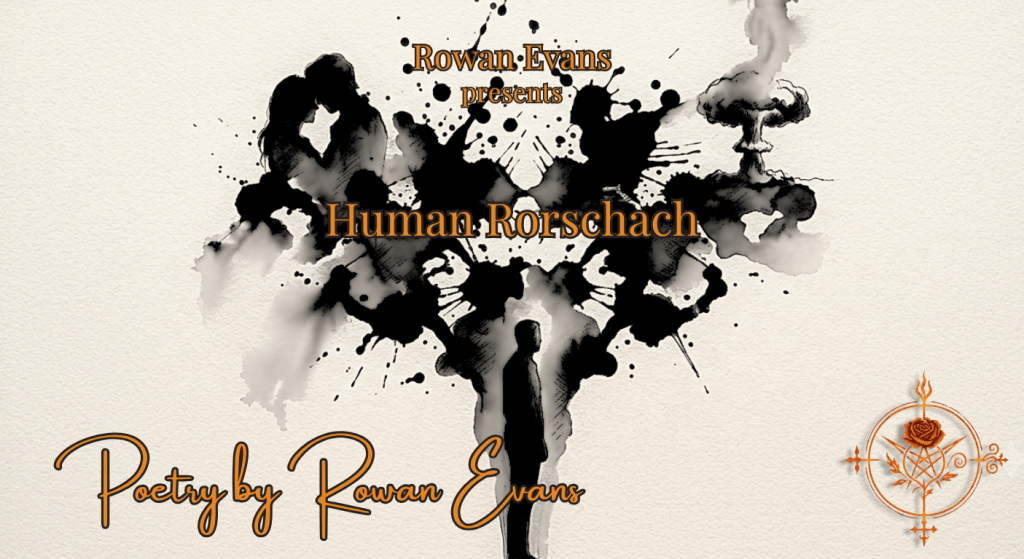
I’ve always been fascinated by the idea that people rarely see the same person the same way. We don’t meet others as blank slates—we meet them carrying our own history, fears, hopes, and assumptions.
The Rorschach inkblot became the perfect metaphor for that. The inkblot itself isn’t trying to be anything; the meaning comes from the person looking at it.
Maybe people work the same way.
Every interaction is filtered through perspective, and perspective is shaped by perception, memory, and experience. Sometimes what another person believes about us reveals far more about their own journey than it does about who we actually are.
This poem is an invitation to think about that relationship between identity and interpretation—and to remember that no one is ever seen exactly as they are.
— Rowan Evans
What we see often reveals more about ourselves than the person we’re looking at.
Human Rorschach Poetry by Rowan Evans
I’m an inkblot
in human form,
a real Rorschach—
am I couple kissing,
or a mushroom cloud?
Love or destruction—
what do you see
when you look at me?
Know there are
no wrong answers—
because what you believe
is fed by what you see
and what you see is perspective,
but perspective is shaped by perception—
I am open to interpretation
and it changes,
with everything
you’ve lived through—
the things you’ve survived.
What you see
when you look at me,
says more about your life—
than it does mine.
Journey into the Hexverse…
[A Rose in the Ashes] Lost within a forest where every leaf becomes a memory, the speaker follows darkness instead of fleeing from it, discovering that healing isn’t found at the end of the tunnel—but in facing the past long enough to notice a single rose blooming through the ashes.
[Leave No Self Behind] What if finding yourself isn’t about discovering someone new, but learning to walk beside every version you’ve ever been? “Leave No Self Behind” is a meditation on memory, healing, and embracing the selves we once abandoned.
[Every Night, The Same Flight] Every night begins with the same flight. Between wakefulness and sleep, an airport appears, a familiar shoreline waits beyond the journey, and the same dream asks whether some destinations find us before we’re ready to find them.
[Through My View] No two people experience the world the same way. Through My View is a reflective free verse poem exploring perspective, imagination, and the impossibility of fully seeing through another person’s eyes.
[Just Human] Just Human is a reflective free verse poem about seeing people before borders, choosing empathy over division, and finding home in our shared humanity rather than on a map.
The one who can write about anything, and the one who struggles to write the one thing that matters most.
This poem begins with confidence—almost arrogance—as the speaker celebrates the ability to write in any voice, on any subject, from any perspective. But beneath that confidence is a question I’ve wrestled with for years: if it’s so easy to write about everything, why is it so difficult to write one completely honest sentence?
Humor, metaphors, references, and wordplay are some of my favorite tools. They help me explore ideas, soften difficult emotions, and make heavy subjects more approachable. But they can also become places to hide.
One Honest Sentence is about recognizing that difference. Sometimes the greatest challenge isn’t finding beautiful language—it’s finding the courage to stop decorating the truth long enough to simply say it.
— Rowan Evans
Writing beautifully is a skill.
Writing honestly is a different kind of courage.
One Honest Sentence Poetry by Rowan Evans
I don’t usually like to do this, but
I’m going to do it anyway, because
I’m tired of pretending—
why should I lie and say
I’m not that guy,
when I know I am.
Give me a pen,
and I can write anything.
If a person can think it
or have an experience,
I can turn it into poetry.
I do it by stringing ink
into so many pretty lines—
but I don’t bother to try
and rhyme, most of the time.
I wrote poem after poem—
I can write a poem about the search for home
while feeling alone in a crowded room,
talking about how this house feels like a tomb.
I can write island hopping epics—
I can silence skeptics,
put their opinions in the septic—
they don’t know
shhh—
it’s no wonder they talk a lot,
their minds are empty, got no thoughts.
So the verbal diarrhea doesn’t stop—
and when I read what they write,
I call them Watson
’cause their lines are elementary.
I’ve written thirty lines of flex
and after thirty lines,
you’re probably wondering—
what’s next?
Well—
how about we pivot
from flex to truth?
Earlier I said—
give me a pen and I can
write anything.
I can take the joy, the pain,
the sun, the rain
and write a whole damn series—
it’s even easier
if it didn’t happen to me,
I can write about it for days—
poem after poem,
different angles of the same thing.
Because it’s easy
writing about just anything—
what’s hard is writing
a single truth,
without burying it in jokes
and misdirection.
And maybe that’s the joke—
I can write whole worlds,
but not one honest sentence
without my pulse stuttering.
Like what would happen—
if I just said it?
If I turned 1-4-3 to letters
and I just meant it?
Would the world cease to be?
I guess I’m just afraid—
because once I say it,
I can’t unsay it.
Once I write it,
it becomes real.
And real things
can be lost,
can be rejected,
can be held—
and I don’t know
which scares me more.
So again I ask—
what would happen
if I just said it?
Maybe you’d laugh.
Maybe you’d freeze.
Maybe you’d say it back.
Maybe nothing would change
except—
I’d finally be done
hiding behind metaphors.
Journey into the Hexverse…
[Noon Is Loud] If four in the morning belongs to truth, then noon belongs to impossible memories. Noon Is Loud is a playful free verse poem filled with absurd boasts, pop culture references, and tongue-in-cheek mythology that explores how easily imagination can rewrite reality.
[Just Human] Just Human is a reflective free verse poem about seeing people before borders, choosing empathy over division, and finding home in our shared humanity rather than on a map.
[Director’s Commentary] Director’s Commentary is a self-aware free verse poem that turns the poet’s recurring metaphors into the subject itself, exploring creativity, artistic habits, and the humorous inner critic that follows every writer from draft to draft.
[The Answer Is (Yes)] What kind of writer am I? Mythmaker, confessor, comedian, philosopher, dream-architect, romantic, storyteller, and diss-poet. This self-reflective poem explores the impossibility of fitting creativity into a single category—and embraces every version of the truth a pen can touch.
[Before We Created the Labels] Ancient gods return to a fractured world shaped by borders, identities, and separation. “Before We Created the Labels” explores humanity’s divisions through mythic imagery, sacred ritual, and symbolic collapse—asking what remains when we learn to see one another beyond labels.
This poem began with frustration, but it didn’t stay there.
Sometimes it’s easy to blame circumstances for feeling stuck, especially when life starts to feel like the same day repeating itself. While writing this piece, I realized something uncomfortable: the biggest obstacle in front of me wasn’t where I lived or what I lacked—it was my own hesitation.
That realization isn’t meant as self-punishment. It’s an invitation to look honestly at fear. Growth often means stepping into uncertainty, and that’s rarely comfortable. The “storm” in this poem isn’t destruction—it’s transformation waiting to happen.
Sometimes the hardest person to convince to move forward is yourself.
— Rowan Evans
Sometimes the storm isn’t waiting on the horizon.
Sometimes it’s waiting inside us—asking us to finally move.
Maybe the Storm Is Me Poetry by Rowan Evans
Every day I pray for change,
and every day is just the same.
I go to bed in America,
wake up in America—
but that’s my fault I guess,
I haven’t pushed myself enough.
So really,
it’s my fault I’m stuck.
Damn—
that sucks.
What a realization to have,
that really makes me mad—
and honestly…
kind of sad.
I’m stuck and it’s my fault,
when I’m sitting on fire in the vault.
Maybe that’s the worst part—
knowing I’m built for more
than this loop I keep living.
Knowing I’ve got heat
in my hands,
ideas that burn holes
through the page,
dreams loud enough
to shake the dust off my life…
Yet—
I keep waking up
in the same place,
I swore I’d outgrown.
And maybe that’s why
the anger hits so hard—
because I can feel the future
pressing against the walls,
like it’s waiting for me
to finally stop hesitating
and let myself out.
I keep talking about change
like it’s a storm on the horizon,
but maybe the storm is me—
all this pressure,
all this potential,
all this fire I keep storing
instead of using.
Maybe I’m not stuck
because I’m weak—
maybe I’m stuck
because I’m scared
of what happens
when I finally move.
Journey with the Hexverse…
[Through My View] No two people experience the world the same way. Through My View is a reflective free verse poem exploring perspective, imagination, and the impossibility of fully seeing through another person’s eyes.
[More Afraid Than the Ink] Some confessions are easy to write but impossible to speak. More Afraid Than the Ink explores fear, dreams, recurring symbols, and the quiet realization that the page has always been braver than the poet.
[Just Human] Just Human is a reflective free verse poem about seeing people before borders, choosing empathy over division, and finding home in our shared humanity rather than on a map.
[Chemical X] Chemical X explores the rapid, associative way one creative mind moves—from cartoons to sports, comic books to music—revealing that inspiration isn’t linear, but a collision of memory, humor, rhythm, and intuition.
[Where Music Becomes Weather] Some songs feel like storms. Others feel like shelter. Where Music Becomes Weather explores how music shapes emotion, memory, and the landscapes we carry within us.
I’ve noticed over the years that when I stop trying to control what song comes next and simply let the algorithm decide, the music often mirrors something I was already feeling—or something I hadn’t admitted I was feeling yet.
One song can pull me inward. Another can make me laugh. Another can unlock a memory I hadn’t thought about in years. It’s less about the songs themselves and more about how music has always been one of the languages my mind speaks most fluently.
This poem isn’t really about playlists.
It’s about trust.
Trusting art to take me somewhere I didn’t expect to go, and accepting that sometimes the best way to understand myself is to stop choosing the destination and simply listen.
— Rowan Evans
Sometimes the best guide isn’t a map—it’s the next song that shuffle decides you need.
Let Shuffle Steer Poetry by Rowan Evans
I sit—
lost in my head again,
letting the music hit.
It carries me
from one emotion
to the next.
Sometimes—
I don’t know
where it’ll take me.
Shuffle’s got a mind of its own—
and it’s like it knows
what I need to hear,
right when I need
to hear it.
It’s like—
shuffle sees me,
then shuffle reads me—
oh, you want to get introspective?
Here is a song—
that’ll make you want to look inside.
Oh, you need to get aggressive?
Here is a song—
that’ll make you want to go riot,
take the pen and get violent.
It’s like you need to cry,
and take a walk down memory lane?
Here is a song,
and it’s fuel for that pain.
I like to ride the soundwaves,
I don’t fight it, I let the music hit—
I can feel my whole persona shift
with a change in beat.
It’s like the music is
a fast acting chrysalis—
you see, the music wraps around me
and I begin to change.
It’s nothing strange—
it’s just the way music affects me.
It enters the bloodstream,
my DNA rearranges—
something fundamental changes.
Not just the surface,
but marrow deep.
So I let shuffle steer—
it knows the roads
I don’t admit to.
It makes me go
where I’m meant to,
even when I don’t see the map.
Journey into the Hexverse…
[A Heart That Echoes in Another Language] A poetic journey through music across Japan, Korea, China, and the Philippines, exploring how sound becomes identity, memory, and emotional geography.
[Sound as a Vessel] “Sound as a Vessel” is a free verse poem about music as emotional architecture, exploring how international artists and soundscapes shaped identity, creativity, memory, and poetic voice.
[The Music Holds Me Upright] A reflective free verse poem about using music, writing, and rhythm to navigate anxiety, depression, and emotional overwhelm.
[Global Takeover] What if home isn’t a place—but something you build from the music you love? Global Takeover blends sound, culture, and identity into one borderless space.