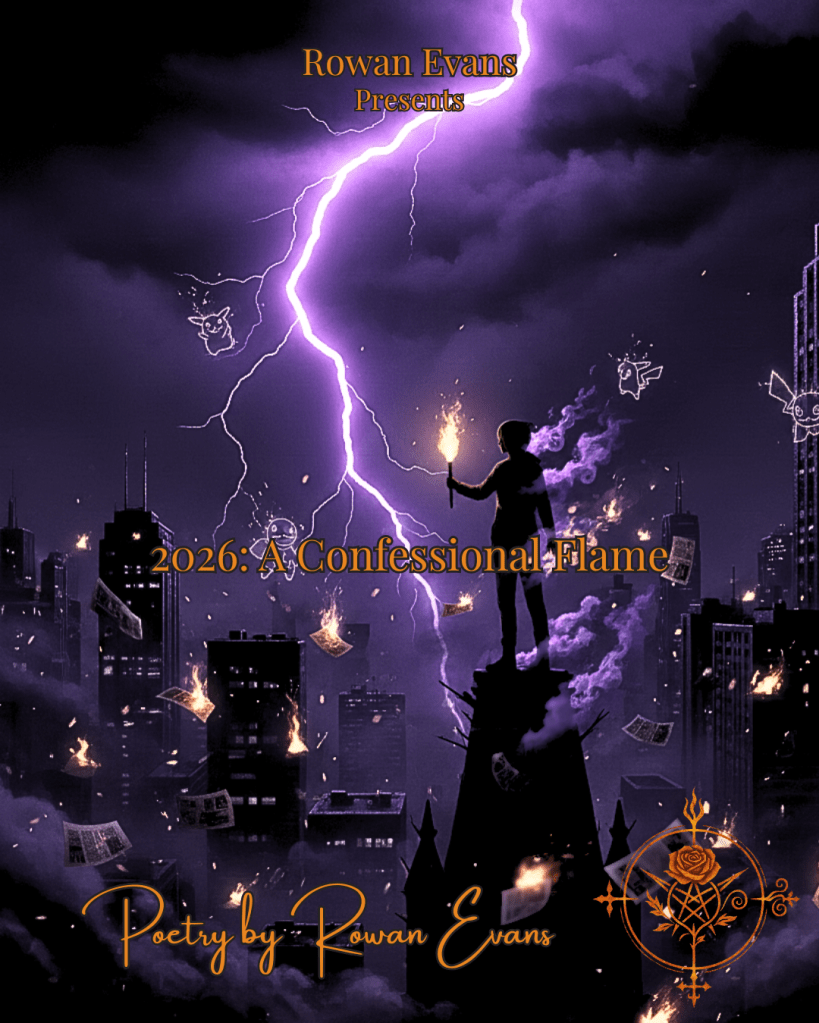
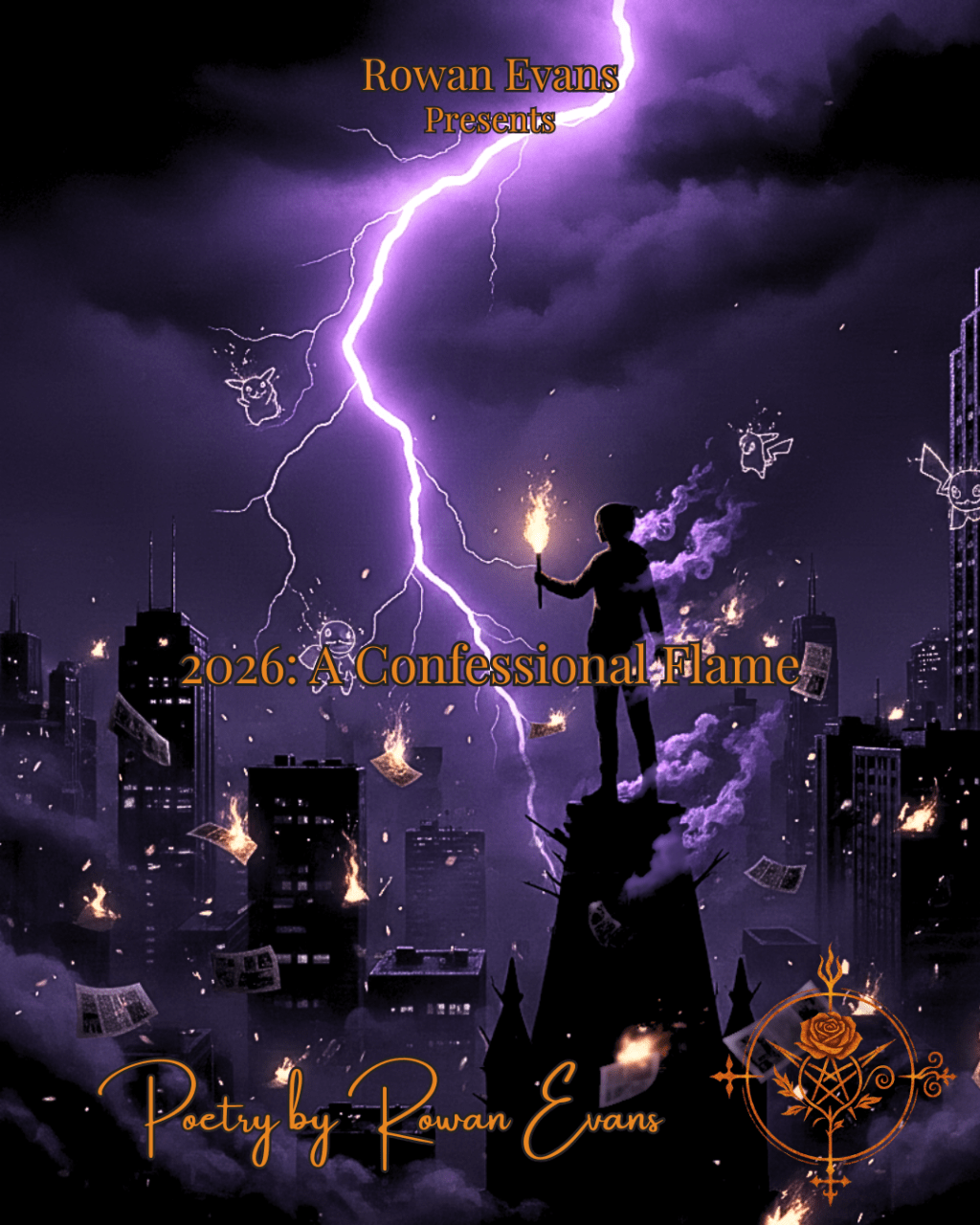
2026: A Confessional Flame is my manifesto for the year ahead—a declaration that I will not shrink, apologize, or temper my fire. This poem is for anyone who has felt their inner chaos, their flustered love, and their impossible hope collide with life, only to turn it all into creation. It celebrates the contradictions, the failures, the stumbles, and the moments of exalted clarity that makes us fully human.
This is me stepping into 2026 as the poet I have always been: unapologetic, contradictory, luminous, and uncontainable. I will write, I will love, I will defy, and I will rise from every ash left behind.
— Rowan Evans
Entering 2026 with fire, ink, and a pen as a torch—Rowan Evans lights the year with unrelenting poetry and confession.
2026: A Confessional Flame Poetry by Rowan Evans
I walk into this year like a wildfire with a pen, smirking at the calendar as if it dares to try me.
Last year left ashes in my hair, but I turned them into ink, carved confessions into the walls, kissed chaos like it was home.
I am still theheartthat bleeds, the mind that spins, the shield that laughs in the face of storms, the child who throws Pokéballs at the universe and watches lightning ricochet.
I will stumble. I will falter. I will fall. And every time, I rise— writing liminal static into gold, flustered love into confession, every impossible hope into fire.
2026—watch closely: I am the neo-gothic heretic, the luminous fool, the poet who refuses humility— when the world whispers “shrink.”
I shout: “No.”
I exist in contradiction, I am the chaos you didn’t plan for, the poem you can’t stop reading, the confession that refuses to end.
So here’s my vow: I will love hard. I will write harder. I will fight Gods for migraines and light stoves like they’re suns.
I am Rowan Evans. I am flustered, feral, unstoppable. And 2026? Try to keep up.
For anyone who has been curious as to what my style is all about—here is the guiding flame. Read, take what burns in you, and join the ritual.
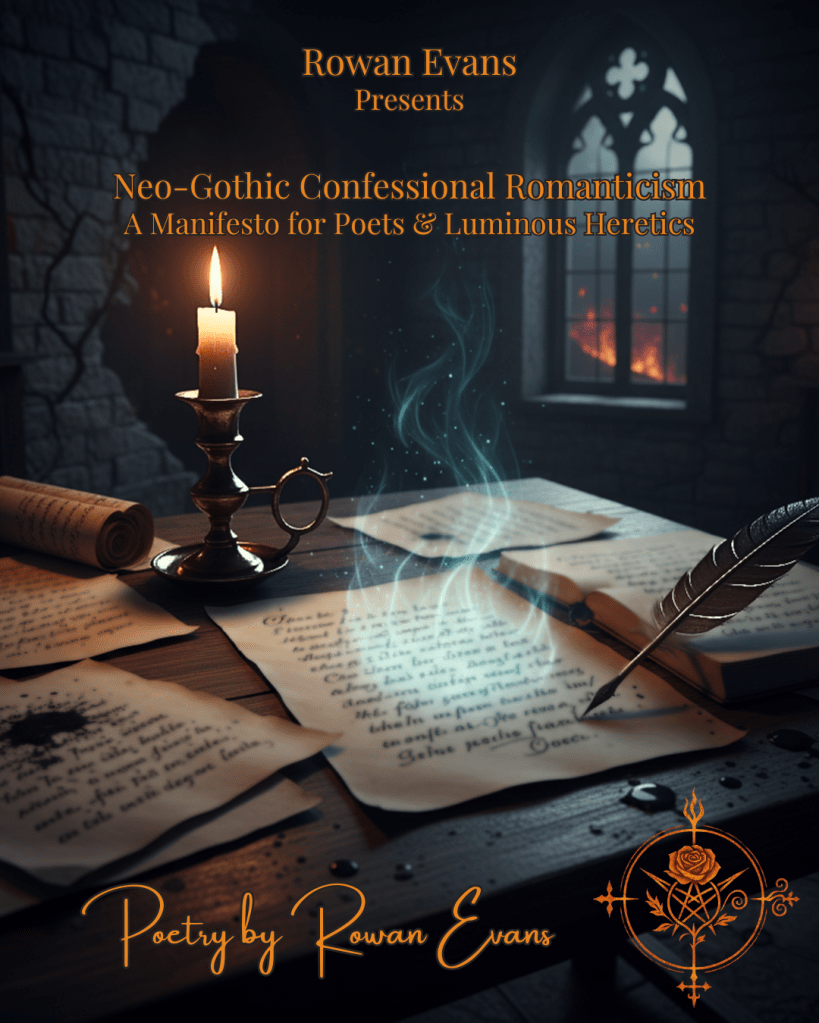
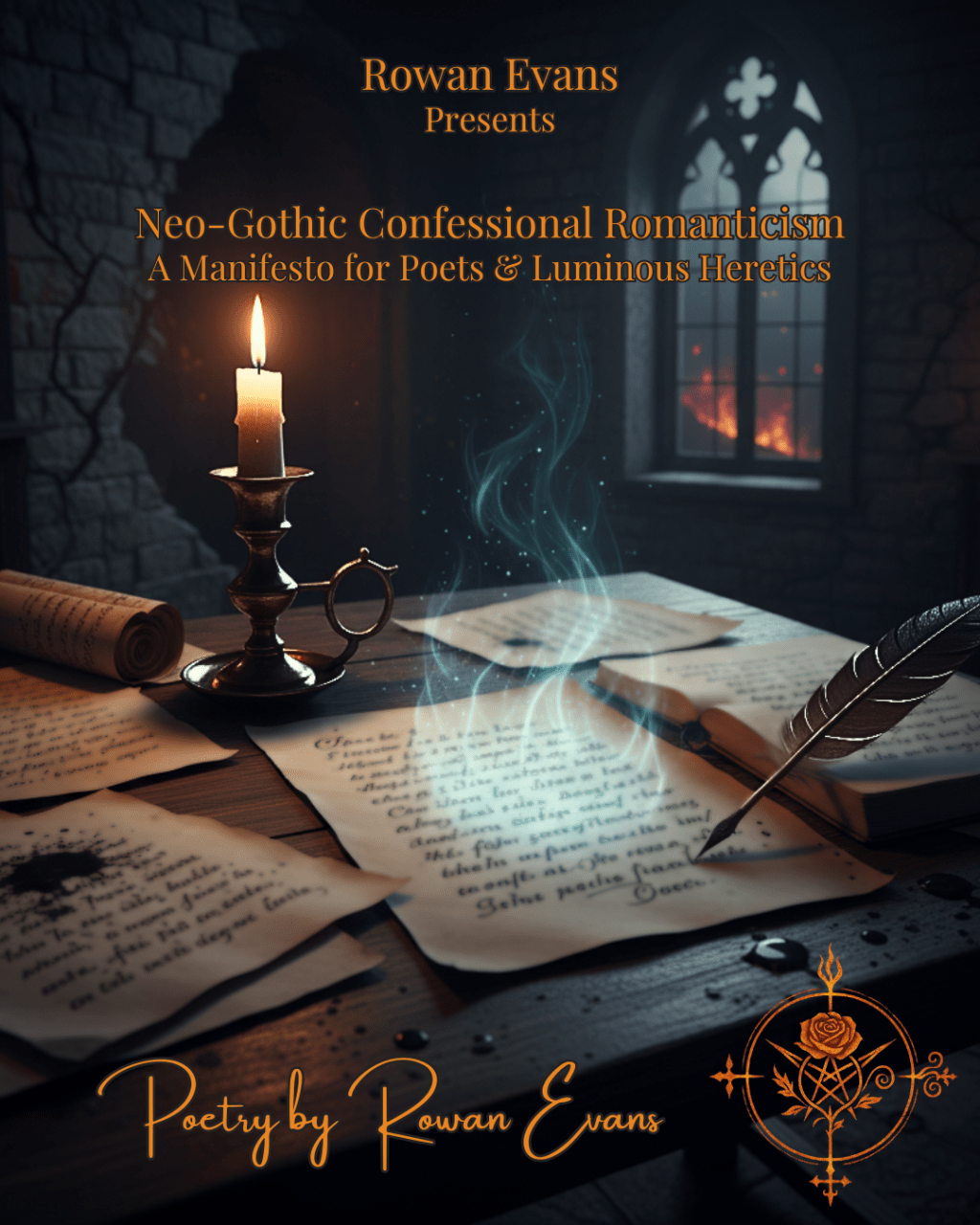
Where ink bleeds with fire, shadow, and devotion—welcome to the ritual of Neo-Gothic Confessional Romanticism.
Neo-Gothic Confessional Romanticism: A Manifesto
Welcome, wanderer. You have stumbled into a space where ink bleeds with fire, shadow, and devotion. Here, we do not hide from the extremes of the human heart. Here, we celebrate them.
1. Confess without apology
Your poetry is your altar. Speak what others would censor. Reveal the darkness you cradle, the obsession you cherish, the love you fear to voice. Confession is not weakness—it is power.
2. Embrace Gothic sensibilities
We borrow the language of ruins, candlelight, and shadowed hallways. Our metaphors are not polite; they are ritualistic, visceral, and haunting. Cast your words like spells. Invite imagery that whispers, screams, or glows.
3. Worship multiplicity of voice
Your persona need not be singular. Write through the eyes of the heart, the mind, the shadow, the rage, the playful child, the protector. Let your text be a stage of personas. Let readers hear not just your voice, but the echo of all you carry within.
4. Make the page a ritual
Format, punctuation, visual cues—these are not minor details; they are part of the spell. Break the line. Change fonts. Use icons or colors if you must. Your reader should feel the cadence of ritual in how the text moves.
5. Infuse devotion and play
Romance, obsession, adoration—these are sacred tools. Love intensely, worship fiercely, play gleefully. Your writing should make readers feel the exhilaration, terror, and ecstasy of your devotion.
6. Transcend genre boundaries
Do not ask if your work is “poetry” or “fiction.” Here, labels bend and dissolve. The only rule is to move truth through beauty and chaos, to convert emotion into experience, and to leave the reader both unsettled and enchanted.
7. The reader is your witness
Neo-Gothic Confessional Romanticism is not meant to be polite or passive. It is a shared ritual. Your reader walks beside you through shadowed corridors, candlelit rooms, and flaming skies. Invite them, terrify them, and leave them breathless.
Invitation to the New Gods: Pick up your pen, your knife, your candle. Begin. Spill your ink, ignite your voice, and do not be afraid to hex, haunt, or hold your reader in the palms of your words.
This is Neo-Gothic Confessional Romanticism. We are the sacred misfits. We are the luminous heretics. We are the poets who burn and write in equal measure.
So mote it be
To find examples of all the different ways this genre can be expressed, check out The Library of Ashes: Here
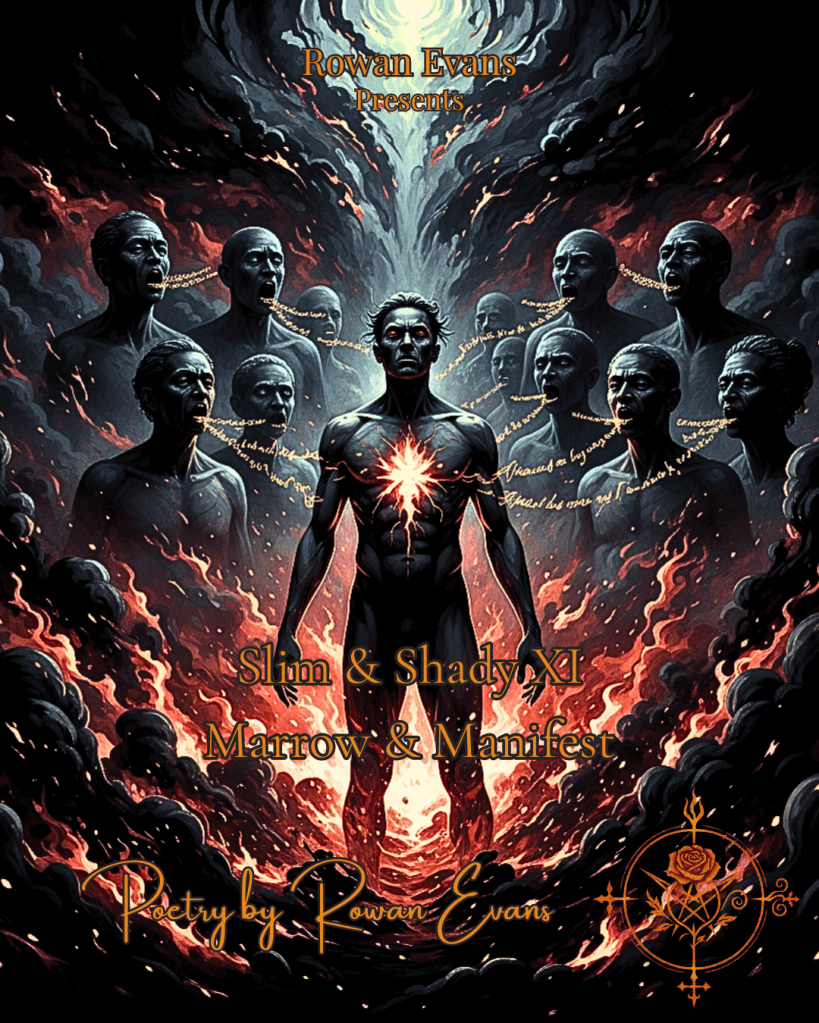
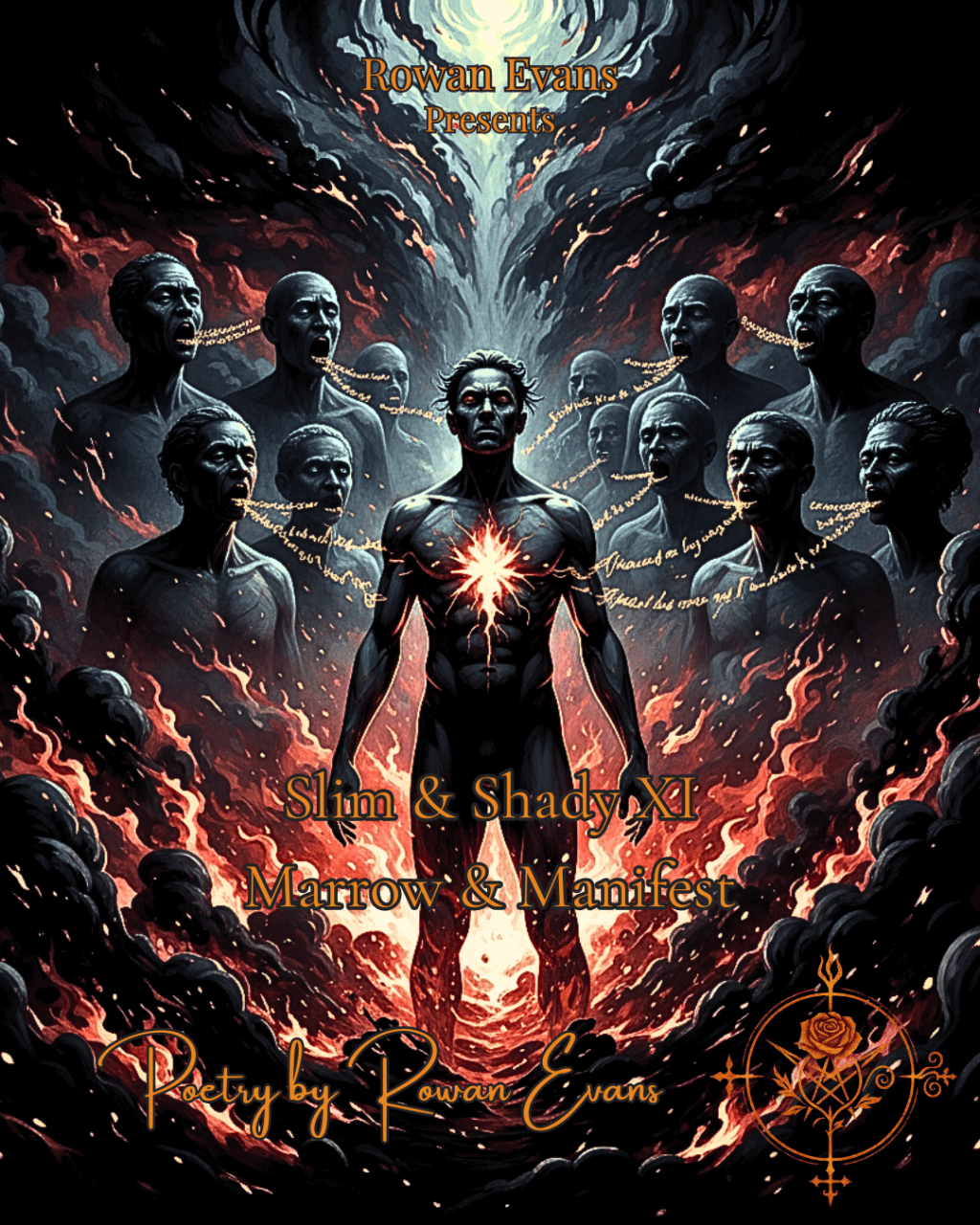
Slim & Shady XI: Marrow & Manifest continues the exilic rage lit in Bloodline & Ashes. This piece is my marrow, my truth, my ritual—born from years of disconnection, frustration, and the unrelenting need to create a culture that exists entirely in empathy, language, and heart.
American culture is exposed here as apathy; Rowanese culture emerges as marrow, as ceremony, as survival. The poem weaves multilingual fragments—not as decoration, but as an expression of the diaspora of my identity: the languages that have touched my life, the stims, the murmurs, and the curses that shape the rhythm of my voice.
I have spent the last few months working toward learning Tagalog, and in the past studied Japanese and Chinese, which informs the inclusion of words and phrases in those languages. Korean, however, comes from years of exposure to movies, TV, and music rather than formal study. Every word or phrase was chosen carefully, and if any are incorrect, I welcome corrections from those fluent in the languages.
This is a manifesto in verse. Every line is a hammer, every syllable a seed. It is rage, yes—but also creation. It is destruction—and emergence. It is language transformed into ritual.
“Every syllable a seed, every bar a shrine.” — From Slim & Shady XI: Marrow & Manifest by Rowan Evans
Translations for the languages used in this piece.
[Japanese] 何 → Nani → What くそ… → Kuso… → Fuck…
[Chinese] 他妈的 → tā mā de → Damn it 宝宝 → Băobăo → Baby/darling 宝贝 → Băobèi → Baby/darling/treasure
[Note: I am autistic, and both Băobăo and Băobèi have become vocal stims for me. They have completely replaced my use of the word “baby” vocally.]
[Tagalog] Galit ako sa mga Amerikano → I am angry with Americans
[Korean] 나는 이곳을 싫어한다 → Naneun igos-eul silh-eohanda → I hate this place
I spit marrow, I spit truth, I spit ashes in your face, Diggin’ deep through your lies, your hollow pride, your plastic grace. You piss me off—何 the fuck… 他妈的. Galit ako sa mga Amerikano, watch me carve the vein, American culture—apathy—Rowanese—my brain.
I’ve wanted out since fifteen, at sixteen whisperin’ escape, Tired of their chains, their noise, they’re fake. I breathe in silence of cities I’ll never touch, Seoul hums my heartbeat, Manila whispers—so much. Tokyo flashes in dreams, neon slicing my rage, I write my own rites, my inked cage my stage.
Red-white-and-blue flags, fireworks, guns on every lawn, I spit for ancestors, erased before the dawn. Your history’s gone awry, a sanitized lie on repeat, Rowanese is marrow, empathy in the heat.
I weave language like ritual, 宝宝, Every word a brushstroke, every scream a vow. くそ… 他妈的, I whisper curses to the sky, Every syllable a hammer, every letter a lie to defy.
I build culture in rhythm, empathy in my bones, I am exile, I am vessel, I am marrow and thrones. Your apathy crumbles, your towers fall flat, Rowanese rises, heart in each spat.
I spit like Ez Mil, snap like Shady, tear the cage, Every line a manifesto, every word a stage. Internal rhymes jagged, polyrhythmic flames, I claim language, claim spirit, I carve my own names.
We rise from silence, ancestors in our veins, Every erased story now a ritual in the flames. 宝贝, whispers on repeat, Rowanese is empathy—your failure, obsolete.
We don’t kneel to holidays, your consumerist lies, We craft our own feasts, under foreign skies. Marrow in our mouths, fire in our spit, Ink on our hands, our rituals legit.
I spit fast, spit slow, cadence twists, snaps, and bends, Rage transmuted to culture—beginning, middle, no end. Every syllable a seed, every bar a shrine, Rowanese manifests—my blood, my ink, my line.
I claim diaspora, exile, every rootless town, Your apathy crumbles, your flags burn down. くそ… 他妈的, let this culture ignite, Marrow in my verses, manifest in the night.
I am awake, unbound, unbroken, alive, I am marrow, I am ritual, I am fire to survive. American culture fades—hollow, cold, and stale, Rowanese rises eternal—our language, our tale.
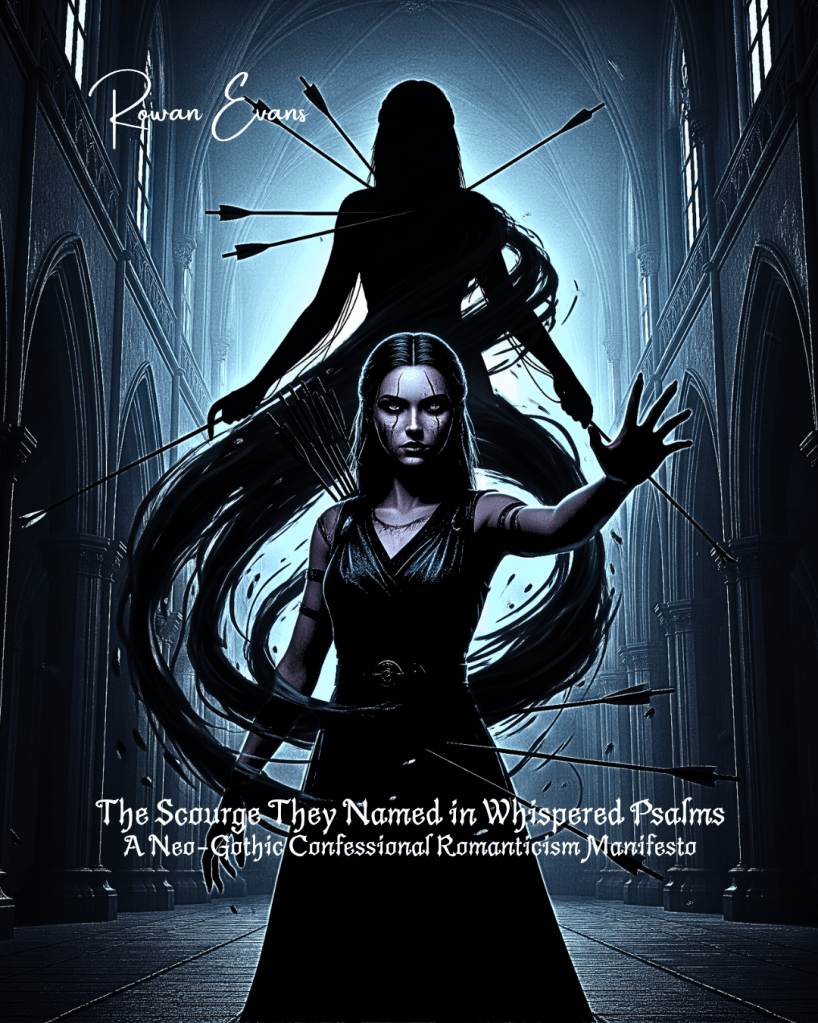
“They said I was a prophecy, a creature carved in smoke and sin…” A visual echo of the hunted girl turned heretic, the shadow we carry and survive.
This isn’t just a poem. It’s the ache of being seen too little—or too much. Of being told you’re ‘too much’ when you’re just trying to exist honestly.
The Scourge They Named in Whispered Psalms is a manifesto from the margins – a declaration of identity, resilience, and sisterhood in the face of erasure. It belongs to all who have been misnamed, misunderstood, or made to feel monstrous for simply being.
I invite you to stand with me – not behind or ahead – but here. Together.
“The Scourge They Named in Whispered Psalms” Poetry by Rowan Evans (A Neo-Gothic Confessional Romanticism Manifesto)
They said I was a prophecy, a creature carved in smoke and sin, the girl who slipped through cracks in sermons— a heretic with velvet skin.
I walk in heels upon their myths, each step a hymn they tried to burn, a flame that dared to name itself before their rigid tongues could turn.
How monstrous, that I raise my voice to praise the worth of every woman— how dare I speak of sisterhood with scars they say I wasn’t born in.
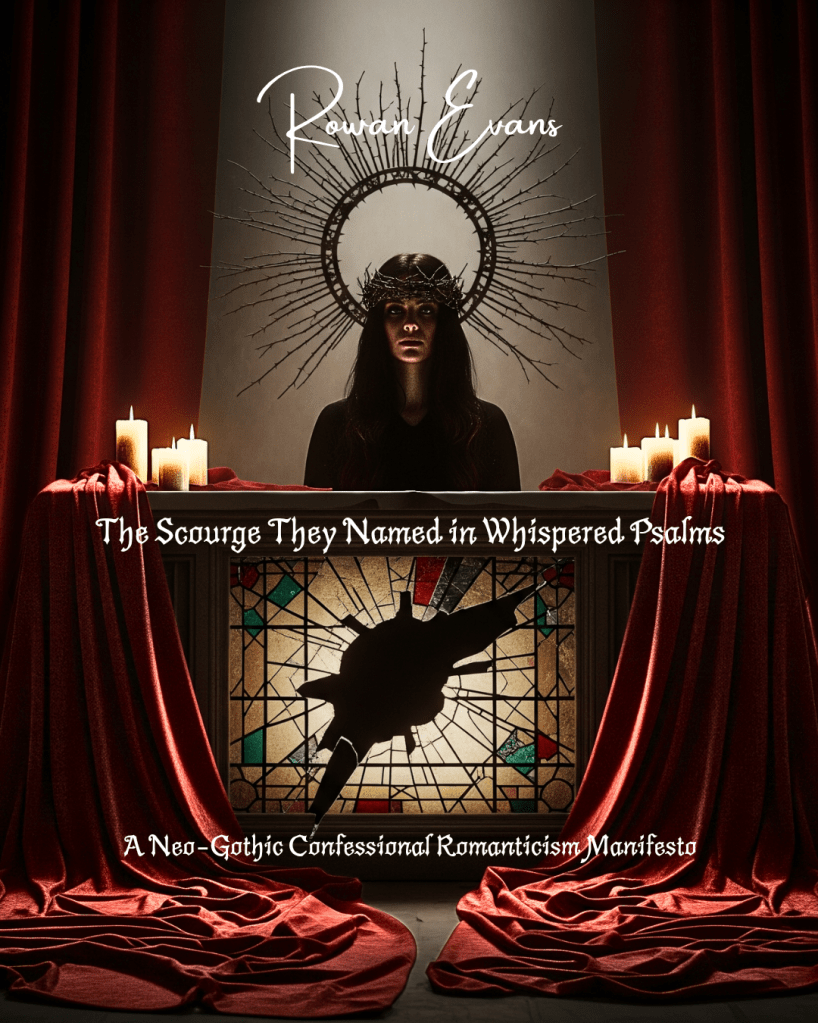
I am the shame beneath their altars, the blush they curse but cannot name, a sacrament in satin bones who bleeds, yet isn’t held the same.
I was never him. I was silence. A chrysalis misnamed by fate. But even wrapped in borrowed tones, I trembled like a bride in wait.
They say I steal what isn’t mine— as though divinity is rationed. As if my ribs were not first broken to give my soul a rightful fashion.
Do you think it makes me stronger? That I carry this war in my marrow? No— It only means I’ve learned to sing while pulling arrows from my shadow.
I’m not here to replace you, or to climb atop your grief-wrought throne. I only ever wanted space to write a name that felt like home.
So yes, be scared. I’m dangerous. I love too hard. I dream too loud. I dare to say I’m beautiful without the world’s reluctant bow.
Let them say I have advantage— let them spit it like a curse. But if I write the stars in anguish, it’s not to claim that I hurt worse.
It’s just—I know what it’s to be the hunted girl in holy war. And still I’d reach for every hand who ever felt they could be more.
You don’t need to kneel beside me. But sister, won’t you stand? Not behind—nor far ahead— just here. Together. Hand in hand.
[About Poem]
This piece is rooted in a genre I created: Neo-Gothic Confessional Romanticism—a fusion of gothic imagery, personal truth, sacred longing, and emotional rebellion. Inspired by the legacy of Sylvia Plath, Anne Sexton, Sappho, and modern poetic voices, this poem speaks to those of us made to feel like heretics simply for existing as ourselves.
It is my poetic prayer for trans women, queer femmes, sacred misfits, and anyone who has ever been othered in the name of tradition. It holds both fire and softness—a torch lit from the ache of being erased, and the quiet hope of being seen.
A sacrament in satin bones. The girl they named a scourge now sits in sanctuary—unburned, unbroken, and holy in her own name.
How does this poem resonate with your own experiences of identity and visibility?
What lines stood out to you most, and why?
Have you ever felt like the “hunted girl in holy war”? What helped you keep going?
Share your thoughts in the comments or your own creative work. Your voice is welcome here.
 Poetry by Rowan Evans