Author’s Note
This piece is not about mocking faith.
It’s about the difference between faith and certainty.
Growing up around religion, I was often taught belief through absolutes. Questions were treated like weakness sometimes, uncertainty treated like danger. But the older I got, the more I realized that questioning was never the opposite of spirituality for me—it was part of it.
Because if faith exists in the absence of proof, then certainty and faith cannot fully occupy the same space. Certainty closes the door. Faith leaves room for the unknown.
That tension shaped this poem.
Over time, I stopped seeing writing as separate from spirituality. The language changed, the framework changed, but the emotional instinct remained the same. I still seek meaning. I still seek connection. I still seek reverence. I just no longer place those things exclusively inside organized religion.
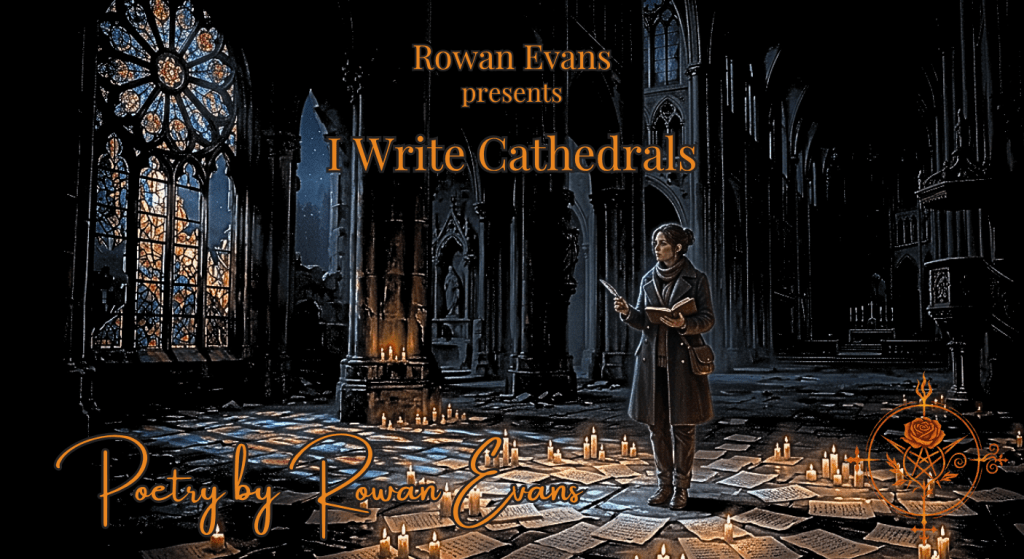
That’s where the cathedral imagery comes from.
When I say “I write cathedrals,” I mean that poetry became the place where I rebuilt my sense of the sacred. Not through doctrine, but through honesty. Through confession. Through empathy. Through creating spaces where brokenness doesn’t disqualify someone from belonging.
The “sacred misfits” and “luminous heretics” in this piece are the people who exist outside easy categorization. The people who question. The people who feel spiritually displaced. The people who were told they were too much, too different, too doubtful, too strange to belong cleanly inside traditional structures.
This poem is for them too.
And ultimately, this piece isn’t arguing that one worldview is more beautiful than another. In fact, one of the most important lines to me is:
“Both are beautiful.”
Because whether someone sees divine creation or cosmic coincidence, I still think wonder itself matters.
Wonder is sacred enough for me.
— Rowan Evans
I Write Cathedrals
Poetry by Rowan Evans
I used to pray in churches,
now I write cathedrals
with broken compass needles
dipped in ink—
the direction they point
ought to make you think.
In church they say
faith is necessary—
but they talked
with such certainty.
It never made sense to me.
Faith is the belief
in the absence of evidence.
Certainty and faith,
cannot co-exist.
They contradict.
I had questions—
about faith,
about belonging.
Was I wrong
for longing—
for asking for more?
They said I should be grateful
for scraps on the floor.
Miracles. Where?
I didn’t see the proof anymore,
didn’t have faith in what I missed.
And if you believe?
That’s fine—
your journey, isn’t mine.
Just don’t push
your faith on me.
You look around,
see God’s creation.
I look around
at a series of
happy accidents.
Both are beautiful.
You can continue
to pray in your churches,
I’ll continue penning cathedrals—
building altars
to the broken and forgotten,
the outcast just like me.
Sacred misfits,
and the luminous heretics—
all are welcome here.
Journey into the Hexverse…
[Drought Resistant]
“Drought Resistant” is a confessional poem about growing up poor in California’s Central Valley—where triple-digit heat, EBT cycles, dry ramen, and hard landscapes become part of emotional memory. Blending humor, slang, and working-class reflection, the poem explores survival, regional identity, and complicated love for the place that shaped you.
[Escaped to the Page]
“Escaped to the Page” is a confessional meta-poem about individuality, artistic identity, and surviving through writing. Blending sharp confidence with emotional vulnerability, the poem explores the difference between shared labels and lived experience—and the ways art becomes inseparable from the life behind it.
[Ink as a Second Mouth]
“Ink as a Second Mouth” explores the distance between thought and speech, and the ways writing can become a form of survival, continuity, and self-translation. Through confessional imagery and reflections on growth, identity, and articulation, the poem examines what it means to keep becoming through language.0
If you’re interested in more poetry, you can find it here → [The Library of Ashes]