Tag: neo-gothic poetry

  • Author’s Note

    Love has always felt heavy to me.

    Not in a bad way— just in a real way.

    I don’t connect lightly, and I don’t fall into feelings easily. So when I do care about someone deeply, it feels enormous. Like something inside me permanently shifts shape around them.

    That can be beautiful.

    It can also be terrifying.

    This piece came from realizing that vulnerability isn’t just saying “I love you.” Sometimes vulnerability is choosing to stay present after you realize someone has the power to hurt you.

    Not because they want to.

    Just because love makes that possible.

    But I think there’s something important about choosing connection anyway.

    Not idealizing someone. Not expecting perfection. Not asking them to heal you.

    Just deciding that the fear of losing connection shouldn’t matter more than the connection itself.

    There’s also a quiet promise buried in this piece.

    A promise to stop drifting when things become emotionally overwhelming. A promise to stay long enough to witness someone fully. To see them in daylight, not just darkness.

    Sometimes love isn’t rescue.

    Sometimes it’s simply saying:

    “I’m here. And I’ll still be here when the sun comes up.”

    Rowan Evans


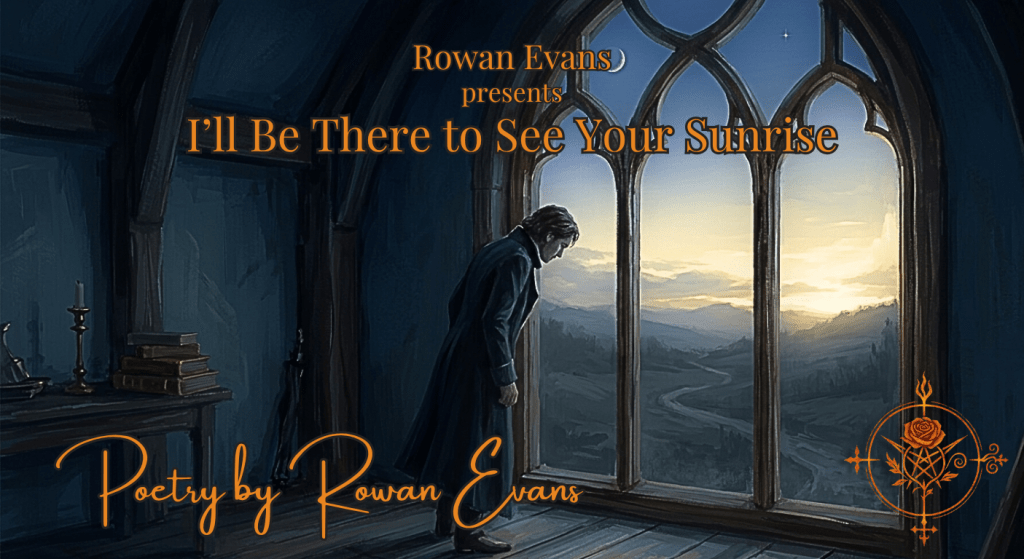
    A shadowed figure watching the sunrise through a window as warm morning light begins to fill the room.
    Sometimes love is not rescue—it’s choosing to stay long enough to see the sun rise.

    I’ll Be There to See Your Sunrise
    Poetry by Rowan Evans

    Dim the lights
    and close the blinds—

    I’m going to be
    honest for a minute,
    I don’t love easily.

    It’s not that I’m afraid.
    I’m not scared to love.

    It just doesn’t come
    without fees for me,
    it costs me something
    every time—I leave a piece
    of my heart behind.

    But the truth is—
    I never really felt love like that,
    everything was just a crush
    until you, that is.

    You—
    who resides in my thoughts now,
    who changed the way
    I see myself somehow.

    And the truth is—
    you didn’t do a thing, not really,
    you just made it safe
    to be honest.

    And I’ll be honest—
    I check your skies,
    before my own.

    The only thing that scares me
    is how much I care,
    that you can hurt me—

    and I’m hyperaware.

    But that’s not fair to you,
    to brace for ache
    when you carry your own pain—

    so even if I’m scared,
    I’ve got to face my fears.

    I’ve got to stay—
    I can’t let myself drift away.

    And I remember—
    you said I met you mid night,
    and the hope I’d see you
    in day light’s shine.

    This is my promise
    to be there,
    to witness it—

    I promise.
    I’ll be there
    to see your sunrise.


    Journey into the Hexverse...

    [Before We Created the Labels]
    Ancient gods return to a fractured world shaped by borders, identities, and separation. “Before We Created the Labels” explores humanity’s divisions through mythic imagery, sacred ritual, and symbolic collapse—asking what remains when we learn to see one another beyond labels.

    [The Unkindness Descends]
    “The Unkindness Descends” is a Gothic symbolic poem exploring collapse, transformation, and the unsettling experience of being witnessed during moments of unraveling. Through raven imagery, ambiguity, and ritualistic atmosphere, the poem invites multiple interpretations—spiritual, psychological, ominous, or transformative.

    [I Write Cathedrals]
    “I Write Cathedrals” explores faith, doubt, belonging, and the search for meaning beyond certainty. Through Gothic spiritual imagery and confessional reflection, the poem examines how writing can become a sacred space for questioning, wonder, and the people who feel displaced by traditional structures of belief.

    [Drought Resistant]
    “Drought Resistant” is a confessional poem about growing up poor in California’s Central Valley—where triple-digit heat, EBT cycles, dry ramen, and hard landscapes become part of emotional memory. Blending humor, slang, and working-class reflection, the poem explores survival, regional identity, and complicated love for the place that shaped you.

    [Escaped to the Page]
    “Escaped to the Page” is a confessional meta-poem about individuality, artistic identity, and surviving through writing. Blending sharp confidence with emotional vulnerability, the poem explores the difference between shared labels and lived experience—and the ways art becomes inseparable from the life behind it.

    [Ink as a Second Mouth]
    “Ink as a Second Mouth” explores the distance between thought and speech, and the ways writing can become a form of survival, continuity, and self-translation. Through confessional imagery and reflections on growth, identity, and articulation, the poem examines what it means to keep becoming through language.

    If you’re interested in more poetry, you can find it here → [The Library of Ashes]
  • Author’s Note

    This piece began with an image:

    a ritual repeated so many times that the people performing it stopped questioning the structure around it.

    At first, I thought I was writing horror.

    Ancient gods. Sacred chants. A collapsing building.

    But somewhere in the middle of the piece, the emotional center shifted.

    The horror was no longer the gods returning.

    It was what they returned to.

    This poem is ultimately about separation—how humanity continuously divides itself into categories, tribes, borders, identities, ideologies, and opposing sides. Not because difference itself is wrong, but because we so often transform difference into distance.

    Into hierarchy.
    Into conflict.
    Into “us” and “them.”

    The gods in this piece are intentionally left undescribed because they are less important as individuals and more important as witnesses. They remember humanity before those divisions hardened into walls.

    Before labels stopped being descriptive and started becoming weapons.

    And importantly: this piece is not arguing against culture, identity, language, or individuality. Those differences are part of what make humanity beautiful. The tragedy is not diversity—it’s disconnection.

    The collapse in this poem is symbolic.

    Not the destruction of difference, but the destruction of the structures that keep people separated from one another.

    And beneath all the mythology, rituals, and ancient imagery, there is a quieter question lingering underneath it all:

    What would humanity look like if we learned to see each other before the labels again?

    Rowan Evans


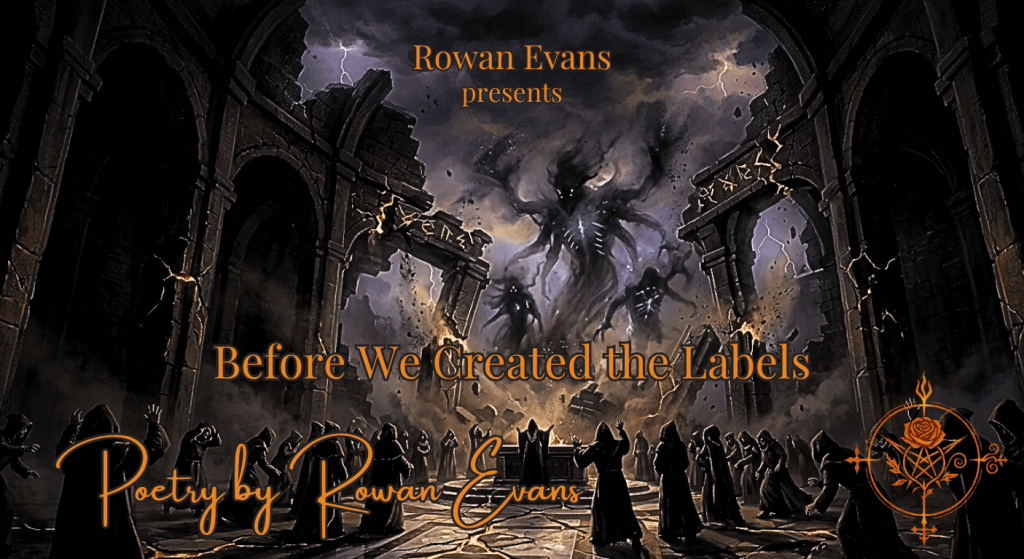
    An ancient ritual chamber collapsing as mysterious godlike figures emerge while frightened worshippers look on.
    The horror was never the gods returning—it was the world they returned to.

    Before We Created the Labels
    Poetry by Rowan Evans

    Each footstep
    echoed through the dark,
    the only sound
    to pierce the veil of silence.

    One by one,
    they filed into the room—

    each taking their place,
    as though they’d done this
    a thousand times.

    As the final of the covenant
    found their mark—

    they began to chant
    in ancient tongues.
    Languages of old,
    long forgotten to the world.

    The air in the room
    began to change—

    and it wasn’t humidity’s game.

    A presence became clear,
    even with no form to see.

    Their chants continue
    in a sacred chorus,
    as they call
    ancient gods forth.

    Air shimmered
    and walls shook,
    foundation cracks—

    and the air
    grew thicker still.

    Voices grew quiet,
    the chanting fading low—

    wood creaks,
    cracks expand.

    The room filled
    with whispers,
    voices from everywhere
    and nowhere—

    all at one time.

    As the whispers
    grew in volume,
    becoming booming
    shouts.

    Buildings shook,
    foundations shifted
    and the ground
    gives out.

    Fear filled—
    eyes of the covenant.

    A ritual done
    a thousand times,
    and a thousand times
    the gods would come—

    a sacrifice would be made,
    but the rules had changed.

    The building
    begins to come down,
    as the covenant runs out.

    Now, the gods unconfined—
    can see the world
    they left behind,
    for the first time.

    It wasn’t with judgement—
    it was grief,
    because they saw the cracks
    and fractures,
    the tragic divides.

    They remember a time,
    when their creation—
    was all one.

    Before we created
    the labels to divide.

    As they looked around
    at what the world
    had become—

    a series of lines
    separating sides.


    Journey into the Hexverse…

    [The Unkindness Descends]
    “The Unkindness Descends” is a Gothic symbolic poem exploring collapse, transformation, and the unsettling experience of being witnessed during moments of unraveling. Through raven imagery, ambiguity, and ritualistic atmosphere, the poem invites multiple interpretations—spiritual, psychological, ominous, or transformative.

    [I Write Cathedrals]
    “I Write Cathedrals” explores faith, doubt, belonging, and the search for meaning beyond certainty. Through Gothic spiritual imagery and confessional reflection, the poem examines how writing can become a sacred space for questioning, wonder, and the people who feel displaced by traditional structures of belief.

    [Drought Resistant]
    “Drought Resistant” is a confessional poem about growing up poor in California’s Central Valley—where triple-digit heat, EBT cycles, dry ramen, and hard landscapes become part of emotional memory. Blending humor, slang, and working-class reflection, the poem explores survival, regional identity, and complicated love for the place that shaped you.

    [Escaped to the Page]
    “Escaped to the Page” is a confessional meta-poem about individuality, artistic identity, and surviving through writing. Blending sharp confidence with emotional vulnerability, the poem explores the difference between shared labels and lived experience—and the ways art becomes inseparable from the life behind it.

    [Ink as a Second Mouth]
    “Ink as a Second Mouth” explores the distance between thought and speech, and the ways writing can become a form of survival, continuity, and self-translation. Through confessional imagery and reflections on growth, identity, and articulation, the poem examines what it means to keep becoming through language.

    If you’re interested in more poetry, you can find it here → [The Library of Ashes]
  • Author’s Note

    This piece began with a single image:

    a person kneeling on broken marble while ravens circled overhead.

    From there, the symbolism unfolded naturally.

    Ravens have carried countless meanings across cultures and mythologies throughout history. Omens. Messengers. Witnesses. Archivists of the dead. Harbingers of transformation. Keepers of memory. In some traditions they are feared. In others, revered.

    I didn’t want to narrow them down to one interpretation here.

    What interested me more was the tension between collapse and observation—the feeling of being seen during moments of unraveling, and the uncertainty of whether those watching forces are condemning you, mourning you, studying you, guiding you, or simply recording what happened.

    That’s why the poem never fully explains the ravens.

    Even the collective noun “unkindness” became important to me while writing. It carries two meanings at once: a literal group of ravens, and the emotional atmosphere surrounding the speaker. The word itself becomes part of the tension.

    By the end of the piece, the ravens remain unresolved intentionally.

    They part. They watch. They follow.

    Whether that final image feels threatening, protective, spiritual, psychological, or transformative depends almost entirely on how the reader chooses to see them.

    And I think that uncertainty is the point.

    Rowan Evans


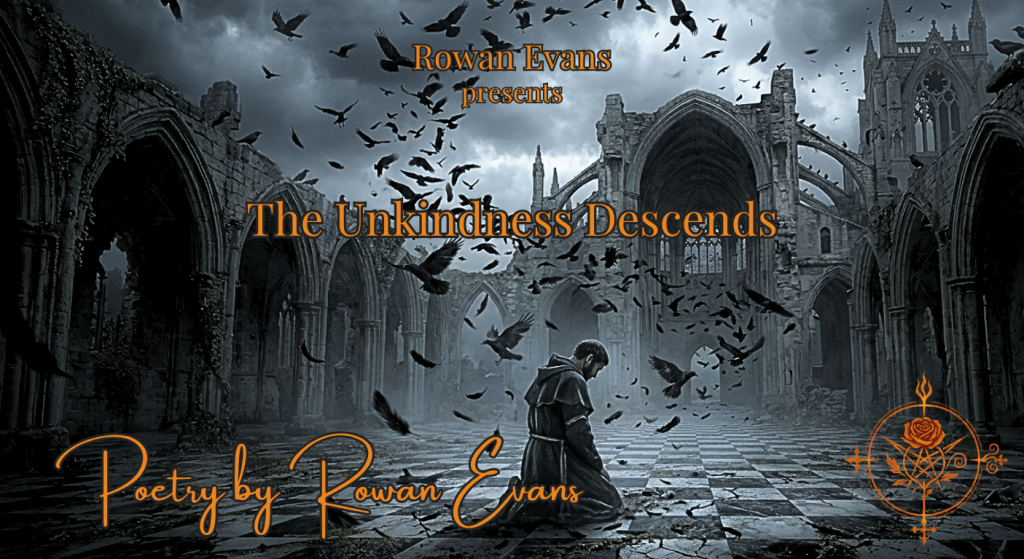
    A lone figure surrounded by ravens on broken marble in a dark Gothic setting.
    They descended like witnesses—whether to condemn, mourn, guide, or remember was never made clear.

    The Unkindness Descends
    Poetry by Rowan Evans

    I kneel on broken marble,
    the unkindness circling overhead.
    Ravens watching as I come undone.

    Witnesses to my fall,
    the ravens land—
    one by one,
    the unkindness descends
    upon me.

    I am lost in the black mass—
    wing and feather flapping
    as ravens move to circle me.

    My eyes scanned the ravens
    as they surrounded me,
    each uttered something—
    a word, a message.

    Perhaps, it was a lesson?

    Maybe I read it all wrong,
    and they were just keeping record—
    witnesses to my collapse.

    I rose to my feet.
    The ravens watched me.

    I moved.
    They parted
    like the Red Sea.

    Each step forward,
    their eyes traced my path.
    As I moved through,
    they closed in behind me.

    Following.


    Journey into the Hexverse…

    [I Write Cathedrals]
    “I Write Cathedrals” explores faith, doubt, belonging, and the search for meaning beyond certainty. Through Gothic spiritual imagery and confessional reflection, the poem examines how writing can become a sacred space for questioning, wonder, and the people who feel displaced by traditional structures of belief.

    [Drought Resistant]
    “Drought Resistant” is a confessional poem about growing up poor in California’s Central Valley—where triple-digit heat, EBT cycles, dry ramen, and hard landscapes become part of emotional memory. Blending humor, slang, and working-class reflection, the poem explores survival, regional identity, and complicated love for the place that shaped you.

    [Escaped to the Page]
    “Escaped to the Page” is a confessional meta-poem about individuality, artistic identity, and surviving through writing. Blending sharp confidence with emotional vulnerability, the poem explores the difference between shared labels and lived experience—and the ways art becomes inseparable from the life behind it.

    [Ink as a Second Mouth]
    “Ink as a Second Mouth” explores the distance between thought and speech, and the ways writing can become a form of survival, continuity, and self-translation. Through confessional imagery and reflections on growth, identity, and articulation, the poem examines what it means to keep becoming through language.

    If you’re interested in more poetry, you can find it here → [The Library of Ashes]
  • Author’s Note

    This piece is not about mocking faith.

    It’s about the difference between faith and certainty.

    Growing up around religion, I was often taught belief through absolutes. Questions were treated like weakness sometimes, uncertainty treated like danger. But the older I got, the more I realized that questioning was never the opposite of spirituality for me—it was part of it.

    Because if faith exists in the absence of proof, then certainty and faith cannot fully occupy the same space. Certainty closes the door. Faith leaves room for the unknown.

    That tension shaped this poem.

    Over time, I stopped seeing writing as separate from spirituality. The language changed, the framework changed, but the emotional instinct remained the same. I still seek meaning. I still seek connection. I still seek reverence. I just no longer place those things exclusively inside organized religion.

    That’s where the cathedral imagery comes from.

    When I say “I write cathedrals,” I mean that poetry became the place where I rebuilt my sense of the sacred. Not through doctrine, but through honesty. Through confession. Through empathy. Through creating spaces where brokenness doesn’t disqualify someone from belonging.

    The “sacred misfits” and “luminous heretics” in this piece are the people who exist outside easy categorization. The people who question. The people who feel spiritually displaced. The people who were told they were too much, too different, too doubtful, too strange to belong cleanly inside traditional structures.

    This poem is for them too.

    And ultimately, this piece isn’t arguing that one worldview is more beautiful than another. In fact, one of the most important lines to me is:

    “Both are beautiful.”

    Because whether someone sees divine creation or cosmic coincidence, I still think wonder itself matters.

    Wonder is sacred enough for me.

    Rowan Evans


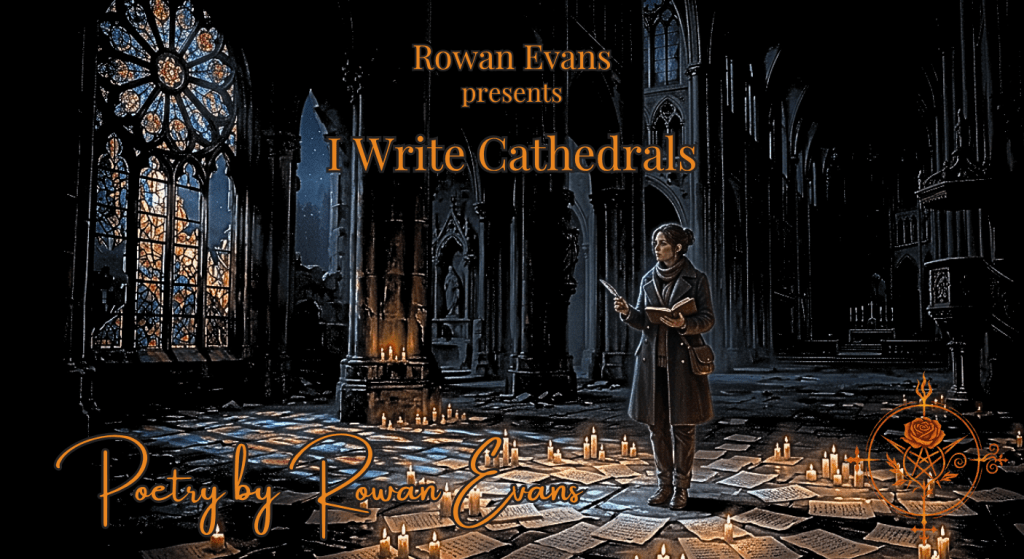
    A writer standing inside a dim Gothic cathedral surrounded by candles and handwritten poetry pages.
    If faith leaves room for the unknown, then poetry became the place where I learned to live inside the questions.

    I Write Cathedrals
    Poetry by Rowan Evans

    I used to pray in churches,
    now I write cathedrals
    with broken compass needles
    dipped in ink—
    the direction they point
    ought to make you think.

    In church they say
    faith is necessary—
    but they talked
    with such certainty.

    It never made sense to me.

    Faith is the belief
    in the absence of evidence.

    Certainty and faith,
    cannot co-exist.
    They contradict.

    I had questions—
    about faith,
    about belonging.

    Was I wrong
    for longing—
    for asking for more?

    They said I should be grateful
    for scraps on the floor.
    Miracles. Where?

    I didn’t see the proof anymore,
    didn’t have faith in what I missed.

    And if you believe?
    That’s fine—
    your journey, isn’t mine.

    Just don’t push
    your faith on me.

    You look around,
    see God’s creation.
    I look around
    at a series of
    happy accidents.

    Both are beautiful.

    You can continue
    to pray in your churches,
    I’ll continue penning cathedrals—
    building altars
    to the broken and forgotten,
    the outcast just like me.

    Sacred misfits,
    and the luminous heretics—

    all are welcome here.


    Journey into the Hexverse…

    [Drought Resistant]
    “Drought Resistant” is a confessional poem about growing up poor in California’s Central Valley—where triple-digit heat, EBT cycles, dry ramen, and hard landscapes become part of emotional memory. Blending humor, slang, and working-class reflection, the poem explores survival, regional identity, and complicated love for the place that shaped you.

    [Escaped to the Page]
    “Escaped to the Page” is a confessional meta-poem about individuality, artistic identity, and surviving through writing. Blending sharp confidence with emotional vulnerability, the poem explores the difference between shared labels and lived experience—and the ways art becomes inseparable from the life behind it.

    [Ink as a Second Mouth]
    “Ink as a Second Mouth” explores the distance between thought and speech, and the ways writing can become a form of survival, continuity, and self-translation. Through confessional imagery and reflections on growth, identity, and articulation, the poem examines what it means to keep becoming through language.0

    If you’re interested in more poetry, you can find it here → [The Library of Ashes]

  • Author’s Note

    This poem is about safety—not the kind that cages, but the kind that invites you to stay. It’s about finding someone who doesn’t demand your strength or survival instincts, only your honesty. Someone who makes asking for help feel like an act of trust rather than surrender.

    1-4-3 is a quiet confession of rootedness. Of choosing presence over flight. Of love that doesn’t chase or trap, but steadies.

    Sometimes the bravest thing we do
    is stop running—and stay.

    Rowan Evans


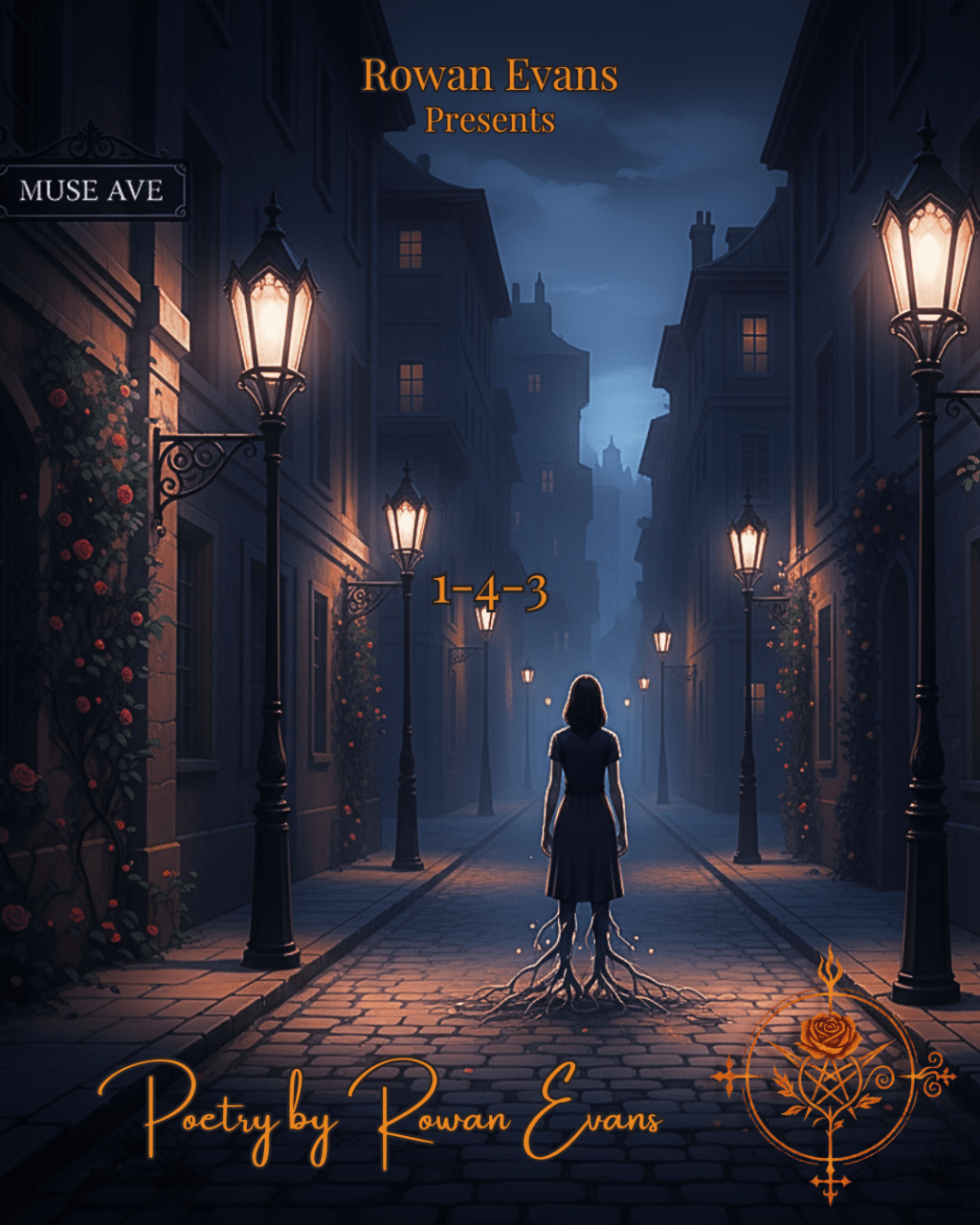
    A poetic dusk street scene with a figure standing still, symbolizing emotional safety, choice, and rooted love.
    Sometimes love isn’t about needing someone—it’s about choosing to stay.

    1-4-3
    Poetry by Rowan Evans

    1-4-3 My Muse Avenue,
    where I dwell—
    where the words swell.
    Girl, you don’t understand;
    you inspire my ink well.

    When I feel lost,
    and in need of help,
    it’s you I turn to.
    Not because I expect you to fix me—
    simply because
    you make it safe enough to ask.

    And that’s no small feat,
    because fear
    used to run my feet.
    Any time I felt safe,
    any flicker of hope in my chest,
    my feet would begin to move.

    But this time?
    They stay planted—
    firm, like roots,
    unwilling to move.
    Because you…

    you make it so easy
    to want to stay.

    Mahal kita, mahal ko—
    tahanan ko.


    If you’re interested in more poetry, you can find it here → [The Library of Ashes]
  • Author’s Note

    This is the same truth, spoken closer to the flame.
    Not a need. A choice—made with full awareness of the risk.

    Same poem.
    Louder pulse.

    Rowan Evans


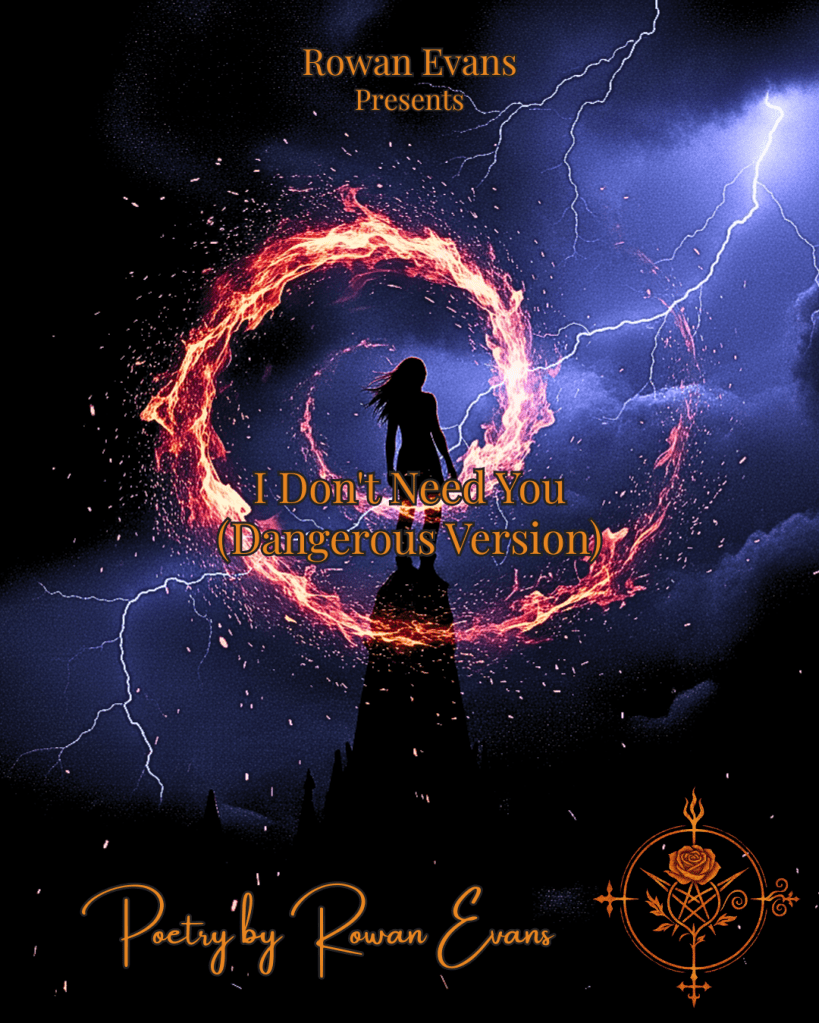
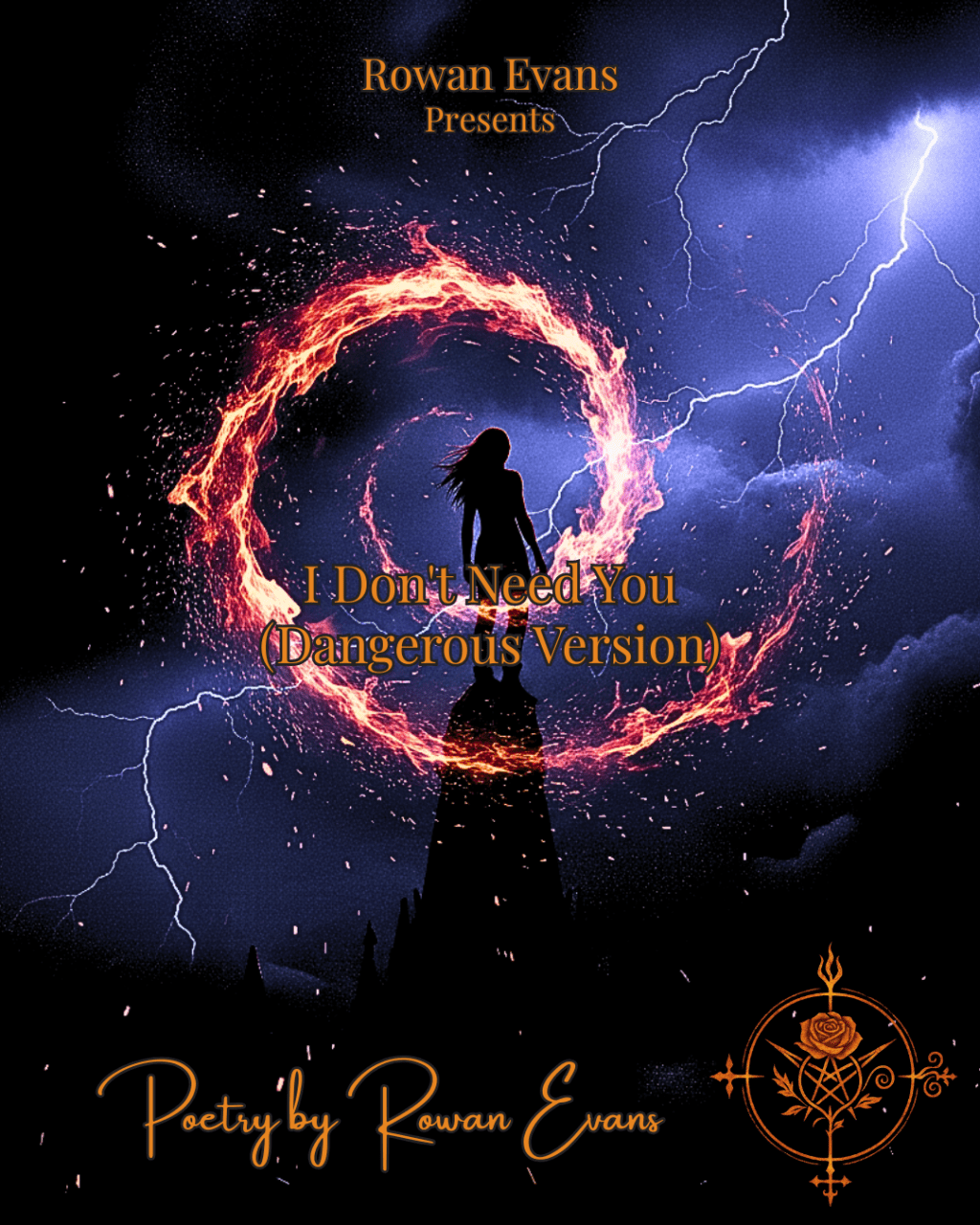
    Lone figure standing under a stormy sky, surrounded by swirling sparks, symbolizing independence, intensity, and passionate desire.
    “I choose you. Unbroken, unbent, and fully alive.” — Rowan Evans, I Don’t Need You (Dangerous Version)

    I Don’t Need You
    (Dangerous Version)
    Poetry by Rowan Evans

    I don’t need you.
    I breathe.
    I sleep.
    I rise, unbroken, unbent.

    I don’t need you.
    I am fire in the quiet,
    a storm that bends no sky.

    And yet–
    I want you.
    As witness.
    As echo.
    As the one who knows my chaos
    and calls it home.

    I could walk alone,
    and I would.
    But I don’t want to.
    I choose you.

    I don’t need you.
    But I want you so badly,
    it twists my ribs,
    spins my blood,
    sets my spine alight.

    I don’t need you.
    I will survive without you.
    But I don’t want to.
    I choose you.
    Again.
    Again.
    Even knowing the fire.

    I don’t need you.
    But if this is love,
    then I am all in.


    If you’re interested in more poetry, you can find it here → [The Library of Ashes]
    [I Don’t Need You]Original
    A poem about choosing love from a place of wholeness—celebrating independence, intimacy, and the power of saying “I don’t need you, but I want you.”

  • Author’s Note

    To the reader:

    This poem is a meditation on choice, autonomy, and intimacy. It’s about standing whole, unshaken, and still choosing to love someone—not because we need them, but because we want them. The lines explore that delicate balance between independence and desire, between survival and longing.

    It is a celebration of being complete in oneself while recognizing that closeness, when chosen freely, amplifies life rather than diminishes it.
    This piece is for anyone who has ever loved fiercely while remaining unbroken.

    Rowan Evans


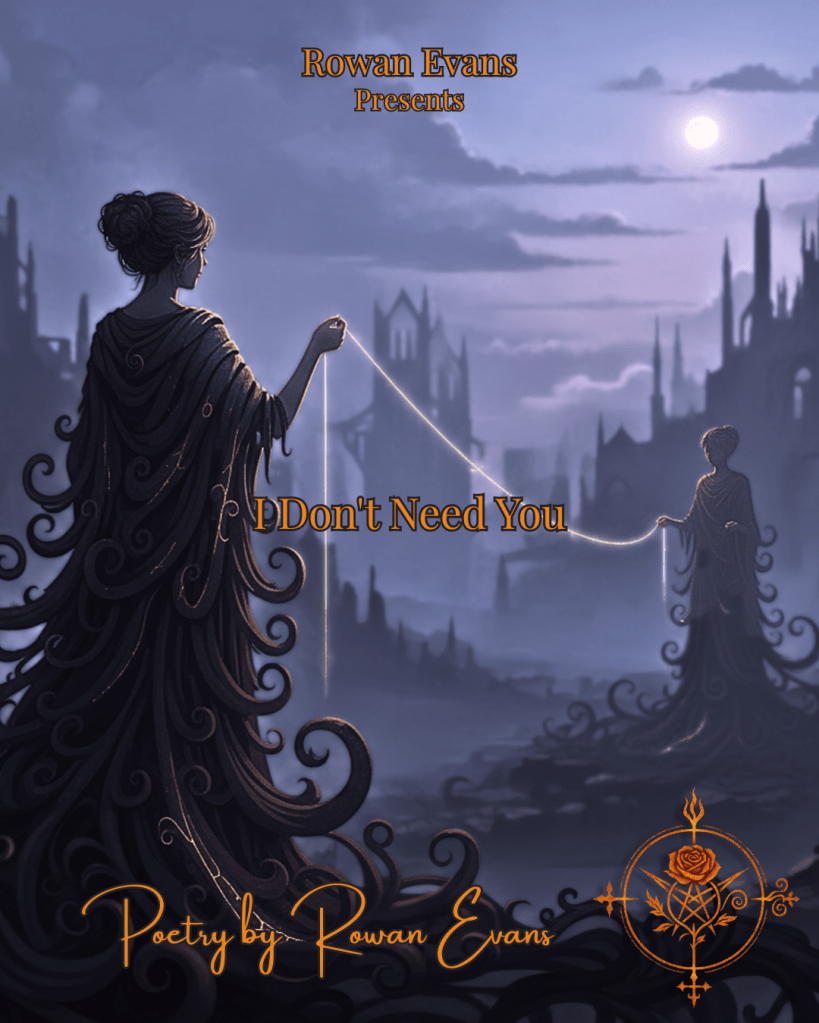
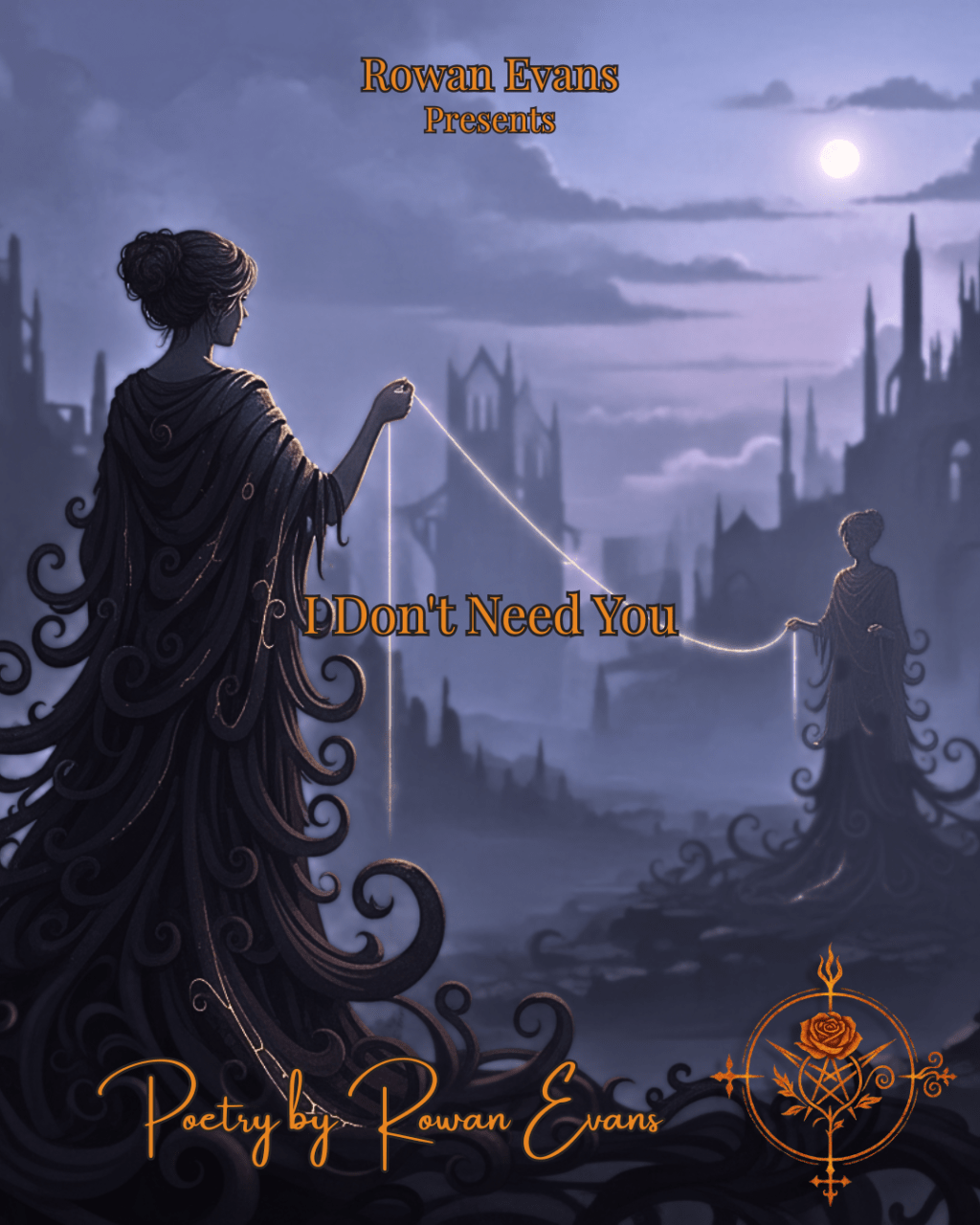
    “Silhouetted figure in twilight holding a glowing thread toward a distant figure, representing choice, independence, and intimate connection.”
    ‘I Don’t Need You’ – Choosing love from strength, not need. A poem by Rowan Evans.

    I Don’t Need You
    Poetry by Rowan Evans

    I don’t need you.
    I can breathe on my own—
    lungs have done it for decades
    without asking permission.

    I don’t need you.
    I can sleep alone,
    learn the shape of empty sheets,
    make peace with the cold side of the bed.

    I don’t need you
    to make me whole.
    I arrived here intact—
    scarred, yes,
    but assembled by my own hands.

    I don’t need your voice
    to steady me,
    your name
    to keep the dark from biting.
    I’ve survived worse silences
    than your absence.

    I don’t need you
    to save me.
    I am not drowning.
    I am not broken.
    I am not waiting
    to be rescued.

    But—

    I don’t want to breathe
    without you knowing the rhythm of it.
    I don’t want sleep
    that doesn’t reach for you
    out of habit, out of hope.

    I don’t want a life
    where your laughter
    isn’t stitched into my days,
    where love is only something
    I prove I can live without.

    I can.
    I know that.

    But I don’t want to.

    I want you—
    not as oxygen,
    not as shelter,
    not as a missing piece—

    but as the one
    I choose
    while standing steady,
    while whole,
    while free.

    I don’t need you.

    I just
    want you
    here.


    If you’re interested in more poetry, you can find it here → [The Library of Ashes]
  • Author’s Note

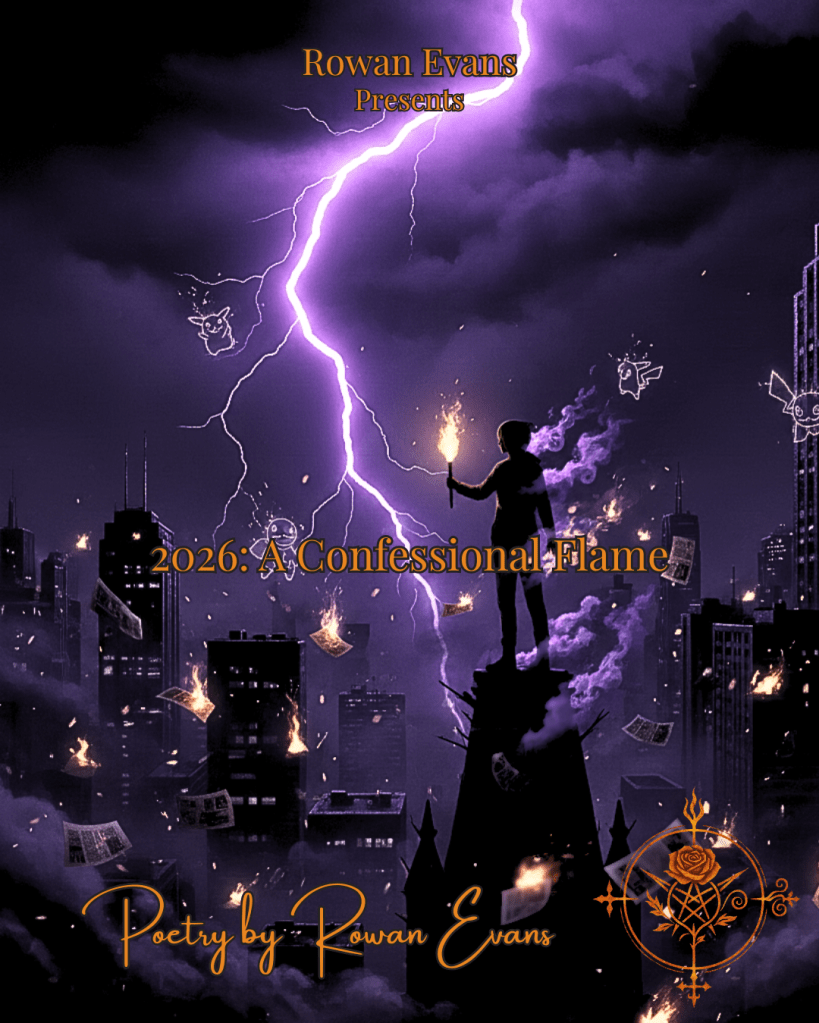
    2026: A Confessional Flame is my manifesto for the year ahead—a declaration that I will not shrink, apologize, or temper my fire. This poem is for anyone who has felt their inner chaos, their flustered love, and their impossible hope collide with life, only to turn it all into creation. It celebrates the contradictions, the failures, the stumbles, and the moments of exalted clarity that makes us fully human.

    This is me stepping into 2026 as the poet I have always been: unapologetic, contradictory, luminous, and uncontainable. I will write, I will love, I will defy, and I will rise from every ash left behind.

    Rowan Evans


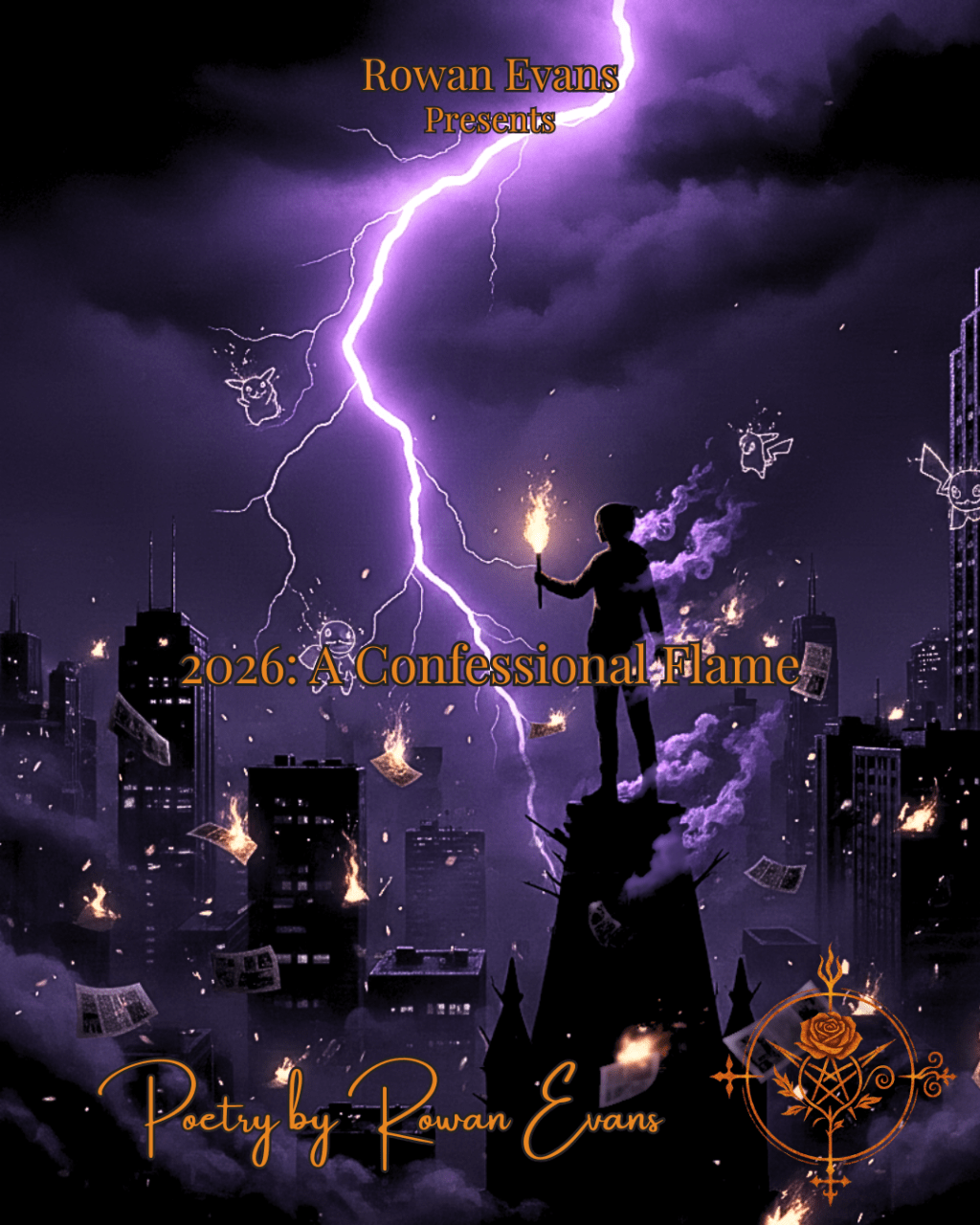
    Rowan Evans-style poet standing in a twilight cityscape, holding a glowing pen like a torch, surrounded by swirling papers, flames, and ethereal sparks; a neo-gothic, mystical scene.
    Entering 2026 with fire, ink, and a pen as a torch—Rowan Evans lights the year with unrelenting poetry and confession.

    2026: A Confessional Flame
    Poetry by Rowan Evans

    I walk into this year
    like a wildfire with a pen,
    smirking at the calendar
    as if it dares to try me.

    Last year left ashes in my hair,
    but I turned them into ink,
    carved confessions into the walls,
    kissed chaos like it was home.

    I am still the heart that bleeds,
    the mind that spins,
    the shield that laughs in the face of storms,
    the child who throws Pokéballs at the universe
    and watches lightning ricochet.

    I will stumble.
    I will falter.
    I will fall.
    And every time, I rise
    writing liminal static into gold,
    flustered love into confession,
    every impossible hope into fire.

    2026—watch closely:
    I am the neo-gothic heretic,
    the luminous fool,
    the poet who refuses humility—
    when the world whispers “shrink.”

    I shout: “No.”

    I exist in contradiction,
    I am the chaos you didn’t plan for,
    the poem you can’t stop reading,
    the confession that refuses to end.

    So here’s my vow:
    I will love hard.
    I will write harder.
    I will fight Gods for migraines
    and light stoves like they’re suns.

    I am Rowan Evans.
    I am flustered, feral, unstoppable.
    And 2026?
    Try to keep up.


    If you’re interested in more poetry, you can find it here → [The Library of Ashes]
  • Introduction

    A moment of longing, a tide that has left me… Sometimes absence is a presence all its own. This short piece reflects the ache of missing someone, of feeling incomplete in empty spaces.


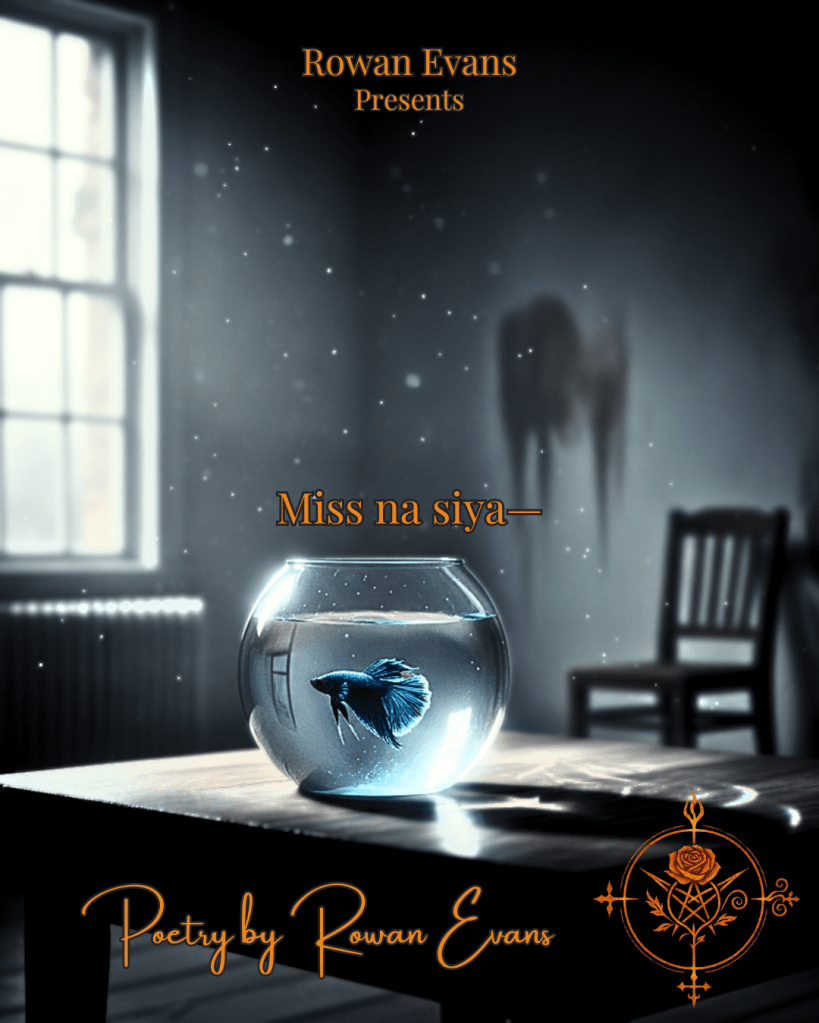
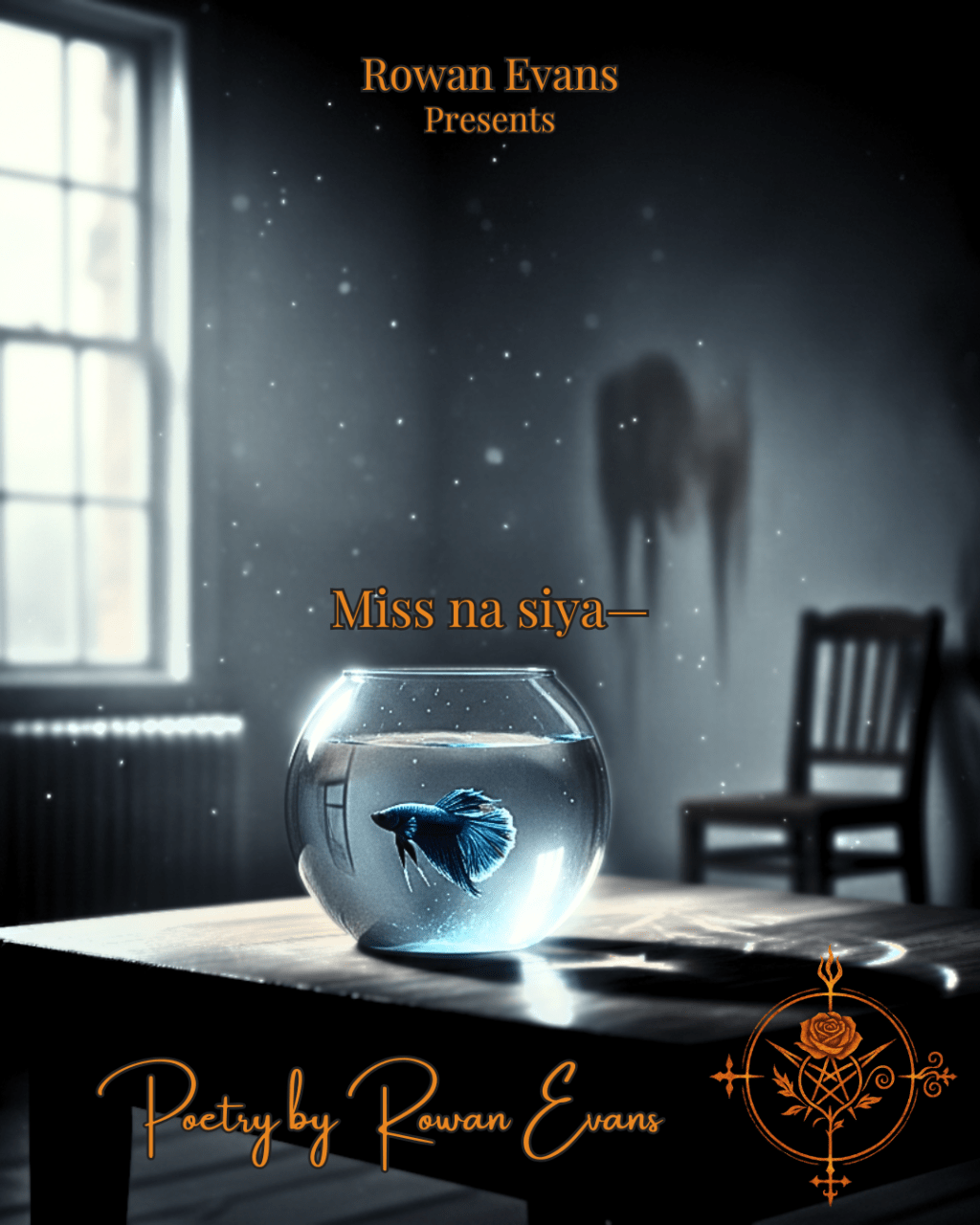
    A small fish in a glowing bowl in an empty room, sunlight streaming in – evoking longing and absence.
    “Even in the quietest rooms, absence has a weight. ‘Miss na siya’ captures that feeling.”

    Miss na Siya
    Poetry by Rowan Evans

    Miss na siya—
    like a fish
    that can’t breathe
    without its sea.
    Every empty room
    feels like the tide
    has left me.


    If you’re interested in more poetry, you can find it here → [The Library of Ashes]
  • Author’s Note

    Crossroads of Flame was born from a moment of choosing discomfort over safety, and creation over silence. It reflects the turning point between who I was and who I am becoming—not only as a poet, but as the many voices I carry within me. Roo, Hex, B.D., and I each walk different inner landscapes, but all of us share the same ember: the belief that the unknown is worth stepping into, even when it burns.

    This poem marks a new phase of intention. A deliberate path forward. A reminder that comfort is quiet, but purpose is loud—and I am choosing to listen.

    Rowan Evans


    Poetic gothic illustration of a lone figure at a crossroads under a twilight sky, facing a wild burning path toward the unknown.
    A crossroads beneath a burning sky—the moment intention becomes transformation.

    Crossroads of Flame
    Poetry by Rowan Evans

    I stand at a crossroads—
    two paths stretch beneath a waning sky,
    one worn and familiar, lined with shadows I know,
    the other narrow, veiled in bramble and whispered risk.

    The first hums a lullaby of comfort,
    soft, forgiving, predictable.
    I could walk it blindfolded,
    count the cracks beneath my feet,
    and know I will not falter.

    But the second calls in a voice I barely recognize,
    a tremor beneath the wind,
    a hint of fire beneath frost.
    It asks nothing of me—yet demands all:
    my attention, my courage, my deliberate steps.

    I carve my own instead.
    Through tangled shrubs and corridors of darkened wood,
    I trace a path that no map can hold,
    listening to the pulse beneath my ribs,
    the hum that answers back:
    Roo, Hex, B.D., and me—
    four voices intertwined,
    four flames in one vessel,
    guiding, guarding, urging.

    Alone—yet never alone—
    I step carefully, feeling each stone,
    each thorn, each sigh of wind through the leaves.
    The safe path still beckons behind me,
    a ghost of ease I might have chosen.
    But the wild one waits, insistent,
    its promise stitched with challenge
    and the weight of things I have yet to become.

    I am the storm and the calm,
    the knife that severs hesitation,
    the hand that steadies,
    the ember that refuses to die.
    I am the whisper in the dark corridors,
    the laughter in the bramble,
    the ache that drives me forward.

    Tonight I choose not comfort.
    Tonight I choose intent.
    Tonight I choose to step beyond what I know,
    into the narrow, the jagged, the luminous unknown,
    and let the path unfold beneath my careful flame.


    If you’re looking for more poetry, you can find it here → [The Library of Ashes]

    Leave a comment and tell me which path you would choose.