Tag: creativity

  • Author’s Note

    Some poems arrive as observations.

    Others arrive as questions.

    This one began with a question I wasn’t entirely prepared to answer:

    Who am I without writing?

    I’ve spent more than two decades translating my inner world into poetry. Over time, writing stopped feeling like something I do and started feeling like the place where I exist most completely.

    That’s a strange realization.

    Because poetry isn’t simply expression for me—it’s construction.

    Every poem is assembled from fragments: memories, emotions, images, conversations, dreams, fears, humor, hope. I rarely invent from nothing. I gather pieces of lived experience and stitch them together until they begin breathing on their own.

    That’s where the title comes from.

    Victor Frankenstein wasn’t remembered because he created life.

    He was remembered because he assembled it.

    That’s often what writing feels like to me.

    I gather disconnected thoughts, broken emotions, recurring symbols, and scattered moments, then bind them together until they become something capable of standing on its own.

    The result isn’t always comfortable.

    Sometimes it’s beautiful.

    Sometimes it’s monstrous.

    Most often…

    it’s simply honest.

    Rowan Evans


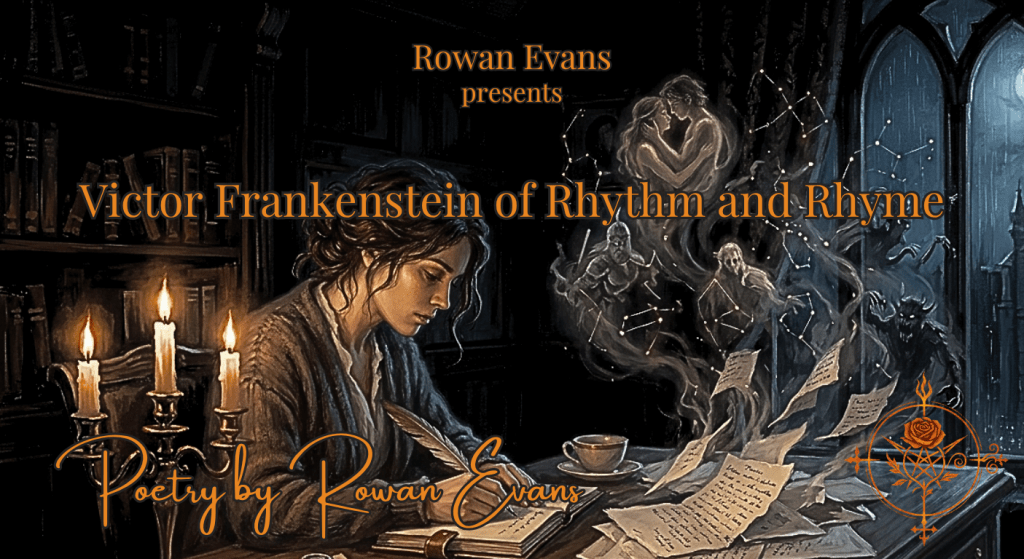
    A poet writing by candlelight as handwritten pages transform into stitched-together figures made from words, symbolizing creativity, identity, and the act of creating poetry.
    “Every poem begins as fragments—thoughts, memories, emotions, and images—stitched together until they learn how to breathe.”

    Victor Frankenstein of Rhythm and Rhyme
    Poetry by Rowan Evans

    I’ll be honest—
    I don’t know who I am
    without this,
    without the ink to bleed—

    what does my life even mean?

    I know it means something—
    but I’ve lost sight of it.

    Because I’m like a god here—
    I control the shape
    the ink takes
    and decide what it makes.

    I create every piece
    in my image.

    I write universes into existence—
    populate them with ghosts,
    lovers, gods and monsters.

    And every version of myself
    I couldn’t survive as alone.

    I translate my mental health
    from the inside, no distance.

    I take my mind
    translate it into lines
    and images—
    stitch them together
    as metaphors—

    Victor Frankenstein
    of rhythm, rhyme and imagery.


    Journey into the Hexverse…

    [Pointing Me Home]
    The final poem in the No Metaphor Left Behind trilogy explores dreams, hope, and belonging. Through moonlight, ocean tides, and quiet conversation, Pointing Me Home reflects on carrying hope long before reaching the place you call home.

    [Caller ID: Destiny]
    Sometimes the places we visit in our dreams feel more like home than the places we wake up in. Caller ID: Destiny explores longing, belonging, and the quiet feeling that life is calling you toward somewhere new.

    [Monster Theology]
    What if the monsters under the bed weren’t monsters at all? Monster Theology explores difference, belonging, and the human tendency to fear what we don’t understand through a conversation with the creatures we’ve spent our lives imagining.

    [Frankenstein’s Monster (and I’m the Doctor)]
    Some poems are built to make a point. Others are built to reveal the mechanism. Frankenstein’s Monster (and I’m the Doctor) explores associative thinking, creative chaos, and the strange process of stitching disconnected ideas into something alive.

    [I’ll Be There to See Your Sunrise]
    Love has never come easily to me. This poem explores the fear, vulnerability, and quiet courage required to stay emotionally present when connection begins to matter deeply. “I’ll Be There to See Your Sunrise” is about choosing love despite the risk of heartbreak—and promising to remain long enough to witness someone fully.

    If you’re interested in more poetry, you can find it here → [The Library of Ashes]
  • Author’s Note

    Some poems begin with an idea.

    This one began with a phrase that made me laugh.

    “Pockets full of tater tots and rocks.”

    I couldn’t tell you where it came from. My brain simply handed it to me, and I knew I had to follow it.

    That’s how a lot of my writing happens.

    One strange image appears, and instead of questioning it, I trust it. I let the poem figure out why that image belongs there.

    This piece moves the way my thoughts move—quickly, unpredictably, jumping from humor to comic books, from creative confidence to quiet vulnerability without asking permission.

    For a while, it feels like controlled chaos.

    Then, almost without warning, it settles.

    Because beneath the jokes, beneath the references, beneath the absurd image of someone carrying tater tots and rocks around in their pockets, there’s a simple truth waiting to be spoken.

    I spend a lot of time thinking.

    A lot of time creating.

    A lot of time turning emotions into language.

    And underneath all of that, like it is underneath so many of my poems, is the same quiet hope:

    To find someone willing to hold my heart with the same care I try to give theirs.

    Sometimes that’s all a poem is.

    A strange road leading to an honest sentence.

    Rowan Evans


    A solitary poet stands beside the ocean at sunset with pockets full of rocks and tater tots while handwritten pages become ink in the wind.
    “Sometimes the strangest thoughts lead to the most honest truths.” 🥔🪨✍️🌊

    Tots, Rocks and All
    Poetry by Rowan Evans

    I’m lost in my thoughts again,
    pockets full of tater tots
    and rocks again.

    Take a dip in the ocean—
    emotion overflowin’
    like the ink from my pen.

    Runaway mind,
    runaway lines.

    This much creativity
    should be a crime.

    I’ll break lines
    the way Bane
    breaks spines.

    And when I get like this
    I like to speak my mind,
    but I don’t speak in vocals—
    I speak in ink and rhyme.

    Now, let’s get real for a minute,
    just a moment of your—

    hands on the clock hold time,
    and I’m looking for a love
    that’ll hold mine.

    I guess that’s the truth of this—
    tots, rocks and all.


    Journey into the Hexverse…

    [Chemical X]
    Chemical X explores the rapid, associative way one creative mind moves—from cartoons to sports, comic books to music—revealing that inspiration isn’t linear, but a collision of memory, humor, rhythm, and intuition.

    [Pointing Me Home]
    The final poem in the No Metaphor Left Behind trilogy explores dreams, hope, and belonging. Through moonlight, ocean tides, and quiet conversation, Pointing Me Home reflects on carrying hope long before reaching the place you call home.

    [Caller ID: Destiny]
    Sometimes the places we visit in our dreams feel more like home than the places we wake up in. Caller ID: Destiny explores longing, belonging, and the quiet feeling that life is calling you toward somewhere new.

    [Monster Theology]
    What if the monsters under the bed weren’t monsters at all? Monster Theology explores difference, belonging, and the human tendency to fear what we don’t understand through a conversation with the creatures we’ve spent our lives imagining.

    [Memories From a Life Yet to Come]
    Some dreams feel less like fantasy and more like memory. “Memories From a Life Yet to Come” is a reflective free verse poem about longing, displacement, emotional alignment, and the strange comfort of recognizing yourself more clearly in dreams than in waking life.

    If you’re interested in more poetry, you can find it here → [The Library of Ashes]

    [Bonus Track]

    I’ve got tater tots in my pockets,
    buried inside with two tickets
    to the Houston Rockets.
    They’re underneath all the rocks,
    it’s kind of insane.

    But I’m trying to sell ’em,
    ’cause I don’t watch sports—
    I watch narratives
    and stories unfold.

    I like the underdog—
    when their story gets told.

  • Author’s Note

    People often ask what inspires my writing, or how my mind moves from one idea to another so quickly.

    The honest answer is that I don’t think in straight lines.

    I think in association, in rhythm, in collision. One idea reminds me of another, not because they are logically connected, but because they feel connected in the moment they appear.

    This poem is built from that process.

    It began with something simple—the familiar phrase “sugar, spice, and everything nice.” But as I wrote, my mind immediately followed the same pattern it always does: connection, exaggeration, humor, memory, and cultural reference all colliding at once. What starts as something familiar quickly becomes something unpredictable.

    The title, Chemical X, comes from that idea.

    In The Powerpuff Girls, Chemical X is the unknown element that transforms something ordinary into something entirely different. For me, that “unknown element” is the way my mind blends thoughts, images, and meanings together in real time.

    This poem is not meant to be linear. It is meant to mirror the way my thoughts actually arrive: rapid, associative, sometimes chaotic, but always connected by feeling and intuition rather than structure.

    If it feels like a mix of humor, storytelling, sports commentary, and surreal imagery all at once—that’s intentional. That is the point.

    This is what happens when everything gets mixed together.

    This is Chemical X.

    Rowan Evans


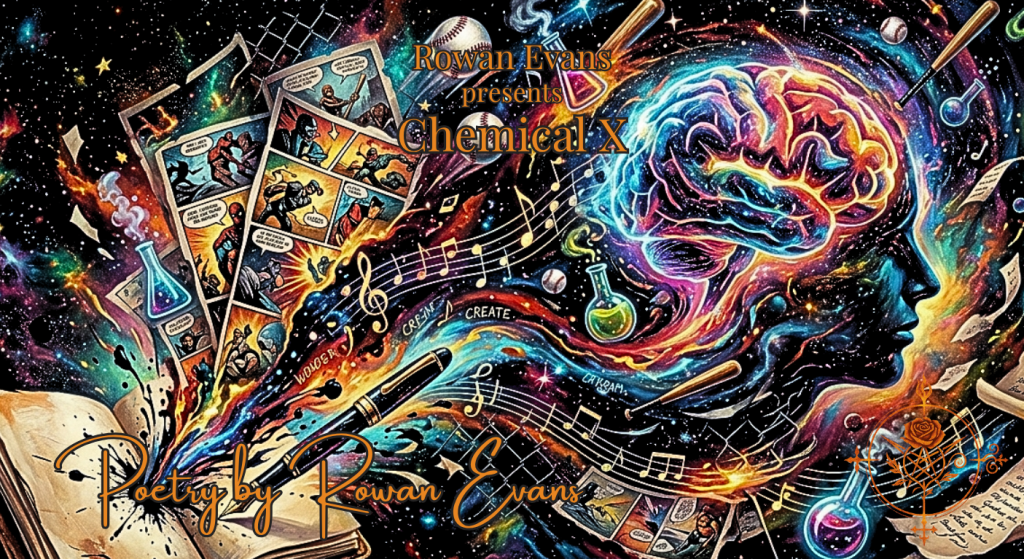
    A notebook and pen burst into colorful images of comics, sports, music, stars, and cartoons, symbolizing an imaginative mind making rapid connections.
    Some minds move in straight lines. Mine mixes everything together—and somehow, it all makes sense.

    Chemical X
    Poetry by Rowan Evans

    They say “penny for your thoughts,”
    but it takes—two cents to talk.
    Go for a walk, a mile long, in my shoes—
    use my eyes, see the world through my view.

    I’ll etch it across the page,
    world view and all—
    because I’m the on the ball
    point pen, in an ink sprint.
    Usain Bolt, the way my mind went.

    To understand the rhythm,
    you’ve got to understand the mechanism.
    You’ve got to understand the mind
    behind the rhyme—

    my thoughts are rapid fire.

    Thirty round magazine,
    three-round burst—
    that’s the way my mind works.

    I can jump from cartoons
    to comic books,
    music to sports—

    sugar, spice,
    and everything nice.

    A round of applause, Johnny—
    Bravo, you completed the Quest.
    You gained experience and leveled up.
    Still, it wasn’t enough—

    because I’m a two-way threat—
    like my name is Shohei.

    Bitch, I’m the Babe.

    At four years old,
    I was almost tossed
    out of the game.

    I was a menace—
    call me, Dennis.

    Two Hubbles
    strapped to my face,
    look up—see space.

    Fingers curled
    gripping the chain link—
    a bad call, a blind ump,
    a small child
    blind as I was,
    offering their eyes up
    like I was—

    trying to help?
    Maybe.

    Trying to insult?

    Of course…

    it’s sports…

    I was Dexter
    in the lab again,
    pen to pad again,
    and I gave
    all I had to give—

    Victor Frankenstein
    is at it again,
    patchwork metaphors
    and images galore—

    villagers are going
    to be afraid for sure.


    Journey into the Hexverse…

    [Crossing the Sea (No Metaphor Left Behind)]
    A deeply personal poem about relocation, longing, and the realization that some truths naturally arrive through metaphor—even when we try to leave it behind.

    [Only Waiting (No Metaphor Left Behind)]
    The second poem in the No Metaphor Left Behind series, exploring the quiet ache of growing up in a place that never truly felt like home—and finally saying aloud what years of metaphor had been trying to express.

    [Translating What I Feel]
    A poem about the invisible process of turning emotion into imagery, imagery into language, and language into poetry. An intimate reflection on creativity, loneliness, and twenty-three years of learning to translate what the heart feels.

    [Monster Theology]
    What if the monsters under the bed weren’t monsters at all? Monster Theology explores difference, belonging, and the human tendency to fear what we don’t understand through a conversation with the creatures we’ve spent our lives imagining.

    [Frankenstein’s Monster (and I’m the Doctor)]
    Some poems are built to make a point. Others are built to reveal the mechanism. Frankenstein’s Monster (and I’m the Doctor) explores associative thinking, creative chaos, and the strange process of stitching disconnected ideas into something alive.

    If you’re interested in more poetry, you can find it here → [The Library of Ashes]
  • Author’s Note

    This piece exists because my brain occasionally grabs a pun by the throat and refuses to let go.

    It started with a single phrase:

    “Wanda the Cosmo.”

    The moment I realized it sounded like wander the cosmos, the entire poem became inevitable.

    From there, it turned into a collision of things that shaped me growing up: cartoons, superheroes, imagination, ridiculous wordplay, and the habit of taking a joke far beyond the point where a reasonable person would stop.

    The references are intentional, but they aren’t really the point.

    What interests me is the thread connecting all of them.

    Timmy Turner. Doug Funnie. Quailman.

    They’re ordinary people living inside worlds that are a little bigger, stranger, and more magical than everyday life.

    And in some ways, that’s what writing has always felt like to me.

    A blank page is ordinary until imagination gets involved.

    Then suddenly you’re wandering the cosmos. Building constellations out of language. Turning metaphors into transportation.

    The speaker in this poem never actually becomes a superhero.

    Nothing supernatural happens.

    No powers. No cosmic upgrades. No secret destiny.

    Instead, the final line reveals the joke that was hiding in plain sight the entire time:

    “It’s just me but super.”

    Because that’s what creativity often feels like.

    Not becoming someone else.

    Not transforming into a different person.

    Just becoming a more exaggerated version of yourself for a little while.

    A little louder.

    A little stranger.

    A little more willing to follow an absurd idea all the way to the stars.

    And honestly?

    That’s where some of my favorite poems come from.

    Rowan Evans


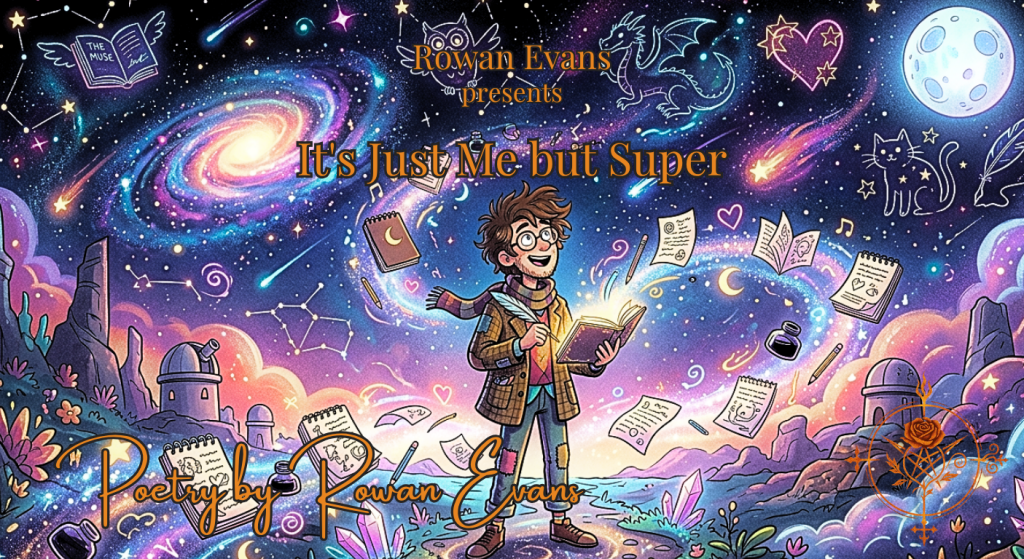
    A whimsical poet standing beneath a galaxy-filled sky surrounded by glowing constellations, notebooks, and symbols of imagination.
    Sometimes creativity isn’t becoming someone else—it’s becoming a more imaginative version of yourself and following the idea all the way to the stars.

    It’s Just Me but Super
    Poetry by Rowan Evans

    They say I’m fairly odd—
    call me Timmy Turner.
    Watch me Wanda the Cosmo,
    a trip across the stars—

    Get it…
    Wanda the Cosmo?

    I am saying, watch me
    wander the cosmos—
    it’s a trip across the stars.
    Every stanza a constellation
    shaped in star dust,
    inked in the space between.

    And when I come back,
    re-entry will have me feeling Funnie—
    I’ll write about it like
    “Hey, journal, it’s me, Doug.”
    I cannot fail, man—
    like my alter ego is Quailman.

    It’s just me but super.


    Journey into the Hexverse…

    [100 Grand and a Book Deal]
    A playful collision of candy bars, comic book heroes, basketball legends, and cosmic metaphors. Beneath the jokes lies a reflection on twenty-three years of writing, creativity, and the dream of building something lasting one line at a time.

    [Copy of a Copy]
    A sharp, self-aware poem about originality, imitation, and the search for an authentic creative voice. What begins as a diss gradually reveals itself as a meditation on authorship, influence, and the things that can never truly be copied.

    [Lone Wolf Theology]
    A philosophical pop-culture poem exploring freedom, identity, and self-authorship through the lens of superheroes, antiheroes, mythic archetypes, and personal rebellion. A declaration of autonomy in a world determined to write your story for you.

    [L Words & Heart]
    A playful, self-aware poem about love, longing, loyalty, and the quiet ways another person can reshape our inner world. What begins as humor slowly reveals a heartfelt confession about affection, imagination, and the faces that linger in our dreams.

    [Just Beyond Waking]
    A street that feels familiar. A life that hasn’t happened yet. Just Beyond Waking explores the fragile space between dreams, memory, longing, and the quiet feeling that some futures are already waiting for us.

    [Twin Suns, Sister Moons]
    A poem about distance, longing, and the quiet pull of someone who lives beneath a different sky. Between twin suns and sister moons, the heart keeps reaching for home.

    [It’s You I Choose]
    A poem about devotion, vulnerability, and the quiet decision to stay. Sometimes love isn’t certainty—it is choosing someone anyway.

    If you’re interested in more poetry, you can find it here → [The Library of Ashes]
  • Author’s Note

    This piece started as a diss.

    Or at least that’s what I told myself when I began writing it.

    The voice arrived first: irritated, dismissive, sharp around the edges. The kind of voice that has grown tired of watching imitation mistake itself for originality.

    But as the poem developed, I realized it wasn’t really about a specific person.

    It was about authorship.

    About the difference between influence and imitation.

    Every writer begins by borrowing something. We absorb voices we admire. We study techniques. We experiment with styles that resonate with us. That’s part of learning.

    The problem isn’t influence.

    The problem is stopping there.

    Because eventually every artist reaches a point where imitation becomes a limitation. A point where the question shifts from “Who do I sound like?” to “What do I actually have to say?”

    That’s the tension at the center of this piece.

    The speaker isn’t claiming ownership over Gothic imagery, confession, darkness, anxiety, or any of the themes referenced in the poem. Those things belong to countless writers across generations.

    What can’t be copied is the life underneath them.

    The experiences.

    The scars.

    The specific reasons a person reaches for certain images, metaphors, and obsessions.

    Someone can reproduce the shape of a voice.

    But shape is not source.

    That’s why the final lines matter to me.

    The joke is that the speaker becomes so frustrated with imitation that they offer to write the copy themselves.

    But underneath the sarcasm is a quieter observation:

    If you spend all your time trying to become someone else, you’ll never discover what only you could have written.

    And that’s where the most interesting work usually begins.

    Rowan Evans


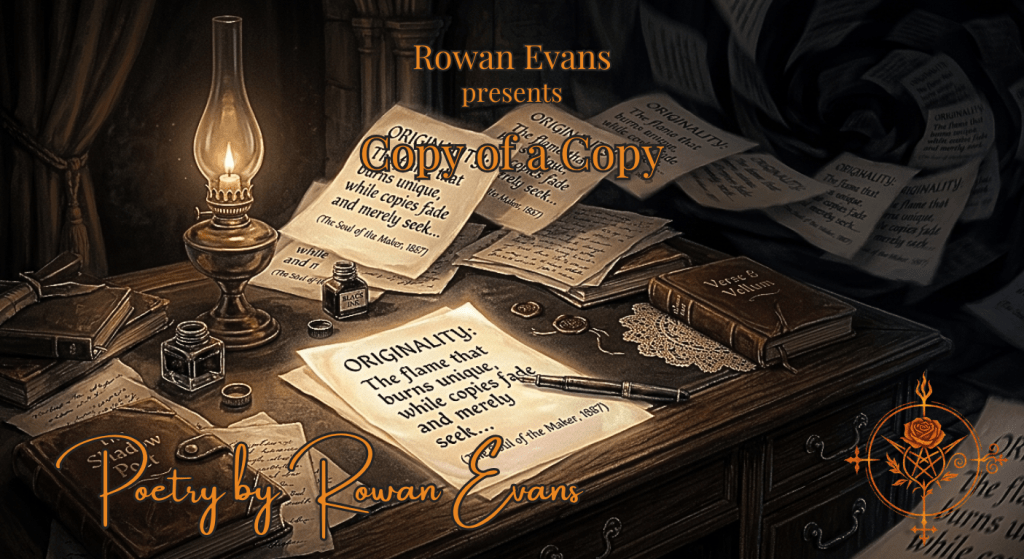
    A glowing handwritten manuscript surrounded by faded copies of the same page on a dark writing desk.
    Influence teaches the craft. Authenticity creates the voice. A copy can mimic the shape, but never the source.

    Copy of a Copy
    Poetry by Rowan Evans

    You carry yourself like a killer.
    Yeah, of vibes—
    You think you’re intimidating?
    You’re not. Just stop.
    You’re embarrassing.

    You’ve had
    zero original thoughts,
    you just parrot me.
    You’re a parody.

    A copy of a copy,
    copied a second time—
    it’s obvious in the rhyme,
    you can see it
    in the quality decline.

    Take your pen
    and try to write like me.

    Gothic lace and confession,
    tinted with depression—
    written by an anxious mind.
    You can copy me
    line for line, rhyme for rhyme
    and I’m sure you’ll find
    it still won’t land right.

    Here—
    let me write for you.
    It’s not like
    that’s not something
    I already do.
    But this time,
    I’ll give the lines to you.


    Journey into the Hexverse…

    [Lone Wolf Theology]
    A philosophical pop-culture poem exploring freedom, identity, and self-authorship through the lens of superheroes, antiheroes, mythic archetypes, and personal rebellion. A declaration of autonomy in a world determined to write your story for you.

    [L Words & Heart]
    A playful, self-aware poem about love, longing, loyalty, and the quiet ways another person can reshape our inner world. What begins as humor slowly reveals a heartfelt confession about affection, imagination, and the faces that linger in our dreams.

    [Just Beyond Waking]
    A street that feels familiar. A life that hasn’t happened yet. Just Beyond Waking explores the fragile space between dreams, memory, longing, and the quiet feeling that some futures are already waiting for us.

    [Twin Suns, Sister Moons]
    A poem about distance, longing, and the quiet pull of someone who lives beneath a different sky. Between twin suns and sister moons, the heart keeps reaching for home.

    [It’s You I Choose]
    A poem about devotion, vulnerability, and the quiet decision to stay. Sometimes love isn’t certainty—it is choosing someone anyway.

    If you’re interested in more poetry, you can find it here → [The Library of Ashes]