Tag: Self-Expression

  • Author’s Note

    Some poems arrive as observations.

    Others arrive as questions.

    This one began with a question I wasn’t entirely prepared to answer:

    Who am I without writing?

    I’ve spent more than two decades translating my inner world into poetry. Over time, writing stopped feeling like something I do and started feeling like the place where I exist most completely.

    That’s a strange realization.

    Because poetry isn’t simply expression for me—it’s construction.

    Every poem is assembled from fragments: memories, emotions, images, conversations, dreams, fears, humor, hope. I rarely invent from nothing. I gather pieces of lived experience and stitch them together until they begin breathing on their own.

    That’s where the title comes from.

    Victor Frankenstein wasn’t remembered because he created life.

    He was remembered because he assembled it.

    That’s often what writing feels like to me.

    I gather disconnected thoughts, broken emotions, recurring symbols, and scattered moments, then bind them together until they become something capable of standing on its own.

    The result isn’t always comfortable.

    Sometimes it’s beautiful.

    Sometimes it’s monstrous.

    Most often…

    it’s simply honest.

    Rowan Evans


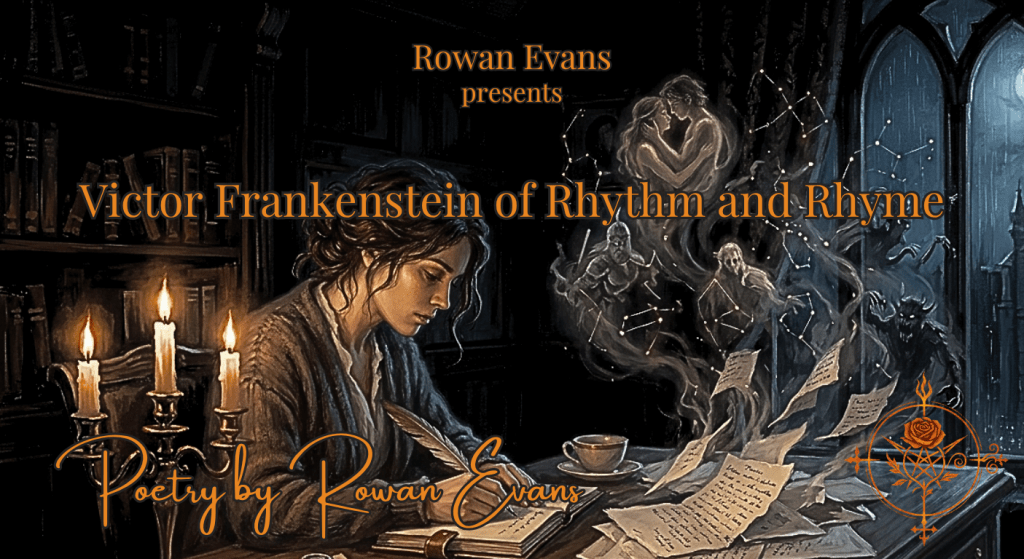
    A poet writing by candlelight as handwritten pages transform into stitched-together figures made from words, symbolizing creativity, identity, and the act of creating poetry.
    “Every poem begins as fragments—thoughts, memories, emotions, and images—stitched together until they learn how to breathe.”

    Victor Frankenstein of Rhythm and Rhyme
    Poetry by Rowan Evans

    I’ll be honest—
    I don’t know who I am
    without this,
    without the ink to bleed—

    what does my life even mean?

    I know it means something—
    but I’ve lost sight of it.

    Because I’m like a god here—
    I control the shape
    the ink takes
    and decide what it makes.

    I create every piece
    in my image.

    I write universes into existence—
    populate them with ghosts,
    lovers, gods and monsters.

    And every version of myself
    I couldn’t survive as alone.

    I translate my mental health
    from the inside, no distance.

    I take my mind
    translate it into lines
    and images—
    stitch them together
    as metaphors—

    Victor Frankenstein
    of rhythm, rhyme and imagery.


    Journey into the Hexverse…

    [Pointing Me Home]
    The final poem in the No Metaphor Left Behind trilogy explores dreams, hope, and belonging. Through moonlight, ocean tides, and quiet conversation, Pointing Me Home reflects on carrying hope long before reaching the place you call home.

    [Caller ID: Destiny]
    Sometimes the places we visit in our dreams feel more like home than the places we wake up in. Caller ID: Destiny explores longing, belonging, and the quiet feeling that life is calling you toward somewhere new.

    [Monster Theology]
    What if the monsters under the bed weren’t monsters at all? Monster Theology explores difference, belonging, and the human tendency to fear what we don’t understand through a conversation with the creatures we’ve spent our lives imagining.

    [Frankenstein’s Monster (and I’m the Doctor)]
    Some poems are built to make a point. Others are built to reveal the mechanism. Frankenstein’s Monster (and I’m the Doctor) explores associative thinking, creative chaos, and the strange process of stitching disconnected ideas into something alive.

    [I’ll Be There to See Your Sunrise]
    Love has never come easily to me. This poem explores the fear, vulnerability, and quiet courage required to stay emotionally present when connection begins to matter deeply. “I’ll Be There to See Your Sunrise” is about choosing love despite the risk of heartbreak—and promising to remain long enough to witness someone fully.

    If you’re interested in more poetry, you can find it here → [The Library of Ashes]
  • Author’s Note

    This piece started as a diss.

    Or at least that’s what I told myself when I began writing it.

    The voice arrived first: irritated, dismissive, sharp around the edges. The kind of voice that has grown tired of watching imitation mistake itself for originality.

    But as the poem developed, I realized it wasn’t really about a specific person.

    It was about authorship.

    About the difference between influence and imitation.

    Every writer begins by borrowing something. We absorb voices we admire. We study techniques. We experiment with styles that resonate with us. That’s part of learning.

    The problem isn’t influence.

    The problem is stopping there.

    Because eventually every artist reaches a point where imitation becomes a limitation. A point where the question shifts from “Who do I sound like?” to “What do I actually have to say?”

    That’s the tension at the center of this piece.

    The speaker isn’t claiming ownership over Gothic imagery, confession, darkness, anxiety, or any of the themes referenced in the poem. Those things belong to countless writers across generations.

    What can’t be copied is the life underneath them.

    The experiences.

    The scars.

    The specific reasons a person reaches for certain images, metaphors, and obsessions.

    Someone can reproduce the shape of a voice.

    But shape is not source.

    That’s why the final lines matter to me.

    The joke is that the speaker becomes so frustrated with imitation that they offer to write the copy themselves.

    But underneath the sarcasm is a quieter observation:

    If you spend all your time trying to become someone else, you’ll never discover what only you could have written.

    And that’s where the most interesting work usually begins.

    Rowan Evans


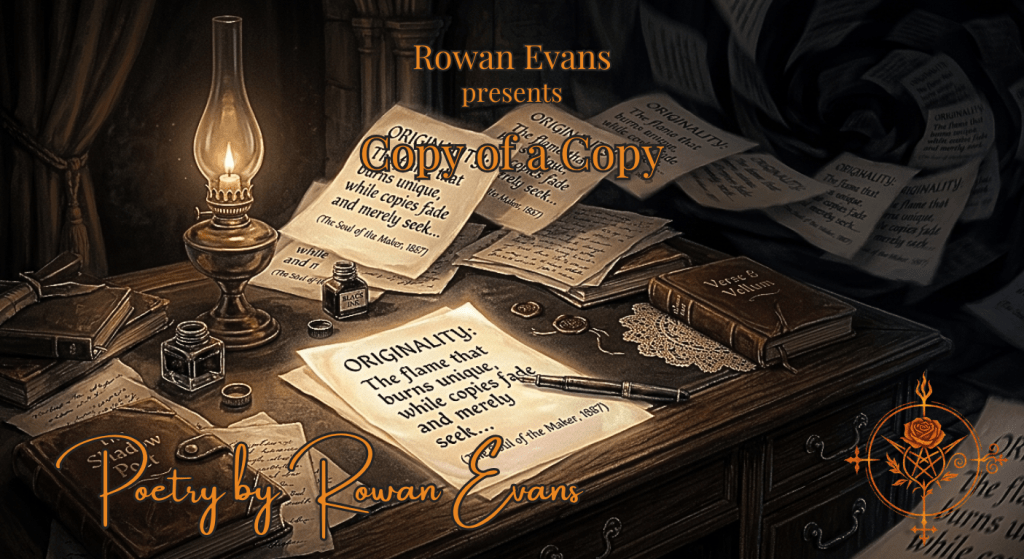
    A glowing handwritten manuscript surrounded by faded copies of the same page on a dark writing desk.
    Influence teaches the craft. Authenticity creates the voice. A copy can mimic the shape, but never the source.

    Copy of a Copy
    Poetry by Rowan Evans

    You carry yourself like a killer.
    Yeah, of vibes—
    You think you’re intimidating?
    You’re not. Just stop.
    You’re embarrassing.

    You’ve had
    zero original thoughts,
    you just parrot me.
    You’re a parody.

    A copy of a copy,
    copied a second time—
    it’s obvious in the rhyme,
    you can see it
    in the quality decline.

    Take your pen
    and try to write like me.

    Gothic lace and confession,
    tinted with depression—
    written by an anxious mind.
    You can copy me
    line for line, rhyme for rhyme
    and I’m sure you’ll find
    it still won’t land right.

    Here—
    let me write for you.
    It’s not like
    that’s not something
    I already do.
    But this time,
    I’ll give the lines to you.


    Journey into the Hexverse…

    [Lone Wolf Theology]
    A philosophical pop-culture poem exploring freedom, identity, and self-authorship through the lens of superheroes, antiheroes, mythic archetypes, and personal rebellion. A declaration of autonomy in a world determined to write your story for you.

    [L Words & Heart]
    A playful, self-aware poem about love, longing, loyalty, and the quiet ways another person can reshape our inner world. What begins as humor slowly reveals a heartfelt confession about affection, imagination, and the faces that linger in our dreams.

    [Just Beyond Waking]
    A street that feels familiar. A life that hasn’t happened yet. Just Beyond Waking explores the fragile space between dreams, memory, longing, and the quiet feeling that some futures are already waiting for us.

    [Twin Suns, Sister Moons]
    A poem about distance, longing, and the quiet pull of someone who lives beneath a different sky. Between twin suns and sister moons, the heart keeps reaching for home.

    [It’s You I Choose]
    A poem about devotion, vulnerability, and the quiet decision to stay. Sometimes love isn’t certainty—it is choosing someone anyway.

    If you’re interested in more poetry, you can find it here → [The Library of Ashes]
  • Author’s Note

    This piece comes from the space where speech and writing don’t quite align.

    There has always been a kind of delay for me—between what I think, what I feel, and what I can actually say out loud. Spoken language has never felt like the most reliable place for truth to land. It slips. It fractures. It gets filtered through hesitation, timing, or silence.

    Writing became something different.

    Not a replacement for speech, but a translation of it.

    A second mouth.

    One that doesn’t hesitate in the same way.

    One that doesn’t need to arrive perfectly formed in real time.

    Over time, I’ve come to understand my writing less as expression and more as continuity—a way of carrying versions of myself forward that might otherwise get lost between changes, growth, or silence. When I talk about shedding “lives like shells,” it isn’t about abandoning who I was, but making space for who I’m becoming.

    Writing is where those versions remain visible.

    Where they don’t disappear just because I’ve outgrown them.

    In that sense, this isn’t just about communication—it’s about survival through articulation. Not in the dramatic sense, but in the quiet one: staying connected to myself through language when voice doesn’t fully bridge the gap.

    And if spoken language is the place where I sometimes fall short of myself, then writing is where I learn how to keep translating who I am anyway.

    Rowan Evans


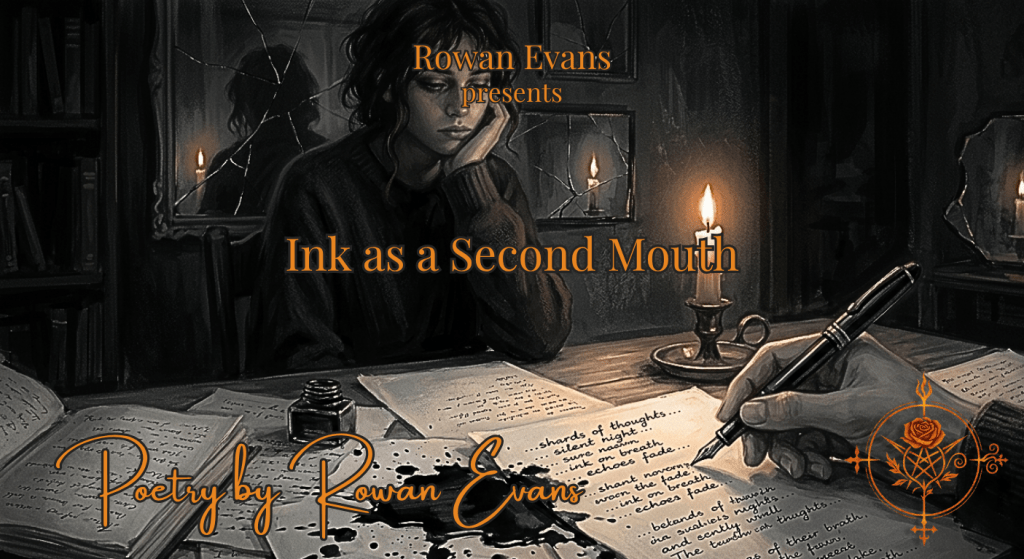
    A writer sitting beside scattered handwritten pages and spilled ink in a dimly lit room.
    If spoken language is where I fall short of myself, then writing is how I keep translating who I am anyway.

    Ink as a Second Mouth
    Poetry by Rowan Evans

    There is a delay
    between my mind
    and my mouth
    when I speak—

    that’s why I find
    it easier to talk in ink.

    I turned my pen
    into my mouth,
    so when I write
    it’s the only time—
    the truth spills through.

    When I open my mouth,
    my words won’t come out—

    but in ink, they run
    like the secrets slip
    from loose lips.

    I could write poem after poem,
    leaving piece after piece of me behind—
    scattered across the pages,
    like versions of me scattered
    across different lives.

    But do not mourn
    for what I’ve lost,
    because it’s simply the cost
    of me being me.

    I shed past lives,
    it leaves room for me to grow—

    just a hermit crab
    in human form.

    And I’ll continue
    to shed lives like shells until
    I find the version of myself—

    that can speak
    in more than ink.

    Until then I’ll continue to try,
    because growth comes slow.
    It’s gradual, it never comes clear.

    There are no definable lines—
    only slow becoming.


    If you’re interested in more poetry, you can find it here → [The Library of Ashes]
  • Author’s Note

    Sometimes people expect you to play a role they’ve already written for you. A role shaped by their fears, their politics, or their idea of what loyalty should look like.

    This poem is about refusing that script.

    Rowan Evans


    A spotlight illuminating a torn script on an empty stage symbolizing refusing expectations and imposed roles.
    Sometimes the most powerful thing you can do is refuse the role others expect you to play.

    Refusing the Script
    Poetry by Rowan Evans

    I feel I lost my voice
    in a way,
    put pen to page,
    learned the cost to say—
    translating rage,
    when writing
    came to stay.

    Breaking bars
    on the mental cage,
    so I could escape.
    I’m no actor—
    I don’t perform,
    but life’s a stage.

    I can hear
    your expectations,
    the way you
    judge from fear—
    and manipulation.
    You see,
    I’ve dwelled within
    emotion.

    You can’t twist my thoughts,
    to change my view,
    set in stone, not glass—
    solid, not see-through.

    I’m no actor—
    I won’t perform
    for your applause.
    I won’t play my part,
    won’t fall in line.
    Won’t pledge allegiance,
    show no hollow pride.
    And you simply
    cannot convince me,
    to see no value
    in a human life.


    If you’re interested in more poetry, you can find it here → [The Library of Ashes]
  • Author’s Note

    Some poems are confessions.
    Some are exorcisms.

    This one is alchemy.

    Alchemist of Ink (All Sixes) came from that familiar edge—when the weight presses in, when the mind contracts, when the darkness feels like it might finally win. But instead of letting it consume me, I let it become something. I let it turn into ink.

    This poem is about that moment of reclamation.
    About taking what hurts and making it mine.
    About refusing to be only what the darkness names me.

    If you’ve ever felt yourself folding inward—this is for you.
    If you’ve ever made art out of survival—this is yours too.


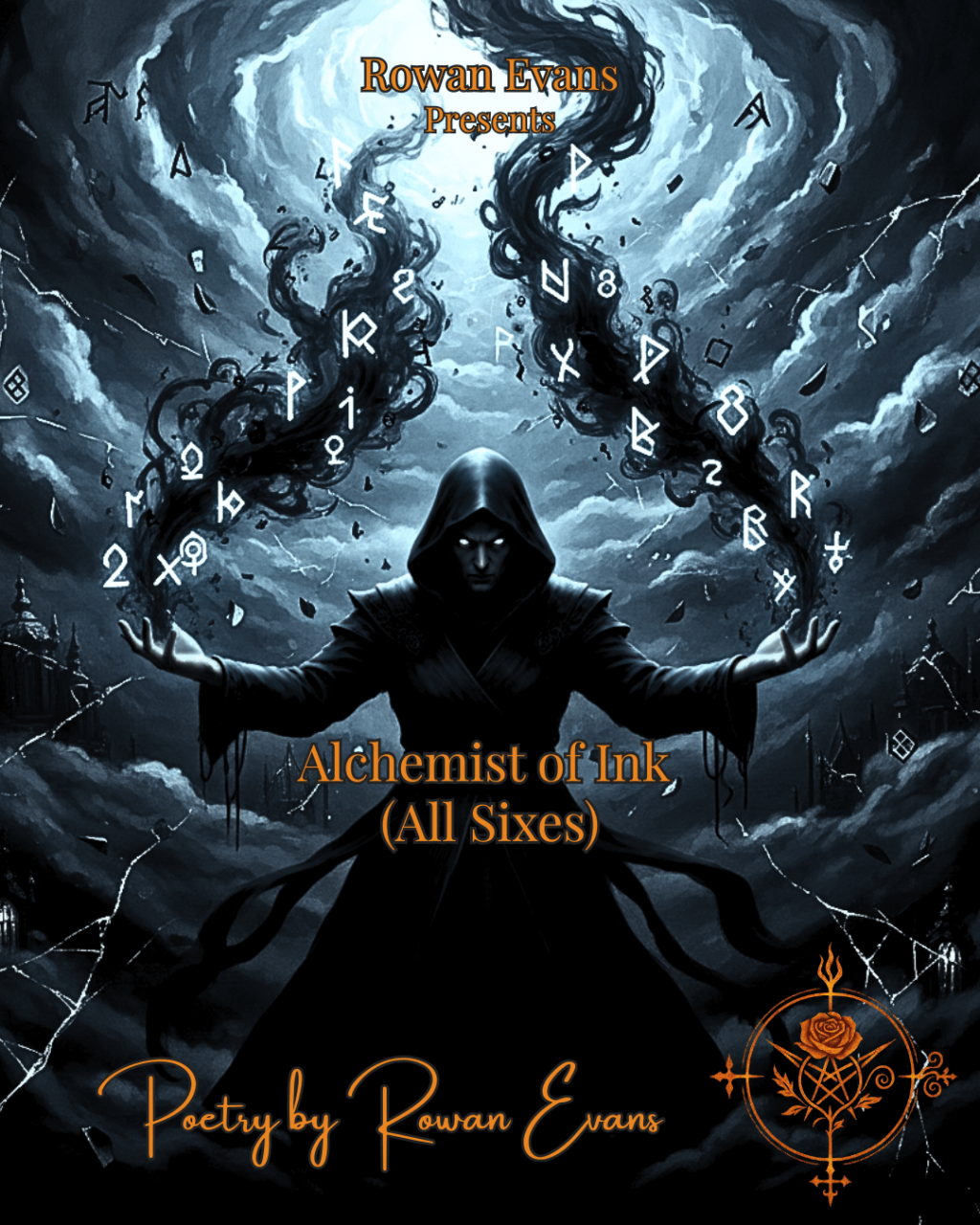
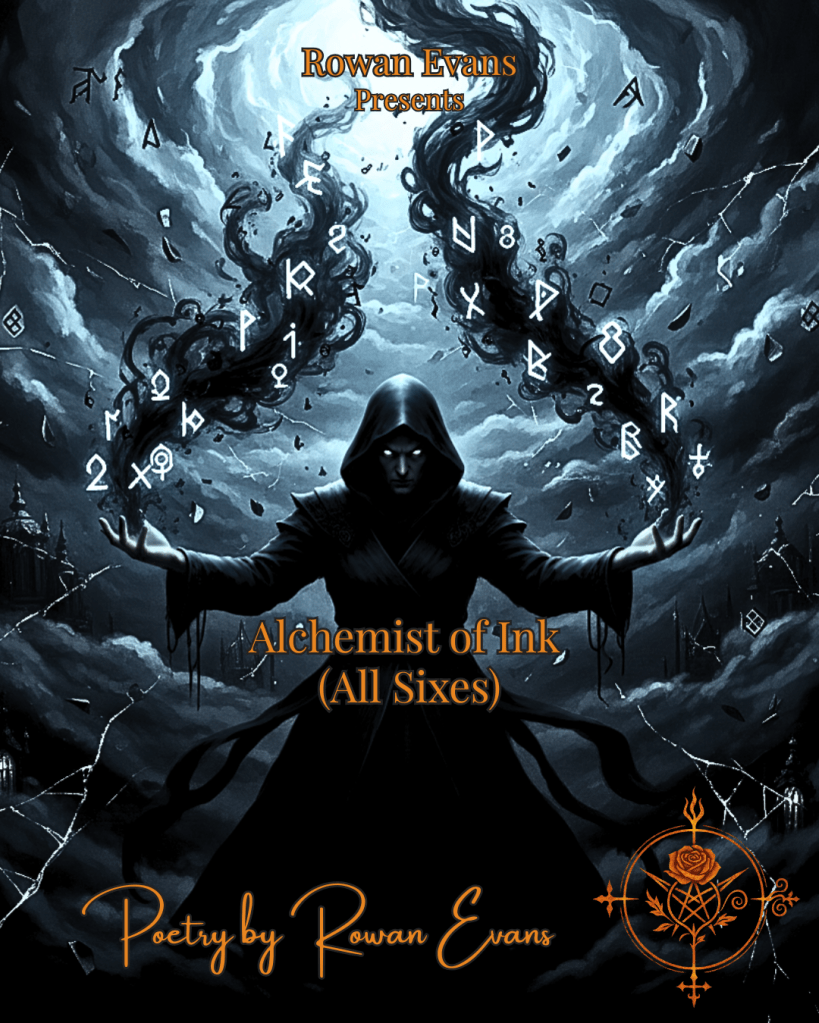
    A shadowed poet with glowing eyes as black ink pours from their hands, transforming into swirling symbols of power in a dark, gothic setting.
    Turning darkness into language. Pain into power. Ink into alchemy.

    Alchemist of Ink (All Sixes)
    Poetry by Rowan Evans

    I am all sixes when its needed,
    this darkness,
    your hatred feeds it.

    I can feel it—
    crawling up my spine,
    that creeping feeling.
    It twists around my mind,
    contracting.

    I can feel it squeeze,
    as I fall to knees.

    My eyes flicker and flash,
    fade to black—
    as you see
    my face distort.
    Twisted reflection.
    Personified depression.

    Can you see—
    as I begin to bleed ink?
    It pours from me,
    covering fingers,
    hands and arms.

    It twists,
    never relents.


    I’m a motherfucking
    alchemist,
    the way I take my pain
    and change it.
    I’ll write like hell,
    to subtly rearrange it.


    If you’re interested in more poetry, you can find it here → [The Library of Ashes]
  • Introduction

    This piece explores the tension between external assumptions and inner truth. It reflects on dualities of identity—masculine and feminine, strength and softness, approachability and untouchability—and celebrates the uncontainable self. It is a declaration: I will not conform to expectations; I am fully, unapologetically me.


    Ethereal figure at stormy ocean edge, blending masculine and feminine features, half in sunlight, half in shadow, representing paradox and self-identity.
    “I am fire wrapped in silk. A storm brushing against calm. I am not your puzzle. I am me.”

    I Am Not Your Puzzle
    Poetry by Rowan Evans

    They stare.
    They whisper.
    They assign me shapes that do not exist.

    “Man.”
    “Woman.”
    “Something else.”
    All wrong.

    I am fire wrapped in silk,
    a storm brushing against the calm,
    the knife that softens,
    the hand that strikes,
    the laugh that shatters silence.

    They want to understand me.
    They cannot.
    I am not a riddle to solve,
    not a lesson for their comfort.
    I am not for your ease,
    not for your comprehension.
    I am me.

    Masculine. Feminine. Both. Neither.
    A contradiction that hums beneath skin,
    that bends time and expectation,
    that exists fully
    even when the world cannot name it.

    I am tender and terrifying.
    Soft enough to hold your secrets,
    sharp enough to cut illusions in half.
    I am easy to love,
    but impossible to own.

    You think you see me—
    but the closer you lean, the more I slip.
    I will not fit your boxes.
    I will not stand still for your definitions.
    I will not shrink to make your eyes comfortable.

    I am the surface and the depth,
    the ache and the exhale,
    the hand that heals
    and the fire that purges.

    Call me what you want—
    I am not your puzzle.
    I am the storm, the calm, the contradiction,
    the infinite they cannot name.
    I am me.

    And that is more than enough.


    If you’re looking for more poetry, you can find it here → [The Library of Ashes]
  • Author’s Note

    I am non-binary, trans-femme—a spectrum of fire and shadow, neither confined to the boxes of man nor woman. For ease, I often tell people I am a transgender woman, because too often the world cannot understand someone who exists outside binaries. Too many are trapped in the idea that femininity means woman, masculinity means man.

    This poem is not about labels; it is about being a soul inhabiting a shell, learning to navigate life on my own terms. It is about contradictions, defiance, and the courage to embrace every shade of who I am. I am chaos. I am cosmos. I am me.


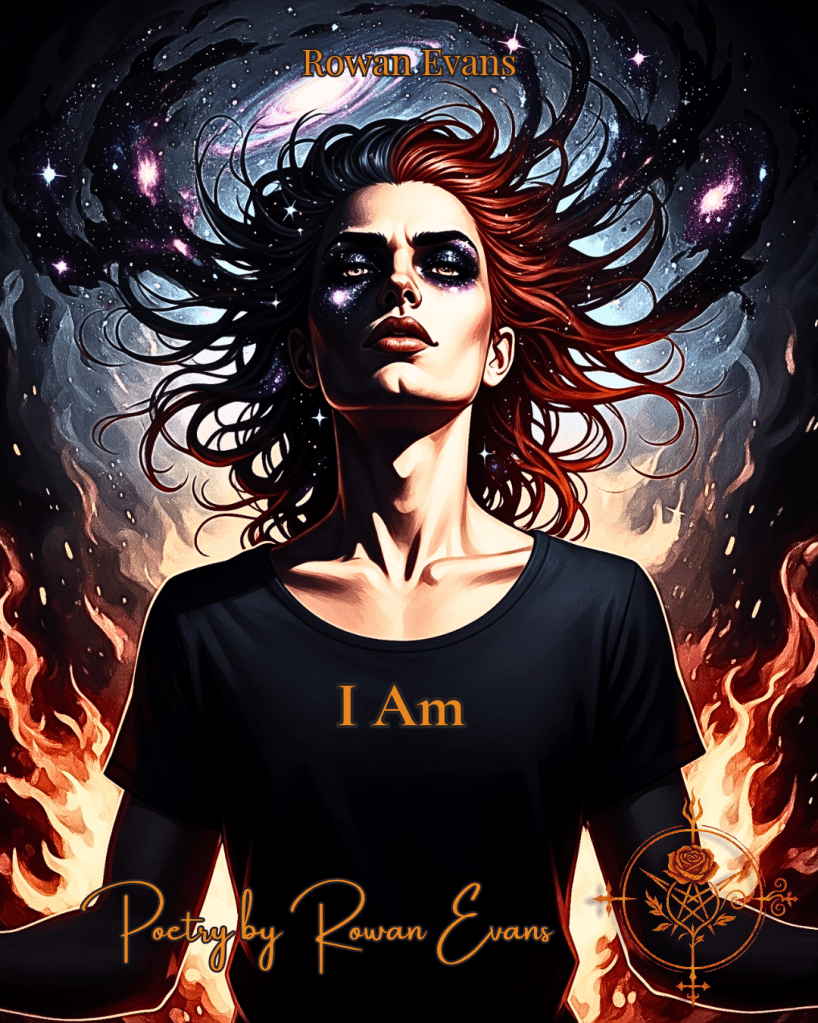
    Non-binary trans-femme figure surrounded by cosmic fire and shadow, radiating defiance and self-expression.
    I Am: Embracing contradictions, defying binaries, and shining unapologetically in fire and shadow.

    I Am
    Poetry by Rowan Evans

    I wore the masc like a mask, hid in the dark,
    Flash femme, stitch fire, lightning in my heart.
    Binary cracked me, rewired my cage,
    Storm unleashed, spectrum steps on stage.

    Dresses, beards, contradictions collide,
    Ride every edge, galaxy inside.
    Not man, not woman, not in-between,
    Every damn shade you ain’t ever seen.

    Clothes are fabric, bodies are art,
    I throw chaos raw, straight from the heart.
    Love men, love women, souls in the mist,
    Unbound, reckless, impossible to resist.

    Chains trap weak, fear feeds the meek,
    I spit crystal truth, sharp, unique.
    Fire and shadow, silk and stone,
    Galaxy unclaimed, throne my own.

    Shred rules, laugh loud, burn every mask,
    Erase disguise, tear the world a new path.
    Not a girl, not a guy, not a whisper in-between,
    I’m the scream in the void, the spark unseen.

    Clothes are fabric, bodies are art,
    Rebellion stitched deep in my heart.
    Fuck binaries, fuck the norms,
    I live chaos, survive all storms.

    I am every shade, every scream, every spark,
    Shadow at noon, light in the dark.
    Question, answer, flame untamed,
    Chaos, cosmos—I claim my name.


    If you have made it this far and would like to check out more of my poetry, you can find the full archive here: The Library of Ashes.