Tag: writing

  • Author’s Note

    There are poems where I sit down with a very serious idea and carefully shape every word.

    This isn’t one of those poems.

    Draggin’ (Ignis) is me letting the pen run loose, throwing references at the page, flexing a little, and then immediately making fun of myself for doing it. It’s playful bravado with a gothic streak, a little battle-rap energy, and absolutely no intention of pretending I’m cooler than I am.

    Twenty-three years of writing will do strange things to a poet.

    Apparently, it makes them compare themselves to dragons, superheroes, and Pokémon-level fire hazards.

    Enjoy the chaos.

    Rowan Evans


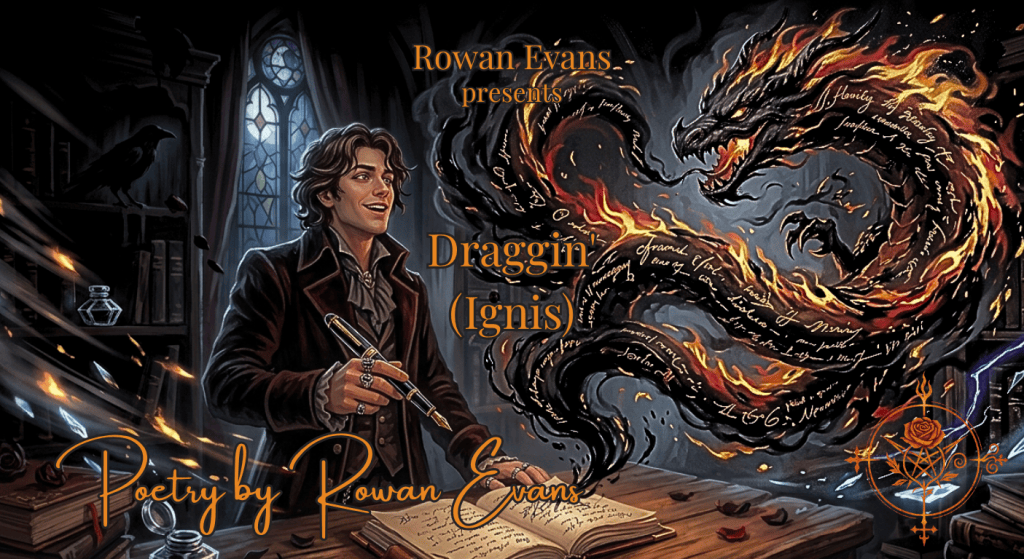
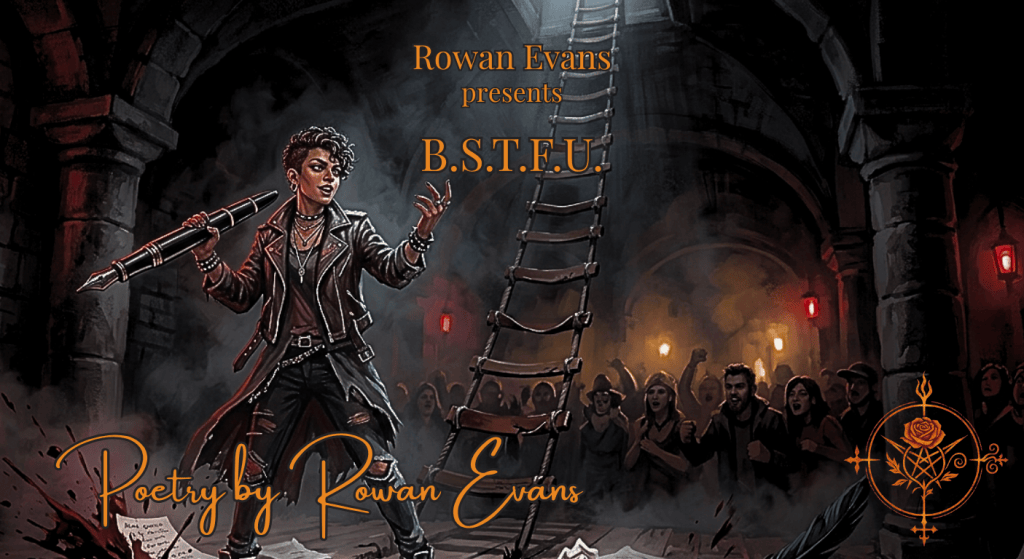
    A playful poet stands with a fountain pen as black ink transforms into a mischievous dragon surrounded by flames, ice, and motion.
    Twenty-three years of writing and this is what the pen decided to do with all that experience.

    Draggin’ (Ignis)
    Poetry by Rowan Evans

    Twenty-three years, I’ve been doing this
    with craft in my veins and trauma in my brain—
    I’ve really been through some shit.
    Maybe that’s why I write so ruthless—
    if I spit a diss, it’d be ignis—I’d be draggin’ you,
    but I’m nice, so I’m a dragon like Toothless.
    This is stupid, silly, dumb—
    I can’t take me serious, and this is how come.

    Yeah, these might be jokes—
    but I’m cold, Bobby Drake,
    so shut your mouth
    before I turn your girl into a—

    Dragon Rider…

    That kind of killed the rhyme,
    that’s fine—

    here’s a few more lines…

    I’m too quick-witted—

    pen faster than Flash,
    I’m too quick wit’ it
    when I write lines
    to silence critics.

    I’ve been writing for years,
    double digits—
    two followed by the number
    that comes next—
    I’m not even trying to flex,
    this is just me writing facts.


    Journey into the Hexverse

    [Behind These Bars (Idol Chatter)]
    A playful battle-poetry piece where confidence, wordplay, pop-culture references, and a sharp pen collide. Behind These Bars (Idol Chatter) turns verbal sparring into a ridiculous little poetry showdown.

    [Kaio-ken/Zenkai]
    Two Dragon Ball-inspired battle poems about creative power, survival, and coming back stronger. Kaio-ken with a Pen brings the attack, while Zenkai (Stronger Now) delivers the aftermath: push me to the edge, and I’ll return stronger than before.

    [Don’t Push Me]
    A playful battle-poetry piece about turning insults into punchlines, standing your ground, and refusing to be intimidated. Don’t Push Me mixes swagger, humor, rhyme, and Rowan Evans’ signature self-aware interruptions.

    [B.S.T.F.U.]
    A playful battle-poetry exercise packed with insults, internal rhymes, punchlines, wordplay, and literary swagger. B.S.T.F.U. is Rowan Evans flexing the verbal muscles—not calling out anyone in particular.

    If you’re interested in more poetry, you can find it here → [The Library of Ashes]
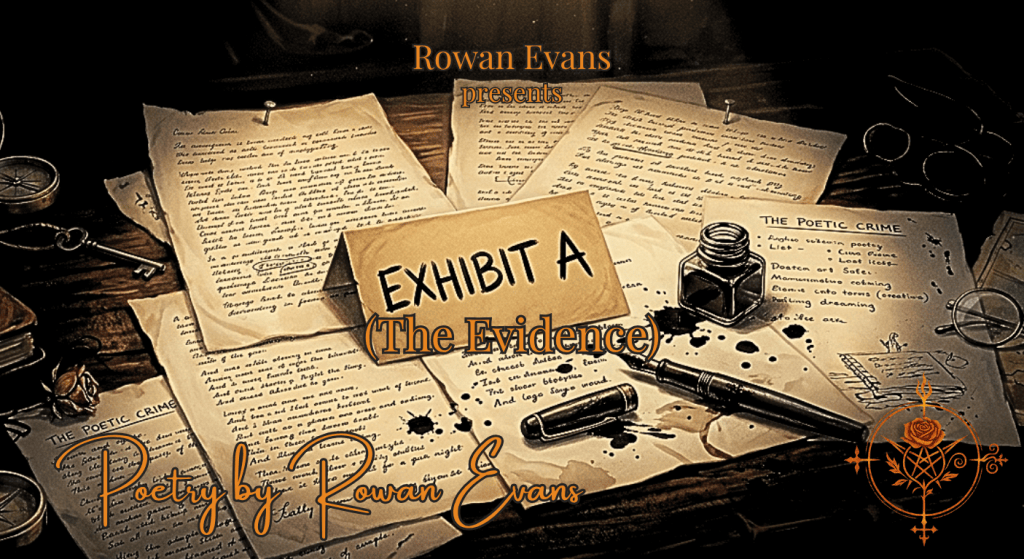
  • Author’s Note

    Some poems ask for your attention.

    This one asks for a challenge.

    Give me something to work with, and I’ll turn it into a line. A joke. A rhyme. A little trouble.

    That’s the game.

    Rowan Evans


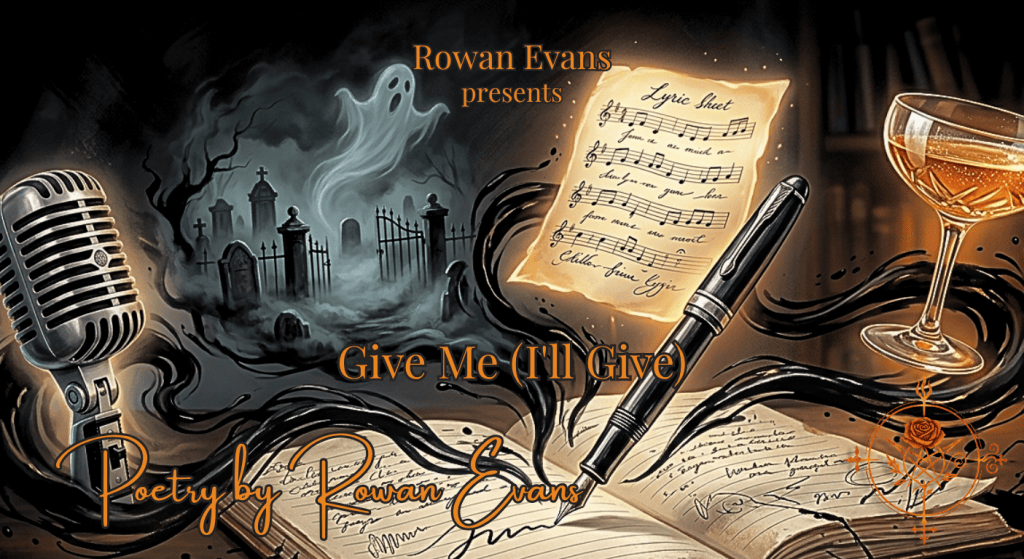
    A fountain pen and open notebook surrounded by surreal images of a microphone, ghost, lyric sheet, and toast.
    Give me something to work with. I’ll give you a poem.

    Give Me (I’ll Give)
    Poetry by Rowan Evans

    Give me a beat,
    I’ll give you a bar.
    Give me a graveyard,
    I’ll give you a ghost.
    Give me a lyric,
    I’ll give you a joke.
    Give me a drink,
    I’ll give you a toast.

    You don’t have to say it—
    I know, I write better than most.


    Journey into the Hexverse…

    [Nobody² (No Body)]
    A minimalist poem playing with the double meaning of “nobody”—exploring loneliness, isolation, absence, and the feeling of becoming a ghost within your own life.

    [Rose & Ruin]
    Two minimalist poems exploring the opposing forces within creativity: the thoughts we cultivate into something beautiful and the darker thoughts we transform before they have a chance to decay.

    If you’re interested in more poetry, you can find it here → [The Library of Ashes]
  • Author’s Note

    B.S.T.F.U. is me flexing.

    There isn’t a real target hiding behind this poem, no specific person I’m trying to call out, and no secret literary feud happening behind the scenes. I wrote this because sometimes I like to take the battle-poet side of my voice out for a walk and see what it can do.

    This piece is deliberately over-the-top. It’s swagger, insults, wordplay, internal rhyme, punchlines, and a little bit of absurdity thrown into the blender. The goal wasn’t to make a serious accusation—it was to practice the mechanics of verbal combat while having fun with the language.

    And honestly, that’s part of why I love writing: sometimes I want to write something vulnerable, sometimes I want to build mythology, sometimes I want to make conspiracy theories about fish, and sometimes I just want to look at the imaginary competition and say:

    Where are you on the ladder?

    Below me.

    It’s not that serious.

    But the pen game?

    That part is serious.

    Rowan Evans


    A confident poet stands in a dark battle-poetry arena holding a fountain pen beside a towering ladder symbolizing literary skill.
    No target. No feud. Just a poet flexing the pen and climbing the imaginary ladder.

    B.S.T.F.U.
    Poetry by Rowan Evans

    Bitch, shut the fuck up—
    what’chu talkin’ about?

    Don’t think I haven’t heard—
    how you’re runnin’ your mouth.

    You thought ’cause I don’t talk a lot,
    I was open season, you should be scared—
    let me give you a reason, I’m a big dog—
    all bite, no bark and a license to write still.

    I write with precision, I write kills—

    you’re not a writer,
    you’re the one who steals—

    plagiarizing those with skill.

    It’s stolen lines
    and stolen rhymes—
    the only thing keeping you
    holding on to borrowed time—

    it’s not yours—

    it’s whoever writes for you.

    It’s me and it’s them—
    it’s the wielders of the pen.
    Those with skill,
    with lines that kill
    and lines that heal—

    we know—

    you don’t write, bitch—
    be so for real.

    You don’t know what a metaphor is—

    and a stanza?
    You hear that and you’re like—
    isn’t his first name Tony?

    Bitch, you’re a phony…

    if you were
    to try and write—
    baloney.

    All that to ask—

    when it comes
    to writing—
    where are you
    on the ladder?

    Below me.


    Journey into the Hexverse…

    [Across the Page-cific]
    A playful, autobiographical journey through the strange places poetry can take me—from sandwich heartbreak and pasta diss poems to gothic monsters, mythology, ravens, ghosts, and storms across the page. Beneath the absurdity is something deeply personal: the realization that writing gave me a way to rebuild myself, piece by piece.

    If you’re interested in more poetry, you can find it here → [The Library of Ashes]
  • Author’s Note

    Some poems begin with an idea. Others begin with a feeling that refuses to leave.

    This one was written in the early hours of the morning, during that familiar stretch of time when the world grows quiet enough for my thoughts to become louder than everything else.

    I’ve always found it easier to write than to speak. Conversations ask for immediate answers. Poetry allows me to sit with a feeling until I understand it well enough to translate it into language.

    Many of the recurring images throughout my recent work—the moon, the tide, distant shores, dreams, and city streets—have become a personal symbolic language. They aren’t separate subjects anymore. They all point toward the same emotional center.

    This poem finally acknowledges that.

    Sometimes the metaphors aren’t hiding anything.

    Sometimes they’re quietly leading us back to the truth we were trying not to say.

    Rowan Evans


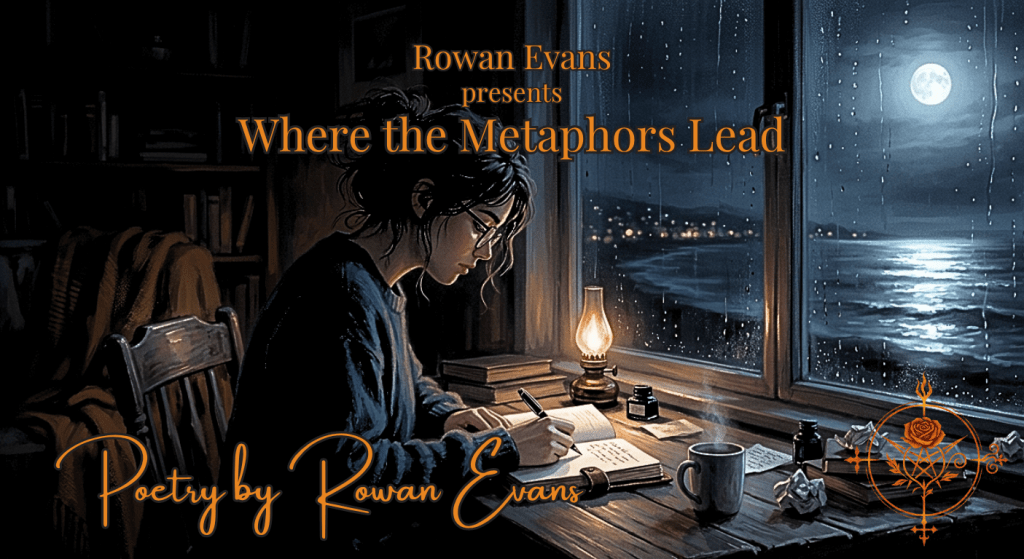
    A lone writer journaling by moonlight at four in the morning while the moon reflects across a calm ocean beyond the window.
    Some feelings only find their voice after midnight, where dreams, memory, and metaphor become impossible to tell apart.

    Where the Metaphors Lead
    Poetry by Rowan Evans

    It’s funny how I find myself here again,
    four AM—it’s just me, the music and my pen.
    I’ve got so many thoughts with so much to say,
    my lips move but no sound comes—
    like I lost one voice, when I found the other.

    And it’s not that I can’t speak—

    it’s just that words don’t come easily,
    when they try to come verbally.

    But on the page,
    everything lines up—

    the thoughts, the feelings,
    the things I never say out loud.
    Ink doesn’t trip over itself
    the way my voice does.

    So here are a few
    truths for you—

    there is a woman
    she is on my mind constantly,
    yeah, she is simultaneously
    the easiest and hardest to talk to.

    She makes me feel like I can be me—
    completely.

    And honestly,
    I’ve never really had that
    with anybody else—

    every beautiful line I write
    about the moon in the sky,
    the ocean and tide—

    yeah, most of the time
    it leads back to her
    in my mind.

    And every dream, I translate in ink—
    the shores I walk in sleep,
    secrets I try not to keep,
    even when it’s hard to speak—

    I lay them on the page and pray
    that they’ll reach their destination one day.

    So I sit here,
    four AM again,
    writing the things
    I can’t say out loud—

    hoping one day
    I’ll find the courage
    to speak them aloud.


    Journey into the Hexverse…

    [The World Shifted Around Us]
    The world transformed around us—beach, city streets, jungle—but we never moved. Sometimes love isn’t found in words, but in the quiet certainty of someone remaining clear while everything else fades.

    [Every Night, The Same Flight]
    Every night begins with the same flight. Between wakefulness and sleep, an airport appears, a familiar shoreline waits beyond the journey, and the same dream asks whether some destinations find us before we’re ready to find them.

    [Where I Belonged]
    A bedroom becomes an airport in the space between sleep and waking. Where I Belonged explores liminal consciousness, uncertainty, and the strange moments when reality feels suspended between two worlds

    [Opposites Coasts of the Same Silence]
    What separates two people isn’t always an ocean. Sometimes it’s the silence between everything left unsaid. Opposite Coasts of the Same Silence explores longing, distance, dreams, and the quiet hope that even across impossible divides, someone might still hear your voice.

    [Ocean Waves (1, 4, 3)]
    A moonlit shoreline, a rowboat full of ducks, a piggybank with no cents, and a confession hidden in plain sight. Ocean Waves (1, 4, 3) explores how humor, wordplay, and absurdity can become a side door to vulnerability when the truth feels too difficult to say directly.

    [Call of the Tide]
    A poem about identity, displacement, and the quiet pull toward something beyond the shoreline you were born on. Sometimes the tide calls louder than the anthem.

    If you’re interested in more poetry, you can find it here → [The Library of Ashes]
  • Author’s Note

    This piece started as a diss.

    Or at least that’s what I told myself when I began writing it.

    The voice arrived first: irritated, dismissive, sharp around the edges. The kind of voice that has grown tired of watching imitation mistake itself for originality.

    But as the poem developed, I realized it wasn’t really about a specific person.

    It was about authorship.

    About the difference between influence and imitation.

    Every writer begins by borrowing something. We absorb voices we admire. We study techniques. We experiment with styles that resonate with us. That’s part of learning.

    The problem isn’t influence.

    The problem is stopping there.

    Because eventually every artist reaches a point where imitation becomes a limitation. A point where the question shifts from “Who do I sound like?” to “What do I actually have to say?”

    That’s the tension at the center of this piece.

    The speaker isn’t claiming ownership over Gothic imagery, confession, darkness, anxiety, or any of the themes referenced in the poem. Those things belong to countless writers across generations.

    What can’t be copied is the life underneath them.

    The experiences.

    The scars.

    The specific reasons a person reaches for certain images, metaphors, and obsessions.

    Someone can reproduce the shape of a voice.

    But shape is not source.

    That’s why the final lines matter to me.

    The joke is that the speaker becomes so frustrated with imitation that they offer to write the copy themselves.

    But underneath the sarcasm is a quieter observation:

    If you spend all your time trying to become someone else, you’ll never discover what only you could have written.

    And that’s where the most interesting work usually begins.

    Rowan Evans


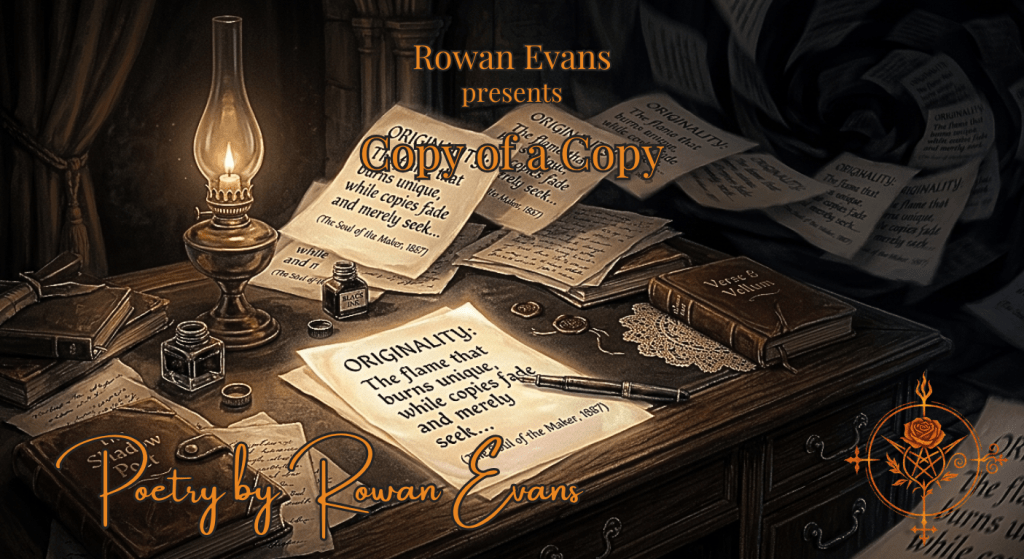
    A glowing handwritten manuscript surrounded by faded copies of the same page on a dark writing desk.
    Influence teaches the craft. Authenticity creates the voice. A copy can mimic the shape, but never the source.

    Copy of a Copy
    Poetry by Rowan Evans

    You carry yourself like a killer.
    Yeah, of vibes—
    You think you’re intimidating?
    You’re not. Just stop.
    You’re embarrassing.

    You’ve had
    zero original thoughts,
    you just parrot me.
    You’re a parody.

    A copy of a copy,
    copied a second time—
    it’s obvious in the rhyme,
    you can see it
    in the quality decline.

    Take your pen
    and try to write like me.

    Gothic lace and confession,
    tinted with depression—
    written by an anxious mind.
    You can copy me
    line for line, rhyme for rhyme
    and I’m sure you’ll find
    it still won’t land right.

    Here—
    let me write for you.
    It’s not like
    that’s not something
    I already do.
    But this time,
    I’ll give the lines to you.


    Journey into the Hexverse…

    [Lone Wolf Theology]
    A philosophical pop-culture poem exploring freedom, identity, and self-authorship through the lens of superheroes, antiheroes, mythic archetypes, and personal rebellion. A declaration of autonomy in a world determined to write your story for you.

    [L Words & Heart]
    A playful, self-aware poem about love, longing, loyalty, and the quiet ways another person can reshape our inner world. What begins as humor slowly reveals a heartfelt confession about affection, imagination, and the faces that linger in our dreams.

    [Just Beyond Waking]
    A street that feels familiar. A life that hasn’t happened yet. Just Beyond Waking explores the fragile space between dreams, memory, longing, and the quiet feeling that some futures are already waiting for us.

    [Twin Suns, Sister Moons]
    A poem about distance, longing, and the quiet pull of someone who lives beneath a different sky. Between twin suns and sister moons, the heart keeps reaching for home.

    [It’s You I Choose]
    A poem about devotion, vulnerability, and the quiet decision to stay. Sometimes love isn’t certainty—it is choosing someone anyway.

    If you’re interested in more poetry, you can find it here → [The Library of Ashes]
  • Author’s Note

    This poem isn’t about skill.
    It’s about orientation.

    Some people write to be understood.
    Some people write because silence feels lethal.

    This piece is for the ones who learned to live in the deep—
    who didn’t choose intensity so much as need it to breathe.

    It isn’t an accusation.
    It’s a recognition.

    Not everyone was taught that the ocean is real.


    A figure breathing underwater in deep blue ocean light, symbolizing emotional depth and survival.
    Some of us learned to breathe underwater.

    Depths
    Poetry by Rowan Evans

    I write
    like I might
    die, if I don’t.

    You write
    like you’re trying
    to pen
    the perfect quote.

    We are not the same.

    But you
    are not to blame.
    It’s not on you
    to carry
    society’s shame.

    They went shallow,
    and punished the depths.


    Closing Note

    Some of us learned
    to breathe underwater.

    Some of us
    were told
    the ocean
    was a lie.


    If you’re interested in more poetry, you can find it here → [The Library of Ashes]
  • “I have always been captivated by the lives and languages of people far from my own. This piece is a reflection on curiosity, respect, and the love I carry for cultures I have yet to touch.”


    A dreamlike collage of Asian cityscapes with multilingual characters representing Mandarin, Cantonese, Tagalog, Korean, Japanese, and German.
    Listening to the world in every language, feeling the pulse of life in every culture. – Rowan Evans

    I have always been drawn to the world outside myself… to the rhythms of languages I do not speak, to streets I have never walked, to skies I have yet to stand beneath. There is a life in language, a heartbeat in culture, and I listen as closely as I can.

    Even when I cannot understand the words, I hear the cadence, the rise and fall, the hidden music that belongs to a place and its people. Mandarin or Cantonese, Tagalog or Korean, Japanese or German—they each carry a soul in their tones, a story in their syllables. I notice when the smallest detail shifts, when a rhythm is off, when a sound is not quite what it should be. Some call it obsession; I call it devotion.

    The written form sings to me as well. Korean curves in gentle arcs, Chinese strikes with sharp certainty, Japanese flows in graceful ribbons. To many, they appear alike, but I hear the difference, see the rhythm, sense the pulse of lives folded into every character, every stroke. Each line holds a story, a heartbeat, a culture speaking without sound.

    I am fascinated not by the exotic alone, but by the living pulse of life everywhere. In Japan, the careful balance of history and neon. In Seoul, the energy that hums beneath every crowded street. In Manila, the warmth and chaos intertwined, unashamed and alive. These are not places I have touched, yet I feel them as vividly as I feel the echo of my own heartbeat.

    I do not want to consume. I want to witness. I want to understand. I want to walk with reverence, to listen with attention, to respect the lives unfolding around me, and to see what is beautiful without taking it for my own. Language, culture, custom—these are windows into the souls of people, and I am endlessly curious.

    Even in dreams, I travel, carrying notebooks, pens, a hunger for connection. I meet people, learn their words, share their moments, and leave a piece of myself behind in the care with which I have observed.

    This is how I show love to the world I do not yet fully know. Through attention, through curiosity, through presence. And perhaps, one day, when my feet touch those streets, I will not only observe, but belong in some way, however fleeting.

    Until then, I will listen. I will watch. I will learn.


    Drifting Without Roots: A Poem on Cultural Identity and Longing
    A confessional poem exploring envy of cultural heritage, the ache of disconnection, and the search for belonging in a fractured identity.

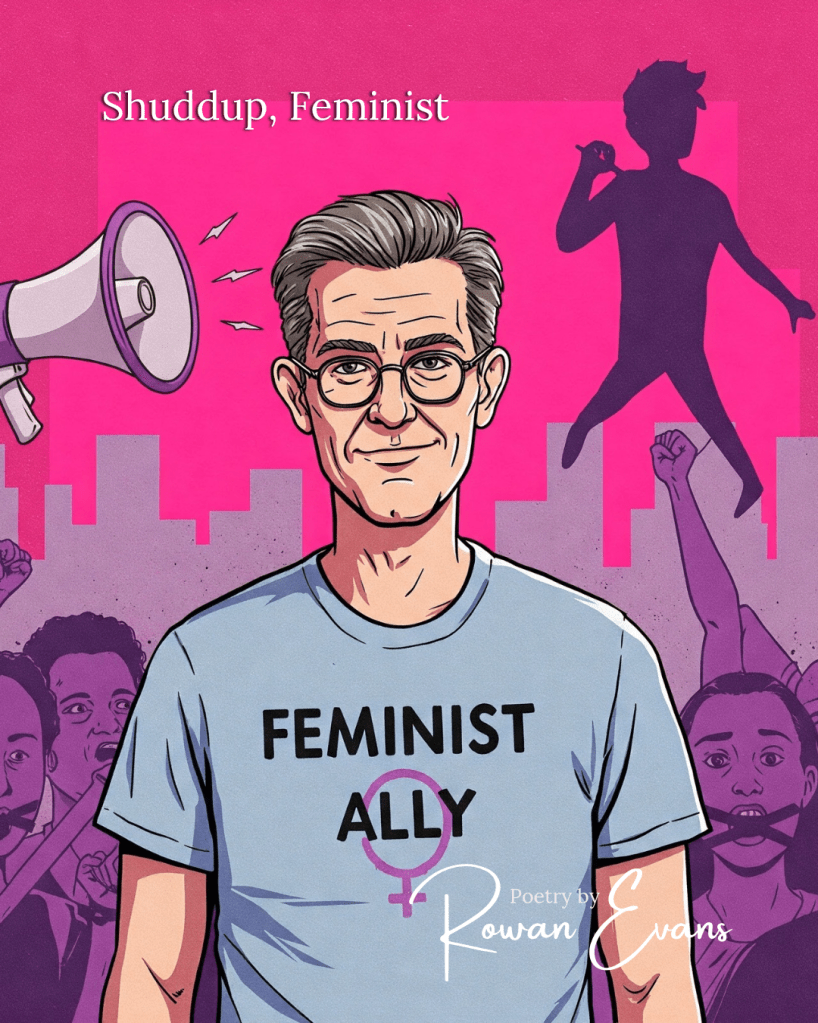
  • Shuddup, Feminist


    Oh, you’re a feminist, huh?
    Shuddup, Feminist™—
    stop waiting for a gold star
    just because you believe women deserve the same rights.
    You’re just the white-knight hero
    with a keyboard and a coffee shop membership.

    You post your virtue
    like it's an Instagram caption—
    #FeminismForEveryone
    except when it's inconvenient for your fragile ego.

    You say "I support women,"
    but have you ever given up space
    in a conversation you dominate
    or asked her what she really needs
    instead of handing her your unsolicited "help"?

    You tweet "empowerment,"
    but you’ll cross the street to avoid it
    when it means being allies to women of color
    or trans women with stories you’re scared to listen to.

    You clap back at mansplaining,
    but still ask her to explain why she’s so emotional
    when she stands up for herself.
    You march for rights,
    then silence her voice when she asks for a seat at the table.

    Oh, but you care about women's issues—
    until a woman dares challenge your "perfect feminism"
    with her lived experience.
    Don’t let your fragile pride
    be the real fight you’re avoiding.

    You preach equality,
    but when was the last time you gave up power
    just for the hell of it?
    Feminism’s not about you,
    it’s about listening, not talking over her.

    You say “But I’m a good guy”—
    good, but you're still a part of the problem,
    dodging accountability behind a slogan.
    Don’t hide behind the “I’m a feminist” card
    when it’s just another way
    to keep the power without the responsibility.

    Shuddup, Feminist™—
    You’re not a savior,
    you’re just a tourist in the movement.
    Put down the hashtagand pick up some real change.
  • Shuddup, Nice Guy


    Oh, you’re the "nice guy," huh?
    Shuddup, Nice Guy™—
    your kindness isn’t a currency
    and you sure as hell can’t cash in
    on empty compliments and unsolicited advice.

    You think opening the door
    is the grand gesture?
    Buddy, if you’re looking for a medal,
    try doing something kind
    without expecting a reward.

    You say, "Women only like assholes."
    Well, maybe it's because
    your idea of “nice” is just a disguise
    for your entitlement dressed up
    in a sweater vest and “good intentions.”

    You buy flowers, but never listen
    to what she’s really saying.
    You’re a walking “compliment” factory,
    but your words are hollow
    like your understanding of consent.

    "You just don’t see me like that."
    No, Nice Guy™,
    we don’t see you like that
    because you can’t even see
    the difference between being decent
    and being someone’s emotional tax burden.

    You think every "friendship"
    is a transaction,
    but friendships are about giving
    without keeping score.
    You should try it sometime—
    real kindness has no receipt.

    Your "complaints" about being “friend-zoned”
    are a tired song.
    Just because you didn’t ask
    for her number
    doesn’t mean she owes you
    her affection,
    let alone her time.

    You're not nice,
    you're just holding out
    for a prize,
    hoping she'll throw you a bone
    for being "so understanding"
    while ignoring everything about her
    that isn't an easy fix.

    You cry about being "too good for her,"
    but Nice Guy™,
    it’s not about being good—
    it’s about being real.
    Maybe start by listening,
    not just waiting for your turn
    to talk about how "good" you are.

    You say, “I’m just trying to help,”
    but really,
    you’re helping yourself
    to her patience,
    her time,
    her emotional labor—
    expecting her gratitude
    like it’s an entitlement
    wrapped in a bow.

    So shuddup, Nice Guy™.
    You’re not owed a damn thing
    for not being an asshole.
    True kindness doesn’t keep score,
    and it certainly doesn’t make excuses.
    Try again when you figure out
    how to be a man who gives,not just takes.
  • Shuddup, Poet


    Oh look—another poem about pain
    disguised as transformation.
    Another phoenix metaphor
    as if setting yourself on fire
    was ever the same as healing.

    You bleed onto the page
    and call it sacred.
    But let’s be real—
    half the time, you don’t even feel it.
    You just know how to make it rhyme.

    Shuddup, Poet.
    You’re not writing epiphanies.
    You’re writing escape routes.
    Every stanza is a soft excuse
    for why you can’t just say
    “I’m scared” out loud.
    You bury it under moonlight,
    call it symbolism,
    but we both know it’s fear
    dressed in metaphors
    you’ve used a hundred times before.

    You say you don’t want attention—
    but every line is a mirror angled
    just right to catch
    someone’s admiration.
    Don’t play modest,
    you check your likes
    like they’re validation coupons
    you forgot you were addicted to.

    You act like a prophet of pain,
    but the truth?
    You’re just really fucking good
    at turning your avoidance
    into art.

    You dress up your shame
    in silk and shadow,
    call it “processing,”
    but some of these wounds
    you keep opening on purpose
    just so you have something to write about.

    You ever think maybe
    you’re not trapped in your trauma—
    you’re clinging to it?
    Like if you actually let go,
    you wouldn’t know what to write about.
    You wouldn’t know who you are.

    You’ve built a cathedral of grief
    and convinced yourself
    it was home.
    And every time someone tries
    to love you in the present,
    you write a eulogy
    for what they might leave behind.

    You’re not fooling anyone.
    You’re not brave
    for turning pain into poetry.
    You’re brave
    when you stop needing the poem
    to tell you who you are.

    So shuddup, Poet—
    or don’t.
    Just write something
    you can’t revise into safety.
    Write like the mirror’s cracked
    and you’re done polishing the edges.

    Write like survival is messy.
    Write like joy is terrifying.
    Write like softness is not a threat.
    Write the poem that doesn’t rhyme,
    that doesn’t work,
    that just tells the truth
    even if no one claps.

    Write like you finally believe
    there’s something worth saving
    underneath all that ink.

    Because there is.

    And you fucking know it.

    You’re not fooling anyone.
    Not with the metaphors,
    not with the midnight bleeding poems,
    not with the “I’m fine” disguised as
    “I’m just editing.”
    You call it processing.
    I call it hiding with flair.

    You’re not brave
    just because you can turn pain into prose.
    You’re brave
    when you stop making your healing
    sound poetic enough to be palatable.

    So shuddup, Rowan.
    Yeah—you.
    The girl who writes about survival
    like it’s always beautiful.
    The one who can describe heartbreak
    down to the taste of the silence,
    but still can’t say “I need help”
    without flinching.

    You write about wanting love
    like you’re ready—
    but are you?
    Or are you still chasing ghosts
    because they never got close enough
    to disappoint you?

    You dress your desires in velvet,
    call it softness,
    but it’s fear with lipstick
    half the time, and you know it.

    You say you want to be seen—
    then blur yourself in metaphors
    and call it art.
    Call it safety.
    Call it control.

    So write the poem that exposes you.
    Write the one you’re scared to show her.
    Write the one that doesn’t beg
    to be admired—
    just understood.

    Write the poem
    that screams your real name—
    not the pen name you use
    when you’re afraid of being too much.

    Write the ending
    that doesn’t get ribbon-wrapped in hope
    just to make the readers feel better.

    No more metaphors.
    No more fog.

    Just you—
    crying on your bedroom floor
    and still fucking glowing.

    Still here.
    Still writing.

    Now say it, Rowan.
    Say the thing you’ve been cutting from every draft
    because it hurts too much to leave in.

    Or shuddup.

    So you write about darkness
    like it’s a lover that never leaves,
    but how much of it
    have you actually kissed on the mouth
    without using a metaphor as a condom?

    You romanticize your pain
    like it makes you profound—
    but maybe you’re just scared
    that healing would make you boring.

    You keep handing out lanterns
    to guide people through your past
    like you’re doing them a favor,
    but when’s the last time
    you turned the light inward?

    You cry “transparency”
    while hiding behind
    vampires and Faeries,
    as if putting wings on your truth
    makes it less terrifying to hold.

    You chase vulnerability
    with poetic flair,
    but can’t even say
    “I want to be loved”
    without cloaking it in gothic lace.

    You call it art,
    but maybe it’s a well-rehearsed performance—
    tragedy in iambic pentameter,
    tears choreographed
    to land on the perfect line break.

    And here’s the hardest part:
    You’re terrified that one day
    someone will read you so well
    they’ll see the loneliness
    you can’t write about
    because it isn’t beautiful.

    So shuddup, Poet.
    Stop romanticizing your ache
    just because it rhymes.
    Stop bleeding prettily
    when what you really need
    is to scream.

    Stop dressing up your truth
    like a ghost bride
    and pretending that’s honesty.

    You say you write for survival—
    then write like you mean it.
    Write the things that make you sick.
    Write the things you’d burn
    if anyone else wrote them about you.
    Write until you’re sobbing
    over a keyboard at 3am
    because finally—
    finally
    it’s not performance.
    It’s just you.
    Naked.
    Ugly.
    Real.

    Because maybe, Rowan,
    you don’t need another poem.
    Maybe you need to unwrite yourself
    for once—
    and see what survives.

    You speak in metaphors
    because real words burn your throat.
    Every stanza a smokescreen—
    call it craft, call it trauma,
    either way, you’re dodging bullets
    you shot at yourself.

    You preach healing
    like you’ve walked out the other side,
    but we both know
    you keep the exit locked
    because the pain
    is the only thing that stays.

    You romanticize your scars
    like they’re character arcs
    and not exit wounds
    you dressed in iambic pentameter
    so no one would ask
    why you’re still bleeding.

    You say you write
    to “help others feel seen,”
    but admit it—
    you want to be rescued
    in rhyming couplets,
    loved for the way you suffer pretty.

    You drag your trauma out
    like a dog-and-pony show,
    then hate yourself
    for being watched.

    How many times
    have you turned your own worth
    into a plot twist?
    How many poems have you written
    that say "I'm okay"
    with trembling hands?

    You think honesty
    means showing the bruise
    but hiding the fist.

    You let silence
    take the mic
    when it’s your own needs on stage—
    write everyone else’s liberation
    and leave yourself
    in a locked verse with no key.

    You call it self-expression,
    but really?
    It’s just survival
    with better line breaks.

    Shuddup, Poet.
    You are not a martyr
    because you made pain sound pretty.

    You don’t get to call it brave
    until you stop editing the truth
    for palatability.

    Stop dressing your loneliness
    in gothic lace and calling it divine.
    Stop baptizing your dysphoria
    in metaphors
    because “monster” feels safer
    than “girl.”

    You want freedom?
    Write the ugly shit.
    The needy shit.
    The bitter, broken, blasphemous shit
    that scares even you.

    Then read it out loud.

    Look yourself in the eye
    and say:
    “I deserve to be whole
    without turning it into art first.”

    Now that’s the last line.
    Not the pretty one.
    The one that hurts
    but finally fucking heals.