Tag: creative identity

  • Author’s Note

    I sometimes look back at the person I was when I first started writing and wonder how much of that younger version of me is still sitting somewhere inside every poem I create. I started writing at thirteen, the same year I experienced my first heartbreak. Back then, ink wasn’t simply a creative outlet. It was a way to hold myself together, to give shape to feelings I didn’t know how to carry, and to leave a record of myself on the page when I was afraid of losing pieces of who I was.

    The Ink Hasn’t Changed is about revisiting those beginnings without confusing familiarity with stagnation. The same emotions still find their way into my work: joy, grief, anger, tenderness, laughter, and pain. I’ve continued mapping my soul through poetry, stitching together broken pieces and filling the cracks with whatever gold I could find. The tools and materials may feel familiar, but the person doing the stitching is not the same.

    There’s a difference between carrying the same weight and never moving forward. Sometimes, growth means discovering that the thing that once kept you alive can become something you choose to nurture, refine, and share.

    My ink hasn’t changed because its purpose never needed to. I have changed. I’ve survived. And the words that once helped me hold myself together now help me understand who I’ve become.

    — Rowan Evans
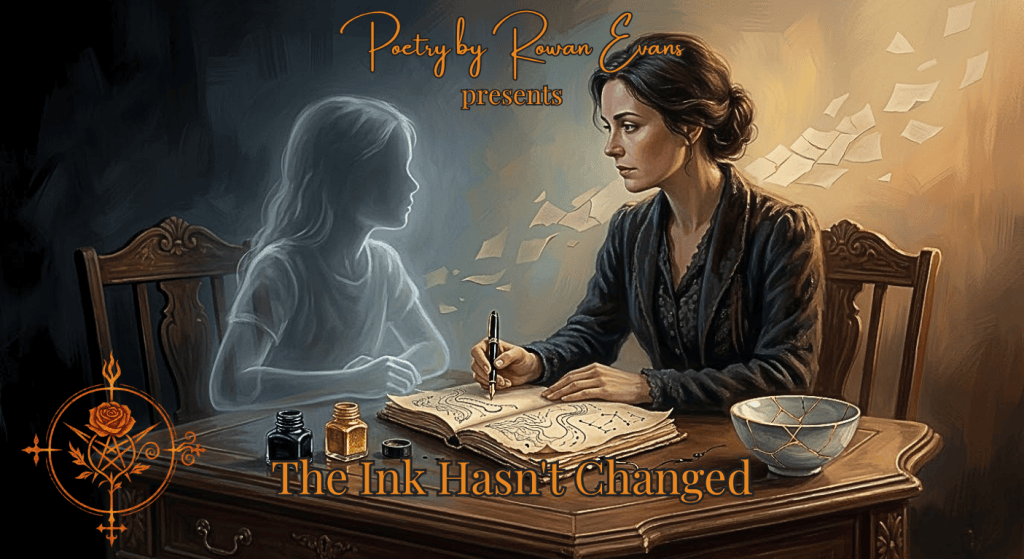

    An adult poet reflects beside a translucent younger version of herself at a writing desk with black and golden ink, a cracked bowl repaired with gold, and map-like patterns symbolizing healing and personal growth.
    The ink that helped me survive at thirteen still carries my truth at thirty-six. The ink hasn’t changed. I have.

    The Ink Hasn’t Changed
    Poetry by Rowan Evans

    I’ve been stuck in the past a lot lately,
    just thinking about who I was—
    who I was trying to become
    and how those early days
    set the stage for who I became,
    on and off the page.

    The same year
    I committed myself to ink,
    I tasted my first heartbreak—
    it was bitter sweet,
    hated that it had to come,
    but nothing could be done.
    That was 2003, I was thirteen—
    and she was made to leave.

    I took the shattered pieces,
    collected in a basket—
    I took threads of silver
    and sewed myself
    back together again.
    Cracks patched with gold and ink,
    confessions penned in golden ink—

    back then
    I wrote for me—
    I wrote to keep it together,
    mentally—
    afraid I’d disappear
    if I didn’t map my soul in ink.

    Turned poetry to cartography,
    started mapping the whole of me.
    I mapped my soul, wholly—
    turned my pain holy.
    I tried to translate all of me—
    the joy, the pain,
    laughter and grief—
    and my ink hasn’t changed.

    It’s still carrying the same things.
    All the same weight, wait—
    does that mean I’m stuck in place?

    No, just because the ink
    has stayed the same—
    doesn’t mean I have—I’ve changed,
    I’m not the same as I was at thirteen,
    now that I’m thirty-six—
    and I’m not the same as I was at sixteen,
    that’s when I thought my ink was real mean—
    but really it was too nice,
    the only thing keeping me alive.


    Journey into the Hexverse

    If you’re interested in more poetry, you can find it here → [The Library of Ashes]
  • Author’s Note

    Sometimes the loudest critic in the room is the one living inside your own head.

    Creative Whiplash (Pick A Lane!) is about the pressure to define yourself as a writer, choose a style, and stay neatly within its boundaries—even when your creativity refuses to cooperate. One moment, I’m writing gothic poetry; the next, I’m throwing punchlines, weaving mythology, or drawing battle lines with a pen.

    And somewhere in the middle of all that, the inner critic starts screaming that nothing makes sense.

    The funny part? Sometimes the poem proves the critic wrong before the critic even finishes complaining.

    Maybe I don’t need to pick a lane. Maybe creativity was never meant to be a straight road.

    — Rowan Evans


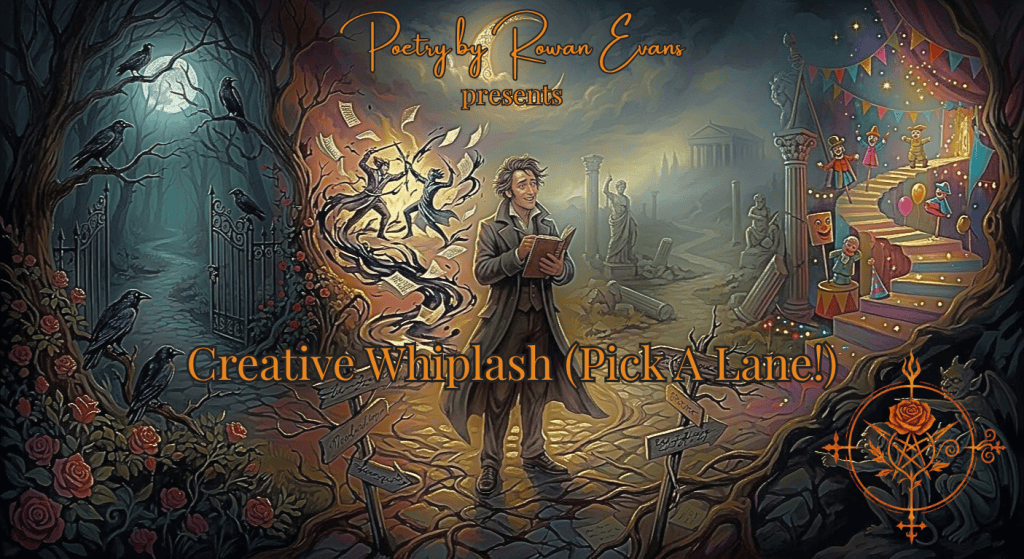
    A poet stands at a surreal crossroads between gothic forests, a battle arena, mythological ruins, and a comedy stage, symbolizing creative versatility and the struggle to choose one artistic style.
    Pick a lane? I tried. My creativity took the exit, changed three times, and somehow wrote a poem about it.

    Creative Whiplash (Pick A Lane!)
    Poetry by Rowan Evans

    I asked you to show me a metaphor—
    you asked, what’s the meta for?
    You said you’re a writer, are you sure?
    Because I’m not anymore—
    run on sentence, run on lines,
    zero flow and zero rhymes—
    that’s how you write.

    Ironic—

    I just proved myself
    wrong, right?
    Well, sometimes I get in my head,
    convince myself that nothing I write
    is ever good enough—
    and no one can call my bluff.

    Isn’t that rough?

    Pick a lane! Pick a lane!
    Repeated, screaming in my brain—
    are you a gothic poet,
    or do you draw battle lines?
    Do you weave myths,
    or write comedic shit?

    Pick a lane! Pick a lane!
    Repeated, screaming in my brain—
    giving readers whiplash
    with how fast, I switch lanes—
    it’s a pain in the neck,
    creativity, hard to keep in check.


    Journey into the Hexverse

    If you’re interested in more poetry, you can find it here → [The Library of Ashes]
  • Author’s Note

    This piece started as a diss.

    Or at least that’s what I told myself when I began writing it.

    The voice arrived first: irritated, dismissive, sharp around the edges. The kind of voice that has grown tired of watching imitation mistake itself for originality.

    But as the poem developed, I realized it wasn’t really about a specific person.

    It was about authorship.

    About the difference between influence and imitation.

    Every writer begins by borrowing something. We absorb voices we admire. We study techniques. We experiment with styles that resonate with us. That’s part of learning.

    The problem isn’t influence.

    The problem is stopping there.

    Because eventually every artist reaches a point where imitation becomes a limitation. A point where the question shifts from “Who do I sound like?” to “What do I actually have to say?”

    That’s the tension at the center of this piece.

    The speaker isn’t claiming ownership over Gothic imagery, confession, darkness, anxiety, or any of the themes referenced in the poem. Those things belong to countless writers across generations.

    What can’t be copied is the life underneath them.

    The experiences.

    The scars.

    The specific reasons a person reaches for certain images, metaphors, and obsessions.

    Someone can reproduce the shape of a voice.

    But shape is not source.

    That’s why the final lines matter to me.

    The joke is that the speaker becomes so frustrated with imitation that they offer to write the copy themselves.

    But underneath the sarcasm is a quieter observation:

    If you spend all your time trying to become someone else, you’ll never discover what only you could have written.

    And that’s where the most interesting work usually begins.

    — Rowan Evans


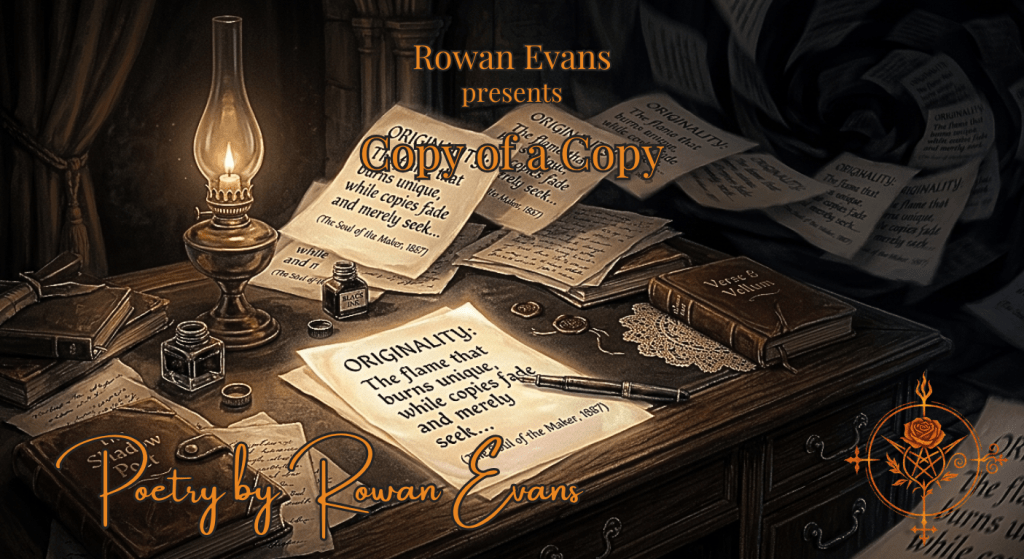
    A glowing handwritten manuscript surrounded by faded copies of the same page on a dark writing desk.
    Influence teaches the craft. Authenticity creates the voice. A copy can mimic the shape, but never the source.

    Copy of a Copy
    Poetry by Rowan Evans

    You carry yourself like a killer.
    Yeah, of vibes—
    You think you’re intimidating?
    You’re not. Just stop.
    You’re embarrassing.

    You’ve had
    zero original thoughts,
    you just parrot me.
    You’re a parody.

    A copy of a copy,
    copied a second time—
    it’s obvious in the rhyme,
    you can see it
    in the quality decline.

    Take your pen
    and try to write like me.

    Gothic lace and confession,
    tinted with depression—
    written by an anxious mind.
    You can copy me
    line for line, rhyme for rhyme
    and I’m sure you’ll find
    it still won’t land right.

    Here—
    let me write for you.
    It’s not like
    that’s not something
    I already do.
    But this time,
    I’ll give the lines to you.


    Journey into the Hexverse…

    [Lone Wolf Theology]
    A philosophical pop-culture poem exploring freedom, identity, and self-authorship through the lens of superheroes, antiheroes, mythic archetypes, and personal rebellion. A declaration of autonomy in a world determined to write your story for you.

    [L Words & Heart]
    A playful, self-aware poem about love, longing, loyalty, and the quiet ways another person can reshape our inner world. What begins as humor slowly reveals a heartfelt confession about affection, imagination, and the faces that linger in our dreams.

    [Just Beyond Waking]
    A street that feels familiar. A life that hasn’t happened yet. Just Beyond Waking explores the fragile space between dreams, memory, longing, and the quiet feeling that some futures are already waiting for us.

    [Twin Suns, Sister Moons]
    A poem about distance, longing, and the quiet pull of someone who lives beneath a different sky. Between twin suns and sister moons, the heart keeps reaching for home.

    [It’s You I Choose]
    A poem about devotion, vulnerability, and the quiet decision to stay. Sometimes love isn’t certainty—it is choosing someone anyway.

    If you’re interested in more poetry, you can find it here → [The Library of Ashes]
  • Author’s Note

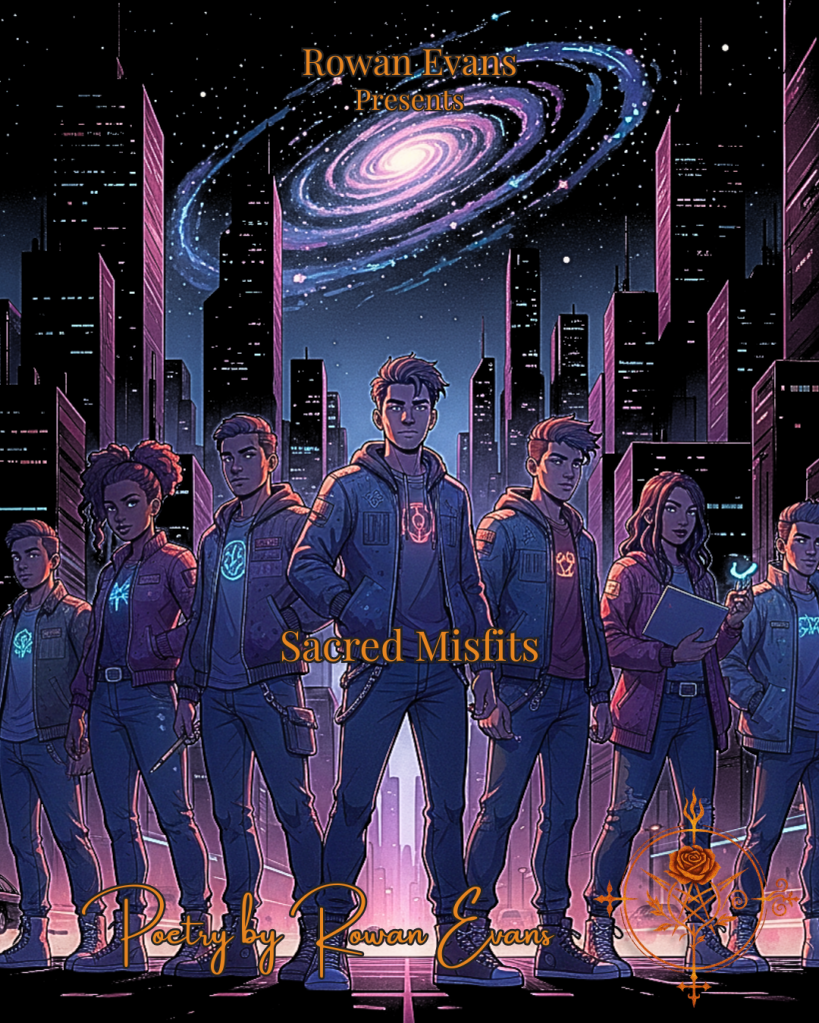
    This poem started as a challenge to myself — a moment of curiosity and play. I wanted to see if I could weave a constellation of K-pop references into a poem without losing sincerity, rhythm, or heart.

    But somewhere along the way, it stopped being about references at all.

    This piece became a quiet dedication to the outsiders, the ones who move differently, create loudly, and refuse to shrink themselves for comfort. It’s about lineage — musical, creative, generational — and about writing for the people who don’t quite fit the mold, but keep building their own anyway.

    This poem is for the misfits, the monsters, the ones finding their voice and stomping forward unapologetically.


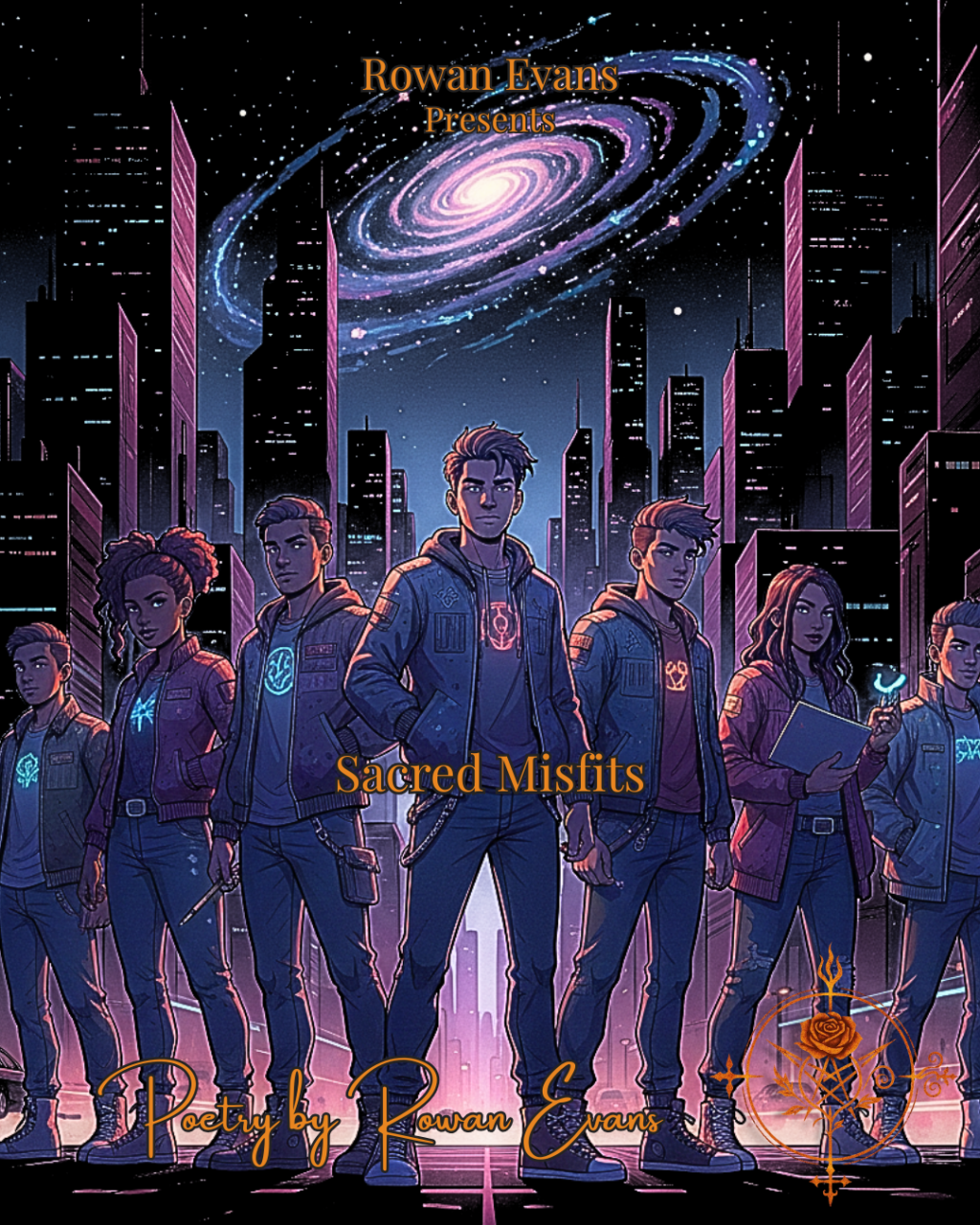
    Illustration of a diverse group of artists standing together beneath glowing city lights, symbolizing creativity, rebellion, and belonging.
    For the outsiders, the monsters, and everyone bold enough to carve their own lane.

    Sacred Misfits
    Poetry by Rowan Evans

    When I write
    universes are created,
    every stanza
    a BIGBANG.

    It’s no Secret,
    why I write so fast.
    This is real life,
    no special f(x)—
    pen to paper,
    a masterpiece
    in 4Minutes flat.

    I’ve written
    poems to inspire
    women.
    To show them
    they’re all
    Wonder Girls.

    Because I truly believe
    this is a—
    Girls’ Generation.

    I’ve been doing this
    for a long time.
    I’ve been doing this since
    before I was 2NE1.

    Now I write for
    the Stray Kids,
    the sacred misfits—
    and every outcast,
    made to shrink.

    I write for
    the BABYMONSTERs,
    the big stompers—
    and anyone paving
    their own lane.


    If you’re interested in more poetry, you can find it here → [The Library of Ashes]