Author’s Note
This piece was written while listening to “Role Model” by Eminem, and you can probably feel that influence in the posture of it.
There’s swagger here. Sharpness. A little confrontation.
But beneath that, this piece is really about the difference between shared labels and shared experience.
Two people can both call themselves poets and still arrive at the page from completely different places emotionally, stylistically, philosophically, and spiritually. The label itself doesn’t erase individuality. If anything, art becomes meaningful because of the differences in how we carry our histories into it.
That’s what this poem is wrestling with.
Not superiority. Specificity.
The truth is, I’ve spent more than two decades building my relationship with language. Not just learning how to write, but learning how to survive through writing. A lot of the imagery in this piece—cathedrals, altars, confession, Gothic romanticism—comes from the emotional architecture I’ve spent years constructing around my work.
Those images aren’t aesthetic decoration for me. They’re autobiographical.
When I say my environment “felt more like a cage,” I mean that literally in the emotional sense. Writing became escape, translation, preservation, and eventually identity. The page became the place where I could expand beyond the limits of the environments I grew up inside.
So while the voice in this poem is intentionally bold, the core of it is actually vulnerable:
the fear of becoming interchangeable, the need to protect individuality, and the understanding that art is shaped as much by lived experience as talent itself.
Because someone can imitate style. They can imitate rhythm. They can imitate aesthetic.
But nobody else has lived your exact life.
And eventually, that truth always bleeds through the writing.
— Rowan Evans
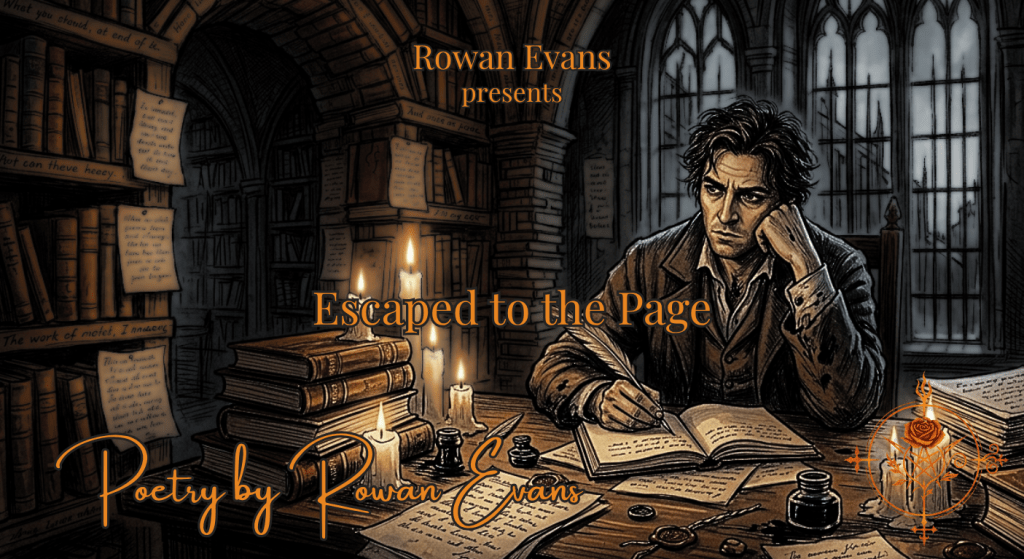
Escaped to the Page
Poetry by Rowan Evans
You could be just like me,
you could write like me—
be full of empathy like me,
definition of compassion just like me.
You could be just like me—
but still you’d never be me.
You could build worlds
with words, just like me—
cathedrals and altars,
reverence and devotion, just like me—
You could imitate the shape—
but you’d never be the source.
Don’t even try, just stop.
You think we’re the same
because the labels we wear?
I’m a poet, you’re a poet too—
but that doesn’t make us a matching pair.
Twenty-three years,
I’ve been doing this—
metaphors like weapons,
meta-poetry, meta-lessons—
look at everything I’ve written.
Confessions penned
in Gothic lace,
Romanticized darkness
because that’s the only place
I feel at home.
My environment
felt more like a cage,
so I escaped to the page.
I wrote lines of longing,
looking for belonging—
because I’ve been knowing,
this isn’t the place I’d finish growing.
Journey into the Hexverse…
[Ink as a Second Mouth]
“Ink as a Second Mouth” explores the distance between thought and speech, and the ways writing can become a form of survival, continuity, and self-translation. Through confessional imagery and reflections on growth, identity, and articulation, the poem examines what it means to keep becoming through language.
If you’re interested in more poetry, you can find it here → [The Library of Ashes]

