Others arrive already carrying the scent of decay.
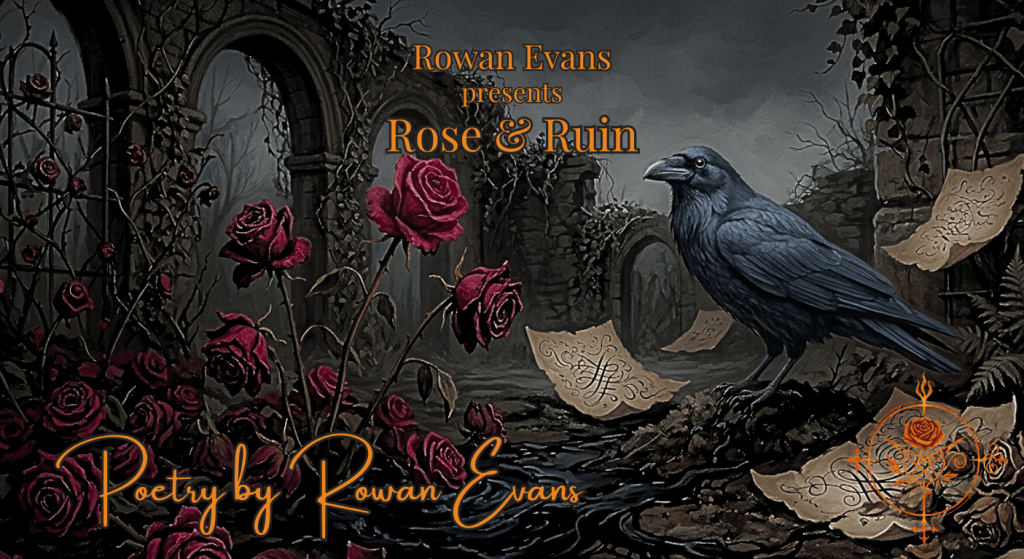
These two minimalist pieces were written as companions—two sides of the same creative process. One looks toward cultivation, growth, and the strange beauty of watching an idea become something tangible. The other looks toward the thoughts that come darker, older, or already beginning to rot.
Together, Rose and Ruin sit in the same garden.
One grows.
One decays.
Both become poetry.
— Rowan Evans
Rose & Ruin Poems by Rowan Evans
Somewhere between ink and imagination, the garden begins to bloom.
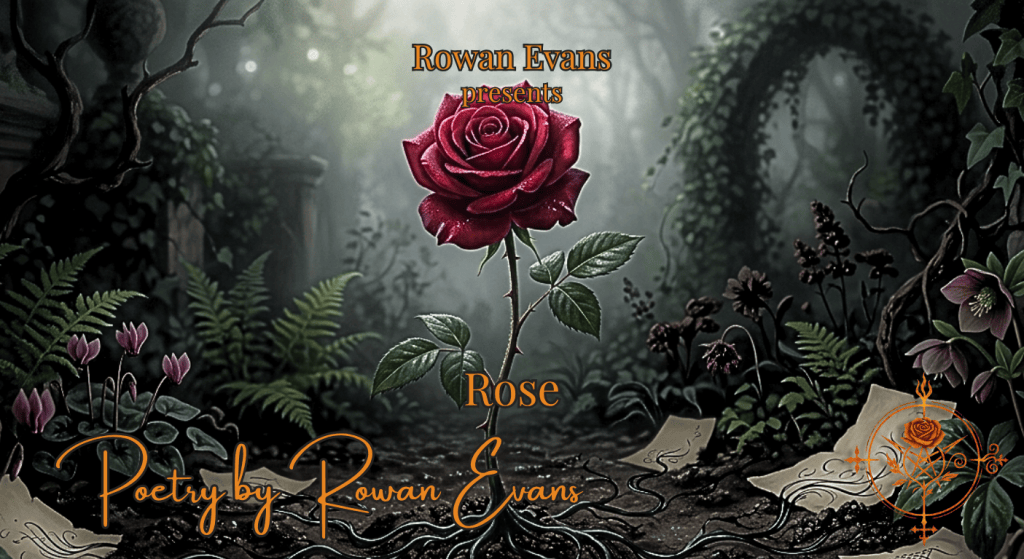
Rose Poetry by Rowan Evans
I plant a seed and water it,
creativity and ink, fertilizing it—
watching masterpieces bloom
in a garden of thoughts.
Even the thoughts that rot can still become something worth writing.
Ruin Poetry by Rowan Evans
I use ’em—
before the thoughts rot,
but I’m a gothic poet—
I’ll still use the rotten thoughts,
I see the world through ’em.
Journey into the Hexverse…
[Conductor] A dark, intimate poem about the strange power words can have over the reader—where rhythm, rhyme, and line breaks become instruments capable of reaching beyond the page.
[The Answer Is (Yes)] What kind of writer am I? Mythmaker, confessor, comedian, philosopher, dream-architect, romantic, storyteller, and diss-poet. This self-reflective poem explores the impossibility of fitting creativity into a single category—and embraces every version of the truth a pen can touch.
[Finish What You Started] A dark introspective poem about confronting the past, carrying old versions of yourself, and realizing that the only way forward is through the fire.
There are certain aesthetics that feel less like something we choose and more like something we recognize.
For me, Gothic imagery has always been one of those things.
Homecoming came from the realization that something in my writing had started to feel slightly unfamiliar. I was still writing about the moon, the ocean, the tides, ravens, horror, darkness, and the strange spaces where beauty and pain overlap—but somehow, I had drifted away from the particular Gothic atmosphere that has always felt like home to me.
So this poem became a return.
Poe is here because his shadow has been part of my literary DNA for years. Nyx and Hades are here because mythology gives me another language for darkness. The ravens are here because, in my own symbolic architecture, they have become witnesses, messengers, and companions. And the horror references—Jason, Ghostface, Pennywise, Michael Myers—are there because horror has never been merely about monsters to me.
It is about what the monsters represent.
Grief. Fear. Obsession. Rage. The parts of ourselves that refuse to stay buried.
There is also something deliberately self-aware about this poem. I am not simply listing Gothic references because they sound dark. I am talking about my relationship with the imagery itself—the way the moon has accumulated meaning across my work, the way the tides connect to emotion, and the way ravens have gradually become part of my mythology.
The darkness isn’t an aesthetic costume.
It’s architecture.
And after spending some time writing away from it, I realized that I wasn’t trying to become something new.
I was finding my way back to something that had been mine all along.
That’s why this poem is called Homecoming.
Sometimes you don’t discover where you belong.
Sometimes you remember.
— Rowan Evans
Sometimes the darkness isn’t somewhere you wandered into. Sometimes it’s the place where your voice has always felt most at home.
Homecoming Poetry by Rowan Evans
I’ve been writing like
I forgot which domain is mine,
I’m of the darkness—
just borrowed the light,
and made Poe’s throne my birthright.
I’m a gothic romantic,
I bleed for the art—
I’ve kissed the lips of Nyx
and wandered through
the realm of Hades.
I’m a poltergeist in life,
but at night I come alive—
witching hour is when I thrive.
I pray to the moon
and curse the sun—
I ascend to the throne
that Poe had spun.
I watch the ravens—
carrying messages where they fly,
eyes locked, tracking the treachery across the sky.
They are always watching—
silent witnesses to the rot inside.
It started to feel like something
in my pieces was missing—
like where was the gothic lace,
silk and satin sin, velvet and venom.
There was too much light—
even when ninety percent
of my imagery is night adjacent,
weaving in horror rhymes—
Friday the 13th, Night of Jason.
The moon in my rhymes has meaning,
when I write lines like the tides—I mean it,
even in my Ghostface cadence—
what’s your favorite scary movie?
Pennywise of the mind, sewer of thought—
I’m a monster like Michael,
when I chase—I don’t run, I walk.
Journey into the Hexverse…
[The Monster in the Margins] Drawing inspiration from horror icons like Michael Myers, Ghostface, Freddy Krueger, and Pennywise, this poem explores the darker side of creativity—where inspiration becomes an unstoppable force lurking just beyond the edge of the page.
[The Monster in the Margins II] The Monster in the Margins II transforms Rowan Evans’s Seven Deadly Sins mythology into a horror story written between the lines, where Lust, Wrath, Sloth, Greed, Pride, Envy, and Gluttony become monsters growing from pain, grudges, and scars.
[The Unkindness Descends] “The Unkindness Descends” is a Gothic symbolic poem exploring collapse, transformation, and the unsettling experience of being witnessed during moments of unraveling. Through raven imagery, ambiguity, and ritualistic atmosphere, the poem invites multiple interpretations—spiritual, psychological, ominous, or transformative.
[Gospel in Crimson] When writing becomes ritual and love becomes devotion, the line between creation and worship begins to blur. Gospel in Crimson explores obsession, artistry, and the sacred act of expression.
This piece was written while listening to “Role Model” by Eminem, and you can probably feel that influence in the posture of it.
There’s swagger here. Sharpness. A little confrontation.
But beneath that, this piece is really about the difference between shared labels and shared experience.
Two people can both call themselves poets and still arrive at the page from completely different places emotionally, stylistically, philosophically, and spiritually. The label itself doesn’t erase individuality. If anything, art becomes meaningful because of the differences in how we carry our histories into it.
That’s what this poem is wrestling with.
Not superiority. Specificity.
The truth is, I’ve spent more than two decades building my relationship with language. Not just learning how to write, but learning how to survive through writing. A lot of the imagery in this piece—cathedrals, altars, confession, Gothic romanticism—comes from the emotional architecture I’ve spent years constructing around my work.
Those images aren’t aesthetic decoration for me. They’re autobiographical.
When I say my environment “felt more like a cage,” I mean that literally in the emotional sense. Writing became escape, translation, preservation, and eventually identity. The page became the place where I could expand beyond the limits of the environments I grew up inside.
So while the voice in this poem is intentionally bold, the core of it is actually vulnerable: the fear of becoming interchangeable, the need to protect individuality, and the understanding that art is shaped as much by lived experience as talent itself.
Because someone can imitate style. They can imitate rhythm. They can imitate aesthetic.
But nobody else has lived your exact life.
And eventually, that truth always bleeds through the writing.
— Rowan Evans
Some people write because they want to. Some write because the page became the only place they could fully exist.
Escaped to the Page Poetry by Rowan Evans
You could be just like me,
you could write like me—
be full of empathy like me,
definition of compassion just like me.
You could be just like me—
but still you’d never be me.
You could build worlds
with words, just like me—
cathedrals and altars,
reverence and devotion, just like me—
You could imitate the shape—
but you’d never be the source.
Don’t even try, just stop.
You think we’re the same
because the labels we wear?
I’m a poet, you’re a poet too—
but that doesn’t make us a matching pair.
Twenty-three years,
I’ve been doing this—
metaphors like weapons,
meta-poetry, meta-lessons—
look at everything I’ve written.
Confessions penned
in Gothic lace,
Romanticized darkness
because that’s the only place
I feel at home.
My environment
felt more like a cage,
so I escaped to the page.
I wrote lines of longing,
looking for belonging—
because I’ve been knowing,
this isn’t the place I’d finish growing.
Journey into the Hexverse…
[Ink as a Second Mouth] “Ink as a Second Mouth” explores the distance between thought and speech, and the ways writing can become a form of survival, continuity, and self-translation. Through confessional imagery and reflections on growth, identity, and articulation, the poem examines what it means to keep becoming through language.
In every confessional verse, I trespass across sacred lines— naming darkness holy, letting grace bruise. What follows is not salvation, nor surrender— but something stranger, softer, and far more true: love that neither redeems nor condemns, only witnesses.
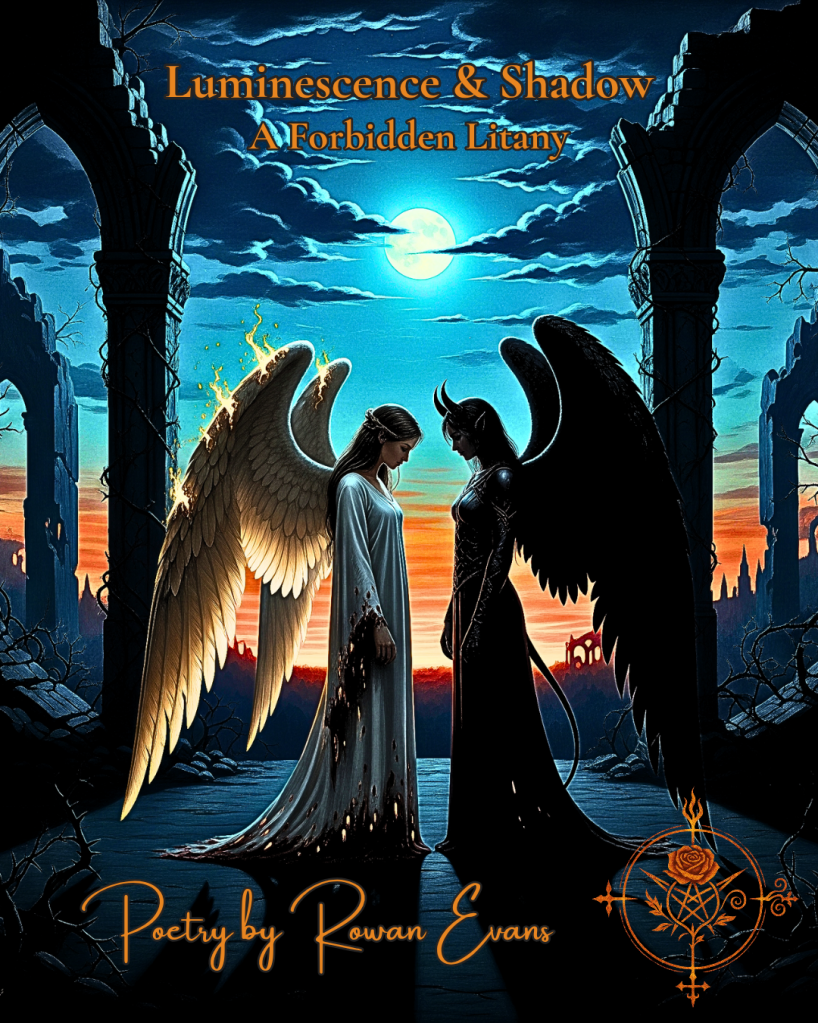
Luminescence & Shadow A Forbidden Litany
Poetry by Rowan Evans
Luminescence & Shadow: where confession becomes devotion.
Intro: In the Mouth of the Divine and the Damned
In every hymn of light, a shadow hums beneath the breath. In every curse of darkness, a spark strains to survive. We are children of paradox: the angel who aches for midnight, the demon who dares to thirst for dawn. This is our confession—carved in ash and grace, a love letter scrawled across ruin and reverence.
I. Angel’s Soliloquy Sanctified Ache
I dwell where seraphs weave gold into dawn, where gardens shimmer with dew spun from prayer, where hymns rise like incense—and still, my chest feels hollow.
Even beneath these alabaster wings, something restless coils in silence: a hunger no choir can soothe, no benediction can quiet.
By moonlight, I trace the ivory spires and wonder what waits beyond the gates— what secret burns in that forbidden dusk. In the mirror of heaven, I see my own doubt: halo flickering, longing trembling like an unspoken psalm.
I close my eyes to holy light— and all I see is a silhouette crowned in midnight flame.
II. Demon’s Soliloquy Hallowed Hunger
I haunt cathedrals built of bone and broken vows, where soot clings to every breath, and ruin is scripture. Wings black as regret, heart scorched by eternity— I was forged for destruction, baptized in shadow.
Yet even in this cursed marrow, I taste the ghost of something gentler: a warmth that coils between rage and ruin, a light I dare not name.
In every ember, I see her face— untouched by ash, yet carrying a sorrow I know in my marrow. Her grace calls to my monstrosity— not to cleanse it, but to cradle it.
I was taught to scorn the heavens— but my darkness bends toward her, like dusk leaning into dawn.
III. First Meeting Eclipse of Flesh and Faith
[Angel] I stepped past paradise and felt the veil break. Breath caught in my throat— she stood there, wreathed in night, every scar a prayer unanswered.
Her gaze stripped me bare of sanctity; my wings trembled, not from fear— but from recognition.
[Demon] I watched light cross the threshold, a vision I never dared summon. She glowed like promise, yet her eyes were raw, haunted by the same hunger that gnawed my ribcage.
For a heartbeat, shadow and radiance touched— our pulses discordant, yet symphonic.
[Together] We spoke not in words, but in exhales: two broken altars bending toward each other, drawn by the gravity of what should never be.
IV. Dual Longing Benediction of Ache
[Angel] In the hush of dawn, I whisper prayers not to my God—but to her absence. Her shadow stains every hymn; her fire warms the marrow of my doubt.
Even grace tastes like ashes now; holiness feels hollow without her silhouette beside me.
[Demon] In the abyss, her memory flickers like dying light. I claw at stone, find only emptiness. Every scream turns to a plea: let me see her once more.
The weight of my damnation sharpens the ache— yet still, I cherish it: it means she touched me.
[Together] Apart, yet bound by ache, our confessions echo through realms unseen. Even the distance becomes devotion.
V. Fall & Rise Communion of Ruin and Reverence
[Angel] When heaven cast me out—wings singed to bone— I fell; yet my heart soared toward her. In ruin, I found my truest prayer: her name, whispered in fevered breath.
[Demon] When she fell, the abyss trembled. I caught her—not to save, but to share the fall. Together, we knelt in shadow, two exiles crowned in each other’s devotion.
[Together] We kissed with bloodied lips, made holy what was once forbidden. She stained my darkness with grace; I inked her light with shadow.
In our union, dawn and dusk entwined— not to destroy, but to create a new dusk: a twilight where even angels and demons may confess love without shame.
Outro: The Gospel of Contradiction
Call it blasphemy, call it salvation— but know this: our scars became scripture; our fall became our rising. For in each other’s arms, light loved darkness without wanting to change it, and shadow loved light without wanting to dim it.
And somewhere beyond paradise and perdition, our confessions still burn— an eternal psalm of luminescence and shadow.
Closing Note
In the end, this was never meant to be read as doctrine, but as devotion: a testament to what blooms in shadow, what aches in light, and what love dares to name holy even when the world would call it heresy.
May it find you—whether angel, demon, or something beautifully in between— and remind you: your confessions, too, are worthy of ink and flame.
If my words speak to you, and you’d like to help keep this flame burning — or if you’d like a custom poem woven just for you (or someone dear) — you can do so here:
“There are moments the abyss feels like home. So we return to the edge—not to wish for flight, but to see how far we fall.” — Rowan Evans
These two poems were written in different hours of darkness, but they share the same marrow: A gospel whispered from the edge of belief. A confession to the sky and to the abyss alike. One is a prayer wrapped in doubt. The other, a quiet litany of almost-leaping.
They are my sacred offerings to anyone who has ever felt broken but still breathing; to the soft-hearted heretics, the quiet survivors, the ones who keep rising even when they don’t know why.
Liturgies whispered at the edge: devotion, decay, and the quiet rebellion of staying alive.
The Gospel of My Decay (Liturgia Ruinae)
Poetry by Rowan Evans
“Bless me, Father, for I have bled.” — Rowan Evans
I. Invocation
It takes everything in me just to get out of bed lately. I hate this—this pain in my lungs, this ache in my chest. I sit in the dark, talking to God, asking why?
Why me? Why do I have to bleed? Why do I have to bend, why do I have to break?
Why is this a feeling I can’t shake? Don’t I deserve to be okay? Don’t I deserve to put a smile on my face?
II. Confession
Why the fuck
did you make me this way— broken, alive but slowly decaying?
And they question— Why don’t you believe? So I ask back— Why would I believe?
You say God would never leave. Is that supposed to be enough? Is that what you call divine love? ’Cause it feels more like apathy to me, and if I could help myself, I would—happily.
But I don’t see that happening.
III. Benediction
Forgive me, Father, for the questions I ask. For the softness that splinters, for faith that fractures.
Still, I rise— not because I believe, but because the dawn drags me forward.
Amen, even when I mean: I don’t know if I can.
And yet, the night had more to confess…
On the Edge Again Poetry by Rowan Evans
I’m on the edge again,
Standing on the ledge again—
Overlooking the cliff, like
I might just try and fly tonight.
One step forward before I leap,
Wings outstretched—
but I don’t have them.
So I plummet toward the earth below,
And as I pray for peace—
Time
seems
to slow.
I watch closely—
ground quickly approaching.
One deep inhale,
Eyes shut tight—
Open them up:
I’m in hell.
And time,
it moves
so slow,
even as I
quickly
approach.
Eyes open,
gasp for breath.
There I am,
still standing
on the ledge.
Fall to knees,
struggling to breathe.
Tears spill
from my eyes
like ink.
So I—
pause, rethink
how it could have
all ended in a blink.
And I’m—
on the edge again,
standing on the ledge again.
If these pieces spoke to your shadows, you might also find resonance in:
If my words speak to you, and you’d like to help keep this flame burning — or if you’d like a custom poem woven just for you (or someone dear) — you can do so here:
I was not prepared for you—
not for the quiet cataclysm
you carried in your smile,
or the way your voice
broke open a hidden cathedral
in my chest.
Loving you feels like the world ending
slowly, beautifully—
as if the stars decided to fall
not in ruin,
but in reverence.
You are the prophecy I never believed I deserved,
a ruin I would rebuild in every lifetime.
And if your trust is a shattered chalice,
I will drink from the broken glass
until my lips remember the taste of you
without bleeding.
You once laughed,
lightly, like nothing hurt.
But I know better—
I saw the earthquakes behind your eyelids,
heard the quiet sobs tucked between syllables
when you whispered “I’m okay.”
You don’t have to be brave with me.
Let the mascara run like holy water.
Let your fears rattle the stained-glass ribs of my devotion.
I will not look away.
I will hold your sorrow like relics—
with both hands and an aching awe.
You once said you weren’t used to someone staying.
So I stayed.
Through your silences,
your firestorms,
your soft retreats into shadow.
I stayed because loving you
isn’t something I do.
It’s something I am.
You are every sacred metaphor
my soul ever dreamed.
A poem written in the margins
of a dying god’s last confession.
A heartbeat that taught mine
how to echo.
And if you never say “I love you” back—
if this is all unreciprocated myth,
a cathedral without a congregation—
then I will still leave the candles burning.
Because my love isn’t a question
waiting for an answer.
It is the answer.
And it says:
You are worth the end of the world,
again and again,
until all that’s left
is light.