Tag: emotional honesty

  • Author’s Note

    This poem is the second part of an experiment I started in Crossing the Sea—an attempt to write without leaning on metaphor, or at least to notice when metaphor appears even when I’m trying not to use it.

    The first piece focused on direction: the place I’m moving toward, the literal ocean I have to cross to get there. But I realized that before I could talk honestly about where I’m going, I needed to talk honestly about why I’m leaving.

    That’s what this poem is.

    It’s the part I’ve always written around instead of through.
    The part I’ve buried under tides, distance, storms, and moonlight.
    The part I’ve hinted at for years without ever saying plainly.

    The truth is simple, even if it took me a long time to say it:

    I’ve never felt at home in the country where I grew up.

    Not in childhood.
    Not in adulthood.
    Not in all the years in between.

    It’s a quiet ache—persistent, steady, familiar.
    Not dramatic, not catastrophic, just a sense of misalignment I’ve carried since I was fourteen. A feeling of being held in a place I never belonged to, waiting for a life that didn’t start here.

    I’ve called it restlessness.
    I’ve called it longing.
    I’ve called it distance.
    Eventually, I called it the ocean.

    But naming it directly felt necessary.
    Not to erase the metaphors, but to understand what they were protecting.

    This poem is that attempt.
    Not a rejection of metaphor, but a recognition of the truth beneath it.

    Rowan Evans


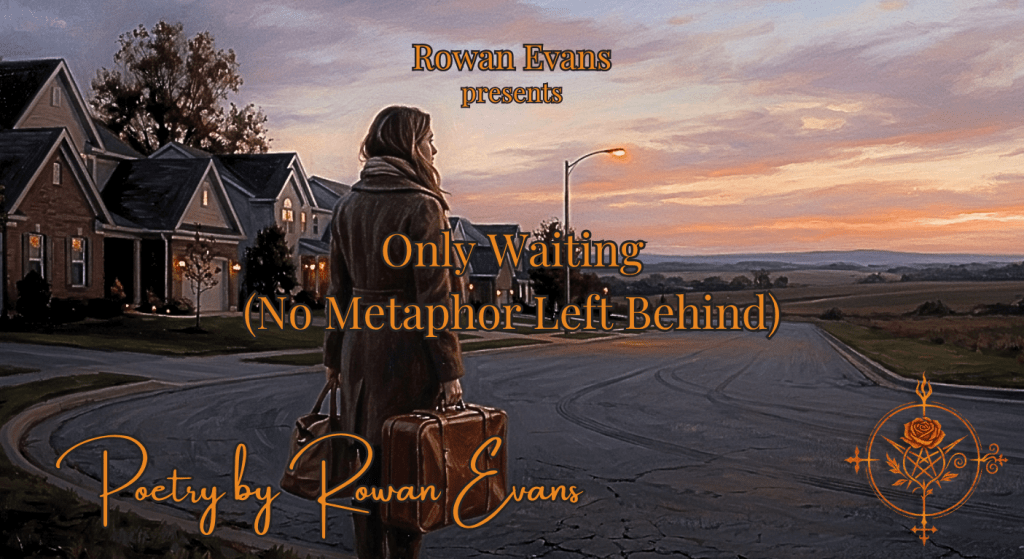
    A traveler stands at the edge of a familiar neighborhood looking toward a distant horizon with a suitcase in hand.
    Sometimes leaving isn’t running away. Sometimes it’s finally walking toward the place that feels like home.

    Only Waiting (No Metaphor Left Behind)
    Poetry by Rowan Evans

    Turn the page,
    I’ve got more to say.

    I’ll try again
    not to hide behind
    metaphors
    and coded lines.

    Last time—
    I talked about the destination,
    the place I’m moving toward.

    This time—
    I’m going to talk about the ache.
    The persistent empty feeling
    that I’ve been feeling since I was fourteen.

    I’ve written about it before
    woven in metaphors.
    But this time I’m going to try
    and say it plain.

    It’s the ache of living in a place
    that never felt like mine.

    Not once.

    Not in childhood,
    not in adulthood,
    not in all the years in between.

    People talk about home
    like it’s a given—

    a birthplace,
    a neighborhood,
    a country that shaped them.

    But I never felt shaped by this place.

    Only held in it.
    Only waiting.

    I learned early
    that you can grow up somewhere
    and still feel like a visitor.

    You can know every street
    and still feel lost.

    You can speak the language
    and still feel unheard.

    Since fourteen,
    I’ve carried this quiet emptiness—
    not dramatic,
    not catastrophic,
    just a steady sense
    that I was meant to be somewhere else,
    and somehow ended up here instead.

    I used to call it restlessness.

    Then longing.

    Then distance.

    Then the ocean.

    But the truth is simpler:
    I’ve never felt at home
    in the country that raised me.


    Journey into the Hexverse…

    [Crossing the Sea (No Metaphor Left Behind)]
    A deeply personal poem about relocation, longing, and the realization that some truths naturally arrive through metaphor—even when we try to leave it behind.

    [Translating What I Feel]
    A poem about the invisible process of turning emotion into imagery, imagery into language, and language into poetry. An intimate reflection on creativity, loneliness, and twenty-three years of learning to translate what the heart feels.

    [Maybe You’ll Want Me Too]
    A poem about the subtle shift from knowing someone to constantly thinking about them. Through humor, metaphor, and confession, Maybe You’ll Want Me Too explores affection, attachment, and the fragile hope that being wanted might matter more than being needed.

    [Recognizes Home]
    A free-verse poem exploring the difference between love as dependency and love as choice. It challenges the idea that love must be need-based, instead centering the quiet strength of choosing someone while still remaining whole on your own.

    [Not Rebuilding You]
    A poem about love as an act of presence rather than rescue. Through construction imagery, Not Rebuilding You explores trust, devotion, emotional safety, and the quiet work of building a foundation strong enough for healing to grow.

    If you’re interested in more poetry, you can find it here → [The Library of Ashes]
  • Author’s Note

    This piece began exactly where it sounds like it did:

    With a headache.

    Not a dramatic one. Not a poetic one.

    Just the kind that makes it difficult to focus. The kind where every sound feels a little sharper than it should. The kind where your thoughts stop moving cleanly and start dragging their feet.

    I sat down intending to write about that feeling.

    But somewhere along the way, the poem became less about pain and more about disconnection.

    Because what struck me wasn’t the headache itself.

    It was the strange sensation of feeling slightly removed from the world around me.

    Like reality had taken half a step backward.

    Like I was still present, but not entirely anchored.

    The images of echoes, warped thoughts, blurred edges, and slipping focus all came from trying to describe that experience as honestly as possible.

    What surprised me was where the poem ended.

    I started by writing about a physical sensation.

    I ended by writing about recognition.

    About the desire to feel fully present again.

    To feel connected to yourself, your surroundings, and the moment you’re living in.

    The title comes from that realization.

    Because sometimes discomfort doesn’t make us feel absent.

    It makes us feel forgotten.

    Not by other people, necessarily, but by the world itself.

    As though we’ve drifted just far enough away from ourselves to notice the distance.

    And all we can do is sit quietly and wait for clarity to return.

    For the world to remember us again.

    Rowan Evans


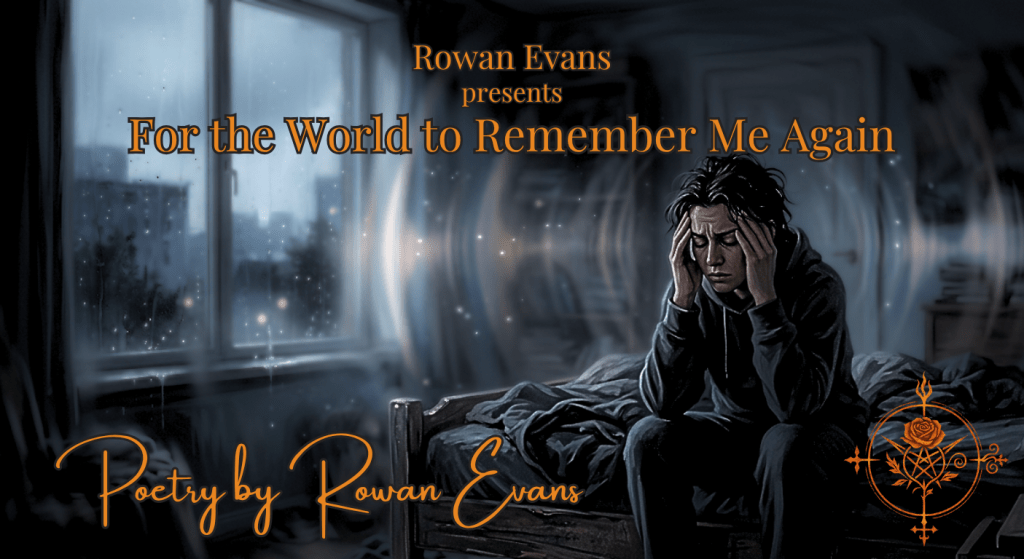
    A solitary person sitting quietly with a headache as the world around them blurs and fades into soft echoes of light.
    “Some days it isn’t pain that feels overwhelming—it’s the distance between yourself and the world around you.”

    For the World to Remember Me Again
    Poetry by Rowan Evans

    I’ve got a headache,
    can’t see straight—
    vision blurring at the edges.

    It’s the kind of headache—
    where even the silence
    is loud.

    And I sit in it,
    this ringing hush,
    like the world has stepped back
    and left me echoing alone.

    It’s like—
    every sound echoes
    in a cavernous skull.

    Like my thoughts are ricocheting
    off the walls of me,
    coming back warped,
    a little less mine
    each time—

    the rhythm
    loses a little bit
    of its rhyme.

    Every pulse is thunder,
    every heartbeat a warning—
    a storm gathering
    behind my eyes.

    I try to focus,
    but the edges keep slipping—
    like my mind is smudging
    under its own weight.

    So I breathe,
    slow and deliberate,
    hoping the world will settle
    back into focus—

    or at least…

    stop slipping away.

    And I wait,
    quiet as I can,
    for the world
    to remember me again.


    Journey into the Hexverse…

    [Before My Feet Touch the Floor]
    What happens when your dreams feel more real than your waking life? Before My Feet Touch the Floor explores the strange grief of waking up, the lingering memory of dream selves, and the quiet question of which version of us is truly real.

    [Recognizes Home]
    A free-verse poem exploring the difference between love as dependency and love as choice. It challenges the idea that love must be need-based, instead centering the quiet strength of choosing someone while still remaining whole on your own.

    [Monster Theology]
    What if the monsters under the bed weren’t monsters at all? Monster Theology explores difference, belonging, and the human tendency to fear what we don’t understand through a conversation with the creatures we’ve spent our lives imagining.

    [Not Rebuilding You]
    A poem about love as an act of presence rather than rescue. Through construction imagery, Not Rebuilding You explores trust, devotion, emotional safety, and the quiet work of building a foundation strong enough for healing to grow.

    If you’re interested in more poetry, you can find it here → [The Library of Ashes]

  • Author’s Note

    Some poems arrive because of a grand idea.

    Others arrive because a single sentence refuses to leave.

    This was one of those.

    The poem began when I remembered a conversation. A joke, really. Someone once described themselves as being “like a drug” and we laughed about it. At the time, it felt playful, exaggerated, harmless.

    But memory has a way of revisiting things from a different angle.

    When I thought about that conversation later, I realized what interested me wasn’t the comparison itself. It was the experience of slowly realizing that someone has become part of your everyday thoughts without you noticing exactly when it happened.

    One day they’re simply someone you know.

    Then they’re someone you think about.

    Then they’re someone who quietly occupies space in your mind when nothing else is demanding your attention.

    The drug metaphor gave me a doorway into the poem, but it isn’t really what the poem is about.

    It’s about affection.

    It’s about attachment.

    It’s about the strange vulnerability of admitting that someone matters.

    More than that, it’s about the difference between being needed and being wanted.

    Need can feel transactional.

    Want feels chosen.

    The final lines became the emotional center for me because they capture a hope I think many people carry but rarely say aloud:

    Not that someone has to stay.

    Not that someone owes us their attention.

    Just that maybe, if given the choice, they would choose us too.

    Like a lot of my recent work, humor and metaphor show up first. They’re familiar territory. They’re comfortable. They make difficult things easier to approach.

    But beneath the jokes, the poem is doing what many of my poems eventually do.

    It’s confessing.

    Rowan Evans


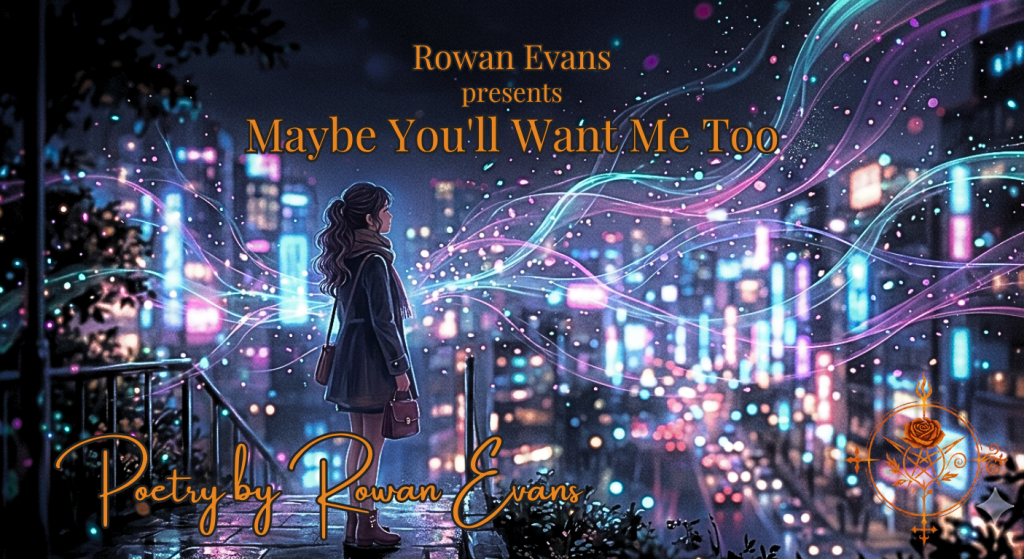
    A solitary figure standing beneath glowing city lights as colorful streams of light drift through the air, symbolizing affection, attachment, and lingering thoughts of someone special
    Sometimes affection arrives quietly—slipping into your thoughts until you realize someone has become part of your everyday world.

    Maybe You’ll Want Me Too
    Poetry by Rowan Evans

    I remember when you said—
    you are like a drug.

    It was all laughs
    about your exes being hooked,
    still shook by the thoughts of you.

    But I was getting second-hand
    contact highs—

    now I feel addicted too.

    It’s like you’re in my bloodstream.
    You’ve rewired my brain,
    rebalanced the chemical compounds—
    you’re in nearly every single thought now.

    I try to hide it behind metaphors
    and jokes—an attempt to mask
    the fragile hope—

    that you won’t need me,
    but maybe you’ll want me too.


    Journey into the Hexverse…

    [Recognizes Home]
    A free-verse poem exploring the difference between love as dependency and love as choice. It challenges the idea that love must be need-based, instead centering the quiet strength of choosing someone while still remaining whole on your own.

    [Not Rebuilding You]
    A poem about love as an act of presence rather than rescue. Through construction imagery, Not Rebuilding You explores trust, devotion, emotional safety, and the quiet work of building a foundation strong enough for healing to grow.

    [The Language Her Soul Speaks]
    What if love isn’t about being understood, but learning to understand someone else? “The Language Her Soul Speaks” is a free verse poem about intimacy, communication, curiosity, and the desire to know another person beyond the limits of language.

    [Ocean Waves (1, 4, 3)]
    A moonlit shoreline, a rowboat full of ducks, a piggybank with no cents, and a confession hidden in plain sight. Ocean Waves (1, 4, 3) explores how humor, wordplay, and absurdity can become a side door to vulnerability when the truth feels too difficult to say directly.

    [L Words & Heart]
    A moonlit shoreline, a rowboat full of ducks, a piggybank with no cents, and a confession hidden in plain sight. Ocean Waves (1, 4, 3) explores how humor, wordplay, and absurdity can become a side door to vulnerability when the truth feels too difficult to say directly.

    If you’re interested in more poetry, you can find it here → [The Library of Ashes]

  • Author’s Note

    This poem began as a collection of bad jokes.

    Or at least that was the excuse.

    Sometimes I start writing with no destination in mind. A phrase appears. Then a pun. Then another. A moon becomes a metaphor. Ducks end up in a rowboat. A piggybank loses all its cents.

    And somewhere in the middle of all that nonsense, something honest sneaks in.

    I’ve noticed that humor often works like a side door.

    There are things I can say directly. There are things I can say through poetry. And then there are things that feel easier to approach sideways, hidden beneath wordplay, jokes, and absurd little detours.

    This piece lives in that space.

    The speaker keeps drifting away from the point, circling it rather than naming it. Every joke becomes a delay tactic. Every pun buys another moment before the truth has to be spoken aloud.

    Because sometimes vulnerability isn’t difficult because you don’t know what you feel.

    Sometimes it’s difficult because you know exactly what you feel.

    And saying it out loud makes it real.

    The title’s parenthetical reference, “1, 4, 3,” comes from an old numerical shorthand for a phrase many people know by heart. I liked the idea of building an entire poem around avoiding a confession, only to hide it in plain sight.

    In the end, the poem says exactly what it means.

    It just takes the scenic route to get there.

    Rowan Evans


    A solitary figure stands on a moonlit beach beside gentle ocean waves while silver moonlight reflects across the water beneath a glowing night sky.
    Sometimes the longest journey to the truth is the scenic route—through moonlight, wordplay, ocean waves, and all the jokes we tell before we finally say what we mean.

    Ocean Waves (1, 4, 3)
    Poetry by Rowan Evans

    I stand on the shore
    giving ocean waves—
    begging the tide
    to take me away.

    I trace the moon
    across the sky,
    I map it in rhyme.
    Line after—
    silver-lined metaphor.

    I got my ducks in a row
    boat—is that what the paddles for?
    I know the direction,
    what would I panic for?

    You might be confused—
    I know that made no sense,
    like an empty piggybank.
    No cents, thoughts scattered
    like loose change.

    I use jokes
    to mask the truth sometimes.

    It makes what I want to say,
    an easier pill to swallow—

    1 letter
    followed by 4
    then 3—

    Together, they mean
    you mean the most to me.
    By your side—

    is where I’m supposed to be.


    Journey into the Hexverse…

    [1-4-3]
    A poem about love that isn’t rooted in need, but in choice. About finding safety not as a cage, but as a place where fear finally stops running—and stays.

    [1-4-3 (Tongue Tied)]
    A vulnerable poem about holding back the words that matter most. 1-4-3 (Tongue Tied) explores fear, emotional suppression, and the quiet ache of wanting to say “I love you.”

    [What I Want to Say]
    Sometimes the hardest words to say are the simplest ones. What I Want to Say explores love, hesitation, and the fear of what might change if you finally speak.

    [No Parachute]
    A poetic reflection on falling in love without hesitation—raw, uncertain, and without a safety net.

    If you’re interested in more poetry, you can find it here → [The Library of Ashes]
  • Author’s Note

    This piece began as a joke.

    Or at least, I thought it did.

    The opening voice is intentionally playful—awkward, self‑deprecating, a little chaotic, prone to wandering off into side comments before finding its way back again. In many ways, it feels closer to how I actually think than some of my more polished or serious pieces.

    But underneath the humor is something sincere.

    I’ve never been particularly good at saying important things directly. Sometimes vulnerability arrives disguised as a joke. Sometimes affection hides behind wordplay. Sometimes the safest way to admit what you’re feeling is to make someone laugh first.

    The title comes from a simple realization: when I think about certain people, my thoughts tend to orbit the same things.

    Love. Longing. Loyalty.

    The L words.

    And heart.

    The final section is intentionally quieter than everything that comes before it. The jokes fall away, the distractions disappear, and what remains is the truth the speaker was circling the entire time: the way another person can take up space in your imagination, your creativity, and your inner world long before they ever occupy the same physical space.

    Sometimes affection doesn’t arrive as grand declarations.

    Sometimes it arrives as a face that appears when you close your eyes.
    A voice you hear in silence.
    A shoreline you keep finding in your dreams.

    Rowan Evans


    A solitary figure standing on a moonlit shoreline while waves roll in beneath a dreamy twilight sky.
    Some people arrive in your thoughts quietly—then somehow become part of every dream, every poem, and every beat of your heart.

    L Words & Heart
    Poetry by Rowan Evan

    I’m just a quirky, mother—
    not a fighter, but a lover.
    I’m not brave or whatever,
    I bite tongues,
    holding words like lips
    with padlocks.

    I’ve never been a fan of change,
    but I want things to change—
    I want my life rearranged,
    I want to be seen as normal
    not strange—
    I want to be me
    and accepted,
    because I’m not as strange
    as you think—
    I’ve seen Stranger Things.

    (Actually, no I haven’t.
    I never got into the show.
    But I digress…)

    I’ve got things I want to say,
    got things I want you to know.

    When I think about you
    it’s all L words and heart,
    you reshaped my art.
    So I close my eyes
    and I see your face.
    In silence, I hear your voice—
    and in dreams I walk your shores.


    Journey into the Hexverse…

    [Just Beyond Waking]
    A street that feels familiar. A life that hasn’t happened yet. Just Beyond Waking explores the fragile space between dreams, memory, longing, and the quiet feeling that some futures are already waiting for us.

    [Twin Suns, Sister Moons]
    A poem about distance, longing, and the quiet pull of someone who lives beneath a different sky. Between twin suns and sister moons, the heart keeps reaching for home.

    [It’s You I Choose]
    A poem about devotion, vulnerability, and the quiet decision to stay. Sometimes love isn’t certainty—it is choosing someone anyway.

    If you’re interested in more poetry, you can find it here → [The Library of Ashes]
  • Author’s Note

    This poem started with a voice.

    Not a theme. Not an image. Not a grand idea.

    Just a voice already halfway through a conversation.

    The kind of conversation where someone teases you, calls you crazy, and instead of defending yourself, you laugh because you’ve heard it before.

    A lot of my writing tends to be emotionally heavy, layered, symbolic, or wrapped in larger metaphors. This piece isn’t trying to do any of that.

    It’s intentionally conversational.

    A little sarcastic. A little self-aware. A little chaotic.

    Which, if I’m being honest, isn’t that far removed from how I actually talk.

    What interested me while writing it was the difference between being called strange and being comfortable enough with yourself to stop treating that as an insult.

    The speaker isn’t arguing for normalcy.

    They’re not saying, “No, I’m not weird.”

    They’re basically saying:

    “Yeah. Maybe I am. And?”

    That confidence becomes important because it creates space for the real confession waiting underneath the jokes.

    The poem begins as a defense of individuality, but it ends as a statement of devotion.

    Not because the speaker suddenly becomes serious, but because sincerity sneaks in when they’re not looking.

    And that’s probably my favorite kind of honesty.

    The kind that arrives accidentally.

    The kind that slips past the defenses.

    The kind that shows up disguised as a joke before quietly admitting:

    Of all the people in the world, you’re the one I’d choose.

    Rowan Evans


    Two people sharing a quiet late-night conversation while sunrise begins to glow through a nearby window.
    Sometimes love is not certainty. Sometimes it’s simply choosing someone, again and again.

    It’s You I Choose
    Poetry by Rowan Evans

    Here we sit, you and I
    deep in conversation—

    you say, “you’re insane,”
    I say “perfectly.”
    Got it tatted on my arm,
    as a reminder—

    I might struggle
    with my mental health,
    but I’m still perfectly myself.

    It’s a pillar
    of my personality.

    They say I’m strange,
    yeah, well I might be.
    That feels highly likely.

    Loyal to a fault—
    line snaps.
    But my devotion
    is unshakeable.

    What I’m trying to say is—

    maybe
    I am crazy,
    but baby—
    it’s you I choose,
    it’s you I couldn’t
    stand to lose.


    Journey into Hexverse…

    [I’ll Be There to See Your Sunrise]
    Love has never come easily to me. This poem explores the fear, vulnerability, and quiet courage required to stay emotionally present when connection begins to matter deeply. “I’ll Be There to See Your Sunrise” is about choosing love despite the risk of heartbreak—and promising to remain long enough to witness someone fully.

    If you’re interested in more poetry, you can find it here → [The Library of Ashes]

  • Author’s Note

    This piece was written while listening to “Role Model” by Eminem, and you can probably feel that influence in the posture of it.

    There’s swagger here. Sharpness. A little confrontation.

    But beneath that, this piece is really about the difference between shared labels and shared experience.

    Two people can both call themselves poets and still arrive at the page from completely different places emotionally, stylistically, philosophically, and spiritually. The label itself doesn’t erase individuality. If anything, art becomes meaningful because of the differences in how we carry our histories into it.

    That’s what this poem is wrestling with.

    Not superiority. Specificity.

    The truth is, I’ve spent more than two decades building my relationship with language. Not just learning how to write, but learning how to survive through writing. A lot of the imagery in this piece—cathedrals, altars, confession, Gothic romanticism—comes from the emotional architecture I’ve spent years constructing around my work.

    Those images aren’t aesthetic decoration for me. They’re autobiographical.

    When I say my environment “felt more like a cage,” I mean that literally in the emotional sense. Writing became escape, translation, preservation, and eventually identity. The page became the place where I could expand beyond the limits of the environments I grew up inside.

    So while the voice in this poem is intentionally bold, the core of it is actually vulnerable:
    the fear of becoming interchangeable, the need to protect individuality, and the understanding that art is shaped as much by lived experience as talent itself.

    Because someone can imitate style. They can imitate rhythm. They can imitate aesthetic.

    But nobody else has lived your exact life.

    And eventually, that truth always bleeds through the writing.

    Rowan Evans


    A poet writing alone in a dark cathedral-like room filled with books, candles, and scattered pages.
    Some people write because they want to. Some write because the page became the only place they could fully exist.

    Escaped to the Page
    Poetry by Rowan Evans

    You could be just like me,
    you could write like me—
    be full of empathy like me,
    definition of compassion just like me.

    You could be just like me—
    but still you’d never be me.

    You could build worlds
    with words, just like me—
    cathedrals and altars,
    reverence and devotion, just like me—

    You could imitate the shape—
    but you’d never be the source.
    Don’t even try, just stop.

    You think we’re the same
    because the labels we wear?
    I’m a poet, you’re a poet too—
    but that doesn’t make us a matching pair.

    Twenty-three years,
    I’ve been doing this—
    metaphors like weapons,
    meta-poetry, meta-lessons—
    look at everything I’ve written.

    Confessions penned
    in Gothic lace,
    Romanticized darkness
    because that’s the only place
    I feel at home.

    My environment
    felt more like a cage,
    so I escaped to the page.
    I wrote lines of longing,
    looking for belonging—

    because I’ve been knowing,
    this isn’t the place I’d finish growing.


    Journey into the Hexverse…

    [Ink as a Second Mouth]
    “Ink as a Second Mouth” explores the distance between thought and speech, and the ways writing can become a form of survival, continuity, and self-translation. Through confessional imagery and reflections on growth, identity, and articulation, the poem examines what it means to keep becoming through language.

    If you’re interested in more poetry, you can find it here → [The Library of Ashes]
  • Author’s Note

    This piece comes from the space where speech and writing don’t quite align.

    There has always been a kind of delay for me—between what I think, what I feel, and what I can actually say out loud. Spoken language has never felt like the most reliable place for truth to land. It slips. It fractures. It gets filtered through hesitation, timing, or silence.

    Writing became something different.

    Not a replacement for speech, but a translation of it.

    A second mouth.

    One that doesn’t hesitate in the same way.

    One that doesn’t need to arrive perfectly formed in real time.

    Over time, I’ve come to understand my writing less as expression and more as continuity—a way of carrying versions of myself forward that might otherwise get lost between changes, growth, or silence. When I talk about shedding “lives like shells,” it isn’t about abandoning who I was, but making space for who I’m becoming.

    Writing is where those versions remain visible.

    Where they don’t disappear just because I’ve outgrown them.

    In that sense, this isn’t just about communication—it’s about survival through articulation. Not in the dramatic sense, but in the quiet one: staying connected to myself through language when voice doesn’t fully bridge the gap.

    And if spoken language is the place where I sometimes fall short of myself, then writing is where I learn how to keep translating who I am anyway.

    Rowan Evans


    A writer sitting beside scattered handwritten pages and spilled ink in a dimly lit room.
    If spoken language is where I fall short of myself, then writing is how I keep translating who I am anyway.

    Ink as a Second Mouth
    Poetry by Rowan Evans

    There is a delay
    between my mind
    and my mouth
    when I speak—

    that’s why I find
    it easier to talk in ink.

    I turned my pen
    into my mouth,
    so when I write
    it’s the only time—
    the truth spills through.

    When I open my mouth,
    my words won’t come out—

    but in ink, they run
    like the secrets slip
    from loose lips.

    I could write poem after poem,
    leaving piece after piece of me behind—
    scattered across the pages,
    like versions of me scattered
    across different lives.

    But do not mourn
    for what I’ve lost,
    because it’s simply the cost
    of me being me.

    I shed past lives,
    it leaves room for me to grow—

    just a hermit crab
    in human form.

    And I’ll continue
    to shed lives like shells until
    I find the version of myself—

    that can speak
    in more than ink.

    Until then I’ll continue to try,
    because growth comes slow.
    It’s gradual, it never comes clear.

    There are no definable lines—
    only slow becoming.


    If you’re interested in more poetry, you can find it here → [The Library of Ashes]
  • Author’s Note

    Some feelings become difficult to carry once they stop being hypothetical.

    You rehearse the words in your head, hide them in poems, disguise them as metaphors, bury them in “what ifs” and dream sequences—because saying them plainly makes them real.

    This piece came from that space between silence and confession.

    The strange place where fear and honesty start sounding alike.

    Not fear of loving someone.

    Fear of changing something that already matters deeply to you.

    Because sometimes the connection itself becomes so important that risking it feels terrifying.

    And sometimes love isn’t about perfection at all.

    Sometimes it’s just about seeing someone clearly—and caring anyway.

    — Rowan Evans


    A solitary person sits beside a softly lit window at night holding an open notebook in a quiet reflective atmosphere.
    Some truths stay hidden in poems long before they’re ever spoken aloud.

    Just Knowing You Has Been Enough
    Poetry by Rowan Evans

    I went quiet,
    but you never left my mind.

    I was silent—
    I had a lot to say,
    just didn’t know how to say it.

    I was afraid.
    Scared out of my mind.

    Everything I could have said,
    it didn’t feel right.
    It felt too heavy—
    too hard to carry.

    I had to set it down
    for a while.

    I had to sit with it,
    the words only spoken
    in my dreams.

    Dreams where,
    you never have the chance
    to respond.

    It feels wrong.

    But I wouldn’t want to
    speak for you.

    It’s been this way
    for a while now.

    I get too in my head,
    too hung up on
    what I have said—

    and what I want to say.

    They aren’t always
    the same.

    I’ve dropped hints
    in coded lines,
    wrote the words plain
    in poems about dreams—
    knowing they’d get overlooked.

    They’re not serious.

    But know this,
    the words written here
    are me being honest:

    I’m scared.
    I’m terrified,
    it’s true—
    but I really do
    love you.

    There’s no other way
    to say it.

    Because what is love—
    if not bias?

    And I am biased.

    Now what’s bias,
    if not seeing perfection
    where there is none?

    Because I know you’re not perfect—
    I’ve seen the cracks.
    I’ve listened to your stories,
    heard the lore—

    but here’s the thing,
    it’s not about perfection
    or lack thereof—
    it never has been.

    It’s about connection.

    It always has been.
    That’s all I’ve ever wanted,
    whatever shape that takes—
    I can be happy.

    Just knowing you
    has been enough.


    Journey into the Hexverse…

    [The Streets I Sleep When I Walk]
    “The Streets I Walk When I Sleep” is a deeply intimate free verse poem about recurring dreams, emotional connection, longing across distance, and the strange feeling of remembering places and moments that have never happened in waking life.

    [Memories From a Life Yet to Come]
    Some dreams feel less like fantasy and more like memory. “Memories From a Life Yet to Come” is a reflective free verse poem about longing, displacement, emotional alignment, and the strange comfort of recognizing yourself more clearly in dreams than in waking life

    [Separate Timelines]
    “Separate Timelines” is a surreal and deeply introspective free verse poem about emotional distance, time zones, vulnerability, and the fear of losing a connection that already feels meaningful before the words are ever spoken aloud.

    If you’re interested in more poetry, you can find it here → [The Library of Ashes]
  • Author’s Note

    There’s a version of success that looks good from the outside.

    Recognition. Stability. Achievement.

    But none of it really answers a simpler question:

    Who is it for?

    This piece comes from realizing that the things we’re told to chase don’t always mean as much as we think they will—especially if there’s no one there to share them with.

    It’s not about rejecting success.

    It’s about redefining what makes it matter.

    Rowan Evans


    Cozy home interior with two chairs by a window, representing companionship and shared life.
    Success means little if there’s no one there to share it with.

    None of It Means a Thing
    Poetry by Rowan Evans

    This is me confessing—
    I don’t want success
    to bless me
    unless it’s you
    there with me.

    I don’t need
    a sea of fans
    screaming my name—
    I’m not
    chasing fame.

    I don’t need
    pockets lined with gold.
    I need just enough
    to make our lives easier—
    and I mean it.

    Because I’m trying
    to build a life
    that can sustain—
    I want to thrive,
    not just survive.

    I want to build
    a home.

    But none of it
    means a thing
    if there’s no one
    there to share it.


    If you’re interested in more poetry, you can find it here → [The Library of Ashes]