Tag: writing as survival

  • Author’s Note

    This piece was written while listening to “Role Model” by Eminem, and you can probably feel that influence in the posture of it.

    There’s swagger here. Sharpness. A little confrontation.

    But beneath that, this piece is really about the difference between shared labels and shared experience.

    Two people can both call themselves poets and still arrive at the page from completely different places emotionally, stylistically, philosophically, and spiritually. The label itself doesn’t erase individuality. If anything, art becomes meaningful because of the differences in how we carry our histories into it.

    That’s what this poem is wrestling with.

    Not superiority. Specificity.

    The truth is, I’ve spent more than two decades building my relationship with language. Not just learning how to write, but learning how to survive through writing. A lot of the imagery in this piece—cathedrals, altars, confession, Gothic romanticism—comes from the emotional architecture I’ve spent years constructing around my work.

    Those images aren’t aesthetic decoration for me. They’re autobiographical.

    When I say my environment “felt more like a cage,” I mean that literally in the emotional sense. Writing became escape, translation, preservation, and eventually identity. The page became the place where I could expand beyond the limits of the environments I grew up inside.

    So while the voice in this poem is intentionally bold, the core of it is actually vulnerable:
    the fear of becoming interchangeable, the need to protect individuality, and the understanding that art is shaped as much by lived experience as talent itself.

    Because someone can imitate style. They can imitate rhythm. They can imitate aesthetic.

    But nobody else has lived your exact life.

    And eventually, that truth always bleeds through the writing.

    Rowan Evans


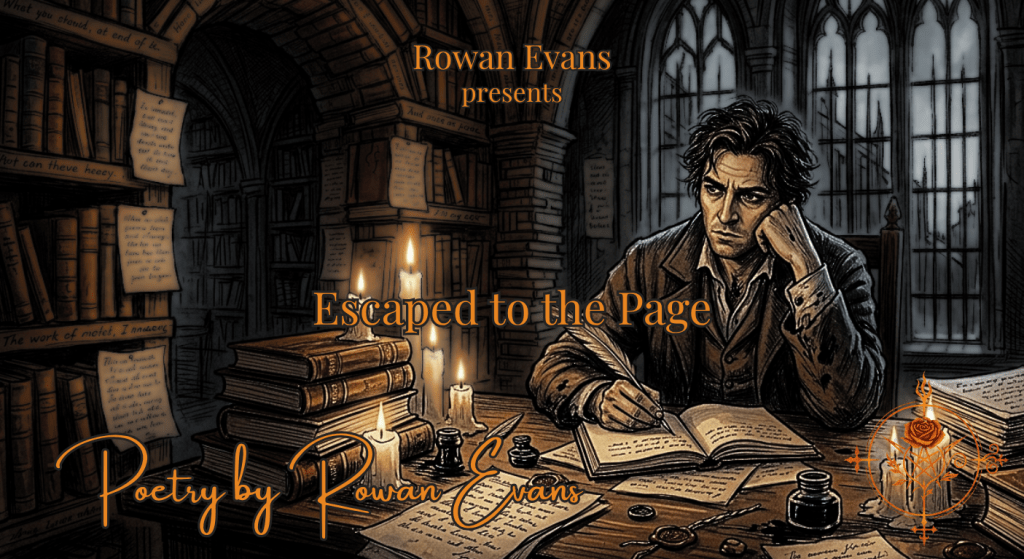
    A poet writing alone in a dark cathedral-like room filled with books, candles, and scattered pages.
    Some people write because they want to. Some write because the page became the only place they could fully exist.

    Escaped to the Page
    Poetry by Rowan Evans

    You could be just like me,
    you could write like me—
    be full of empathy like me,
    definition of compassion just like me.

    You could be just like me—
    but still you’d never be me.

    You could build worlds
    with words, just like me—
    cathedrals and altars,
    reverence and devotion, just like me—

    You could imitate the shape—
    but you’d never be the source.
    Don’t even try, just stop.

    You think we’re the same
    because the labels we wear?
    I’m a poet, you’re a poet too—
    but that doesn’t make us a matching pair.

    Twenty-three years,
    I’ve been doing this—
    metaphors like weapons,
    meta-poetry, meta-lessons—
    look at everything I’ve written.

    Confessions penned
    in Gothic lace,
    Romanticized darkness
    because that’s the only place
    I feel at home.

    My environment
    felt more like a cage,
    so I escaped to the page.
    I wrote lines of longing,
    looking for belonging—

    because I’ve been knowing,
    this isn’t the place I’d finish growing.


    Journey into the Hexverse…

    [Ink as a Second Mouth]
    “Ink as a Second Mouth” explores the distance between thought and speech, and the ways writing can become a form of survival, continuity, and self-translation. Through confessional imagery and reflections on growth, identity, and articulation, the poem examines what it means to keep becoming through language.

    If you’re interested in more poetry, you can find it here → [The Library of Ashes]
  • Author’s Note

    This piece comes from the space where speech and writing don’t quite align.

    There has always been a kind of delay for me—between what I think, what I feel, and what I can actually say out loud. Spoken language has never felt like the most reliable place for truth to land. It slips. It fractures. It gets filtered through hesitation, timing, or silence.

    Writing became something different.

    Not a replacement for speech, but a translation of it.

    A second mouth.

    One that doesn’t hesitate in the same way.

    One that doesn’t need to arrive perfectly formed in real time.

    Over time, I’ve come to understand my writing less as expression and more as continuity—a way of carrying versions of myself forward that might otherwise get lost between changes, growth, or silence. When I talk about shedding “lives like shells,” it isn’t about abandoning who I was, but making space for who I’m becoming.

    Writing is where those versions remain visible.

    Where they don’t disappear just because I’ve outgrown them.

    In that sense, this isn’t just about communication—it’s about survival through articulation. Not in the dramatic sense, but in the quiet one: staying connected to myself through language when voice doesn’t fully bridge the gap.

    And if spoken language is the place where I sometimes fall short of myself, then writing is where I learn how to keep translating who I am anyway.

    Rowan Evans


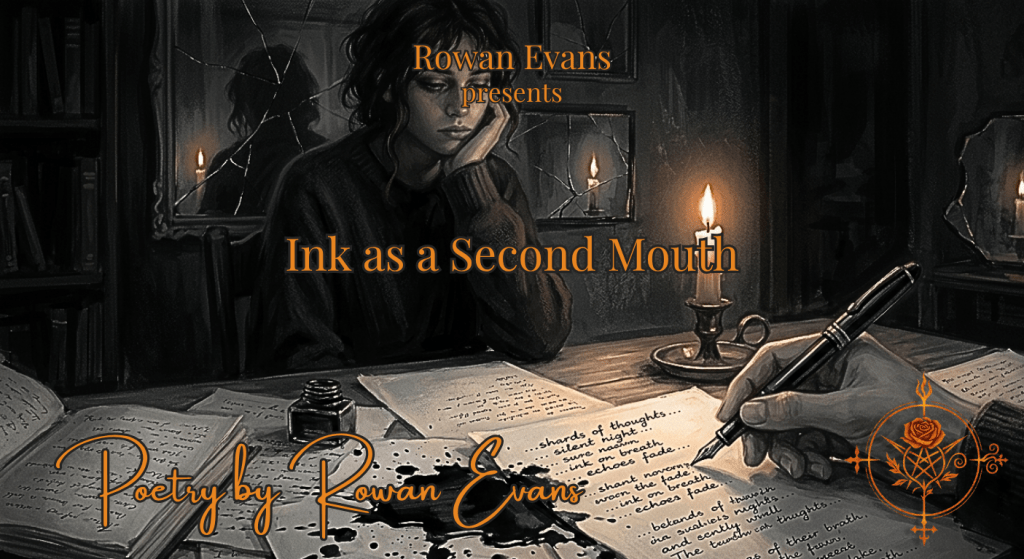
    A writer sitting beside scattered handwritten pages and spilled ink in a dimly lit room.
    If spoken language is where I fall short of myself, then writing is how I keep translating who I am anyway.

    Ink as a Second Mouth
    Poetry by Rowan Evans

    There is a delay
    between my mind
    and my mouth
    when I speak—

    that’s why I find
    it easier to talk in ink.

    I turned my pen
    into my mouth,
    so when I write
    it’s the only time—
    the truth spills through.

    When I open my mouth,
    my words won’t come out—

    but in ink, they run
    like the secrets slip
    from loose lips.

    I could write poem after poem,
    leaving piece after piece of me behind—
    scattered across the pages,
    like versions of me scattered
    across different lives.

    But do not mourn
    for what I’ve lost,
    because it’s simply the cost
    of me being me.

    I shed past lives,
    it leaves room for me to grow—

    just a hermit crab
    in human form.

    And I’ll continue
    to shed lives like shells until
    I find the version of myself—

    that can speak
    in more than ink.

    Until then I’ll continue to try,
    because growth comes slow.
    It’s gradual, it never comes clear.

    There are no definable lines—
    only slow becoming.


    If you’re interested in more poetry, you can find it here → [The Library of Ashes]
  • Author’s Note

    Sometimes writing becomes survival before you even realize that’s what it’s turned into.

    This piece came from the realization that I often disappear into craft when my mind gets too loud. I’ll drift into rhyme schemes, metaphors, cadence, imagery—anything that helps me stay afloat emotionally.

    Not because I’m trying to escape life completely.

    More because writing gives shape to feelings that otherwise feel impossible to carry.

    A lot of this poem revolves around rootlessness: the feeling of growing in soil that never fully nurtured you, while still refusing to break under the pressure of it.
    And I think that distinction matters.

    Struggling to root yourself somewhere doesn’t mean you’re weak. Sometimes it simply means the environment around you was never meant to hold the version of you that was trying to grow.

    So this piece became less about collapse and more about persistence.

    About continuing to create meaning even while feeling displaced.

    About refusing to let your environment define your voice.

    Rowan Evans


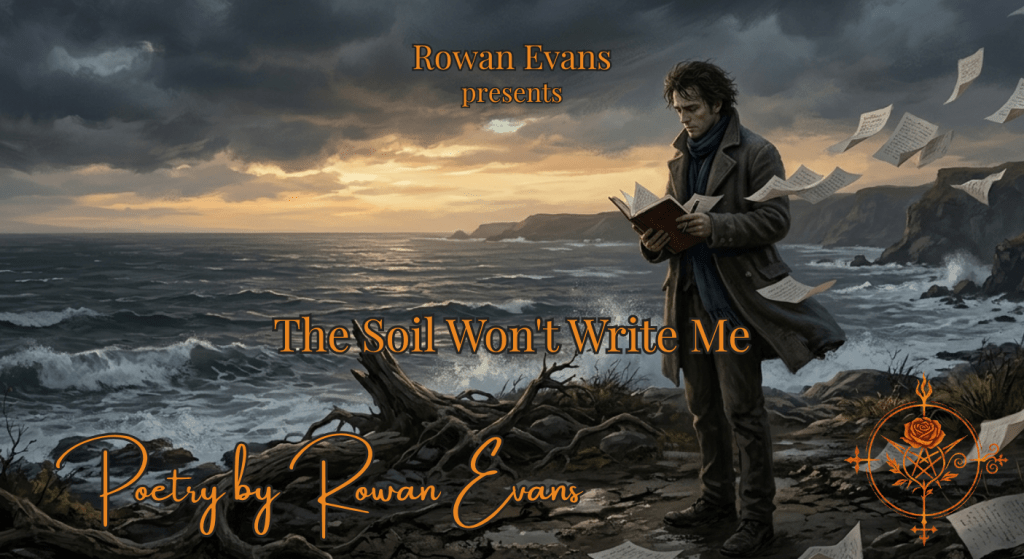
    A solitary figure stands near the ocean at dusk holding a notebook while storm clouds part above exposed roots in cracked earth.
    Some roots fail because the soil was never meant to hold them.

    The Soil Won’t Write Me
    Poetry by Rowan Evans

    I’m sorry—
    I got lost again.

    Drifting between lines,
    bouncing between rhymes—
    if life’s a game,
    I keep forgetting to play.

    Too focused on the craft,
    lost sight of the life behind it.

    Don’t worry—
    I’m not in danger.

    I’ve just gone quiet—
    trying to silence
    a mental riot.

    Thoughts get too loud,
    become a stranger to myself.

    I get lost in the craft,
    turn the pen to a life raft.

    Ink crashes
    like waves overhead,
    carrying secrets
    in the cadence
    of the tides.

    Because every rhyme
    is a shoreline
    on ocean’s edge.

    And this is how it works for me—

    it starts small
    then quickly grows—
    a seed
    into a tree.

    A tree big and tall,
    but the foundation is weak—
    there are no roots here
    to anchor me.

    They say I’d waver
    in the slightest breeze.

    But that’s not true,
    just because I have no roots—
    doesn’t mean that I will falter,
    it just means
    life won’t come with ease.

    It just means
    this soil wasn’t right for me—

    and these people
    cannot speak for me,
    I write what I think
    in ink and let that
    carry what I mean.

    All that means—
    I won’t let this soil write for me.

    And I’ll deal with
    this stuck feeling,
    that I feel
    deep inside—
    in the only way
    I know how…

    I’ve got to write it out,
    can’t ignore it.

    Got to ride it out.


    Journey into the Hexverse…

    [The Needle Doesn’t Point North]
    “The Needle Doesn’t Point North” is a deeply personal free verse poem about displacement, identity, and spending a lifetime feeling emotionally disconnected from the place you were born while being drawn toward distant shores.

    [Weather in My Chest]
    “Weather in My Chest” is a free verse poem about emotional hyperawareness, social tension, and the quiet experience of carrying internal storms into rooms that react before a singl[e word is spoken.

    [Sound as a Vessel]
    “Sound as a Vessel” is a free verse poem about music as emotional architecture, exploring how international artists and soundscapes shaped identity, creativity, memory, and poetic voice.

    [Just Knowing You Has Been Enough]
    “Just Knowing You Has Been Enough” is a deeply vulnerable free verse poem about unspoken love, emotional fear, coded confessions, and the quiet truth of caring for someone without needing perfection in return.

    [The Streets I Walk When I Sleep]
    “The Streets I Walk When I Sleep” is a deeply intimate free verse poem about recurring dreams, emotional connection, longing across distance, and the strange feeling of remembering places and moments that have never happened in waking life.

    [Memories From a Life Yet to Come]
    Some dreams feel less like fantasy and more like memory. “Memories From a Life Yet to Come” is a reflective free verse poem about longing, displacement, emotional alignment, and the strange comfort of recognizing yourself more clearly in dreams than in waking life

    [Separate Timelines]
    “Separate Timelines” is a surreal and deeply introspective free verse poem about emotional distance, time zones, vulnerability, and the fear of losing a connection that already feels meaningful before the words are ever spoken aloud.

    If you’re interested in more poetry, you can find it here → [The Library of Ashes]