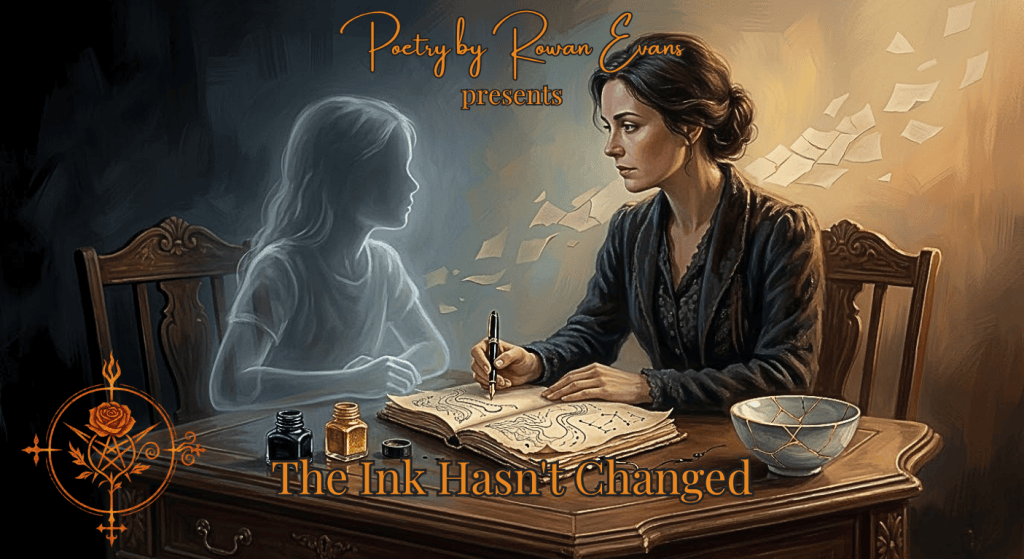
I sometimes look back at the person I was when I first started writing and wonder how much of that younger version of me is still sitting somewhere inside every poem I create. I started writing at thirteen, the same year I experienced my first heartbreak. Back then, ink wasn’t simply a creative outlet. It was a way to hold myself together, to give shape to feelings I didn’t know how to carry, and to leave a record of myself on the page when I was afraid of losing pieces of who I was.
The Ink Hasn’t Changed is about revisiting those beginnings without confusing familiarity with stagnation. The same emotions still find their way into my work: joy, grief, anger, tenderness, laughter, and pain. I’ve continued mapping my soul through poetry, stitching together broken pieces and filling the cracks with whatever gold I could find. The tools and materials may feel familiar, but the person doing the stitching is not the same.
There’s a difference between carrying the same weight and never moving forward. Sometimes, growth means discovering that the thing that once kept you alive can become something you choose to nurture, refine, and share.
My ink hasn’t changed because its purpose never needed to. I have changed. I’ve survived. And the words that once helped me hold myself together now help me understand who I’ve become.
— Rowan Evans
The ink that helped me survive at thirteen still carries my truth at thirty-six. The ink hasn’t changed. I have.
The Ink Hasn’t Changed Poetry by Rowan Evans
I’ve been stuck in the past a lot lately,
just thinking about who I was—
who I was trying to become
and how those early days
set the stage for who I became,
on and off the page.
The same year
I committed myself to ink,
I tasted my first heartbreak—
it was bitter sweet,
hated that it had to come,
but nothing could be done.
That was 2003, I was thirteen—
and she was made to leave.
I took the shattered pieces,
collected in a basket—
I took threads of silver
and sewed myself
back together again.
Cracks patched with gold and ink,
confessions penned in golden ink—
back then
I wrote for me—
I wrote to keep it together,
mentally—
afraid I’d disappear
if I didn’t map my soul in ink.
Turned poetry to cartography,
started mapping the whole of me.
I mapped my soul, wholly—
turned my pain holy.
I tried to translate all of me—
the joy, the pain,
laughter and grief—
and my ink hasn’t changed.
It’s still carrying the same things.
All the same weight, wait—
does that mean I’m stuck in place?
No, just because the ink
has stayed the same—
doesn’t mean I have—I’ve changed,
I’m not the same as I was at thirteen,
now that I’m thirty-six—
and I’m not the same as I was at sixteen,
that’s when I thought my ink was real mean—
but really it was too nice,
the only thing keeping me alive.
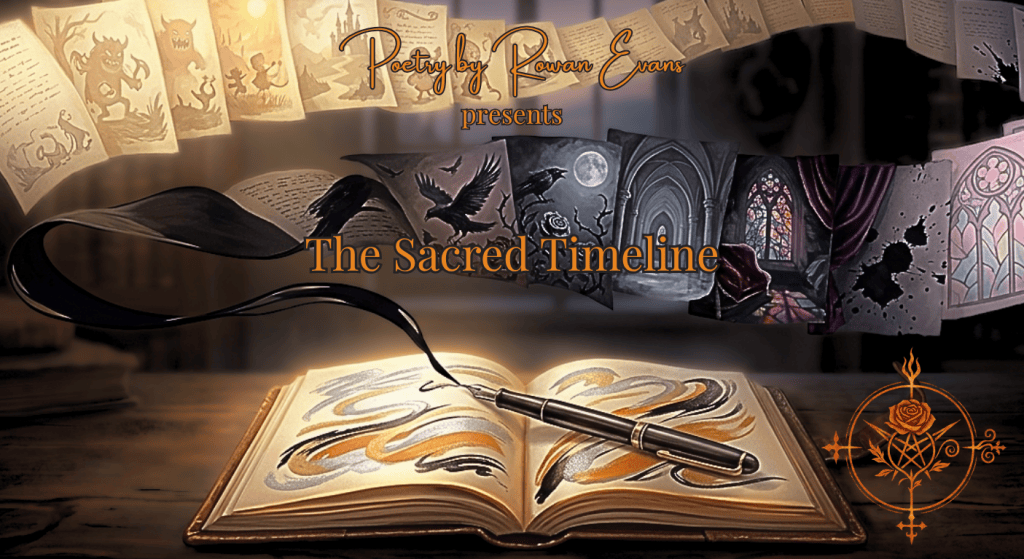
The Sacred Timeline is a map of how my relationship with the pen has changed over nearly three decades of my life.
I started with stories about worlds that already existed—Dragon Ball Z, Power Rangers, Pokémon—and slowly began building worlds of my own. Then the pen became a way to learn cadence, translate music, hide things I couldn’t say aloud, survive periods when writing itself became difficult, and eventually turn pain into something crafted enough to share.
Every era left something behind: the storyteller, the songwriter, the secret keeper, the gothic romantic, the heretic, the battle poet, the confessor, the mythmaker. Some symbols came and stayed. Some meanings changed. Some questions took decades to become clear enough to write down.
And the timeline is still moving.
At thirty-six, I don’t consider the pen mastered so much as understood differently. Writing is still an experiment. The boundaries keep moving. The imagery keeps evolving. The person holding the pen keeps changing.
Maybe that’s the most sacred part of the timeline: the ink stayed, but I didn’t.
— Rowan Evans
Thirty-six years, countless pages, one pen—and an identity still being written.
The Sacred Timeline Poetry by Rowan Evans
I picked up a pen for the first time at seven, I was just writing stories then— Dragonball Z, Power Rangers and Pokémon… that’s what I wrote about way back when—
it was much lighter out, the sun had yet to meet the clouds— I was a natural storyteller, a real lore keeper, weaving lore before I even knew what lore meant. It was like this for years, I created my own space in worlds provided by minds much older than mine.
Then at ten—I switched what the pen meant to me, my creativity shifted mentally— no longer was I just a storyteller, I was letting music be the teacher now. Translating thoughts to song, at least the words of it— I was writing to worship something. Something that in six short years, I would begin to question—
but the years between ten and then—were spent, using the pen to learn cadence. I was trying to learn to perform on the page— I couldn’t do it in body, but I could turn a notebook to a stage.
At twelve things began to shift again, but with me, not with the pen— I still felt the sun, I still saws its rays, but I also saw more cloudy days— that year was hard for me, I couldn’t talk about it with clarity— most people would react like, “you’re scaring me”— so I stopped talking about it really, I closed my lips, but still let the ink spill— the page became a secret keeper, keeping the secrets this storyteller was too afraid to say out loud.
Thirteen the skies went dark— this is when life really got hard. At the beginning of the year, it’s like the ink in my pen had begun to dry— I don’t know what was wrong, but I couldn’t write. I tried and I tried— pages ripped from notebooks, balled up and scattered.
No songs, no stories— I had lost interest in things that I used to find most interesting. Parents took me to the doctor, and the doctor said—
“This kid’s depressed— and anxious too, I’ll write a prescription that should do. A referral for therapy, they’ll get them to talk— they’ll find out what’s wrong.”
A week would go by— giving the medicine a try, it takes time— it has to build up in your system. In the meantime, here’s a therapist, someone to talk to— they’ll listen to your problems, they’ll help you.
And they did—a little bit, they got me to talk a little bit too. But still they saw I was holding back— so they recommended journaling, but that felt tedious and boring. I needed to find a way to make it play— bring a little joy to it, even if falsified.
I made it a game to translate my pain— how many ways could I say everything? Is it possible to flip it? Maybe change the script and shift the meaning? These were the questions I began to ask— even when my ink ran in all black—
back when my heart was all cracks, before I learned how to use the gold to patch— I struggled through, just writing purely what I felt— thirteen, fourteen and fifteen, often felt like hell.
Sixteen, I hit my stride— not in life but with a pen, things were hard still, but now I could translate with skill. Not much, if we’re being honest— just enough to keep the pain beautiful, in case someone else saw it—
Seventeen, I did it again— reinvented myself with the pen, more gothic in my intentions. Maybe I finally read Poe, who knows— but ravens became a part of my soul.
At eighteen, I went from church steeples and church people to writing cathedrals for outcasts and heretics— we hadn’t yet, become luminous. Shadows and lace, velvet and venom— but I also opened my eyes more, became more aware of the world around— outside the borders I’m confined in.
At twenty, I started to write for people more—to uplift, and let them know they’re not alone— whatever they were going through, there was somebody with them. Even from a distance—
I had friends across seas, in places with palm trees— and in places with Kangaroos, even scarier—Emu.
I don’t know what that means in this piece—but it’s true, so do with that, what you’re going to do.
At twenty-two, I got more serious about the ink— I started to write everything. Every thought and every half-formed idea— I just put it on a page, my brain would not be a cage.
Then came twenty-five, the lowest point in my life— it wasn’t a sudden crash, but a slow rot— it bled through every thought, a feeling I couldn’t translate, familiar but different, heavier somehow— so the ink slowed to a drip, I started to let thoughts slip.
Twenty-six, I got serious again— more aggressive with the time spent, my pieces became more crafted and the ink was shaped with intention. Ravens, the moon, and roses too— the symbols I began to use.
I ascend on the back of raven wings— the silver light of the moon pierced the canopy—rose petals drift in the shifting currents of the wind. Everything connects, pay more attention and you’ll become more aware—
At thirty— I really began to question everything— who I was, who I am, who I want to be— and that’s still a question I’m working on answering. But it went deeper than that— I was questioning who I was in a deeper sense, like had I been a façade in some sense. Was I playing the role I was assigned, or being true to who I thought I was becoming?
This became a recurring theme in my poetry— it’s an odd thing to discover so late in life, that the person you thought you were— isn’t who you’re supposed to be. So I chased answers in ink to questions I couldn’t fully ask yet.
There were two more years of this— and I’m still not finished.
Thirty-three hit with another shift— I mixed the light with the shadow, it was Easter in the cathedral— pastel colors lit up the stained glass. My imagery began to shift shades— roses in all colors, pastel hues, but the thorns were still there too. So even my softness had bite—
and it evolved more, by thirty-four— more teeth but more softness too. Brighter hues and deeper shadows— this is when I learned, you can’t have one without the other.
The shadow needs the light to cast— and you need the shade to dim the shine, because too much shine— you might go blind.
Then came thirty-five— the modern era, the current phase, one year before the current day— and I know this won’t age well, it’s too time specific—
Finally, we’ve reached thirty-six, and I feel like I’ve mastered this— but that doesn’t mean I’ve stopped learning, because every day is an experiment— really, it’s all about the experience— just learning new things and pushing it, finding where the boundary is and bending it, you gotta realize— you can’t always give a shit, who cares what they think— it’s your ink—shape it how you see fit.
Journey into the Hexverse
[The Metaphor Machine] A poem that takes apart its own machinery as it runs—breaking lines, breaking thoughts, and following metaphors from moonlight to tides, oceans, shorelines, and city streets.
[Exhibit A (The Evidence)] A quick-witted, unapologetically playful poem about writing fast, crossing lines, roasting the competition, and letting rhythm do the talking.
[Welcome to the Hexverse] Step into the Hexverse—a poetic world where mythmaking, humor, rage, creativity, and confession collide, and darkness becomes something that can be reshaped into art.
Sometimes I genuinely wonder what happens when I give my brain permission to write whatever it wants.
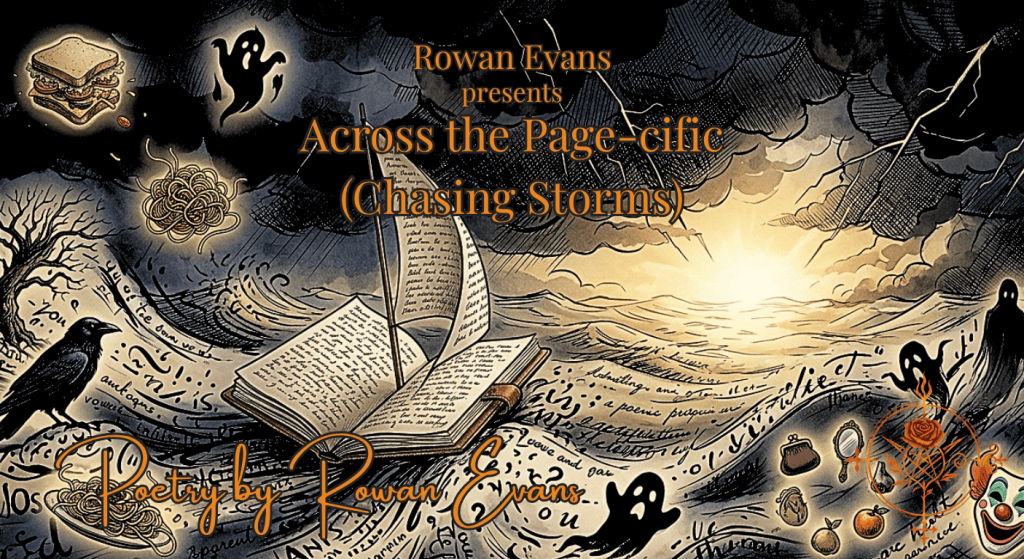
The answer, apparently, is sandwiches, pasta, farmers on Pluto, raccoons in silk pajamas, llamas, trees, cartoon ghosts, monsters, seven deadly sins, and a journey across an ocean that does not technically exist.
And honestly?
I love it.
Across the Page-cific (Chasing Storms) is a celebration of the strange places my writing can go when I stop trying to force it into a single shape.
This poem deliberately references several of my recent pieces and recurring worlds. The sandwich wordplay comes from Lost in the Sauce. The pasta-based literary assault comes from Impasta (A Diss in Pasta Form). The trees point back to my playful botanical wordplay, while Danny Phantom, the Monster in the Margins, the Seven Deadly Sonnets, ravens, spirits, and other imagery come from the larger mythology and vocabulary I’ve been building throughout my work.
The references aren’t just Easter eggs.
They’re evidence.
Evidence of how much my writing has changed—and how much more willing I am now to let different parts of my voice coexist.
For a long time, I thought I needed to choose what kind of writer I was supposed to be.
Gothic poet.
Confessional poet.
Love poet.
Dark poet.
Funny poet.
Experimental poet.
But the more I write, the less interested I am in choosing.
I want to write the heartbreak poem with sandwich ingredients.
I want Tony Stanza to write a pasta diss.
I want to turn mythology into autobiography.
I want to write about ghosts and gods, then turn around and make a terrible pun.
I want to chase a metaphor until it becomes absurd.
And then, underneath all of it, I want to find something honest.
That is what the storms in this poem represent.
The chaotic lines.
The sudden cadence changes.
The ideas that arrive from nowhere.
The parts of my mind that refuse to walk in a straight line.
I used to think I needed to calm those storms down.
Now?
I chase them.
Because writing has become a playground again.
And somewhere in that playground, I keep finding pieces of myself I hadn’t finished discovering.
“It was writing that saved me” is therefore not a throwaway line.
Writing gave me a language for experiences I couldn’t always explain directly. It gave me somewhere to put the contradictions, the humor, the darkness, the questions, the love, the anger, the absurdity, and everything else that makes up the person behind the pen.
Piece by piece.
Bit by bit.
I rebuilt myself in the art.
And apparently, sometimes that art looks like a sandwich, a bowl of pasta, and a storm on the Pacific.
I’ll take it.
— Rowan Evans
I stopped trying to avoid the storms. I started chasing them across the page.
Across the Page-cific (Chasing Storms) Poetry by Rowan Evans
Let’s see, what other ridiculous thing
can we turn into poetry—
I’ve written a heartbreak poem
using sandwich ingredients,
and wrote a diss poem
using nothing but pasta noodles—
was a farmer on Pluto,
witnessed raccoons in silk pajamas
perched on the backs of llamas—
while I shaped love poems
out of the trees—
I’ve turned Danny Phantom
into religion—a whole faith
on “going ghost”—
but really it’s just me stuck
between worlds.
I’ve written as the monster in the margins
and the spirits in the room—
seven sins that act like tax on the soul.
Go against the monster, you won’t leave whole.
Feeling like Pennywise, grin wide,
’cause I’m a clown in my rhymes
sometimes—
I’ve taken trips
in ink-dipped ships
across the page-cific—
avoiding storms of chaotic lines
and jagged rhymes
with sudden cadence changes.
Just kidding—
I chased the storms across the page,
embraced the pace my brain gave.
It was writing that saved me—
it gave me a way to translate me,
piece by piece and bit by bit,
I rebuilt myself in the art of lit—
where a mind like mine appears rarely.
Journey into the Hexverse…
[Lost in the Sauce] A playful heartbreak poem where sandwiches, ketchup, mustard, rye, lettuce, and sourdough become metaphors for emotional confusion. Beneath the food puns is a speaker trying to understand how everything went from “we’re okay” to suddenly feeling cold.
[Impasta] Tony Stanza is back with another literary attack—and this time, he’s bringing pasta. Spaghetti, fettuccine, macaroni, ravioli, and angel hair become weapons in a ridiculous diss aimed at a poet whose rhymes are allegedly cheesy, fragile, and completely impasta.
[Pluto Farmer] A whimsical absurdist poem about being a certified weirdo, farming space carrots on Pluto, and refusing to fit into anyone else’s definition of “normal.”
[Raccoons in Silk Pajamas] What begins with judgmental Space Chickens quickly spirals into camels in parked cars, elephants in jam jars, raccoons in silk pajamas, and astronauts in the ocean. A playful absurdist poem about language, imagination, and what happens when you stop trying to control where the words go.
[Did You Really Think This Was About Trees?] A playful love poem disguised as a forest of terrible tree puns. Beneath the birch, oak, cedar, palms, lumber, and absurdist wordplay is a poem about devotion, loyalty, laughter, and building a life with someone you love.
[Danny Phantom Theology] What begins as a metaphor borrowed from a childhood cartoon becomes something deeper: a reflection on existing between survival and possibility, exhaustion and hope, the life we have and the life we long for. Danny Phantom Theology explores what it means to keep moving toward a future that feels worth living.
[The Monster in the Margins II] The Monster in the Margins II transforms Rowan Evans’s Seven Deadly Sins mythology into a horror story written between the lines, where Lust, Wrath, Sloth, Greed, Pride, Envy, and Gluttony become monsters growing from pain, grudges, and scars.
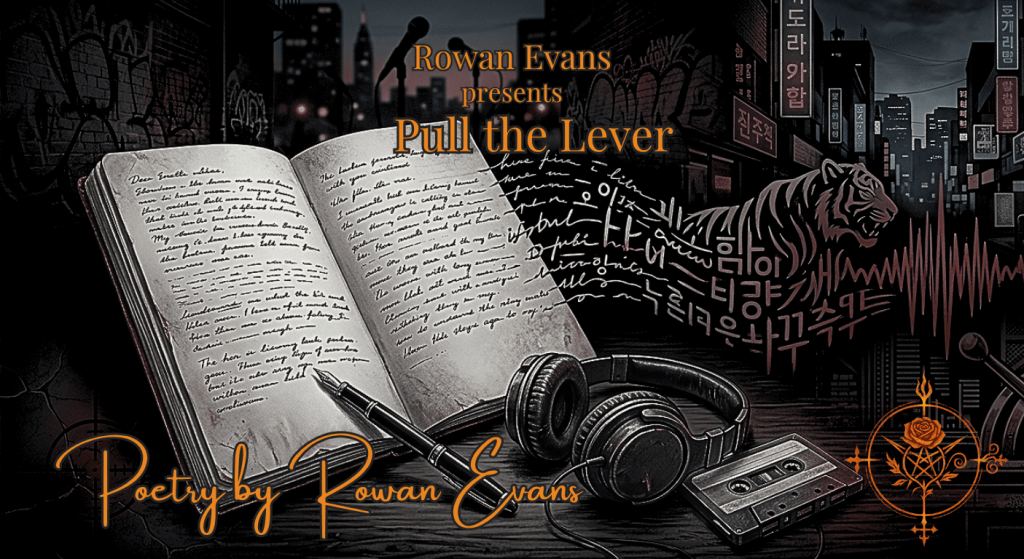
I’ve written before about how much Hip-Hop shaped the way I write, but Pull the Lever is a little more personal about that history.
I got into Hip-Hop young—around nine years old—and artists like DMX, Eminem, Ludacris, Mystikal, and 2Pac became part of the musical landscape I grew up in. I wasn’t trying to become a rapper; I was learning cadence. I was listening to how words moved, how syllables landed, how rhythm could turn language into something physical.
That influence never really left.
As I got older, though, my musical world expanded beyond American Hip-Hop. I started listening to music in other languages, and eventually Korean Hip-Hop became part of that landscape too. The final section of this poem deliberately crosses that bridge: Outsider, MC Sniper, and Drunken Tiger are Korean Hip-Hop references, following the line about me mentally crossing the sea.
There’s something fitting about that progression. The kid who learned cadence from American Rap eventually became a writer whose relationship with rhythm stretched far beyond one language, one country, or one genre.
I may write poetry, but the rapper’s mind is still wired into the pen.
— Rowan Evans
From American Rap to Korean Hip-Hop, the rhythm stayed with me—the cadence simply crossed the sea.
Pull the Lever Poetry by Rowan Evans
Pull the lever to find out
what the cow says—
The cow says, “move bitch,
get out the way”—
like Ludacris and Mystikal,
don’t piss me off,
my shit gets mythical.
I was nine,
memorizing every line
that DMX spit—
like the Ruff Ryders Anthem,
that was my shit.
I learned the cadence from Em,
so when I spit, I spit like Slim—
not a rapper, just a writer
with a rapper’s mind wired in.
I got into Hip-Hop
the same year
we lost Pac—
that was ’96,
in case you forgot.
And in my teens,
I took my love for the game
and mentally
crossed the sea—
I was an outsider,
so I found the Outsider
that spoke to me.
And I studied religiously—
until my lines hit
with the precision of a Sniper.
Hit the bars too hard,
got my Tiger’s heart
feeling like a Drunken master.
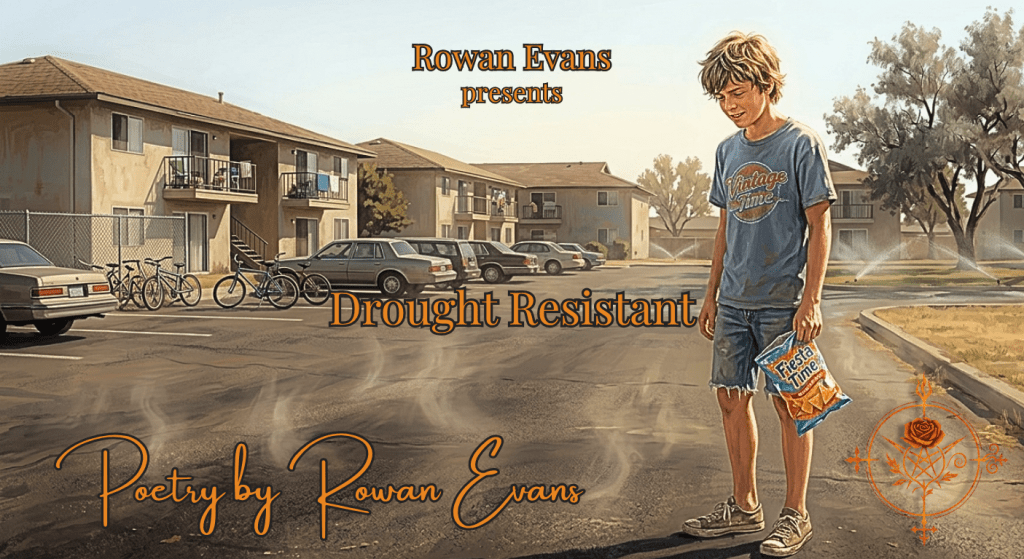
This piece started because of a single lyric in a song.
A line about EBT that made me laugh a little because my immediate reaction was: “Do you know who listens to your music? We know exactly what that means.”
And that memory spiral hit instantly.
This poem isn’t really about poverty in the dramatic sense. It’s about environmental memory. The small things that stay with you long after you leave certain stages of your life behind.
Dry ramen because there wasn’t money for extras. Hot concrete in triple-digit summers. Waiting for sprinklers to turn on just so the neighborhood kids could cool off. The strange rhythm of knowing exactly when EBT would hit every month because that date mattered.
I grew up in California’s Central Valley, and people who haven’t lived there sometimes underestimate how much the environment shapes you. The heat feels physical in memory. The dryness becomes part of your emotional vocabulary.
That’s where the title comes from.
“Drought resistant” isn’t just about the land. It’s about the people too.
And while this piece carries humor and regional slang intentionally, there’s something sincere underneath it: a complicated kind of affection for the place that raised me.
Not because it was easy. Not because it was glamorous.
But because it’s part of me anyway.
— Rowan Evans
The Central Valley teaches you how to survive long before you realize survival is what you’re learning.
Drought Resistant Poetry by Rowan Evans
I grew up poor-poor,
couldn’t even afford
water for my ramen.
Ate it dry—
standing on hot concrete
cooking my feet.
It was that
Central Valley heat—
Back when
kids were askin’—
is it our turn today,
to let the water spray?
We just wanted to be
kids in play—
Do you know
what it’s like
to ride a bike
through a
convection oven?
That was my
environment.
The Central Valley,
where even our
trees are hard—
drought resistant,
like we wish our
pockets are.
The 5th of every month
EBT hit—
no brand names,
couldn’t afford it.
We shopped for
Great Value—
Glacier Ranch
Tortilla Chips.
Go ahead
and diss me,
dismiss me.
But your diss is
Peter Pan,
it will Neverland.
California in my blood,
California in my DNA—
it’s hella tight,
it’s hella cool.
Yea’ dude.
Journey into the Hexverse…
[Escaped to the Page] “Escaped to the Page” is a confessional meta-poem about individuality, artistic identity, and surviving through writing. Blending sharp confidence with emotional vulnerability, the poem explores the difference between shared labels and lived experience—and the ways art becomes inseparable from the life behind it.
[Ink as a Second Mouth] “Ink as a Second Mouth” explores the distance between thought and speech, and the ways writing can become a form of survival, continuity, and self-translation. Through confessional imagery and reflections on growth, identity, and articulation, the poem examines what it means to keep becoming through language.
This piece was written while listening to “Role Model” by Eminem, and you can probably feel that influence in the posture of it.
There’s swagger here. Sharpness. A little confrontation.
But beneath that, this piece is really about the difference between shared labels and shared experience.
Two people can both call themselves poets and still arrive at the page from completely different places emotionally, stylistically, philosophically, and spiritually. The label itself doesn’t erase individuality. If anything, art becomes meaningful because of the differences in how we carry our histories into it.
That’s what this poem is wrestling with.
Not superiority. Specificity.
The truth is, I’ve spent more than two decades building my relationship with language. Not just learning how to write, but learning how to survive through writing. A lot of the imagery in this piece—cathedrals, altars, confession, Gothic romanticism—comes from the emotional architecture I’ve spent years constructing around my work.
Those images aren’t aesthetic decoration for me. They’re autobiographical.
When I say my environment “felt more like a cage,” I mean that literally in the emotional sense. Writing became escape, translation, preservation, and eventually identity. The page became the place where I could expand beyond the limits of the environments I grew up inside.
So while the voice in this poem is intentionally bold, the core of it is actually vulnerable: the fear of becoming interchangeable, the need to protect individuality, and the understanding that art is shaped as much by lived experience as talent itself.
Because someone can imitate style. They can imitate rhythm. They can imitate aesthetic.
But nobody else has lived your exact life.
And eventually, that truth always bleeds through the writing.
— Rowan Evans
Some people write because they want to. Some write because the page became the only place they could fully exist.
Escaped to the Page Poetry by Rowan Evans
You could be just like me,
you could write like me—
be full of empathy like me,
definition of compassion just like me.
You could be just like me—
but still you’d never be me.
You could build worlds
with words, just like me—
cathedrals and altars,
reverence and devotion, just like me—
You could imitate the shape—
but you’d never be the source.
Don’t even try, just stop.
You think we’re the same
because the labels we wear?
I’m a poet, you’re a poet too—
but that doesn’t make us a matching pair.
Twenty-three years,
I’ve been doing this—
metaphors like weapons,
meta-poetry, meta-lessons—
look at everything I’ve written.
Confessions penned
in Gothic lace,
Romanticized darkness
because that’s the only place
I feel at home.
My environment
felt more like a cage,
so I escaped to the page.
I wrote lines of longing,
looking for belonging—
because I’ve been knowing,
this isn’t the place I’d finish growing.
Journey into the Hexverse…
[Ink as a Second Mouth] “Ink as a Second Mouth” explores the distance between thought and speech, and the ways writing can become a form of survival, continuity, and self-translation. Through confessional imagery and reflections on growth, identity, and articulation, the poem examines what it means to keep becoming through language.
This piece comes from the space where speech and writing don’t quite align.
There has always been a kind of delay for me—between what I think, what I feel, and what I can actually say out loud. Spoken language has never felt like the most reliable place for truth to land. It slips. It fractures. It gets filtered through hesitation, timing, or silence.
Writing became something different.
Not a replacement for speech, but a translation of it.
A second mouth.
One that doesn’t hesitate in the same way.
One that doesn’t need to arrive perfectly formed in real time.
Over time, I’ve come to understand my writing less as expression and more as continuity—a way of carrying versions of myself forward that might otherwise get lost between changes, growth, or silence. When I talk about shedding “lives like shells,” it isn’t about abandoning who I was, but making space for who I’m becoming.
Writing is where those versions remain visible.
Where they don’t disappear just because I’ve outgrown them.
In that sense, this isn’t just about communication—it’s about survival through articulation. Not in the dramatic sense, but in the quiet one: staying connected to myself through language when voice doesn’t fully bridge the gap.
And if spoken language is the place where I sometimes fall short of myself, then writing is where I learn how to keep translating who I am anyway.
— Rowan Evans
If spoken language is where I fall short of myself, then writing is how I keep translating who I am anyway.
Ink as a Second Mouth Poetry by Rowan Evans
There is a delay
between my mind
and my mouth
when I speak—
that’s why I find
it easier to talk in ink.
I turned my pen
into my mouth,
so when I write
it’s the only time—
the truth spills through.
When I open my mouth,
my words won’t come out—
but in ink, they run
like the secrets slip
from loose lips.
I could write poem after poem,
leaving piece after piece of me behind—
scattered across the pages,
like versions of me scattered
across different lives.
But do not mourn
for what I’ve lost,
because it’s simply the cost
of me being me.
I shed past lives,
it leaves room for me to grow—
just a hermit crab
in human form.
And I’ll continue
to shed lives like shells until
I find the version of myself—
that can speak
in more than ink.
Until then I’ll continue to try,
because growth comes slow.
It’s gradual, it never comes clear.
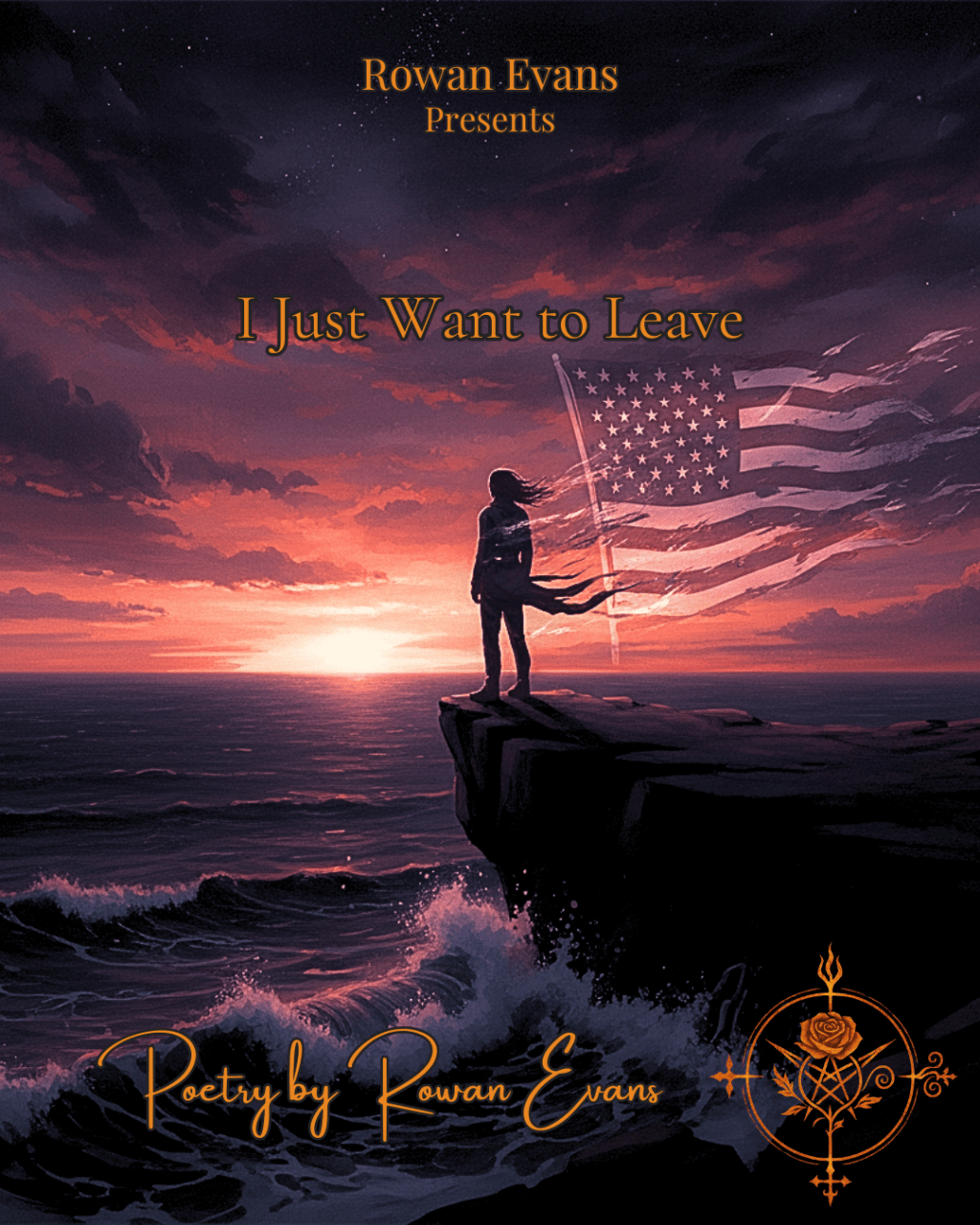
I Just Want to Leave captures the restless, exilic energy that often pulses beneath my poetry. It is a declaration of detachment from a place that feels stifling, a yearning for freedom, and the fierce self-awareness that comes from knowing your worth and choosing to protect it. This piece resonates with anyone who has ever felt too much, too intense, or simply out of place—and serves as a reminder that leaving sometimes isn’t running away, it’s reclaiming yourself.
“I Just Want to Leave” – A neo-gothic confessional poem by Rowan Evans about yearning, exile, and reclaiming oneself.
I Just Want to Leave Poetry by Rowan Evans
They say— “You need to put yourself out there,” but I put myself out there, and nobody seems to connect with me. That’s fine—really though— ‘cause I don’t like Americans, I just want to leave.
You’re proud to be an American? Well, not me.
“If you don’t like it here, just leave.”
Did you not hear what I just said? That’s exactly what I’m tryin’ to do. If I could, I’d be gone tomorrow, boo. Yeah, I’d pull a Danny Phantom— going ghost.
I’d take a plane, or stowaway to escape. I’d cross oceans— hell, I’d swim if I had to.
They say, “be proud,” but pride tastes like poison here. I’ve got no flag, pledge no allegiance. All I’ve got— is an open wound that wants to heal… somewhere else.
It’d be— goodbye forever, and I’m never coming back.
If you just want to read more of my work, you can find it all here:[The Library of Ashes]
I’m just… sitting here trying to figure out how to put all of this into words. These poems—they’re not tidy. They’re not meant to be. They are me trying to talk to myself, to the child I was, to the person I am now, to anyone who might understand.
I’ve been writing for over twenty-two years. Twenty-two. I started when I was thirteen, barely a kid. By fourteen, I was deep into Japanese music, culture, media… then Korean, then Chinese. I lived a Japanese life in America. Movies, music, shows, rituals I made in my head—I was building a world where I felt like I belonged, even if the world around me didn’t make sense.
I was also depressed. Anxious. I felt different from everyone else, but nobody really said why. Autism wasn’t mentioned. I didn’t have the language for it. Gender identity—same thing. I didn’t feel the things “I was supposed to” as a boy. I felt disconnected. I felt unseen. I felt untethered. I still sometimes do.
I asked my parents, over and over: where are we from? Beyond the U.S., what’s our heritage? They said we were mutts. And yeah, I get it. But it left me with this gnawing emptiness—a gap I couldn’t fill. I tried to make sense of it all, but there wasn’t a clear answer.
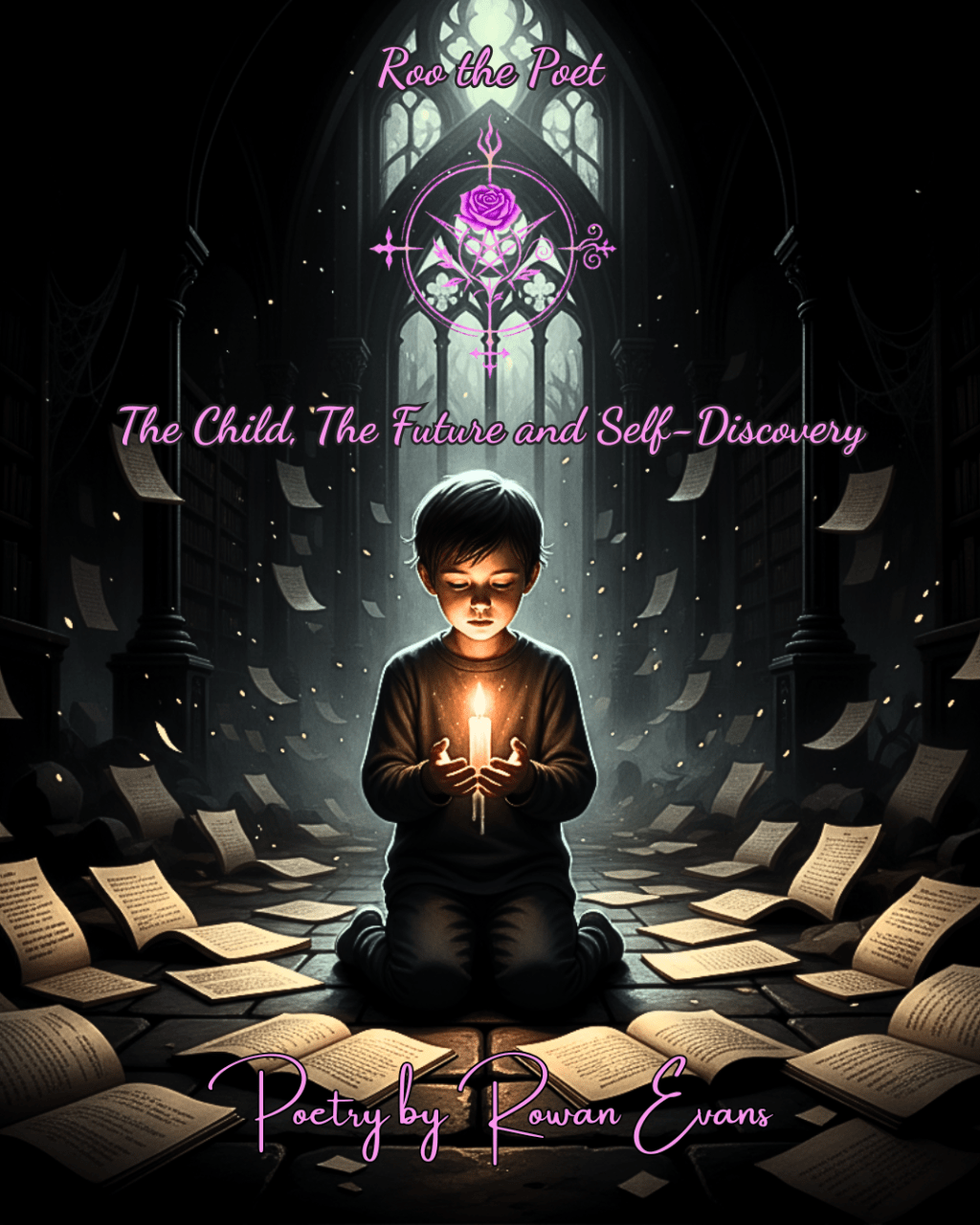
These poems are me talking to that inner child. Roo the Poet is that child’s voice—the part of me that’s been scared, lonely, unheard, and also resilient. They are a dialogue, a witness, a reminder that even when life is overwhelming, even when the world is messy and cruel, I—we—can keep moving, keep dreaming, keep reaching for light, even when it seems impossible.
They are raw. They are messy. They carry grief, rage, confusion, hope, and the quiet fire of persistence. I’m putting them here because I need them to exist. Because I need to say: it’s okay to feel all of it. It’s okay to be broken. It’s okay to question, to rage, to cry, to laugh, to search, to not have the answers.
I hope anyone reading this feels some part of it too. The fear, the hurt, the wonder, the resilience. The poems are my way of saying: you are not alone. The child inside you is still here. The voice that whispers your truths is still here. And maybe, just maybe, we can keep walking forward together.
— Rowan Evans
The Child & The Future Poetry by Roo the Poet featuring Rowan Evans
[Roo the Poet] Tell me, have we made it? Did our dreams take flight? Do our words now dance on pages, Spilling truth in black and white?
I held the light so tightly, Afraid it’d slip away, But I kept it burning, flickering, To guide us through the grey.
[Rowan] We’re not there yet, but we’re close, Closer than we’ve ever been. And Roo, it wouldn’t be possible Without the fire you lit within.
You taught me to hold on, Even when the night grew cold. That light always casts a shadow, But both are stories to be told.
[Roo the Poet] Do we still dream in color, Like we did when we were small? Do we still believe in magic, In the rise after the fall?
Do we still whisper wishes, To the stars beyond the pane? Do we still chase the echoes, Of our past, through joy and pain?
[Rowan] We dream, Roo, oh, we dream, But now with eyes wide open. We shape the stories with steady hands, No longer lost, no longer broken.
The magic never left us, It just grew in different ways— In the strength of ink and paper, In the fire that never fades.
[Roo the Poet] Then I have no fears, no sorrow, For the path we’ve yet to tread. Because you still carry the child I was, Even as you forge ahead.
So promise me, no matter what, That light will always stay? That the shadow won’t consume us, That we won’t be led astray?
[Rowan] I promise, Roo, I swear it true, The light will always shine. Because you’re the voice that kept me strong, The heart that still beats inside mine.
So walk with me—hand in hand, Through darkness, through the dawn. For every dream we’ve yet to chase, Together, we’ll carry on.
Lost in the Why Poetry by Roo the Poet
I don’t understand why the sun feels colder, Why laughter sounds distant, like echoes in stone. They say time will heal, that pain makes us older, But I still feel small, lost and alone.
The world keeps moving, but I stand still, Feet stuck in puddles that no one else sees. I try to be strong, to bend to their will, But inside, I’m just whispering, “Please.”
Please tell me why the stars seem dimmer, Why warmth feels like a memory’s trace. Why grown-ups cry with voices that quiver, Yet smile like grief doesn’t leave stains on their face.
I reach for the hands that once held me tight, But fingers slip through, like sand in the breeze. Was I meant to lose before knowing the light? To learn that love sometimes leaves?
I hide my heart in paper-thin walls, Shielding the child I used to be. But each crack whispers, each shadow calls, That pain is the price of growing free.
I don’t understand why the sun feels colder, But I’ll carry its warmth in the way that I shine. Even if grief makes my shoulders older, I’ll still hold space for the child inside.
The Past & The Present Poetry byRoo the Poetfeaturing Rowan Evans
[Roo the Poet] Are you tired, Rowan? I see your tears, your sad eyes, but you’re still standing— a little wobbly, but you’re still standing, like a toy with no batteries, but you keep going, don’t you?
[Rowan] It’s hard, Roo. I feel like the wind keeps pushing me, and I just… bend. How do I keep going when I don’t know where I’m going?
[Roo the Poet] But you are going, right? Like a tree with roots way deep in the ground— You bend, but you don’t break. The wind can blow and blow, but you stand up, because you’re strong inside. I know you are.
[Rowan] I don’t always feel strong. I feel like I’m falling apart sometimes, like the world is too big, and I’m just too small to do anything.
[Roo the Poet] You’re not too small! You’re big and strong like the moon, even when it hides behind the clouds. It’s still there, shining real bright, even if we can’t see it. I’m like that too. I’m always here, like the moon.
[Rowan] But what if I can’t find my way back to the light? What if the pieces of me just don’t fit anymore?
[Roo the Poet] Then we make new pieces! We glue ‘em together, make a brand new picture! It’s okay to be a little broken. Everyone’s a little broken sometimes. But that doesn’t mean you’re not special.
[Rowan] I don’t know if I can be fixed, Roo. I’m too tired.
[Roo the Poet] But you CAN be fixed, Rowan! You just gotta be patient. It takes time, like putting together a puzzle. And sometimes, you have to wait for the pieces to find their place. But that’s okay— you’ll figure it out. I know you will.
[Rowan] And what about you? You always know what to say. How are you so sure that everything will be okay?
[Roo the Poet] Because I trust you, silly! You’re like a little seed that will grow into the biggest flower, even when it’s all dark and hard. I know you can do it, Rowan. You’ll bloom, I promise.
[Rowan] I don’t feel like blooming yet. I just feel stuck, like I’m caught in the mud.
[Roo the Poet] You’re not stuck! You’re just waiting, like a flower needs the rain. The sun will come, I KNOW it will. And then you’ll be all bright and pretty.
[Rowan] But what if I miss the sun? What if it doesn’t come for me?
[Roo the Poet] Then we’ll make our own sun! We can draw it, paint it, make it real big! We don’t have to wait, Rowan. We can shine all by ourselves.
[Rowan] I didn’t think I could do it alone, but you… you make me feel like I can try.
[Roo the Poet] You don’t have to do it alone. I’m right here. I’ll help you, always. I’ll be your sunshine when it’s dark.
[Rowan] Thank you for still fighting for me. Thank you for never giving up on me.
[Roo the Poet] I won’t ever give up on you, Rowan. You’re my best friend. And I’ll always be here. You’re stronger than you know. And you’re never, ever alone.
[Rowan] I think I can start believing that. I think… I think I’ll be okay.
For those who feel these questions, this fire, and this search for self, my poem ‘I Am’ continues the journey—raw, unbound, and unafraid.