Author’s Note
Love has always felt heavy to me.
Not in a bad way— just in a real way.
I don’t connect lightly, and I don’t fall into feelings easily. So when I do care about someone deeply, it feels enormous. Like something inside me permanently shifts shape around them.
That can be beautiful.
It can also be terrifying.
This piece came from realizing that vulnerability isn’t just saying “I love you.” Sometimes vulnerability is choosing to stay present after you realize someone has the power to hurt you.
Not because they want to.
Just because love makes that possible.
But I think there’s something important about choosing connection anyway.
Not idealizing someone. Not expecting perfection. Not asking them to heal you.
Just deciding that the fear of losing connection shouldn’t matter more than the connection itself.
There’s also a quiet promise buried in this piece.
A promise to stop drifting when things become emotionally overwhelming. A promise to stay long enough to witness someone fully. To see them in daylight, not just darkness.
Sometimes love isn’t rescue.
Sometimes it’s simply saying:
“I’m here. And I’ll still be here when the sun comes up.”
— Rowan Evans
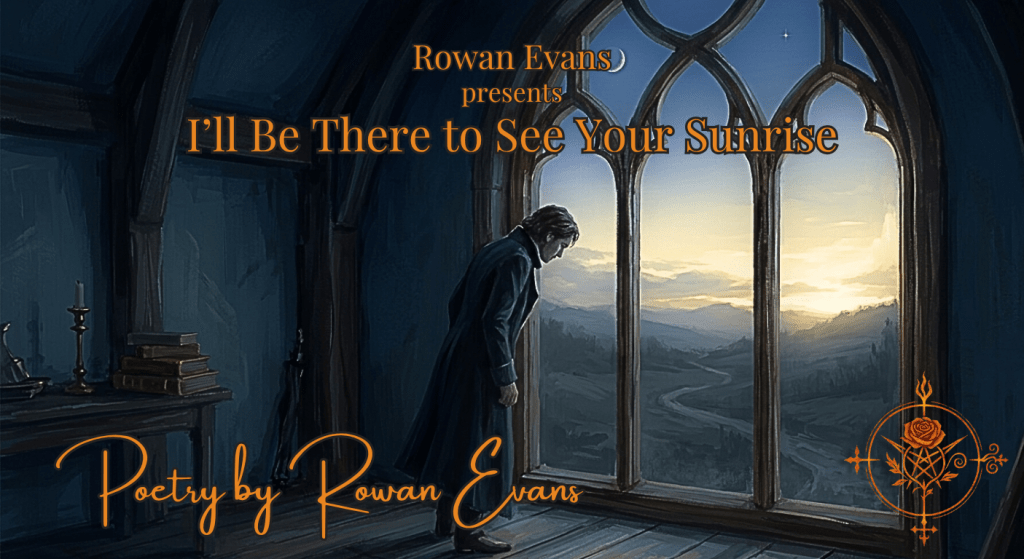
I’ll Be There to See Your Sunrise
Poetry by Rowan Evans
Dim the lights
and close the blinds—
I’m going to be
honest for a minute,
I don’t love easily.
It’s not that I’m afraid.
I’m not scared to love.
It just doesn’t come
without fees for me,
it costs me something
every time—I leave a piece
of my heart behind.
But the truth is—
I never really felt love like that,
everything was just a crush
until you, that is.
You—
who resides in my thoughts now,
who changed the way
I see myself somehow.
And the truth is—
you didn’t do a thing, not really,
you just made it safe
to be honest.
And I’ll be honest—
I check your skies,
before my own.
The only thing that scares me
is how much I care,
that you can hurt me—
and I’m hyperaware.
But that’s not fair to you,
to brace for ache
when you carry your own pain—
so even if I’m scared,
I’ve got to face my fears.
I’ve got to stay—
I can’t let myself drift away.
And I remember—
you said I met you mid night,
and the hope I’d see you
in day light’s shine.
This is my promise
to be there,
to witness it—
I promise.
I’ll be there
to see your sunrise.
Journey into the Hexverse...
[Before We Created the Labels]
Ancient gods return to a fractured world shaped by borders, identities, and separation. “Before We Created the Labels” explores humanity’s divisions through mythic imagery, sacred ritual, and symbolic collapse—asking what remains when we learn to see one another beyond labels.
[The Unkindness Descends]
“The Unkindness Descends” is a Gothic symbolic poem exploring collapse, transformation, and the unsettling experience of being witnessed during moments of unraveling. Through raven imagery, ambiguity, and ritualistic atmosphere, the poem invites multiple interpretations—spiritual, psychological, ominous, or transformative.
[I Write Cathedrals]
“I Write Cathedrals” explores faith, doubt, belonging, and the search for meaning beyond certainty. Through Gothic spiritual imagery and confessional reflection, the poem examines how writing can become a sacred space for questioning, wonder, and the people who feel displaced by traditional structures of belief.
[Drought Resistant]
“Drought Resistant” is a confessional poem about growing up poor in California’s Central Valley—where triple-digit heat, EBT cycles, dry ramen, and hard landscapes become part of emotional memory. Blending humor, slang, and working-class reflection, the poem explores survival, regional identity, and complicated love for the place that shaped you.
[Escaped to the Page]
“Escaped to the Page” is a confessional meta-poem about individuality, artistic identity, and surviving through writing. Blending sharp confidence with emotional vulnerability, the poem explores the difference between shared labels and lived experience—and the ways art becomes inseparable from the life behind it.
[Ink as a Second Mouth]
“Ink as a Second Mouth” explores the distance between thought and speech, and the ways writing can become a form of survival, continuity, and self-translation. Through confessional imagery and reflections on growth, identity, and articulation, the poem examines what it means to keep becoming through language.
If you’re interested in more poetry, you can find it here → [The Library of Ashes]

