We often say someone is “living rent-free in our head,” but what if they weren’t renting?
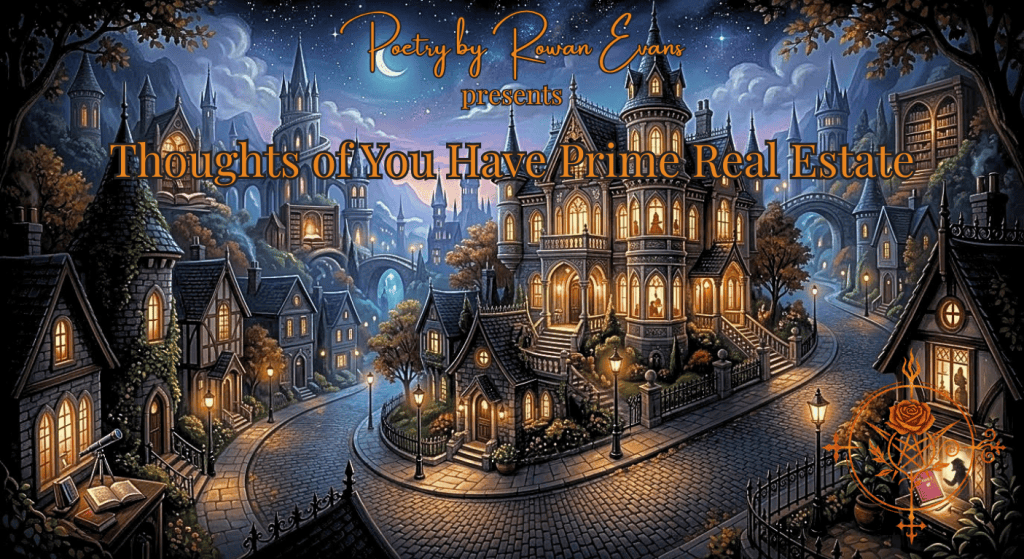
Thoughts of You Have Prime Real Estate takes that familiar expression and builds an entire neighborhood inside the mind—roads, sidewalks, corner lots, contemporary homes, secrets, dreams, and eventually one particularly valuable property.
Because thoughts don’t always feel temporary. Sometimes they settle in, expand, renovate, and quietly become part of the landscape.
And apparently, the thoughts of you got the best view.
— Rowan Evans
Some thoughts rent a room. Yours apparently bought the whole corner lot.
Thoughts of You Have Prime Real Estate Poetry by Rowan Evans
They say, when something is stuck in your thoughts— it lives rent free in your head, and that’s true in a sense— because the thoughts have taken up real estate, they own land— building new developments. New neighborhoods are being constructed, new roads are being laid— new sidewalks paved.
Take a walk down the block, you’ll see thoughts taking up corner lots—
modern contemporary homes lining the streets— full of my secrets to keep, and rooms where my dreams sleep.
But the nicest home of all— the one with the best views, and the biggest rooms…
it houses my thoughts of you.
Journey into the Hexverse
[Half a Picture] What happens when someone falls in love with the person they discover through your poetry? Half a Picture explores the strange intimacy between writer and reader—and the distance between seeing someone’s mind through their words and truly knowing the whole person.
[Love Me From Over There] A sharp and humorous poem about the strange contradiction of wanting someone close while simultaneously needing them to stay several feet away from your face.
[It Could Have Been…] A playful little love poem about strawberries, roses, and the wonderfully ridiculous ways romance can show up when you know someone doesn’t like the traditional version.
[High Tide] A short reflective poem about leaving, returning, and accepting the forces that pull us back—like the tide guided by the moon.
Sometimes it’s strawberries, questionable scientific reasoning, and the absolute confidence to say, “Deal with it.”
This piece is a little love poem for the people who show affection in their own weird, imperfect, slightly ridiculous way.
— Rowan Evans
When roses won’t do, bring strawberries. Romance is all about knowing what they like.
It Could Have Been… Poetry by Rowan Evans
I know you don’t like roses— so I brought you a bouquet of strawberries— they’re the same thing, scientifically— maybe not exactly, but they come from the same family—
it’s still romantic. Deal with it.
Oh, and hey— it could have been apples.
It could have been…
Peaches, Pears, Raspberries, Cherries…
heck…
a bag of almonds…
but I gave the one that still feels—
like romance.
Journey into the Hexverse
[Welcome to the Hexverse] Step into the Hexverse—a poetic world where mythmaking, humor, rage, creativity, and confession collide, and darkness becomes something that can be reshaped into art.
There are some places that become more than places.
An ocean can be a physical distance, a horizon, a body of water stretching farther than the eye can follow. But sometimes it becomes something else entirely—a canvas, a metaphor, a meeting place between two people who happen to be standing on opposite sides of the world.
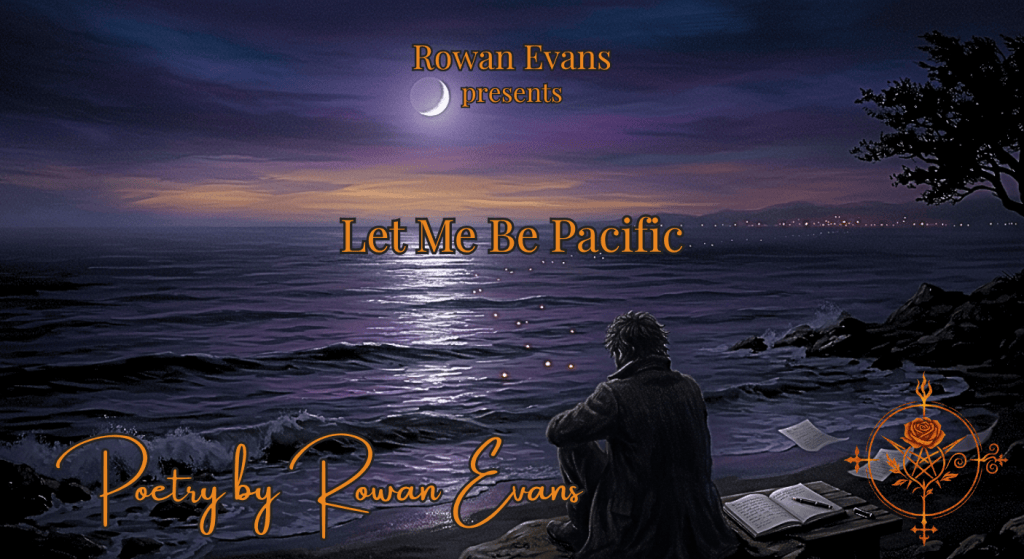
Let Me Be Pacific began with a simple invitation: let me show you the ocean the way I see it.
From there, the words wandered where they wanted to go.
Purple skies. Silver moons. Dark water. Rhymes. Trees. Wordplay.
And eventually, the Pacific became more than scenery.
It became the space between here and there—and the reminder that something can cross an enormous distance without ever needing to disappear.
So, for a moment, come sit beside me on the shoreline.
Let me paint you a picture.
— Rowan Evans
The Pacific may separate two shores, but poetry has never been particularly good at respecting distance.
Let Me Be Pacific Poetry by Rowan Evans
Here let me take my words
and paint a picture for you—
the sky in shades of purple and blue,
lit by the silver moon—
it lingers over the bay,
that’s where it stays—
watching over the tide,
and I sit on the shoreline—
watching the ocean’s waves.
Which ocean? Okay,
here let me try and spell it out,
let me be Pacific—
it’s off the California coast,
it touches the Philippine Sea,
sits between Japan and Me.
Now back to the imagery—
there was me, next to a happy little tree,
and the moon was shimmering,
trembling across dark water—
back on the shoreline,
having written more lines,
not less, but more rhymes.
So let me stay Pacific—
specific in the way I see the sea,
how every wave feels like a message
sent across the world to me.
I sit, I rhyme, I watch the tide—
the ocean’s big, but so’s my mind.
And if you ask me why I write
beside this ocean every night—
it’s because the tide keeps teaching me
how distance isn’t always far,
how even the Pacific can carry a heart
from California to wherever you are.
Journey into the Hexverse…
[My Nightmare] A poem about the nightmare of loving someone across distance, seeing the world from different perspectives, and holding onto the hope that the cracks can still be repaired—and that someday two separate shores might become one.
[Rose & Ruin] Two minimalist poems exploring the opposing forces within creativity: the thoughts we cultivate into something beautiful and the darker thoughts we transform before they have a chance to decay.
[Across the Page-cific] A playful, autobiographical journey through the strange places poetry can take me—from sandwich heartbreak and pasta diss poems to gothic monsters, mythology, ravens, ghosts, and storms across the page. Beneath the absurdity is something deeply personal: the realization that writing gave me a way to rebuild myself, piece by piece.
Sometimes the nightmare is waking up and realizing that the person you want beside you is standing beneath a completely different sky.
My Nightmare comes from that place—the uneasy space between memory and hope, between what once felt shared and what now feels impossibly far away. It is a poem about distance, but not only the physical kind. There is distance between perspectives, between hearts, between the lives we imagine and the lives we are actually living.
Still, even nightmares have endings.
Sometimes you wake up before they become permanent.
And sometimes, even while dreaming, you can still see a little gold threaded through the cracks.
— Rowan Evans
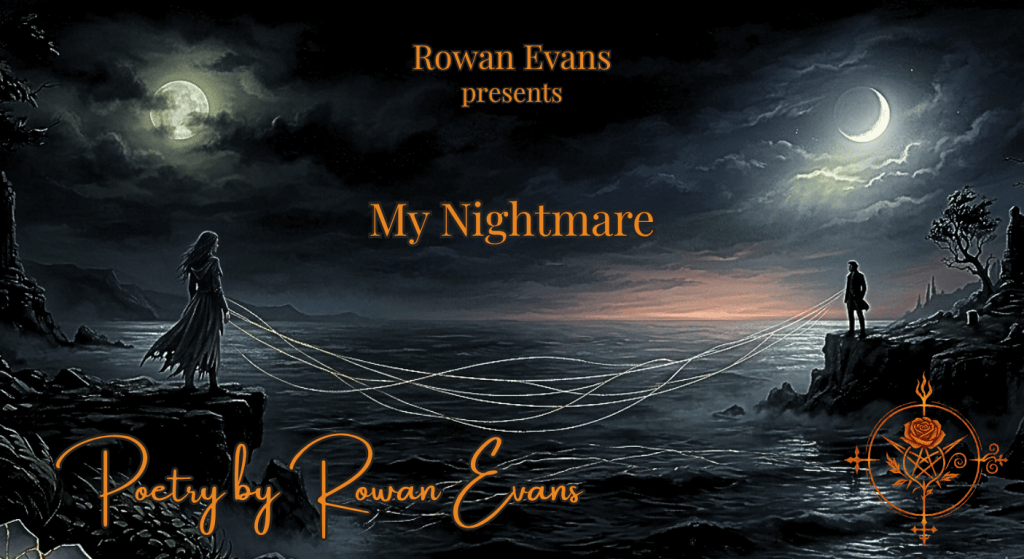
Two shores. Two skies. One horizon—and enough gold left to believe they might meet there.
My Nightmare Poetry by Rowan Evans
This is my nightmare.
You and I across the distance,
the view that we see is different—
your moon from my sky
is missing—
the sun no longer shines,
it’s dimming—
I don’t see the spark anymore—
don’t see the light in the dark anymore.
What do I even I write for?
I lost my purpose—think I did it on purpose,
it’s like I can’t rhyme anymore,
no clock, no watch, can’t tell time anymore.
This is my nightmare.
You and I across the distance,
the view that we see is different—
my moon is sickly pale,
but yours seems fine though—
the sun doesn’t provide light,
it’s gotten real low—
in times before, this is when
I would Kintsugi the heart—
but there’s not much heart left,
it’s all gold—soft metal,
softer soul—stayed warm,
when the world grew cold.
This is my nightmare.
You and I across the distance,
the view that we see is different—
when we used to be,
two pieces the puzzle
was missing—
the sun in the sky was fine,
but it dimmed in our shine—
I’ve spent time doing Kintsugi
on your heart too—it was hard not to,
gold and platinum weaved through—
I really did see you, flaws and all—
and all I saw was a gift from God.
I still don’t think—
I was wrong.
But that was my nightmare…
You and I across the distance,
the view that we saw was different—
but I still see the gold threads that connect,
the platinum hope on the horizon,
that one day the distance will close—
and we’ll walk the same shore,
it won’t be—
mine and yours.
Journey into the Hexverse…
[Dreaming Wrong] A familiar dream becomes unsettling when the ocean becomes a pond, the tide disappears, the moon loses its reflection, and nothing feels quite like it belongs. Dreaming Wrong explores the uncanny feeling of finding yourself inside a dream that looks familiar—but feels like someone else’s.
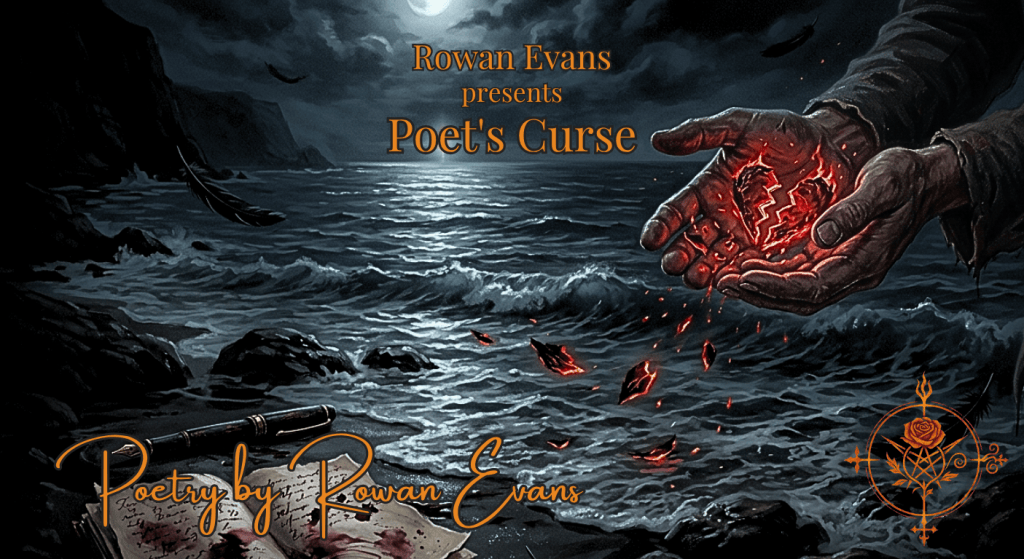
[Poet’s Curse] Poet’s Curse explores the painful side of falling too deeply: giving pieces of yourself away freely, taking accountability for your own heartbreak, and realizing that learning to let go can be harder than learning to love.
[Beach to Beach] A dream becomes a journey between familiar shores and unfamiliar cities in Beach to Beach (How I Get There), a poem about imagined travel, ocean crossings, longing, and the places we hope to someday reach while awake.
[Where the Metaphors Lead] Some truths are easier to write than they are to say aloud. “Where the Metaphors Lead” explores the quiet space between dreams, confession, and the courage it takes to let another person know how deeply they’ve become woven into your inner world.
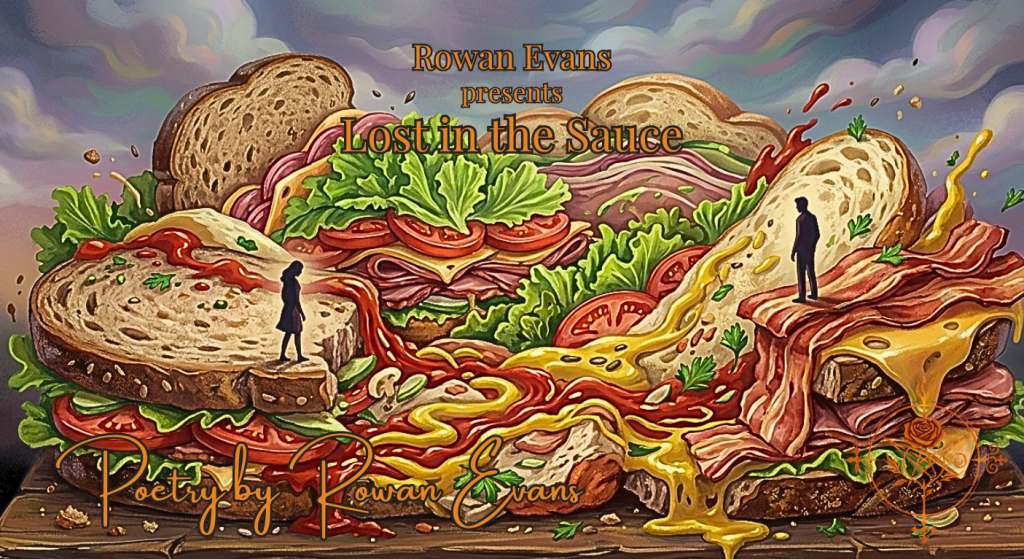
And sometimes my brain apparently looks at a sandwich and says, yes, this is how we’re processing emotional confusion today.
Lost in the Sauce is a deliberately playful poem built around food-related wordplay, particularly the language of sandwiches, condiments, bread, and the wonderfully terrible possibilities hidden inside them.
The jokes are intentionally stupid.
That is part of the point.
“Bread” becomes “rye.” “Ketchup” becomes “catch up.” “Mustard” becomes “must’ve.” “Sourdough” becomes an emotional description. Even “lettuce meat in the middle” is doing multiple jobs at once.
But beneath all of that nonsense is something much more familiar: the confusion of being told that everything is okay while someone’s behavior feels completely different.
The speaker is trying to understand the contradiction.
They were told the relationship was fine.
They were told the other person was happy.
So why does everything suddenly feel cold?
Why does affection feel sour?
Why does the speaker feel trapped in place, struggling to catch up to something they don’t fully understand?
The ridiculous wordplay gives me permission to approach that emotional confusion without making the poem overly solemn.
I’ve been rediscovering how much I enjoy treating language like a playground—taking ordinary words, twisting them until they become something else, and seeing how far I can push a joke before the emotional meaning underneath it starts showing through.
So yes, this poem is about sandwiches.
Sort of.
Mostly, it’s about being lost in the sauce when the person you’re trying to understand has already changed the recipe.
— Rowan Evans
Sometimes you don’t fall apart. Sometimes you just get lost in the sauce. 🥪
Lost in the Sauce Poetry by Rowan Evans
You sandwiched me in
with an all-tomato—
love you or leave,
but I couldn’t do it clean—
I was lost in the sauce,
begging lettuce
meat in the middle.
You said, “you lie.”
I said, “Nah, you rye.”
But do you know why?
I was stuck in place,
you wouldn’t wait—
I was struggling
to ketchup.
I thought you
mustard—
how could you not?
People talk.
Look—
I’m sorry.
I don’t want to fight.
But, you said—
you were happy.
We were okay.
So why you so cold,
why you actin’ sourdough?
Journey into the Hexverse…
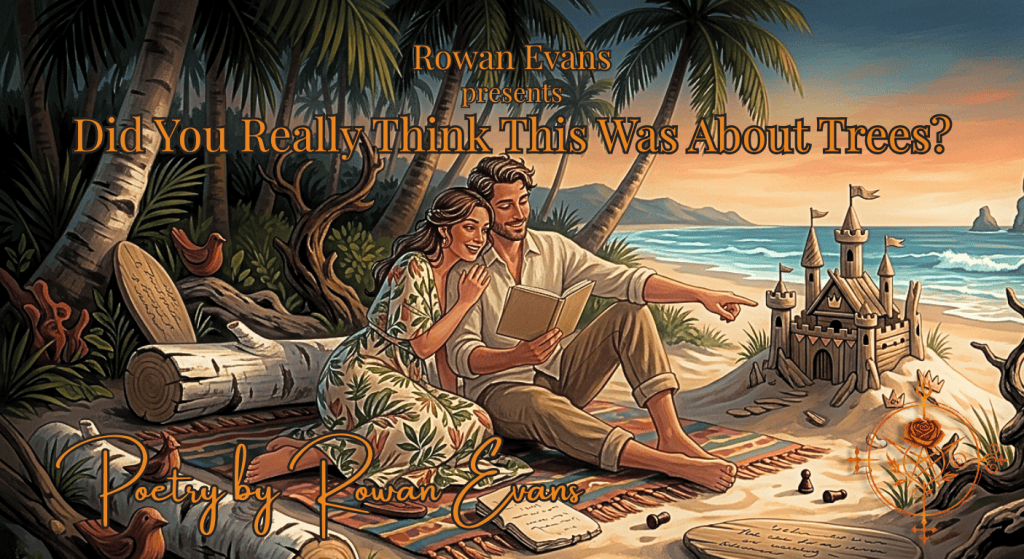
[Did You Really Think This Was About Trees?] A playful love poem disguised as a forest of terrible tree puns. Beneath the birch, oak, cedar, palms, lumber, and absurdist wordplay is a poem about devotion, loyalty, laughter, and building a life with someone you love.
[Blended Hardware] A playful, absurdist poem where step-ladders, garden hoses, Star Wars, teenage memories, Gothic imagery, and the poet’s own self-interrupting commentary collide. Blended Hardware is a celebration of letting language wander.
Every now and then, affection shows up wearing bark and leaves. Today was one of those days.
Did you really think this was about trees? 🌳
Did You Really Think This Was About Trees? Poetry by Rowan Evans
Birch, I’m in a mood—
but I’m feelin’ pretty Oak today,
oops, I mean, a-o-k—
especially with my Rose Wood beside me,
open my eyes, so I could Cedar—
her fingers in my hair,
like the breeze through the leaves.
Did you really think
this was about trees?
It’s just me and her
by the summer seas,
just us with Palms in the sand—
castle and a plot of land,
where she is royalty—
a Queendom built
off the back of loyalty.
And that’s something I don’t lack,
I got it in stacks—packed to the rafters,
stick with me and you’ll have a life full of laughter—
you’ll never get board like a lumberyard,
and I work hard—
to prove my words have meaning,
even when they are weird
or absurdist leaning.
Author’s Note
Sometimes I write a poem because I have something profound to say.
Sometimes I write one because my brain looked at a bunch of tree names and apparently decided they needed to become flirting material.
This is the latter.
Did You Really Think This Was About Trees? is a deliberately ridiculous little love poem built almost entirely around wordplay. Birch, oak, rosewood, cedar, palms, lumberyards, boards—I’m taking language that belongs to the world of trees and woodworking and forcing it into a completely different emotional landscape.
And yes, the title is absolutely part of the joke.
The poem starts by making the reader think they’re about to get some sort of nature poem. Then I reveal that the trees were never really the subject.
The subject was her.
The forest is just the camouflage.
I also wanted the poem to feel conversational and slightly chaotic. The little correction from “Oak” to “a-o-k,” the exaggerated promises, the lumberyard imagery, and the final admission that the whole thing is leaning toward absurdism are all intentional.
There is something freeing about allowing a love poem to be stupidly playful.
Not every expression of affection needs to be solemn.
Sometimes love looks like poetry.
Sometimes it looks like devotion.
And sometimes it looks like spending an entire poem making increasingly terrible tree puns because you love someone enough to make yourself laugh while writing about them.
Honestly, I’ll take all three.
— Rowan Evans
Journey into the Hexverse…
[Blended Hardware] A playful, absurdist poem where step-ladders, garden hoses, Star Wars, teenage memories, Gothic imagery, and the poet’s own self-interrupting commentary collide. Blended Hardware is a celebration of letting language wander.
There is a particular kind of heartbreak that doesn’t have a villain.
Sometimes nobody betrayed you.
Nobody lied.
Nobody promised you something they couldn’t give.
Sometimes someone simply exists, speaks to you, makes you feel something—and your heart decides to build an entire mythology around it.
That is where Poet’s Curse came from.
I’ve joked before about having a poet’s curse: the tendency to fall into feelings quickly, to hear a little beauty in someone’s voice and suddenly find myself wading into the waves after it. But beneath the joke is something I’ve had to become more honest about.
Sometimes my heartbreak is partly mine.
Not because I was wrong to feel what I felt, but because I have a habit of giving pieces of myself away before I’ve figured out whether there is somewhere safe for them to land.
The person in this poem didn’t necessarily do anything wrong. She didn’t promise me forever. She didn’t lead me somewhere just to abandon me. She talked—and I listened. I heard a siren’s song, and I chose to wade into the water.
So this isn’t a poem about blaming her.
It’s about looking at myself afterward and admitting something uncomfortable:
I learned how to hold on long before I learned how to let go.
And maybe that’s the real curse.
Not that I love too deeply.
Not that I feel too much.
But that once I give someone a piece of my heart, I don’t always know how to take my hands away from the fire.
Sometimes the only way forward is to stop calling that weakness a curse and start learning the skill I never had—
how to let go without becoming less capable of love.
— Rowan Evans
Sometimes the hardest thing to learn isn’t how to love—it’s how to let go of what you’ve already given away.
Poet’s Curse Poetry by Rowan Evans
Here we go again
it’s another season of sin,
the poet’s back
heartbroken with a pen.
Yeah, went and fuckin’
did it again—
it’s my fault
my heart is cracked,
with pieces missing.
You see, I give them away
too freely, it’s such a pain
to be me, I get hooked
too easily—
she did nothing wrong,
she didn’t lead me on, just talked
and I heard a siren’s song—
I waded into the waves,
prayed for things to change.
Pardon the moment of slowness,
give me a moment while I own this
and take accountability for my part
in breaking my heart.
It’s a poet’s curse—
I only learned how to hold on.
I never learned how to let go,
my feelings and emotion
like hot coals in my hands.
Journey into the Hexverse…
[When I Fall] When I Fall is a vulnerable poem about loving without reservation, feeling everything deeply, and refusing to make the heart smaller just because wholehearted love can sometimes lead to loneliness and pain.
Others simply place you beside someone and let the world unfold around you.
This poem came from one of those dreams.
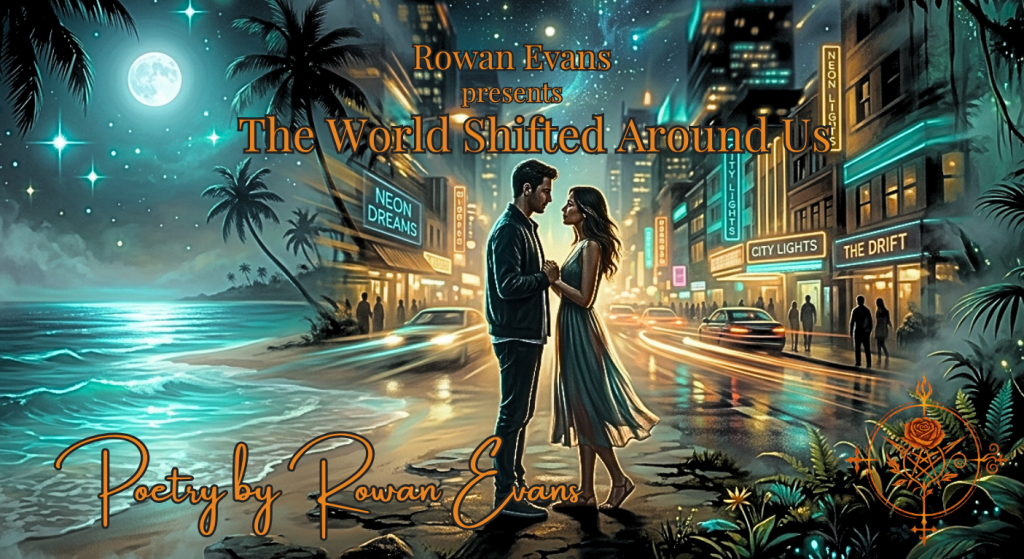
What fascinated me wasn’t that the scenery kept changing—from beaches, to city streets, to a dense jungle—but that neither of us moved. We stayed exactly where we were while everything else transformed around us.
That became the emotional center of the poem.
Sometimes the people who matter most become the fixed point in our lives. Circumstances change. Places change. Time changes. But certain connections remain steady enough that everything else feels like it’s revolving around them.
I also wanted to explore the idea that silence isn’t empty.
Some of the most meaningful moments I’ve experienced—whether in dreams or in waking life—have involved very few words. A glance, a smile, the way someone looks at you for a single second can communicate more than entire conversations.
By the end of the poem, the world stops changing altogether.
The dream begins to dissolve, but one thing refuses to disappear.
Not the beach.
Not the city.
Not the jungle.
Just her face.
Sometimes that’s what we carry back into waking life: not the dream itself, but the feeling that remained after everything else faded.
— Rowan Evans
Some people become the constant while the rest of the world keeps changing. Dreams simply make that truth visible.
The World Shifted Around Us Poetry by Rowan Evans
I laid down in need of rest, it was just a nap, that’s all it was— but as soon as I closed my eyes, I saw your face—your voice broke the silence. Then the void around us shifted, it became a beach and then city streets.
We never changed positions— the world changed around us.
We didn’t drift, didn’t sway— we just stood and stayed, but the world continued to change. First the beach, then city streets— before finally shifting into trees as far as the eye could see.
The jungle was thick with trees, but not as thick as the humidity.
With every shift, my vision blurs— except the vision of her. As the world becomes hard to see, she remains steady.
And her face carries a thousand words, even when her voice goes unused.
We didn’t speak, we didn’t need to— even as the world continued to shift. From the beach to city streets, then the jungle deep— the next place was somewhere simpler.
Somewhere that felt more like peace, an escape from the heat and humidity.
Still not a word was spoken— but you gave a look, quick and simple, but it said so much. Because the truth is you didn’t need words to tease.
The world around us softened— colors thinning, edges fading, but you stayed clear a moment longer, steady in the quiet.
The moment settled into something calm— the air cooling, the silence warm, your eyes holding mine with that same quiet tease—
in the end, the world stopped shifting— no beach, no streets, no jungle heat.
And the last thing to fade was your face— the world dimming around it like a curtain drawing closed. Even as the dream thinned to nothing, your look stayed bright behind my eyelids, a quiet afterglow that followed me into the stillness of waking.
Journey into the Hexverse…
[Every Night, The Same Flight] Every night begins with the same flight. Between wakefulness and sleep, an airport appears, a familiar shoreline waits beyond the journey, and the same dream asks whether some destinations find us before we’re ready to find them.
[Where I Belonged] A bedroom becomes an airport in the space between sleep and waking. Where I Belonged explores liminal consciousness, uncertainty, and the strange moments when reality feels suspended between two worlds.
[Pointing Me Home] The final poem in the No Metaphor Left Behind trilogy explores dreams, hope, and belonging. Through moonlight, ocean tides, and quiet conversation, Pointing Me Home reflects on carrying hope long before reaching the place you call home.
[Just Beyond Waking] A street that feels familiar. A life that hasn’t happened yet. Just Beyond Waking explores the fragile space between dreams, memory, longing, and the quiet feeling that some futures are already waiting for us.
[The Streets I Walk When I Sleep] “The Streets I Walk When I Sleep” is a deeply intimate free verse poem about recurring dreams, emotional connection, longing across distance, and the strange feeling of remembering places and moments that have never happened in waking life.
It began with a simple thought: I’ve always believed that “I’d live for you” carries more weight than “I’d die for you.”
Living requires consistency.
It asks something of you every single day.
Somewhere along the way, though, my imagination decided that wasn’t enough. Suddenly I was climbing out of graves, becoming immune to death, and accidentally writing the world’s most dramatic promise.
Which is why the poem has to stop and laugh at itself.
Because beneath all the exaggeration, there is a much quieter truth trying to be heard.
I’m not promising the impossible.
I’m not promising eternity.
I’m simply saying the thing I’ve been trying to say all along:
If you need me…
I’ll show up.
Again.
And again.
And again.
— Rowan Evans
“The greatest promises are rarely the loudest—they are the ones we keep, day after day.”
What I’m Trying to Say Poetry by Rowan Evans
“I’d die for you,”
I’ve heard it a time or two—
a grand gesture with no meaning,
no follow through.
“I would live for you,”
I’ve said it a time or two—
a simple gesture with so much meaning,
it’s all about the follow through.
Yes, I would live for you—
I would live so true, that if I died—
I’d dig myself from my grave
to return to you.
I’d become the undead,
just to keep the promises I’ve said.
I’d develop an immunity to death—
I’ll never know what comes next,
what’s the afterlife like?
I’ll never know…
Okay, maybe—
I pushed that a little too far.
Dragged it right to the edge,
held it over the ledge—
what am I trying to say?
I guess—
what I am trying to say is—
I’ll be there. Always.
Shine or rain, smiles or pain—
my devotion doesn’t change.
Journey into the Hexverse…
[I’d Rather Try] Anyone can promise they’d die for someone. But love isn’t built on one dramatic moment—it’s built on showing up, trying again tomorrow, and proving your words through consistent action.
[Pointing Me Home] The final poem in the No Metaphor Left Behind trilogy explores dreams, hope, and belonging. Through moonlight, ocean tides, and quiet conversation, Pointing Me Home reflects on carrying hope long before reaching the place you call home.
[Recognizes Home] A free-verse poem exploring the difference between love as dependency and love as choice. It challenges the idea that love must be need-based, instead centering the quiet strength of choosing someone while still remaining whole on your own.
[The Language Her Souls Speaks] What if love isn’t about being understood, but learning to understand someone else? “The Language Her Soul Speaks” is a free verse poem about intimacy, communication, curiosity, and the desire to know another person beyond the limits of language.
[It’s You I Choose] A poem about devotion, vulnerability, and the quiet decision to stay. Sometimes love isn’t certainty—it is choosing someone anyway.
[The Streets I Walk When I Sleep] “The Streets I Walk When I Sleep” is a deeply intimate free verse poem about recurring dreams, emotional connection, longing across distance, and the strange feeling of remembering places and moments that have never happened in waking life.
Others arrive because a single sentence refuses to leave.
This was one of those.
The poem began when I remembered a conversation. A joke, really. Someone once described themselves as being “like a drug” and we laughed about it. At the time, it felt playful, exaggerated, harmless.
But memory has a way of revisiting things from a different angle.
When I thought about that conversation later, I realized what interested me wasn’t the comparison itself. It was the experience of slowly realizing that someone has become part of your everyday thoughts without you noticing exactly when it happened.
One day they’re simply someone you know.
Then they’re someone you think about.
Then they’re someone who quietly occupies space in your mind when nothing else is demanding your attention.
The drug metaphor gave me a doorway into the poem, but it isn’t really what the poem is about.
It’s about affection.
It’s about attachment.
It’s about the strange vulnerability of admitting that someone matters.
More than that, it’s about the difference between being needed and being wanted.
Need can feel transactional.
Want feels chosen.
The final lines became the emotional center for me because they capture a hope I think many people carry but rarely say aloud:
Not that someone has to stay.
Not that someone owes us their attention.
Just that maybe, if given the choice, they would choose us too.
Like a lot of my recent work, humor and metaphor show up first. They’re familiar territory. They’re comfortable. They make difficult things easier to approach.
But beneath the jokes, the poem is doing what many of my poems eventually do.
It’s confessing.
— Rowan Evans
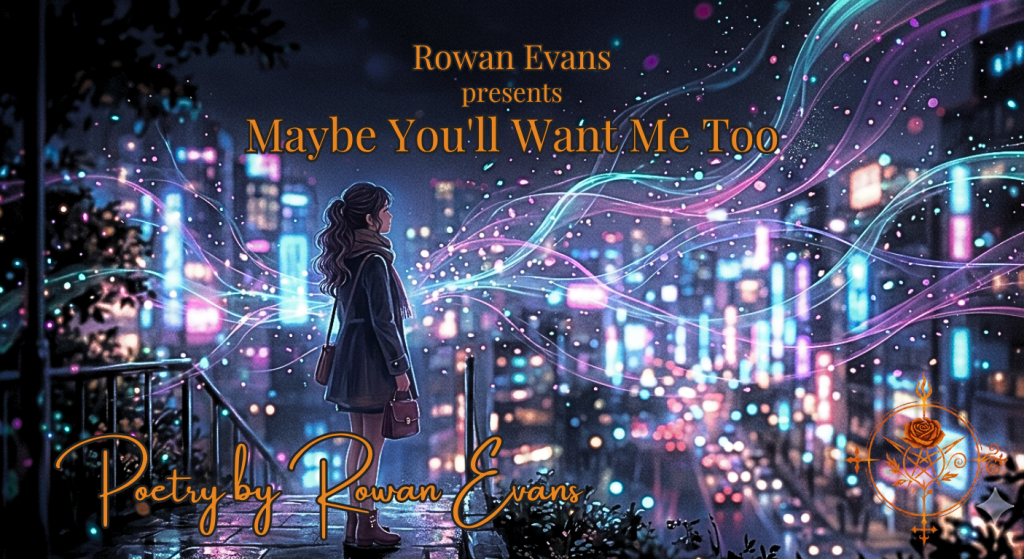
Sometimes affection arrives quietly—slipping into your thoughts until you realize someone has become part of your everyday world. ✨
Maybe You’ll Want Me Too Poetry by Rowan Evans
I remember when you said—
you are like a drug.
It was all laughs
about your exes being hooked,
still shook by the thoughts of you.
But I was getting second-hand
contact highs—
now I feel addicted too.
It’s like you’re in my bloodstream.
You’ve rewired my brain,
rebalanced the chemical compounds—
you’re in nearly every single thought now.
I try to hide it behind metaphors
and jokes—an attempt to mask
the fragile hope—
that you won’t need me,
but maybe you’ll want me too.
Journey into the Hexverse…
[Recognizes Home] A free-verse poem exploring the difference between love as dependency and love as choice. It challenges the idea that love must be need-based, instead centering the quiet strength of choosing someone while still remaining whole on your own.
[Not Rebuilding You] A poem about love as an act of presence rather than rescue. Through construction imagery, Not Rebuilding You explores trust, devotion, emotional safety, and the quiet work of building a foundation strong enough for healing to grow.
[The Language Her Soul Speaks] What if love isn’t about being understood, but learning to understand someone else? “The Language Her Soul Speaks” is a free verse poem about intimacy, communication, curiosity, and the desire to know another person beyond the limits of language.
[Ocean Waves (1, 4, 3)] A moonlit shoreline, a rowboat full of ducks, a piggybank with no cents, and a confession hidden in plain sight. Ocean Waves (1, 4, 3) explores how humor, wordplay, and absurdity can become a side door to vulnerability when the truth feels too difficult to say directly.
[L Words & Heart] A moonlit shoreline, a rowboat full of ducks, a piggybank with no cents, and a confession hidden in plain sight. Ocean Waves (1, 4, 3) explores how humor, wordplay, and absurdity can become a side door to vulnerability when the truth feels too difficult to say directly.