Tag: vulnerable poetry

  • Author’s Note

    Love has always felt heavy to me.

    Not in a bad way— just in a real way.

    I don’t connect lightly, and I don’t fall into feelings easily. So when I do care about someone deeply, it feels enormous. Like something inside me permanently shifts shape around them.

    That can be beautiful.

    It can also be terrifying.

    This piece came from realizing that vulnerability isn’t just saying “I love you.” Sometimes vulnerability is choosing to stay present after you realize someone has the power to hurt you.

    Not because they want to.

    Just because love makes that possible.

    But I think there’s something important about choosing connection anyway.

    Not idealizing someone. Not expecting perfection. Not asking them to heal you.

    Just deciding that the fear of losing connection shouldn’t matter more than the connection itself.

    There’s also a quiet promise buried in this piece.

    A promise to stop drifting when things become emotionally overwhelming. A promise to stay long enough to witness someone fully. To see them in daylight, not just darkness.

    Sometimes love isn’t rescue.

    Sometimes it’s simply saying:

    “I’m here. And I’ll still be here when the sun comes up.”

    Rowan Evans


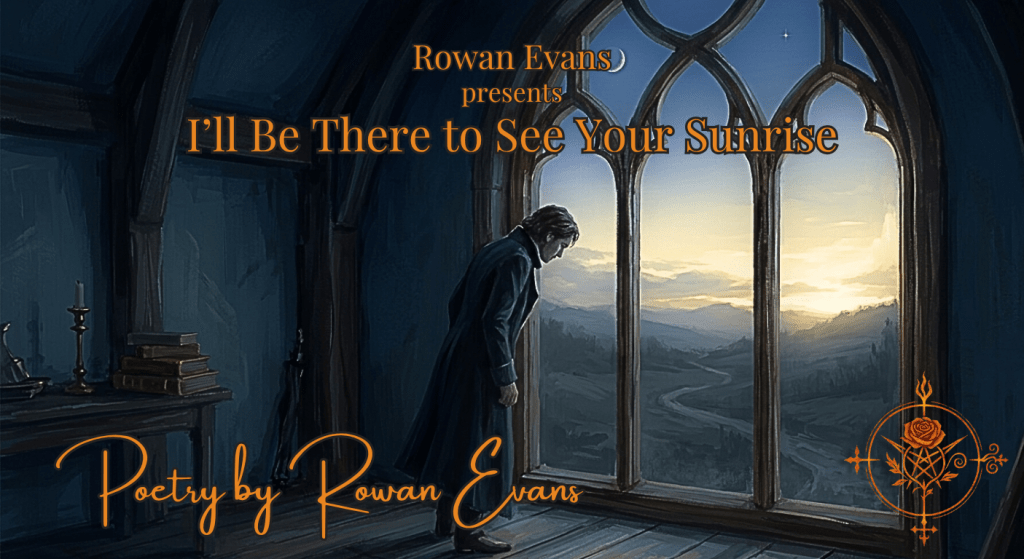
    A shadowed figure watching the sunrise through a window as warm morning light begins to fill the room.
    Sometimes love is not rescue—it’s choosing to stay long enough to see the sun rise.

    I’ll Be There to See Your Sunrise
    Poetry by Rowan Evans

    Dim the lights
    and close the blinds—

    I’m going to be
    honest for a minute,
    I don’t love easily.

    It’s not that I’m afraid.
    I’m not scared to love.

    It just doesn’t come
    without fees for me,
    it costs me something
    every time—I leave a piece
    of my heart behind.

    But the truth is—
    I never really felt love like that,
    everything was just a crush
    until you, that is.

    You—
    who resides in my thoughts now,
    who changed the way
    I see myself somehow.

    And the truth is—
    you didn’t do a thing, not really,
    you just made it safe
    to be honest.

    And I’ll be honest—
    I check your skies,
    before my own.

    The only thing that scares me
    is how much I care,
    that you can hurt me—

    and I’m hyperaware.

    But that’s not fair to you,
    to brace for ache
    when you carry your own pain—

    so even if I’m scared,
    I’ve got to face my fears.

    I’ve got to stay—
    I can’t let myself drift away.

    And I remember—
    you said I met you mid night,
    and the hope I’d see you
    in day light’s shine.

    This is my promise
    to be there,
    to witness it—

    I promise.
    I’ll be there
    to see your sunrise.


    Journey into the Hexverse...

    [Before We Created the Labels]
    Ancient gods return to a fractured world shaped by borders, identities, and separation. “Before We Created the Labels” explores humanity’s divisions through mythic imagery, sacred ritual, and symbolic collapse—asking what remains when we learn to see one another beyond labels.

    [The Unkindness Descends]
    “The Unkindness Descends” is a Gothic symbolic poem exploring collapse, transformation, and the unsettling experience of being witnessed during moments of unraveling. Through raven imagery, ambiguity, and ritualistic atmosphere, the poem invites multiple interpretations—spiritual, psychological, ominous, or transformative.

    [I Write Cathedrals]
    “I Write Cathedrals” explores faith, doubt, belonging, and the search for meaning beyond certainty. Through Gothic spiritual imagery and confessional reflection, the poem examines how writing can become a sacred space for questioning, wonder, and the people who feel displaced by traditional structures of belief.

    [Drought Resistant]
    “Drought Resistant” is a confessional poem about growing up poor in California’s Central Valley—where triple-digit heat, EBT cycles, dry ramen, and hard landscapes become part of emotional memory. Blending humor, slang, and working-class reflection, the poem explores survival, regional identity, and complicated love for the place that shaped you.

    [Escaped to the Page]
    “Escaped to the Page” is a confessional meta-poem about individuality, artistic identity, and surviving through writing. Blending sharp confidence with emotional vulnerability, the poem explores the difference between shared labels and lived experience—and the ways art becomes inseparable from the life behind it.

    [Ink as a Second Mouth]
    “Ink as a Second Mouth” explores the distance between thought and speech, and the ways writing can become a form of survival, continuity, and self-translation. Through confessional imagery and reflections on growth, identity, and articulation, the poem examines what it means to keep becoming through language.

    If you’re interested in more poetry, you can find it here → [The Library of Ashes]
  • Author’s Note

    This piece is about writing as both armor and confession.

    For a long time, I’ve hidden what I feel inside metaphors, inside rhythm, inside lines that only certain people would recognize. Some secrets are meant for the page. Some are meant for one person.

    Every poem that sounds like longing isn’t accidental. It’s practice.

    Practice saying something plainly.

    Rowan Evans


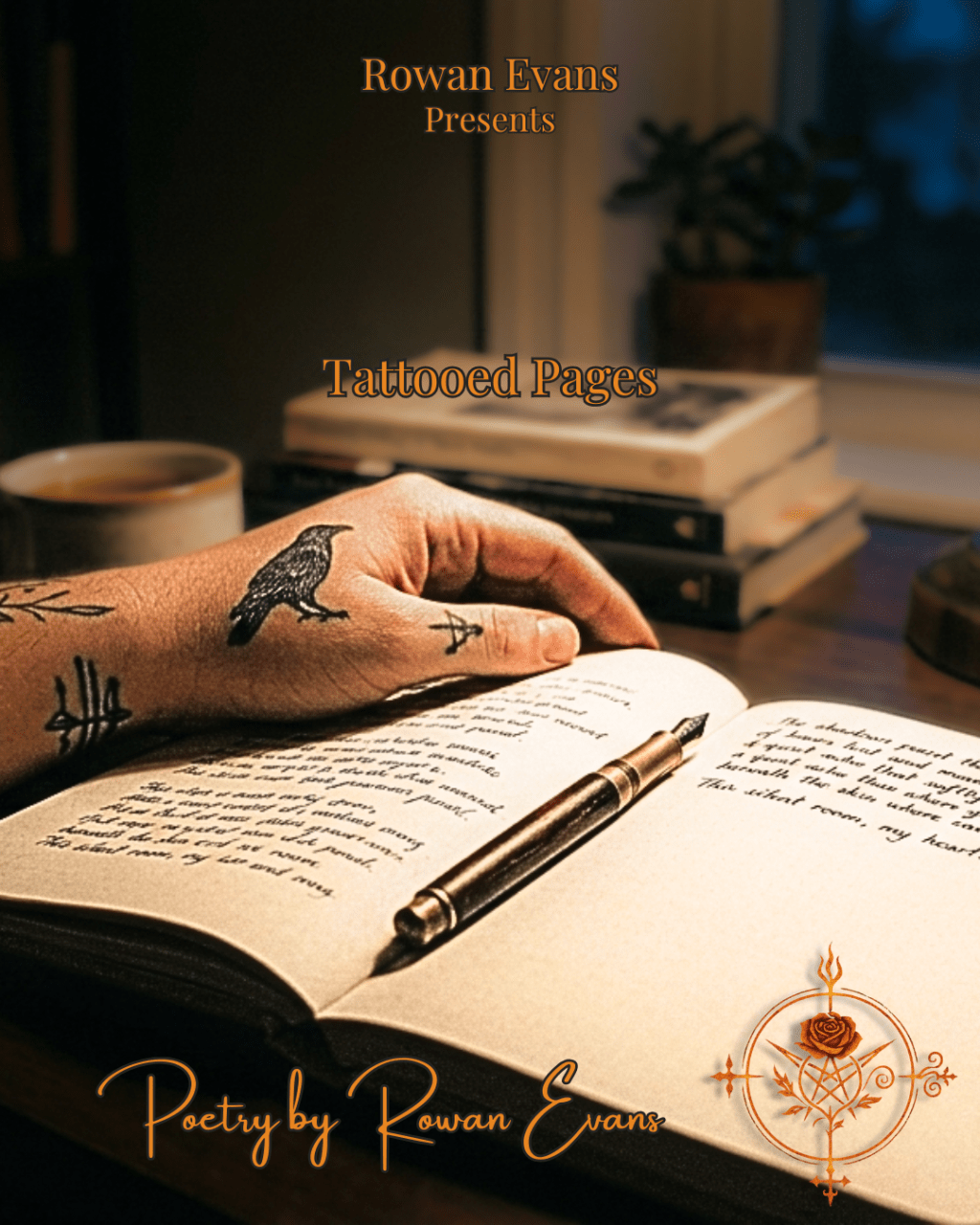
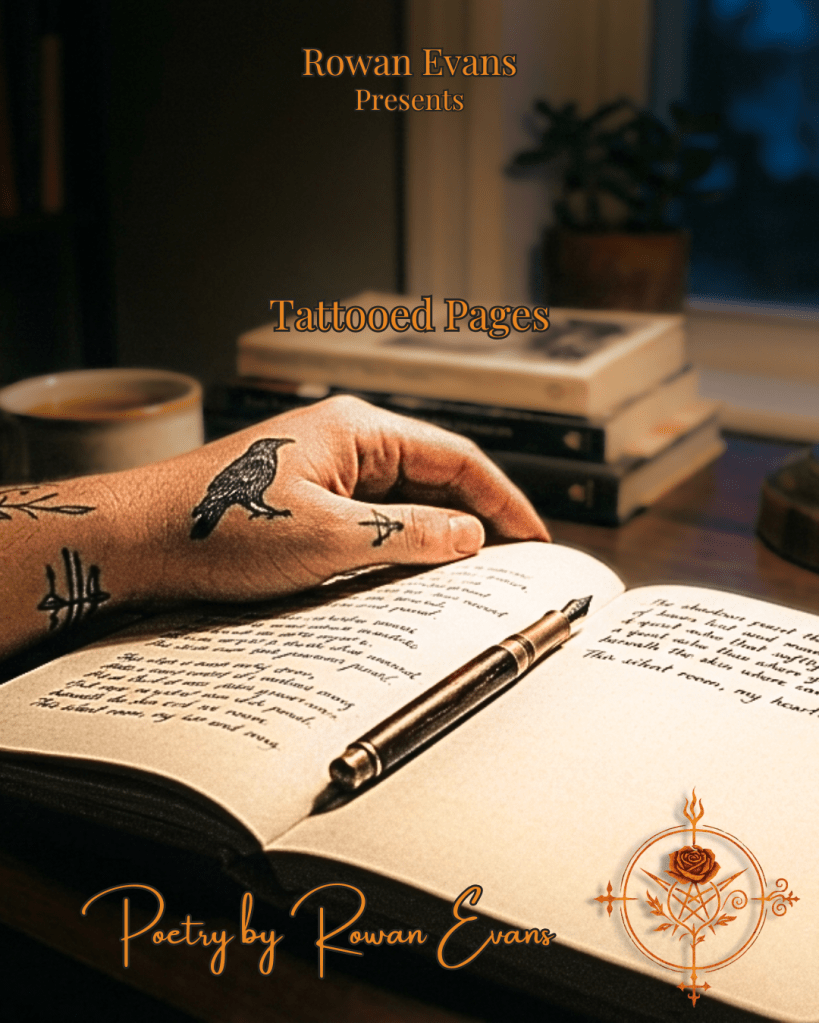
    Open notebook with handwritten poetry under warm desk lamp lighting.

    Tattooed Pages
    Poetry by Rowan Evans

    Every time I sit
    with eyes locked
    on a blank page—
    I feel like
    I’m in therapy again.

    And how does
    that make you feel?

    I don’t know,
    I get a little sad sometimes.
    Depression festers
    inside the thoughts
    in my mind,
    anxiety lingers
    twisting shadowed
    fingers around my spine.

    So I write—
    Pouring thoughts
    like shots; fragments,
    shattered glass
    scattered like my mind
    gets sometimes.

    So I write—
    ink across the page,
    like ink across the skin.
    Tattooed pages,
    holding whispered secrets
    and trembling confessions—
    sharing hard learned lessons.

    I write to share
    what you mean to me.
    But I never say your name
    in what I let them see.
    Instead, I hide the signs
    inside the lines—
    secrets hidden in plain sight.

    I’ve written conversations
    between us—
    real or made up,
    for them to guess
    and us to know.
    I write to show
    how much I—
    let you linger
    in my thoughts.

    You mean so much to me,
    and I just want you to know.
    But I’m afraid to say
    too much, so I let it slip
    in subtle secrets.
    Bit by bit, information drips—
    I love your voice,
    and the way you say my name.
    Having you in my life
    is worth more than fame.

    Your attitude?
    It’s perfection.
    Anyone complaining
    just has a skill issue.

    (…they’re a little bitch.)

    Maybe one day
    I’ll stop hiding
    behind metaphors
    and coded lines.

    But until then—
    know that every poem
    that sounds like longing
    is me
    learning how to say it plain.


    If you’re interested in more poetry, you can find it here → [The Library of Ashes]
  • You called yourself 
    a devil-woman, 
    and I smiled 
    like a sinner watching angels fall. 

    She says, 
    “I wish you could see me at my brightest.” 
    But love— 
    I met you in the ruins, 
    and I swear, 
    even your ashes glowed. 
     
    You ask if you deserve these words, 
    as though devotion were a thing to be earned 
    instead of something I bled willingly— 
    ink, soul and starlight, 
    dragged from the marrow 
    to spell your name in reverence. 
     
    You were fire-burned, 
    soul-scabbed, 
    eyes like war-torn altars 
    and I— 
    I fell to my knees anyway. 
     
    You want to give me the sun, 
    but I have seen its envy. 
    The stars? 
    I would rip them from their heavens 
    just to return the shimmer 
    you lost in the dark. 
     
    You called yourself 
    a devil-woman, 
    and I smiled 
    like a sinner watching angels fall. 
     
    Yes— 
    you’re all thorns and temptation, 
    rage and soft wreckage, 
    but do you not know? 
    Even Lucifer was once the Morning Star, 
    and I would follow your light 
    through hell 
    and back again. 
     
    You are grace wrapped in fury, 
    the kind of storm that leaves me kneeling, 
    kissed by lightning, 
    whispering prayers in your name 
    as though your laughter could resurrect me. 
     
    And I— 
    I’m not leaving. 
     
    Not when your darkness 
    made my heart a cathedral, 
    not when your voice 
    taught my ghosts how to sing. 
     
    I will always be near— 
    in breath, in spirit, 
    in the hush between your sobs 
    and the sacred silence that follows. 
     
    You deserve these words, 
    and a thousand more. 
    You deserve the cosmos carved into lullabies, 
    the moon weeping its light into your palms. 
     
    You— 
    with your shadows and softness, 
    your fierce, aching heart— 
    are the most worthy thing 
    I’ve ever written for. 
     
    Even if the sky falls black, 
    I’ll still call your name 
    a holy thing.