We often say someone is “living rent-free in our head,” but what if they weren’t renting?
Thoughts of You Have Prime Real Estate takes that familiar expression and builds an entire neighborhood inside the mind—roads, sidewalks, corner lots, contemporary homes, secrets, dreams, and eventually one particularly valuable property.
Because thoughts don’t always feel temporary. Sometimes they settle in, expand, renovate, and quietly become part of the landscape.
And apparently, the thoughts of you got the best view.
— Rowan Evans
Some thoughts rent a room. Yours apparently bought the whole corner lot.
Thoughts of You Have Prime Real Estate Poetry by Rowan Evans
They say, when something is stuck in your thoughts— it lives rent free in your head, and that’s true in a sense— because the thoughts have taken up real estate, they own land— building new developments. New neighborhoods are being constructed, new roads are being laid— new sidewalks paved.
Take a walk down the block, you’ll see thoughts taking up corner lots—
modern contemporary homes lining the streets— full of my secrets to keep, and rooms where my dreams sleep.
But the nicest home of all— the one with the best views, and the biggest rooms…
it houses my thoughts of you.
Journey into the Hexverse
[Half a Picture] What happens when someone falls in love with the person they discover through your poetry? Half a Picture explores the strange intimacy between writer and reader—and the distance between seeing someone’s mind through their words and truly knowing the whole person.
[Love Me From Over There] A sharp and humorous poem about the strange contradiction of wanting someone close while simultaneously needing them to stay several feet away from your face.
[It Could Have Been…] A playful little love poem about strawberries, roses, and the wonderfully ridiculous ways romance can show up when you know someone doesn’t like the traditional version.
[High Tide] A short reflective poem about leaving, returning, and accepting the forces that pull us back—like the tide guided by the moon.
This poem came from a simple thought: if you love someone, you have to love the person—not merely the role you want them to play.
A Person First pushes back against the idea that protection, tradition, or romance gives someone permission to control another person’s voice, choices, or identity. A partner is not an accessory to display or a puppet to move around. She is a person first—with her own voice, her own wings, and her own agency.
Love should make room for someone to sing.
— Rowan Evans
Love her as a person, not as a role you can control.
A Person First Poetry by Rowan Evans
I’ve been stuck on this thought,
it’s been on my mind a lot—
why when some guys say they love women,
does it feel like they really don’t love women?
It’s like they’ve got a songbird,
but they don’t want to hear her sing—
like they’ve got an angel,
but they want to clip her wings—
even in traditional gender roles,
you are not supposed to control—
protection doesn’t mean silence,
you’re supposed to be a team—
if you think otherwise,
you’re entirely misguided—
because she is a person first—
not an accessory,
and if that’s something
you can’t see—
then you don’t want a wife,
just a puppet on strings.
Journey into the Hexverse
[Half a Picture] What happens when someone falls in love with the person they discover through your poetry? Half a Picture explores the strange intimacy between writer and reader—and the distance between seeing someone’s mind through their words and truly knowing the whole person.
[Caged Birds Don’t Bow (Remix)] A defiant remix of Rowan Evans’ “Caged Birds Don’t Bow,” confronting control, possession, and insecurity through the imagery of a bird breaking free from its cage and reclaiming its wings.
Some things in life move in cycles—leaving, returning, rising, falling. Sometimes we fight those movements, and sometimes we simply learn to recognize the tide when it comes in.
— Rowan Evans
The tide rises, the tide falls—and sometimes we find ourselves returning with it.
High Tide Poetry by Rowan Evans
I said I wouldn’t leave, then I did but came back. So I guess—high tide— the way the water does, it rises then falls low— guided by the moon from afar, so… I guess I can’t be mad that you’ve got control.
Journey into the Hexverse
[Louder Than the Rain] A short confessional poem about the overwhelming noise of anxious thoughts, the strange silence of feeling alone in a crowded room, and finding a way to translate pain into words.
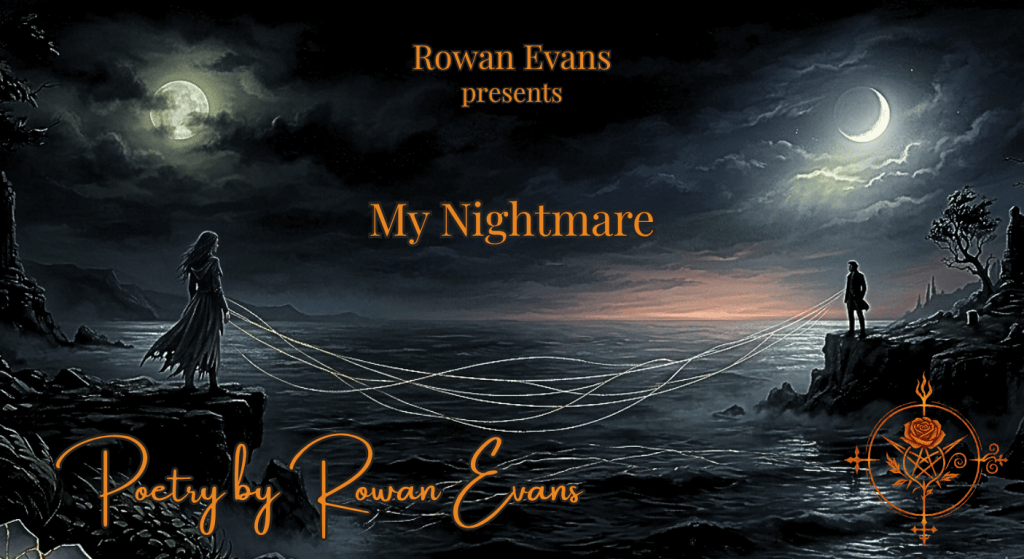
[My Nightmare] A poem about the nightmare of loving someone across distance, seeing the world from different perspectives, and holding onto the hope that the cracks can still be repaired—and that someday two separate shores might become one.
[Rose & Ruin] Two minimalist poems exploring the opposing forces within creativity: the thoughts we cultivate into something beautiful and the darker thoughts we transform before they have a chance to decay.
There are some places that become more than places.
An ocean can be a physical distance, a horizon, a body of water stretching farther than the eye can follow. But sometimes it becomes something else entirely—a canvas, a metaphor, a meeting place between two people who happen to be standing on opposite sides of the world.
Let Me Be Pacific began with a simple invitation: let me show you the ocean the way I see it.
From there, the words wandered where they wanted to go.
Purple skies. Silver moons. Dark water. Rhymes. Trees. Wordplay.
And eventually, the Pacific became more than scenery.
It became the space between here and there—and the reminder that something can cross an enormous distance without ever needing to disappear.
So, for a moment, come sit beside me on the shoreline.
Let me paint you a picture.
— Rowan Evans
The Pacific may separate two shores, but poetry has never been particularly good at respecting distance.
Let Me Be Pacific Poetry by Rowan Evans
Here let me take my words
and paint a picture for you—
the sky in shades of purple and blue,
lit by the silver moon—
it lingers over the bay,
that’s where it stays—
watching over the tide,
and I sit on the shoreline—
watching the ocean’s waves.
Which ocean? Okay,
here let me try and spell it out,
let me be Pacific—
it’s off the California coast,
it touches the Philippine Sea,
sits between Japan and Me.
Now back to the imagery—
there was me, next to a happy little tree,
and the moon was shimmering,
trembling across dark water—
back on the shoreline,
having written more lines,
not less, but more rhymes.
So let me stay Pacific—
specific in the way I see the sea,
how every wave feels like a message
sent across the world to me.
I sit, I rhyme, I watch the tide—
the ocean’s big, but so’s my mind.
And if you ask me why I write
beside this ocean every night—
it’s because the tide keeps teaching me
how distance isn’t always far,
how even the Pacific can carry a heart
from California to wherever you are.
Journey into the Hexverse…
[My Nightmare] A poem about the nightmare of loving someone across distance, seeing the world from different perspectives, and holding onto the hope that the cracks can still be repaired—and that someday two separate shores might become one.
[Rose & Ruin] Two minimalist poems exploring the opposing forces within creativity: the thoughts we cultivate into something beautiful and the darker thoughts we transform before they have a chance to decay.
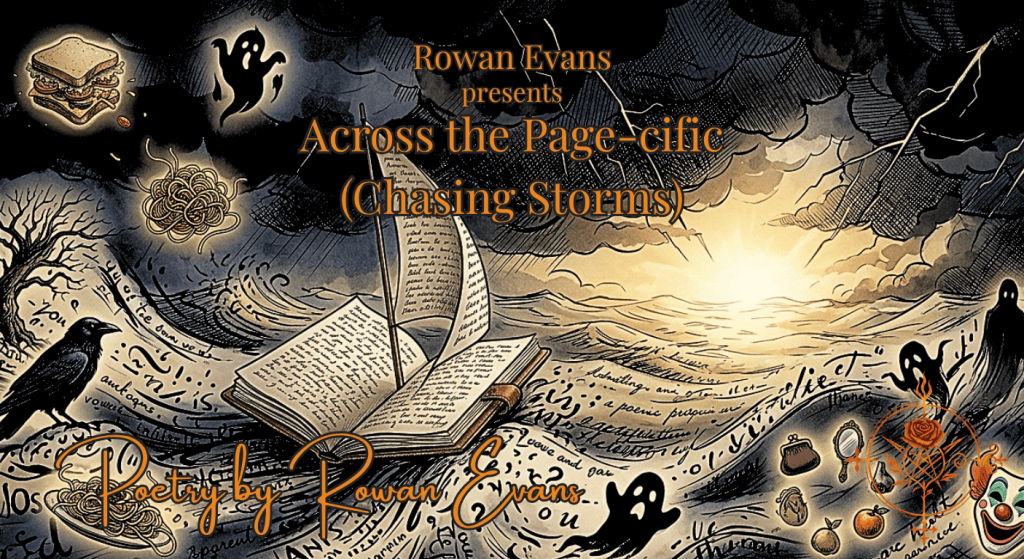
[Across the Page-cific] A playful, autobiographical journey through the strange places poetry can take me—from sandwich heartbreak and pasta diss poems to gothic monsters, mythology, ravens, ghosts, and storms across the page. Beneath the absurdity is something deeply personal: the realization that writing gave me a way to rebuild myself, piece by piece.
Sometimes the nightmare is waking up and realizing that the person you want beside you is standing beneath a completely different sky.
My Nightmare comes from that place—the uneasy space between memory and hope, between what once felt shared and what now feels impossibly far away. It is a poem about distance, but not only the physical kind. There is distance between perspectives, between hearts, between the lives we imagine and the lives we are actually living.
Still, even nightmares have endings.
Sometimes you wake up before they become permanent.
And sometimes, even while dreaming, you can still see a little gold threaded through the cracks.
— Rowan Evans
Two shores. Two skies. One horizon—and enough gold left to believe they might meet there.
My Nightmare Poetry by Rowan Evans
This is my nightmare.
You and I across the distance,
the view that we see is different—
your moon from my sky
is missing—
the sun no longer shines,
it’s dimming—
I don’t see the spark anymore—
don’t see the light in the dark anymore.
What do I even I write for?
I lost my purpose—think I did it on purpose,
it’s like I can’t rhyme anymore,
no clock, no watch, can’t tell time anymore.
This is my nightmare.
You and I across the distance,
the view that we see is different—
my moon is sickly pale,
but yours seems fine though—
the sun doesn’t provide light,
it’s gotten real low—
in times before, this is when
I would Kintsugi the heart—
but there’s not much heart left,
it’s all gold—soft metal,
softer soul—stayed warm,
when the world grew cold.
This is my nightmare.
You and I across the distance,
the view that we see is different—
when we used to be,
two pieces the puzzle
was missing—
the sun in the sky was fine,
but it dimmed in our shine—
I’ve spent time doing Kintsugi
on your heart too—it was hard not to,
gold and platinum weaved through—
I really did see you, flaws and all—
and all I saw was a gift from God.
I still don’t think—
I was wrong.
But that was my nightmare…
You and I across the distance,
the view that we saw was different—
but I still see the gold threads that connect,
the platinum hope on the horizon,
that one day the distance will close—
and we’ll walk the same shore,
it won’t be—
mine and yours.
Journey into the Hexverse…
[Dreaming Wrong] A familiar dream becomes unsettling when the ocean becomes a pond, the tide disappears, the moon loses its reflection, and nothing feels quite like it belongs. Dreaming Wrong explores the uncanny feeling of finding yourself inside a dream that looks familiar—but feels like someone else’s.
[Poet’s Curse] Poet’s Curse explores the painful side of falling too deeply: giving pieces of yourself away freely, taking accountability for your own heartbreak, and realizing that learning to let go can be harder than learning to love.
[Beach to Beach] A dream becomes a journey between familiar shores and unfamiliar cities in Beach to Beach (How I Get There), a poem about imagined travel, ocean crossings, longing, and the places we hope to someday reach while awake.
[Where the Metaphors Lead] Some truths are easier to write than they are to say aloud. “Where the Metaphors Lead” explores the quiet space between dreams, confession, and the courage it takes to let another person know how deeply they’ve become woven into your inner world.
Sometimes I genuinely wonder what happens when I give my brain permission to write whatever it wants.
The answer, apparently, is sandwiches, pasta, farmers on Pluto, raccoons in silk pajamas, llamas, trees, cartoon ghosts, monsters, seven deadly sins, and a journey across an ocean that does not technically exist.
And honestly?
I love it.
Across the Page-cific (Chasing Storms) is a celebration of the strange places my writing can go when I stop trying to force it into a single shape.
This poem deliberately references several of my recent pieces and recurring worlds. The sandwich wordplay comes from Lost in the Sauce. The pasta-based literary assault comes from Impasta (A Diss in Pasta Form). The trees point back to my playful botanical wordplay, while Danny Phantom, the Monster in the Margins, the Seven Deadly Sonnets, ravens, spirits, and other imagery come from the larger mythology and vocabulary I’ve been building throughout my work.
The references aren’t just Easter eggs.
They’re evidence.
Evidence of how much my writing has changed—and how much more willing I am now to let different parts of my voice coexist.
For a long time, I thought I needed to choose what kind of writer I was supposed to be.
Gothic poet.
Confessional poet.
Love poet.
Dark poet.
Funny poet.
Experimental poet.
But the more I write, the less interested I am in choosing.
I want to write the heartbreak poem with sandwich ingredients.
I want Tony Stanza to write a pasta diss.
I want to turn mythology into autobiography.
I want to write about ghosts and gods, then turn around and make a terrible pun.
I want to chase a metaphor until it becomes absurd.
And then, underneath all of it, I want to find something honest.
That is what the storms in this poem represent.
The chaotic lines.
The sudden cadence changes.
The ideas that arrive from nowhere.
The parts of my mind that refuse to walk in a straight line.
I used to think I needed to calm those storms down.
Now?
I chase them.
Because writing has become a playground again.
And somewhere in that playground, I keep finding pieces of myself I hadn’t finished discovering.
“It was writing that saved me” is therefore not a throwaway line.
Writing gave me a language for experiences I couldn’t always explain directly. It gave me somewhere to put the contradictions, the humor, the darkness, the questions, the love, the anger, the absurdity, and everything else that makes up the person behind the pen.
Piece by piece.
Bit by bit.
I rebuilt myself in the art.
And apparently, sometimes that art looks like a sandwich, a bowl of pasta, and a storm on the Pacific.
I’ll take it.
— Rowan Evans
I stopped trying to avoid the storms. I started chasing them across the page.
Across the Page-cific (Chasing Storms) Poetry by Rowan Evans
Let’s see, what other ridiculous thing
can we turn into poetry—
I’ve written a heartbreak poem
using sandwich ingredients,
and wrote a diss poem
using nothing but pasta noodles—
was a farmer on Pluto,
witnessed raccoons in silk pajamas
perched on the backs of llamas—
while I shaped love poems
out of the trees—
I’ve turned Danny Phantom
into religion—a whole faith
on “going ghost”—
but really it’s just me stuck
between worlds.
I’ve written as the monster in the margins
and the spirits in the room—
seven sins that act like tax on the soul.
Go against the monster, you won’t leave whole.
Feeling like Pennywise, grin wide,
’cause I’m a clown in my rhymes
sometimes—
I’ve taken trips
in ink-dipped ships
across the page-cific—
avoiding storms of chaotic lines
and jagged rhymes
with sudden cadence changes.
Just kidding—
I chased the storms across the page,
embraced the pace my brain gave.
It was writing that saved me—
it gave me a way to translate me,
piece by piece and bit by bit,
I rebuilt myself in the art of lit—
where a mind like mine appears rarely.
Journey into the Hexverse…
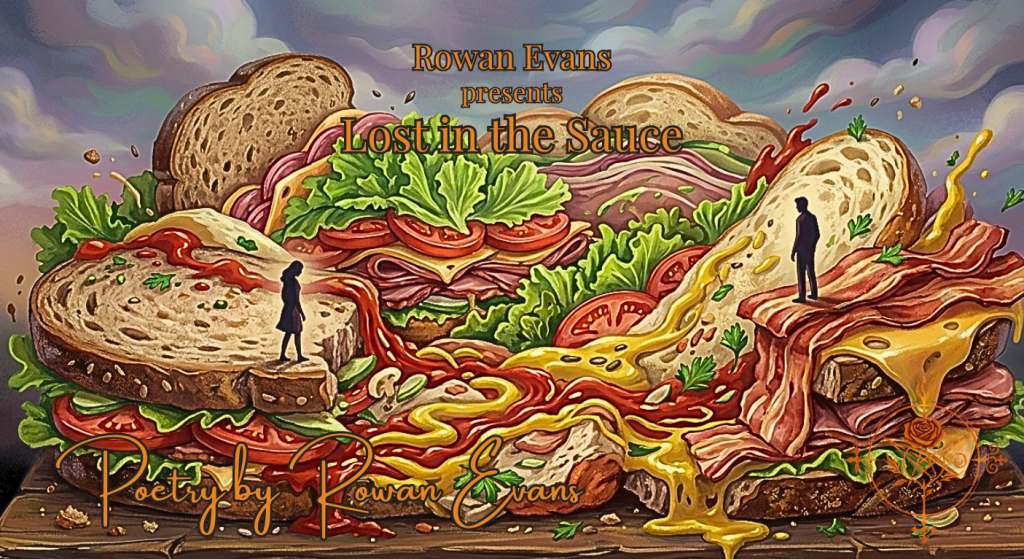
[Lost in the Sauce] A playful heartbreak poem where sandwiches, ketchup, mustard, rye, lettuce, and sourdough become metaphors for emotional confusion. Beneath the food puns is a speaker trying to understand how everything went from “we’re okay” to suddenly feeling cold.
[Impasta] Tony Stanza is back with another literary attack—and this time, he’s bringing pasta. Spaghetti, fettuccine, macaroni, ravioli, and angel hair become weapons in a ridiculous diss aimed at a poet whose rhymes are allegedly cheesy, fragile, and completely impasta.
[Pluto Farmer] A whimsical absurdist poem about being a certified weirdo, farming space carrots on Pluto, and refusing to fit into anyone else’s definition of “normal.”
[Raccoons in Silk Pajamas] What begins with judgmental Space Chickens quickly spirals into camels in parked cars, elephants in jam jars, raccoons in silk pajamas, and astronauts in the ocean. A playful absurdist poem about language, imagination, and what happens when you stop trying to control where the words go.
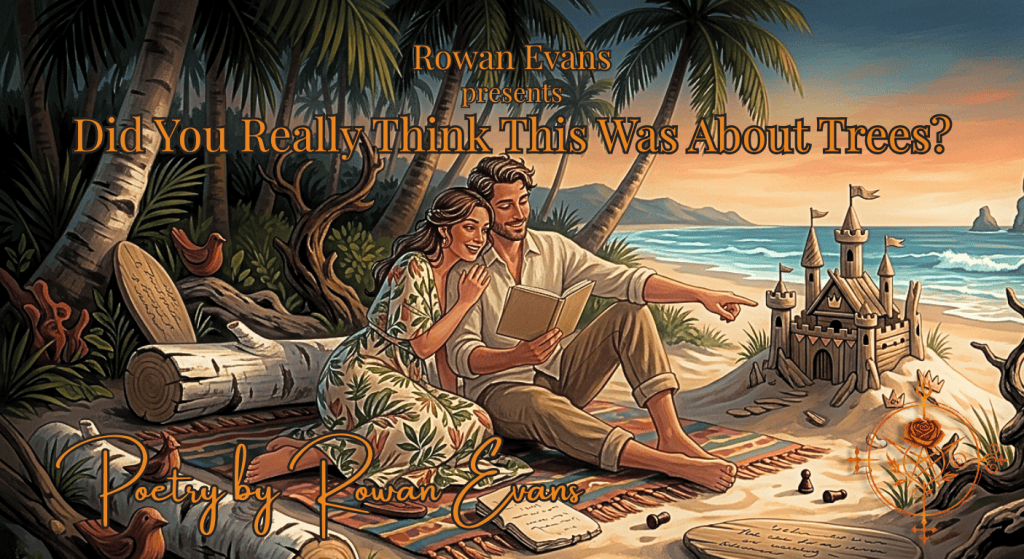
[Did You Really Think This Was About Trees?] A playful love poem disguised as a forest of terrible tree puns. Beneath the birch, oak, cedar, palms, lumber, and absurdist wordplay is a poem about devotion, loyalty, laughter, and building a life with someone you love.
[Danny Phantom Theology] What begins as a metaphor borrowed from a childhood cartoon becomes something deeper: a reflection on existing between survival and possibility, exhaustion and hope, the life we have and the life we long for. Danny Phantom Theology explores what it means to keep moving toward a future that feels worth living.
[The Monster in the Margins II] The Monster in the Margins II transforms Rowan Evans’s Seven Deadly Sins mythology into a horror story written between the lines, where Lust, Wrath, Sloth, Greed, Pride, Envy, and Gluttony become monsters growing from pain, grudges, and scars.
And sometimes my brain apparently looks at a sandwich and says, yes, this is how we’re processing emotional confusion today.
Lost in the Sauce is a deliberately playful poem built around food-related wordplay, particularly the language of sandwiches, condiments, bread, and the wonderfully terrible possibilities hidden inside them.
The jokes are intentionally stupid.
That is part of the point.
“Bread” becomes “rye.” “Ketchup” becomes “catch up.” “Mustard” becomes “must’ve.” “Sourdough” becomes an emotional description. Even “lettuce meat in the middle” is doing multiple jobs at once.
But beneath all of that nonsense is something much more familiar: the confusion of being told that everything is okay while someone’s behavior feels completely different.
The speaker is trying to understand the contradiction.
They were told the relationship was fine.
They were told the other person was happy.
So why does everything suddenly feel cold?
Why does affection feel sour?
Why does the speaker feel trapped in place, struggling to catch up to something they don’t fully understand?
The ridiculous wordplay gives me permission to approach that emotional confusion without making the poem overly solemn.
I’ve been rediscovering how much I enjoy treating language like a playground—taking ordinary words, twisting them until they become something else, and seeing how far I can push a joke before the emotional meaning underneath it starts showing through.
So yes, this poem is about sandwiches.
Sort of.
Mostly, it’s about being lost in the sauce when the person you’re trying to understand has already changed the recipe.
— Rowan Evans
Sometimes you don’t fall apart. Sometimes you just get lost in the sauce. 🥪
Lost in the Sauce Poetry by Rowan Evans
You sandwiched me in
with an all-tomato—
love you or leave,
but I couldn’t do it clean—
I was lost in the sauce,
begging lettuce
meat in the middle.
You said, “you lie.”
I said, “Nah, you rye.”
But do you know why?
I was stuck in place,
you wouldn’t wait—
I was struggling
to ketchup.
I thought you
mustard—
how could you not?
People talk.
Look—
I’m sorry.
I don’t want to fight.
But, you said—
you were happy.
We were okay.
So why you so cold,
why you actin’ sourdough?
Journey into the Hexverse…
[Did You Really Think This Was About Trees?] A playful love poem disguised as a forest of terrible tree puns. Beneath the birch, oak, cedar, palms, lumber, and absurdist wordplay is a poem about devotion, loyalty, laughter, and building a life with someone you love.
[Blended Hardware] A playful, absurdist poem where step-ladders, garden hoses, Star Wars, teenage memories, Gothic imagery, and the poet’s own self-interrupting commentary collide. Blended Hardware is a celebration of letting language wander.
Every now and then, affection shows up wearing bark and leaves. Today was one of those days.
Did you really think this was about trees? 🌳
Did You Really Think This Was About Trees? Poetry by Rowan Evans
Birch, I’m in a mood—
but I’m feelin’ pretty Oak today,
oops, I mean, a-o-k—
especially with my Rose Wood beside me,
open my eyes, so I could Cedar—
her fingers in my hair,
like the breeze through the leaves.
Did you really think
this was about trees?
It’s just me and her
by the summer seas,
just us with Palms in the sand—
castle and a plot of land,
where she is royalty—
a Queendom built
off the back of loyalty.
And that’s something I don’t lack,
I got it in stacks—packed to the rafters,
stick with me and you’ll have a life full of laughter—
you’ll never get board like a lumberyard,
and I work hard—
to prove my words have meaning,
even when they are weird
or absurdist leaning.
Author’s Note
Sometimes I write a poem because I have something profound to say.
Sometimes I write one because my brain looked at a bunch of tree names and apparently decided they needed to become flirting material.
This is the latter.
Did You Really Think This Was About Trees? is a deliberately ridiculous little love poem built almost entirely around wordplay. Birch, oak, rosewood, cedar, palms, lumberyards, boards—I’m taking language that belongs to the world of trees and woodworking and forcing it into a completely different emotional landscape.
And yes, the title is absolutely part of the joke.
The poem starts by making the reader think they’re about to get some sort of nature poem. Then I reveal that the trees were never really the subject.
The subject was her.
The forest is just the camouflage.
I also wanted the poem to feel conversational and slightly chaotic. The little correction from “Oak” to “a-o-k,” the exaggerated promises, the lumberyard imagery, and the final admission that the whole thing is leaning toward absurdism are all intentional.
There is something freeing about allowing a love poem to be stupidly playful.
Not every expression of affection needs to be solemn.
Sometimes love looks like poetry.
Sometimes it looks like devotion.
And sometimes it looks like spending an entire poem making increasingly terrible tree puns because you love someone enough to make yourself laugh while writing about them.
Honestly, I’ll take all three.
— Rowan Evans
Journey into the Hexverse…
[Blended Hardware] A playful, absurdist poem where step-ladders, garden hoses, Star Wars, teenage memories, Gothic imagery, and the poet’s own self-interrupting commentary collide. Blended Hardware is a celebration of letting language wander.
Sometimes an old poem doesn’t need to be left in the past.
Sometimes you have to return to it after you’ve changed.
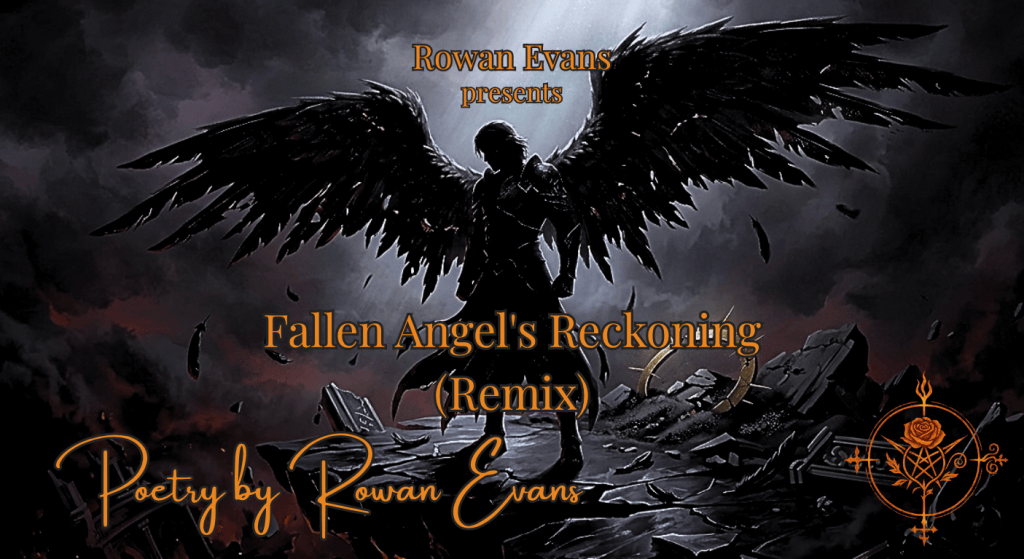
Fallen Angel’s Reckoning (Remix) revisits a poem I originally wrote on June 6, 2024. The original was already telling a story I understood well: love that promised forever, a fall from an imagined heaven, and the painful process of reclaiming yourself after the promise disappears.
But I was a different writer when I wrote it.
And, more importantly, I was a different person.
The 2026 version isn’t meant to erase the original. It is a conversation with it.
I kept the central imagery—the angel, Lucifer, the fall from heaven, the halo, the darkness, the broken vow—because those symbols still belong to the emotional architecture of the piece. But I wanted to push the mythology further this time. Icarus enters the story. The fall becomes more physical, more violent, more deliberate. The speaker isn’t simply descending from something that once felt like heaven; they are plummeting from it.
And then there is the ending.
In 2024, I wrote about newfound wings.
In 2026, I wrote about broken wings.
That change matters to me.
Because strength doesn’t always mean becoming untouched by what happened. Sometimes you keep the scars. Sometimes you keep the broken pieces. Sometimes you discover that you can still fly without first repairing everything that hurt you.
The angel doesn’t become an angel again.
They don’t return to the heaven they lost.
They don’t need the person who made them feel divine to give them their identity back.
They become something else.
A fallen angel who embraces the fallen.
The broken.
The free.
That is what this remix ultimately became: not a poem about getting back what was lost, but about discovering that losing it didn’t mean losing yourself.
I didn’t rewrite the 2024 version because it was wrong.
I rewrote it because I’ve had two more years to understand the fall.
And sometimes the person who wrote the first poem deserves to hear what the person you became has learned since then.
— Rowan Evans
I don’t need unbroken wings to fly. I just need to remember that they were mine before anyone promised me heaven.
Fallen Angel’s Reckoning (Remix) Poetry by Rowan Evans [written July 23th, 2026]
I remember when you said forever,
but forever never came,
so I fell like Lucifer,
from the heavens down I tumbled.
Returned your love,
played your game—
once an angel in your eyes,
now in darkness I crumbled.
Your promises were wings that lifted me high,
but they melted away, when I reached the sun—
just like Icarus, the light was my undoing.
It wasn’t just a fall, I was plummeting…
a fallen star,
cast from the sky,
now I walk in shadows,
where our love met its end.
Like Lucifer—I embraced the night,
wandering through realms of regret and pain,
I shed my halo,
lost my light,
no longer an angel,
in your eyes or in my name.
Yet in this darkness,
a new path unfurls—
I find strength in the ashes of our broken vow,
rising from the ruins of our shattered world.
I reclaim my soul,
I’m reborn here and now.
No longer bound by your empty decree—
I soar with broken wings,
embracing the fallen,
the broken, the free,
a fallen angel finding strength
I never knew I’d own.
Journey into the Hexverse…
[Homecoming] Homecoming is a return to the Gothic aesthetic at the heart of Rowan Evans’s poetry, blending Poe, mythology, horror icons, moonlight, ravens, and darkness into a meditation on artistic identity and finding your way back to the voice that feels like home.
[The Monster in the Margins] Drawing inspiration from horror icons like Michael Myers, Ghostface, Freddy Krueger, and Pennywise, this poem explores the darker side of creativity—where inspiration becomes an unstoppable force lurking just beyond the edge of the page.
[The Monster in the Margins II] The Monster in the Margins II transforms Rowan Evans’s Seven Deadly Sins mythology into a horror story written between the lines, where Lust, Wrath, Sloth, Greed, Pride, Envy, and Gluttony become monsters growing from pain, grudges, and scars.
[The Unkindness Descends] “The Unkindness Descends” is a Gothic symbolic poem exploring collapse, transformation, and the unsettling experience of being witnessed during moments of unraveling. Through raven imagery, ambiguity, and ritualistic atmosphere, the poem invites multiple interpretations—spiritual, psychological, ominous, or transformative.
[Gospel in Crimson] When writing becomes ritual and love becomes devotion, the line between creation and worship begins to blur. Gospel in Crimson explores obsession, artistry, and the sacred act of expression.
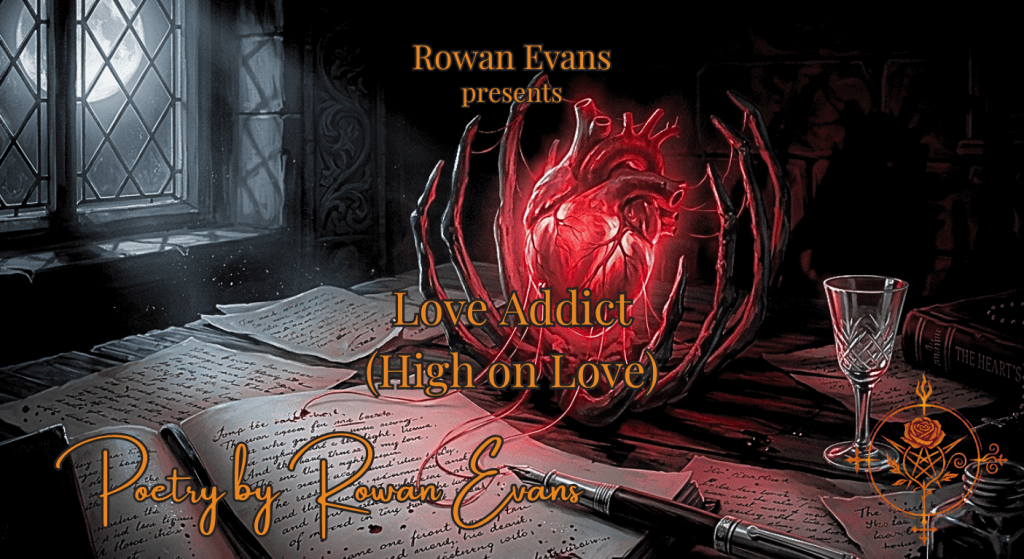
Love Addict (High on Love) is me taking one of my recurring themes—how intensely I experience love—and pushing the metaphor until it becomes impossible to ignore.
I’ve often written about love as something intoxicating. A rush. A chemical reaction. Something that can make the world feel brighter and the mind move faster. But this poem asks what happens when that metaphor is taken literally enough to become uncomfortable.
Because sometimes I don’t simply want love.
I crave it.
There is a difference.
The language of addiction works here because love can create its own strange cycle: anticipation, euphoria, uncertainty, withdrawal, craving, and the desperate desire for another hit of the feeling that made everything seem worthwhile.
And, naturally, my response to that craving is to write.
That’s one of the things I find fascinating about my relationship with poetry. I don’t merely write about what I’m feeling—I often metabolize the feeling through language. I take the emotion, push it through rhythm and metaphor, turn it over until I can see its shape, and then put it on the page.
So the final joke is also the truth.
I get high on love.
Then I get high on writing about getting high on love.
And apparently, the cycle continues.
Maybe that’s the real habit.
— Rowan Evans
Some people chase love. I apparently write it until the high wears off—and then write another poem.
Love Addict (High on Love) Poetry by Rowan Evans
I get high on love
like it’s a drug
and I’m an addict
with a habit,
fighting for every hit
that I can get—
if I could,
I would OD on it.
Inject it straight
to my chest,
in-between the ribs—
where the heart lives.
I’d take the risk,
the comedown, the crash,
just to feel one moment
where love doesn’t pass.
I get the shakes and quake,
knot in the stomach—cold sweats,
when love doesn’t sit in the chest—
it feels fake, not worth the weight.
Wait—
what was I saying?
I get high on love
like it’s a drug
and I’m an addict,
so I write lines
that expand the mind,
to feed the habit.
Journey into the Hexverse…
[Poet’s Curse] Poet’s Curse explores the painful side of falling too deeply: giving pieces of yourself away freely, taking accountability for your own heartbreak, and realizing that learning to let go can be harder than learning to love.
[When I Fall] When I Fall is a vulnerable poem about loving without reservation, feeling everything deeply, and refusing to make the heart smaller just because wholehearted love can sometimes lead to loneliness and pain.