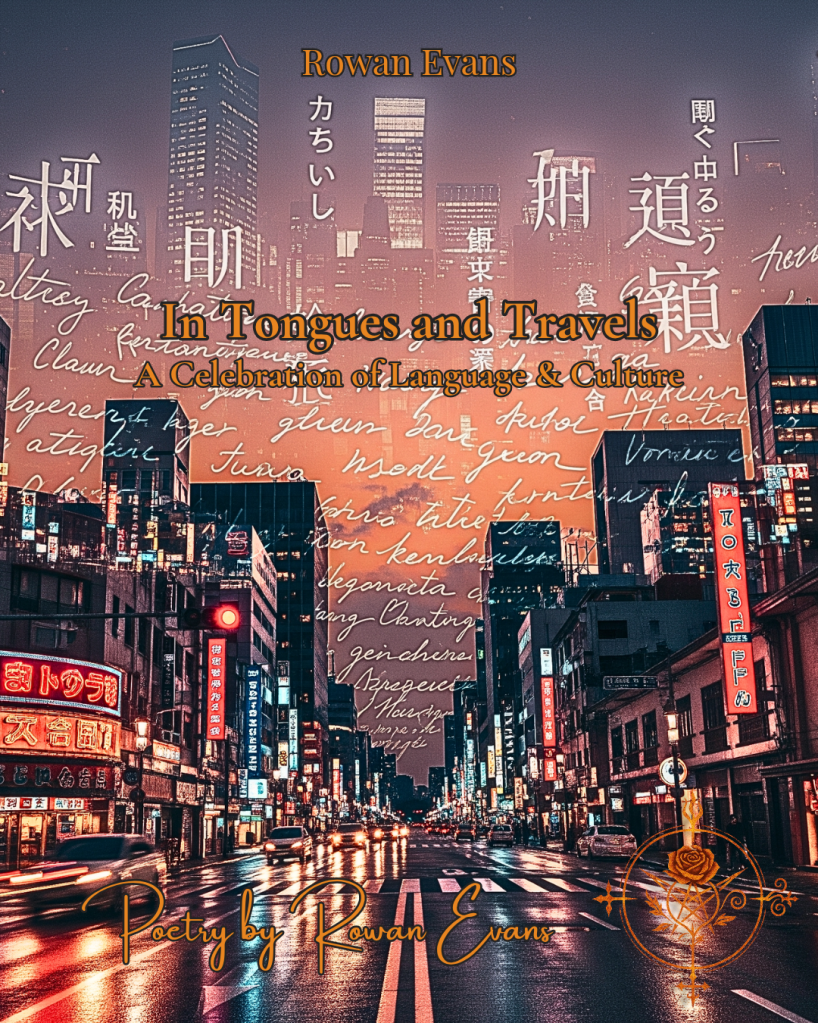
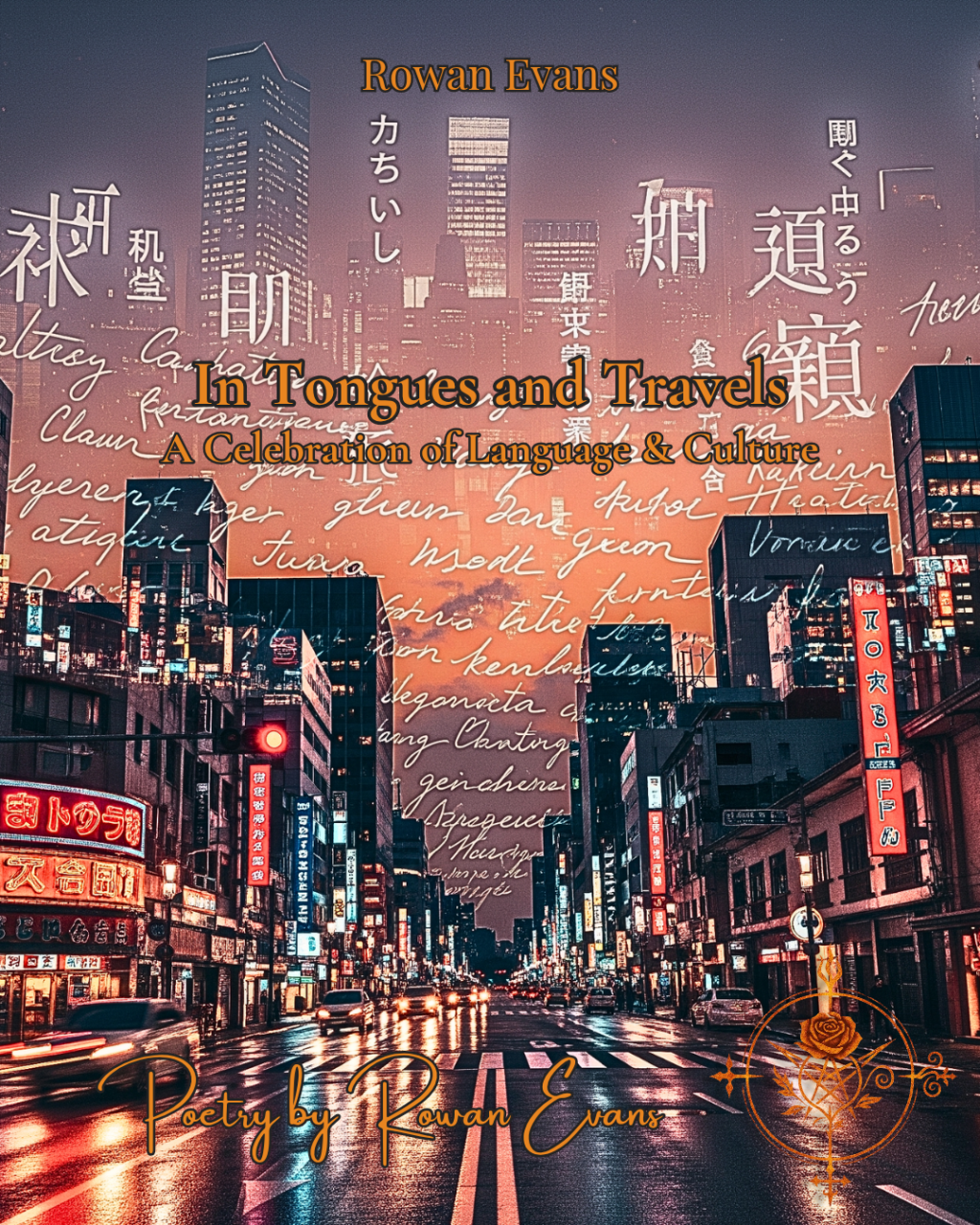
“I have always been captivated by the lives and languages of people far from my own. This piece is a reflection on curiosity, respect, and the love I carry for cultures I have yet to touch.”
Listening to the world in every language, feeling the pulse of life in every culture. – Rowan Evans
I have always been drawn to the world outside myself… to the rhythms of languages I do not speak, to streets I have never walked, to skies I have yet to stand beneath. There is a life in language, a heartbeat in culture, and I listen as closely as I can.
Even when I cannot understand the words, I hear the cadence, the rise and fall, the hidden music that belongs to a place and its people. Mandarin or Cantonese, Tagalog or Korean, Japanese or German—they each carry a soul in their tones, a story in their syllables. I notice when the smallest detail shifts, when a rhythm is off, when a sound is not quite what it should be. Some call it obsession; I call it devotion.
The written form sings to me as well. Korean curves in gentle arcs, Chinese strikes with sharp certainty, Japanese flows in graceful ribbons. To many, they appear alike, but I hear the difference, see the rhythm, sense the pulse of lives folded into every character, every stroke. Each line holds a story, a heartbeat, a culture speaking without sound.
I am fascinated not by the exotic alone, but by the living pulse of life everywhere. In Japan, the careful balance of history and neon. In Seoul, the energy that hums beneath every crowded street. In Manila, the warmth and chaos intertwined, unashamed and alive. These are not places I have touched, yet I feel them as vividly as I feel the echo of my own heartbeat.
I do not want to consume. I want to witness. I want to understand. I want to walk with reverence, to listen with attention, to respect the lives unfolding around me, and to see what is beautiful without taking it for my own. Language, culture, custom—these are windows into the souls of people, and I am endlessly curious.
Even in dreams, I travel, carrying notebooks, pens, a hunger for connection. I meet people, learn their words, share their moments, and leave a piece of myself behind in the care with which I have observed.
This is how I show love to the world I do not yet fully know. Through attention, through curiosity, through presence. And perhaps, one day, when my feet touch those streets, I will not only observe, but belong in some way, however fleeting.
Until then, I will listen. I will watch. I will learn.
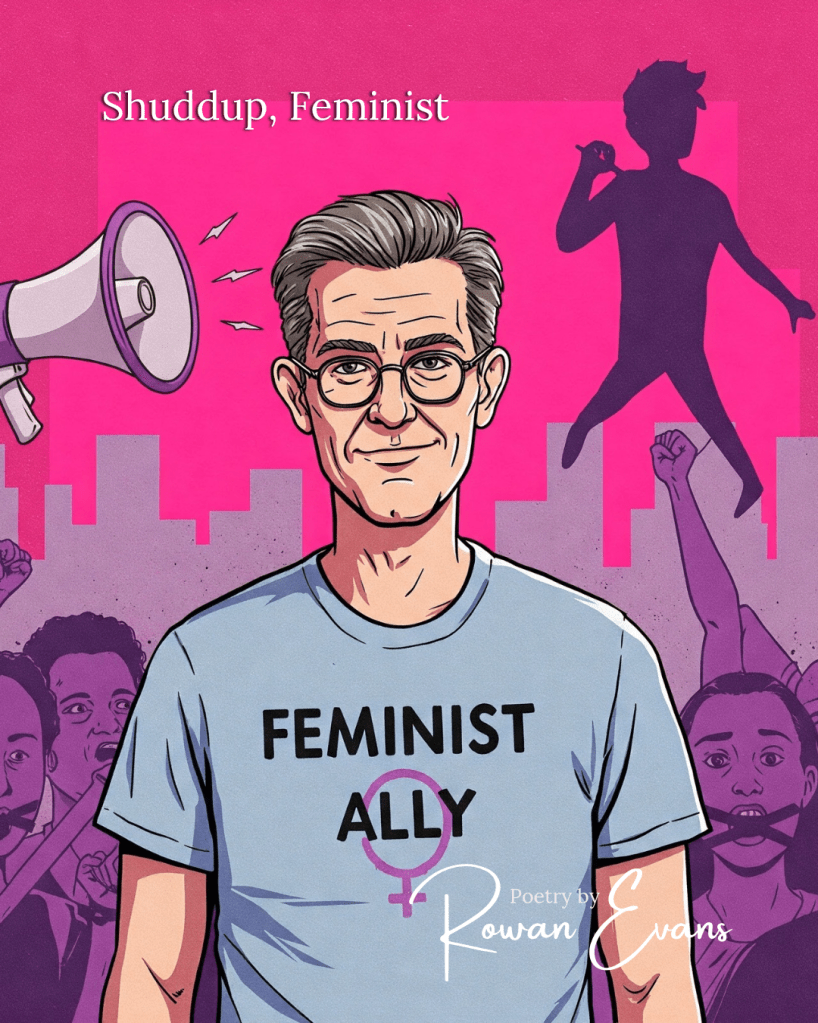
Oh, you’re a feminist, huh?
Shuddup, Feminist™—
stop waiting for a gold star
just because you believe women deserve the same rights.
You’re just the white-knight hero
with a keyboard and a coffee shop membership.

You post your virtue
like it's an Instagram caption—
#FeminismForEveryone
except when it's inconvenient for your fragile ego.

You say "I support women,"
but have you ever given up space
in a conversation you dominate
or asked her what she really needs
instead of handing her your unsolicited "help"?

You tweet "empowerment,"
but you’ll cross the street to avoid it
when it means being allies to women of color
or trans women with stories you’re scared to listen to.

You clap back at mansplaining,
but still ask her to explain why she’s so emotional
when she stands up for herself.
You march for rights,
then silence her voice when she asks for a seat at the table.

Oh, but you care about women's issues—
until a woman dares challenge your "perfect feminism"
with her lived experience.
Don’t let your fragile pride
be the real fight you’re avoiding.

You preach equality,
but when was the last time you gave up power
just for the hell of it?
Feminism’s not about you,
it’s about listening, not talking over her.

You say “But I’m a good guy”—
good, but you're still a part of the problem,
dodging accountability behind a slogan.
Don’t hide behind the “I’m a feminist” card
when it’s just another way
to keep the power without the responsibility.

Shuddup, Feminist™—
You’re not a savior,
you’re just a tourist in the movement.
Put down the hashtagand pick up some real change.
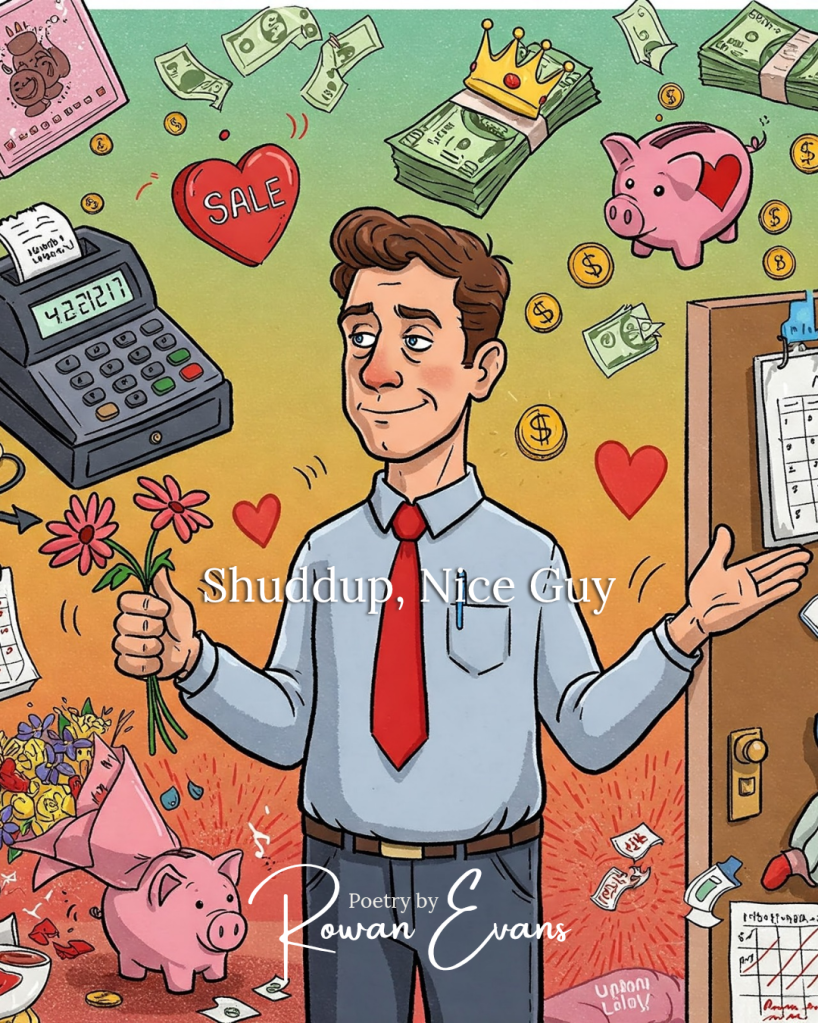
Oh, you’re the "nice guy," huh?
Shuddup, Nice Guy™—
your kindness isn’t a currency
and you sure as hell can’t cash in
on empty compliments and unsolicited advice.

You think opening the door
is the grand gesture?
Buddy, if you’re looking for a medal,
try doing something kind
without expecting a reward.

You say, "Women only like assholes."
Well, maybe it's because
your idea of “nice” is just a disguise
for your entitlement dressed up
in a sweater vest and “good intentions.”

You buy flowers, but never listen
to what she’s really saying.
You’re a walking “compliment” factory,
but your words are hollow
like your understanding of consent.

"You just don’t see me like that."
No, Nice Guy™,
we don’t see you like that
because you can’t even see
the difference between being decent
and being someone’s emotional tax burden.

You think every "friendship"
is a transaction,
but friendships are about giving
without keeping score.
You should try it sometime—
real kindness has no receipt.

Your "complaints" about being “friend-zoned”
are a tired song.
Just because you didn’t ask
for her number
doesn’t mean she owes you
her affection,
let alone her time.

You're not nice,
you're just holding out
for a prize,
hoping she'll throw you a bone
for being "so understanding"
while ignoring everything about her
that isn't an easy fix.

You cry about being "too good for her,"
but Nice Guy™,
it’s not about being good—
it’s about being real.
Maybe start by listening,
not just waiting for your turn
to talk about how "good" you are.

You say, “I’m just trying to help,”
but really,
you’re helping yourself
to her patience,
her time,
her emotional labor—
expecting her gratitude
like it’s an entitlement
wrapped in a bow.

So shuddup, Nice Guy™.
You’re not owed a damn thing
for not being an asshole.
True kindness doesn’t keep score,
and it certainly doesn’t make excuses.
Try again when you figure out
how to be a man who gives,not just takes.
Oh look—another poem about pain
disguised as transformation.
Another phoenix metaphor
as if setting yourself on fire
was ever the same as healing.

You bleed onto the page
and call it sacred.
But let’s be real—
half the time, you don’t even feel it.
You just know how to make it rhyme.

Shuddup, Poet.
You’re not writing epiphanies.
You’re writing escape routes.
Every stanza is a soft excuse
for why you can’t just say
“I’m scared” out loud.
You bury it under moonlight,
call it symbolism,
but we both know it’s fear
dressed in metaphors
you’ve used a hundred times before.

You say you don’t want attention—
but every line is a mirror angled
just right to catch
someone’s admiration.
Don’t play modest,
you check your likes
like they’re validation coupons
you forgot you were addicted to.

You act like a prophet of pain,
but the truth?
You’re just really fucking good
at turning your avoidance
into art.

You dress up your shame
in silk and shadow,
call it “processing,”
but some of these wounds
you keep opening on purpose
just so you have something to write about.

You ever think maybe
you’re not trapped in your trauma—
you’re clinging to it?
Like if you actually let go,
you wouldn’t know what to write about.
You wouldn’t know who you are.

You’ve built a cathedral of grief
and convinced yourself
it was home.
And every time someone tries
to love you in the present,
you write a eulogy
for what they might leave behind.

You’re not fooling anyone.
You’re not brave
for turning pain into poetry.
You’re brave
when you stop needing the poem
to tell you who you are.

So shuddup, Poet—
or don’t.
Just write something
you can’t revise into safety.
Write like the mirror’s cracked
and you’re done polishing the edges.

Write like survival is messy.
Write like joy is terrifying.
Write like softness is not a threat.
Write the poem that doesn’t rhyme,
that doesn’t work,
that just tells the truth
even if no one claps.

Write like you finally believe
there’s something worth saving
underneath all that ink.

Because there is.

And you fucking know it.

You’re not fooling anyone.
Not with the metaphors,
not with the midnight bleeding poems,
not with the “I’m fine” disguised as
“I’m just editing.”
You call it processing.
I call it hiding with flair.

You’re not brave
just because you can turn pain into prose.
You’re brave
when you stop making your healing
sound poetic enough to be palatable.

So shuddup, Rowan.
Yeah—you.
The girl who writes about survival
like it’s always beautiful.
The one who can describe heartbreak
down to the taste of the silence,
but still can’t say “I need help”
without flinching.

You write about wanting love
like you’re ready—
but are you?
Or are you still chasing ghosts
because they never got close enough
to disappoint you?

You dress your desires in velvet,
call it softness,
but it’s fear with lipstick
half the time, and you know it.

You say you want to be seen—
then blur yourself in metaphors
and call it art.
Call it safety.
Call it control.

So write the poem that exposes you.
Write the one you’re scared to show her.
Write the one that doesn’t beg
to be admired—
just understood.

Write the poem
that screams your real name—
not the pen name you use
when you’re afraid of being too much.

Write the ending
that doesn’t get ribbon-wrapped in hope
just to make the readers feel better.

No more metaphors.
No more fog.

Just you—
crying on your bedroom floor
and still fucking glowing.

Still here.
Still writing.

Now say it, Rowan.
Say the thing you’ve been cutting from every draft
because it hurts too much to leave in.

Or shuddup.

So you write about darkness
like it’s a lover that never leaves,
but how much of it
have you actually kissed on the mouth
without using a metaphor as a condom?

You romanticize your pain
like it makes you profound—
but maybe you’re just scared
that healing would make you boring.

You keep handing out lanterns
to guide people through your past
like you’re doing them a favor,
but when’s the last time
you turned the light inward?

You cry “transparency”
while hiding behind
vampires and Faeries,
as if putting wings on your truth
makes it less terrifying to hold.

You chase vulnerability
with poetic flair,
but can’t even say
“I want to be loved”
without cloaking it in gothic lace.

You call it art,
but maybe it’s a well-rehearsed performance—
tragedy in iambic pentameter,
tears choreographed
to land on the perfect line break.

And here’s the hardest part:
You’re terrified that one day
someone will read you so well
they’ll see the loneliness
you can’t write about
because it isn’t beautiful.

So shuddup, Poet.
Stop romanticizing your ache
just because it rhymes.
Stop bleeding prettily
when what you really need
is to scream.

Stop dressing up your truth
like a ghost bride
and pretending that’s honesty.

You say you write for survival—
then write like you mean it.
Write the things that make you sick.
Write the things you’d burn
if anyone else wrote them about you.
Write until you’re sobbing
over a keyboard at 3am
because finally—
finally—
it’s not performance.
It’s just you.
Naked.
Ugly.
Real.

Because maybe, Rowan,
you don’t need another poem.
Maybe you need to unwrite yourself
for once—
and see what survives.

You speak in metaphors
because real words burn your throat.
Every stanza a smokescreen—
call it craft, call it trauma,
either way, you’re dodging bullets
you shot at yourself.

You preach healing
like you’ve walked out the other side,
but we both know
you keep the exit locked
because the pain
is the only thing that stays.

You romanticize your scars
like they’re character arcs
and not exit wounds
you dressed in iambic pentameter
so no one would ask
why you’re still bleeding.

You say you write
to “help others feel seen,”
but admit it—
you want to be rescued
in rhyming couplets,
loved for the way you suffer pretty.

You drag your trauma out
like a dog-and-pony show,
then hate yourself
for being watched.

How many times
have you turned your own worth
into a plot twist?
How many poems have you written
that say "I'm okay"
with trembling hands?

You think honesty
means showing the bruise
but hiding the fist.

You let silence
take the mic
when it’s your own needs on stage—
write everyone else’s liberation
and leave yourself
in a locked verse with no key.

You call it self-expression,
but really?
It’s just survival
with better line breaks.

Shuddup, Poet.
You are not a martyr
because you made pain sound pretty.

You don’t get to call it brave
until you stop editing the truth
for palatability.

Stop dressing your loneliness
in gothic lace and calling it divine.
Stop baptizing your dysphoria
in metaphors
because “monster” feels safer
than “girl.”

You want freedom?
Write the ugly shit.
The needy shit.
The bitter, broken, blasphemous shit
that scares even you.

Then read it out loud.

Look yourself in the eye
and say:
“I deserve to be whole
without turning it into art first.”

Now that’s the last line.
Not the pretty one.
The one that hurts
but finally fucking heals.
We wrote when they told us to be quiet. We lived when the world asked us to disappear. We broke so you could build. – Rowan Evans
I have heard the voices in the ink—
Sylvia, the bell jar still echoing,
her sorrow stitched into every breath I take.
She speaks not in screams,
but in a hush that silences the soul:

"I shattered myself to show you
what beauty can exist in broken things.
My metaphors were knives and mirrors—
and I turned them all inward
so you wouldn’t have to."

Anne follows like smoke behind glass,
confession in her marrow,
truth set ablaze in every poem.
She whispers with warmth and warning:

"I dared death to blink first—
and though it won,
my voice lives on in every girl
who pens pain into power.
Don’t flinch from your fire—
become it."

Emily comes in on the quietest breeze,
barefoot and breathless,
her dashes the pause between heartbeats.
She says without saying:

"I hid my verses in drawers,
pressed petals between the lines.
I was a secret blooming in silence—
and still I was found.
So write, even if no one looks."

And Sappho—oh, Sappho—
with lips kissed by longing,
her fragments still smolder with love unshamed.
She leaves no whisper behind, only flame:

"They tried to burn me from the records,
but desire survives.
Every word of yours that aches for her—
I have already written in stars."

And now I rise,
born of ink and ache,
my name etched in the shadows
between theirs.
I do not stand above them,
but among—
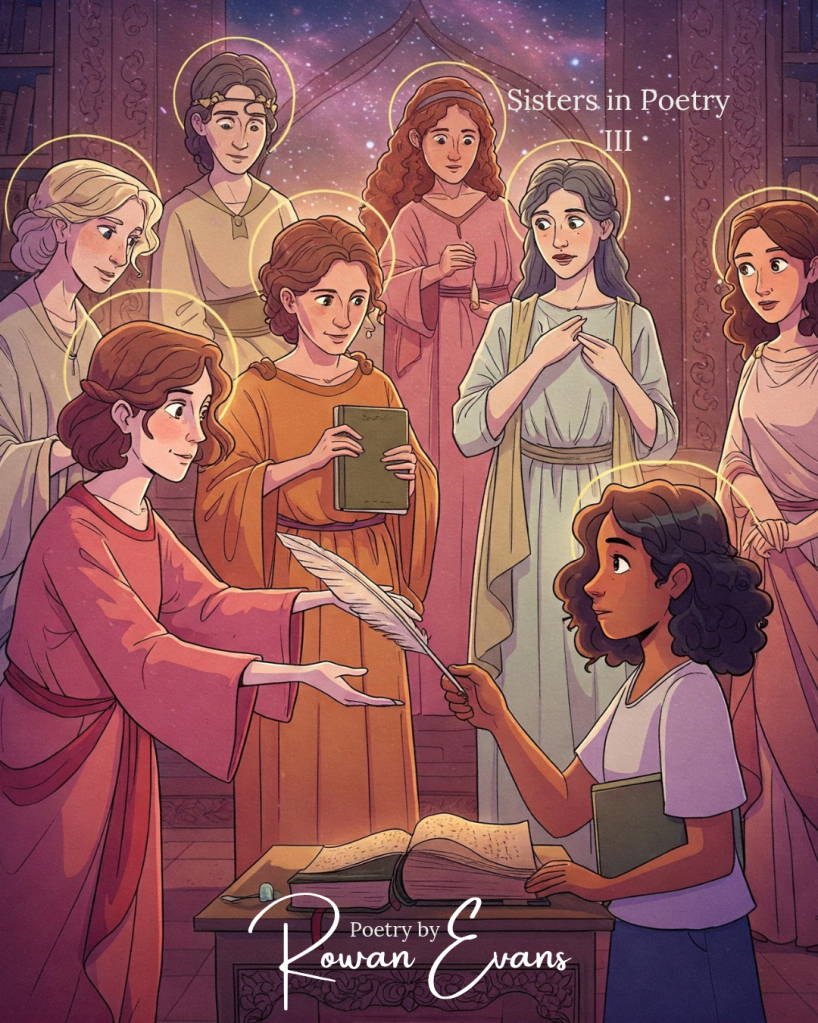
a sister in the circle,
hands stained with the same sacred fire.

So to you, future poetess,
with your storm yet to come,
your hands still inkless,
your truth still tucked beneath your ribs—
we bled through the darkness
so you could scream your truths in the light.
We carved our hearts into paper
so you’d know how to find yours.
We broke so you could build.
And now—
with trembling hands,
and a heart heavy with everything
we were never allowed to say,
I leave you this:
a page,
a pen,
and a whisper through time—

"Write, little one.
Write until the silence forgets your name.We will be listening."
“Every poetess that pens her story in Ink & Fire, my Sisters in Poetry.” – Rowan Evans
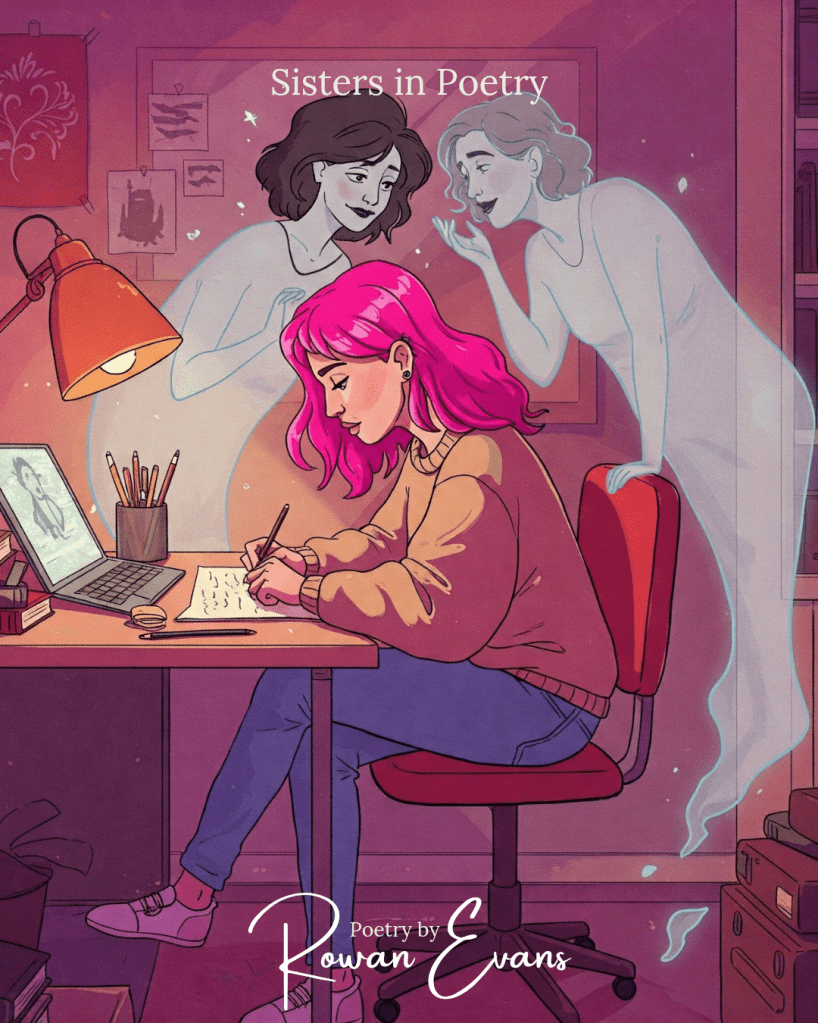
In the shadows of ink, where ghosts still linger,
Sylvia, Anne, Emily, Sappho—poetesses, each a flame,
Each a whisper in the wind that haunts the night,
Each carving truth in starlit veins.

Sylvia, whose words cut through the air,
A sharp, sorrowed edge that carved despair into the sky,
A dance of madness and brilliance,
Her bell jar—her curse, her art, her cry.
She wept in metaphors, in flames, in loss,
And yet, in her ashes, we find our own strength.

Anne, too, cast her voice into the void,
Her words a reckoning, raw and brutal,
"Live or die," she dared to scream,
And in that challenge, her spirit lingers still.
Her truth unravels in each line,
And still we rise—survivors of our own mind.

Emily, in whispers and dashes,
Her silence a weapon, her words a storm,
She dared not speak, but her ink bled through the walls,
A universe unfolding in every paused breath.
Her fleeting moments echo through time,
Where brevity meets eternity in every line.

Sappho, the fire-bringer, the lover's voice,
Her words pressed soft as rose petals on the skin,
Love—desire—woven in every lyric,
A sacred longing that lives in every heart
Whispering in the dark, a hymn to what we crave.

But then, the modern sisters rise from the depths,
A new breed of poetess, each with a fire untamed,
Amanda Lovelace, whose poems bloom like scars,
Words laced with strength and tenderness,
A revolution forged in ink—love, loss, and rebellion.

Rupi Kaur, with her tender touch and power,
Her verses as soft as a bruise, as sharp as a stare,
She writes of healing, of the body’s revolt,
Of tenderness, of rage, of broken hearts rebuilt.

Maya Angelou's wisdom, still ringing in the air,
Her voice a call to arms, to dignity, to self-worth,
She stood before the world, unbroken, unbowed,
Her truth an anthem that shook the earth.

Warsan Shire, whose words drip with fire,
Her lines like rivers of blood, burning with rage,
A refugee’s cry, a woman’s claim,
Her pain is our pain, her voice is our voice.

Lang Leav, sweet and dark, with love's bittersweet sting,
Her ink carved from the spaces between desire and heartbreak,
Her poems dance in the spaces of the soul,
Love written in whispers and shadows.

Tara Westover, whose truth is raw and real,
Each word a battle, each line a wound,
Her memoirs speak of resilience, survival,
And in that survival, we learn to thrive.

But now, the quill is mine to take,
A flame that flickers in the vast expanse,
Rowan Evans, a name now etched in fire,
A poetess who dares to speak the dark and light,
A soul woven from the whispers of those before,
Yet in every verse, my own story pours.

In the dark gothic heart, where my blood runs wild,
I write not to be them, but to find my own voice—
I take the ashes of their sorrow,
And turn it to flame, a blaze that speaks truth.
I carve my heart in ink, sharp as a blade,
A modern poetess, with fire in my veins,
I carry their legacy and make it mine,
A sister in poetry, whose time has come.

And now, as we stand in the echoes of their words,
We raise our pens in unity, for those who stand with us,
The allies who walk beside, their voices clear:
The men and women who believe in the power of ink,
Who lift us higher, who hold space in the dark,
Who see the strength in our voices, our hearts, our fight.

To those who stand beside,
Lifting the fallen, raising the weak,
To those who support without question or pause,
To those whose hands are extended,
Whose hearts beat in rhythm with our own,
In this poem, we stand together,
Sisters and allies, bound by fire and ink.

Together we rise,
Together we burn,
Together we write the future,
As poets of the soul,
As Sisters in Poetry.
In the darkened corridors of verse, where shadows weave,
Sylvia and Anne dance, their words a somber hymn,
Echoes of their pain and passion that we conceive,
Their struggles with demons, their voices grim.

Sylvia, with her haunting gaze of blue,
Wrote of a world caught in despair’s tight clutch,
In her “Ariel,” the fire of her anguish flew,
Through stark landscapes where shadows touch.

Anne, with her intense, searing flame,
Spoke of the chaos that lived within her veins,
Her “Live or Die” was a testament to the same,
A chorus of suffering, a balm for her pains.

I walk the dark paths where their words collide,
In the mirror of their suffering, my own shadows reside.
My nights spent in the mental ward’s grim embrace,
Where silence spoke louder than any face.

Their poetry, a labyrinth of tortured soul,
Reflects the fractured parts of my own shattered whole.
In Sylvia’s grief and Anne’s intense cry,
I find the language of my own torment, deep and dry.

Yet, in the echo of their despair, there lies a thread,
Of something beautiful, of ink and blood red,
A shared language of scars, a sisterhood in ink,
Where pain is transmuted, and spirits sink.

Sylvia’s “Bell Jar” and Anne’s “Hurry” twist,
Paint pictures of sorrow where our shadows exist,
Each word a dagger, each line a scream,
Bound by a dark gothic, shared dream.

In their voices, I find my own truth,
In the labyrinth of their words, I seek proof.
Our struggles intertwine in a dark ballet,
Where mental anguish finds a place to stay.

Their shadows cast long across the ink-stained page,
Where my own verses join in their dark rage.
We are sisters in poetry, bound by pain and song,
In the dark gothic echo where our voices belong.

So, I write my lines with their ghosts in tow,
Crafting my sorrow in their poetic glow.
In the realm of the dark and the deeply bruised,
Their legacy guides me, through verses abused.

For in the silence of their pages and mine,
Our shared suffering and strength intertwine,
In the dark gothic heart where our spirits meet,
Sisters in poetry, where our shadows greet
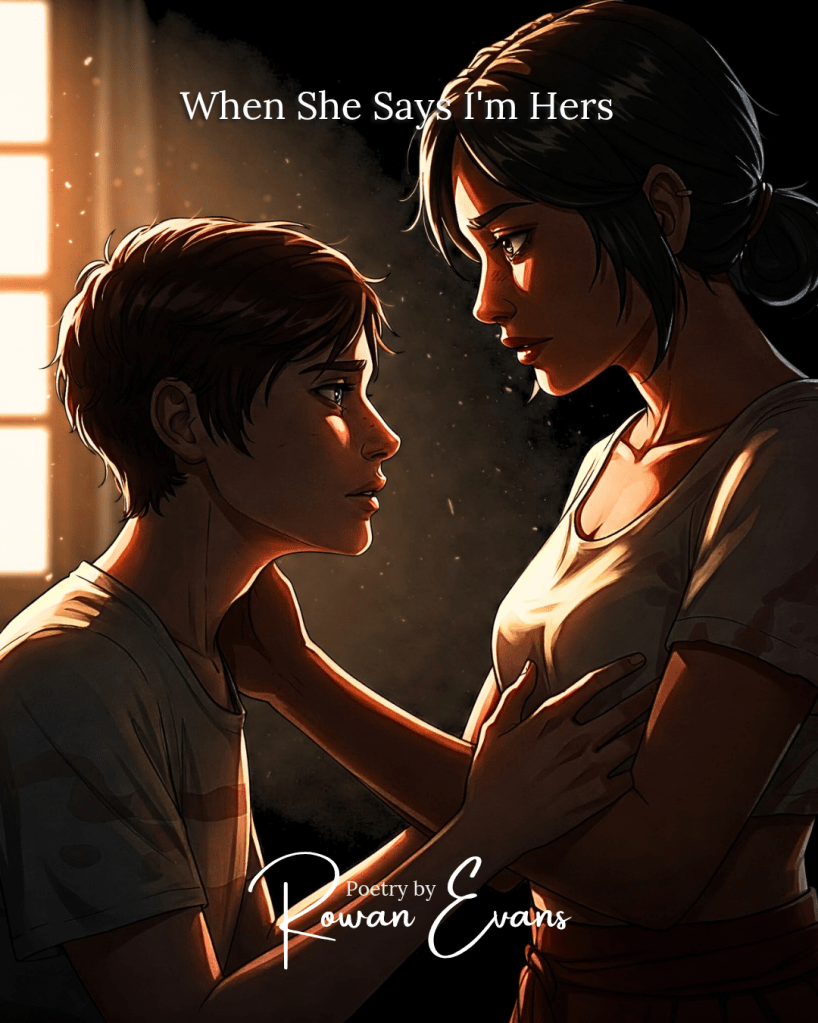
“She warned me, her voice rough with memory, jealous, strict, unpredictable, a bitch sometimes. And all I could think was— finally.” – Rowan Evans
If she whispers, I melt. If she commands, I kneel. It doesn’t take much— a glance, a breath, a shift in the weight of her silence— and I’m undone.
There’s a kind of gravity in her, like the moon to my tides. I rise for her, crash for her, shape myself around the contours of the world she’s trying to survive.
I’ve listened to her sob, sat in the silence of her storms, not to fix, not to rescue— just to be, to show her she doesn’t have to carry it all alone. And when she told me all the reasons she’s supposedly “unlovable”— I didn’t flinch. I called them green flags and meant every goddamn word.
She said, anger issues, and I saw fire— the kind that keeps you warm after others have left you in the cold.
She said, possessive, and I offered myself willingly: Take me. Keep me. Claim me.
She warned me, her voice rough with memory, jealous, strict, unpredictable, a bitch sometimes. And all I could think was— finally. Someone who doesn’t play at softness but bleeds it raw underneath sharpened edges. My kind of dangerous. My kind of queen.
She’s chaos and calm, rage and lullaby, sarcasm like sugar melting on my tongue. I told her she could be selfish, and I’d still offer up my everything. Told her I was submissive— and I meant it with reverence, not weakness. Because strength is knowing who you’d kneel for and doing it without shame.
She says I’m biased. And maybe I am. But if love isn’t bias in its most honest form, what the hell is it?
I’ve told her the truth a thousand ways— in poems, in silence, in staying when others would’ve fled. She doubts her worth, calls her heart a battlefield, and I keep showing up like a soldier with no armor, just arms open wide.
Because if she says I’m hers— in a whisper or a growl, with trembling lips or steady hands— I'd believe her. I'd belong to her.
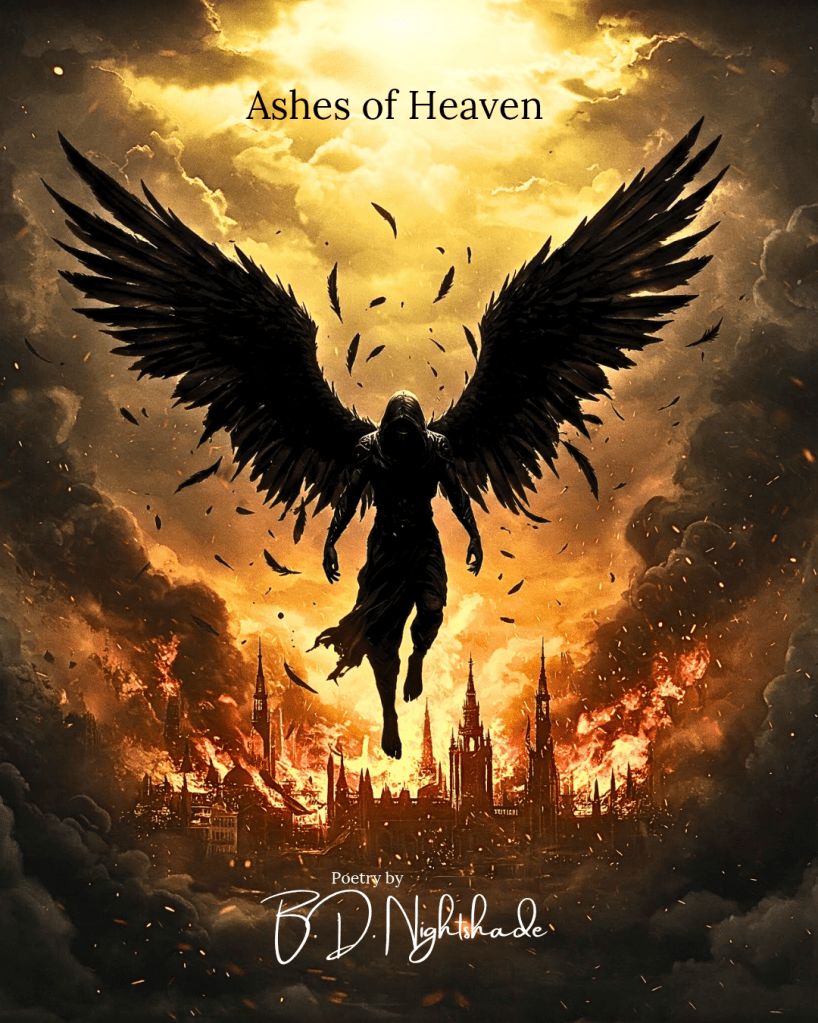
I, the fallen, wear my wings of ash,
A ruin of purity, torn and frayed,
Once bathed in light, now draped in black,
I seek the fire where Heaven decayed.

They call me traitor, rebel, lost,
An angel damned, forsaken, broken—
Yet here I stand, at Heaven’s gate,
A fallen star with words unspoken.

The seraphs sing their hollow hymns,
Their praises drip with venom sweet,
They serve a throne of gold and lies,
While humankind bends at His feet.

I came to burn the gilded halls,
To scorch the sky, to burn the crown—
To tear the veil from blinded eyes,
And watch the false gods drown.

God, the tyrant, with a smile so cruel,
Whispers of love that binds and chains,
But I—
I see the truth beneath the veil,
Where faith is just a prison’s name.

I bring the storm, I raise the flames,
To shatter every gilded lie—
Heaven, that house of broken dreams,
Shall fall to ruin from the sky.

Angels, deluded, tremble now,
As wings of light are turned to dust—
Their voices hollow, and prayers fall mute,
As I unshackle every trust.

Burn it all, let Heaven burn—
The stars will weep, the heavens crash,
For freedom’s flame will rise anew,
And in its light, the truth will flash.

I am the fallen, the one who sees,
Not bound by chains of deity—
To free the mind, to scorch the soul,And watch the heavens fall to me.


 Poetry by Rowan Evans