Sometimes you sit quietly long enough to hear things you’ve spent years trying not to hear.
This piece comes from that kind of silence—the kind where the voices around you become just as important as your own.
— Rowan Evans
Sometimes the hardest thing to carry is realizing you were never carrying it alone.
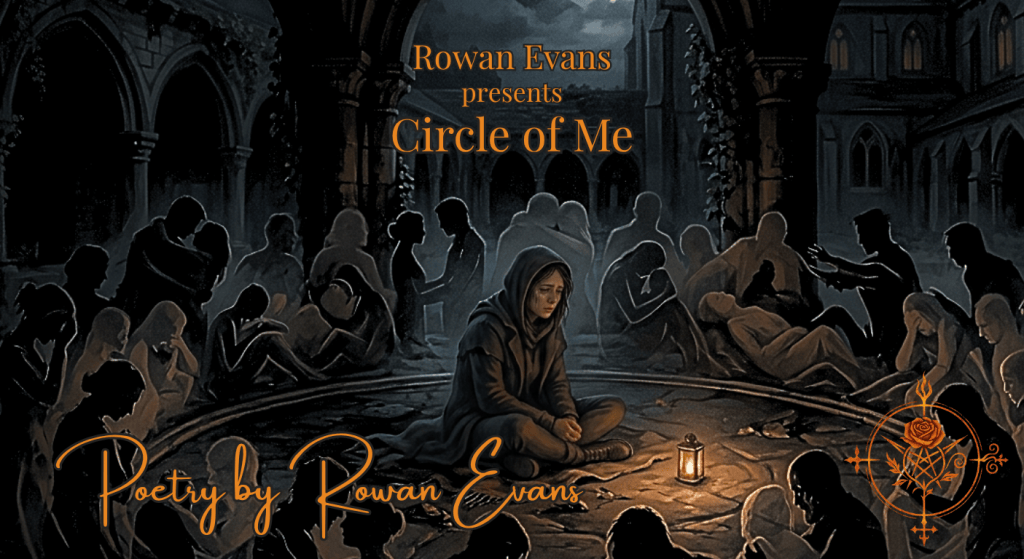
Circle of Me Poetry by Rowan Evans
I sit in a circle of me—
for the first time
since I was thirteen,
just listening…
because it’s not
my turn to speak—
some share joy,
some share pain—
and others share memories
that are hard to hear—
and in their voices
I could hear the fear,
in their eyes, see the tears—
and I feel helpless now,
just as I did back then
but now it feels different.
Heavier.
Like I’m not
just carrying
the weight of one—
I’m carrying
the weight of the sum.
It’s all of us…
it’s everyone.
Journey into the Hexverse
[High Tide] A short reflective poem about leaving, returning, and accepting the forces that pull us back—like the tide guided by the moon.
[Louder Than the Rain] A short confessional poem about the overwhelming noise of anxious thoughts, the strange silence of feeling alone in a crowded room, and finding a way to translate pain into words.
[Poet’s Curse] Poet’s Curse explores the painful side of falling too deeply: giving pieces of yourself away freely, taking accountability for your own heartbreak, and realizing that learning to let go can be harder than learning to love.
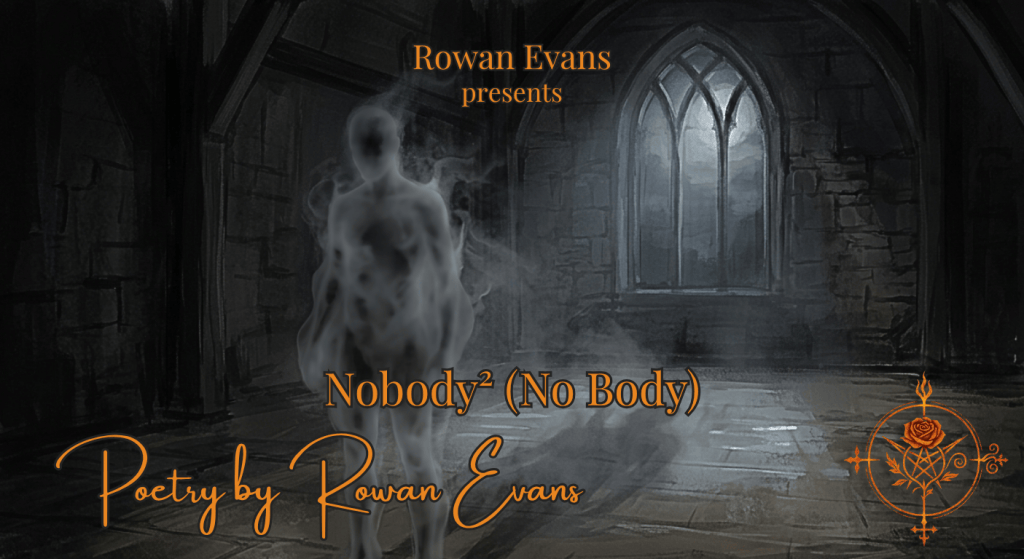
Sometimes absence isn’t just being alone. Sometimes it feels like having no body at all.
Nobody² (No Body) Poetry by Rowan Evans
I’m a nobody,
I’ve got nobody.
I’m just a ghost—
I’ve got no body.
[Rose & Ruin] Two minimalist poems exploring the opposing forces within creativity: the thoughts we cultivate into something beautiful and the darker thoughts we transform before they have a chance to decay.
[Conductor] A dark, intimate poem about the strange power words can have over the reader—where rhythm, rhyme, and line breaks become instruments capable of reaching beyond the page.
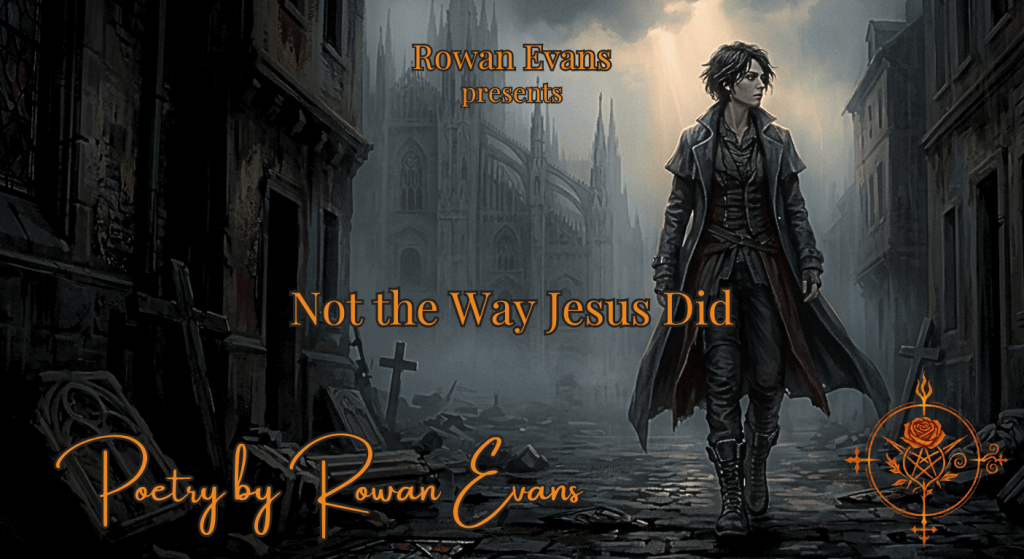
Not the Way Jesus Did (Get Stoned, Not Crucified) is intentionally irreverent. The title is meant to make you laugh, wince, or possibly do both at once—but beneath the joke is a serious frustration with religious judgment and the way people can use faith as a weapon against those they consider outsiders.
The poem isn’t really interested in attacking Christianity itself. It’s interested in the contradiction between preaching compassion and practicing condemnation. By placing myself alongside Jesus as someone walking with outcasts, misfits, and people pushed to the margins, I turn the accusation around: if your faith teaches you not to judge, why are you so determined to judge me?
The language is deliberately sharp because sometimes humor is the easiest way to expose hypocrisy. Sometimes you have to throw a little irreverence into the room before anyone is willing to look at the uncomfortable truth underneath it.
— Rowan Evans
Sometimes the people preaching judgment forget who they claim to follow.
Not the Way Jesus Did (Get Stoned, Not Crucified) Poetry by Rowan Evans
I’ve lived a life full of pain,
society throwing rocks and hate—
they think they are on the inside
of judgement’s gate.
I mean—
don’t get wrong,
I like to get stoned—
but not the way Jesus did.
If you’re offended by that,
you only see the surface—
you see the words,
but not the purpose.
You say you’re a Christian,
yet here you are trying to judge?
You know that’s not your job,
you have to leave it up to your God.
But it makes sense
you would treat me like him,
I walk the same path as he did.
Walking with the outcasts
and misfits—
the black sheep
of God’s kids.
Don’t make me a martyr
for the sins that he died for.
So, you want to know why
we don’t listen to you—
because your book
says not to listen to the fools,
preaching on corners
and praying outside of their rooms.
You do you
and leave us alone,
if we’re good people—
we’ll find our way home.
Journey into the Hexverse…
[Just Human] Just Human is a reflective free verse poem about seeing people before borders, choosing empathy over division, and finding home in our shared humanity rather than on a map.
[No You and I, Only Us] A hopeful free verse poem about empathy, borders, and imagining a world where humanity matters more than division.
[Sermon for the Fractured] Every poem I write is a sermon for the fractured soul. In Sermon for the Fractured, I explore divinity, imperfection, and the sacred act of rebuilding oneself, even when the world refuses your light.
I’ve always been fascinated by the idea that people rarely see the same person the same way. We don’t meet others as blank slates—we meet them carrying our own history, fears, hopes, and assumptions.
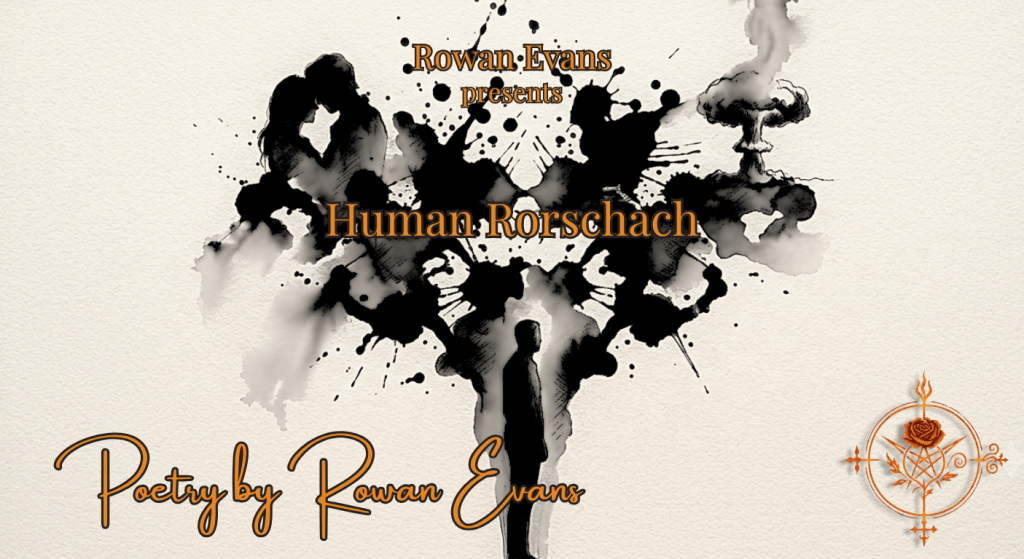
The Rorschach inkblot became the perfect metaphor for that. The inkblot itself isn’t trying to be anything; the meaning comes from the person looking at it.
Maybe people work the same way.
Every interaction is filtered through perspective, and perspective is shaped by perception, memory, and experience. Sometimes what another person believes about us reveals far more about their own journey than it does about who we actually are.
This poem is an invitation to think about that relationship between identity and interpretation—and to remember that no one is ever seen exactly as they are.
— Rowan Evans
What we see often reveals more about ourselves than the person we’re looking at.
Human Rorschach Poetry by Rowan Evans
I’m an inkblot
in human form,
a real Rorschach—
am I couple kissing,
or a mushroom cloud?
Love or destruction—
what do you see
when you look at me?
Know there are
no wrong answers—
because what you believe
is fed by what you see
and what you see is perspective,
but perspective is shaped by perception—
I am open to interpretation
and it changes,
with everything
you’ve lived through—
the things you’ve survived.
What you see
when you look at me,
says more about your life—
than it does mine.
Journey into the Hexverse…
[A Rose in the Ashes] Lost within a forest where every leaf becomes a memory, the speaker follows darkness instead of fleeing from it, discovering that healing isn’t found at the end of the tunnel—but in facing the past long enough to notice a single rose blooming through the ashes.
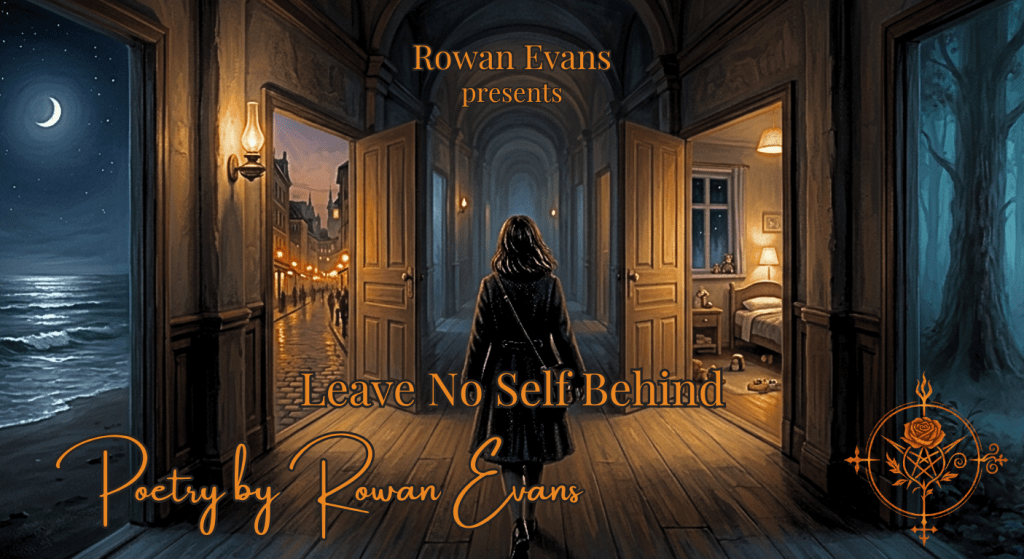
[Leave No Self Behind] What if finding yourself isn’t about discovering someone new, but learning to walk beside every version you’ve ever been? “Leave No Self Behind” is a meditation on memory, healing, and embracing the selves we once abandoned.
[Every Night, The Same Flight] Every night begins with the same flight. Between wakefulness and sleep, an airport appears, a familiar shoreline waits beyond the journey, and the same dream asks whether some destinations find us before we’re ready to find them.
[Through My View] No two people experience the world the same way. Through My View is a reflective free verse poem exploring perspective, imagination, and the impossibility of fully seeing through another person’s eyes.
[Just Human] Just Human is a reflective free verse poem about seeing people before borders, choosing empathy over division, and finding home in our shared humanity rather than on a map.
This poem grew out of a realization that getting “lost” isn’t always the same as losing yourself.
I’ve written many pieces about dreams, memory, shifting landscapes, and wandering through places that seem to exist somewhere between reality and imagination. Over time, I realized those places weren’t asking me to escape who I was—they were asking me to revisit the parts of myself I had left behind.
We often talk about “finding ourselves” as though there’s one true version waiting to be discovered. My experience has been almost the opposite. Every season of life leaves behind another version of us: the frightened one, the hopeful one, the grieving one, the joyful one. None of them disappear simply because we’ve grown older.
Healing, at least for me, isn’t replacing those earlier selves.
It’s learning to walk beside them without shame.
This poem is an invitation to stop treating old versions of ourselves as mistakes to erase and instead see them as companions who helped us survive long enough to become who we are today.
— Rowan Evans
Healing isn’t finding one true self—it’s learning to walk beside every version of yourself with compassion.
Leave No Self Behind Poetry by Rowan Evans
I feel like I’ve lost myself again—
don’t know when it began,
but I get lost a lot.
It doesn’t take much for me
to get lost in thought—
I wander off
without meaning to,
slipping between memories
like loose floorboards.
One thought opens a door,
another pulls me down a hallway,
and suddenly I’m somewhere
I didn’t plan to be—
with some version of me
I didn’t plan to meet.
Sometimes the hallway
tilts into something else—
a shoreline I’ve walked in sleep,
a city humming with heat,
a room I haven’t entered in years.
The world shifts
without warning,
and I follow it
the way I follow dreams—
half-aware,
half-afraid
of what I’ll find
in the scene change.
I never know
which version of me
I’ll find in those places—
the one who’s tired,
the one who’s trying,
the one who’s still carrying
things I swore I let go.
Sometimes I meet
the versions of me
I thought I’d outgrown—
the one who flinches,
the one who freezes,
the one who still thinks
they’re hard to love.
And I walk with them
for a while,
through whatever memory
the hallway decides to show—
letting them speak,
letting them breathe,
letting them…
exist.
Without rushing them back
into the dark.
And maybe that’s
what finding myself
really looks like—
not a single moment
of clarity,
not a sudden return,
but walking through
every hallway
my mind opens,
meeting every version
I’ve ever been,
and letting them stay
long enough
to feel seen.
Maybe I’m not lost.
Maybe I’m just learning
how to carry
all the selves
I used to abandon
when the world
felt too loud.
Maybe this time…
I won’t leave anyone—
behind.
Journey into the Hexverse…
[Where the Metaphors Lead] Some truths are easier to write than they are to say aloud. “Where the Metaphors Lead” explores the quiet space between dreams, confession, and the courage it takes to let another person know how deeply they’ve become woven into your inner world.
[Noon Is Loud] If four in the morning belongs to truth, then noon belongs to impossible memories. Noon Is Loud is a playful free verse poem filled with absurd boasts, pop culture references, and tongue-in-cheek mythology that explores how easily imagination can rewrite reality.
[5:01 (Pull the Punchline Back)] What happens when a confessional poet instinctively hides every confession behind a joke? 5:01 (Pull the Punchline Back) explores humor as emotional armor, the speed of an overactive mind, and the difficult choice between making people laugh and letting them see what’s really there.
[Chemical X] Chemical X explores the rapid, associative way one creative mind moves—from cartoons to sports, comic books to music—revealing that inspiration isn’t linear, but a collision of memory, humor, rhythm, and intuition.
[Monster Theology] What if the monsters under the bed weren’t monsters at all? Monster Theology explores difference, belonging, and the human tendency to fear what we don’t understand through a conversation with the creatures we’ve spent our lives imagining.
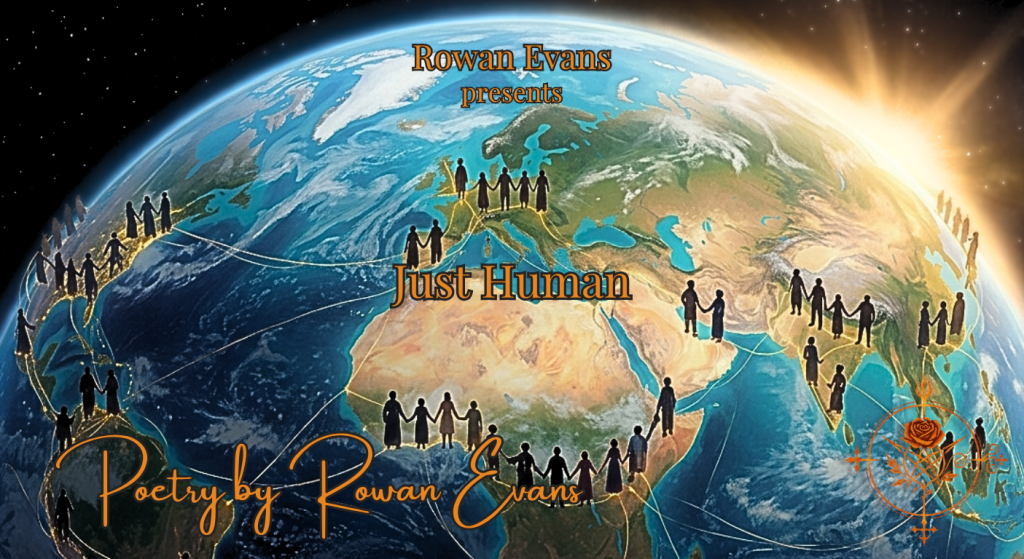
I’ve never been particularly good at thinking in borders.
When I look at a map, I see countries.
When I look at people, I don’t.
I’ve always found it easier to connect with someone’s story than with the place they happened to be born. A passport can tell you where someone came from, but it can’t tell you what keeps them awake at night, what they dream about, or what they’ve survived.
That’s the part that interests me.
This poem isn’t political.
It’s personal.
It’s an attempt to describe the way I’ve always experienced humanity—as something far larger than geography.
I don’t believe compassion should stop at a border.
I don’t believe kindness needs a nationality.
Maybe that’s why so much of my writing wanders across oceans and continents, chasing people I’ll probably never meet, writing about places I’ve only visited through dreams, conversations, photographs, and stories.
To me, humanity has always felt like one conversation happening in countless languages.
Different histories.
Different landscapes.
The same heartbeat.
That’s all this poem is trying to say.
We’re all just human.
— Rowan Evans
Before we’re anything else, we’re human.
Just Human Poetry by Rowan Evans
With my eyes wide—
I see the world.
Not one corner.
The whole globe,
and I’ve got love for it.
Every person,
every soul—
not divided by borders,
not separated by flags,
just human.
Just here.
Trying to make it
through the same sunrise
and the same storms.
Not because I know them,
but because I recognize them—
the way a heartbeat
recognizes another heartbeat
anywhere on Earth.
I don’t split the map
into colors or countries.
I don’t measure worth
by lines drawn long before I was born.
I just see people—
living, trying, hoping.
Maybe it’s the way I grew up
feeling like I belonged everywhere
and nowhere at once.
Maybe it’s the way strangers
always felt more familiar
than the places I called home.
Because home, to me,
was never a location—
it was a feeling,
a recognition,
a quiet knowing
that we’re all carrying
the same fragile humanity
through different landscapes.
And when I say
I love the world,
I mean I love its people—
the way they rise,
the way they break,
the way they keep going
even when the map
forgets their names.
Journey into the Hexverse…
[Another Fire] A powerful poem exploring global chaos, systemic inequality, and emotional exhaustion in a world where conflict grows faster than it can be understood.
[Raising Governments] A sharp, satirical poem that reframes global leadership as misbehaving children, Raising Governments blends humor with frustration to highlight the immaturity and contradictions often seen in power structures.
[Government Time-Out] A direct and controlled follow-up to Raising Governments, this poem strips away humor to confront power with accountability—demanding reflection, responsibility, and change.
[Calculating Profits (Ledger of Lives)] Calculating Profits (Ledger of Lives) is a raw anti-war poem confronting how modern conflict is often reduced to statistics, strategy, and spectacle. Through stark imagery and direct language, Rowan Evans challenges the “us vs. them” narrative and reminds readers that behind every number in war’s ledger is a human life.
[Crash Landed] A reflective poem about feeling like an outsider in a world shaped by tribalism, selective compassion, and identity-driven thinking.
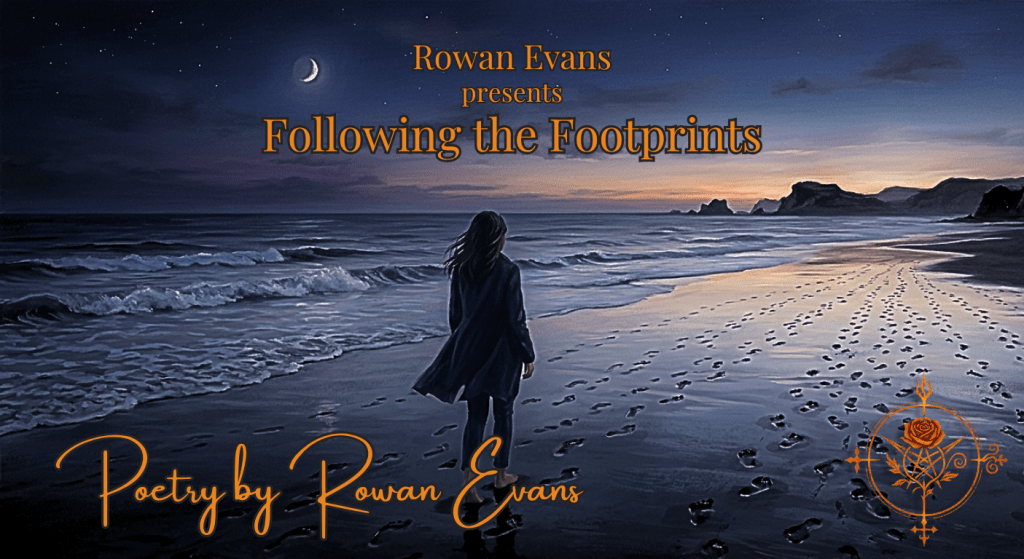
The beach, the horizon, the whispers, and the footprints aren’t meant to be frightening. They’re invitations. They represent the quiet moments when life seems to pause long enough for us to notice something we’ve been overlooking within ourselves.
I’ve written often about dreams leading me toward places that feel like home. This time, the destination wasn’t a city or a shoreline—it was a version of myself.
The footprints became a simple question:
What if the person I’m trying to become has been leaving signs for me all along?
Sometimes growth doesn’t happen by discovering somewhere new.
Sometimes it happens by recognizing the path we’ve already been walking, even when we couldn’t see it at the time.
This poem lives in that space between mystery and recognition, where intuition quietly whispers louder than certainty ever could.
— Rowan Evans
“Sometimes the path we’re searching for is already beneath our feet—we only have to choose to follow it.”
Following the Footprints Poetry by Rowan Evans
I sat at the ocean’s edge,
watching as the tide came and went—
I was lost in thought,
eyes locked on the horizon.
I was watching the sun set
as night came—
I watched the light fade.
I could hear the echoes
of whispers and laughter,
they seem to ring—
from every direction.
The beach was littered
with footprints—
but not a person in sight,
something didn’t feel right.
The air felt too still,
like the world had paused
mid‑breath.
Even the waves moved quietly,
as if they were trying
not to disturb whatever
was watching me back.
I stood up slowly,
not out of fear,
but out of recognition—
like I had been here before,
in another dream,
as another version of myself
I hadn’t met yet.
The sky darkened
in a way that felt deliberate,
as if the night was arriving
for me specifically.
The whispers grew softer,
closer,
almost familiar—
like memories I’d forgotten
were trying to find their way back.
I turned toward the footprints,
each one pressed deep
into the sand,
leading somewhere
I couldn’t see.
And I knew,
without knowing how,
that if I followed them,
I would find the part of myself—
I had been missing
for years.
Journey into the Hexverse…
[Pointing Me Home] The final poem in the No Metaphor Left Behind trilogy explores dreams, hope, and belonging. Through moonlight, ocean tides, and quiet conversation, Pointing Me Home reflects on carrying hope long before reaching the place you call home.
[Only Waiting] The second poem in the No Metaphor Left Behind series, exploring the quiet ache of growing up in a place that never truly felt like home—and finally saying aloud what years of metaphor had been trying to express.
[Crossing the Sea] A deeply personal poem about relocation, longing, and the realization that some truths naturally arrive through metaphor—even when we try to leave it behind.
[Caller ID: Destiny] Sometimes the places we visit in our dreams feel more like home than the places we wake up in. Caller ID: Destiny explores longing, belonging, and the quiet feeling that life is calling you toward somewhere new.
[Returning to My Bones] Some dreams fade the moment we wake. Others leave behind emotions that linger long after reality returns. Returning to My Bones explores the strange grief of leaving a dream that felt real enough to matter.
[Before My Feet Touch the Floor] What happens when your dreams feel more real than your waking life? Before My Feet Touch the Floor explores the strange grief of waking up, the lingering memory of dream selves, and the quiet question of which version of us is truly real.
[Just Beyond Waking] A street that feels familiar. A life that hasn’t happened yet. Just Beyond Waking explores the fragile space between dreams, memory, longing, and the quiet feeling that some futures are already waiting for us.
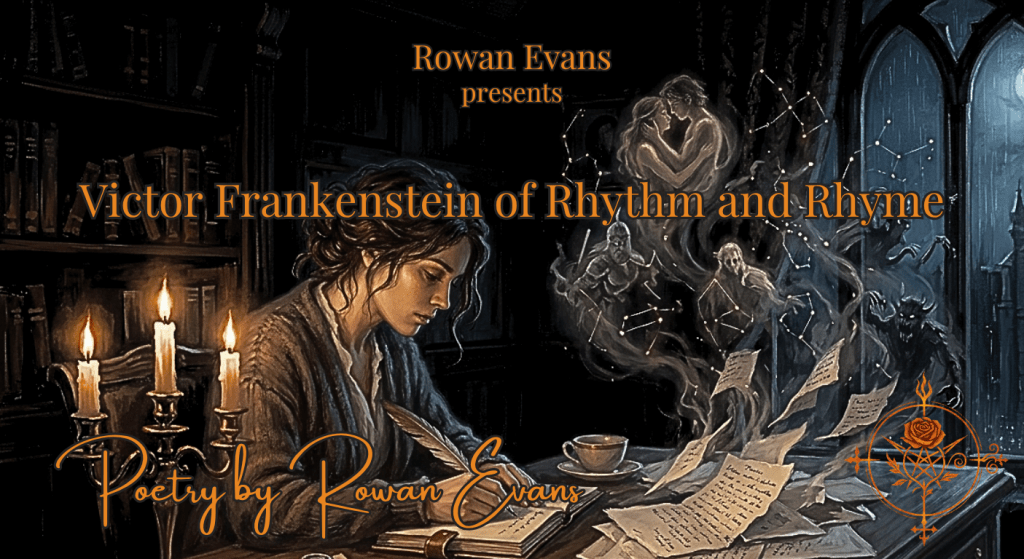
This one began with a question I wasn’t entirely prepared to answer:
Who am I without writing?
I’ve spent more than two decades translating my inner world into poetry. Over time, writing stopped feeling like something I do and started feeling like the place where I exist most completely.
That’s a strange realization.
Because poetry isn’t simply expression for me—it’s construction.
Every poem is assembled from fragments: memories, emotions, images, conversations, dreams, fears, humor, hope. I rarely invent from nothing. I gather pieces of lived experience and stitch them together until they begin breathing on their own.
That’s where the title comes from.
Victor Frankenstein wasn’t remembered because he created life.
He was remembered because he assembled it.
That’s often what writing feels like to me.
I gather disconnected thoughts, broken emotions, recurring symbols, and scattered moments, then bind them together until they become something capable of standing on its own.
The result isn’t always comfortable.
Sometimes it’s beautiful.
Sometimes it’s monstrous.
Most often…
it’s simply honest.
— Rowan Evans
“Every poem begins as fragments—thoughts, memories, emotions, and images—stitched together until they learn how to breathe.”
Victor Frankenstein of Rhythm and Rhyme Poetry by Rowan Evans
I’ll be honest—
I don’t know who I am
without this,
without the ink to bleed—
what does my life even mean?
I know it means something—
but I’ve lost sight of it.
Because I’m like a god here—
I control the shape
the ink takes
and decide what it makes.
I create every piece
in my image.
I write universes into existence—
populate them with ghosts,
lovers, gods and monsters.
And every version of myself
I couldn’t survive as alone.
I translate my mental health
from the inside, no distance.
I take my mind
translate it into lines
and images—
stitch them together
as metaphors—
Victor Frankenstein
of rhythm, rhyme and imagery.
Journey into the Hexverse…
[Pointing Me Home] The final poem in the No Metaphor Left Behind trilogy explores dreams, hope, and belonging. Through moonlight, ocean tides, and quiet conversation, Pointing Me Home reflects on carrying hope long before reaching the place you call home.
[Caller ID: Destiny] Sometimes the places we visit in our dreams feel more like home than the places we wake up in. Caller ID: Destiny explores longing, belonging, and the quiet feeling that life is calling you toward somewhere new.
[Monster Theology] What if the monsters under the bed weren’t monsters at all? Monster Theology explores difference, belonging, and the human tendency to fear what we don’t understand through a conversation with the creatures we’ve spent our lives imagining.
[Frankenstein’s Monster (and I’m the Doctor)] Some poems are built to make a point. Others are built to reveal the mechanism. Frankenstein’s Monster (and I’m the Doctor) explores associative thinking, creative chaos, and the strange process of stitching disconnected ideas into something alive.
[I’ll Be There to See Your Sunrise] Love has never come easily to me. This poem explores the fear, vulnerability, and quiet courage required to stay emotionally present when connection begins to matter deeply. “I’ll Be There to See Your Sunrise” is about choosing love despite the risk of heartbreak—and promising to remain long enough to witness someone fully.
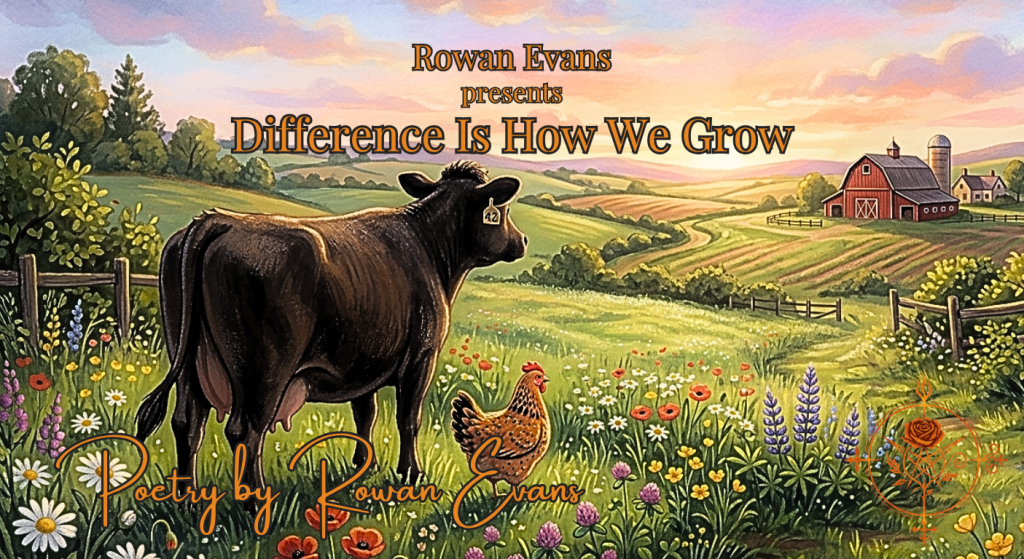
This poem started with one of those wonderfully ridiculous thoughts that refuses to leave.
What if I took the opening joke from an old cartoon and treated it completely seriously?
A chicken. A cow. A father who proudly accepts both without ever asking for an explanation.
The image made me laugh, but as I kept writing, I realized the joke was quietly carrying something much larger.
So much of life is spent convincing people that difference is something to overcome. We flatten ourselves to fit expectations, compare our gifts to someone else’s, or assume that being different somehow means being less. Nature has never worked that way.
A forest isn’t strong because every tree is identical. An orchestra doesn’t create harmony by playing the same note. Communities become richer because different people bring different strengths, experiences, perspectives, and ways of seeing the world.
That’s what this poem slowly became.
The cartoon setup stayed, because I think humor can open a door that seriousness sometimes cannot.
Once the reader laughs, they’re already listening.
And maybe they’ll leave remembering something simple:
You don’t have to become someone else to have value.
Sometimes the thing that makes you different is exactly what the world needs.
— Rowan Evans
Difference Is How We Grow Poetry by Rowan Evans
“Don’t have a cow,” they said—
why, my mama did?
You see—
Mama had a chicken.
Mama had a cow.
Dad was proud;
he didn’t care how.
And I know—
that may sound absurd to you,
but it’s a setup for a simple truth.
There is strength in our differences—
so let us try and identify
what our difference is.
Difference is not a warning sign—
it’s a spark.
A start.
A door kicked open
to a room you didn’t know you needed.
You see—
my family tree
is less a tree
and more a barnyard free‑for‑all.
Feathers in the branches,
hoofprints on the roots,
and me somewhere in the middle
trying to make sense of it all.
But difference is not disorder—
it’s the rhythm of the world
learning to harmonize.
So what makes you different—
what is your strength?
A cow gives milk,
a chicken gives eggs—
neither tries to be the other,
yet breakfast would be poorer
without both.
So what do you bring to the table—
that no one else can,
and why hide it?
Because sameness is a field gone fallow,
but difference—
difference is how we grow.
Journey into the Hexverse…
[Tots, Rocks and All] What begins as a surreal collection of tater tots, rocks, comic book references, and runaway thoughts slowly reveals something much quieter: a poem about creativity, vulnerability, and the simple hope of finding someone willing to hold your heart.
[Off Leash Thought] A reflective free verse poem exploring the mind as a living, wandering force—unpredictable, creative, and sometimes chaotic—through the metaphor of a dog off leash. It embraces mental drift not as a flaw, but as a natural part of creative thought and self-awareness.
[Monster Theology] What if the monsters under the bed weren’t monsters at all? Monster Theology explores difference, belonging, and the human tendency to fear what we don’t understand through a conversation with the creatures we’ve spent our lives imagining.
[Raccoons in Silk Pajamas] What begins with judgmental Space Chickens quickly spirals into camels in parked cars, elephants in jam jars, raccoons in silk pajamas, and astronauts in the ocean. A playful absurdist poem about language, imagination, and what happens when you stop trying to control where the words go.
[The Answer Is (Yes)] What kind of writer am I? Mythmaker, confessor, comedian, philosopher, dream-architect, romantic, storyteller, and diss-poet. This self-reflective poem explores the impossibility of fitting creativity into a single category—and embraces every version of the truth a pen can touch.
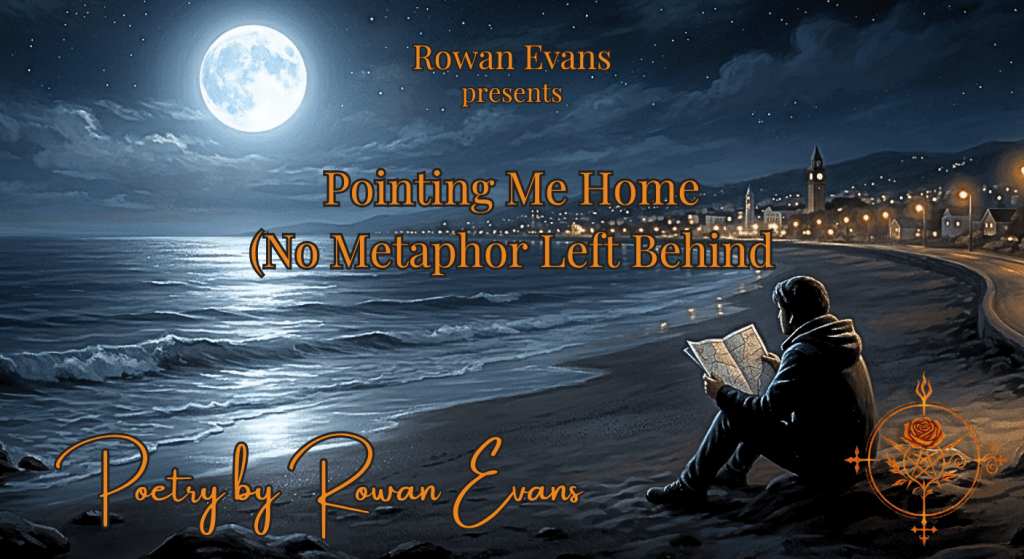
This poem became the quiet conclusion to a trilogy I never intended to write.
Crossing the Sea was about direction.
Only Waiting was about the reason I needed that direction in the first place.
This piece asks a different question:
How do you keep moving when you haven’t arrived yet?
For me, the answer has always been dreams.
Not because I confuse them with reality, but because they remind me that another reality is possible.
I’ve written about dreams for years. They rarely feel random to me. They often feel like rehearsals—small glimpses of a life my mind already believes exists somewhere beyond the horizon.
The city in this poem isn’t a specific city.
The moon isn’t really the moon.
Even after spending two poems trying to strip away metaphor, I found myself sitting beside it again.
I think that’s because hope has always spoken to me symbolically.
When I’m awake, I know where I am.
When I’m asleep, I remember where I’m going.
The dream doesn’t replace reality.
It sustains me until reality catches up.
The final image—a dream folded into my chest like a map—is probably the clearest way I’ve ever described hope.
Hope isn’t certainty.
It isn’t arrival.
It’s carrying the direction with you, even when you’re still standing at the beginning of the journey.
And maybe that’s what this trilogy has been trying to say all along.
Sometimes home begins as a place.
Sometimes it becomes an ache.
Sometimes…
it’s simply the direction you’re already walking.
— Rowan Evans
“Sometimes home isn’t where you’re standing—it’s the direction you’re already walking.” 🌙🗺️
Pointing Me Home (No Metaphor Left Behind) Poetry by Rowan Evans
Tick tock, tick tock— that’s the sound of the clock. I listen as I wait for the escape, a simple trip, brought on by sleep. Because I only feel at home in my dreams.
So as I close my eyes and my head hits the pillow— I follow the moon to the ocean’s edge, I listen to the tide— I follow it in stride until I find where it’s pulling me.
With every step, I move deeper in. Slowly sand turns to concrete beneath my feet, as the beach transitions into city streets.
Streetlights flicker like they’re remembering they used to be stars.
The hum of the city folds into the sound of waves, each echo a reminder of where I started and where I’m going.
I walk until the moon hangs between buildings like it’s lost too—
like it’s looking for someone to talk to.
So I sit and conversate, I tell the moon all about the quiet ache— the feeling that I need to change my environment to one that aligns more with what I feel inside.
And the moon sits with me, just listening—so I talk some more. Out of my heart, the words just pour. I spill every secret, I hold nothing back until I feel like I might collapse.
The moon listens, patient as ever, its light softening the edges of my thoughts.
And when I finally fall silent, breath trembling, chest heavy—
it tilts itself just enough to remind me I’m not alone in the places I wander.
Tick tock, tick tock.
A return to the rhythm of the clock, interrupting the talk— the moon’s light gives way to the sun’s rays, I’m still stuck in this place—
but I’m only waiting until I can cross the sea, Pacific and the Philippine.
Until then, I carry the dream like a map, folded in my chest—
pointing me home.
Journey into the Hexverse…
[Crossing the Sea (No Metaphor Left Behind)] A deeply personal poem about relocation, longing, and the realization that some truths naturally arrive through metaphor—even when we try to leave it behind.
[Only Waiting (No Metaphor Left Behind)] The second poem in the No Metaphor Left Behind series, exploring the quiet ache of growing up in a place that never truly felt like home—and finally saying aloud what years of metaphor had been trying to express.