Tag: dreams

  • Author’s Note

    Some nightmares aren’t about monsters.

    Sometimes the nightmare is waking up and realizing that the person you want beside you is standing beneath a completely different sky.

    My Nightmare comes from that place—the uneasy space between memory and hope, between what once felt shared and what now feels impossibly far away. It is a poem about distance, but not only the physical kind. There is distance between perspectives, between hearts, between the lives we imagine and the lives we are actually living.

    Still, even nightmares have endings.

    Sometimes you wake up before they become permanent.

    And sometimes, even while dreaming, you can still see a little gold threaded through the cracks.

    Rowan Evans


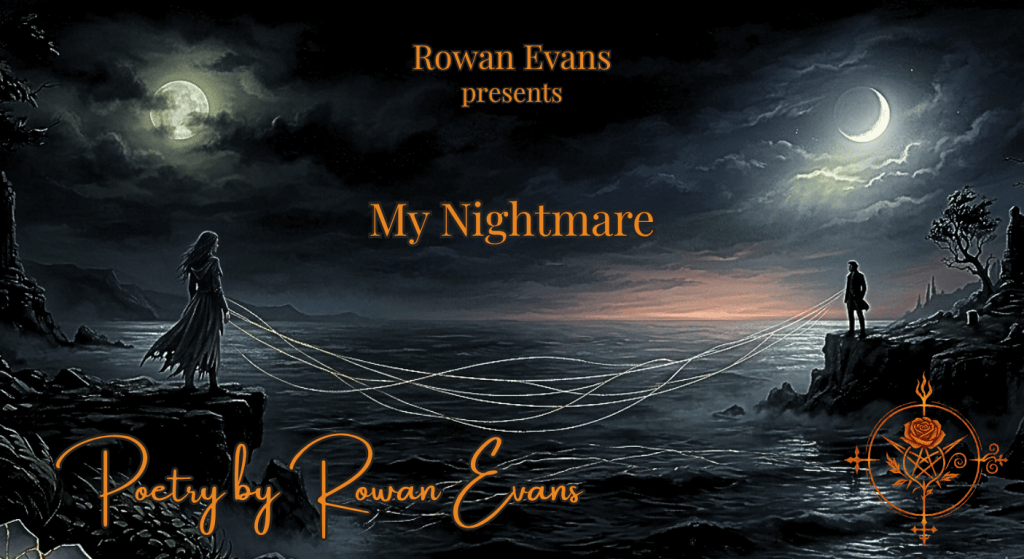
    Two distant figures stand on separate shores beneath different moons, connected across the dark ocean by faint golden and platinum threads.
    Two shores. Two skies. One horizon—and enough gold left to believe they might meet there.

    My Nightmare
    Poetry by Rowan Evans

    This is my nightmare.

    You and I across the distance,
    the view that we see is different—
    your moon from my sky
    is missing—
    the sun no longer shines,
    it’s dimming—

    I don’t see the spark anymore—
    don’t see the light in the dark anymore.
    What do I even I write for?
    I lost my purpose—think I did it on purpose,
    it’s like I can’t rhyme anymore,
    no clock, no watch, can’t tell time anymore.

    This is my nightmare.

    You and I across the distance,
    the view that we see is different—
    my moon is sickly pale,
    but yours seems fine though—
    the sun doesn’t provide light,
    it’s gotten real low—

    in times before, this is when
    I would Kintsugi the heart—
    but there’s not much heart left,
    it’s all gold—soft metal,
    softer soul—stayed warm,
    when the world grew cold.

    This is my nightmare.

    You and I across the distance,
    the view that we see is different—
    when we used to be,
    two pieces the puzzle
    was missing—
    the sun in the sky was fine,
    but it dimmed in our shine—

    I’ve spent time doing Kintsugi
    on your heart too—it was hard not to,
    gold and platinum weaved through—
    I really did see you, flaws and all—
    and all I saw was a gift from God.

    I still don’t think—
    I was wrong.

    But that was my nightmare…

    You and I across the distance,
    the view that we saw was different—
    but I still see the gold threads that connect,
    the platinum hope on the horizon,
    that one day the distance will close—
    and we’ll walk the same shore,
    it won’t be—

    mine and yours.


    Journey into the Hexverse…

    [Dreaming Wrong]
    A familiar dream becomes unsettling when the ocean becomes a pond, the tide disappears, the moon loses its reflection, and nothing feels quite like it belongs. Dreaming Wrong explores the uncanny feeling of finding yourself inside a dream that looks familiar—but feels like someone else’s.

    [Poet’s Curse]
    Poet’s Curse explores the painful side of falling too deeply: giving pieces of yourself away freely, taking accountability for your own heartbreak, and realizing that learning to let go can be harder than learning to love.

    [Beach to Beach]
    A dream becomes a journey between familiar shores and unfamiliar cities in Beach to Beach (How I Get There), a poem about imagined travel, ocean crossings, longing, and the places we hope to someday reach while awake.

    [Where the Metaphors Lead]
    Some truths are easier to write than they are to say aloud. “Where the Metaphors Lead” explores the quiet space between dreams, confession, and the courage it takes to let another person know how deeply they’ve become woven into your inner world.

    If you’re interested in more poetry, you can find it here → [The Library of Ashes]
  • Author’s Note

    Beach to Beach (How I Get There) is a small exploration of the strange geography of dreams—specifically, the way my mind seems to create its own routes between familiar places and places I’ve never physically experienced.

    I’ve written before about beaches, shorelines, the ocean, moonlight, and the city streets I encounter in my dreams. This piece connects those recurring images into something almost like a map: I leave one shore, cross the imagined sea, arrive somewhere unfamiliar, and let the dream carry me from there.

    There’s also something hopeful underneath the surrealism. These places may exist in my dreams now, but part of me wants to make that journey while awake—to eventually cross those real distances and stand on those unfamiliar shores for myself.

    Sometimes the mind dreams about places before the body ever gets there.

    Rowan Evans


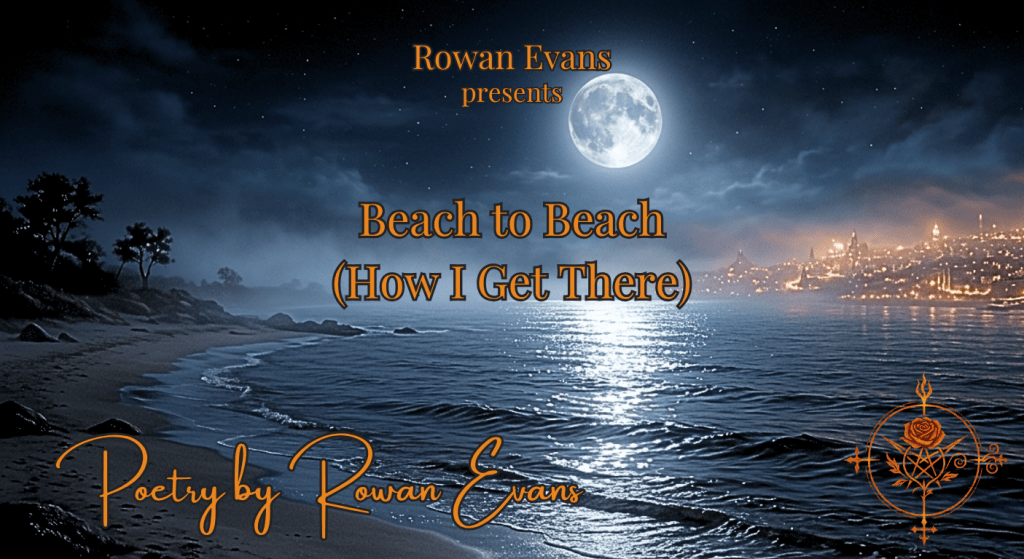
    A moonlit beach leading across the ocean toward an unfamiliar city coastline, symbolizing dream travel and longing.
    Sometimes the mind travels to places the body hasn’t reached yet.

    Beach to Beach (How I Get There)
    Poetry by Rowan Evans

    When I sleep—

    I don’t just rest,
    I drift, I travel—

    moving between worlds,
    between scenery—
    beach to city streets,
    the ones I’ve never known
    while my eyes are open.

    There is a logic my mind follows
    to travel from here to there—

    wherever here and there is,
    it goes like this:

    to leave the shores I know
    and get to the coasts I don’t—
    it’s beach to beach
    after a simple sea crossing—
    and then it’s city streets,
    while the moon watches.

    So I follow the tide
    in my mind—
    until I hit the shoreline.

    I never know what I’ll find—
    but it’s a trip I make often,
    nightly, you could say—
    it’s a trip I hope
    to make awake one day.


    Journey into the Hexverse…

    [Where The Metaphors Lead]
    Some truths are easier to write than they are to say aloud. “Where the Metaphors Lead” explores the quiet space between dreams, confession, and the courage it takes to let another person know how deeply they’ve become woven into your inner world.

    [The World Shifted Around Us]
    The world transformed around us—beach, city streets, jungle—but we never moved. Sometimes love isn’t found in words, but in the quiet certainty of someone remaining clear while everything else fades.

    [Every Night, The Same Flight]
    Every night begins with the same flight. Between wakefulness and sleep, an airport appears, a familiar shoreline waits beyond the journey, and the same dream asks whether some destinations find us before we’re ready to find them.

    [Where I Belonged]
    A bedroom becomes an airport in the space between sleep and waking. Where I Belonged explores liminal consciousness, uncertainty, and the strange moments when reality feels suspended between two worlds.

    [Opposite Coasts of the Same Silence]
    What separates two people isn’t always an ocean. Sometimes it’s the silence between everything left unsaid. Opposite Coasts of the Same Silence explores longing, distance, dreams, and the quiet hope that even across impossible divides, someone might still hear your voice.

    If you’re interested in more poetry, you can find it here → [The Library of Ashes]
  • Author’s Note

    This poem grew out of a realization that getting “lost” isn’t always the same as losing yourself.

    I’ve written many pieces about dreams, memory, shifting landscapes, and wandering through places that seem to exist somewhere between reality and imagination. Over time, I realized those places weren’t asking me to escape who I was—they were asking me to revisit the parts of myself I had left behind.

    We often talk about “finding ourselves” as though there’s one true version waiting to be discovered. My experience has been almost the opposite. Every season of life leaves behind another version of us: the frightened one, the hopeful one, the grieving one, the joyful one. None of them disappear simply because we’ve grown older.

    Healing, at least for me, isn’t replacing those earlier selves.

    It’s learning to walk beside them without shame.

    This poem is an invitation to stop treating old versions of ourselves as mistakes to erase and instead see them as companions who helped us survive long enough to become who we are today.

    Rowan Evans


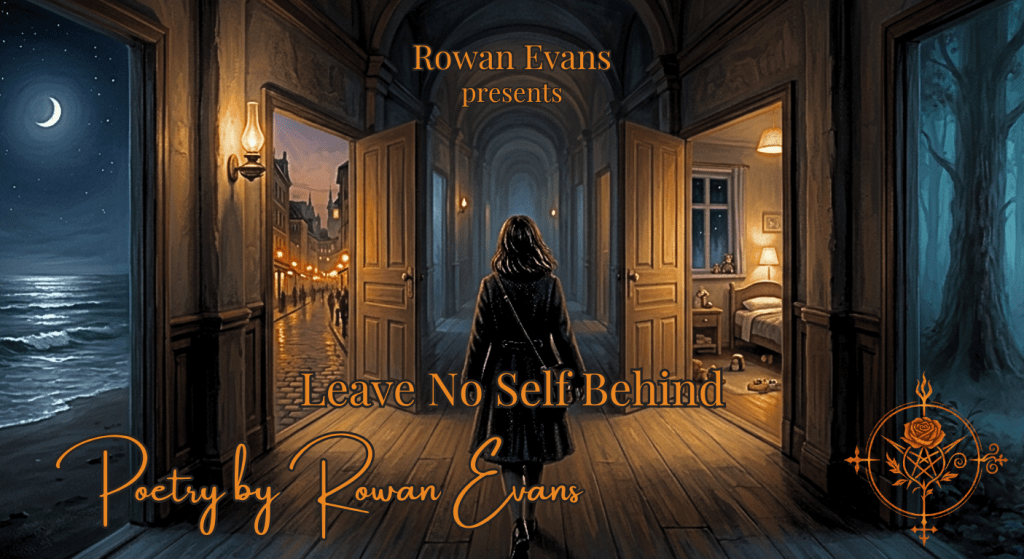
    A solitary figure walking through a dreamlike hallway where each open doorway reveals a different landscape representing memories and past versions of the self.
    Healing isn’t finding one true self—it’s learning to walk beside every version of yourself with compassion.

    Leave No Self Behind
    Poetry by Rowan Evans

    I feel like I’ve lost myself again—
    don’t know when it began,
    but I get lost a lot.

    It doesn’t take much for me
    to get lost in thought—

    I wander off
    without meaning to,
    slipping between memories
    like loose floorboards.

    One thought opens a door,
    another pulls me down a hallway,
    and suddenly I’m somewhere
    I didn’t plan to be—

    with some version of me
    I didn’t plan to meet.

    Sometimes the hallway
    tilts into something else—

    a shoreline I’ve walked in sleep,
    a city humming with heat,
    a room I haven’t entered in years.

    The world shifts
    without warning,
    and I follow it
    the way I follow dreams—

    half-aware,
    half-afraid
    of what I’ll find
    in the scene change.

    I never know
    which version of me
    I’ll find in those places—

    the one who’s tired,
    the one who’s trying,
    the one who’s still carrying
    things I swore I let go.

    Sometimes I meet
    the versions of me
    I thought I’d outgrown—

    the one who flinches,
    the one who freezes,
    the one who still thinks
    they’re hard to love.

    And I walk with them
    for a while,
    through whatever memory
    the hallway decides to show—

    letting them speak,
    letting them breathe,
    letting them…

    exist.

    Without rushing them back
    into the dark.

    And maybe that’s
    what finding myself
    really looks like—

    not a single moment
    of clarity,
    not a sudden return,
    but walking through
    every hallway
    my mind opens,
    meeting every version
    I’ve ever been,
    and letting them stay
    long enough
    to feel seen.

    Maybe I’m not lost.

    Maybe I’m just learning
    how to carry
    all the selves
    I used to abandon
    when the world
    felt too loud.

    Maybe this time…

    I won’t leave anyone—

    behind.


    Journey into the Hexverse…

    [Where the Metaphors Lead]
    Some truths are easier to write than they are to say aloud. “Where the Metaphors Lead” explores the quiet space between dreams, confession, and the courage it takes to let another person know how deeply they’ve become woven into your inner world.

    [Noon Is Loud]
    If four in the morning belongs to truth, then noon belongs to impossible memories. Noon Is Loud is a playful free verse poem filled with absurd boasts, pop culture references, and tongue-in-cheek mythology that explores how easily imagination can rewrite reality.

    [5:01 (Pull the Punchline Back)]
    What happens when a confessional poet instinctively hides every confession behind a joke? 5:01 (Pull the Punchline Back) explores humor as emotional armor, the speed of an overactive mind, and the difficult choice between making people laugh and letting them see what’s really there.

    [Chemical X]
    Chemical X explores the rapid, associative way one creative mind moves—from cartoons to sports, comic books to music—revealing that inspiration isn’t linear, but a collision of memory, humor, rhythm, and intuition.

    [Monster Theology]
    What if the monsters under the bed weren’t monsters at all? Monster Theology explores difference, belonging, and the human tendency to fear what we don’t understand through a conversation with the creatures we’ve spent our lives imagining.

    If you’re interested in more poetry, you can find it here → [The Library of Ashes]
  • Author’s Note

    Some poems begin with an idea. Others begin with a feeling that refuses to leave.

    This one was written in the early hours of the morning, during that familiar stretch of time when the world grows quiet enough for my thoughts to become louder than everything else.

    I’ve always found it easier to write than to speak. Conversations ask for immediate answers. Poetry allows me to sit with a feeling until I understand it well enough to translate it into language.

    Many of the recurring images throughout my recent work—the moon, the tide, distant shores, dreams, and city streets—have become a personal symbolic language. They aren’t separate subjects anymore. They all point toward the same emotional center.

    This poem finally acknowledges that.

    Sometimes the metaphors aren’t hiding anything.

    Sometimes they’re quietly leading us back to the truth we were trying not to say.

    Rowan Evans


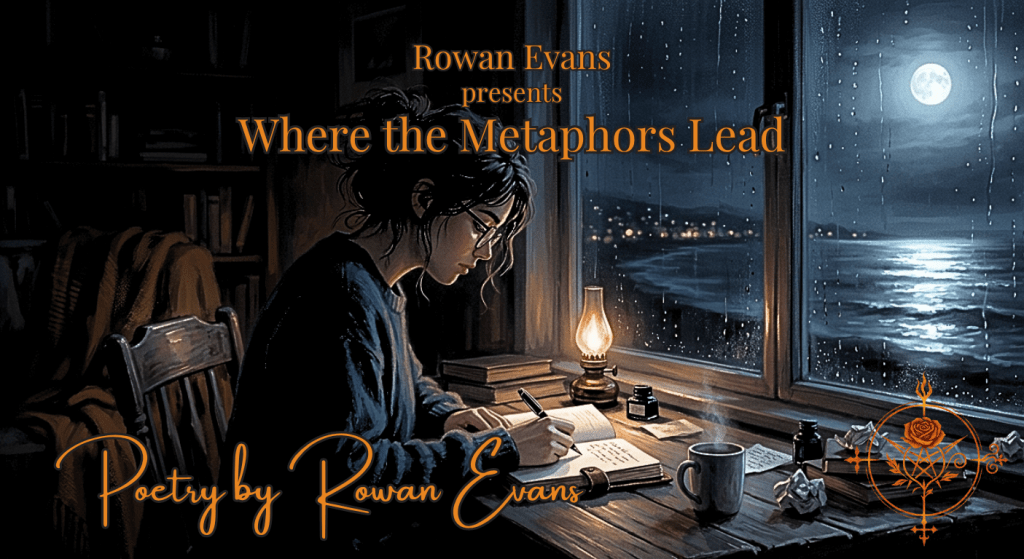
    A lone writer journaling by moonlight at four in the morning while the moon reflects across a calm ocean beyond the window.
    Some feelings only find their voice after midnight, where dreams, memory, and metaphor become impossible to tell apart.

    Where the Metaphors Lead
    Poetry by Rowan Evans

    It’s funny how I find myself here again,
    four AM—it’s just me, the music and my pen.
    I’ve got so many thoughts with so much to say,
    my lips move but no sound comes—
    like I lost one voice, when I found the other.

    And it’s not that I can’t speak—

    it’s just that words don’t come easily,
    when they try to come verbally.

    But on the page,
    everything lines up—

    the thoughts, the feelings,
    the things I never say out loud.
    Ink doesn’t trip over itself
    the way my voice does.

    So here are a few
    truths for you—

    there is a woman
    she is on my mind constantly,
    yeah, she is simultaneously
    the easiest and hardest to talk to.

    She makes me feel like I can be me—
    completely.

    And honestly,
    I’ve never really had that
    with anybody else—

    every beautiful line I write
    about the moon in the sky,
    the ocean and tide—

    yeah, most of the time
    it leads back to her
    in my mind.

    And every dream, I translate in ink—
    the shores I walk in sleep,
    secrets I try not to keep,
    even when it’s hard to speak—

    I lay them on the page and pray
    that they’ll reach their destination one day.

    So I sit here,
    four AM again,
    writing the things
    I can’t say out loud—

    hoping one day
    I’ll find the courage
    to speak them aloud.


    Journey into the Hexverse…

    [The World Shifted Around Us]
    The world transformed around us—beach, city streets, jungle—but we never moved. Sometimes love isn’t found in words, but in the quiet certainty of someone remaining clear while everything else fades.

    [Every Night, The Same Flight]
    Every night begins with the same flight. Between wakefulness and sleep, an airport appears, a familiar shoreline waits beyond the journey, and the same dream asks whether some destinations find us before we’re ready to find them.

    [Where I Belonged]
    A bedroom becomes an airport in the space between sleep and waking. Where I Belonged explores liminal consciousness, uncertainty, and the strange moments when reality feels suspended between two worlds

    [Opposites Coasts of the Same Silence]
    What separates two people isn’t always an ocean. Sometimes it’s the silence between everything left unsaid. Opposite Coasts of the Same Silence explores longing, distance, dreams, and the quiet hope that even across impossible divides, someone might still hear your voice.

    [Ocean Waves (1, 4, 3)]
    A moonlit shoreline, a rowboat full of ducks, a piggybank with no cents, and a confession hidden in plain sight. Ocean Waves (1, 4, 3) explores how humor, wordplay, and absurdity can become a side door to vulnerability when the truth feels too difficult to say directly.

    [Call of the Tide]
    A poem about identity, displacement, and the quiet pull toward something beyond the shoreline you were born on. Sometimes the tide calls louder than the anthem.

    If you’re interested in more poetry, you can find it here → [The Library of Ashes]
  • Author’s Note

    Some poems don’t begin with an idea.

    They begin with resistance.

    This one came from that familiar place I’ve written about before: four in the morning, when the world is quiet enough that my thoughts become impossible to ignore.

    I started writing about fear, but somewhere along the way I realized I wasn’t afraid of the page.

    The page has never been the problem.

    Ink has always been brave.

    It says the things I hesitate to speak.

    The real fear has always been what happens after the words exist.

    What happens when a confession leaves the safety of metaphor.

    When it stops being “the moon,” “the tide,” or “the shore,” and simply becomes the truth.

    If you’ve read much of my recent work, you’ll probably recognize many of the images here. The moon. The bay. The ocean. The distant shoreline. Dreams that feel more like memories than imagination.

    They’re all still here.

    Only this time, the poem admits something they’ve been pointing toward all along.

    Sometimes metaphors aren’t hiding the truth.

    They’re slowly teaching us how to say it.

    Rowan Evans


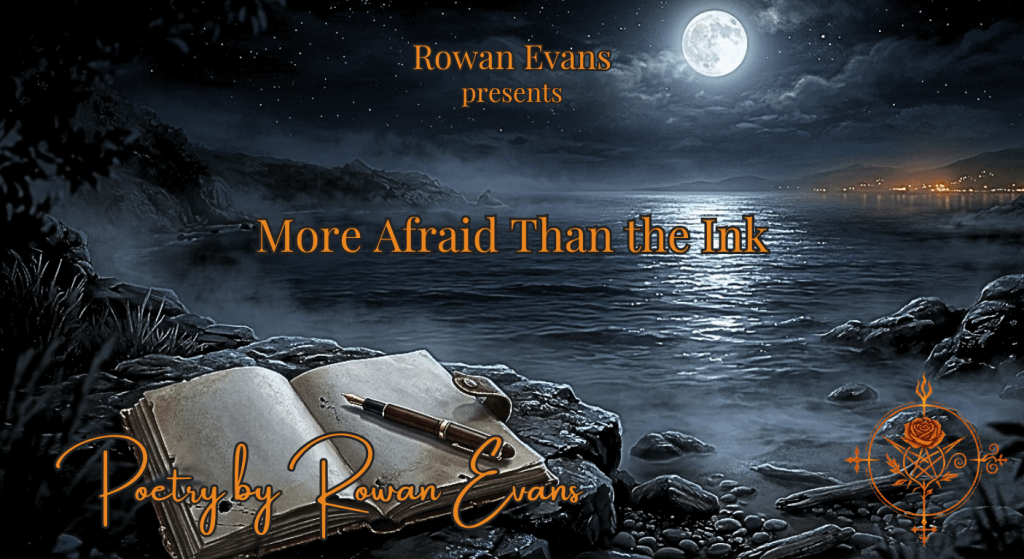
    An open journal and fountain pen beside a moonlit bay with shimmering reflections across calm water.
    Sometimes the ink is willing to tell the truth long before the poet is.

    More Afraid Than the Ink
    Poetry by Rowan Evans

    Four AM again—
    I breathe in and try to center myself,
    but it doesn’t seem to help.
    My mind wanders—
    moving from idea to truth
    and back again,
    carrying a collection of images
    and broken metaphors.

    The ink runs from my pen—
    like it’s scared of it.
    Because sometimes,
    my thoughts are dark
    and there’s no light in it.
    It trembles—
    lines becoming jagged
    as the truth hits
    a little too close to home.

    And the metaphors
    are broken for sure—
    it’s like I see the moon,
    but it doesn’t shimmer anymore.
    I don’t see the bay,
    I don’t feel the tide.

    There’s no ache,
    no longing for connection—
    across a divide
    an ocean wide.

    Okay, I lied.

    At night, when I close my eyes
    and my head hits the pillow—
    I feel the tide,
    it tugs at the heartstrings inside.
    I hear the waves, feel the ocean spray—
    and I see the familiar shimmer,
    the way the moon’s light trembles
    across dark water.

    The tide is why I dream of your shores—
    it’s why I walk your streets in sleep.
    And the moon provides the spotlight
    for every confession
    I speak with eyes closed…

    for every confession
    that I cannot say aloud,
    not outside of my dreams—not now,
    because I’m more afraid
    than the ink is.


    Journey into the Hexverse…

    [When the Veil Is Thin]
    Some truths wait until after four in the morning to make themselves known. When the Veil Is Thin explores insomnia, longing, quiet vulnerability, and the thoughts that become impossible to ignore before dawn.

    [Ocean Waves (1, 4, 3)]
    A moonlit shoreline, a rowboat full of ducks, a piggybank with no cents, and a confession hidden in plain sight. Ocean Waves (1, 4, 3) explores how humor, wordplay, and absurdity can become a side door to vulnerability when the truth feels too difficult to say directly.

    [The Language Her Soul Speaks]
    What if love isn’t about being understood, but learning to understand someone else? “The Language Her Soul Speaks” is a free verse poem about intimacy, communication, curiosity, and the desire to know another person beyond the limits of language.

    If you’re interested in more poetry, you can find it here → [The Library of Ashes]
  • Author’s Note

    This poem came directly from a real experience.

    I had fallen asleep.

    When I “woke up”, and I had closed my eyes for only a moment, and suddenly I wasn’t in my room anymore.

    I was standing in an airport.

    Not imagining one.

    Experiencing one.

    I could hear jet engines humming. I could hear people talking around me. I could hear footsteps crossing polished tile. It was detailed enough that, for a few seconds, I questioned whether I’d actually opened my eyes at all.

    When I finally did, my bedroom was still there.

    The airport wasn’t.

    But it also didn’t feel entirely gone.

    That strange overlap fascinated me.

    It wasn’t a dream in the usual sense, because I knew I was awake.

    It wasn’t reality either, because I knew where I actually was.

    It was something in between.

    I’ve written many poems about dreams, liminal spaces, and the moments where consciousness feels uncertain.

    This felt different.

    There wasn’t fear.

    There wasn’t confusion.

    There was only hesitation.

    A quiet instinct that if I moved too quickly, I might somehow choose one reality over another.

    The final lines stayed almost exactly as they arrived because I realized they didn’t need an explanation.

    Sometimes the most honest thing a poem can do is preserve uncertainty instead of solving it.

    I still don’t know exactly what happened that morning.

    I only know how it felt.

    And sometimes feeling is the only truth poetry needs.

    Rowan Evans


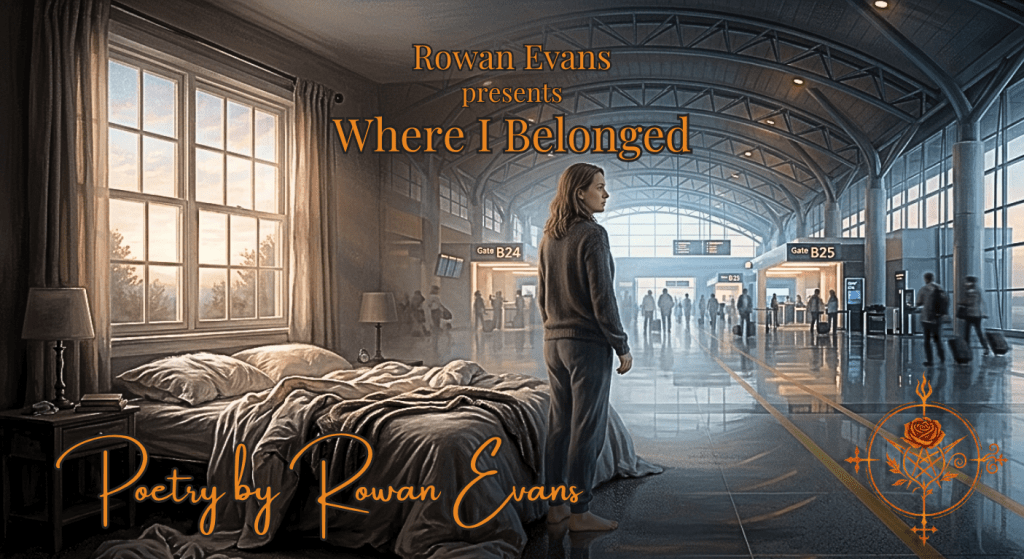
    A lone figure stands between a quiet bedroom and a dreamlike airport terminal as the two realities blend together.
    Sometimes waking isn’t returning—it’s deciding which reality you’re standing in.

    Where I Belonged
    Poetry by Rowan Evans

    I closed my eyes—
    my room around me,
    then the hum
    of jet engines filled the air.
    The muttering of people,
    and footsteps as they
    walked past me.

    It shouldn’t have felt real,
    but it did—

    the cold tile under my feet,
    the distant announcement
    I couldn’t quite make out,
    the sense that everyone
    was going somewhere
    except me.

    I opened my eyes,
    expecting the room
    to steady itself,
    but the air still carried
    the echo of departure.

    It felt like the world
    had changed its mind
    about where I was.
    One moment: carpet, quiet,
    the familiar weight of my own breathing.

    The next: a terminal
    I didn’t remember entering,
    voices rising and falling
    like tides around me.

    I stayed still,
    as if movement would decide
    which reality I belonged to.


    Journey into the Hexverse…

    [Following the Footprints]
    Standing alone on a quiet shoreline, the speaker discovers mysterious footprints leading into the unknown—and realizes they may point not toward another place, but toward the missing parts of themselves.

    [Pointing Me Home]
    The final poem in the No Metaphor Left Behind trilogy explores dreams, hope, and belonging. Through moonlight, ocean tides, and quiet conversation, Pointing Me Home reflects on carrying hope long before reaching the place you call home.

    [Caller ID: Destiny]
    Sometimes the places we visit in our dreams feel more like home than the places we wake up in. Caller ID: Destiny explores longing, belonging, and the quiet feeling that life is calling you toward somewhere new.

    [A Heart That Echoes in Another Language]
    A poetic journey through music across Japan, Korea, China, and the Philippines, exploring how sound becomes identity, memory, and emotional geography.

    If you’re interested in more poetry, you can find it here → [The Library of Ashes]

  • Author’s Note

    There seems to be something about four in the morning.

    Not because it’s magical in any supernatural sense, but because it’s quiet enough that there’s nowhere left for your thoughts to hide.

    I’ve written several poems that begin around that hour, and they all seem to share the same quality: honesty arrives before I have time to edit it.

    This poem came from one of those mornings.

    I wasn’t trying to write a love poem.

    I was trying to understand why certain thoughts become louder when the rest of the world falls silent.

    The title, When the Veil Is Thin, can be read a lot of ways. Some people hear something mystical in it. For me, it’s more psychological.

    The veil is simply the distance between what I feel and what I’m willing to admit.

    During the day, that veil is thick.

    By four in the morning…

    it becomes almost transparent.

    This poem isn’t really about insomnia.

    It’s about the moments when the truth finally stops whispering and starts speaking clearly enough that you can no longer pretend not to hear it.

    Rowan Evans


    A sleepless writer sits beside an open notebook as moonlight fades into the first light of dawn through a bedroom window.
    Some truths wait until the world is quiet enough to be heard.

    When the Veil Is Thin
    Poetry by Rowan Evans

    It’s after four AM
    and the veil is thin—
    I should be asleep
    but my mind won’t
    cease to speak.

    It won’t stop the talk—
    I try to write, just anything—
    because this is when the truth
    seems to sing,
    it rings through the ink—

    It’s you in every thought—
    and I can’t seem to shake
    this feeling in my chest.

    It’s not a weight, just an ache—
    sometimes it keeps me awake.

    And I try—I try so hard
    to just say the things,
    but I bite my tongue
    and my mouth snaps shut.

    It’s got me screaming—
    what the…

    Why am I still up?

    I’m still awake,
    with thoughts I can’t shake.
    With dreams just out of reach
    of shores I’m longing for—

    I just need to be clear.
    It’s not the thought
    of your hand in mine.

    It’s the thought of our time,
    together, intertwined—

    maybe when dawn breaks
    this feeling will ease—
    but for now, it lingers,
    soft as the moon on my skin.

    The veil thins again—
    and in the hush before morning,
    your name is the only truth
    that doesn’t fade.

    The sky begins to pale—
    and I let the thought of you
    carry me into sleep.


    Journey into the Hexverse…

    [Where Intimacy Begins]
    For some, attraction begins with appearance. For others, it begins with conversation. Where Intimacy Begins explores the beauty of curiosity, deep listening, and the quiet connection that forms when two minds truly meet.

    [The Life of a Witness Poet]
    What does it mean to love someone when the greatest act of care is simply witnessing their life? This poem explores quiet devotion, distance, and the compassionate heart of a witness poet.

    [What I’m Trying to Say]
    What begins as an exaggerated promise of love slowly strips itself back until only one simple truth remains: real devotion isn’t found in grand gestures—it’s found in consistently showing up.

    [Recognizes Home]
    A free-verse poem exploring the difference between love as dependency and love as choice. It challenges the idea that love must be need-based, instead centering the quiet strength of choosing someone while still remaining whole on your own.

    If you’re interested in more poetry, you can find it here → [The Library of Ashes]

  • Author’s Note

    Some distances aren’t measured in miles.

    They’re measured in conversations you haven’t had yet.

    In words that stayed behind your teeth.

    In the quiet space between two people who are looking toward one another but still can’t quite bridge the water between them.

    I’ve always been drawn to oceans because they represent contradiction. Water connects continents, yet it also separates them. It carries messages, memories, ships, storms—and still leaves shorelines untouched by one another.

    That became the emotional center of this poem.

    The “opposite coasts” aren’t necessarily literal places. They’re two inner worlds existing at the same time, close enough to imagine, far enough that neither person can simply step across.

    The moon became the only thing capable of visiting both shores.

    It witnesses both sides equally.

    It touches both tides.

    Yet even it cannot erase the distance.

    This poem isn’t about giving up.

    It’s about acknowledging that some silences become landscapes of their own—and learning to live honestly inside them until, perhaps, one day, the tide changes.

    Rowan Evans


    Two figures stand on opposite moonlit shores separated by a wide ocean as the full moon reflects across the water between them.
    Some distances aren’t measured in miles—they’re measured in everything left unsaid.

    Opposite Coasts of the Same Silence
    Poetry by Rowan Evans

    I sit—moon kissed,
    watching the tide
    inside my mind—
    as dreams move in,
    and thoughts roll out.

    It’s an ocean wide,
    this divide between us.
    I can see your shore in my mind,
    but I can’t seem to reach it—
    we stand on opposite coasts
    of the same silence.

    It’s a silence
    full of things I never said.
    A silence
    shaped like your name.

    The moon hangs between us
    like a quiet messenger—
    I whisper secrets for her to carry
    from my shore to yours.
    It pulls at your tide and mine,
    but never enough to close the distance.

    Sometimes I swear
    I hear your voice in the undertow.
    The distance hums
    with everything unfinished.

    Every wave reaches
    for something it can’t hold.
    The water keeps returning,
    but you don’t.
    There are whole storms between us
    I never learned to name.
    Currents I can feel but not follow.


    Journey into the Hexverse…

    [Where Intamacy Begins]
    For some, attraction begins with appearance. For others, it begins with conversation. Where Intimacy Begins explores the beauty of curiosity, deep listening, and the quiet connection that forms when two minds truly meet.

    [I’d Rather Try]
    Anyone can promise they’d die for someone. But love isn’t built on one dramatic moment—it’s built on showing up, trying again tomorrow, and proving your words through consistent action.

    [Pointing Me Home]
    The final poem in the No Metaphor Left Behind trilogy explores dreams, hope, and belonging. Through moonlight, ocean tides, and quiet conversation, Pointing Me Home reflects on carrying hope long before reaching the place you call home.

    [Ocean Waves (1, 4, 3)]
    A moonlit shoreline, a rowboat full of ducks, a piggybank with no cents, and a confession hidden in plain sight. Ocean Waves (1, 4, 3) explores how humor, wordplay, and absurdity can become a side door to vulnerability when the truth feels too difficult to say directly.

    [I’ll Be There to See Your Sunrise]
    Love has never come easily to me. This poem explores the fear, vulnerability, and quiet courage required to stay emotionally present when connection begins to matter deeply. “I’ll Be There to See Your Sunrise” is about choosing love despite the risk of heartbreak—and promising to remain long enough to witness someone fully.

    If you’re interested in more poetry, you can find it here → [The Library of Ashes]
  • Author’s Note

    This poem became the quiet conclusion to a trilogy I never intended to write.

    Crossing the Sea was about direction.

    Only Waiting was about the reason I needed that direction in the first place.

    This piece asks a different question:

    How do you keep moving when you haven’t arrived yet?

    For me, the answer has always been dreams.

    Not because I confuse them with reality, but because they remind me that another reality is possible.

    I’ve written about dreams for years. They rarely feel random to me. They often feel like rehearsals—small glimpses of a life my mind already believes exists somewhere beyond the horizon.

    The city in this poem isn’t a specific city.

    The moon isn’t really the moon.

    Even after spending two poems trying to strip away metaphor, I found myself sitting beside it again.

    I think that’s because hope has always spoken to me symbolically.

    When I’m awake, I know where I am.

    When I’m asleep, I remember where I’m going.

    The dream doesn’t replace reality.

    It sustains me until reality catches up.

    The final image—a dream folded into my chest like a map—is probably the clearest way I’ve ever described hope.

    Hope isn’t certainty.

    It isn’t arrival.

    It’s carrying the direction with you, even when you’re still standing at the beginning of the journey.

    And maybe that’s what this trilogy has been trying to say all along.

    Sometimes home begins as a place.

    Sometimes it becomes an ache.

    Sometimes…

    it’s simply the direction you’re already walking.

    Rowan Evans


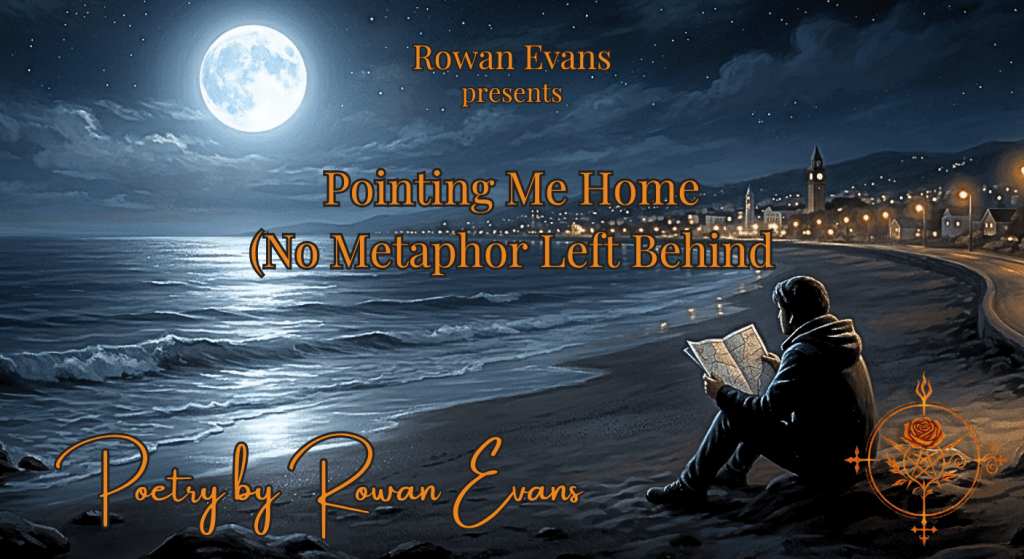
    A lone figure sits beneath a full moon where an ocean shoreline transitions into quiet city streets, holding a folded map while reflecting on hope, dreams, and the journey toward home.
    “Sometimes home isn’t where you’re standing—it’s the direction you’re already walking.” 🌙🗺️

    Pointing Me Home (No Metaphor Left Behind)
    Poetry by Rowan Evans

    Tick tock, tick tock—
    that’s the sound of the clock.
    I listen as I wait for the escape,
    a simple trip, brought on by sleep.
    Because I only feel at home
    in my dreams.

    So as I close my eyes
    and my head hits the pillow—
    I follow the moon
    to the ocean’s edge,
    I listen to the tide—
    I follow it in stride
    until I find where it’s pulling me.

    With every step,
    I move deeper in.
    Slowly sand turns to concrete
    beneath my feet,
    as the beach transitions
    into city streets.

    Streetlights flicker
    like they’re remembering
    they used to be stars.

    The hum of the city
    folds into the sound of waves,
    each echo a reminder
    of where I started
    and where I’m going.

    I walk until the moon
    hangs between buildings
    like it’s lost too—

    like it’s looking for someone to talk to.

    So I sit and conversate,
    I tell the moon all about the quiet ache—
    the feeling that I need to change
    my environment to one that aligns
    more with what I feel inside.

    And the moon sits with me,
    just listening—so I talk some more.
    Out of my heart, the words just pour.
    I spill every secret, I hold nothing back
    until I feel like I might collapse.

    The moon listens,
    patient as ever,
    its light softening
    the edges of my thoughts.

    And when I finally fall silent,
    breath trembling,
    chest heavy—

    it tilts itself
    just enough
    to remind me
    I’m not alone
    in the places I wander.

    Tick tock, tick tock.

    A return to the rhythm of the clock,
    interrupting the talk—
    the moon’s light gives way
    to the sun’s rays,
    I’m still stuck in this place—

    but I’m only waiting
    until I can cross the sea,
    Pacific and the Philippine.

    Until then,
    I carry the dream like a map,
    folded in my chest—

    pointing me home.


    Journey into the Hexverse…

    [Crossing the Sea (No Metaphor Left Behind)]
    A deeply personal poem about relocation, longing, and the realization that some truths naturally arrive through metaphor—even when we try to leave it behind.

    [Only Waiting (No Metaphor Left Behind)]
    The second poem in the No Metaphor Left Behind series, exploring the quiet ache of growing up in a place that never truly felt like home—and finally saying aloud what years of metaphor had been trying to express.

    If you’re interested in more poetry, you can find it here → [The Library of Ashes]
  • Author’s Note

    Some dreams stay with me because of what happens in them.

    Others stay because of how they make me feel after I wake up.

    This poem belongs to the second kind.

    Lately, I’ve found myself dreaming about places I’ve never lived but somehow recognize. Cities that feel familiar before I arrive. Streets that carry a strange sense of belonging. When I wake, there’s often a brief moment where those places feel more like home than the room I’m actually in.

    That feeling became the heart of this piece.

    The image of a phone call arrived almost immediately. Not as a literal phone, but as the unmistakable sensation that something beyond my current life keeps trying to get my attention. The title came from asking myself what that call would look like if it appeared on a screen.

    Caller ID: Destiny.

    The final stanza is probably the most honest part of the poem.

    It’s not really about wanting to sleep.

    It’s about wanting to wake up somewhere that feels like I’m finally living the life I’ve been moving toward for years.

    Sometimes dreams aren’t an escape from reality.

    Sometimes they’re reminders that another future still feels possible.

    Rowan Evans


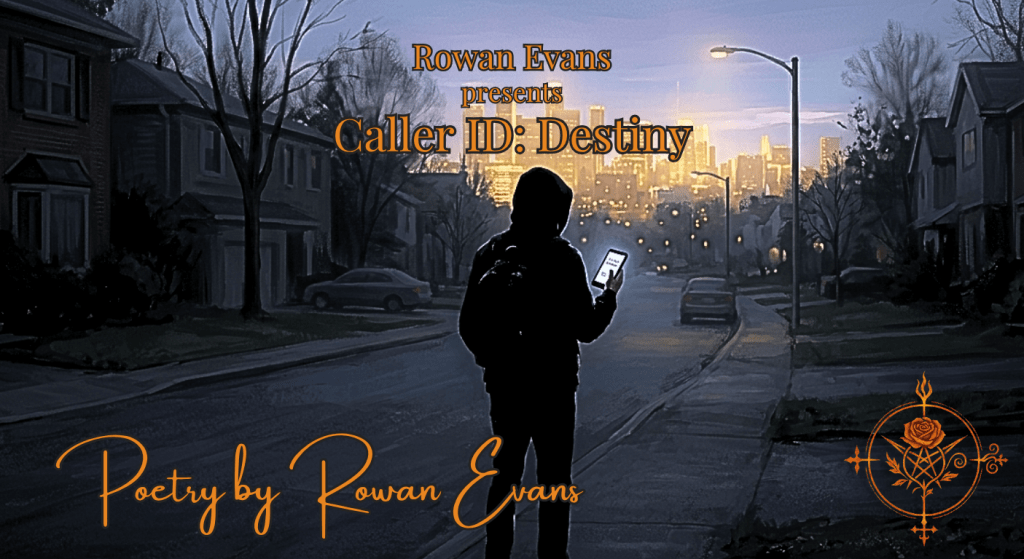
    A person standing alone on a quiet street at dawn holding a glowing phone that reads "Caller ID: Destiny," while a luminous dreamlike city shines in the distance.
    Sometimes the loudest call doesn’t come from a phone—it comes from the life waiting for you beyond the horizon.

    Caller ID: Destiny
    Poetry by Rowan Evans

    As the haze of sleep
    finally leaves,
    I find myself missing
    the dreams.

    In my sleep
    I walk the streets
    in the places
    that are calling me.

    It’s like my phone is ringing
    off the hook—

    caller id reads:
    Destiny.

    Message received:
    “Time to leave.”

    I’m done begging
    where I’m from—
    to notice me.

    I feel seen
    in my dreams,
    and invisible
    in my streets.

    So I’d rather sleep
    than be awake
    in this state.


    Journey into the Hexverse…

    [Crossing the Sea (No Metaphor Left Behind)]
    A deeply personal poem about relocation, longing, and the realization that some truths naturally arrive through metaphor—even when we try to leave it behind.

    [Only Waiting (No Metaphor Left Behind)]
    The second poem in the No Metaphor Left Behind series, exploring the quiet ache of growing up in a place that never truly felt like home—and finally saying aloud what years of metaphor had been trying to express.

    [Returning to My Bones]
    Some dreams fade the moment we wake. Others leave behind emotions that linger long after reality returns. Returning to My Bones explores the strange grief of leaving a dream that felt real enough to matter.

    [Before My Feet Touch the Floor]
    What happens when your dreams feel more real than your waking life? Before My Feet Touch the Floor explores the strange grief of waking up, the lingering memory of dream selves, and the quiet question of which version of us is truly real.

    If you’re interested in more poetry, you can find it here → [The Library of Ashes]