Tag: diversity

  • Author’s Note

    This poem started with one of those wonderfully ridiculous thoughts that refuses to leave.

    What if I took the opening joke from an old cartoon and treated it completely seriously?

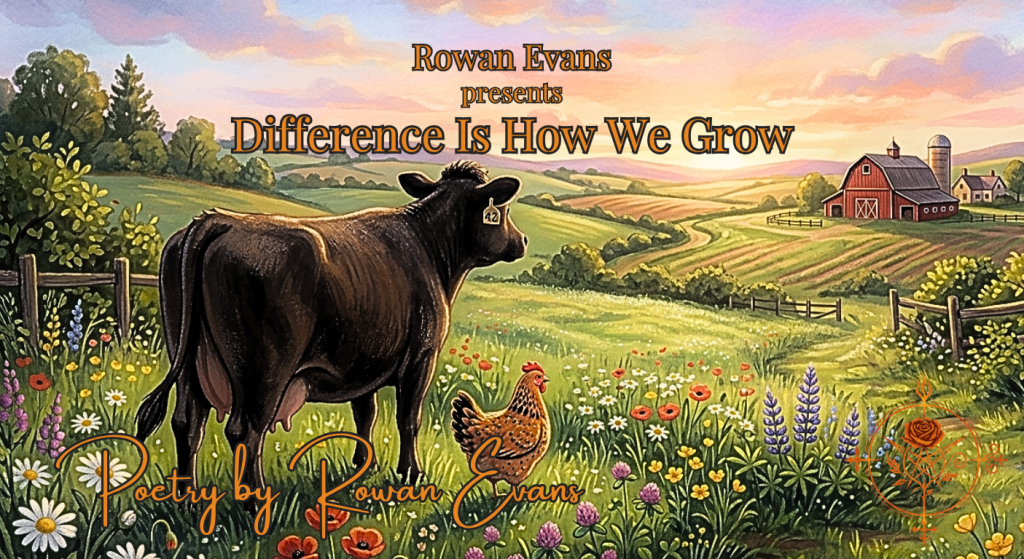
    A chicken. A cow. A father who proudly accepts both without ever asking for an explanation.

    The image made me laugh, but as I kept writing, I realized the joke was quietly carrying something much larger.

    So much of life is spent convincing people that difference is something to overcome. We flatten ourselves to fit expectations, compare our gifts to someone else’s, or assume that being different somehow means being less.
    Nature has never worked that way.

    A forest isn’t strong because every tree is identical. An orchestra doesn’t create harmony by playing the same note. Communities become richer because different people bring different strengths, experiences, perspectives, and ways of seeing the world.

    That’s what this poem slowly became.

    The cartoon setup stayed, because I think humor can open a door that seriousness sometimes cannot.

    Once the reader laughs, they’re already listening.

    And maybe they’ll leave remembering something simple:

    You don’t have to become someone else to have value.

    Sometimes the thing that makes you different is exactly what the world needs.

    Rowan Evans


    A chicken and a cow standing together in a sunlit pasture outside a red barn, symbolizing the beauty and strength found in differences.

    Difference Is How We Grow
    Poetry by Rowan Evans

    “Don’t have a cow,” they said—
    why, my mama did?
    You see—

    Mama had a chicken.
    Mama had a cow.
    Dad was proud;
    he didn’t care how.

    And I know—
    that may sound absurd to you,
    but it’s a setup for a simple truth.

    There is strength in our differences—
    so let us try and identify
    what our difference is.

    Difference is not a warning sign—
    it’s a spark.

    A start.

    A door kicked open
    to a room you didn’t know you needed.

    You see—
    my family tree
    is less a tree
    and more a barnyard free‑for‑all.

    Feathers in the branches,
    hoofprints on the roots,
    and me somewhere in the middle
    trying to make sense of it all.

    But difference is not disorder—
    it’s the rhythm of the world
    learning to harmonize.

    So what makes you different—
    what is your strength?

    A cow gives milk,
    a chicken gives eggs—
    neither tries to be the other,
    yet breakfast would be poorer
    without both.

    So what do you bring to the table—
    that no one else can,
    and why hide it?

    Because sameness is a field gone fallow,
    but difference—
    difference is how we grow.


    Journey into the Hexverse…

    [Tots, Rocks and All]
    What begins as a surreal collection of tater tots, rocks, comic book references, and runaway thoughts slowly reveals something much quieter: a poem about creativity, vulnerability, and the simple hope of finding someone willing to hold your heart.

    [Off Leash Thought]
    A reflective free verse poem exploring the mind as a living, wandering force—unpredictable, creative, and sometimes chaotic—through the metaphor of a dog off leash. It embraces mental drift not as a flaw, but as a natural part of creative thought and self-awareness.

    [Monster Theology]
    What if the monsters under the bed weren’t monsters at all? Monster Theology explores difference, belonging, and the human tendency to fear what we don’t understand through a conversation with the creatures we’ve spent our lives imagining.

    [Raccoons in Silk Pajamas]
    What begins with judgmental Space Chickens quickly spirals into camels in parked cars, elephants in jam jars, raccoons in silk pajamas, and astronauts in the ocean. A playful absurdist poem about language, imagination, and what happens when you stop trying to control where the words go.

    [The Answer Is (Yes)]
    What kind of writer am I? Mythmaker, confessor, comedian, philosopher, dream-architect, romantic, storyteller, and diss-poet. This self-reflective poem explores the impossibility of fitting creativity into a single category—and embraces every version of the truth a pen can touch.

    If you’re interested in more poetry, you can find it here → [The Library of Ashes]
  • Author’s Note

    I’ve always thought it was strange that monsters get such bad press.

    Most of them never asked to be monsters in the first place.

    They’re usually just the things we’re afraid of. The things we don’t understand. The things we refuse to look at directly.

    What would happen if I stopped fearing the monsters under the bed and actually talked to them?

    The answer surprised me.

    Because once the conversation began, the monsters behaving like monsters.

    They became neighbors.

    Parents.

    Friends.

    People with lives beyond the role they had been assigned in my imagination.

    And that’s where the poem’s real interest emerged.

    Not in monsters themselves, but in the human tendency to create them.

    We have a habit of turning difference into danger.

    A habit of mistaking unfamiliarity for threat.

    A habit of reducing people to a single trait, label, identity, or assumption until they become something easier to fear than understand.

    The monsters in this poem don’t seem to share that habit.

    They celebrate what makes them unique.

    They recognize difference without treating it as division.

    They understand something many of us spend our lives trying to learn:

    There is a difference between being different and being separate.

    That’s where the title comes from.

    Theology is simply the study of what we believe.

    And Monster Theology asks a simple question:

    What if the monsters were better at being human than we are?

    Maybe the real lesson isn’t learning how to defeat monsters.

    Maybe it’s learning how to stop creating them.

    Rowan Evans


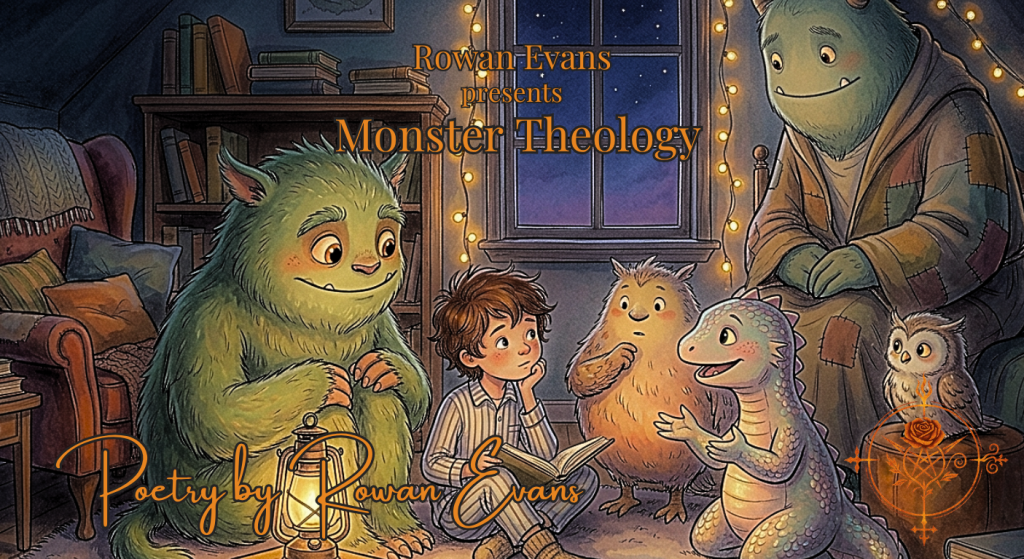
    A child sits peacefully with a group of friendly monsters in a softly lit bedroom, symbolizing understanding and acceptance across differences.
    “Maybe the real lesson isn’t learning how to defeat monsters. Maybe it’s learning how to stop creating them.”

    Monster Theology
    Poetry by Rowan Evans

    I’ve made friends
    with the monsters—
    in my closet,
    and under the bed.

    They used to scare me,
    but I realized
    I wasn’t judging them
    fairly.

    These monsters
    have feelings,
    children and lives
    outside of my room.

    I’m not the only one
    they visit,
    I’m not the only friend
    they have.

    They tell me
    about the others
    sometimes.

    But they aren’t allowed
    to talk about that a lot.

    So we’ll stick to the difference
    between their world and ours.

    They say it’s much the same,
    many lands with many peoples—
    but they find our focus
    on differences strange.

    They don’t understand
    why we fear what makes us unique.
    They don’t understand
    why we can’t acknowledge our strengths
    without diminishing others.

    To them—
    monsters are monsters,
    they are all the same
    but not.

    They celebrate
    what makes them different,
    the things
    that make them unique.

    Celebrate.
    Not separate.

    That’s the monster motto.

    And sometimes I wish
    we lived like they do—

    less afraid
    of what makes us different,

    less eager
    to turn each other
    into monsters.


    Journey into the Hexverse…

    [Danny Phantom Theology]
    What begins as a metaphor borrowed from a childhood cartoon becomes something deeper: a reflection on existing between survival and possibility, exhaustion and hope, the life we have and the life we long for. Danny Phantom Theology explores what it means to keep moving toward a future that feels worth living.

    [Lone Wolf Theology]
    A philosophical pop-culture poem exploring freedom, identity, and self-authorship through the lens of superheroes, antiheroes, mythic archetypes, and personal rebellion. A declaration of autonomy in a world determined to write your story for you.

    If you’re interested in more poetry, you can find it here → [The Library of Ashes]
  • “I have always been captivated by the lives and languages of people far from my own. This piece is a reflection on curiosity, respect, and the love I carry for cultures I have yet to touch.”


    A dreamlike collage of Asian cityscapes with multilingual characters representing Mandarin, Cantonese, Tagalog, Korean, Japanese, and German.
    Listening to the world in every language, feeling the pulse of life in every culture. – Rowan Evans

    I have always been drawn to the world outside myself… to the rhythms of languages I do not speak, to streets I have never walked, to skies I have yet to stand beneath. There is a life in language, a heartbeat in culture, and I listen as closely as I can.

    Even when I cannot understand the words, I hear the cadence, the rise and fall, the hidden music that belongs to a place and its people. Mandarin or Cantonese, Tagalog or Korean, Japanese or German—they each carry a soul in their tones, a story in their syllables. I notice when the smallest detail shifts, when a rhythm is off, when a sound is not quite what it should be. Some call it obsession; I call it devotion.

    The written form sings to me as well. Korean curves in gentle arcs, Chinese strikes with sharp certainty, Japanese flows in graceful ribbons. To many, they appear alike, but I hear the difference, see the rhythm, sense the pulse of lives folded into every character, every stroke. Each line holds a story, a heartbeat, a culture speaking without sound.

    I am fascinated not by the exotic alone, but by the living pulse of life everywhere. In Japan, the careful balance of history and neon. In Seoul, the energy that hums beneath every crowded street. In Manila, the warmth and chaos intertwined, unashamed and alive. These are not places I have touched, yet I feel them as vividly as I feel the echo of my own heartbeat.

    I do not want to consume. I want to witness. I want to understand. I want to walk with reverence, to listen with attention, to respect the lives unfolding around me, and to see what is beautiful without taking it for my own. Language, culture, custom—these are windows into the souls of people, and I am endlessly curious.

    Even in dreams, I travel, carrying notebooks, pens, a hunger for connection. I meet people, learn their words, share their moments, and leave a piece of myself behind in the care with which I have observed.

    This is how I show love to the world I do not yet fully know. Through attention, through curiosity, through presence. And perhaps, one day, when my feet touch those streets, I will not only observe, but belong in some way, however fleeting.

    Until then, I will listen. I will watch. I will learn.


    Drifting Without Roots: A Poem on Cultural Identity and Longing
    A confessional poem exploring envy of cultural heritage, the ache of disconnection, and the search for belonging in a fractured identity.