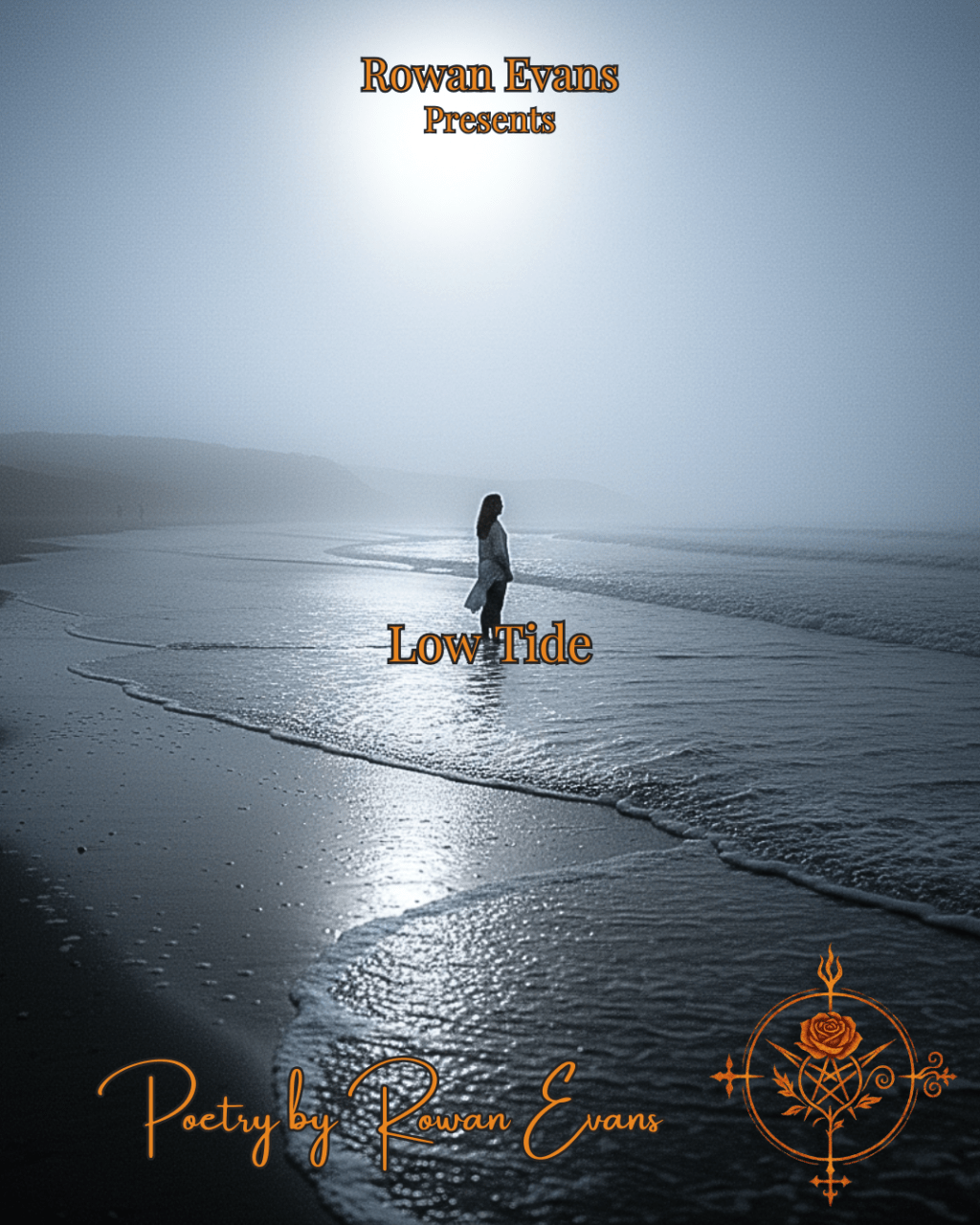
There comes a point in certain conversations when the words have already worn themselves thin. Promises become repetitions, explanations become excuses, and the silence between two people starts saying more than either of them can manage.
“If You Want to Go” steps into that moment—the moment when frustration stops begging to be understood and starts letting go. Its voice is blunt, impatient, and tired of pretending that another conversation will somehow change what has already been made clear.
Sometimes, the hardest part of walking away isn’t opening the door.
It’s finally refusing to stand in front of it, waiting for someone to decide.
— Rowan Evans
When the words become excuses, sometimes letting go says enough.
If You Want to Go Poetry by Rowan Evans
If you want walk—
then walk—
we don’t have to waste our time, we don’t have to talk— I don’t want to listen to another empty line, it’s just excuses—talking is useless—
What?
Now you’re mad?
Why— because I gave you what you wanted?
If you want to go, then go— what do we keep doing this for?
We don’t have pretend anymore—
Journey into the Hexverse
[You Still Pop Into My Brain] Sometimes, someone from your past still wanders into your thoughts—not because you want them back, but because they once held a place in your everyday life. A reflective poem about disappointment, growth, and the strange persistence of memory after moving on.
Some people leave your life in a single, dramatic moment. Others fade through a series of small decisions, subtle disappointments, and lessons you never asked to learn. And sometimes, long after you’ve moved forward, a familiar name still wanders through your thoughts—not because you want them back, but because they once occupied a place in your everyday life.
This piece sits in that strange space between moving on and remembering. It doesn’t reach backward with longing or anger. It simply acknowledges that even when someone no longer belongs in your life, the mind may occasionally forget to stop looking for them.
— Rowan Evans
Some memories still visit. They just don’t feel like home anymore.
You Still Pop Into My Brain Poetry by Rowan Evans
You look at me now,
and see—
someone better than
who I used to be—
but that’s all
thanks to you—
if I hadn’t learned the lessons,
if you hadn’t switched up
and made me see—
you were never the one for me.
It didn’t come all at once,
it came in steps for me,
you began to pull away, gradually—
it was little things at first,
you’d do things you thought would hurt—
introduced me to him,
just so you could flirt—
thinking I’d see it,
and feel like dirt—
but it didn’t work.
Because for me,
it was whatever—
we weren’t officially together.
We never talked, exclusive—
so who would I be
to be mad to begin with?
No, I wasn’t mad—
I was more like your parents,
just disappointed
in who you had become.
You used to be someone
in my life—
I used to reach for my phone
every time something happened—
wanting to tell you,
and sometimes I still do.
It’s a strange feeling
because it’s been so long—
and it feels so wrong,
that you sometimes—
still pop into my brain.
But it’s not the same—
it’s not how it used to be.
Journey into the Hexverse
[Lessons Without Kindness] A reflection on learning self-respect from a relationship that changed—the lessons hidden in manipulation, silence, and loss, and the realization that you don’t have to shrink yourself to make someone else feel tall.
[Circle of Me] A reflective poem about sitting among the voices of memory, joy, pain, and fear—and realizing that some burdens are bigger than any one person.
They’re measured in conversations you haven’t had yet.
In words that stayed behind your teeth.
In the quiet space between two people who are looking toward one another but still can’t quite bridge the water between them.
I’ve always been drawn to oceans because they represent contradiction. Water connects continents, yet it also separates them. It carries messages, memories, ships, storms—and still leaves shorelines untouched by one another.
That became the emotional center of this poem.
The “opposite coasts” aren’t necessarily literal places. They’re two inner worlds existing at the same time, close enough to imagine, far enough that neither person can simply step across.
The moon became the only thing capable of visiting both shores.
It witnesses both sides equally.
It touches both tides.
Yet even it cannot erase the distance.
This poem isn’t about giving up.
It’s about acknowledging that some silences become landscapes of their own—and learning to live honestly inside them until, perhaps, one day, the tide changes.
— Rowan Evans
Some distances aren’t measured in miles—they’re measured in everything left unsaid.
Opposite Coasts of the Same Silence Poetry by Rowan Evans
I sit—moon kissed,
watching the tide
inside my mind—
as dreams move in,
and thoughts roll out.
It’s an ocean wide,
this divide between us.
I can see your shore in my mind,
but I can’t seem to reach it—
we stand on opposite coasts
of the same silence.
It’s a silence
full of things I never said.
A silence
shaped like your name.
The moon hangs between us
like a quiet messenger—
I whisper secrets for her to carry
from my shore to yours.
It pulls at your tide and mine,
but never enough to close the distance.
Sometimes I swear
I hear your voice in the undertow.
The distance hums
with everything unfinished.
Every wave reaches
for something it can’t hold.
The water keeps returning,
but you don’t.
There are whole storms between us
I never learned to name.
Currents I can feel but not follow.
Journey into the Hexverse…
[Where Intamacy Begins] For some, attraction begins with appearance. For others, it begins with conversation. Where Intimacy Begins explores the beauty of curiosity, deep listening, and the quiet connection that forms when two minds truly meet.
[I’d Rather Try] Anyone can promise they’d die for someone. But love isn’t built on one dramatic moment—it’s built on showing up, trying again tomorrow, and proving your words through consistent action.
[Pointing Me Home] The final poem in the No Metaphor Left Behind trilogy explores dreams, hope, and belonging. Through moonlight, ocean tides, and quiet conversation, Pointing Me Home reflects on carrying hope long before reaching the place you call home.
[Ocean Waves (1, 4, 3)] A moonlit shoreline, a rowboat full of ducks, a piggybank with no cents, and a confession hidden in plain sight. Ocean Waves (1, 4, 3) explores how humor, wordplay, and absurdity can become a side door to vulnerability when the truth feels too difficult to say directly.
[I’ll Be There to See Your Sunrise] Love has never come easily to me. This poem explores the fear, vulnerability, and quiet courage required to stay emotionally present when connection begins to matter deeply. “I’ll Be There to See Your Sunrise” is about choosing love despite the risk of heartbreak—and promising to remain long enough to witness someone fully.
I’ve always been fascinated by the strange emotional weight of time zones.
How someone can become such a consistent part of your thoughts that you start measuring your own day against theirs.
Checking the clock. Wondering if they’re asleep. Wondering what their sky looks like while you’re staring at yours.
At some point, distance stops feeling geographical and starts feeling temporal.
That feeling became the foundation for this piece.
The airport in the dream felt symbolic almost immediately while writing it—a place built entirely around arrivals, departures, waiting, and crossing paths for brief moments before separating again.
And in the middle of that emptiness, there’s this presence that feels familiar before it’s visible.
I think that’s what emotional connection can feel like sometimes.
Not certainty. Not possession. Not even clarity.
Just recognition.
This poem also came from the tension between wanting to speak honestly and being afraid of what honesty might change.
Because vulnerability always carries risk.
Sometimes the fear isn’t rejection itself— it’s the possibility of losing a connection that already means something to you.
So the poem lives in that suspended space: between dream and waking, between silence and confession, between leaving and returning.
— Rowan Evans
Some connections feel close even across separate timelines.
Separate Timelines Poetry by Rowan Evans
I had a dream last night—
I sat alone in an empty airport.
Not a soul. Not a sound.
I was the only one around.
It was just me
as far as the eye could see.
Yet, I heard the hum
of jet engines still—
Then there was
the sound of movement,
footsteps echoing in the distance.
Eyes scanning—
trying to locate the source.
Slowly—
I rise.
Getting to my feet,
I stumble
trying to get myself steady.
The footsteps grow clearer—
slow, deliberate,
like someone who already knew
I’d be here.
And in the stillness
of this moment—
silence folds in on itself,
waiting for me
to decide
whether to run
or stay.
The footsteps stop.
My breath catches,
not from fear,
but from the strange familiarity
of a presence I can’t yet see.
And my legs feel heavy—
like they remember something
my mind doesn’t.
I can’t see you—
but I feel your presence.
It’s like you and I
live on separate timelines,
simultaneous
but different—
like we can only exist like this.
Because—
my day
is your night,
and your day
is mine
just the same.
It might seem simple to some,
might even sound a little dumb—
to get caught up
on things like that—
but I’ve been stuck
on her time
since I put widget
on my phone.
Listen to me…
there I go again,
loose lips
let truths slip—
even when they’re
better left unsaid.
Not because I didn’t want to say it.
I did.
But I don’t know
if the timing’s right,
or how you feel—
but I do know
you’re worth the risk
of my heart shattering,
I just don’t know
if I’m strong enough
to handle a connection
breaking.
So I keep quiet—
not because
I don’t want to speak,
but because
I’m scared to.
So I sink
back into my seat—
and I feel your presence fade.
I don’t know if you left
or if I’m awake—
but I promise…
I promise,
I’ll be back.
Journey into the Hexverse…
[Memories From a Life Yet to Come] Some dreams feel less like fantasy and more like memory. “Memories From a Life Yet to Come” is a reflective free verse poem about longing, displacement, emotional alignment, and the strange comfort of recognizing yourself more clearly in dreams than in waking life.