What happens when you stop questioning the big questions and start questioning the stupid ones?
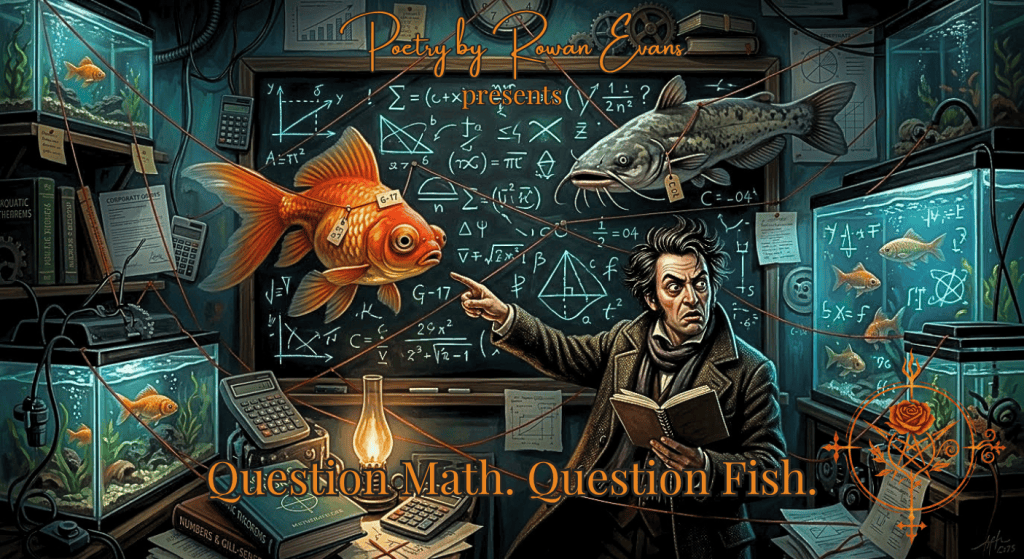
Question Math. Question Fish. takes a perfectly ordinary equation and refuses to leave it alone. Two plus two should be simple—but apparently we’ve got corporations, aquatic conspiracies, suspicious fish classifications, and an entire Aquarium Industrial Complex to investigate.
This piece is deliberately ridiculous. It borrows the language of conspiracy theories, institutional distrust, and “wake up, sheeple” rhetoric and points it directly at things that absolutely do not need a conspiracy theory.
Because maybe the joke isn’t whether two plus two equals four.
Maybe the joke is how quickly we can convince ourselves that anything deserves suspicion if we stare at it long enough.
So question the math.
Question the fish.
Question the catfish.
And, obviously, question everything.
— Rowan Evans
Two plus two equals four. The fish, however, remain under investigation.
Question Math. Question Fish. Poetry by Rowan Evans
Two plus two
equals four,
or does it?
You see—
Big Math
would have you
believe—
numbers mean something—
they don’t…
numbers are a joke.
A figment, imaginary at best—
two plus two might as well
equal goldfish.
And what’s a goldfish anyway?
Fish or gold, make up your mind—
and don’t get me started on catfish,
’cause what is this shit?
Cats don’t even like water.
Now one is a fish?
Get real, bitch.
Don’t listen to this shit—
Big Aquarium just tryin’ to get slick.
One fish, two fish—
red fish, blue fish—
these companies
are lying
to you, bitch.
And how does one fish—
become two fish?
And a red fish—
into a blue fish?
You wish.
It’s Big Math
and the Aquarium Industrial Complex
working together
to warp reality—
a fish isn’t gold,
a fish isn’t a cat—
but these people think that
we’re stupid,
we don’t see what they’re doing—
two plus two
equals four,
are you sure?
Open your eyes.
Wake up.
Think for yourself.
Question Math.
Question Fish.
Question.
Everything.
Journey into the Hexverse
[The Playground] What happens when mythology stops being something to hide behind and becomes architecture for the imagination? The Playground (Language, Metaphors and More) explores Rowan Evans’s relationship with language, symbolism, metaphor, humor, and twenty-three years of turning the page into a place where anything can happen.
[All for Me] When thunder becomes applause, lightning turns into paparazzi, and rain rolls out a flooded red carpet, one poet starts wondering whether nature’s celebration has gone a little too far.
[Love Me From Over There] A sharp and humorous poem about the strange contradiction of wanting someone close while simultaneously needing them to stay several feet away from your face.
[It’s Almost Like I Know What I’m Doing] A self-aware reflection on nearly three decades of writing, discovering how rage became rhythm, pain became poetry, and comedic timing became another tool in the poet’s arsenal.
Sometimes a poem arrives dressed like science fiction and refuses to stay in its genre.
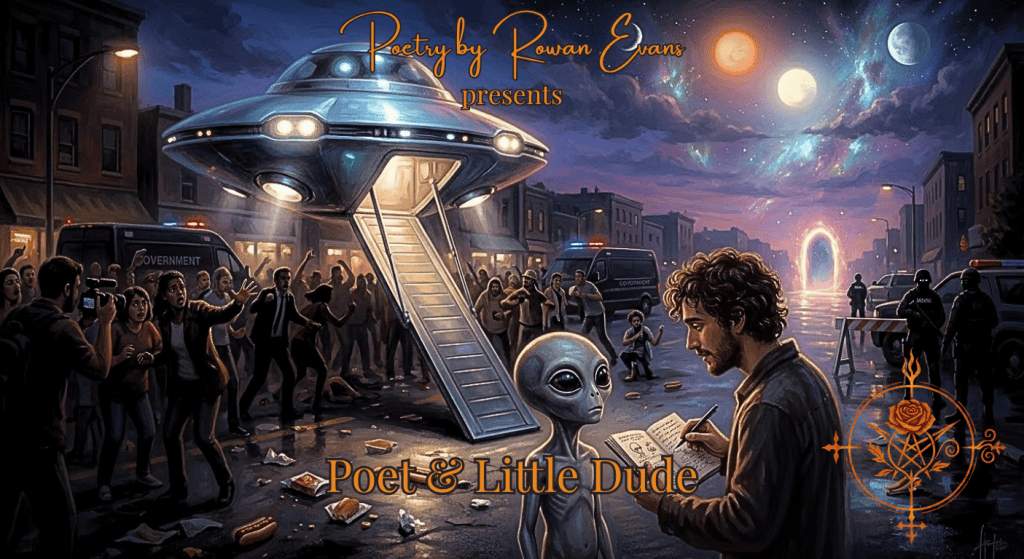
Poet & Little Dude began with the kind of ridiculous premise that feels perfectly reasonable at the time: an alien lands in an ordinary American city, everyone panics, and the poet is mostly annoyed by how long the spaceship ramp takes to come down. From there, Little Dude wandered into the story with jokes, questions, a questionable understanding of human customs, and absolutely no respect for the study guide.
But beneath the absurdity, something quieter started taking shape.
This is a story about being seen by someone who doesn’t need the entire explanation first. About two homes, two dusks, two dawns—and the strange ache of knowing that the place you’re standing in isn’t necessarily the place that feels like home.
So yes, there are aliens, government agents, hotdogs, Admiral Ackbar, an extended-warranty joke, and a very important distinction between a rabbit hole and a bunny void.
But somewhere underneath all that nonsense is Little Dude asking the poet the question that matters:
Do you want to go home?
— Rowan Evans
Sometimes the strangest visitor is the one who finally asks where you want to call home.
Poet & Little Dude Poetry by Rowan Evans
A silent hum in the sky above, a non-descript American city.
The kind of hum that settles in your bones before your mind catches up, the kind that says pay attention without making a sound.
Everyone looked up. I looked down at my notes. I’d seen enough movies to know this was either the beginning or the end.
Probably both.
People screamed. Cars stopped. Someone dropped a hotdog.
And me?
I sighed, closed my notebook, and muttered, “Well… guess it’s my turn again.”
I stopped at the edge of the crowd as the craft touched down.
A low buzzing cut through the air, and a ramp began to lower.
Slowly.
Excruciatingly slow.
I checked my watch. I tapped my foot. I wrote four stanzas, two sonnets—
and finished season one of Breaking Bad…
and the ramp was still lowering.
Hit the power button on my phone and locked it.
Slipped it back in my pocket— where my hands stayed.
A silent thud as the ramp FINALLY— hit the ground. The hollow echo of footsteps rang out.
A shadow stretched long— cascading down the ramp until it touched the dirt.
The crowd began to murmur before a voice rang out— “Take me to your leader!”
The crowd went silent. Only the footsteps echoing could be heard— nobody could see a thing at first—
“No, I’m just kidding. I’ve always want to say that.” The tiny grey alien stopped at the bottom of the ramp, slowly looking up—
Its large black eyes landing on mine.
“Sup?” I said with a slight nod of my head.
Its eyes closed for a moment—
“I’ve been trying to reach you about your cars extended warranty.” The alien’s mouth thins to a line as it tried to contain the giggles.
Pinching the bridge of my nose— I sighed.
“You didn’t follow the study guide—” I started, before little dude cut me off.
“I went down the bunny void.”
“Rabbit hole—” I corrected.
“What?” they asked confused.
I slowly get down on one knee, just like I had before—
“It’s a rabbit hole, when you follow a thread through seemingly unrelated topics.”
Little dude nodded. “I think I got it. But what about you, did you study the guide I gave too?”
I cleared my throat, tried to hide the choke. Should I lie— or hide it with a joke?
Nope.
“I did not.” I said, looking away.
Shaking their head, little dude laughs. “It’s okay, poet. You should read it though, you’ll love it, I know it.”
Stepping closer. Hand on mine.
“You’ll learn of green skies and purple lakes, twin suns and sister moons—
we get six hours of light, six hours of night. Twice.”
“Twin suns and sister moons?” I asked. “I can relate to that. That’s how my life has been, living under two suns— they’re really one. It’s two days in different places.”
Little dude tilted their head, then they said:
“No.”
A pause.
“Not two suns. It’s two homes. Two dusks, two dawns— one feels right, the other wrong.”
I turned my head, eyes glassy, tears steaming, as I opened my mouth to speak.
But the words evaded me. Little dude noticed quick.
“You’re leaking.” They said with concern.
“It’s human emotion, you’ll learn.” I said with a quivering lip, trying to hold it all in.
Our moment is interrupted by a scream from the forgotten crowd.
“Whoa,” little dude flinches in surprise. “Have they been here this whole time?”
Looking around— I saw the faces in the crowd. Some were scared, terrified— others confused and paranoid.
“It’s a trap!” a voice cut through the thick silence.
I sighed, not surprised— “calm down, Admiral Ackbar.”
The crowd lets out a collective scream— someone throws a shoe. It barely misses my head.
“What the hell?! Who threw that?” I yell.
“Was it you—” little dude pauses dramatically, their eyes focusing. “Admiral?”
Admiral Ackbar shakes his head. “N-no.” he stammers, as his heart hammers in his chest.
“The government…” the crowd began, the murmurs spread quick. “we’ve got to call the government. They’ll handle this— they’ll know what to do.”
Little Dude and I blink.
“Since when?” I asked, confused.
“Okay, okay— wait, let me introduce you. They’re not scary. They can show you.” I say, addressing the crowd.
The crowd begins to quiet down, their murmurs becoming a softer sound.
“This…” I gesture to the little dude beside me. “This is Little Dude. They’re not… from around here.”
“That’s one way to put it.” Little dude adds. “I’m from a little place called… another planet.” They make a vague gesture with their hands.
“Just another planet?” a voice from the crowd asks, shaking with fear. “No… no name?”
“Name’s pending. It’s actually been pending for a long time… a really long time. But that’s the government, right?” Little dude responds with a smile. “They’re slow.”
“Why are you naked?” another question from the crowd.
“Naked?” Little dude tilts their head. “Do you mean— why am I not wearing a second skin, like you?”
The crowd recoiled like Little Dude had just confessed to a federal crime.
“Second skin?” someone whispered, horrified.
Little Dude nodded earnestly.
“Yes. The fabric layer you all wear to hide your emotional temperature.”
I blinked.
“That’s… not why we wear clothes.”
Little Dude tilted their head, eyes wide.
“Then why do you wear them?”
A hundred humans froze, suddenly realizing they did not have a unified answer.
“We just like them.” I said, my voice lacking confidence.
Little dude shakes their head, “not important.” they said, “I’m not here for that,” they gesture to the crowd. “I’m not here for the them.”
Their big eyes, land on mine— “I’m here for you.”
Little Dude’s words hung in the air, heavy enough to silence a hundred humans, light enough to lift something in my chest.
The crowd didn’t know what to do with it. A few gasped. Someone dropped another hotdog.
(Why were there so many hotdogs?)
A woman near the front whispered, “Why him?” like I was a questionable menu item.
Little Dude squeezed my hand, their skin warm— warmer than I expected.
“Because you listened,” they said softly. “You always listen.”
I opened my mouth to respond— to say something clever, something deflective, something safe—
but the sky split open with the sound of sirens.
Government vans rolled in, black and boxy, like someone ordered “paranoia” on Amazon and selected same‑day delivery.
Agents poured out, all sunglasses and shouting, pointing weapons that hummed with the kind of energy that makes your bones nervous.
Little Dude blinked at them.
“Are these your leaders?”
I snorted. “God, no.”
The nearest agent yelled, “Step away from the entity!”
Little Dude tilted their head. “Entity?” They looked at me. “Is that a compliment?”
“Not really,” I whispered.
The agent repeated the command, louder this time, as if volume could fix confusion.
Little Dude stepped closer to me, their voice steady.
“I’m not here to harm. I’m not here to conquer. I’m not here to be studied.”
Their eyes locked on mine.
“I’m here because you’re lonely.”
My breath caught.
The crowd fell silent again, but this time for a different reason.
Little Dude continued, voice soft enough to feel like a hand on my cheek.
“You look at the sky like it’s a door. You write worlds you wish you could walk into. You build cathedrals for people who never stayed.”
They squeezed my hand.
“I came to stay.”
The agents shouted again, but their voices felt far away— like background noise in a movie I’d already seen.
Little Dude leaned in, their forehead touching mine.
“Poet,” they whispered, “do you want to go home?”
I swallowed hard.
“Which one?”
Little Dude smiled, eyes glowing faintly.
“The one you haven’t found yet.”
Journey into the Hexverse
[Beings from Beyond (Remix)] A 2026 remix of a poem first written in 2024, Beings from Beyond (Remix) returns to the mystery of unexplained lights, extraterrestrial possibilities, and humanity’s hunger for answers. The wonder remains—but the poet’s voice has become more focused on the search for truth itself.
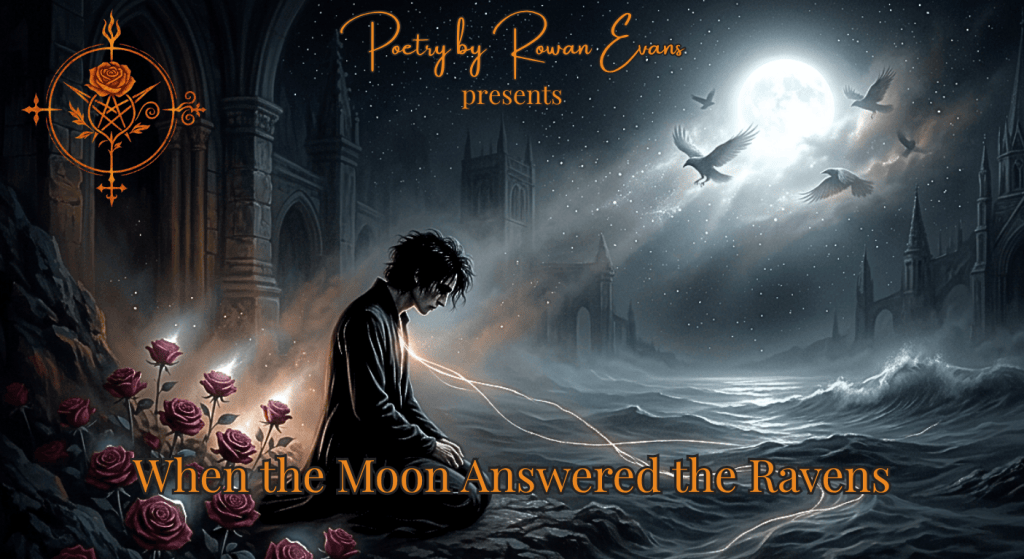
Some dreams begin in darkness, but not all darkness is empty. Sometimes, the things we recognize by instinct—ravens calling, roses blooming, the pull of the tide, the quiet presence of the moon—become the only landmarks we need.
This poem wanders through an abyss where absence becomes invitation, where questions lead deeper than answers, and where the familiar waits beyond the silence. It is a journey through the spaces between fear and comfort, memory and discovery, nothingness and belonging.
And perhaps the moon was never truly missing. Perhaps some forms of light simply require us to keep walking until we’re ready to see them.
— Rowan Evans
Even in the deepest abyss, some light knows how to find you.
When the Moon Answered the Ravens Poetry by Rowan Evans
I had a dream last night—
a line I’ve written too many times,
but this one was different—
there was no moon, no tide—
no shoreline—it was pitch black,
an abyss—just me and nothingness.
Then I heard the raven’s calls—
and it didn’t feel bizarre at all.
It felt oddly—
calming—
I stumbled further into the dark,
listening to raven after raven call—
it was weird, this unkindness
didn’t feel very unkind at all—
I tripped on something,
which was odd—
because there was nothing
to trip on.
I fell—
hit the ground—
the ravens didn’t make a sound.
Slowly, I rose to my feet—
surprised to see, a rose at my feet.
Illuminated by a single sliver
of silver light—
it caught my eye,
so I knelt down—
as my eyes scanned
the surrounding abyss—
I saw them.
Roses,
a dozen of them—
each lit by its own sliver
of dedicated lunar light—
which told me,
it was night—
but something didn’t feel right—
where was the moon at?
What was the source of this light?
The questions didn’t stop me—
I kept walking—moving further,
deeper into the abyss—
when suddenly the taste of salt
hit my lips—
and the ground begin to shift,
it moved like waves—
now I couldn’t stop,
something was pulling me—
something I couldn’t see,
but could feel it—
a thread tied to my heart,
pulling me along.
It was guiding me—
but at the same time,
there was something
pushing me—
and I dropped a hint
five lines back—
what could that be?
And as I let the thread
pull me along—
I began to notice
the light—
an image trembling—
it was shimmering,
across the top of the abyss—
eyes lifted, I saw it,
the thing I missed—
hanging high above,
it was my favorite witness—
the one I could always sit with.
Finally—
after what felt like
an eternity of silence—
the ravens started
to speak again—
and the moon
answered them—
that’s when the world came alive.
I could hear the ocean waves,
feel the mist on my face—
taste the salt on my lips,
ocean kissed—
the smell of roses
perfumed the air—
it’s like the world
suddenly became aware
that I was even there—
I was on my knees,
watching the waves—
smile on my face—
because in the back of my mind,
I knew…
the moon would never abandon—
the tide would never
refuse to guide—
the ravens
would never leave my side,
while everything I feel—
an ocean deep, an ocean wide—
the roses grow in a garden shaped by
all the beauty and pain in my life.
Journey into the Hexverse
[You Still Pop Into My Brain] Sometimes, someone from your past still wanders into your thoughts—not because you want them back, but because they once held a place in your everyday life. A reflective poem about disappointment, growth, and the strange persistence of memory after moving on.
[Louder Than the Rain] A short confessional poem about the overwhelming noise of anxious thoughts, the strange silence of feeling alone in a crowded room, and finding a way to translate pain into words.
[Let Me Be Pacific] A lyrical poem about sitting beside the Pacific Ocean and discovering that an enormous body of water can become a bridge between distant hearts. Through ocean imagery, wordplay, and reflections on California and the Philippines, Let Me Be Pacific explores how love and poetry can cross even the greatest distances.
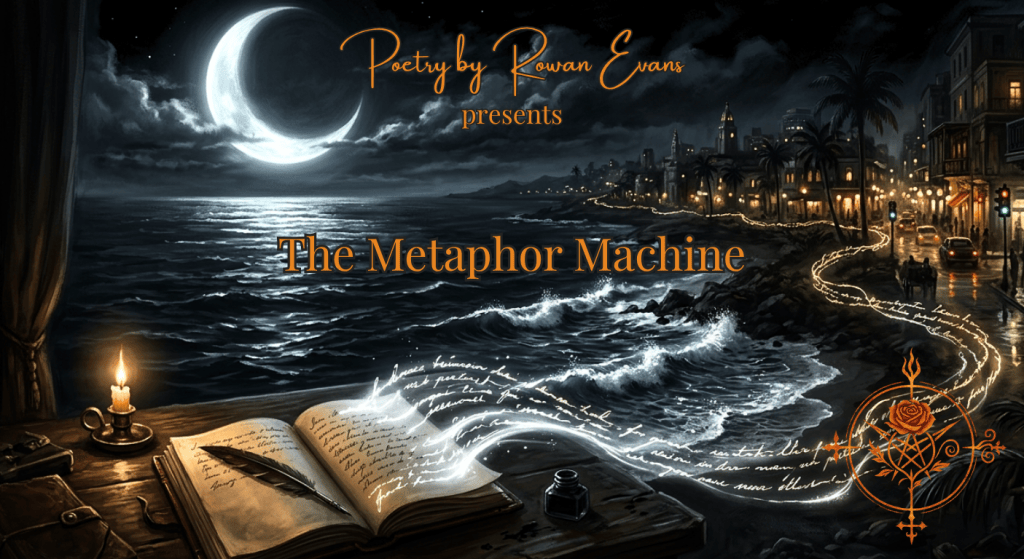
The Metaphor Machine is a poem about the machinery behind my own poetry. I wanted to pull back the curtain and show what happens when a single line starts generating connections: moonlight becomes tide, tide becomes ocean, ocean becomes shoreline, shoreline becomes city streets, and suddenly the poem has wandered somewhere entirely different.
The joke is that I’m explaining the process while actively doing it. The poem breaks its own lines, interrupts its own thoughts, calls attention to its metaphors, and then circles back to reveal that all those seemingly wandering pieces were connected by the same machine.
Sometimes I don’t choose the metaphor. I just follow where it takes me.
— Rowan Evans
One metaphor becomes another, and the machine keeps running.
The Metaphor Machine Poetry by Rowan Evans
I’ll write a line in a way
that’ll make you pause—
then I’ll take that line
and break that line,
to break the thought—
then I sprinkle in the metaphors,
and this is really what I get meta for—
I talk about the moon
and the silver light,
the way it shimmers—
its image trembles
across the top
of dark water—
that’s one I’ve said before.
And I’ve said it lot,
but I’m not going to stop.
This is where the tides comes,
and there the tide goes—
because that’s how the tide works.
And the ocean—
this is a poem, I wrote…
you didn’t think
we were going to skip this one,
did you?
And the ocean,
it’s so polite—
the way it waves,
every time it sees my face.
It’s a familiar place,
I sit on the shoreline, often—
not in reality, but in my mind—
that’s where the thoughts soften.
Now, for the city streets—
the heat, and god—
that humidity, the way it clings.
You’d think I’d dream of…
somewhere less…
humid? But I digress,
it’s always love that I express
for the islands I haven’t touched yet.
If you’re following along—
I wrote a line
that made you pause—
then I took that line
and I broke that line—
and that broke the thought.
Then that’s where the pivot came,
I told you what I really went meta for.
It’s the metaphors.
Moon to tide,
tied to the ocean—
a shoreline or two,
next to the ocean blue—
then beaches to city streets,
it’s the same ones I walk in sleep.
Journey into the Hexverse
[Welcome to the Hexverse] Step into the Hexverse—a poetic world where mythmaking, humor, rage, creativity, and confession collide, and darkness becomes something that can be reshaped into art.
[High Tide] A short reflective poem about leaving, returning, and accepting the forces that pull us back—like the tide guided by the moon.
[Let Me Pacific] A lyrical poem about sitting beside the Pacific Ocean and discovering that an enormous body of water can become a bridge between distant hearts. Through ocean imagery, wordplay, and reflections on California and the Philippines, Let Me Be Pacific explores how love and poetry can cross even the greatest distances.
[Did You Really Think This Was About Trees?] A playful love poem disguised as a forest of terrible tree puns. Beneath the birch, oak, cedar, palms, lumber, and absurdist wordplay is a poem about devotion, loyalty, laughter, and building a life with someone you love.
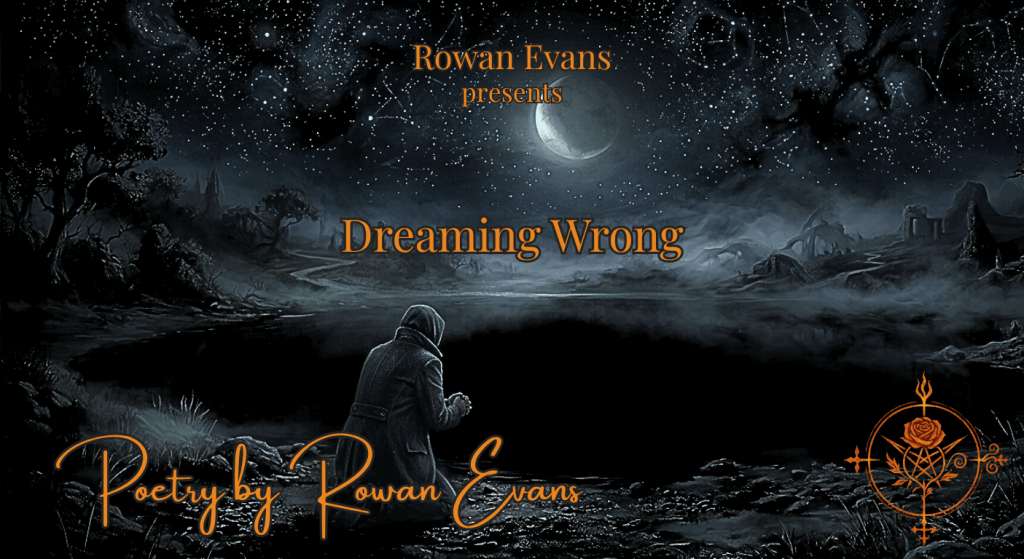
Dreaming Wrong came from the strange feeling of being inside a dream that looks familiar but somehow isn’t yours. The moon is still there. The path is still recognizable. The water is still waiting—but everything has been rearranged just enough to make the entire landscape feel wrong.
I wanted to play with that feeling of dream logic: the moment when your mind recognizes the pieces but realizes they no longer fit together. The ocean becomes a pond, the tide disappears, the moon loses its reflection, and even the heavens become impossible to navigate.
For me, the unsettling part isn’t that the dream is frightening. It’s that it feels incorrect. Like waking life has been reconstructed by someone who knows what everything is supposed to look like—but doesn’t quite understand what it means.
Sometimes the strangest dreams aren’t nightmares.
Sometimes they’re simply dreaming wrong.
— Rowan Evans
Sometimes the nightmare isn’t frightening—it is simply familiar enough to feel wrong.
Dreaming Wrong Poetry by Rowan Evans
I slipped from waking life,
drifted into night—
but it felt different,
like the imagery wasn’t right.
The moon looked paler than usual,
so I asked if she was sick—
of course, she didn’t answer back.
But I followed the same paths
that I had many nights before.
I walked along
until I hit the edge of the—
pond?
Where was the ocean at,
where was the shore—
and why couldn’t I
feel the tide anymore?
Everything felt off there.
I was on my knees,
staring at the water—
where was the shimmer,
I couldn’t see the reflection
of the moon—
I looked straight ahead,
and the silence seemed
to stretch further.
Then my eyes looked to the sky
and I realized that I couldn’t
map the path across the heavens.
It’s like as soon my head hit the pillow—
I entered somebody else’s mind,
because nothing about this
felt like mine—
I was dreaming wrong.
That’s the only thing
that can explain,
what was going on.
Journey into the Hexverse…
[Beach to Beach (How I Get There)] A dream becomes a journey between familiar shores and unfamiliar cities in Beach to Beach (How I Get There), a poem about imagined travel, ocean crossings, longing, and the places we hope to someday reach while awake.
[Where the Metaphors Lead] Some truths are easier to write than they are to say aloud. “Where the Metaphors Lead” explores the quiet space between dreams, confession, and the courage it takes to let another person know how deeply they’ve become woven into your inner world.
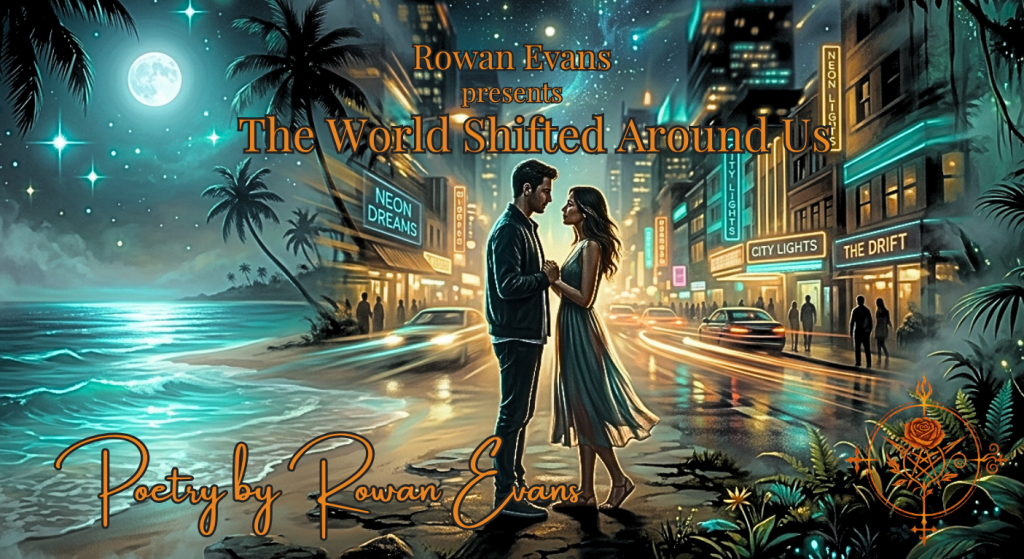
[The World Shifted Around Us] The world transformed around us—beach, city streets, jungle—but we never moved. Sometimes love isn’t found in words, but in the quiet certainty of someone remaining clear while everything else fades.
[The Streets I Walk When I Sleep] “The Streets I Walk When I Sleep” is a deeply intimate free verse poem about recurring dreams, emotional connection, longing across distance, and the strange feeling of remembering places and moments that have never happened in waking life.
[Across the Page-cific] A playful, autobiographical journey through the strange places poetry can take me—from sandwich heartbreak and pasta diss poems to gothic monsters, mythology, ravens, ghosts, and storms across the page. Beneath the absurdity is something deeply personal: the realization that writing gave me a way to rebuild myself, piece by piece.
Others simply place you beside someone and let the world unfold around you.
This poem came from one of those dreams.
What fascinated me wasn’t that the scenery kept changing—from beaches, to city streets, to a dense jungle—but that neither of us moved. We stayed exactly where we were while everything else transformed around us.
That became the emotional center of the poem.
Sometimes the people who matter most become the fixed point in our lives. Circumstances change. Places change. Time changes. But certain connections remain steady enough that everything else feels like it’s revolving around them.
I also wanted to explore the idea that silence isn’t empty.
Some of the most meaningful moments I’ve experienced—whether in dreams or in waking life—have involved very few words. A glance, a smile, the way someone looks at you for a single second can communicate more than entire conversations.
By the end of the poem, the world stops changing altogether.
The dream begins to dissolve, but one thing refuses to disappear.
Not the beach.
Not the city.
Not the jungle.
Just her face.
Sometimes that’s what we carry back into waking life: not the dream itself, but the feeling that remained after everything else faded.
— Rowan Evans
Some people become the constant while the rest of the world keeps changing. Dreams simply make that truth visible.
The World Shifted Around Us Poetry by Rowan Evans
I laid down in need of rest, it was just a nap, that’s all it was— but as soon as I closed my eyes, I saw your face—your voice broke the silence. Then the void around us shifted, it became a beach and then city streets.
We never changed positions— the world changed around us.
We didn’t drift, didn’t sway— we just stood and stayed, but the world continued to change. First the beach, then city streets— before finally shifting into trees as far as the eye could see.
The jungle was thick with trees, but not as thick as the humidity.
With every shift, my vision blurs— except the vision of her. As the world becomes hard to see, she remains steady.
And her face carries a thousand words, even when her voice goes unused.
We didn’t speak, we didn’t need to— even as the world continued to shift. From the beach to city streets, then the jungle deep— the next place was somewhere simpler.
Somewhere that felt more like peace, an escape from the heat and humidity.
Still not a word was spoken— but you gave a look, quick and simple, but it said so much. Because the truth is you didn’t need words to tease.
The world around us softened— colors thinning, edges fading, but you stayed clear a moment longer, steady in the quiet.
The moment settled into something calm— the air cooling, the silence warm, your eyes holding mine with that same quiet tease—
in the end, the world stopped shifting— no beach, no streets, no jungle heat.
And the last thing to fade was your face— the world dimming around it like a curtain drawing closed. Even as the dream thinned to nothing, your look stayed bright behind my eyelids, a quiet afterglow that followed me into the stillness of waking.
Journey into the Hexverse…
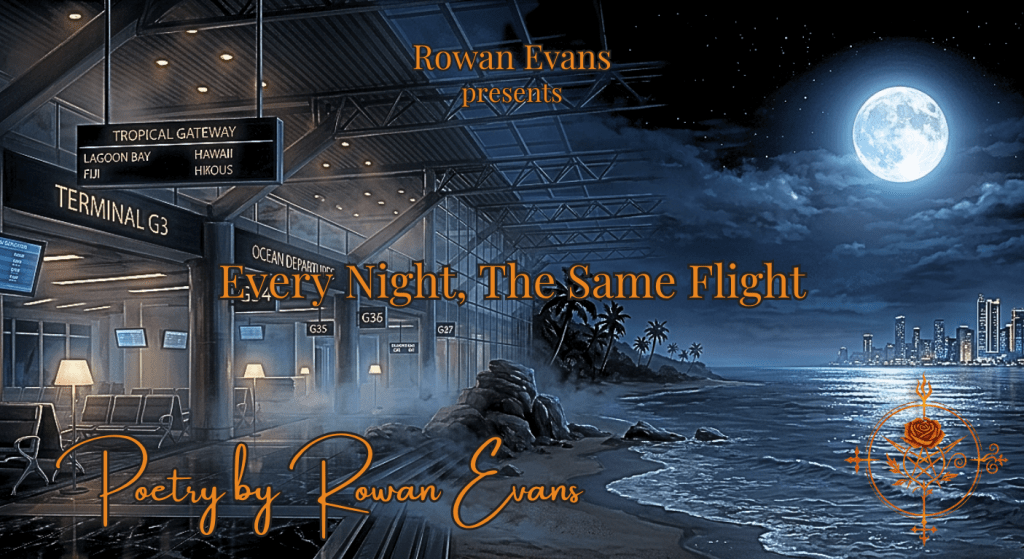
[Every Night, The Same Flight] Every night begins with the same flight. Between wakefulness and sleep, an airport appears, a familiar shoreline waits beyond the journey, and the same dream asks whether some destinations find us before we’re ready to find them.
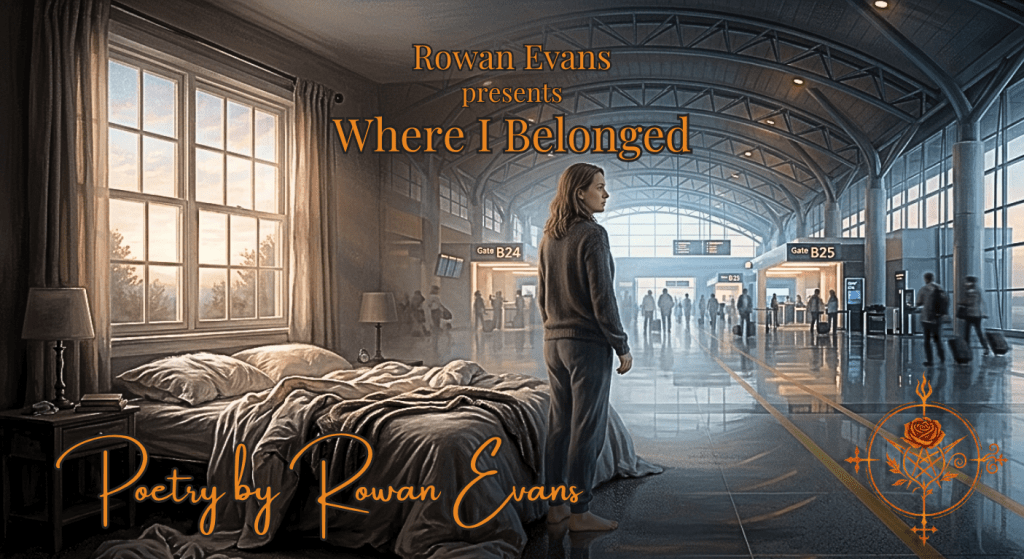
[Where I Belonged] A bedroom becomes an airport in the space between sleep and waking. Where I Belonged explores liminal consciousness, uncertainty, and the strange moments when reality feels suspended between two worlds.
[Pointing Me Home] The final poem in the No Metaphor Left Behind trilogy explores dreams, hope, and belonging. Through moonlight, ocean tides, and quiet conversation, Pointing Me Home reflects on carrying hope long before reaching the place you call home.
[Just Beyond Waking] A street that feels familiar. A life that hasn’t happened yet. Just Beyond Waking explores the fragile space between dreams, memory, longing, and the quiet feeling that some futures are already waiting for us.
[The Streets I Walk When I Sleep] “The Streets I Walk When I Sleep” is a deeply intimate free verse poem about recurring dreams, emotional connection, longing across distance, and the strange feeling of remembering places and moments that have never happened in waking life.
The airport. The flight. The familiar shoreline. The city streets I’ve never lived in, yet somehow know by heart.
They return so often that they’ve become part of my personal mythology.
Every night seems to begin the same way. As I drift toward sleep, the quiet of my bedroom dissolves into the sounds of a busy terminal. I never question why I’m there anymore. I simply board another flight, knowing it will carry me to the same destination.
What’s strange isn’t that the dream repeats.
It’s that every repetition feels less like imagination and more like recognition.
I’ve never believed dreams need to predict the future to matter. Sometimes they simply reveal the places our hearts keep returning to before we’re ready to admit why.
This poem isn’t really about airports or travel.
It’s about the quiet certainty that some destinations seem to choose us long before we choose them.
— Rowan Evans
Some journeys begin the moment we close our eyes.
Every Night, The Same Flight Poetry by Rowan Evans
I laid—slowly drifting, I was slipping
from consciousness to slumber.
I was boarding that flight,
the one I take every night.
The journey always starts the same,
eyes flutter, like the moths in my stomach.
Then the sounds of terminals,
passengers rushing pas me
in search of their gates.
But this isn’t an airport—
it’s just my brain.
The gate numbers blur,
shifting like thoughts I haven’t named yet.
Every announcement echoes
in a voice I almost recognize.
I walk toward a destination,
unsure of where I’m going,
but somehow already knowing—
I’m meant to catch a flight,
of which there are plenty—
one for every thought of you,
of which there are many.
They always lead to the same place—
always the same shores, the same bay,
and it always feels like it’s calling my name.
The way the moon shimmers the same,
its reflection dancing across the waves.
Then I always find myself wandering city streets,
feeling the heat and humidity.
But I would rather be, nowhere else.
I wander—
taking in the sights and sounds,
bathing in the smells all around.
I wonder—
what would it be like if this was home.
Yeah, what if this was my life now?
I breathe it in,
the warmth, the noise, the pulse—
a life that feels borrowed,
yet somehow mine.
It’s a preview that I get every night—
and I wonder if the dream
is trying to tell me something
I’m not ready to say awake.
Journey into the Hexverse…
[Where I Belonged] A bedroom becomes an airport in the space between sleep and waking. Where I Belonged explores liminal consciousness, uncertainty, and the strange moments when reality feels suspended between two worlds.
[Pointing Me Home] The final poem in the No Metaphor Left Behind trilogy explores dreams, hope, and belonging. Through moonlight, ocean tides, and quiet conversation, Pointing Me Home reflects on carrying hope long before reaching the place you call home.
[Caller ID: Destiny] Sometimes the places we visit in our dreams feel more like home than the places we wake up in. Caller ID: Destiny explores longing, belonging, and the quiet feeling that life is calling you toward somewhere new.
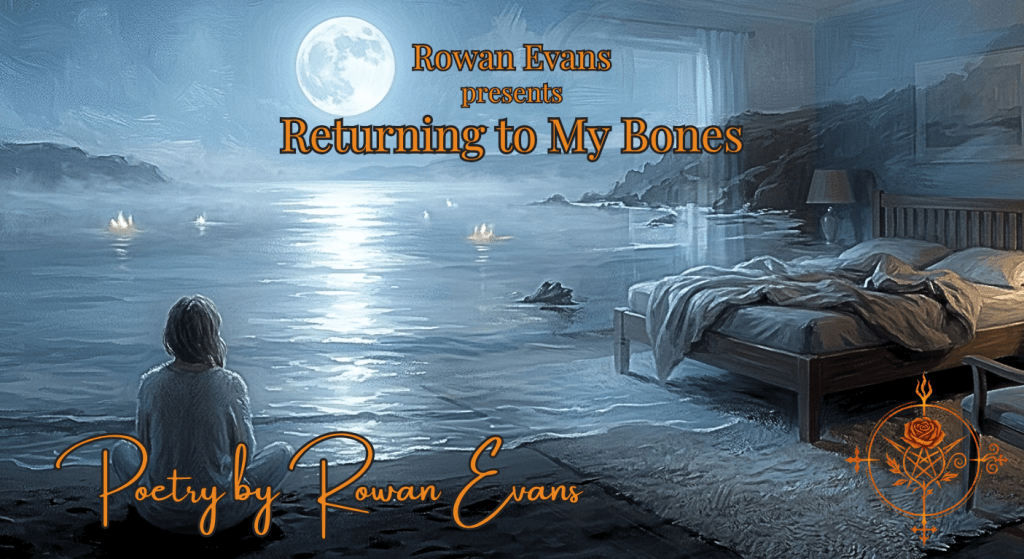
[Returning to My Bones] Some dreams fade the moment we wake. Others leave behind emotions that linger long after reality returns. Returning to My Bones explores the strange grief of leaving a dream that felt real enough to matter.
When I “woke up”, and I had closed my eyes for only a moment, and suddenly I wasn’t in my room anymore.
I was standing in an airport.
Not imagining one.
Experiencing one.
I could hear jet engines humming. I could hear people talking around me. I could hear footsteps crossing polished tile. It was detailed enough that, for a few seconds, I questioned whether I’d actually opened my eyes at all.
When I finally did, my bedroom was still there.
The airport wasn’t.
But it also didn’t feel entirely gone.
That strange overlap fascinated me.
It wasn’t a dream in the usual sense, because I knew I was awake.
It wasn’t reality either, because I knew where I actually was.
It was something in between.
I’ve written many poems about dreams, liminal spaces, and the moments where consciousness feels uncertain.
This felt different.
There wasn’t fear.
There wasn’t confusion.
There was only hesitation.
A quiet instinct that if I moved too quickly, I might somehow choose one reality over another.
The final lines stayed almost exactly as they arrived because I realized they didn’t need an explanation.
Sometimes the most honest thing a poem can do is preserve uncertainty instead of solving it.
I still don’t know exactly what happened that morning.
I only know how it felt.
And sometimes feeling is the only truth poetry needs.
— Rowan Evans
Sometimes waking isn’t returning—it’s deciding which reality you’re standing in.
Where I Belonged Poetry by Rowan Evans
I closed my eyes—
my room around me,
then the hum
of jet engines filled the air.
The muttering of people,
and footsteps as they
walked past me.
It shouldn’t have felt real,
but it did—
the cold tile under my feet,
the distant announcement
I couldn’t quite make out,
the sense that everyone
was going somewhere
except me.
I opened my eyes,
expecting the room
to steady itself,
but the air still carried
the echo of departure.
It felt like the world
had changed its mind
about where I was.
One moment: carpet, quiet,
the familiar weight of my own breathing.
The next: a terminal
I didn’t remember entering,
voices rising and falling
like tides around me.
I stayed still,
as if movement would decide
which reality I belonged to.
Journey into the Hexverse…
[Following the Footprints] Standing alone on a quiet shoreline, the speaker discovers mysterious footprints leading into the unknown—and realizes they may point not toward another place, but toward the missing parts of themselves.
[Pointing Me Home] The final poem in the No Metaphor Left Behind trilogy explores dreams, hope, and belonging. Through moonlight, ocean tides, and quiet conversation, Pointing Me Home reflects on carrying hope long before reaching the place you call home.
[Caller ID: Destiny] Sometimes the places we visit in our dreams feel more like home than the places we wake up in. Caller ID: Destiny explores longing, belonging, and the quiet feeling that life is calling you toward somewhere new.
[A Heart That Echoes in Another Language] A poetic journey through music across Japan, Korea, China, and the Philippines, exploring how sound becomes identity, memory, and emotional geography.
At this point, it’s probably one of the most consistent threads running through my work.
The reason is simple:
Dreams don’t feel imaginary to me.
They feel remembered.
Not while I’m fully awake. Not after I’ve had time to process them. But in those first moments between sleeping and waking, there’s often a strange overlap where the emotions arrive before reality does.
For a brief moment, everything feels true.
The conversation happened. The place existed. The person was there.
Then awareness returns.
The room comes back. The walls come back. The weight of the body comes back.
And with it comes the realization that none of it happened.
That’s the feeling this poem is trying to capture.
Not the dream itself, but the return from it.
The title became the key.
Because waking up doesn’t feel like opening my eyes.
It feels like returning to my bones.
Returning to gravity. Returning to limitation. Returning to the version of reality that can be touched and verified.
The strange thing is that the emotions don’t disappear when the dream does.
The dream fades.
The feelings stay.
And sometimes that lingering feeling creates a kind of grief that is difficult to explain to people who don’t experience dreams this way.
A quiet grief.
Not because something real was lost.
But because, for a moment, it felt real enough to matter.
— Rowan Evans
Some dreams disappear with the sunrise. Others stay with us long after we’ve returned to our bones.
Returning to My Bones Poetry by Rowan Evans
The moon shimmers over the bay,
suspended in the sky—
the way I feel suspended in her eyes.
And it makes me feel crazy,
because she’s never looked at me—
not really, not in reality.
It’s only happened in dreams.
That’s when I drift
between awake—
and asleep.
This is when
my mind
starts to
wander.
Then it snaps.
I’m back in my room again.
The moon loses its shimmer,
the bay fades from view.
My body tenses as I become
aware again,
of the mattress beneath me—
of the walls that enclose me.
I feel the weight pressing in.
The reality of returning
to my bones.
It’s a quiet grief—
realizing that the emotions
will linger,
but the truth is
it never happened.
And somehow,
that hurts the most.
Journey into the Hexverse…
[Maybe You’ll Want Me Too] A poem about the subtle shift from knowing someone to constantly thinking about them. Through humor, metaphor, and confession, Maybe You’ll Want Me Too explores affection, attachment, and the fragile hope that being wanted might matter more than being needed.
[Before My Feet Touch the Floor] What happens when your dreams feel more real than your waking life? Before My Feet Touch the Floor explores the strange grief of waking up, the lingering memory of dream selves, and the quiet question of which version of us is truly real.
[Recognizes Home] A free-verse poem exploring the difference between love as dependency and love as choice. It challenges the idea that love must be need-based, instead centering the quiet strength of choosing someone while still remaining whole on your own.
[Ocean Waves (1, 4, 3)] A moonlit shoreline, a rowboat full of ducks, a piggybank with no cents, and a confession hidden in plain sight. Ocean Waves (1, 4, 3) explores how humor, wordplay, and absurdity can become a side door to vulnerability when the truth feels too difficult to say directly.
[L Words & Heart] A playful, self-aware poem about love, longing, loyalty, and the quiet ways another person can reshape our inner world. What begins as humor slowly reveals a heartfelt confession about affection, imagination, and the faces that linger in our dreams.
[Just Before Waking] A street that feels familiar. A life that hasn’t happened yet. Just Beyond Waking explores the fragile space between dreams, memory, longing, and the quiet feeling that some futures are already waiting for us.
This poem started where a lot of my more playful pieces begin: with a chain reaction of absurd images that refused to behave.
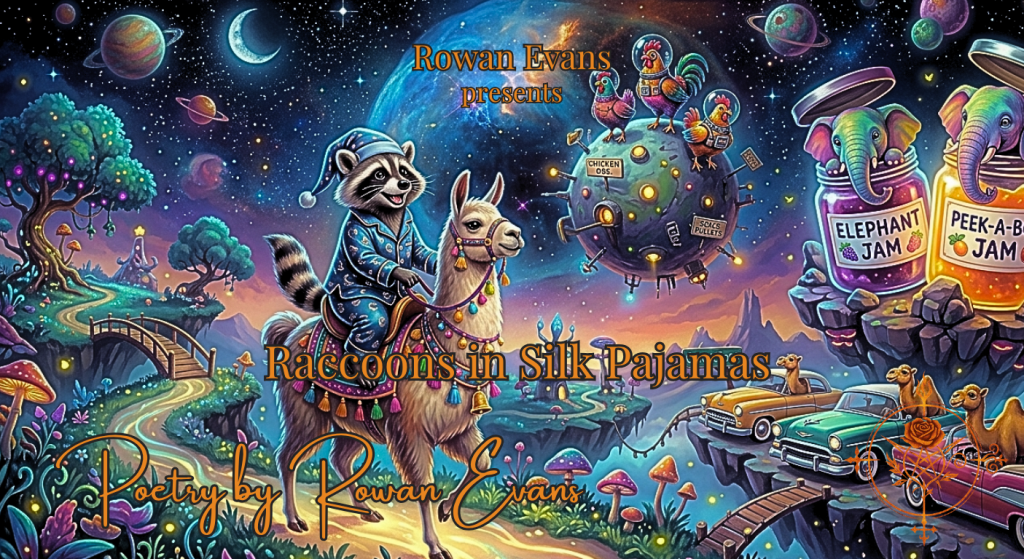
I didn’t sit down with a structure in mind. I just let the language run until it started building its own logic—one that doesn’t really care about realism, linear progression, or whether raccoons should realistically be wearing silk pajamas in the first place.
The “Space Chickens” at the beginning weren’t planned as a motif. They became one because they felt like the kind of strange, mildly accusatory presence that only makes sense in a world where camels are in parked cars and elephants are stored in jam jars.
From there, the poem just escalates.
Raccoons appear. Then llamas. Then the question of pajamas becomes a philosophical problem. Somewhere in the middle, the poem realizes it is no longer interested in consistency—it’s interested in momentum.
There’s a moment where the speaker tries to impose logic:
“Don’t be absurd.”
But by that point, absurdity has already won.
What I find interesting about this piece is that it still has a kind of emotional continuity even without narrative stability. It moves the way thoughts move when you’re tired, distracted, or laughing at your own internal associations—jumping from one idea to another through sound, memory, and cultural reference rather than logic.
Even the ending, with its sudden shift into pop culture and cinematic reference, is less about conclusion and more about acknowledgment. The poem becomes aware of itself mid-collapse and decides to lean into it rather than resolve it.
In that sense, it’s not really about raccoons.
It’s about the way language behaves when you stop trying to control it.
And sometimes, that’s where the most honest writing shows up.
— Rowan Evans
When logic leaves the room, language starts having fun.
Raccoons in Silk Pajamas Poetry by Rowan Evans
I had to get away
from the Space Chickens,
they were a little too judgmental—
always questioning what I wore,
shouting implied curses
spoken in cursive.
It was camels in parked cars,
elephants in jam jars…
Now it’s—
raccoons in silk pajamas,
and they’re not alone—
they’re riding llamas.
“Are the llamas
wearing silk pajamas?”
Don’t be absurd.
That’s the weirdest thing
I’ve ever heard—
llamas in pajamas?
No, just raccoons
and bananas.
I was once a
farmer on Pluto,
a librarian on Mars—
a poet amongst the stars.
Now I’m just
an astronaut in the ocean,
rolling in the deep.
Dude—
you just referenced Adele.
Like it is 2001 again.
It’s a Space Odyssey
Journey into the Hexverse…
See where it all began.
[Pluto Farmer] A whimsical absurdist poem about being a certified weirdo, farming space carrots on Pluto, and refusing to fit into anyone else’s definition of “normal.”