Sometimes it’s strawberries, questionable scientific reasoning, and the absolute confidence to say, “Deal with it.”
This piece is a little love poem for the people who show affection in their own weird, imperfect, slightly ridiculous way.
— Rowan Evans
When roses won’t do, bring strawberries. Romance is all about knowing what they like.
It Could Have Been… Poetry by Rowan Evans
I know you don’t like roses— so I brought you a bouquet of strawberries— they’re the same thing, scientifically— maybe not exactly, but they come from the same family—
it’s still romantic. Deal with it.
Oh, and hey— it could have been apples.
It could have been…
Peaches, Pears, Raspberries, Cherries…
heck…
a bag of almonds…
but I gave the one that still feels—
like romance.
Journey into the Hexverse
[Welcome to the Hexverse] Step into the Hexverse—a poetic world where mythmaking, humor, rage, creativity, and confession collide, and darkness becomes something that can be reshaped into art.
Some poems begin with an idea. Others begin with a feeling that refuses to leave.
This one was written in the early hours of the morning, during that familiar stretch of time when the world grows quiet enough for my thoughts to become louder than everything else.
I’ve always found it easier to write than to speak. Conversations ask for immediate answers. Poetry allows me to sit with a feeling until I understand it well enough to translate it into language.
Many of the recurring images throughout my recent work—the moon, the tide, distant shores, dreams, and city streets—have become a personal symbolic language. They aren’t separate subjects anymore. They all point toward the same emotional center.
This poem finally acknowledges that.
Sometimes the metaphors aren’t hiding anything.
Sometimes they’re quietly leading us back to the truth we were trying not to say.
— Rowan Evans
Some feelings only find their voice after midnight, where dreams, memory, and metaphor become impossible to tell apart.
Where the Metaphors Lead Poetry by Rowan Evans
It’s funny how I find myself here again,
four AM—it’s just me, the music and my pen.
I’ve got so many thoughts with so much to say,
my lips move but no sound comes—
like I lost one voice, when I found the other.
And it’s not that I can’t speak—
it’s just that words don’t come easily,
when they try to come verbally.
But on the page,
everything lines up—
the thoughts, the feelings,
the things I never say out loud.
Ink doesn’t trip over itself
the way my voice does.
So here are a few
truths for you—
there is a woman
she is on my mind constantly,
yeah, she is simultaneously
the easiest and hardest to talk to.
She makes me feel like I can be me—
completely.
And honestly,
I’ve never really had that
with anybody else—
every beautiful line I write
about the moon in the sky,
the ocean and tide—
yeah, most of the time
it leads back to her
in my mind.
And every dream, I translate in ink—
the shores I walk in sleep,
secrets I try not to keep,
even when it’s hard to speak—
I lay them on the page and pray
that they’ll reach their destination one day.
So I sit here,
four AM again,
writing the things
I can’t say out loud—
hoping one day
I’ll find the courage
to speak them aloud.
Journey into the Hexverse…
[The World Shifted Around Us] The world transformed around us—beach, city streets, jungle—but we never moved. Sometimes love isn’t found in words, but in the quiet certainty of someone remaining clear while everything else fades.
[Every Night, The Same Flight] Every night begins with the same flight. Between wakefulness and sleep, an airport appears, a familiar shoreline waits beyond the journey, and the same dream asks whether some destinations find us before we’re ready to find them.
[Where I Belonged] A bedroom becomes an airport in the space between sleep and waking. Where I Belonged explores liminal consciousness, uncertainty, and the strange moments when reality feels suspended between two worlds
[Opposites Coasts of the Same Silence] What separates two people isn’t always an ocean. Sometimes it’s the silence between everything left unsaid. Opposite Coasts of the Same Silence explores longing, distance, dreams, and the quiet hope that even across impossible divides, someone might still hear your voice.
[Ocean Waves (1, 4, 3)] A moonlit shoreline, a rowboat full of ducks, a piggybank with no cents, and a confession hidden in plain sight. Ocean Waves (1, 4, 3) explores how humor, wordplay, and absurdity can become a side door to vulnerability when the truth feels too difficult to say directly.
[Call of the Tide] A poem about identity, displacement, and the quiet pull toward something beyond the shoreline you were born on. Sometimes the tide calls louder than the anthem.
Others simply place you beside someone and let the world unfold around you.
This poem came from one of those dreams.
What fascinated me wasn’t that the scenery kept changing—from beaches, to city streets, to a dense jungle—but that neither of us moved. We stayed exactly where we were while everything else transformed around us.
That became the emotional center of the poem.
Sometimes the people who matter most become the fixed point in our lives. Circumstances change. Places change. Time changes. But certain connections remain steady enough that everything else feels like it’s revolving around them.
I also wanted to explore the idea that silence isn’t empty.
Some of the most meaningful moments I’ve experienced—whether in dreams or in waking life—have involved very few words. A glance, a smile, the way someone looks at you for a single second can communicate more than entire conversations.
By the end of the poem, the world stops changing altogether.
The dream begins to dissolve, but one thing refuses to disappear.
Not the beach.
Not the city.
Not the jungle.
Just her face.
Sometimes that’s what we carry back into waking life: not the dream itself, but the feeling that remained after everything else faded.
— Rowan Evans
Some people become the constant while the rest of the world keeps changing. Dreams simply make that truth visible.
The World Shifted Around Us Poetry by Rowan Evans
I laid down in need of rest, it was just a nap, that’s all it was— but as soon as I closed my eyes, I saw your face—your voice broke the silence. Then the void around us shifted, it became a beach and then city streets.
We never changed positions— the world changed around us.
We didn’t drift, didn’t sway— we just stood and stayed, but the world continued to change. First the beach, then city streets— before finally shifting into trees as far as the eye could see.
The jungle was thick with trees, but not as thick as the humidity.
With every shift, my vision blurs— except the vision of her. As the world becomes hard to see, she remains steady.
And her face carries a thousand words, even when her voice goes unused.
We didn’t speak, we didn’t need to— even as the world continued to shift. From the beach to city streets, then the jungle deep— the next place was somewhere simpler.
Somewhere that felt more like peace, an escape from the heat and humidity.
Still not a word was spoken— but you gave a look, quick and simple, but it said so much. Because the truth is you didn’t need words to tease.
The world around us softened— colors thinning, edges fading, but you stayed clear a moment longer, steady in the quiet.
The moment settled into something calm— the air cooling, the silence warm, your eyes holding mine with that same quiet tease—
in the end, the world stopped shifting— no beach, no streets, no jungle heat.
And the last thing to fade was your face— the world dimming around it like a curtain drawing closed. Even as the dream thinned to nothing, your look stayed bright behind my eyelids, a quiet afterglow that followed me into the stillness of waking.
Journey into the Hexverse…
[Every Night, The Same Flight] Every night begins with the same flight. Between wakefulness and sleep, an airport appears, a familiar shoreline waits beyond the journey, and the same dream asks whether some destinations find us before we’re ready to find them.
[Where I Belonged] A bedroom becomes an airport in the space between sleep and waking. Where I Belonged explores liminal consciousness, uncertainty, and the strange moments when reality feels suspended between two worlds.
[Pointing Me Home] The final poem in the No Metaphor Left Behind trilogy explores dreams, hope, and belonging. Through moonlight, ocean tides, and quiet conversation, Pointing Me Home reflects on carrying hope long before reaching the place you call home.
[Just Beyond Waking] A street that feels familiar. A life that hasn’t happened yet. Just Beyond Waking explores the fragile space between dreams, memory, longing, and the quiet feeling that some futures are already waiting for us.
[The Streets I Walk When I Sleep] “The Streets I Walk When I Sleep” is a deeply intimate free verse poem about recurring dreams, emotional connection, longing across distance, and the strange feeling of remembering places and moments that have never happened in waking life.
There seems to be something about four in the morning.
Not because it’s magical in any supernatural sense, but because it’s quiet enough that there’s nowhere left for your thoughts to hide.
I’ve written several poems that begin around that hour, and they all seem to share the same quality: honesty arrives before I have time to edit it.
This poem came from one of those mornings.
I wasn’t trying to write a love poem.
I was trying to understand why certain thoughts become louder when the rest of the world falls silent.
The title, When the Veil Is Thin, can be read a lot of ways. Some people hear something mystical in it. For me, it’s more psychological.
The veil is simply the distance between what I feel and what I’m willing to admit.
During the day, that veil is thick.
By four in the morning…
it becomes almost transparent.
This poem isn’t really about insomnia.
It’s about the moments when the truth finally stops whispering and starts speaking clearly enough that you can no longer pretend not to hear it.
— Rowan Evans
Some truths wait until the world is quiet enough to be heard.
When the Veil Is Thin Poetry by Rowan Evans
It’s after four AM
and the veil is thin—
I should be asleep
but my mind won’t
cease to speak.
It won’t stop the talk—
I try to write, just anything—
because this is when the truth
seems to sing,
it rings through the ink—
It’s you in every thought—
and I can’t seem to shake
this feeling in my chest.
It’s not a weight, just an ache—
sometimes it keeps me awake.
And I try—I try so hard
to just say the things,
but I bite my tongue
and my mouth snaps shut.
It’s got me screaming—
what the…
Why am I still up?
I’m still awake,
with thoughts I can’t shake.
With dreams just out of reach
of shores I’m longing for—
I just need to be clear.
It’s not the thought
of your hand in mine.
It’s the thought of our time,
together, intertwined—
maybe when dawn breaks
this feeling will ease—
but for now, it lingers,
soft as the moon on my skin.
The veil thins again—
and in the hush before morning,
your name is the only truth
that doesn’t fade.
The sky begins to pale—
and I let the thought of you
carry me into sleep.
Journey into the Hexverse…
[Where Intimacy Begins] For some, attraction begins with appearance. For others, it begins with conversation. Where Intimacy Begins explores the beauty of curiosity, deep listening, and the quiet connection that forms when two minds truly meet.
[The Life of a Witness Poet] What does it mean to love someone when the greatest act of care is simply witnessing their life? This poem explores quiet devotion, distance, and the compassionate heart of a witness poet.
[What I’m Trying to Say] What begins as an exaggerated promise of love slowly strips itself back until only one simple truth remains: real devotion isn’t found in grand gestures—it’s found in consistently showing up.
[Recognizes Home] A free-verse poem exploring the difference between love as dependency and love as choice. It challenges the idea that love must be need-based, instead centering the quiet strength of choosing someone while still remaining whole on your own.
They’re measured in conversations you haven’t had yet.
In words that stayed behind your teeth.
In the quiet space between two people who are looking toward one another but still can’t quite bridge the water between them.
I’ve always been drawn to oceans because they represent contradiction. Water connects continents, yet it also separates them. It carries messages, memories, ships, storms—and still leaves shorelines untouched by one another.
That became the emotional center of this poem.
The “opposite coasts” aren’t necessarily literal places. They’re two inner worlds existing at the same time, close enough to imagine, far enough that neither person can simply step across.
The moon became the only thing capable of visiting both shores.
It witnesses both sides equally.
It touches both tides.
Yet even it cannot erase the distance.
This poem isn’t about giving up.
It’s about acknowledging that some silences become landscapes of their own—and learning to live honestly inside them until, perhaps, one day, the tide changes.
— Rowan Evans
Some distances aren’t measured in miles—they’re measured in everything left unsaid.
Opposite Coasts of the Same Silence Poetry by Rowan Evans
I sit—moon kissed,
watching the tide
inside my mind—
as dreams move in,
and thoughts roll out.
It’s an ocean wide,
this divide between us.
I can see your shore in my mind,
but I can’t seem to reach it—
we stand on opposite coasts
of the same silence.
It’s a silence
full of things I never said.
A silence
shaped like your name.
The moon hangs between us
like a quiet messenger—
I whisper secrets for her to carry
from my shore to yours.
It pulls at your tide and mine,
but never enough to close the distance.
Sometimes I swear
I hear your voice in the undertow.
The distance hums
with everything unfinished.
Every wave reaches
for something it can’t hold.
The water keeps returning,
but you don’t.
There are whole storms between us
I never learned to name.
Currents I can feel but not follow.
Journey into the Hexverse…
[Where Intamacy Begins] For some, attraction begins with appearance. For others, it begins with conversation. Where Intimacy Begins explores the beauty of curiosity, deep listening, and the quiet connection that forms when two minds truly meet.
[I’d Rather Try] Anyone can promise they’d die for someone. But love isn’t built on one dramatic moment—it’s built on showing up, trying again tomorrow, and proving your words through consistent action.
[Pointing Me Home] The final poem in the No Metaphor Left Behind trilogy explores dreams, hope, and belonging. Through moonlight, ocean tides, and quiet conversation, Pointing Me Home reflects on carrying hope long before reaching the place you call home.
[Ocean Waves (1, 4, 3)] A moonlit shoreline, a rowboat full of ducks, a piggybank with no cents, and a confession hidden in plain sight. Ocean Waves (1, 4, 3) explores how humor, wordplay, and absurdity can become a side door to vulnerability when the truth feels too difficult to say directly.
[I’ll Be There to See Your Sunrise] Love has never come easily to me. This poem explores the fear, vulnerability, and quiet courage required to stay emotionally present when connection begins to matter deeply. “I’ll Be There to See Your Sunrise” is about choosing love despite the risk of heartbreak—and promising to remain long enough to witness someone fully.
The answer has never been particularly complicated.
I’ve always been fascinated by minds.
Not intelligence in the competitive sense. Not who can quote the most books or win the most arguments.
I mean curiosity.
The way someone thinks.
The stories they tell without realizing they’re telling them.
The dreams they quietly carry.
The questions that keep them awake at night.
I’ve found that the most beautiful parts of a person usually reveal themselves in conversation.
Not during introductions.
Not through appearances.
But somewhere between laughter, honesty, and those moments when someone forgets they’re trying to impress you.
That’s when people become themselves.
I’ve always believed there are pieces of us that only exist in dialogue. Parts that don’t emerge until someone asks the right question, or listens long enough for the answer to arrive.
Maybe that’s why I chose the word lore.
History is a record of what happened.
Lore is what those moments became.
It’s the mythology of a person—the stories, beliefs, fears, dreams, and experiences that shape how they move through the world.
That’s what I want to know.
Not because I need to solve anyone.
Because understanding another person’s inner world feels like one of the greatest privileges we can offer each other.
This poem isn’t really about romance.
It’s about attention.
About listening deeply enough that another person feels safe becoming fully known.
For me, that’s where intimacy has always begun.
— Rowan Evans
“Some people fall for a smile. Others fall for the mind behind it.”
Where Intimacy Begins Poetry by Rowan Evans
They may want a body,
but I want a mind—
they are fine with the surface,
I want the depths that you hide.
It’s in conversation you find
the light hidden inside.
They see beauty in a face,
I see beauty in the things you say
and the way language takes shape.
I see beauty in the thoughts,
the dreams, the plans.
You see, it’s all about
the mental connection for me.
I want to touch your mind,
see what stories I’ll find—
the lore that I’ll learn.
And when you speak, I’ll listen—
you should always feel heard.
I want the stories
you never say out loud,
the half-formed dreams you keep
tucked beneath your ribs.
There are pieces of you
that only appear in conversation.
So I’ll hold your thoughts gently,
the way others hold hands.
Because I’ve learned beauty
lives deeper than skin,
the way a thought can light a room
inside me—
how a single sentence
can feel like a door unlocking.
I’ll meet you
where your mind wanders.
I’ll be the quiet
that lets your truth come forward.
I’ll fall for the way you think
before anything else,
because the mind—
is where intimacy begins.
Journey into the Hexverse…
[What I’m Trying to Say] What begins as an exaggerated promise of love slowly strips itself back until only one simple truth remains: real devotion isn’t found in grand gestures—it’s found in consistently showing up.
[I’d Rather Try] Anyone can promise they’d die for someone. But love isn’t built on one dramatic moment—it’s built on showing up, trying again tomorrow, and proving your words through consistent action.
[The Language Her Soul Speaks] What if love isn’t about being understood, but learning to understand someone else? “The Language Her Soul Speaks” is a free verse poem about intimacy, communication, curiosity, and the desire to know another person beyond the limits of language.
It began with a simple thought: I’ve always believed that “I’d live for you” carries more weight than “I’d die for you.”
Living requires consistency.
It asks something of you every single day.
Somewhere along the way, though, my imagination decided that wasn’t enough. Suddenly I was climbing out of graves, becoming immune to death, and accidentally writing the world’s most dramatic promise.
Which is why the poem has to stop and laugh at itself.
Because beneath all the exaggeration, there is a much quieter truth trying to be heard.
I’m not promising the impossible.
I’m not promising eternity.
I’m simply saying the thing I’ve been trying to say all along:
If you need me…
I’ll show up.
Again.
And again.
And again.
— Rowan Evans
“The greatest promises are rarely the loudest—they are the ones we keep, day after day.”
What I’m Trying to Say Poetry by Rowan Evans
“I’d die for you,”
I’ve heard it a time or two—
a grand gesture with no meaning,
no follow through.
“I would live for you,”
I’ve said it a time or two—
a simple gesture with so much meaning,
it’s all about the follow through.
Yes, I would live for you—
I would live so true, that if I died—
I’d dig myself from my grave
to return to you.
I’d become the undead,
just to keep the promises I’ve said.
I’d develop an immunity to death—
I’ll never know what comes next,
what’s the afterlife like?
I’ll never know…
Okay, maybe—
I pushed that a little too far.
Dragged it right to the edge,
held it over the ledge—
what am I trying to say?
I guess—
what I am trying to say is—
I’ll be there. Always.
Shine or rain, smiles or pain—
my devotion doesn’t change.
Journey into the Hexverse…
[I’d Rather Try] Anyone can promise they’d die for someone. But love isn’t built on one dramatic moment—it’s built on showing up, trying again tomorrow, and proving your words through consistent action.
[Pointing Me Home] The final poem in the No Metaphor Left Behind trilogy explores dreams, hope, and belonging. Through moonlight, ocean tides, and quiet conversation, Pointing Me Home reflects on carrying hope long before reaching the place you call home.
[Recognizes Home] A free-verse poem exploring the difference between love as dependency and love as choice. It challenges the idea that love must be need-based, instead centering the quiet strength of choosing someone while still remaining whole on your own.
[The Language Her Souls Speaks] What if love isn’t about being understood, but learning to understand someone else? “The Language Her Soul Speaks” is a free verse poem about intimacy, communication, curiosity, and the desire to know another person beyond the limits of language.
[It’s You I Choose] A poem about devotion, vulnerability, and the quiet decision to stay. Sometimes love isn’t certainty—it is choosing someone anyway.
[The Streets I Walk When I Sleep] “The Streets I Walk When I Sleep” is a deeply intimate free verse poem about recurring dreams, emotional connection, longing across distance, and the strange feeling of remembering places and moments that have never happened in waking life.
Some promises sound beautiful because they are dramatic.
“I’d die for you.”
It’s a phrase we’ve heard in songs, films, books, and poetry for centuries. It carries an undeniable emotional weight.
But while writing this poem, I found myself asking a different question.
What happens after the dramatic declaration?
Because most relationships aren’t built on one extraordinary moment.
They’re built on ordinary ones.
Showing up.
Listening.
Being consistent.
Choosing someone again tomorrow after choosing them today.
Dying for someone is an idea that exists in a single moment.
Living for someone is a practice that unfolds across thousands of moments.
That’s what this poem is really about.
Not grand gestures, but quiet commitment.
Not sacrifice for a day…
but presence for a lifetime.
— Rowan Evans
“Love isn’t measured by one extraordinary promise—it is measured by the ordinary moments when we choose to stay, to try, and to be there.”
I’d Rather Try Poetry by Rowan Evans
Oh, they said they’d die for you—
and give all of their life too.
But would they be there for you
and truly care too?
Anyone can say they’d die—
but would they have the spine,
when it comes time
to put it on the line?
What would I do?
Well—
I would try for you
and live all of my life too.
I would be there for you,
and truly care too.
Yeah, I know—
anyone can say they’d try,
but consistency is where
promises live or die.
And I’ve tried to prove
myself consistently.
To show that I mean
what I say—
in more than just words,
because it’s about the actions too.
Journey into the Hexverse…
[Pointing Me Home] The final poem in the No Metaphor Left Behind trilogy explores dreams, hope, and belonging. Through moonlight, ocean tides, and quiet conversation, Pointing Me Home reflects on carrying hope long before reaching the place you call home.
[Only Waiting] The second poem in the No Metaphor Left Behind series, exploring the quiet ache of growing up in a place that never truly felt like home—and finally saying aloud what years of metaphor had been trying to express.
[Crossing the Sea] A deeply personal poem about relocation, longing, and the realization that some truths naturally arrive through metaphor—even when we try to leave it behind.
[Recognizes Home] A free-verse poem exploring the difference between love as dependency and love as choice. It challenges the idea that love must be need-based, instead centering the quiet strength of choosing someone while still remaining whole on your own.
[Not Rebuilding You] A poem about love as an act of presence rather than rescue. Through construction imagery, Not Rebuilding You explores trust, devotion, emotional safety, and the quiet work of building a foundation strong enough for healing to grow.
Others arrive because a single sentence refuses to leave.
This was one of those.
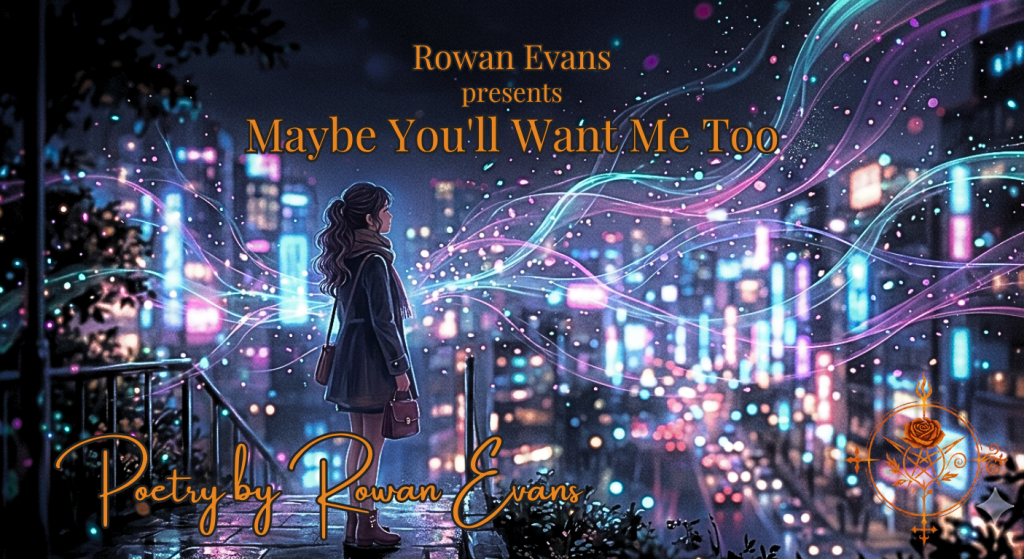
The poem began when I remembered a conversation. A joke, really. Someone once described themselves as being “like a drug” and we laughed about it. At the time, it felt playful, exaggerated, harmless.
But memory has a way of revisiting things from a different angle.
When I thought about that conversation later, I realized what interested me wasn’t the comparison itself. It was the experience of slowly realizing that someone has become part of your everyday thoughts without you noticing exactly when it happened.
One day they’re simply someone you know.
Then they’re someone you think about.
Then they’re someone who quietly occupies space in your mind when nothing else is demanding your attention.
The drug metaphor gave me a doorway into the poem, but it isn’t really what the poem is about.
It’s about affection.
It’s about attachment.
It’s about the strange vulnerability of admitting that someone matters.
More than that, it’s about the difference between being needed and being wanted.
Need can feel transactional.
Want feels chosen.
The final lines became the emotional center for me because they capture a hope I think many people carry but rarely say aloud:
Not that someone has to stay.
Not that someone owes us their attention.
Just that maybe, if given the choice, they would choose us too.
Like a lot of my recent work, humor and metaphor show up first. They’re familiar territory. They’re comfortable. They make difficult things easier to approach.
But beneath the jokes, the poem is doing what many of my poems eventually do.
It’s confessing.
— Rowan Evans
Sometimes affection arrives quietly—slipping into your thoughts until you realize someone has become part of your everyday world. ✨
Maybe You’ll Want Me Too Poetry by Rowan Evans
I remember when you said—
you are like a drug.
It was all laughs
about your exes being hooked,
still shook by the thoughts of you.
But I was getting second-hand
contact highs—
now I feel addicted too.
It’s like you’re in my bloodstream.
You’ve rewired my brain,
rebalanced the chemical compounds—
you’re in nearly every single thought now.
I try to hide it behind metaphors
and jokes—an attempt to mask
the fragile hope—
that you won’t need me,
but maybe you’ll want me too.
Journey into the Hexverse…
[Recognizes Home] A free-verse poem exploring the difference between love as dependency and love as choice. It challenges the idea that love must be need-based, instead centering the quiet strength of choosing someone while still remaining whole on your own.
[Not Rebuilding You] A poem about love as an act of presence rather than rescue. Through construction imagery, Not Rebuilding You explores trust, devotion, emotional safety, and the quiet work of building a foundation strong enough for healing to grow.
[The Language Her Soul Speaks] What if love isn’t about being understood, but learning to understand someone else? “The Language Her Soul Speaks” is a free verse poem about intimacy, communication, curiosity, and the desire to know another person beyond the limits of language.
[Ocean Waves (1, 4, 3)] A moonlit shoreline, a rowboat full of ducks, a piggybank with no cents, and a confession hidden in plain sight. Ocean Waves (1, 4, 3) explores how humor, wordplay, and absurdity can become a side door to vulnerability when the truth feels too difficult to say directly.
[L Words & Heart] A moonlit shoreline, a rowboat full of ducks, a piggybank with no cents, and a confession hidden in plain sight. Ocean Waves (1, 4, 3) explores how humor, wordplay, and absurdity can become a side door to vulnerability when the truth feels too difficult to say directly.
The opening came first—a joke, a banana peel, a little bit of wordplay and self-awareness. The speaker trips over their own feelings and tries to laugh about it before anyone notices.
That’s fairly normal for me.
Humor has always been one of the ways I approach vulnerability. Not because the feelings aren’t real, but because sometimes honesty becomes easier to hold when it’s carrying a joke.
But somewhere during the writing process, the poem shifted.
The focus stopped being the speaker’s feelings and became the person receiving them.
Because love, at least the kind I’m interested in writing about, isn’t ownership.
It isn’t rescue.
It isn’t fixing someone.
It’s creating safety.
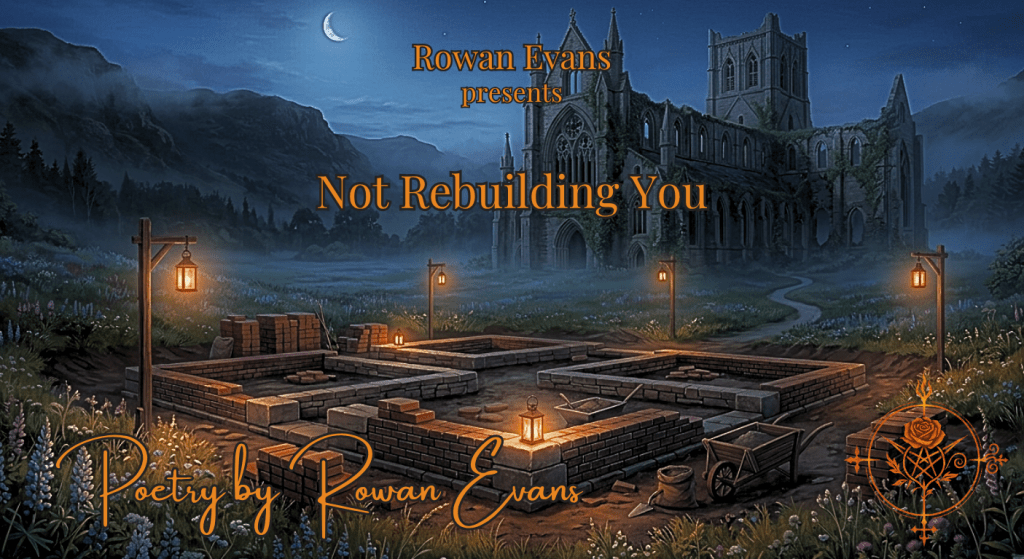
The construction imagery in the second half comes from that idea. The speaker isn’t trying to rebuild another person or erase their past. They’re trying to create something steady. Something reliable. A place where another person can set down their fears for a while and rest.
That distinction matters to me.
Too many love stories focus on saving someone.
I’m more interested in what happens when you simply show up, consistently, and help build conditions where healing becomes possible.
Brick by brick.
Choice by choice.
Day by day.
The final lines grew from a belief I’ve carried for a long time:
Everyone deserves a future that feels safe to stand inside.
Everyone deserves foundations that don’t shake beneath them.
And sometimes the greatest gift we can offer another person isn’t a promise to save them.
It’s a promise to help build something that lasts.
— Rowan Evans
Sometimes love isn’t about fixing what’s broken. Sometimes it’s about laying a foundation strong enough for someone to finally rest without fear of collapse. 🖤🧱✨
Not Rebuilding You Poetry by Rowan Evans
It happened quick. I slipped— banana peel. But you can trust me, I think I’ve proven that, (huh?) so you know you can trust what I feel is real.
From the fear to devotion, loyalty in motion— I try to give you no reason to question.
And you don’t need to return this. This isn’t a library, no overdue charge— just a gift straight from my heart, that I give with purpose.
And if you’re wondering why I give like this…
You’re worth it.
I’d move earth, shift dirt— excavate to stop the hurt. Prepare the land for a new foundation.
So let me lay brick after brick, patience in every layer, hope in every line. Not rebuilding you— just building a place where you can finally rest without fear of collapse.
And if it takes time, I’m not afraid of slow miracles—
because love like this isn’t renovation— it’s resurrection.
A clearing of old ruins, a promise carved into the earth: you deserve a future that doesn’t hurt to stand on.
Journey into the Hexverse…
[The Language Her Soul Speaks] What if love isn’t about being understood, but learning to understand someone else? “The Language Her Soul Speaks” is a free verse poem about intimacy, communication, curiosity, and the desire to know another person beyond the limits of language.
[Ocean Waves (1, 4, 3)] A moonlit shoreline, a rowboat full of ducks, a piggybank with no cents, and a confession hidden in plain sight. Ocean Waves (1, 4, 3) explores how humor, wordplay, and absurdity can become a side door to vulnerability when the truth feels too difficult to say directly.
[L Words & Heart] A playful, self-aware poem about love, longing, loyalty, and the quiet ways another person can reshape our inner world. What begins as humor slowly reveals a heartfelt confession about affection, imagination, and the faces that linger in our dreams.