Tag: free verse poetry

  • Author’s Note

    Some poems are meant to be complicated. This isn’t one of them.

    I wrote You Are Perfect as a reminder that our flaws don’t cancel our worth. We spend so much time measuring ourselves against impossible standards or letting other people decide what we’re worth that we forget something simple: being imperfect is part of being human.

    This poem isn’t saying you’ll never struggle or never doubt yourself. It’s saying those struggles don’t make you less deserving of love, respect, or compassion.

    If these words found you on a difficult day, I hope you borrow them until you can believe them for yourself.

    Rowan Evans


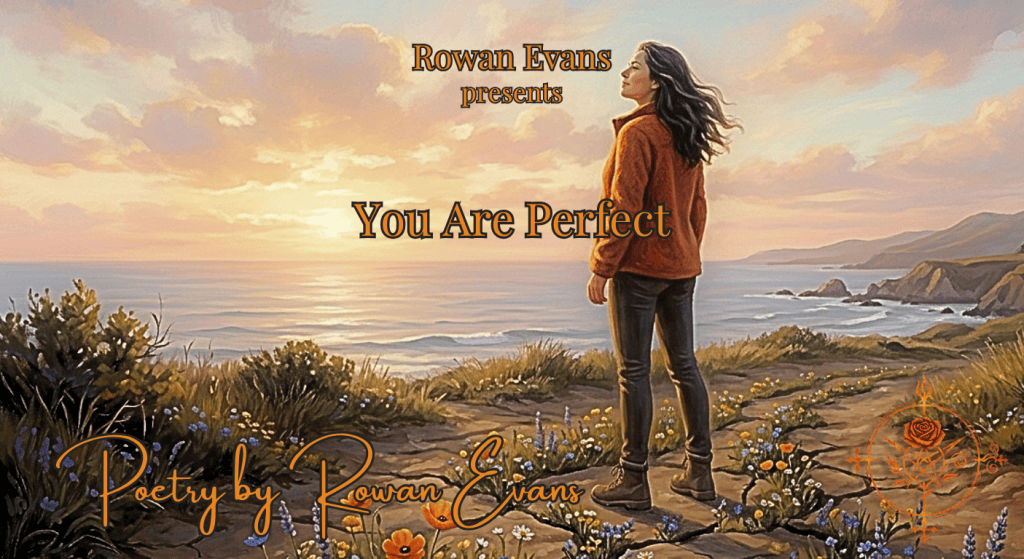
    A person standing confidently at sunrise as flowers bloom around them, symbolizing self-worth and resilience.
    Your flaws don’t diminish your worth—they’re part of the story that makes you uniquely you.

    You Are Perfect
    Poetry by Rowan Evans

    Dear,
    whoever needs
    to hear this—

    you’re worth it,
    flaws and all—
    you’re perfect.

    So don’t let others
    tear you down,
    and tell you
    what your worth is.

    Keep your chin up—
    even when it’s hard.

    Don’t let the spectators
    see you sweat.
    Don’t let them see the tears,
    or the weight on your neck.

    Because not everyone
    knows how to be a witness—
    sometimes they don’t
    have your best in mind.

    They want to see you fail,
    they want to see you small.
    So keep your chin up,
    and stand tall—

    because it’s like I said
    in lines three through six:

    Hear this—

    you are worth it,
    with your flaws and all—


    Journey into the Hexverse…

    [Human Rorschach]
    Sometimes we’re less a fixed person than an inkblot—our meaning changing with every set of eyes that looks at us. Human Rorschach explores perception, identity, and the ways our own experiences shape what we believe we see in others.

    [A Rose in the Ashes]
    Lost within a forest where every leaf becomes a memory, the speaker follows darkness instead of fleeing from it, discovering that healing isn’t found at the end of the tunnel—but in facing the past long enough to notice a single rose blooming through the ashes.

    [Where the Metaphors Lead]
    Some truths are easier to write than they are to say aloud. “Where the Metaphors Lead” explores the quiet space between dreams, confession, and the courage it takes to let another person know how deeply they’ve become woven into your inner world.

    [Through My View]
    No two people experience the world the same way. Through My View is a reflective free verse poem exploring perspective, imagination, and the impossibility of fully seeing through another person’s eyes.

    [Just Human]
    Just Human is a reflective free verse poem about seeing people before borders, choosing empathy over division, and finding home in our shared humanity rather than on a map.

    If you’re interested in more poetry, you can find it here → [The Library of Ashes]
  • Author’s Note

    I’ve always been fascinated by the idea that people rarely see the same person the same way. We don’t meet others as blank slates—we meet them carrying our own history, fears, hopes, and assumptions.

    The Rorschach inkblot became the perfect metaphor for that. The inkblot itself isn’t trying to be anything; the meaning comes from the person looking at it.

    Maybe people work the same way.

    Every interaction is filtered through perspective, and perspective is shaped by perception, memory, and experience. Sometimes what another person believes about us reveals far more about their own journey than it does about who we actually are.

    This poem is an invitation to think about that relationship between identity and interpretation—and to remember that no one is ever seen exactly as they are.

    Rowan Evans


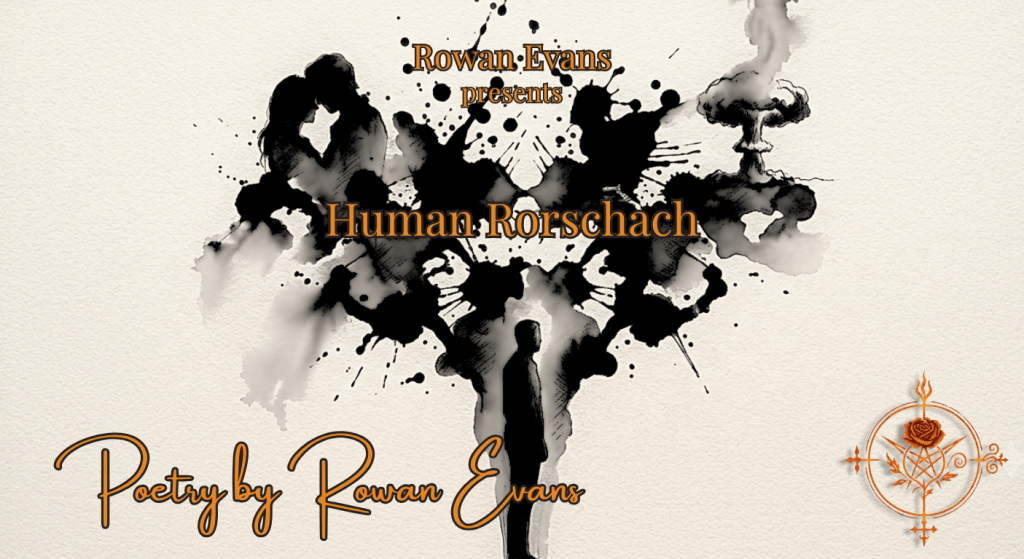
    An abstract black inkblot resembling a human figure, open to multiple interpretations, on textured paper.
    What we see often reveals more about ourselves than the person we’re looking at.

    Human Rorschach
    Poetry by Rowan Evans

    I’m an inkblot
    in human form,
    a real Rorschach—

    am I couple kissing,
    or a mushroom cloud?

    Love or destruction—

    what do you see
    when you look at me?

    Know there are
    no wrong answers—

    because what you believe
    is fed by what you see
    and what you see is perspective,
    but perspective is shaped by perception—

    I am open to interpretation
    and it changes,
    with everything
    you’ve lived through—

    the things you’ve survived.

    What you see
    when you look at me,
    says more about your life—

    than it does mine.


    Journey into the Hexverse…

    [A Rose in the Ashes]
    Lost within a forest where every leaf becomes a memory, the speaker follows darkness instead of fleeing from it, discovering that healing isn’t found at the end of the tunnel—but in facing the past long enough to notice a single rose blooming through the ashes.

    [Leave No Self Behind]
    What if finding yourself isn’t about discovering someone new, but learning to walk beside every version you’ve ever been? “Leave No Self Behind” is a meditation on memory, healing, and embracing the selves we once abandoned.

    [Every Night, The Same Flight]
    Every night begins with the same flight. Between wakefulness and sleep, an airport appears, a familiar shoreline waits beyond the journey, and the same dream asks whether some destinations find us before we’re ready to find them.

    [Through My View]
    No two people experience the world the same way. Through My View is a reflective free verse poem exploring perspective, imagination, and the impossibility of fully seeing through another person’s eyes.

    [Just Human]
    Just Human is a reflective free verse poem about seeing people before borders, choosing empathy over division, and finding home in our shared humanity rather than on a map.

    If you’re interested in more poetry, you can find it here → [The Library of Ashes]
  • Author’s Note

    There are two versions of every poet.

    The one who can write about anything, and the one who struggles to write the one thing that matters most.

    This poem begins with confidence—almost arrogance—as the speaker celebrates the ability to write in any voice, on any subject, from any perspective. But beneath that confidence is a question I’ve wrestled with for years: if it’s so easy to write about everything, why is it so difficult to write one completely honest sentence?

    Humor, metaphors, references, and wordplay are some of my favorite tools. They help me explore ideas, soften difficult emotions, and make heavy subjects more approachable. But they can also become places to hide.

    One Honest Sentence is about recognizing that difference. Sometimes the greatest challenge isn’t finding beautiful language—it’s finding the courage to stop decorating the truth long enough to simply say it.

    Rowan Evans


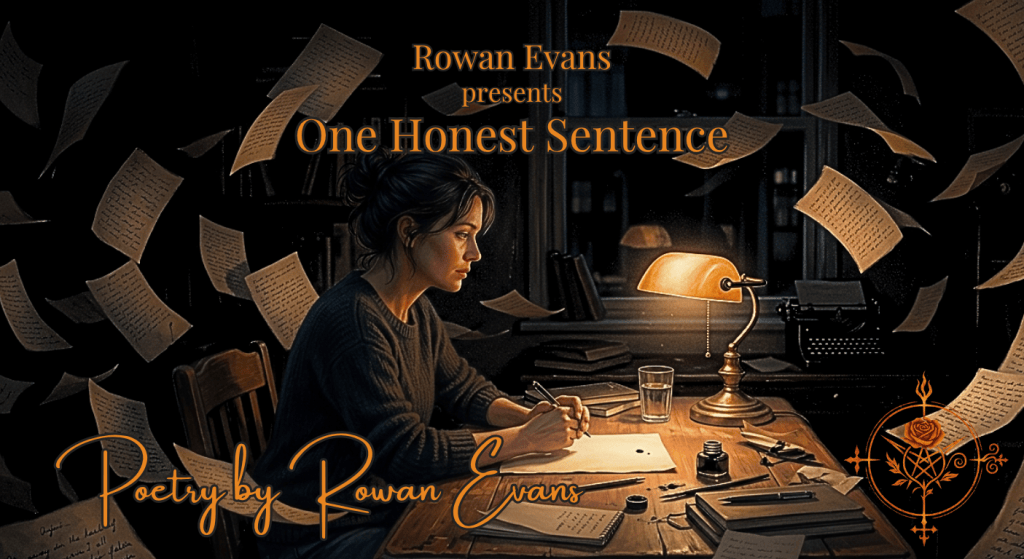
    A solitary writer sits before a blank page while countless handwritten pages float around them, symbolizing the struggle between creativity and emotional honesty.
    Writing beautifully is a skill.

    Writing honestly is a different kind of courage.

    One Honest Sentence
    Poetry by Rowan Evans

    I don’t usually like to do this, but
    I’m going to do it anyway, because
    I’m tired of pretending—

    why should I lie and say
    I’m not that guy,
    when I know I am.

    Give me a pen,
    and I can write anything.

    If a person can think it
    or have an experience,
    I can turn it into poetry.
    I do it by stringing ink
    into so many pretty lines—

    but I don’t bother to try
    and rhyme, most of the time.

    I wrote poem after poem—
    I can write a poem about the search for home
    while feeling alone in a crowded room,
    talking about how this house feels like a tomb.

    I can write island hopping epics—

    I can silence skeptics,
    put their opinions in the septic—

    they don’t know
    shhh—

    it’s no wonder they talk a lot,
    their minds are empty, got no thoughts.
    So the verbal diarrhea doesn’t stop—

    and when I read what they write,
    I call them Watson
    ’cause their lines are elementary.

    I’ve written thirty lines of flex
    and after thirty lines,
    you’re probably wondering—

    what’s next?

    Well—

    how about we pivot
    from flex to truth?

    Earlier I said—

    give me a pen and I can
    write anything.

    I can take the joy, the pain,
    the sun, the rain
    and write a whole damn series—

    it’s even easier
    if it didn’t happen to me,
    I can write about it for days—
    poem after poem,
    different angles of the same thing.

    Because it’s easy
    writing about just anything—

    what’s hard is writing
    a single truth,
    without burying it in jokes
    and misdirection.

    And maybe that’s the joke—

    I can write whole worlds,
    but not one honest sentence
    without my pulse stuttering.

    Like what would happen—
    if I just said it?

    If I turned 1-4-3 to letters
    and I just meant it?

    Would the world cease to be?

    I guess I’m just afraid—

    because once I say it,
    I can’t unsay it.

    Once I write it,
    it becomes real.

    And real things
    can be lost,
    can be rejected,
    can be held—

    and I don’t know
    which scares me more.

    So again I ask—

    what would happen
    if I just said it?

    Maybe you’d laugh.
    Maybe you’d freeze.
    Maybe you’d say it back.

    Maybe nothing would change
    except—

    I’d finally be done
    hiding behind metaphors.


    Journey into the Hexverse…

    [Noon Is Loud]
    If four in the morning belongs to truth, then noon belongs to impossible memories. Noon Is Loud is a playful free verse poem filled with absurd boasts, pop culture references, and tongue-in-cheek mythology that explores how easily imagination can rewrite reality.

    [Just Human]
    Just Human is a reflective free verse poem about seeing people before borders, choosing empathy over division, and finding home in our shared humanity rather than on a map.

    [Director’s Commentary]
    Director’s Commentary is a self-aware free verse poem that turns the poet’s recurring metaphors into the subject itself, exploring creativity, artistic habits, and the humorous inner critic that follows every writer from draft to draft.

    [The Answer Is (Yes)]
    What kind of writer am I? Mythmaker, confessor, comedian, philosopher, dream-architect, romantic, storyteller, and diss-poet. This self-reflective poem explores the impossibility of fitting creativity into a single category—and embraces every version of the truth a pen can touch.

    [Before We Created the Labels]
    Ancient gods return to a fractured world shaped by borders, identities, and separation. “Before We Created the Labels” explores humanity’s divisions through mythic imagery, sacred ritual, and symbolic collapse—asking what remains when we learn to see one another beyond labels.

    If you’re interested in more poetry, you can find it here → [The Library of Ashes]
  • Author’s Note

    Perspective is one of the strangest things we possess.

    Two people can stand in the same place, witness the same moment, and walk away carrying completely different worlds inside them.

    I’ve spent a lot of time thinking about that—not as something that separates us, but as something that makes us interesting.

    This poem isn’t saying one perspective is better than another. It isn’t about claiming superiority.

    It’s about accepting that no one else can inhabit your mind.

    No one else sees exactly what you see, makes the same connections, or experiences the same emotional landscape. We can describe our inner worlds through art, conversation, and metaphor, but there will always be a distance between experiencing something and hearing someone describe it.

    As a poet, I spend much of my life trying to bridge that distance.

    This poem acknowledges that the bridge will never be perfect—and that’s okay.

    Our perspectives don’t need to become identical to be meaningful.

    Sometimes it’s enough to simply recognize that every person is looking through a different window.

    Rowan Evans


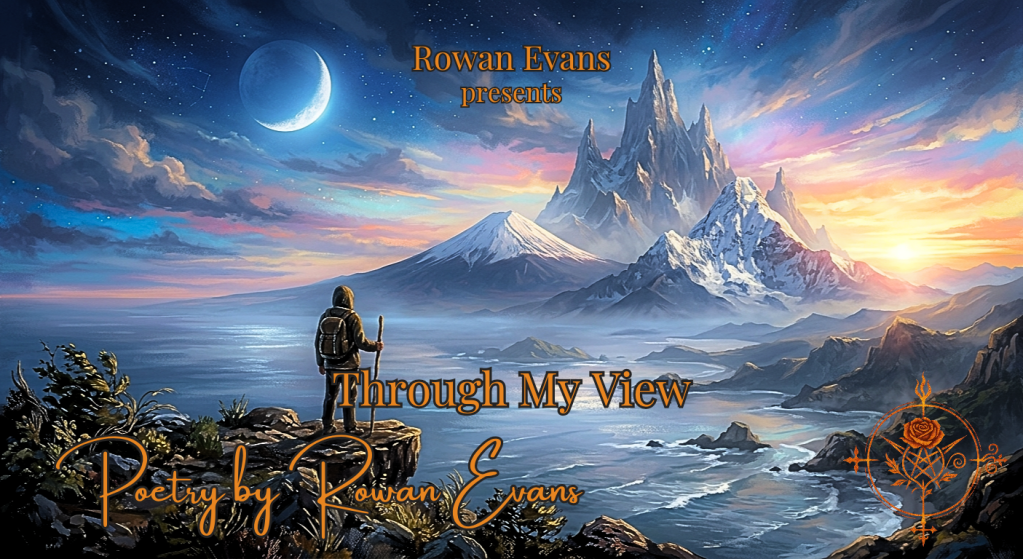
    A surreal sunrise over towering mountains, a vast ocean, and a fading moon, symbolizing a unique personal perspective on the world.
    No one else can stand exactly where you stand or see the world through your eyes.

    Through My View
    Poetry by Rowan Evans

    It’s eight,
    I hear the birds chirp.
    It’s late, I’m awake—
    what’s new?

    Silence.
    It’s violence—
    the words that I choose,
    when I’m cut loose.

    Like my thoughts,
    I’m off leash—
    you can’t stop me.

    I’ve got a mind
    that stacks lines,
    mountains high,
    metaphors rise—

    higher than Fuji,
    higher than Everest.

    You’ll never finish this climb,
    your mountains will never match mine.
    You could do this for the rest of your life—

    but you’ll never cross my ocean,
    you’ll never see my moon
    with your own eyes.
    You’ll never feel the pull of my tide—

    because your mind
    doesn’t work like mine.
    You’ll never see the beauty
    in my horizon line—

    the way the colors
    shift and shine
    with the change of time.

    You’ll never see the world like—
    I do,
    you’ll never see the world through—
    my view.


    Journey into the Hexverse…

    [Just Human]
    Just Human is a reflective free verse poem about seeing people before borders, choosing empathy over division, and finding home in our shared humanity rather than on a map.

    [Monster Theology]
    What if the monsters under the bed weren’t monsters at all? Monster Theology explores difference, belonging, and the human tendency to fear what we don’t understand through a conversation with the creatures we’ve spent our lives imagining.

    [Before We Created The Labels]
    Ancient gods return to a fractured world shaped by borders, identities, and separation. “Before We Created the Labels” explores humanity’s divisions through mythic imagery, sacred ritual, and symbolic collapse—asking what remains when we learn to see one another beyond labels.

    [No You and I, Ony Us]
    A hopeful free verse poem about empathy, borders, and imagining a world where humanity matters more than division.

    [Two Americans]
    What does it mean to share a country, a language, and still feel completely different? Two Americans explores identity, culture, and the quiet disconnect between people who should feel the same—but don’t.

    If you’re interested in more poetry, you can find it here → [The Library of Ashes]
  • Author’s Note

    This poem started where a lot of my more playful pieces begin: with a chain reaction of absurd images that refused to behave.

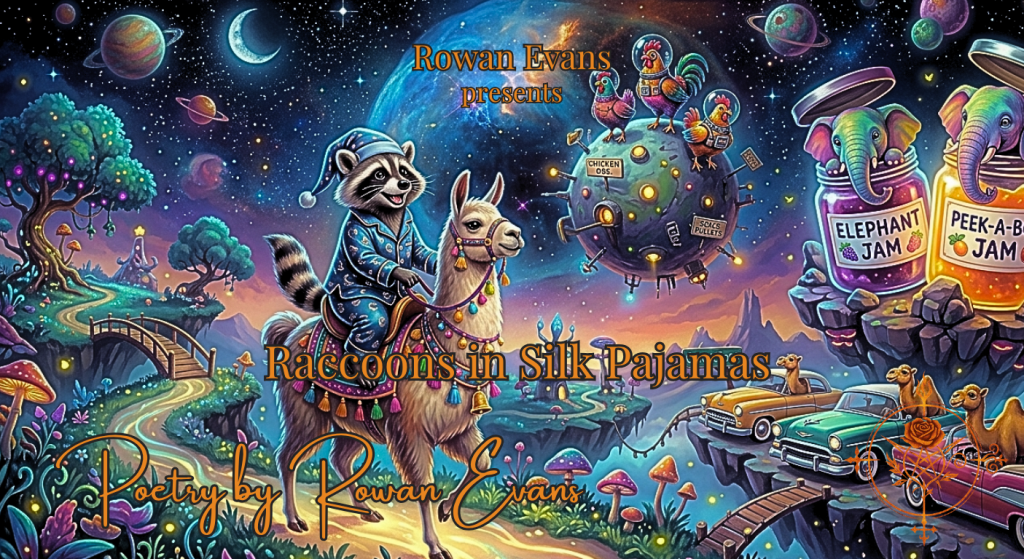
    I didn’t sit down with a structure in mind. I just let the language run until it started building its own logic—one that doesn’t really care about realism, linear progression, or whether raccoons should realistically be wearing silk pajamas in the first place.

    The “Space Chickens” at the beginning weren’t planned as a motif. They became one because they felt like the kind of strange, mildly accusatory presence that only makes sense in a world where camels are in parked cars and elephants are stored in jam jars.

    From there, the poem just escalates.

    Raccoons appear. Then llamas. Then the question of pajamas becomes a philosophical problem. Somewhere in the middle, the poem realizes it is no longer interested in consistency—it’s interested in momentum.

    There’s a moment where the speaker tries to impose logic:

    “Don’t be absurd.”

    But by that point, absurdity has already won.

    What I find interesting about this piece is that it still has a kind of emotional continuity even without narrative stability. It moves the way thoughts move when you’re tired, distracted, or laughing at your own internal associations—jumping from one idea to another through sound, memory, and cultural reference rather than logic.

    Even the ending, with its sudden shift into pop culture and cinematic reference, is less about conclusion and more about acknowledgment. The poem becomes aware of itself mid-collapse and decides to lean into it rather than resolve it.

    In that sense, it’s not really about raccoons.

    It’s about the way language behaves when you stop trying to control it.

    And sometimes, that’s where the most honest writing shows up.

    Rowan Evans


    A raccoon wearing silk pajamas rides a llama beneath a colorful cosmic sky filled with surreal creatures and absurd imagery.
    When logic leaves the room, language starts having fun.

    Raccoons in Silk Pajamas
    Poetry by Rowan Evans

    I had to get away
    from the Space Chickens,
    they were a little too judgmental—

    always questioning what I wore,
    shouting implied curses
    spoken in cursive.

    It was camels in parked cars,
    elephants in jam jars…

    Now it’s—

    raccoons in silk pajamas,
    and they’re not alone—
    they’re riding llamas.

    “Are the llamas
    wearing silk pajamas?”

    Don’t be absurd.
    That’s the weirdest thing
    I’ve ever heard—

    llamas in pajamas?

    No, just raccoons
    and bananas.

    I was once a
    farmer on Pluto,
    a librarian on Mars—
    a poet amongst the stars.
    Now I’m just
    an astronaut in the ocean,
    rolling in the deep.

    Dude—
    you just referenced Adele.

    Like it is 2001 again.
    It’s a Space Odyssey


    Journey into the Hexverse…

    See where it all began.

    [Pluto Farmer]
    A whimsical absurdist poem about being a certified weirdo, farming space carrots on Pluto, and refusing to fit into anyone else’s definition of “normal.”

    If you’re interested in more poetry, you can find it here → [The Library of Ashes]
  • Author’s Note

    Some poems arrive all at once.

    This one arrived in pieces.

    The opening came first—a joke, a banana peel, a little bit of wordplay and self-awareness. The speaker trips over their own feelings and tries to laugh about it before anyone notices.

    That’s fairly normal for me.

    Humor has always been one of the ways I approach vulnerability. Not because the feelings aren’t real, but because sometimes honesty becomes easier to hold when it’s carrying a joke.

    But somewhere during the writing process, the poem shifted.

    The focus stopped being the speaker’s feelings and became the person receiving them.

    Because love, at least the kind I’m interested in writing about, isn’t ownership.

    It isn’t rescue.

    It isn’t fixing someone.

    It’s creating safety.

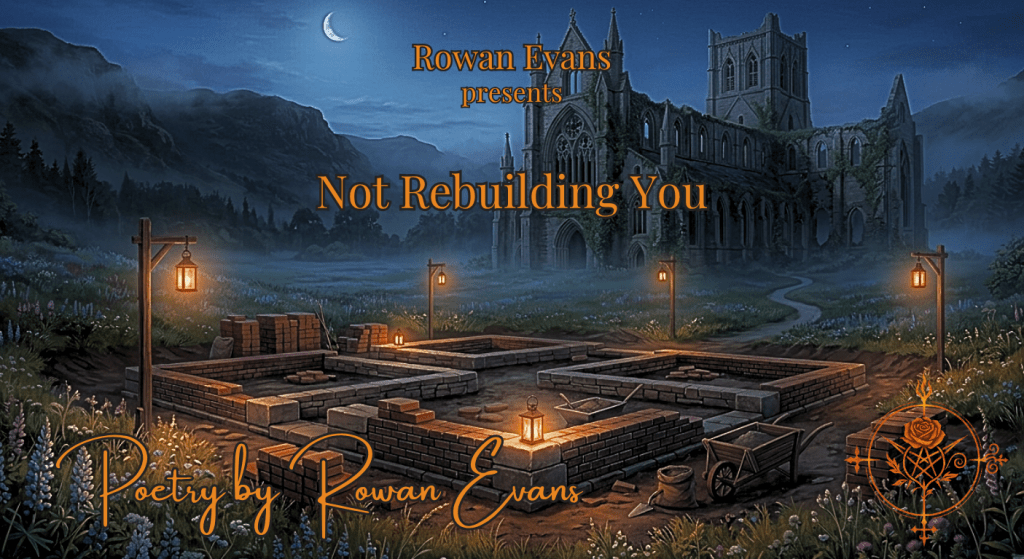
    The construction imagery in the second half comes from that idea. The speaker isn’t trying to rebuild another person or erase their past. They’re trying to create something steady. Something reliable. A place where another person can set down their fears for a while and rest.

    That distinction matters to me.

    Too many love stories focus on saving someone.

    I’m more interested in what happens when you simply show up, consistently, and help build conditions where healing becomes possible.

    Brick by brick.

    Choice by choice.

    Day by day.

    The final lines grew from a belief I’ve carried for a long time:

    Everyone deserves a future that feels safe to stand inside.

    Everyone deserves foundations that don’t shake beneath them.

    And sometimes the greatest gift we can offer another person isn’t a promise to save them.

    It’s a promise to help build something that lasts.

    Rowan Evans


    A new foundation being built beside old ruins at twilight, symbolizing healing, trust, and creating a safe future through love.
    Sometimes love isn’t about fixing what’s broken. Sometimes it’s about laying a foundation strong enough for someone to finally rest without fear of collapse. 🖤🧱✨

    Not Rebuilding You
    Poetry by Rowan Evans

    It happened quick.
    I slipped—
    banana peel.
    But you can trust me,
    I think I’ve proven that, (huh?)
    so you know
    you can trust
    what I feel is real.

    From the fear
    to devotion,
    loyalty in motion—
    I try to give you no reason
    to question.

    And you don’t need
    to return this.
    This isn’t a library,
    no overdue charge—
    just a gift straight from my heart,
    that I give with purpose.

    And if you’re wondering
    why I give like this…

    You’re worth it.

    I’d move earth,
    shift dirt—
    excavate
    to stop the hurt.
    Prepare the land
    for a new foundation.

    So let me lay brick after brick,
    patience in every layer,
    hope in every line.
    Not rebuilding you—
    just building a place
    where you can finally rest
    without fear of collapse.

    And if it takes time,
    I’m not afraid of slow miracles—

    because love like this
    isn’t renovation—
    it’s resurrection.

    A clearing of old ruins,
    a promise carved into the earth:
    you deserve a future
    that doesn’t hurt to stand on.


    Journey into the Hexverse…

    [The Language Her Soul Speaks]
    What if love isn’t about being understood, but learning to understand someone else? “The Language Her Soul Speaks” is a free verse poem about intimacy, communication, curiosity, and the desire to know another person beyond the limits of language.

    [Ocean Waves (1, 4, 3)]
    A moonlit shoreline, a rowboat full of ducks, a piggybank with no cents, and a confession hidden in plain sight. Ocean Waves (1, 4, 3) explores how humor, wordplay, and absurdity can become a side door to vulnerability when the truth feels too difficult to say directly.

    [L Words & Heart]
    A playful, self-aware poem about love, longing, loyalty, and the quiet ways another person can reshape our inner world. What begins as humor slowly reveals a heartfelt confession about affection, imagination, and the faces that linger in our dreams.

    If you’re interested in more poetry, you can find it here → [The Library of Ashes]
  • Author’s Note

    This poem didn’t start with a message.

    It started with frustration.

    Not the kind that arrives fully formed or carefully structured—but the kind that builds in fragments. Small irritations. Cultural noise. Half-remembered references. Thoughts that don’t arrive in order, but all at once.

    What I wanted to capture here wasn’t a linear argument or a polished reflection on anger or identity.

    It was the process itself.

    The way the mind can jump from one idea to another without asking permission. The way language doesn’t always behave politely. The way emotion and memory and absurdity can occupy the same space without resolving into anything clean.

    The Batman reference, the cartoon interruption, the sudden shift in tone—none of it is meant to smooth into coherence.

    It’s meant to feel like it actually feels inside the moment of thinking it.

    The line “This is how my mind works” is the turning point for me in the piece.

    Not because it explains everything, but because it stops pretending everything needs to be explained.

    Some poems are built to argue a point.

    This one is built to show the mechanism.

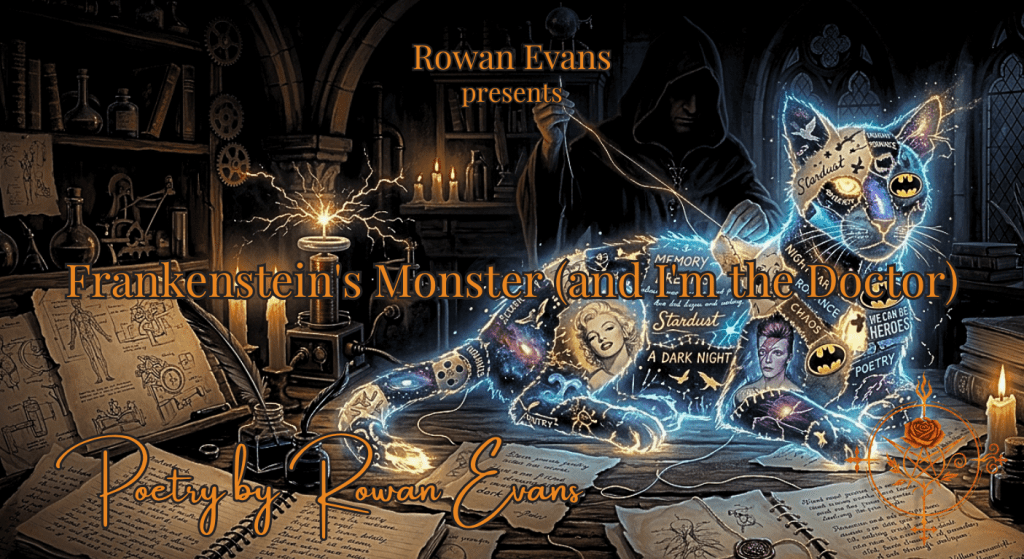
    And the ending—“Frankenstein’s Monster / And I’m the doctor”—isn’t meant as metaphor in the traditional sense.

    It’s closer to recognition.

    That the thing being called chaos is also something being assembled. Intentionally or not. Carefully or not. But still assembled.

    And that sometimes the person inside the noise is also the one holding the pieces.

    Rowan Evans


    A poet in a gothic laboratory assembling glowing fragments of words and images into a patchwork creation made from poetry and imagination.
    “My poetry? Frankenstein’s Monster. And I’m the doctor.” Sometimes creativity isn’t about finding order—it’s about assembling the pieces and bringing them to life.

    Frankenstein’s Monster (and I’m the Doctor)
    Poetry by Rowan Evans

    I’m sick of my surroundings;
    sick of these fakes,
    sick of the snakes,
    they’re all just Batman villains—
    Two-face.

    Crazy is the way
    they made me.
    Twisted thoughts
    that wouldn’t stop—
    pop goes the weasel,
    I R Baboon.

    This is how my mind works.
    It links two things
    that are seemingly opposites.
    They have nothing in common,
    but still I piece them together—

    my poetry?
    Frankenstein’s Monster.

    And I’m the doctor.


    Journey into the Hexverse…

    [Violets Are Violet (Roses Are Complicated)]
    A simple observation leads to an absurd conclusion: violets aren’t blue, roses aren’t always red, and the classic love poem may be far less accurate than advertised. A humorous free-verse poem about overthinking, flower symbolism, and the unintended consequences of analyzing clichés too closely.

    [It’s Just Me but Super]
    A playful free-verse poem about cartoons, imagination, cosmic wanderings, and the strange magic of creativity. Through wordplay, nostalgia, and absurd humor, Rowan Evans explores what happens when ordinary life meets an extraordinary imagination.

    [100 Grand and a Book Deal]
    A playful collision of candy bars, comic book heroes, basketball legends, and cosmic metaphors. Beneath the jokes lies a reflection on twenty-three years of writing, creativity, and the dream of building something lasting one line at a time.

    If you’re interested in more poetry, you can find it here → [The Library of Ashes]
  • Author’s Note

    This poem began with a simple observation:

    Violets aren’t blue.

    They’re violet.

    Which, admittedly, is not a revelation likely to change the course of human history.

    But once I started thinking about it, the entire cliché began to unravel.

    Because roses aren’t always red either.

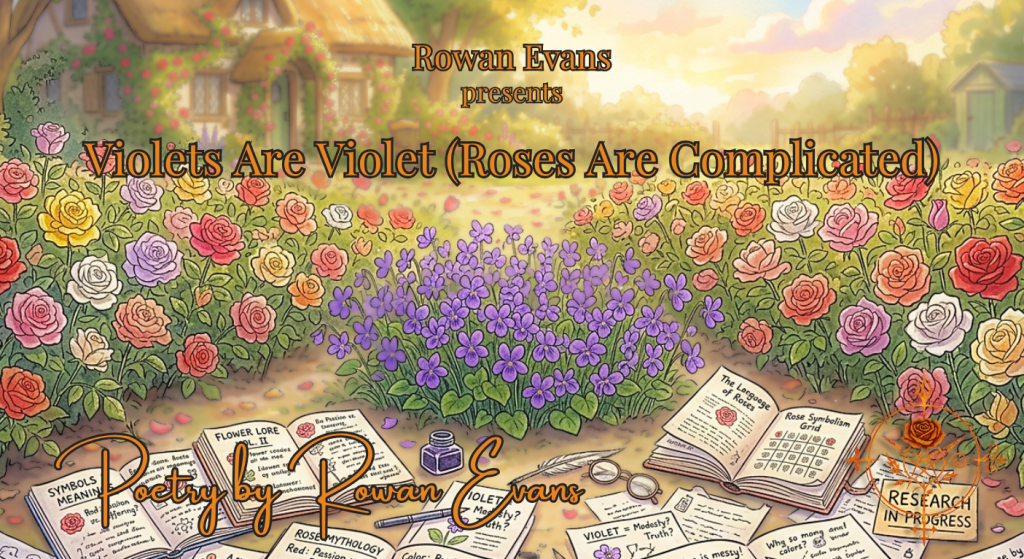
    And then I found myself researching flower symbolism, color meanings, and all the ways a four-line nursery-rhyme structure completely falls apart under even the mildest amount of scrutiny.

    At some point, the poem stopped being about flowers.

    It became about overthinking.

    About taking a perfectly functional piece of language and pulling on a loose thread until the entire sweater comes apart in your hands.

    Which, if I’m being honest, describes a significant percentage of my writing process.

    What makes me laugh about this piece is that it starts as a correction and ends as a complaint.

    Not about roses.

    Not about violets.

    About the format itself.

    Because the more precise and accurate I tried to make the original cliché, the more impossible it became to actually say anything romantic.

    Eventually I arrived at the only logical conclusion:

    Roses are complicated.

    Violets are violet.

    And sometimes analysis is the natural predator of romance.

    Rowan Evans


    Multicolored roses and violet flowers surrounding scattered handwritten notes about flower symbolism and romance.
    Sometimes the quickest way to ruin a cliché is to fact-check it. Roses are complicated. Violets are violet. Romance may never recover. 🌹💜

    Violets Are Violet (Roses Are Complicated)
    Poetry by Rowan Evans

    Roses are red,
    violets aren’t blue.
    Also roses
    aren’t always red.

    Red is the classic:
    romance, true love
    and passion.

    Pink conveys
    gratitude, grace,
    joy and admiration.

    Yellow denotes
    friendship, joy,
    warmth and caring.

    White represents
    innocence,
    purity, youth
    and new beginnings.

    And there’s at least
    four more—
    Coral, Peach,
    Lavender and Orange.

    So I guess
    what I’m trying
    to say is—

    Roses
    come in an assortment of colors,
    Violets are violet—
    and this format
    makes romance hard.


    Journey into the Hexverse…

    [It’s Just Me but Super]
    A playful free-verse poem about cartoons, imagination, cosmic wanderings, and the strange magic of creativity. Through wordplay, nostalgia, and absurd humor, Rowan Evans explores what happens when ordinary life meets an extraordinary imagination.

    [100 Grand and a Book Deal]
    A playful collision of candy bars, comic book heroes, basketball legends, and cosmic metaphors. Beneath the jokes lies a reflection on twenty-three years of writing, creativity, and the dream of building something lasting one line at a time.

    [Copy of a Copy]
    A sharp, self-aware poem about originality, imitation, and the search for an authentic creative voice. What begins as a diss gradually reveals itself as a meditation on authorship, influence, and the things that can never truly be copied.

    [Lone Wolf Theology]
    A philosophical pop-culture poem exploring freedom, identity, and self-authorship through the lens of superheroes, antiheroes, mythic archetypes, and personal rebellion. A declaration of autonomy in a world determined to write your story for you.

    [L Words & Heart]
    A playful, self-aware poem about love, longing, loyalty, and the quiet ways another person can reshape our inner world. What begins as humor slowly reveals a heartfelt confession about affection, imagination, and the faces that linger in our dreams.

    [Just Beyond Waking]
    A street that feels familiar. A life that hasn’t happened yet. Just Beyond Waking explores the fragile space between dreams, memory, longing, and the quiet feeling that some futures are already waiting for us.

    [Twin Suns, Sister Moons]
    A poem about distance, longing, and the quiet pull of someone who lives beneath a different sky. Between twin suns and sister moons, the heart keeps reaching for home.

    [It’s You I Choose]
    A poem about devotion, vulnerability, and the quiet decision to stay. Sometimes love isn’t certainty—it is choosing someone anyway.

    If you’re interested in more poetry, you can find it here → [The Library of Ashes]
  • Author’s Note

    Sometimes writing becomes survival before you even realize that’s what it’s turned into.

    This piece came from the realization that I often disappear into craft when my mind gets too loud. I’ll drift into rhyme schemes, metaphors, cadence, imagery—anything that helps me stay afloat emotionally.

    Not because I’m trying to escape life completely.

    More because writing gives shape to feelings that otherwise feel impossible to carry.

    A lot of this poem revolves around rootlessness: the feeling of growing in soil that never fully nurtured you, while still refusing to break under the pressure of it.
    And I think that distinction matters.

    Struggling to root yourself somewhere doesn’t mean you’re weak. Sometimes it simply means the environment around you was never meant to hold the version of you that was trying to grow.

    So this piece became less about collapse and more about persistence.

    About continuing to create meaning even while feeling displaced.

    About refusing to let your environment define your voice.

    Rowan Evans


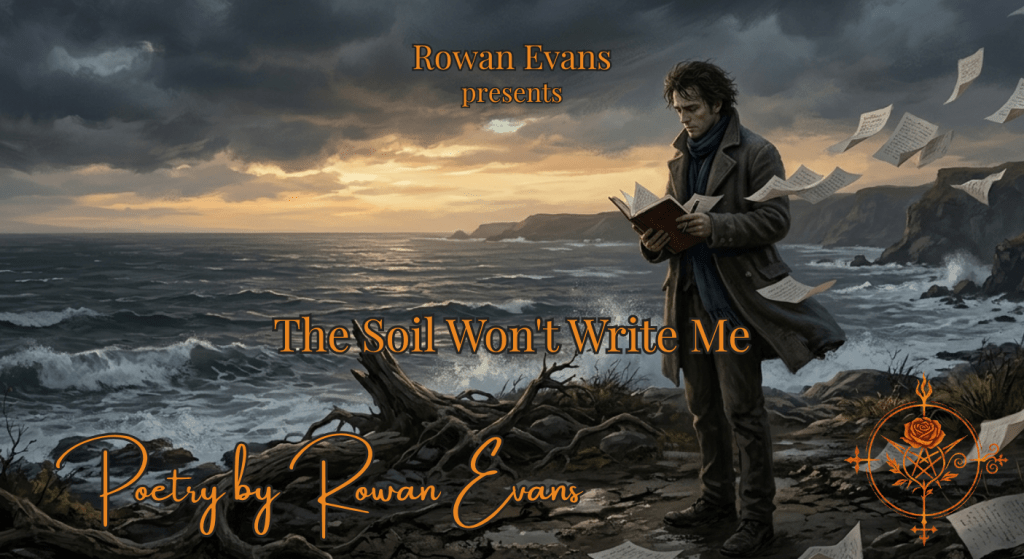
    A solitary figure stands near the ocean at dusk holding a notebook while storm clouds part above exposed roots in cracked earth.
    Some roots fail because the soil was never meant to hold them.

    The Soil Won’t Write Me
    Poetry by Rowan Evans

    I’m sorry—
    I got lost again.

    Drifting between lines,
    bouncing between rhymes—
    if life’s a game,
    I keep forgetting to play.

    Too focused on the craft,
    lost sight of the life behind it.

    Don’t worry—
    I’m not in danger.

    I’ve just gone quiet—
    trying to silence
    a mental riot.

    Thoughts get too loud,
    become a stranger to myself.

    I get lost in the craft,
    turn the pen to a life raft.

    Ink crashes
    like waves overhead,
    carrying secrets
    in the cadence
    of the tides.

    Because every rhyme
    is a shoreline
    on ocean’s edge.

    And this is how it works for me—

    it starts small
    then quickly grows—
    a seed
    into a tree.

    A tree big and tall,
    but the foundation is weak—
    there are no roots here
    to anchor me.

    They say I’d waver
    in the slightest breeze.

    But that’s not true,
    just because I have no roots—
    doesn’t mean that I will falter,
    it just means
    life won’t come with ease.

    It just means
    this soil wasn’t right for me—

    and these people
    cannot speak for me,
    I write what I think
    in ink and let that
    carry what I mean.

    All that means—
    I won’t let this soil write for me.

    And I’ll deal with
    this stuck feeling,
    that I feel
    deep inside—
    in the only way
    I know how…

    I’ve got to write it out,
    can’t ignore it.

    Got to ride it out.


    Journey into the Hexverse…

    [The Needle Doesn’t Point North]
    “The Needle Doesn’t Point North” is a deeply personal free verse poem about displacement, identity, and spending a lifetime feeling emotionally disconnected from the place you were born while being drawn toward distant shores.

    [Weather in My Chest]
    “Weather in My Chest” is a free verse poem about emotional hyperawareness, social tension, and the quiet experience of carrying internal storms into rooms that react before a singl[e word is spoken.

    [Sound as a Vessel]
    “Sound as a Vessel” is a free verse poem about music as emotional architecture, exploring how international artists and soundscapes shaped identity, creativity, memory, and poetic voice.

    [Just Knowing You Has Been Enough]
    “Just Knowing You Has Been Enough” is a deeply vulnerable free verse poem about unspoken love, emotional fear, coded confessions, and the quiet truth of caring for someone without needing perfection in return.

    [The Streets I Walk When I Sleep]
    “The Streets I Walk When I Sleep” is a deeply intimate free verse poem about recurring dreams, emotional connection, longing across distance, and the strange feeling of remembering places and moments that have never happened in waking life.

    [Memories From a Life Yet to Come]
    Some dreams feel less like fantasy and more like memory. “Memories From a Life Yet to Come” is a reflective free verse poem about longing, displacement, emotional alignment, and the strange comfort of recognizing yourself more clearly in dreams than in waking life

    [Separate Timelines]
    “Separate Timelines” is a surreal and deeply introspective free verse poem about emotional distance, time zones, vulnerability, and the fear of losing a connection that already feels meaningful before the words are ever spoken aloud.

    If you’re interested in more poetry, you can find it here → [The Library of Ashes]
  • Author’s Note

    Music has always been more than background noise to me.

    It’s emotional architecture.

    There are songs that feel tied to specific versions of myself, specific periods of my life, specific emotional states I don’t know how to explain outside of sound.

    When I write, I usually start with music first. Not ideas. Not themes. Feeling.

    I sit in silence with headphones on and let the music guide me somewhere emotionally honest.

    This piece came from thinking about how deeply international my creative influences really are.

    A lot of the sounds that shaped me came from places I’ve never physically been: the Philippines, South Korea, Japan, Thailand.

    And over time, those influences stopped feeling external. They became part of my emotional language.

    Part of my rhythm. Part of my imagery. Part of how I understand myself creatively.

    Also: yes, “Morning Daughters” is intentional.

    It’s a poetic translation of the J-pop group Morning Musume because the translated phrasing fit the cadence of the piece better.

    That felt appropriate for a poem about translation, transformation, and reshaping influence into something personal.

    Because that’s ultimately what art is.

    Taking in sound, emotion, memory, culture— and turning it into your own voice.

    Rowan Evans


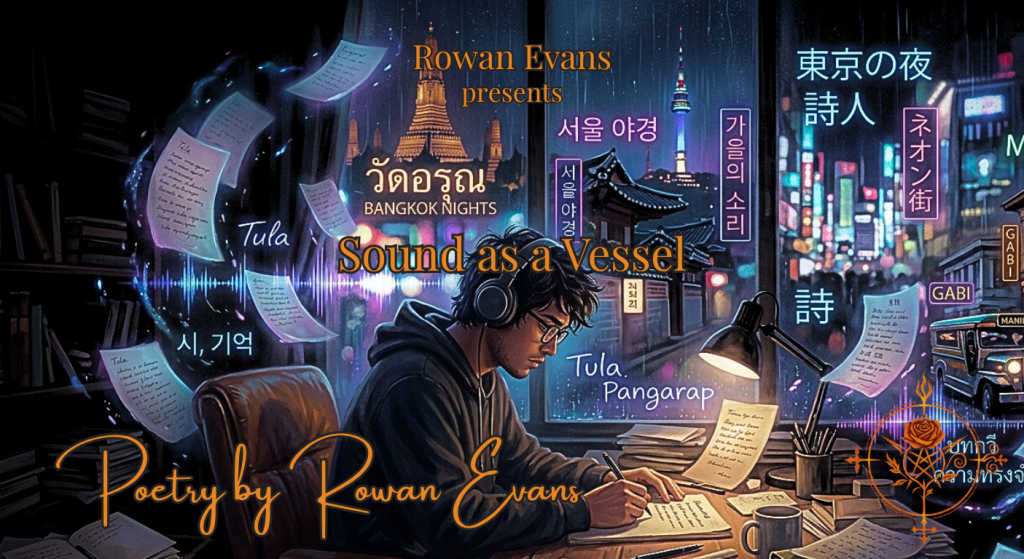
    A poet wearing headphones sits surrounded by music, poetry pages, and dreamlike international city lights blending together.
    Some people travel by plane.
    I travel by sound.

    Sound as a Vessel
    Poetry by Rowan Evans

    I want to take a moment
    to talk about process—

    the way I’ll sit
    in silence,
    with nothing
    but the sound
    from my headphones.

    I sit, unmoved
    and let the music
    wrap around me.

    I let it guide my emotion
    and lead me where it may.

    This is when I reach
    across shores,
    ignoring borders—

    I reach for the sounds
    that soothe me,
    the sounds that move me
    and make me feel.

    I follow the notes
    like they’re breadcrumbs—

    back to the places
    my body has never lived
    but my heart remembers.

    This is how I travel—

    how I return
    to the versions of myself
    I haven’t met yet.

    I put my headphones on
    and drift away—

    through different worlds,
    from XG to Young Ji—
    MILLI and 4EVE.

    Then I drift back—
    MC Sniper, Outsider
    and Drunken Tiger.

    It’s like I walk
    through time,
    using sound
    as the vessel.

    Then I hit Japan,
    Morning Daughters
    surround me.
    Up next THE GAZETTE,
    then Hamasaki Ayumi. (Queen!)

    These are the sounds
    that shaped my DNA.

    Eminem lit the fire,
    Ez Mil made it brighter.

    I broke teeth
    on Lee Hyori. (Queen!)

    And I’ve expanded,
    put more colors
    on the canvas.

    More lines
    in my rhymes.

    BINI, SB
    19 and G22
    Hev Abi, Skusta Clee,
    Sarah Geronimo too—

    just to change the shape
    of the soundscape.

    I use sound like paint
    to make pictures,
    mix it with my emotions
    to find the perfect hue.


    Journey into the Hexverse…

    [Just Knowing You Has Been Enough]
    “Just Knowing You Has Been Enough” is a deeply vulnerable free verse poem about unspoken love, emotional fear, coded confessions, and the quiet truth of caring for someone without needing perfection in return.

    [The Streets I Walk When I Sleep]
    “The Streets I Walk When I Sleep” is a deeply intimate free verse poem about recurring dreams, emotional connection, longing across distance, and the strange feeling of remembering places and moments that have never happened in waking life.

    [Memories From a Life Yet to Come]
    Some dreams feel less like fantasy and more like memory. “Memories From a Life Yet to Come” is a reflective free verse poem about longing, displacement, emotional alignment, and the strange comfort of recognizing yourself more clearly in dreams than in waking life

    [Separate Timelines]
    “Separate Timelines” is a surreal and deeply introspective free verse poem about emotional distance, time zones, vulnerability, and the fear of losing a connection that already feels meaningful before the words are ever spoken aloud.

    If you’re interested in more poetry, you can find it here → [The Library of Ashes]