Tag: existential poetry

  • Author’s Note

    There’s a strange kind of disorientation that comes from feeling like your life should make sense… but doesn’t.

    Like you missed a chapter.
    Or something important got cut before you ever had the chance to understand it.

    Lost the Plot leans into that feeling–but not just on a personal level. It questions what happens when the narrative itself isn’t entirely yours. When the direction shifts, not because it should… but because something behind the scenes decided it needed to.

    We’re often told that confusion is internal.
    That if we feel lost, it’s something we need to fix within ourselves.

    But what if part of that feeling comes from the story constantly being rewritten?
    From forces we don’t see, shaping outcomes we’re expected to accept?

    This piece sits in that space–between personal disconnection and a growing awareness the “plot” might not be as natural as it seems.

    Sometimes it’s not that you lost your way.

    Sometimes… the story changed without you.

    Rowan Evans


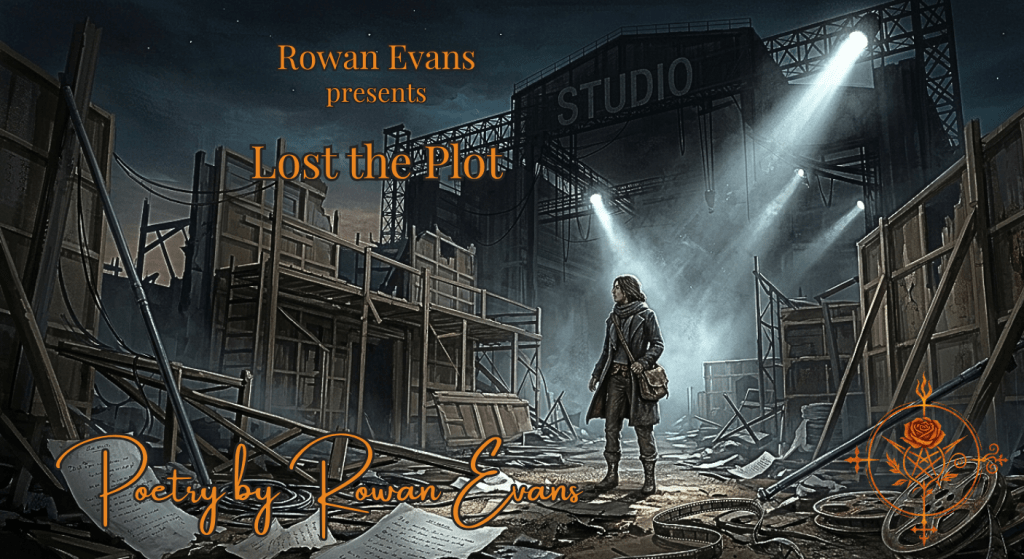
    Person standing on a broken film set with scattered reels and a looming studio above, symbolizing loss of identity and control
    What happens when the story isn’t yours anymore?

    Lost the Plot
    Poetry by Rowan Evans

    I feel like I’ve been
    getting lost a lot lately.

    Like I’ve forgotten
    who I was,
    who I am—
    who I was becoming.

    I’m feeling like
    I’ve lost the plot,
    like the studio
    lost the reel
    that we shot.

    No longer
    can I see
    where I began.

    We got cancelled
    before we
    got going.

    We never saw an end.

    But we weren’t
    cancelled because of
    interest.

    We were cancelled
    because the studio
    got scared.

    Ratings were good.
    The audience cared.

    But they cared too much.

    It was causing
    connection,
    so the studio
    had to change
    direction.

    The studio,
    needs the divide—
    keeps people
    scared and wide-eyed.

    So there’s always
    someone—
    to point to,
    to name as the bad guy.

    The boogeyman.

    So we look to the stars,
    as if they could solve
    the problems.

    As if it wasn’t
    the studio—
    the writer’s room
    behind every decision.

    It was them—

    in the writer’s room,
    rewriting endings
    we never got to reach.

    Ratings be damned.

    The show goes on—

    we just don’t
    exist in it anymore.


    Journey into the Hexverse!

    [Another Fire]
    A powerful poem exploring global chaos, systemic inequality, and emotional exhaustion in a world where conflict grows faster than it can be understood.

    If you’re interested in more poetry, you can find it here → [The Library of Ashes]
  • Author’s Note

    Not Begging, Just Tired lives in that quiet space between breaking and continuing.

    This piece isn’t about giving up–it’s about what comes after the questions, when certainty fades and all that’s left  is awareness. It explores the tension between faith and doubt, between the voice that offers an easy escape and the part of us that still chooses to struggle, to grow, to stay human.

    There’s a kind of exhaustion that doesn’t come from weakness, but from enduring–feeling everything, questioning everything, and still moving forward without clear answers. This poem sits in that space.

    It’s not a resolution.
    It’s not a victory.

    It’s a choice.

    To stay.

    Rowan Evans


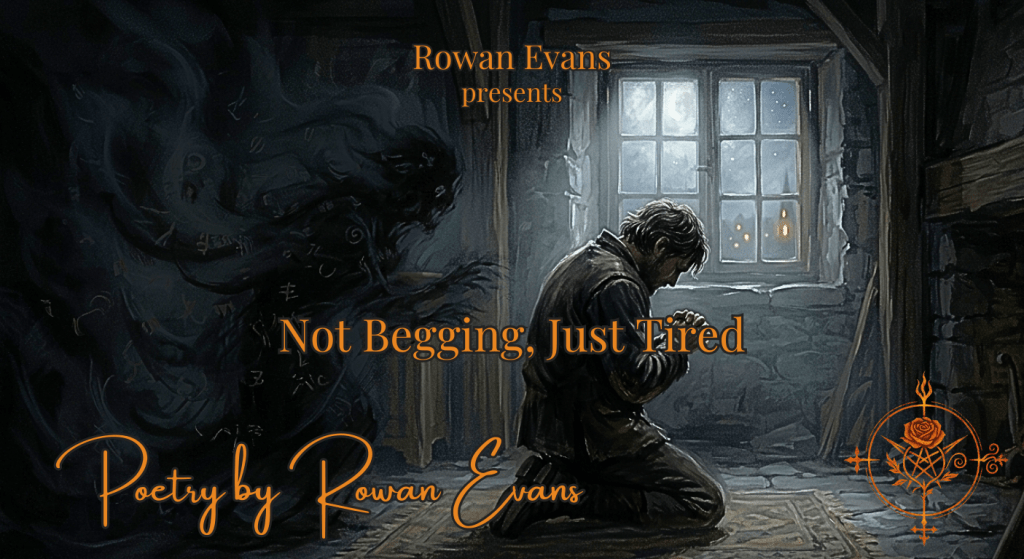
    A person kneeling in a dim room with soft light behind them, symbolizing emotional exhaustion and quiet resilience.
    Not begging—just tired, and still choosing to stay.

    Not Begging, Just Tired
    Poetry by Rowan Evans

    I’m on my knees again,
    begging—please again.
    My brain freezes,
    and I get lost within.

    Confronting sins.

    Am I who I want to be?
    I mean it—truthfully.
    Am I exactly who I want to be,
    or just who I became?

    And the devil whispers…

    He speaks to me,
    I hear him clearly.
    He says he’ll set me free—
    no need to beg or plead.

    But I don’t want ease.
    It’s the challenge I need.

    What comes easily
    is never worth the cost.
    What’s a dream
    if it means
    you lose your humanity?

    God… if you’re listening—
    can you hear me whispering?

    I’m not begging,
    I won’t plead,
    but I’m getting tired
    of having to bleed.

    I’ll be honest—
    I’m not sure if you’re real,
    but I think I used to feel you
    when things got too heavy,
    when life felt a little too rough.

    Back before
    life kind of fucked me up.

    There’s always
    a before and an after.
    Before—there was laughter.

    But that was last chapter.
    This one’s been
    a little too heavy.

    To leave?
    I’ve been a little too ready.

    I don’t mean
    leave permanently—
    I just want to be
    in a different scene.

    Somewhere I don’t feel
    at home through a screen.

    Have you felt
    out of place
    in a place
    that was supposed
    to be your home?

    And still—
    you felt alone…

    Not in a way
    that filled you with despair,
    but in a way
    that made you more aware.

    I’m not begging—
    just tired…
    and still choosing
    to stay.


    [Calculating Profits]
    Calculating Profits (Ledger of Lives) is a raw anti-war poem confronting how modern conflict is often reduced to statistics, strategy, and spectacle. Through stark imagery and direct language, Rowan Evans challenges the “us vs. them” narrative and reminds readers that behind every number in war’s ledger is a human life.

  • Author’s Note

    This piece is about a feeling I’ve struggled to name for most of my life — a feeling that I have tried to explain more recently — a quiet but persistent disconnect that began when I was fourteen.

    It isn’t about hating where I’m from.
    It isn’t about romanticizing somewhere else.

    It’s about that internal shift — the moment you realize you feel unrooted in a place where everyone else seems firmly planted.

    For years, I thought I was running away.
    Now I understand I’ve been moving toward something.

    Whether that “home” is a city, a country, a person, or a version of myself I haven’t fully stepped into yet — I don’t know.

    But I know this:
    I am not lost anymore.
    I am in motion.

    Rowan Evans


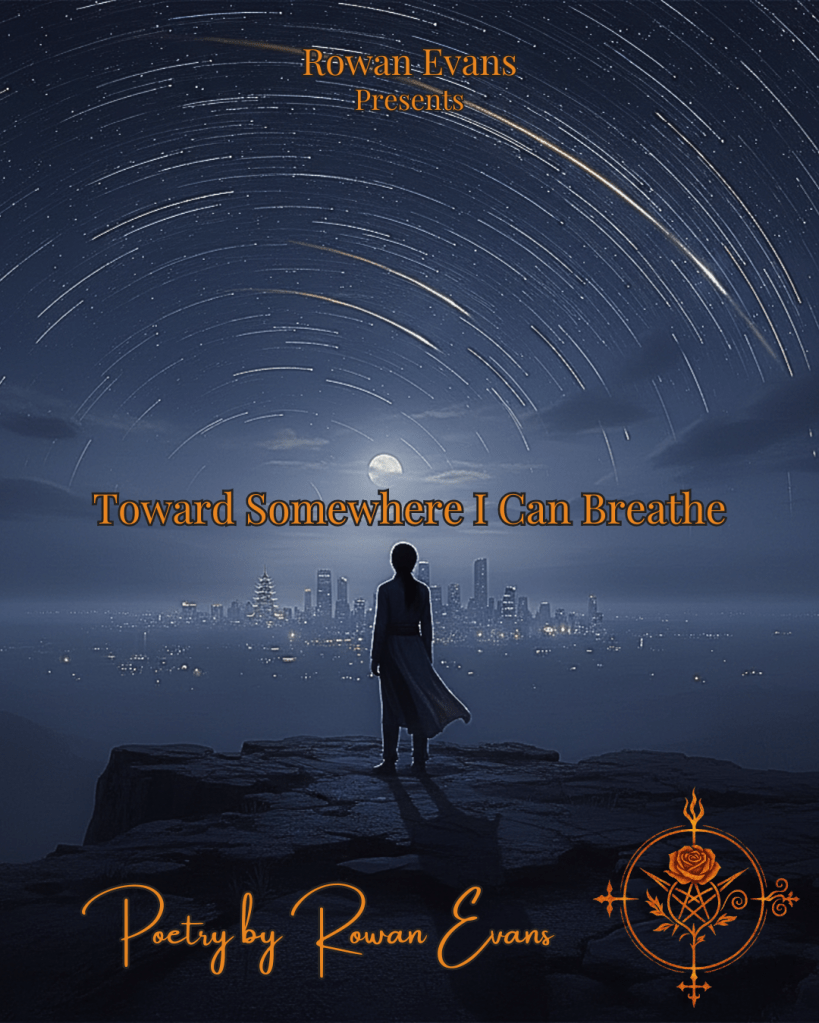
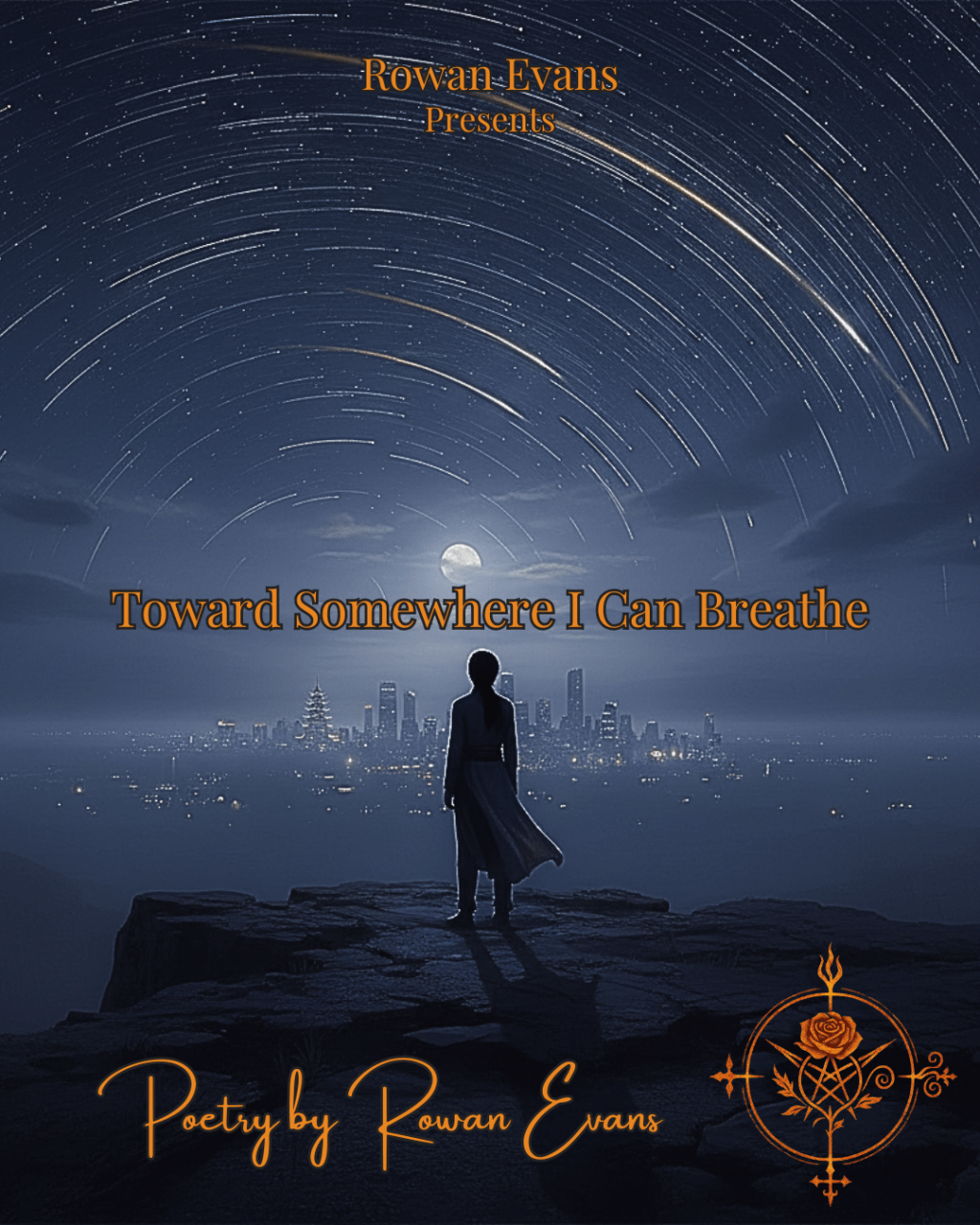
    A lone figure looking toward a distant city skyline under a star-filled night sky, symbolizing longing and the search for home.
    Sometimes home isn’t where you started. Sometimes it’s where you finally breathe.

    Toward Somewhere I Can Breathe
    Poetry by Rowan Evans

    I’ve tried my whole life
    to explain it.
    This disconnect,
    I’ve felt since
    2004.

    How can I make it
    any more clear?
    I just don’t belong here.

    I’m going to try
    and try to make it
    make sense.
    I was fourteen,
    Hi Hi Puffy AmiYumi
    on the screen.

    But that’s not the important part.

    Inside—
    I could feel
    threads fray,
    and they
    already existed
    in decay.

    But I learned quickly,
    in 2007 exactly—
    there is Filth in the Beauty,
    and the reverse
    can be the same.

    That’s when
    my view of the
    world changed,
    and became
    cemented.

    Something shifted,
    vision cleared—
    and everything
    I missed before,
    just appeared.

    Where everyone
    around me,
    seemed rooted
    in the here.

    And I—
    would close my eyes,
    and wish upon
    shooting stars.
    I wanted out,
    I wanted to leave,
    go somewhere far.

    I knew it would take time,
    I needed things to align.
    But now I know
    what I’m moving toward,
    what I’m working for.

    I’m moving toward home.
    A place, where I belong.

    Maybe when I finally leave,
    I’ll touch down in the Philippines
    to walk Manila’s streets,
    and finally be able to breathe.


    If you’re interested in more poetry, you can find it here → [The Library of Ashes]
  • Author’s Note

    This poem is a birthday rite, not a reckoning.

    I’ve always treated birthdays less like milestones and more like ceremonial thresholds—moments to shed a skin, laugh at the ghosts behind me, and step forward with intention. Funeral for a Thirty-Six-Year-Old isn’t about mourning age; it’s about staging its death so something sharper, freer, and more self-aware can take its place.

    Thirty-six feels less like getting older and more like arriving. I’m no longer interested in quiet gratitude or graceful humility—I wanted pageantry, drama, and a little irreverence. This piece is me honoring survival with style, embracing the absurdity of time, and celebrating the fact that I’m still here, still dangerous, still writing.

    If this is a funeral, it’s one where the guest of honor very much refuses to stay dead.


    A gothic figure rising from a velvet coffin in a moonlit mausoleum, symbolizing a theatrical celebration of turning thirty-six.
    Thirty-six isn’t an ending—it’s a resurrection with better lighting.

    Funeral for a Thirty-Six-Year-Old
    Poetry by Rowan Evans

    I rise from my velvet coffin,
    for birthdays are sacred rituals of vanity,
    thirty-six too perfect for a quiet exit.

    Cobwebs kiss my ankles
    as I stride the mausoleum of my life,
    counting skeletons I’ve danced with
    and candles I’ve lit in the name of style.

    The moon winks at me through shattered panes,
    celestial bodies admire
    a drama queen in full bloom—
    not wilted, not weary, theatrically immortal.

    I sip absinthe from a skull-shaped chalice,
    grinning at the reaper waiting impatiently,
    his scythe tapping to the rhythm of my heartbeat—
    shrug. He’s never been my type.

    Mirrors whisper secrets of my youthful decay,
    I laugh—lines are suggestions,
    wrinkles invitations to flair,
    every grey hair a medal for surviving
    without losing my mind… entirely.

    Birthday cake, molten lava,
    frosted with sarcasm, glittering regrets.
    I devour it with a ceremonial fork,
    toasting myself—
    who else deserves this gothic pageantry?

    The clock ticks, and I bow to time,
    not in surrender, but in acknowledgment:
    I am older, wiser, and infinitely more unhinged.
    let the world tremble at my theatricality—
    I have arrived.

    Candles gutter. Shadows shiver.
    In the mirror’s reflection, I wink—
    thirty-six has never looked this dangerous,
    this decadent, this deliciously insane.


    If you’re interested in more poetry, you can find it here → [The Library of Ashes]
  • Author’s Note

    God, Explain came from that raw, restless place we all visit when the world feels unbearably unfair. It’s a lament, a scream into the void, asking why those who give, who love, who try to make life better for others, often feel left behind, while the greedy and selfish seem to thrive.

    This poem isn’t just about faith or religion—it’s about justice, morality, and the frustration of seeing inequity everywhere. It’s about holding hope in one hand and despair in the other, demanding answers when the silence is deafening.

    I wanted the language to feel immediate, confessional, and unpolished—because sometimes the heart cannot dress its pain in elegance. God, Explain is my questioning, my pleading, my refusal to stay silent when the imbalance of the world feels unbearable.

    It’s for anyone who has ever looked at the world and wondered, why?


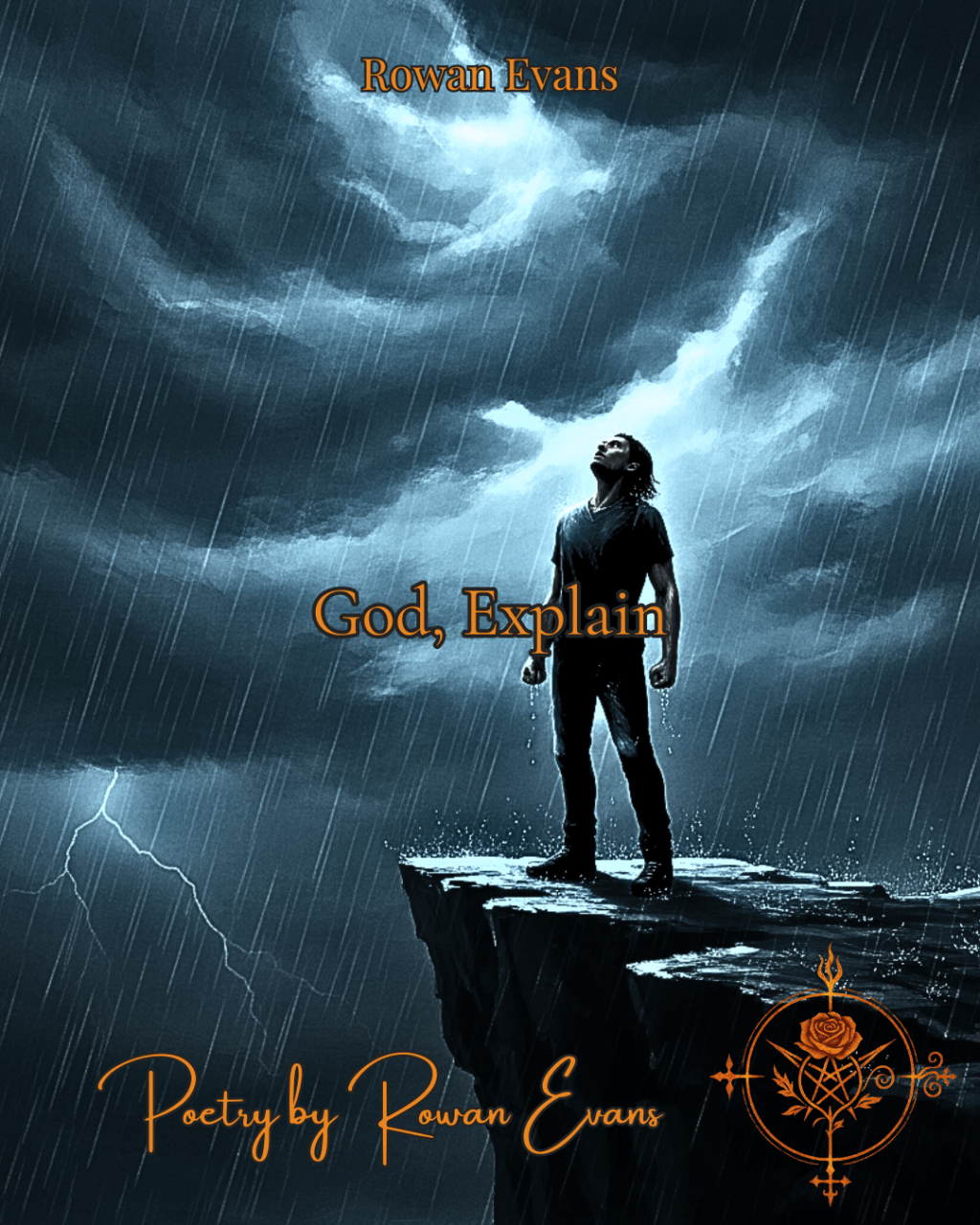
    Lone figure on a cliff under a stormy sky, looking up in frustration and questioning, with rain falling around them.
    When the world rewards the greedy and the good suffer, we lift our voices—asking, God, explain.

    God, Explain
    Poetry by Rowan Evans

    Everybody wants to get rich—
    me? I just want to fucking live.
    To survive, to thrive,
    to reach out my hands—
    to help those in need.

    So I ask—

    God, if you’re real,
    why don’t you move?
    Why don’t you open the doors
    I’ve been pounding on?
    Line my pockets with gold
    not for me, not for pride,
    but for the ones
    who need it most.

    And yet…

    The hateful, the cruel, the greedy—
    they always have it.
    Always.
    Money in their pockets,
    power in their hands,
    while the good ones
    starve in the dark.

    I don’t get it.
    I can’t make sense of it.
    Even as I speak to you,
    even as I pray,
    my heart sinks.

    Why is it always the greedy?
    The selfish?
    Those who ignore the needy,
    yet wrap themselves
    in your name?

    Can you explain that to me?
    Can you explain why I—
    who only want to give,
    who only want to see people rise—
    get left behind?

    I don’t believe.
    I don’t believe in fairness,
    in justice,
    in you.
    And I scream it
    because I can’t be silent anymore.
    I need to know.
    Why?


    You can find more of my work in the full archive—[here]—in the Library of Ashes.