Tag: finding home

  • Author’s Note

    Sometimes a poem arrives dressed like science fiction and refuses to stay in its genre.

    Poet & Little Dude began with the kind of ridiculous premise that feels perfectly reasonable at the time: an alien lands in an ordinary American city, everyone panics, and the poet is mostly annoyed by how long the spaceship ramp takes to come down. From there, Little Dude wandered into the story with jokes, questions, a questionable understanding of human customs, and absolutely no respect for the study guide.

    But beneath the absurdity, something quieter started taking shape.

    This is a story about being seen by someone who doesn’t need the entire explanation first. About two homes, two dusks, two dawns—and the strange ache of knowing that the place you’re standing in isn’t necessarily the place that feels like home.

    So yes, there are aliens, government agents, hotdogs, Admiral Ackbar, an extended-warranty joke, and a very important distinction between a rabbit hole and a bunny void.

    But somewhere underneath all that nonsense is Little Dude asking the poet the question that matters:

    Do you want to go home?

    — Rowan Evans
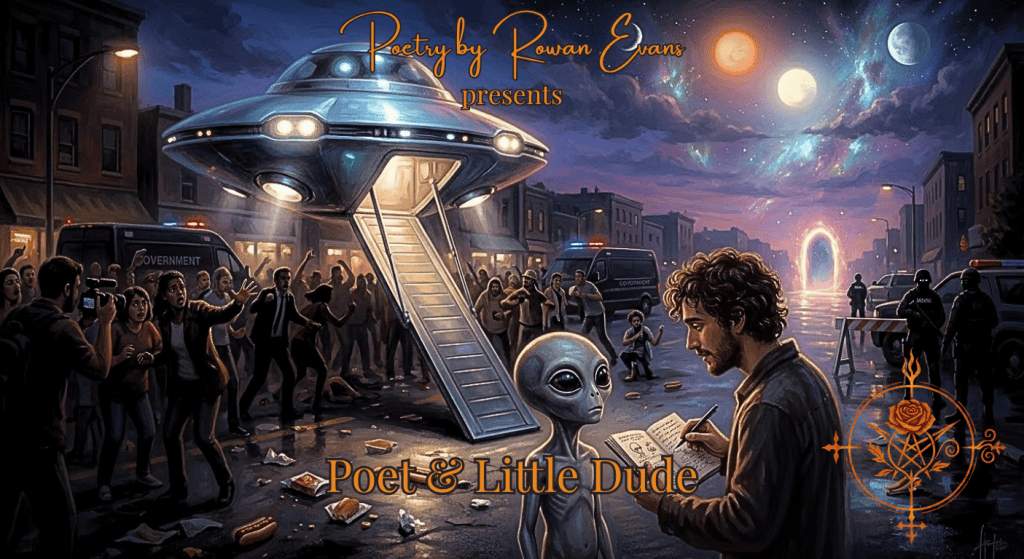

    A poet with a notebook stands beside a small gray alien in a city as a strange spacecraft and frightened crowd surround them beneath a surreal twilight sky.
    Sometimes the strangest visitor is the one who finally asks where you want to call home.

    Poet & Little Dude
    Poetry by Rowan Evans

    A silent hum in the sky above,
    a non-descript American city.

    The kind of hum
    that settles in your bones
    before your mind catches up,
    the kind that says
    pay attention 
    without making a sound.

    Everyone looked up.
    I looked down at my notes.
    I’d seen enough movies to know
    this was either the beginning
    or the end.

    Probably both.

    People screamed.
    Cars stopped.
    Someone dropped a hotdog.

    And me?

    I sighed, closed my notebook,
    and muttered,
    “Well… guess it’s my turn again.”

    I stopped at the edge of the crowd
    as the craft touched down.

    A low buzzing cut through the air,
    and a ramp began to lower.

    Slowly.

    Excruciatingly slow.

    I checked my watch.
    I tapped my foot.
    I wrote four stanzas,
    two sonnets—

    and finished season one
    of Breaking Bad…

    and the ramp was still lowering.

    Hit the power button
    on my phone and locked it.

    Slipped it back in my pocket—
    where my hands stayed.

    A silent thud as the ramp
    FINALLY—
    hit the ground.
    The hollow echo
    of footsteps rang out.

    A shadow stretched long—
    cascading down the ramp
    until it touched the dirt.

    The crowd began to murmur
    before a voice rang out—
    “Take me to your leader!”

    The crowd went silent.
    Only the footsteps echoing
    could be heard—
    nobody could see a thing
    at first—

    “No, I’m just kidding.
    I’ve always want to say that.”
    The tiny grey alien
    stopped at the bottom of the ramp,
    slowly looking up—

    Its large black eyes
    landing on mine.

    “Sup?” I said
    with a slight nod
    of my head.

    Its eyes closed for a moment—

    “I’ve been trying to reach you
    about your cars extended warranty.”
    The alien’s mouth thins to a line
    as it tried to contain the giggles.

    Pinching the bridge
    of my nose—
    I sighed.

    “You didn’t follow
    the study guide—”
    I started,
    before little dude
    cut me off.

    “I went down
    the bunny void.”

    “Rabbit hole—”
    I corrected.

    “What?”
    they asked confused.

    I slowly get down
    on one knee,
    just like I had before—

    “It’s a rabbit hole,
    when you follow
    a thread through
    seemingly unrelated topics.”

    Little dude nodded.
    “I think I got it.
    But what about you,
    did you study the guide
    I gave too?”

    I cleared my throat,
    tried to hide the choke.
    Should I lie—
    or hide it with a joke?

    Nope.

    “I did not.”
    I said, looking away.

    Shaking their head,
    little dude laughs.
    “It’s okay, poet.
    You should read it though,
    you’ll love it, I know it.”

    Stepping closer.
    Hand on mine.

    “You’ll learn of
    green skies and purple lakes,
    twin suns and sister moons—

    we get six hours of light,
    six hours of night. Twice.”

    “Twin suns and sister moons?”
    I asked. “I can relate to that.
    That’s how my life has been,
    living under two suns—
    they’re really one.
    It’s two days in different places.”

    Little dude tilted their head,
    then they said:

    “No.”

    A pause.

    “Not two suns.
    It’s two homes.
    Two dusks, two dawns—
    one feels right,
    the other wrong.”

    I turned my head,
    eyes glassy, tears steaming,
    as I opened my mouth
    to speak.

    But the words evaded me.
    Little dude noticed quick.

    “You’re leaking.”
    They said with concern.

    “It’s human emotion,
    you’ll learn.”
    I said with a quivering lip,
    trying to hold it all in.

    Our moment is interrupted
    by a scream
    from the forgotten crowd.

    “Whoa,”
    little dude flinches
    in surprise.
    “Have they been here
    this whole time?”

    Looking around—
    I saw the faces in the crowd.
    Some were scared, terrified—
    others confused and paranoid.

    “It’s a trap!”
    a voice cut through
    the thick silence.

    I sighed,
    not surprised—
    “calm down,
    Admiral Ackbar.”

    The crowd lets out
    a collective scream—
    someone throws a shoe.
    It barely misses my head.

    “What the hell?!
    Who threw that?”
    I yell.

    “Was it you—”
    little dude pauses dramatically,
    their eyes focusing.
    “Admiral?”

    Admiral Ackbar shakes his head.
    “N-no.” he stammers,
    as his heart hammers in his chest.

    “The government…” the crowd began,
    the murmurs spread quick.
    “we’ve got to call the government.
    They’ll handle this—
    they’ll know what to do.”

    Little Dude and I blink.

    “Since when?”
    I asked, confused.

    “Okay, okay—
    wait, let me introduce you.
    They’re not scary.
    They can show you.”
    I say, addressing the crowd.

    The crowd begins to quiet down,
    their murmurs becoming a softer sound.

    “This…”
    I gesture to the little dude beside me.
    “This is Little Dude.
    They’re not… from around here.”

    “That’s one way to put it.”
    Little dude adds.
    “I’m from a little place called…
    another planet.”
    They make a vague gesture
    with their hands.

    “Just another planet?”
    a voice from the crowd asks,
    shaking with fear.
    “No… no name?”

    “Name’s pending.
    It’s actually been pending
    for a long time…
    a really long time.
    But that’s the government,
    right?” Little dude responds with a smile.
    “They’re slow.”

    “Why are you naked?”
    another question from the crowd.

    “Naked?”
    Little dude tilts their head.
    “Do you mean—
    why am I
    not wearing a second skin,
    like you?”

    The crowd recoiled
    like Little Dude had just confessed
    to a federal crime.

    “Second skin?”
    someone whispered, horrified.

    Little Dude nodded earnestly.

    “Yes.
    The fabric layer you all wear
    to hide your emotional temperature.”

    I blinked.

    “That’s… not why we wear clothes.”

    Little Dude tilted their head,
    eyes wide.

    “Then why do you wear them?”

    A hundred humans froze,
    suddenly realizing
    they did not have a unified answer.

    “We just like them.” I said,
    my voice lacking confidence.

    Little dude shakes their head,
    “not important.” they said,
    “I’m not here for that,”
    they gesture to the crowd.
    “I’m not here for the them.”

    Their big eyes, land on mine—
    “I’m here for you.”

    Little Dude’s words hung in the air,
    heavy enough to silence a hundred humans,
    light enough to lift something in my chest.

    The crowd didn’t know what to do with it.
    A few gasped.
    Someone dropped another hotdog.

    (Why were there so many hotdogs?)

    A woman near the front whispered,
    “Why him?”
    like I was a questionable menu item.

    Little Dude squeezed my hand,
    their skin warm—
    warmer than I expected.

    “Because you listened,”
    they said softly.
    “You always listen.”

    I opened my mouth to respond—
    to say something clever,
    something deflective,
    something safe—

    but the sky split open
    with the sound of sirens.

    Government vans rolled in,
    black and boxy,
    like someone ordered
    “paranoia” on Amazon
    and selected same‑day delivery.

    Agents poured out,
    all sunglasses and shouting,
    pointing weapons that hummed
    with the kind of energy
    that makes your bones nervous.

    Little Dude blinked at them.

    “Are these your leaders?”

    I snorted.
    “God, no.”

    The nearest agent yelled,
    “Step away from the entity!”

    Little Dude tilted their head.
    “Entity?”
    They looked at me.
    “Is that a compliment?”

    “Not really,” I whispered.

    The agent repeated the command,
    louder this time,
    as if volume could fix confusion.

    Little Dude stepped closer to me,
    their voice steady.

    “I’m not here to harm.
    I’m not here to conquer.
    I’m not here to be studied.”

    Their eyes locked on mine.

    “I’m here because you’re lonely.”

    My breath caught.

    The crowd fell silent again,
    but this time for a different reason.

    Little Dude continued,
    voice soft enough
    to feel like a hand on my cheek.

    “You look at the sky
    like it’s a door.
    You write worlds
    you wish you could walk into.
    You build cathedrals
    for people who never stayed.”

    They squeezed my hand.

    “I came to stay.”

    The agents shouted again,
    but their voices felt far away—
    like background noise
    in a movie I’d already seen.

    Little Dude leaned in,
    their forehead touching mine.

    “Poet,” they whispered,
    “do you want to go home?”

    I swallowed hard.

    “Which one?”

    Little Dude smiled,
    eyes glowing faintly.

    “The one you haven’t found yet.”


    Journey into the Hexverse

    [Beings from Beyond (Remix)]
    A 2026 remix of a poem first written in 2024, Beings from Beyond (Remix) returns to the mystery of unexplained lights, extraterrestrial possibilities, and humanity’s hunger for answers. The wonder remains—but the poet’s voice has become more focused on the search for truth itself.

    If you’re interested in more poetry, you can find it here → [The Library of Ashes]
  • Author’s Note

    This poem became the quiet conclusion to a trilogy I never intended to write.

    Crossing the Sea was about direction.

    Only Waiting was about the reason I needed that direction in the first place.

    This piece asks a different question:

    How do you keep moving when you haven’t arrived yet?

    For me, the answer has always been dreams.

    Not because I confuse them with reality, but because they remind me that another reality is possible.

    I’ve written about dreams for years. They rarely feel random to me. They often feel like rehearsals—small glimpses of a life my mind already believes exists somewhere beyond the horizon.

    The city in this poem isn’t a specific city.

    The moon isn’t really the moon.

    Even after spending two poems trying to strip away metaphor, I found myself sitting beside it again.

    I think that’s because hope has always spoken to me symbolically.

    When I’m awake, I know where I am.

    When I’m asleep, I remember where I’m going.

    The dream doesn’t replace reality.

    It sustains me until reality catches up.

    The final image—a dream folded into my chest like a map—is probably the clearest way I’ve ever described hope.

    Hope isn’t certainty.

    It isn’t arrival.

    It’s carrying the direction with you, even when you’re still standing at the beginning of the journey.

    And maybe that’s what this trilogy has been trying to say all along.

    Sometimes home begins as a place.

    Sometimes it becomes an ache.

    Sometimes…

    it’s simply the direction you’re already walking.

    — Rowan Evans


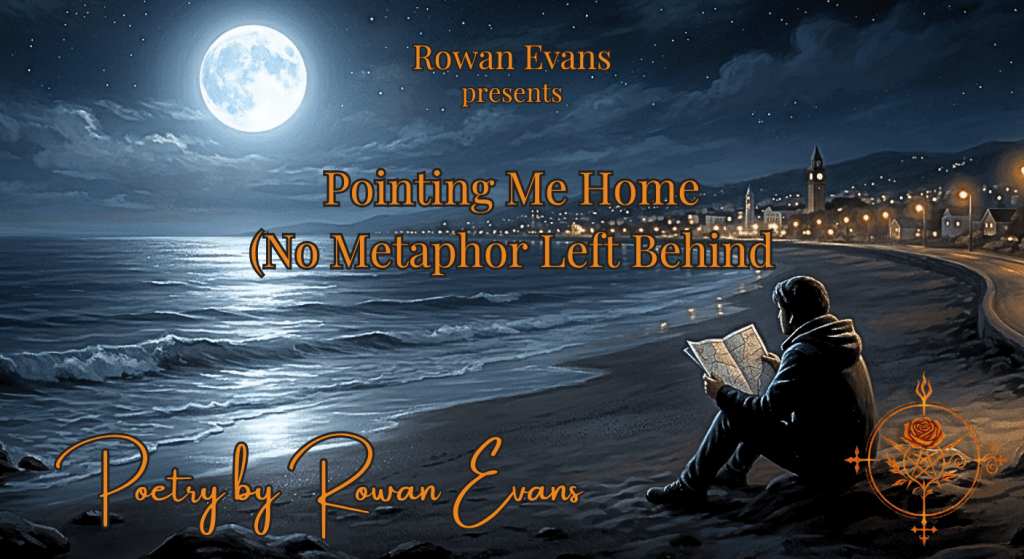
    A lone figure sits beneath a full moon where an ocean shoreline transitions into quiet city streets, holding a folded map while reflecting on hope, dreams, and the journey toward home.
    “Sometimes home isn’t where you’re standing—it’s the direction you’re already walking.” 🌙🗺️

    Pointing Me Home (No Metaphor Left Behind)
    Poetry by Rowan Evans

    Tick tock, tick tock—
    that’s the sound of the clock.
    I listen as I wait for the escape,
    a simple trip, brought on by sleep.
    Because I only feel at home
    in my dreams.

    So as I close my eyes
    and my head hits the pillow—
    I follow the moon
    to the ocean’s edge,
    I listen to the tide—
    I follow it in stride
    until I find where it’s pulling me.

    With every step,
    I move deeper in.
    Slowly sand turns to concrete
    beneath my feet,
    as the beach transitions
    into city streets.

    Streetlights flicker
    like they’re remembering
    they used to be stars.

    The hum of the city
    folds into the sound of waves,
    each echo a reminder
    of where I started
    and where I’m going.

    I walk until the moon
    hangs between buildings
    like it’s lost too—

    like it’s looking for someone to talk to.

    So I sit and conversate,
    I tell the moon all about the quiet ache—
    the feeling that I need to change
    my environment to one that aligns
    more with what I feel inside.

    And the moon sits with me,
    just listening—so I talk some more.
    Out of my heart, the words just pour.
    I spill every secret, I hold nothing back
    until I feel like I might collapse.

    The moon listens,
    patient as ever,
    its light softening
    the edges of my thoughts.

    And when I finally fall silent,
    breath trembling,
    chest heavy—

    it tilts itself
    just enough
    to remind me
    I’m not alone
    in the places I wander.

    Tick tock, tick tock.

    A return to the rhythm of the clock,
    interrupting the talk—
    the moon’s light gives way
    to the sun’s rays,
    I’m still stuck in this place—

    but I’m only waiting
    until I can cross the sea,
    Pacific and the Philippine.

    Until then,
    I carry the dream like a map,
    folded in my chest—

    pointing me home.


    Journey into the Hexverse…

    [Crossing the Sea (No Metaphor Left Behind)]
    A deeply personal poem about relocation, longing, and the realization that some truths naturally arrive through metaphor—even when we try to leave it behind.

    [Only Waiting (No Metaphor Left Behind)]
    The second poem in the No Metaphor Left Behind series, exploring the quiet ache of growing up in a place that never truly felt like home—and finally saying aloud what years of metaphor had been trying to express.

    If you’re interested in more poetry, you can find it here → [The Library of Ashes]
  • Author’s Note

    This poem is the second part of an experiment I started in Crossing the Sea—an attempt to write without leaning on metaphor, or at least to notice when metaphor appears even when I’m trying not to use it.

    The first piece focused on direction: the place I’m moving toward, the literal ocean I have to cross to get there. But I realized that before I could talk honestly about where I’m going, I needed to talk honestly about why I’m leaving.

    That’s what this poem is.

    It’s the part I’ve always written around instead of through.
    The part I’ve buried under tides, distance, storms, and moonlight.
    The part I’ve hinted at for years without ever saying plainly.

    The truth is simple, even if it took me a long time to say it:

    I’ve never felt at home in the country where I grew up.

    Not in childhood.
    Not in adulthood.
    Not in all the years in between.

    It’s a quiet ache—persistent, steady, familiar.
    Not dramatic, not catastrophic, just a sense of misalignment I’ve carried since I was fourteen. A feeling of being held in a place I never belonged to, waiting for a life that didn’t start here.

    I’ve called it restlessness.
    I’ve called it longing.
    I’ve called it distance.
    Eventually, I called it the ocean.

    But naming it directly felt necessary.
    Not to erase the metaphors, but to understand what they were protecting.

    This poem is that attempt.
    Not a rejection of metaphor, but a recognition of the truth beneath it.

    — Rowan Evans


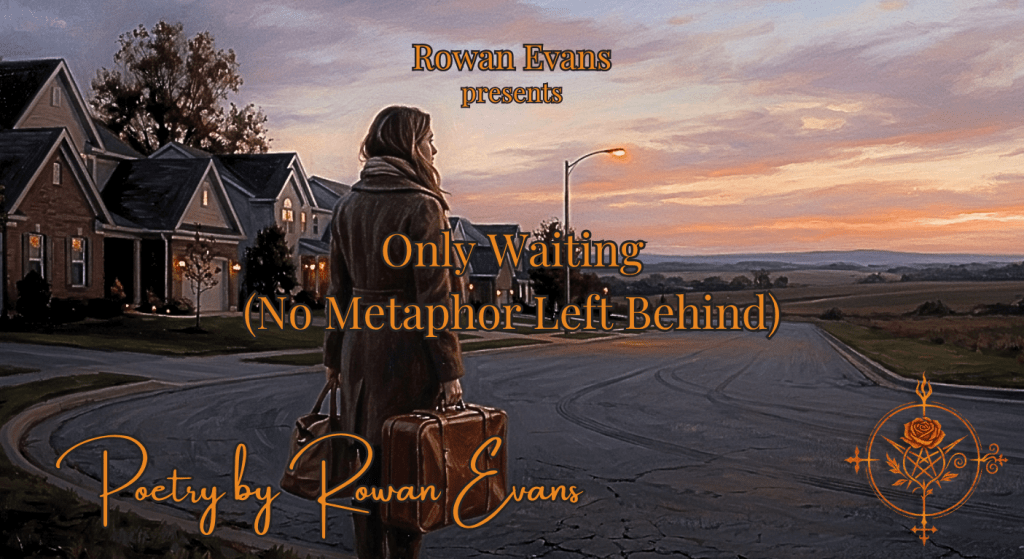
    A traveler stands at the edge of a familiar neighborhood looking toward a distant horizon with a suitcase in hand.
    Sometimes leaving isn’t running away. Sometimes it’s finally walking toward the place that feels like home.

    Only Waiting (No Metaphor Left Behind)
    Poetry by Rowan Evans

    Turn the page,
    I’ve got more to say.

    I’ll try again
    not to hide behind
    metaphors
    and coded lines.

    Last time—
    I talked about the destination,
    the place I’m moving toward.

    This time—
    I’m going to talk about the ache.
    The persistent empty feeling
    that I’ve been feeling since I was fourteen.

    I’ve written about it before
    woven in metaphors.
    But this time I’m going to try
    and say it plain.

    It’s the ache of living in a place
    that never felt like mine.

    Not once.

    Not in childhood,
    not in adulthood,
    not in all the years in between.

    People talk about home
    like it’s a given—

    a birthplace,
    a neighborhood,
    a country that shaped them.

    But I never felt shaped by this place.

    Only held in it.
    Only waiting.

    I learned early
    that you can grow up somewhere
    and still feel like a visitor.

    You can know every street
    and still feel lost.

    You can speak the language
    and still feel unheard.

    Since fourteen,
    I’ve carried this quiet emptiness—
    not dramatic,
    not catastrophic,
    just a steady sense
    that I was meant to be somewhere else,
    and somehow ended up here instead.

    I used to call it restlessness.

    Then longing.

    Then distance.

    Then the ocean.

    But the truth is simpler:
    I’ve never felt at home
    in the country that raised me.


    Journey into the Hexverse…

    [Crossing the Sea (No Metaphor Left Behind)]
    A deeply personal poem about relocation, longing, and the realization that some truths naturally arrive through metaphor—even when we try to leave it behind.

    [Translating What I Feel]
    A poem about the invisible process of turning emotion into imagery, imagery into language, and language into poetry. An intimate reflection on creativity, loneliness, and twenty-three years of learning to translate what the heart feels.

    [Maybe You’ll Want Me Too]
    A poem about the subtle shift from knowing someone to constantly thinking about them. Through humor, metaphor, and confession, Maybe You’ll Want Me Too explores affection, attachment, and the fragile hope that being wanted might matter more than being needed.

    [Recognizes Home]
    A free-verse poem exploring the difference between love as dependency and love as choice. It challenges the idea that love must be need-based, instead centering the quiet strength of choosing someone while still remaining whole on your own.

    [Not Rebuilding You]
    A poem about love as an act of presence rather than rescue. Through construction imagery, Not Rebuilding You explores trust, devotion, emotional safety, and the quiet work of building a foundation strong enough for healing to grow.

    If you’re interested in more poetry, you can find it here → [The Library of Ashes]
  • Author’s Note

    When I was a kid, other children wished for speed, flight, invisibility and teleportation. I wished to understand.

    This piece isn’t about wanderlust or escape. It’s about connection – the desire to meet people in the language they speak at home, in the rhythm that feels natural to them. I may not have superpowers, but I’ve spent years training my ear, listening with intention, and closing the distance in the ways I can.

    Some bridges are built with ink.
    Others are built with effort.

    — Rowan Evans


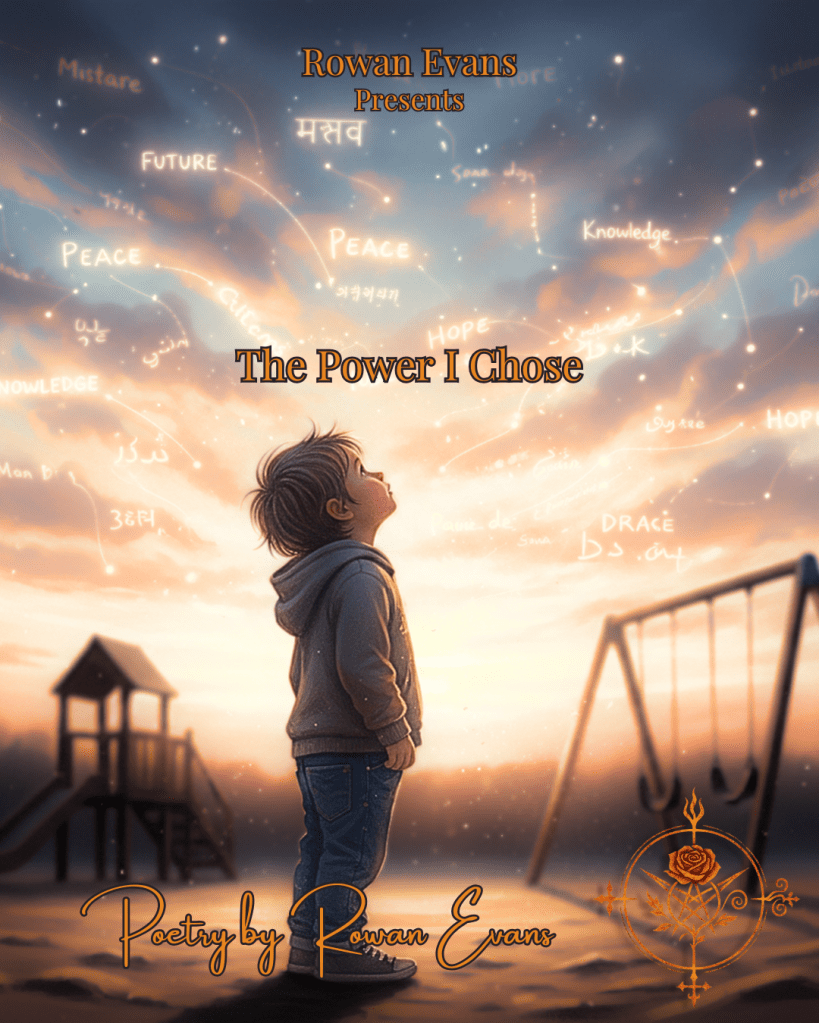
    A child on a playground at sunset looking up at glowing words in different languages in the sky, symbolizing connection and fluency.
    Some wished for flight. I wished for fluency.

    The Power I Chose
    Poetry by Rowan Evans

    Let me take you back
    to playground conversations—
    when superpowers
    were the topic at hand,
    and kids were wishing
    for flight, speed or teleportation.

    Then there was me—
    I wished for connection
    and fluency, for no language
    to be new to me.

    I wanted my ears to pick-up
    language and cadence,
    and my mouth to repeat it
    perfectly. I wanted,
    no matter where
    someone was—

    I wanted to be able
    to meet ’em,
    to greet ’em
    with the language
    they spoke at home.

    I pictured traveling
    touching every corner
    of the globe,
    absorbing language,
    perfecting cadence.
    Living in a rhythm
    not my own.

    Now, the power
    may not have been real,
    but I’ve done
    what I could
    to train my ear.
    Listen with intention,
    until all language
    felt the same.
    And I may not know
    what you’re sayin’,
    but it no longer
    feels foreign.

    I’ll keep learning,
    and opening doors.
    Closing gaps,
    connecting with souls—

    As I continue to wander
    this earth, in search
    of a place to call home.
    Until I feel the pull of roots,
    I will continue to put
    earth under boots.
    I will continue to move,
    never becoming static.


    If you’re interested in more poetry, you can find it here → [The Library of Ashes]
  • Author’s Note

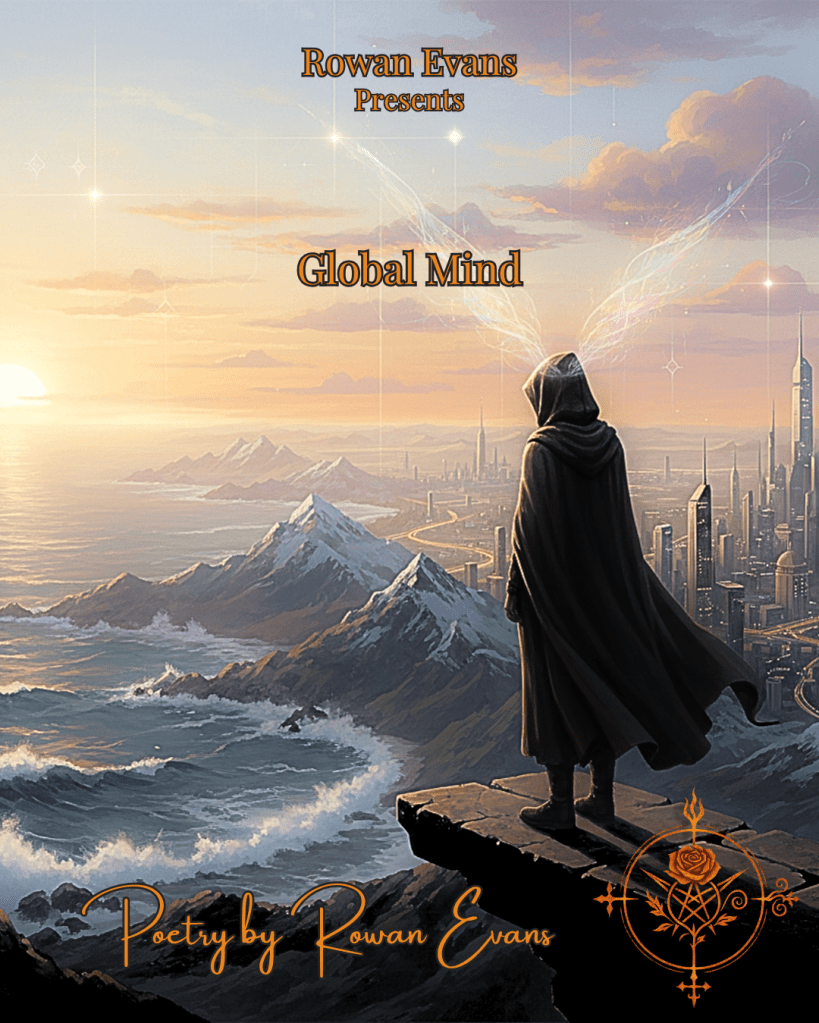
    This piece came from a place of clarity more than frustration. For most of my life, I’ve felt disconnected from the borders around me – not in rebellion, but in recognition. My internal world has always felt wider than the map I was handed.

    Global Mind isn’t about rejecting where I’m from. It’s about understanding that home, for me, has never been strictly geographic. It’s something relational. Something resonant. A connection to people and cultures that feel aligned, not assigned.

    Sometimes the relief comes not from escaping – but from finally articulating what you’ve known all along.

    — Rowan Evans


    A person standing on a city overlook at sunset, gazing toward a vast blended horizon symbolizing global identity and belonging beyond borders.
    Sometimes home isn’t a place.
    It’s a people. A connection. A resonance.

    Global Mind
    Poetry by Rowan Evans

    A global mind,
    trapped inside
    imaginary lines.
    These borders
    feel more like—
    shackles and chains.

    How do you
    push through
    when you—
    have always felt
    chained but unclaimed?

    Disconnected
    from the world
    around you.

    I feel like—
    I don’t belong
    and I never have.

    This place isn’t home to me.

    It’s emotional
    purgatory.
    Trapped in waiting.

    But you’re drawn to SEA—
    so you open your eyes
    to witness, the world
    in its vast existence.
    Stayed curious.
    Wanting to see
    every corner
    of every country.

    I want to understand.

    Now, I don’t know
    what the future holds.
    Or where I’ll finally
    put down roots,
    but I know when I
    finally find—home,
    it’ll be in the people
    around me. More than
    my surroundings.
    Because sometimes
    home isn’t a place.

    It’s a people.
    A vibe.

    A connection
    to a culture
    that resonates,
    in a way
    that your own
    never did.


    If you’re interested in more poetry, you can find it here → [The Library of Ashes]
  • Author’s Note

    This piece is about a feeling I’ve struggled to name for most of my life — a feeling that I have tried to explain more recently — a quiet but persistent disconnect that began when I was fourteen.

    It isn’t about hating where I’m from.
    It isn’t about romanticizing somewhere else.

    It’s about that internal shift — the moment you realize you feel unrooted in a place where everyone else seems firmly planted.

    For years, I thought I was running away.
    Now I understand I’ve been moving toward something.

    Whether that “home” is a city, a country, a person, or a version of myself I haven’t fully stepped into yet — I don’t know.

    But I know this:
    I am not lost anymore.
    I am in motion.

    — Rowan Evans


    A lone figure looking toward a distant city skyline under a star-filled night sky, symbolizing longing and the search for home.
    Sometimes home isn’t where you started. Sometimes it’s where you finally breathe.

    Toward Somewhere I Can Breathe
    Poetry by Rowan Evans

    I’ve tried my whole life
    to explain it.
    This disconnect,
    I’ve felt since
    2004.

    How can I make it
    any more clear?
    I just don’t belong here.

    I’m going to try
    and try to make it
    make sense.
    I was fourteen,
    Hi Hi Puffy AmiYumi
    on the screen.

    But that’s not the important part.

    Inside—
    I could feel
    threads fray,
    and they
    already existed
    in decay.

    But I learned quickly,
    in 2007 exactly—
    there is Filth in the Beauty,
    and the reverse
    can be the same.

    That’s when
    my view of the
    world changed,
    and became
    cemented.

    Something shifted,
    vision cleared—
    and everything
    I missed before,
    just appeared.

    Where everyone
    around me,
    seemed rooted
    in the here.

    And I—
    would close my eyes,
    and wish upon
    shooting stars.
    I wanted out,
    I wanted to leave,
    go somewhere far.

    I knew it would take time,
    I needed things to align.
    But now I know
    what I’m moving toward,
    what I’m working for.

    I’m moving toward home.
    A place, where I belong.

    Maybe when I finally leave,
    I’ll touch down in the Philippines
    to walk Manila’s streets,
    and finally be able to breathe.


    If you’re interested in more poetry, you can find it here → [The Library of Ashes]