I sometimes look back at the person I was when I first started writing and wonder how much of that younger version of me is still sitting somewhere inside every poem I create. I started writing at thirteen, the same year I experienced my first heartbreak. Back then, ink wasn’t simply a creative outlet. It was a way to hold myself together, to give shape to feelings I didn’t know how to carry, and to leave a record of myself on the page when I was afraid of losing pieces of who I was.
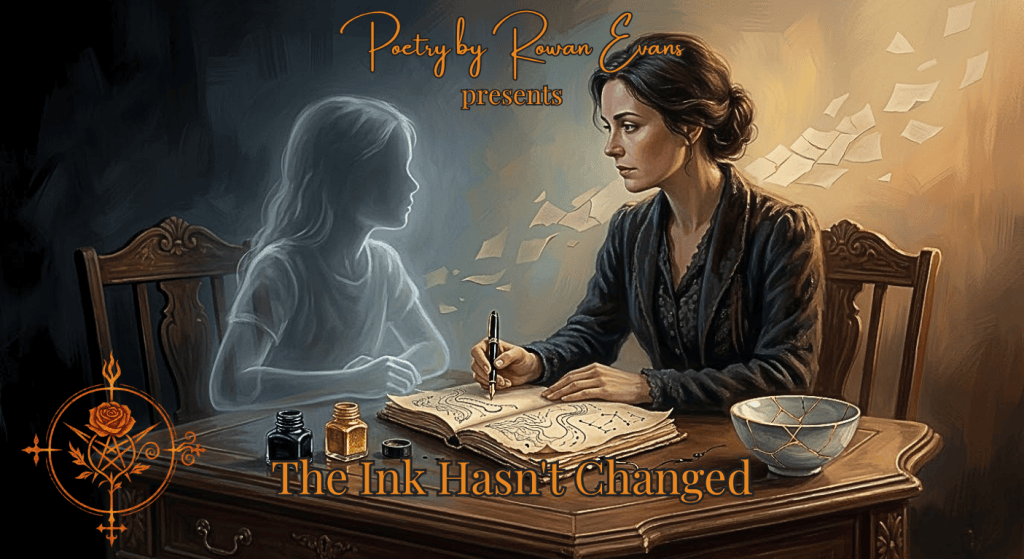
The Ink Hasn’t Changed is about revisiting those beginnings without confusing familiarity with stagnation. The same emotions still find their way into my work: joy, grief, anger, tenderness, laughter, and pain. I’ve continued mapping my soul through poetry, stitching together broken pieces and filling the cracks with whatever gold I could find. The tools and materials may feel familiar, but the person doing the stitching is not the same.
There’s a difference between carrying the same weight and never moving forward. Sometimes, growth means discovering that the thing that once kept you alive can become something you choose to nurture, refine, and share.
My ink hasn’t changed because its purpose never needed to. I have changed. I’ve survived. And the words that once helped me hold myself together now help me understand who I’ve become.
— Rowan Evans
The ink that helped me survive at thirteen still carries my truth at thirty-six. The ink hasn’t changed. I have.
The Ink Hasn’t Changed Poetry by Rowan Evans
I’ve been stuck in the past a lot lately,
just thinking about who I was—
who I was trying to become
and how those early days
set the stage for who I became,
on and off the page.
The same year
I committed myself to ink,
I tasted my first heartbreak—
it was bitter sweet,
hated that it had to come,
but nothing could be done.
That was 2003, I was thirteen—
and she was made to leave.
I took the shattered pieces,
collected in a basket—
I took threads of silver
and sewed myself
back together again.
Cracks patched with gold and ink,
confessions penned in golden ink—
back then
I wrote for me—
I wrote to keep it together,
mentally—
afraid I’d disappear
if I didn’t map my soul in ink.
Turned poetry to cartography,
started mapping the whole of me.
I mapped my soul, wholly—
turned my pain holy.
I tried to translate all of me—
the joy, the pain,
laughter and grief—
and my ink hasn’t changed.
It’s still carrying the same things.
All the same weight, wait—
does that mean I’m stuck in place?
No, just because the ink
has stayed the same—
doesn’t mean I have—I’ve changed,
I’m not the same as I was at thirteen,
now that I’m thirty-six—
and I’m not the same as I was at sixteen,
that’s when I thought my ink was real mean—
but really it was too nice,
the only thing keeping me alive.
Sometimes, the mind wanders somewhere between waking and dreaming, and the unfamiliar begins to feel strangely like home. Maybe it’s just a dream. Maybe it’s imagination playing with possibilities. Or maybe it’s a reminder that the life we’re living right now isn’t the only story we could ever tell.
The Chapter After This One is about looking beyond a present that might not feel right and remembering that the story isn’t finished. We don’t always get to choose the circumstances of our current chapter, and we can’t simply flip to the ending to see whether everything works out. Sometimes, we have to keep reading, even when the road ahead is uncertain.
But reading isn’t all we can do. We can question the direction, challenge the expectations, and pick up the pen ourselves. We may not control every twist in the plot, but we can make choices that shape what comes next.
The future isn’t a page we’ve already read. It’s a chapter we haven’t reached yet—and perhaps, in more ways than we realize, we’re already helping to write it.
— Rowan Evans
You may not be able to skip to the ending, but you can still pick up the pen and help write what comes next.
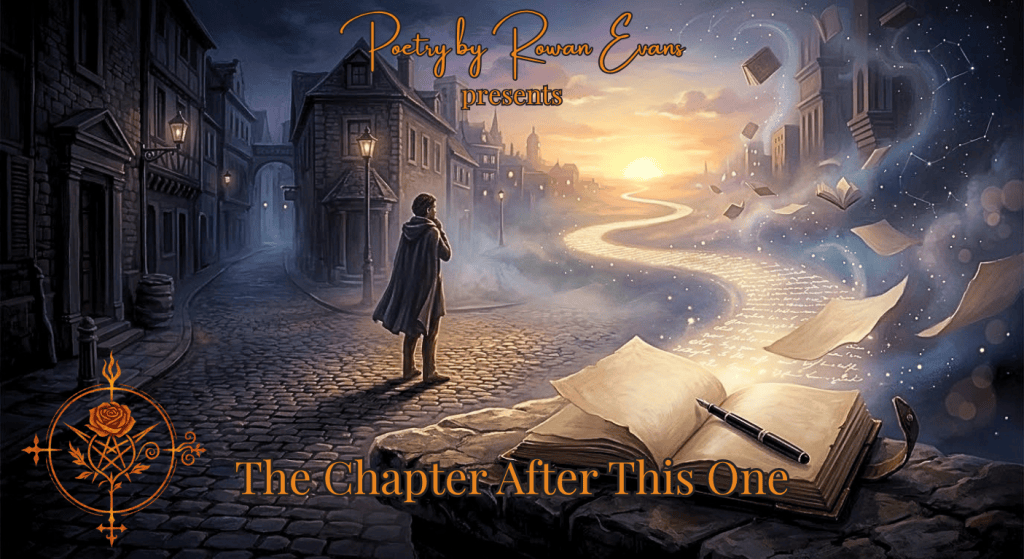
The Chapter After This One Poetry by Rowan Evans
I’ve been drifting today— constantly somewhere in-between awake and asleep— between reality and a dream. One moment, I’m sitting alone— the next I’m walking streets I’ve never known.
Yet somehow, those streets feel like home.
I can’t say for certain where I was, but I had a pretty good idea— it felt familiar but not, like I was getting a preview— for a future plot. Like the writers for my life— were showing me, I’m not stuck in the story I got.
And while it’s true, I may not like the current chapter— I just have to keep reading, to find out what comes after— you cannot skip ahead, that’ll only lead you down the wrong road instead.
If you don’t like the direction, pick up a pen—become a co-writer then. You can’t rely on, just anyone, take matters into your own hands. You can shape fate, you can write for your own life— you know you can guide the plot, right?
Journey into the Hexverse
[Everything and Nothing]
What happens when you’re quiet but observant, overwhelmed yet seemingly empty, surrounded by beauty but sometimes seeing only decay? Everything and Nothing is a confessional poem about overthinking, mental exhaustion, contradiction, and the absurd humor that helps us keep going—even when we’re wobbling in socks and Crocs.
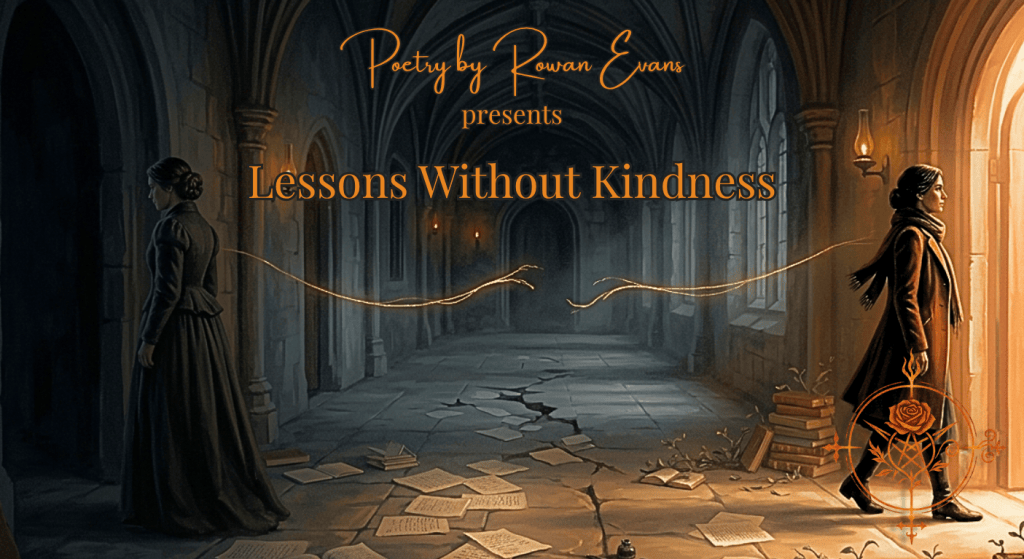
Lessons Without Kindness is about the strange education that can come from losing someone who once felt like your entire world.
This isn’t really a poem about getting even. It’s about looking back at a relationship that changed, recognizing the games, the silence, and the ways I allowed myself to become smaller just to keep someone else comfortable—and realizing that I don’t live that way anymore.
The person who taught me these lessons never intended to be my teacher. They didn’t sit me down and explain what I needed to learn. They simply gave me an experience harsh enough that I eventually learned it myself.
Sometimes the most important lessons don’t come from kindness, wisdom, or good intentions.
Sometimes they come from realizing what you will never allow yourself to become again.
— Rowan Evans
Not every teacher is kind. Not every lesson is wasted.
Lessons Without Kindness Poetry by Rowan Evans
There was a time when
you were my world,
everything was fine and
we really did love each other,
or so I thought—
yeah, we’d always talk—constantly,
I was always thinking of you,
and I thought
you thought about me too.
Maybe you did—once,
then you changed
and started playing games—
you tried to get under my skin,
pit me against him.
But here’s the thing—
he was never gonna win.
I mean, truly,
the only real loser was you—
because in doing what you did,
you lost me too.
And I’m not saying I was a prize,
but I really was a catch for you—
I put up with too much,
and spoke up too little.
But I don’t do that anymore.
I don’t shrink so someone else can feel tall.
I don’t bend so someone else can feel right.
I don’t stay quiet so someone else can stay comfortable.
You taught me that.
Not intentionally—
but lessons don’t need kindness
to be true,
just a student and a teacher—
that was me and you.
Journey into the Hexverse
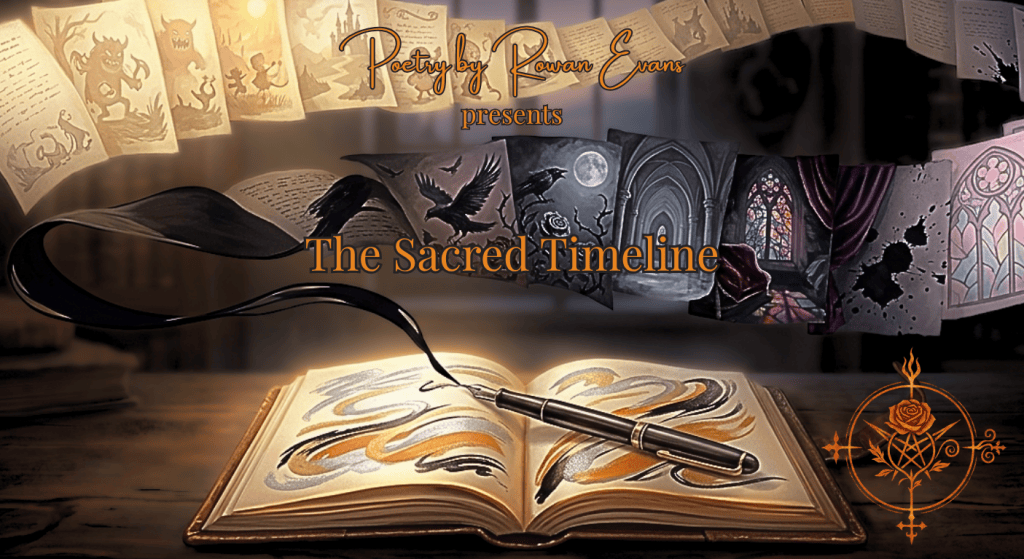
[The Sacred Timeline] From childhood stories about Dragon Ball Z, Power Rangers, and Pokémon to gothic cathedrals, ravens, roses, identity, healing, and experimentation, The Sacred Timeline traces how Rowan Evans’s relationship with the pen evolved across thirty-six years—and how the ink remained while the writer kept changing.
[The Metaphor Machine] A poem that takes apart its own machinery as it runs—breaking lines, breaking thoughts, and following metaphors from moonlight to tides, oceans, shorelines, and city streets.
[Louder Than the Rain] A short confessional poem about the overwhelming noise of anxious thoughts, the strange silence of feeling alone in a crowded room, and finding a way to translate pain into words.
The Sacred Timeline is a map of how my relationship with the pen has changed over nearly three decades of my life.
I started with stories about worlds that already existed—Dragon Ball Z, Power Rangers, Pokémon—and slowly began building worlds of my own. Then the pen became a way to learn cadence, translate music, hide things I couldn’t say aloud, survive periods when writing itself became difficult, and eventually turn pain into something crafted enough to share.
Every era left something behind: the storyteller, the songwriter, the secret keeper, the gothic romantic, the heretic, the battle poet, the confessor, the mythmaker. Some symbols came and stayed. Some meanings changed. Some questions took decades to become clear enough to write down.
And the timeline is still moving.
At thirty-six, I don’t consider the pen mastered so much as understood differently. Writing is still an experiment. The boundaries keep moving. The imagery keeps evolving. The person holding the pen keeps changing.
Maybe that’s the most sacred part of the timeline: the ink stayed, but I didn’t.
— Rowan Evans
Thirty-six years, countless pages, one pen—and an identity still being written.
The Sacred Timeline Poetry by Rowan Evans
I picked up a pen for the first time at seven, I was just writing stories then— Dragonball Z, Power Rangers and Pokémon… that’s what I wrote about way back when—
it was much lighter out, the sun had yet to meet the clouds— I was a natural storyteller, a real lore keeper, weaving lore before I even knew what lore meant. It was like this for years, I created my own space in worlds provided by minds much older than mine.
Then at ten—I switched what the pen meant to me, my creativity shifted mentally— no longer was I just a storyteller, I was letting music be the teacher now. Translating thoughts to song, at least the words of it— I was writing to worship something. Something that in six short years, I would begin to question—
but the years between ten and then—were spent, using the pen to learn cadence. I was trying to learn to perform on the page— I couldn’t do it in body, but I could turn a notebook to a stage.
At twelve things began to shift again, but with me, not with the pen— I still felt the sun, I still saws its rays, but I also saw more cloudy days— that year was hard for me, I couldn’t talk about it with clarity— most people would react like, “you’re scaring me”— so I stopped talking about it really, I closed my lips, but still let the ink spill— the page became a secret keeper, keeping the secrets this storyteller was too afraid to say out loud.
Thirteen the skies went dark— this is when life really got hard. At the beginning of the year, it’s like the ink in my pen had begun to dry— I don’t know what was wrong, but I couldn’t write. I tried and I tried— pages ripped from notebooks, balled up and scattered.
No songs, no stories— I had lost interest in things that I used to find most interesting. Parents took me to the doctor, and the doctor said—
“This kid’s depressed— and anxious too, I’ll write a prescription that should do. A referral for therapy, they’ll get them to talk— they’ll find out what’s wrong.”
A week would go by— giving the medicine a try, it takes time— it has to build up in your system. In the meantime, here’s a therapist, someone to talk to— they’ll listen to your problems, they’ll help you.
And they did—a little bit, they got me to talk a little bit too. But still they saw I was holding back— so they recommended journaling, but that felt tedious and boring. I needed to find a way to make it play— bring a little joy to it, even if falsified.
I made it a game to translate my pain— how many ways could I say everything? Is it possible to flip it? Maybe change the script and shift the meaning? These were the questions I began to ask— even when my ink ran in all black—
back when my heart was all cracks, before I learned how to use the gold to patch— I struggled through, just writing purely what I felt— thirteen, fourteen and fifteen, often felt like hell.
Sixteen, I hit my stride— not in life but with a pen, things were hard still, but now I could translate with skill. Not much, if we’re being honest— just enough to keep the pain beautiful, in case someone else saw it—
Seventeen, I did it again— reinvented myself with the pen, more gothic in my intentions. Maybe I finally read Poe, who knows— but ravens became a part of my soul.
At eighteen, I went from church steeples and church people to writing cathedrals for outcasts and heretics— we hadn’t yet, become luminous. Shadows and lace, velvet and venom— but I also opened my eyes more, became more aware of the world around— outside the borders I’m confined in.
At twenty, I started to write for people more—to uplift, and let them know they’re not alone— whatever they were going through, there was somebody with them. Even from a distance—
I had friends across seas, in places with palm trees— and in places with Kangaroos, even scarier—Emu.
I don’t know what that means in this piece—but it’s true, so do with that, what you’re going to do.
At twenty-two, I got more serious about the ink— I started to write everything. Every thought and every half-formed idea— I just put it on a page, my brain would not be a cage.
Then came twenty-five, the lowest point in my life— it wasn’t a sudden crash, but a slow rot— it bled through every thought, a feeling I couldn’t translate, familiar but different, heavier somehow— so the ink slowed to a drip, I started to let thoughts slip.
Twenty-six, I got serious again— more aggressive with the time spent, my pieces became more crafted and the ink was shaped with intention. Ravens, the moon, and roses too— the symbols I began to use.
I ascend on the back of raven wings— the silver light of the moon pierced the canopy—rose petals drift in the shifting currents of the wind. Everything connects, pay more attention and you’ll become more aware—
At thirty— I really began to question everything— who I was, who I am, who I want to be— and that’s still a question I’m working on answering. But it went deeper than that— I was questioning who I was in a deeper sense, like had I been a façade in some sense. Was I playing the role I was assigned, or being true to who I thought I was becoming?
This became a recurring theme in my poetry— it’s an odd thing to discover so late in life, that the person you thought you were— isn’t who you’re supposed to be. So I chased answers in ink to questions I couldn’t fully ask yet.
There were two more years of this— and I’m still not finished.
Thirty-three hit with another shift— I mixed the light with the shadow, it was Easter in the cathedral— pastel colors lit up the stained glass. My imagery began to shift shades— roses in all colors, pastel hues, but the thorns were still there too. So even my softness had bite—
and it evolved more, by thirty-four— more teeth but more softness too. Brighter hues and deeper shadows— this is when I learned, you can’t have one without the other.
The shadow needs the light to cast— and you need the shade to dim the shine, because too much shine— you might go blind.
Then came thirty-five— the modern era, the current phase, one year before the current day— and I know this won’t age well, it’s too time specific—
Finally, we’ve reached thirty-six, and I feel like I’ve mastered this— but that doesn’t mean I’ve stopped learning, because every day is an experiment— really, it’s all about the experience— just learning new things and pushing it, finding where the boundary is and bending it, you gotta realize— you can’t always give a shit, who cares what they think— it’s your ink—shape it how you see fit.
Journey into the Hexverse
[The Metaphor Machine] A poem that takes apart its own machinery as it runs—breaking lines, breaking thoughts, and following metaphors from moonlight to tides, oceans, shorelines, and city streets.
[Exhibit A (The Evidence)] A quick-witted, unapologetically playful poem about writing fast, crossing lines, roasting the competition, and letting rhythm do the talking.
[Welcome to the Hexverse] Step into the Hexverse—a poetic world where mythmaking, humor, rage, creativity, and confession collide, and darkness becomes something that can be reshaped into art.
Sometimes I genuinely wonder what happens when I give my brain permission to write whatever it wants.
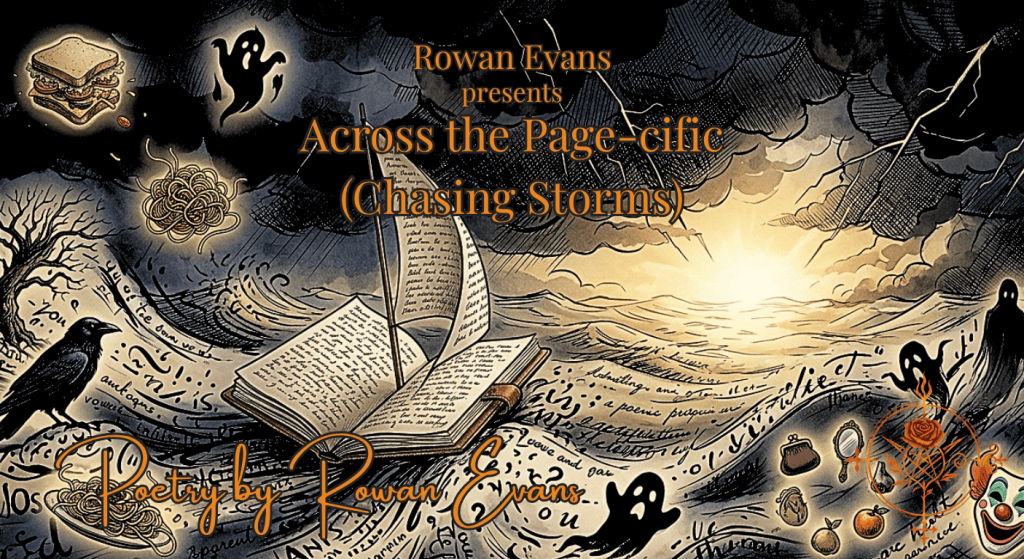
The answer, apparently, is sandwiches, pasta, farmers on Pluto, raccoons in silk pajamas, llamas, trees, cartoon ghosts, monsters, seven deadly sins, and a journey across an ocean that does not technically exist.
And honestly?
I love it.
Across the Page-cific (Chasing Storms) is a celebration of the strange places my writing can go when I stop trying to force it into a single shape.
This poem deliberately references several of my recent pieces and recurring worlds. The sandwich wordplay comes from Lost in the Sauce. The pasta-based literary assault comes from Impasta (A Diss in Pasta Form). The trees point back to my playful botanical wordplay, while Danny Phantom, the Monster in the Margins, the Seven Deadly Sonnets, ravens, spirits, and other imagery come from the larger mythology and vocabulary I’ve been building throughout my work.
The references aren’t just Easter eggs.
They’re evidence.
Evidence of how much my writing has changed—and how much more willing I am now to let different parts of my voice coexist.
For a long time, I thought I needed to choose what kind of writer I was supposed to be.
Gothic poet.
Confessional poet.
Love poet.
Dark poet.
Funny poet.
Experimental poet.
But the more I write, the less interested I am in choosing.
I want to write the heartbreak poem with sandwich ingredients.
I want Tony Stanza to write a pasta diss.
I want to turn mythology into autobiography.
I want to write about ghosts and gods, then turn around and make a terrible pun.
I want to chase a metaphor until it becomes absurd.
And then, underneath all of it, I want to find something honest.
That is what the storms in this poem represent.
The chaotic lines.
The sudden cadence changes.
The ideas that arrive from nowhere.
The parts of my mind that refuse to walk in a straight line.
I used to think I needed to calm those storms down.
Now?
I chase them.
Because writing has become a playground again.
And somewhere in that playground, I keep finding pieces of myself I hadn’t finished discovering.
“It was writing that saved me” is therefore not a throwaway line.
Writing gave me a language for experiences I couldn’t always explain directly. It gave me somewhere to put the contradictions, the humor, the darkness, the questions, the love, the anger, the absurdity, and everything else that makes up the person behind the pen.
Piece by piece.
Bit by bit.
I rebuilt myself in the art.
And apparently, sometimes that art looks like a sandwich, a bowl of pasta, and a storm on the Pacific.
I’ll take it.
— Rowan Evans
I stopped trying to avoid the storms. I started chasing them across the page.
Across the Page-cific (Chasing Storms) Poetry by Rowan Evans
Let’s see, what other ridiculous thing
can we turn into poetry—
I’ve written a heartbreak poem
using sandwich ingredients,
and wrote a diss poem
using nothing but pasta noodles—
was a farmer on Pluto,
witnessed raccoons in silk pajamas
perched on the backs of llamas—
while I shaped love poems
out of the trees—
I’ve turned Danny Phantom
into religion—a whole faith
on “going ghost”—
but really it’s just me stuck
between worlds.
I’ve written as the monster in the margins
and the spirits in the room—
seven sins that act like tax on the soul.
Go against the monster, you won’t leave whole.
Feeling like Pennywise, grin wide,
’cause I’m a clown in my rhymes
sometimes—
I’ve taken trips
in ink-dipped ships
across the page-cific—
avoiding storms of chaotic lines
and jagged rhymes
with sudden cadence changes.
Just kidding—
I chased the storms across the page,
embraced the pace my brain gave.
It was writing that saved me—
it gave me a way to translate me,
piece by piece and bit by bit,
I rebuilt myself in the art of lit—
where a mind like mine appears rarely.
Journey into the Hexverse…
[Lost in the Sauce] A playful heartbreak poem where sandwiches, ketchup, mustard, rye, lettuce, and sourdough become metaphors for emotional confusion. Beneath the food puns is a speaker trying to understand how everything went from “we’re okay” to suddenly feeling cold.
[Impasta] Tony Stanza is back with another literary attack—and this time, he’s bringing pasta. Spaghetti, fettuccine, macaroni, ravioli, and angel hair become weapons in a ridiculous diss aimed at a poet whose rhymes are allegedly cheesy, fragile, and completely impasta.
[Pluto Farmer] A whimsical absurdist poem about being a certified weirdo, farming space carrots on Pluto, and refusing to fit into anyone else’s definition of “normal.”
[Raccoons in Silk Pajamas] What begins with judgmental Space Chickens quickly spirals into camels in parked cars, elephants in jam jars, raccoons in silk pajamas, and astronauts in the ocean. A playful absurdist poem about language, imagination, and what happens when you stop trying to control where the words go.
[Did You Really Think This Was About Trees?] A playful love poem disguised as a forest of terrible tree puns. Beneath the birch, oak, cedar, palms, lumber, and absurdist wordplay is a poem about devotion, loyalty, laughter, and building a life with someone you love.
[Danny Phantom Theology] What begins as a metaphor borrowed from a childhood cartoon becomes something deeper: a reflection on existing between survival and possibility, exhaustion and hope, the life we have and the life we long for. Danny Phantom Theology explores what it means to keep moving toward a future that feels worth living.
[The Monster in the Margins II] The Monster in the Margins II transforms Rowan Evans’s Seven Deadly Sins mythology into a horror story written between the lines, where Lust, Wrath, Sloth, Greed, Pride, Envy, and Gluttony become monsters growing from pain, grudges, and scars.
This poem grew out of a realization that getting “lost” isn’t always the same as losing yourself.
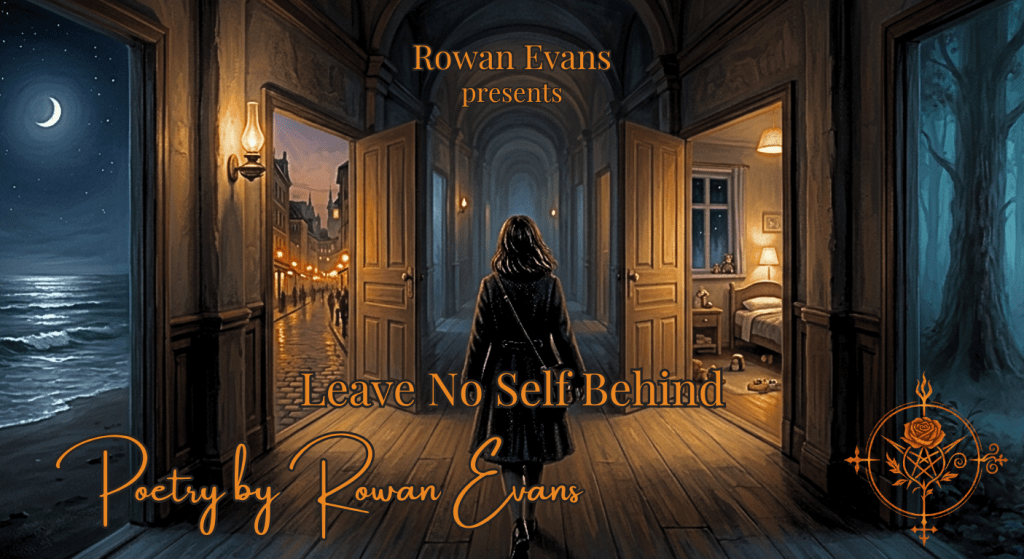
I’ve written many pieces about dreams, memory, shifting landscapes, and wandering through places that seem to exist somewhere between reality and imagination. Over time, I realized those places weren’t asking me to escape who I was—they were asking me to revisit the parts of myself I had left behind.
We often talk about “finding ourselves” as though there’s one true version waiting to be discovered. My experience has been almost the opposite. Every season of life leaves behind another version of us: the frightened one, the hopeful one, the grieving one, the joyful one. None of them disappear simply because we’ve grown older.
Healing, at least for me, isn’t replacing those earlier selves.
It’s learning to walk beside them without shame.
This poem is an invitation to stop treating old versions of ourselves as mistakes to erase and instead see them as companions who helped us survive long enough to become who we are today.
— Rowan Evans
Healing isn’t finding one true self—it’s learning to walk beside every version of yourself with compassion.
Leave No Self Behind Poetry by Rowan Evans
I feel like I’ve lost myself again—
don’t know when it began,
but I get lost a lot.
It doesn’t take much for me
to get lost in thought—
I wander off
without meaning to,
slipping between memories
like loose floorboards.
One thought opens a door,
another pulls me down a hallway,
and suddenly I’m somewhere
I didn’t plan to be—
with some version of me
I didn’t plan to meet.
Sometimes the hallway
tilts into something else—
a shoreline I’ve walked in sleep,
a city humming with heat,
a room I haven’t entered in years.
The world shifts
without warning,
and I follow it
the way I follow dreams—
half-aware,
half-afraid
of what I’ll find
in the scene change.
I never know
which version of me
I’ll find in those places—
the one who’s tired,
the one who’s trying,
the one who’s still carrying
things I swore I let go.
Sometimes I meet
the versions of me
I thought I’d outgrown—
the one who flinches,
the one who freezes,
the one who still thinks
they’re hard to love.
And I walk with them
for a while,
through whatever memory
the hallway decides to show—
letting them speak,
letting them breathe,
letting them…
exist.
Without rushing them back
into the dark.
And maybe that’s
what finding myself
really looks like—
not a single moment
of clarity,
not a sudden return,
but walking through
every hallway
my mind opens,
meeting every version
I’ve ever been,
and letting them stay
long enough
to feel seen.
Maybe I’m not lost.
Maybe I’m just learning
how to carry
all the selves
I used to abandon
when the world
felt too loud.
Maybe this time…
I won’t leave anyone—
behind.
Journey into the Hexverse…
[Where the Metaphors Lead] Some truths are easier to write than they are to say aloud. “Where the Metaphors Lead” explores the quiet space between dreams, confession, and the courage it takes to let another person know how deeply they’ve become woven into your inner world.
[Noon Is Loud] If four in the morning belongs to truth, then noon belongs to impossible memories. Noon Is Loud is a playful free verse poem filled with absurd boasts, pop culture references, and tongue-in-cheek mythology that explores how easily imagination can rewrite reality.
[5:01 (Pull the Punchline Back)] What happens when a confessional poet instinctively hides every confession behind a joke? 5:01 (Pull the Punchline Back) explores humor as emotional armor, the speed of an overactive mind, and the difficult choice between making people laugh and letting them see what’s really there.
[Chemical X] Chemical X explores the rapid, associative way one creative mind moves—from cartoons to sports, comic books to music—revealing that inspiration isn’t linear, but a collision of memory, humor, rhythm, and intuition.
[Monster Theology] What if the monsters under the bed weren’t monsters at all? Monster Theology explores difference, belonging, and the human tendency to fear what we don’t understand through a conversation with the creatures we’ve spent our lives imagining.
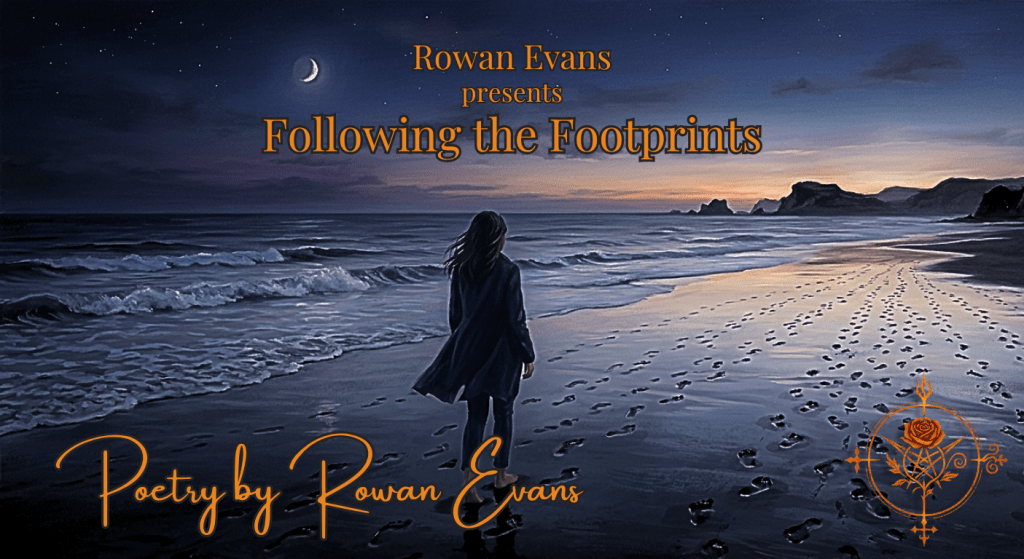
The beach, the horizon, the whispers, and the footprints aren’t meant to be frightening. They’re invitations. They represent the quiet moments when life seems to pause long enough for us to notice something we’ve been overlooking within ourselves.
I’ve written often about dreams leading me toward places that feel like home. This time, the destination wasn’t a city or a shoreline—it was a version of myself.
The footprints became a simple question:
What if the person I’m trying to become has been leaving signs for me all along?
Sometimes growth doesn’t happen by discovering somewhere new.
Sometimes it happens by recognizing the path we’ve already been walking, even when we couldn’t see it at the time.
This poem lives in that space between mystery and recognition, where intuition quietly whispers louder than certainty ever could.
— Rowan Evans
“Sometimes the path we’re searching for is already beneath our feet—we only have to choose to follow it.”
Following the Footprints Poetry by Rowan Evans
I sat at the ocean’s edge,
watching as the tide came and went—
I was lost in thought,
eyes locked on the horizon.
I was watching the sun set
as night came—
I watched the light fade.
I could hear the echoes
of whispers and laughter,
they seem to ring—
from every direction.
The beach was littered
with footprints—
but not a person in sight,
something didn’t feel right.
The air felt too still,
like the world had paused
mid‑breath.
Even the waves moved quietly,
as if they were trying
not to disturb whatever
was watching me back.
I stood up slowly,
not out of fear,
but out of recognition—
like I had been here before,
in another dream,
as another version of myself
I hadn’t met yet.
The sky darkened
in a way that felt deliberate,
as if the night was arriving
for me specifically.
The whispers grew softer,
closer,
almost familiar—
like memories I’d forgotten
were trying to find their way back.
I turned toward the footprints,
each one pressed deep
into the sand,
leading somewhere
I couldn’t see.
And I knew,
without knowing how,
that if I followed them,
I would find the part of myself—
I had been missing
for years.
Journey into the Hexverse…
[Pointing Me Home] The final poem in the No Metaphor Left Behind trilogy explores dreams, hope, and belonging. Through moonlight, ocean tides, and quiet conversation, Pointing Me Home reflects on carrying hope long before reaching the place you call home.
[Only Waiting] The second poem in the No Metaphor Left Behind series, exploring the quiet ache of growing up in a place that never truly felt like home—and finally saying aloud what years of metaphor had been trying to express.
[Crossing the Sea] A deeply personal poem about relocation, longing, and the realization that some truths naturally arrive through metaphor—even when we try to leave it behind.
[Caller ID: Destiny] Sometimes the places we visit in our dreams feel more like home than the places we wake up in. Caller ID: Destiny explores longing, belonging, and the quiet feeling that life is calling you toward somewhere new.
[Returning to My Bones] Some dreams fade the moment we wake. Others leave behind emotions that linger long after reality returns. Returning to My Bones explores the strange grief of leaving a dream that felt real enough to matter.
[Before My Feet Touch the Floor] What happens when your dreams feel more real than your waking life? Before My Feet Touch the Floor explores the strange grief of waking up, the lingering memory of dream selves, and the quiet question of which version of us is truly real.
[Just Beyond Waking] A street that feels familiar. A life that hasn’t happened yet. Just Beyond Waking explores the fragile space between dreams, memory, longing, and the quiet feeling that some futures are already waiting for us.
Not because I think they predict the future. Not because I think they’re magical.
Because they feel real.
Real enough that sometimes waking up feels stranger than the dream itself.
I don’t think people talk enough about that moment between sleeping and waking—the brief period where both realities still exist at the same time.
The dream is fading.
The room is returning.
And for a few seconds, you’re caught between them.
That’s where this poem lives.
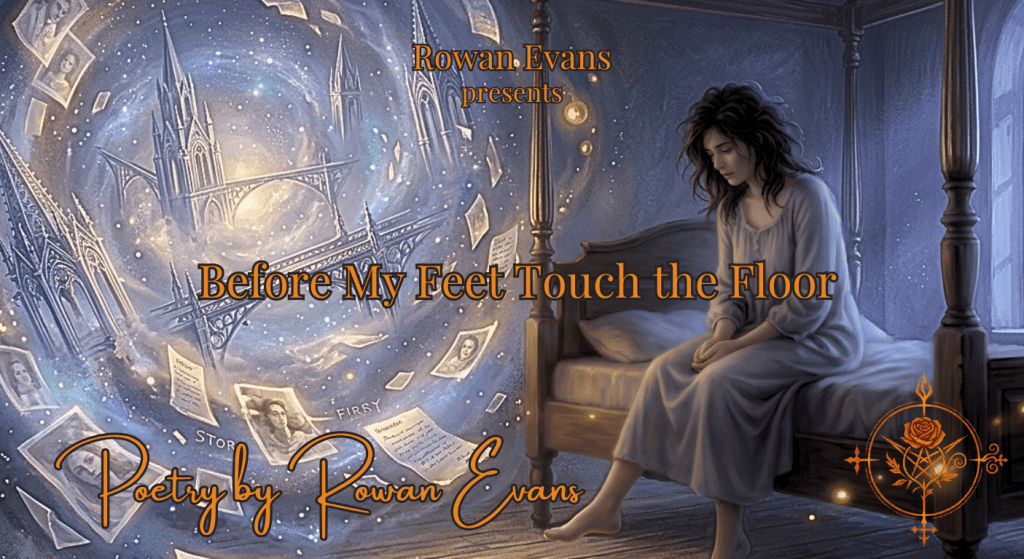
I’ve had dreams that felt so vivid, so emotionally complete, that waking up felt like losing something. Not a person. Not a place. A version of myself.
A self that existed somewhere else.
The older I get, the more fascinated I become by that feeling.
Why do some dreams linger for hours while entire days disappear from memory?
Why do imaginary places sometimes feel more familiar than real ones?
Why does waking occasionally feel like arriving somewhere instead of returning?
This piece doesn’t try to answer those questions.
It simply sits with them.
Because there are mornings when the first thing I feel isn’t relief that the dream is over.
It’s grief that it ended.
And I suspect I’m not the only one.
— Rowan Evans
Some mornings feel less like waking up and more like saying goodbye to a life that only existed while you were asleep.
Before My Feet Touch the Floor Poetry by Rowan Evans
Dreams—
a common topic
in my poetry.
It’s because
they don’t feel fake to me.
They feel like memories.
Do know what it’s like
to wake up confused—
because you’re in your own room?
How do you live—
when your dreams are more alive
than your waking life?
It’s as if the person I was
a moment ago
is still out there,
waiting for me
to return.
So I lie there,
trying to remember
which version of me
is the imposter—
the one who wakes,
or the one who wanders.
Sometimes I think
the dream‑me
is the one who remembers,
and I’m the one
who forgets.
Because if I feel more alive
in the places I can’t stay,
what does that make
the life I return to?
There’s a mourning
no one talks about—
the kind that happens
before your feet
touch the floor.
Journey into the Hexverse…
[The Streets I Walk When I Sleep] “The Streets I Walk When I Sleep” is a deeply intimate free verse poem about recurring dreams, emotional connection, longing across distance, and the strange feeling of remembering places and moments that have never happened in waking life.
[Memories From a Life Yet to Come] Some dreams feel less like fantasy and more like memory. “Memories From a Life Yet to Come” is a reflective free verse poem about longing, displacement, emotional alignment, and the strange comfort of recognizing yourself more clearly in dreams than in waking life.
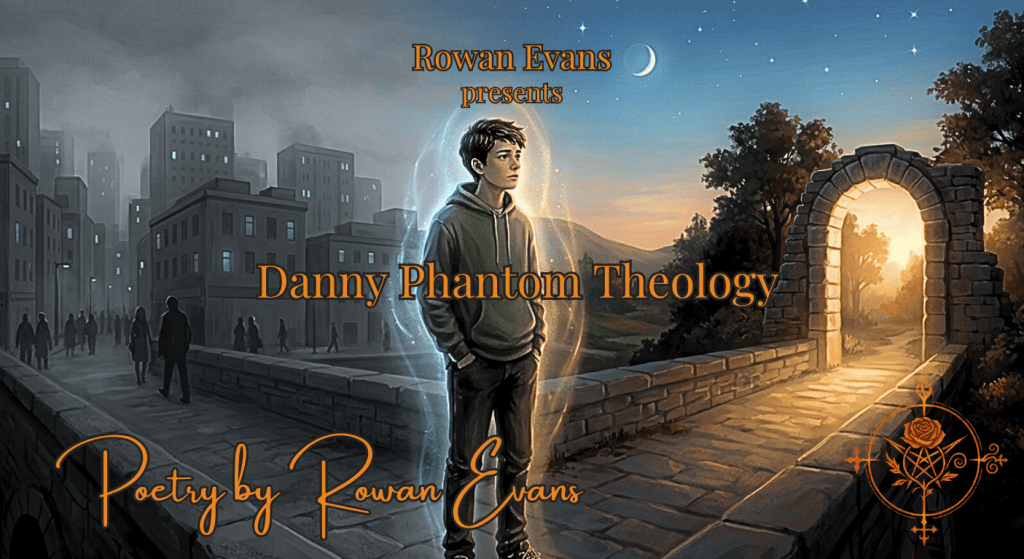
Or rather, it began with a metaphor borrowed from one.
I’ve always been drawn to characters who exist between worlds—people who don’t fully belong in one place or another, who spend their lives navigating the space between identities, expectations, realities, and possibilities.
When I thought about Danny Phantom, I realized the metaphor fit more than I expected.
Not because I feel haunted.
Not because I feel supernatural.
But because I understand what it feels like to exist in two places at once.
Part of me lives in the present moment—the practical world of obligations, routines, limitations, and survival.
Another part lives somewhere else.
A quieter place built from hope, imagination, memory, longing, possibility, and the belief that life can become more than what it currently is.
For a long time, much of my writing has existed in the tension between those two worlds.
The opening sections of this poem lean into that tension. They acknowledge exhaustion, frustration, and the feeling of carrying more weight than you’d like. But the poem isn’t interested in staying there.
What matters to me is where it ends.
Because this isn’t a poem about giving up.
It’s a poem about wanting more from life than survival.
About wanting a future that feels inviting instead of merely manageable.
About believing that the light inside us isn’t meant to spend its entire existence fighting to stay alive.
Sometimes it deserves the chance to burn because it’s excited.
Excited about tomorrow.
Excited about possibility.
Excited about whatever comes next.
Maybe that’s the real theology hidden inside the title:
Not that we exist between worlds.
But that we keep moving toward the one where we finally get to live.
— Rowan Evans
Somewhere between the life we endure and the life we imagine, hope keeps the light alive.
Danny Phantom Theology Poetry by Rowan Evan1s
Sometimes I feel
like Danny Phantom,
a boy between worlds—
one alive, the other
a quiet place inside me
where the light flickers
but never fully goes out.
I exist in both.
But I do not thrive,
most the time
it barely feels like I’ll survive.
I know that’s a little dramatic—
it’s a bad habit.
I know my words feel heavy,
more than intended most the time.
I know what it sounds like—
it sounds like I don’t like life.
But that’s not true—
I’m a lover of life,
a hater of the conditions.
I want a change—
in environment,
in circumstance.
I want a world
where I don’t have to split myself
to make it through the day,
where the light inside me
doesn’t flicker
from exhaustion
but from possibility.
I want a life
where survival
isn’t the main objective.
Where waking up
isn’t an act of endurance,
but anticipation.
Where the light inside me
doesn’t flicker
because it’s fighting to stay alive—
but because…
it’s excited
for what’s next.
Journey into the Hexverse…
[Frankenstein’s Monster] Some poems are built to make a point. Others are built to reveal the mechanism. Frankenstein’s Monster (and I’m the Doctor) explores associative thinking, creative chaos, and the strange process of stitching disconnected ideas into something alive.
[Lone Wolf Theology] A philosophical pop-culture poem exploring freedom, identity, and self-authorship through the lens of superheroes, antiheroes, mythic archetypes, and personal rebellion. A declaration of autonomy in a world determined to write your story for you.
[Before We Created the Labels] Ancient gods return to a fractured world shaped by borders, identities, and separation. “Before We Created the Labels” explores humanity’s divisions through mythic imagery, sacred ritual, and symbolic collapse—asking what remains when we learn to see one another beyond labels.
[A Heart That Echoes in Another Language] A poetic journey through music across Japan, Korea, China, and the Philippines, exploring how sound becomes identity, memory, and emotional geography.
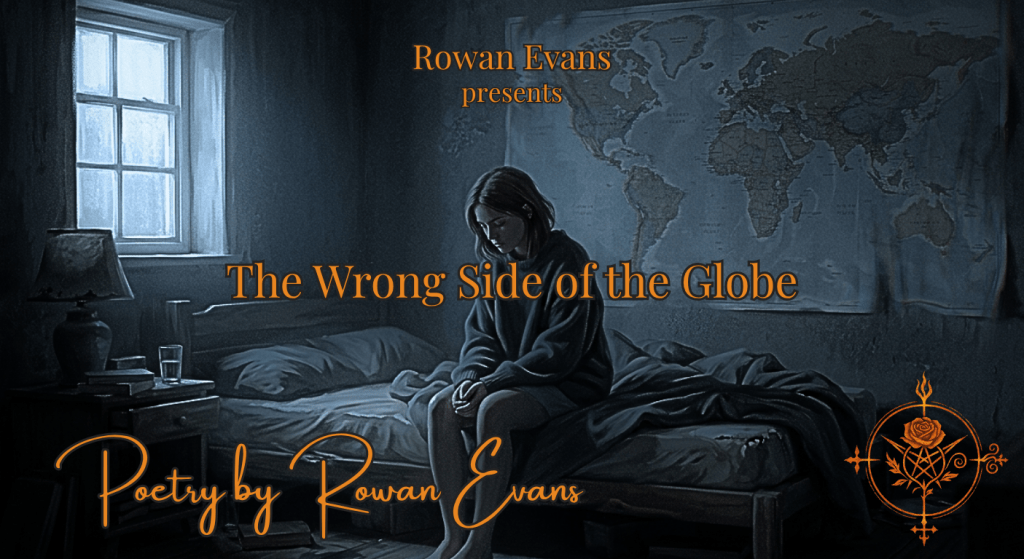
There’s a kind of disconnection that goes beyond mood or circumstance.
It’s not just about having a bad day, or feeling out of place for a moment. It’s deeper than that—like something fundamental doesn’t line up. Like the life you’re living doesn’t match the shape of who you are.
For a long time, I tried to understand that feeling as something internal. Something to fix, adjust, or push through.
But this piece comes from questioning that.
From considering that maybe the discomfort isn’t a flaw— maybe it’s misalignment.
Maybe it’s the result of existing in a space that doesn’t reflect you, doesn’t hear you, doesn’t hold the parts of you that matter.
And maybe the answer isn’t to force yourself to fit— but to find where you already do.
— Rowan Evans
Sometimes it’s not that you’re lost—it’s that you woke up in a life that was never meant for you.
The Wrong Side of the Globe Poetry by Rowan Evans
I wake up—
not just on
the wrong side
of the bed.
I wake up
on the wrong
side of the globe—
in a life
that doesn’t fit
the shape of me
I wake up
in a timezone
my body refuses,
in a climate
my skin protests,
in a country
my soul didn’t choose.
I wake up
as the wrong version
of myself,
a silhouette
in someone else’s dawn,
a life misaligned
with its own pulse—
speaking a language
this place won’t hear,
carrying histories
this soil won’t hold,
belonging to a map
not on the wall.
I wake up…
in a morning
meant for someone else.
In a season
I wasn’t built for.
In a story
I don’t remember choosing.
I wake up
already tired
from carrying a life
that was never mine…
I wake up
wanting a world
that fits my outline—
a morning
that knows my name.
So I drift off—
falling into sleep,
praying that I…
wake up
to a place
that feels like mine,
a life
that finally fits—
the shape of me.
Journey into the Hexverse!
[Where the Tide Calls Me] What if feeling stuck isn’t about being lost—but about resisting where you’re meant to go? Where the Tide Calls Me explores belonging, movement, and the courage to follow an unseen pull.
[I Was Already On My Way] What if the places that call to you aren’t random? I Was Already On My Way explores identity, travel, and the realization that some paths have been forming long before we recognize them.
[Of No Single Nation] What if belonging isn’t tied to where you’re from? Of No Single Nation explores identity beyond borders, reframing home as something found in connection rather than geography.