We often say someone is “living rent-free in our head,” but what if they weren’t renting?
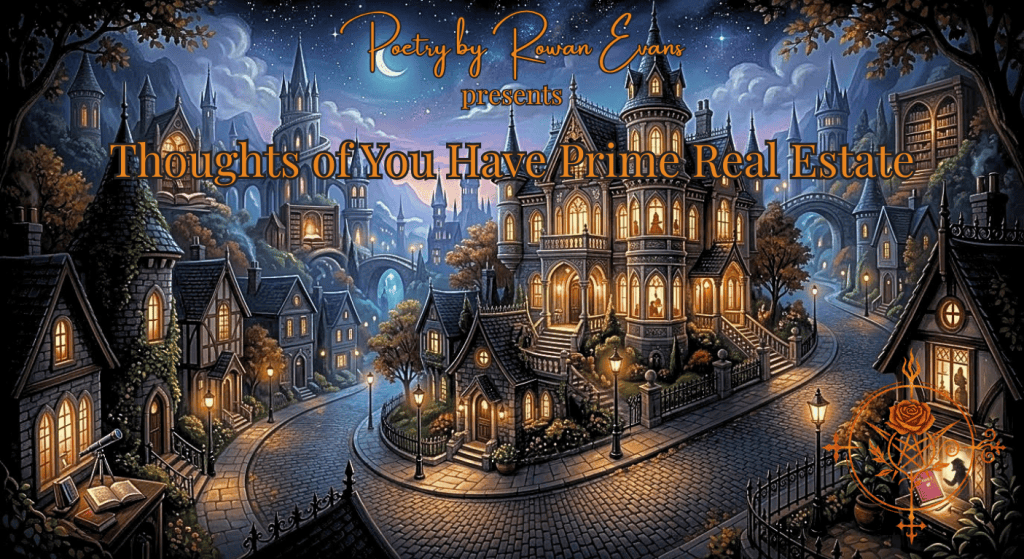
Thoughts of You Have Prime Real Estate takes that familiar expression and builds an entire neighborhood inside the mind—roads, sidewalks, corner lots, contemporary homes, secrets, dreams, and eventually one particularly valuable property.
Because thoughts don’t always feel temporary. Sometimes they settle in, expand, renovate, and quietly become part of the landscape.
And apparently, the thoughts of you got the best view.
— Rowan Evans
Some thoughts rent a room. Yours apparently bought the whole corner lot.
Thoughts of You Have Prime Real Estate Poetry by Rowan Evans
They say, when something is stuck in your thoughts— it lives rent free in your head, and that’s true in a sense— because the thoughts have taken up real estate, they own land— building new developments. New neighborhoods are being constructed, new roads are being laid— new sidewalks paved.
Take a walk down the block, you’ll see thoughts taking up corner lots—
modern contemporary homes lining the streets— full of my secrets to keep, and rooms where my dreams sleep.
But the nicest home of all— the one with the best views, and the biggest rooms…
it houses my thoughts of you.
Journey into the Hexverse
[Half a Picture] What happens when someone falls in love with the person they discover through your poetry? Half a Picture explores the strange intimacy between writer and reader—and the distance between seeing someone’s mind through their words and truly knowing the whole person.
[Love Me From Over There] A sharp and humorous poem about the strange contradiction of wanting someone close while simultaneously needing them to stay several feet away from your face.
[It Could Have Been…] A playful little love poem about strawberries, roses, and the wonderfully ridiculous ways romance can show up when you know someone doesn’t like the traditional version.
[High Tide] A short reflective poem about leaving, returning, and accepting the forces that pull us back—like the tide guided by the moon.
Some thoughts don’t arrive quietly. They repeat, build momentum, and turn themselves into a soundtrack you never asked to hear.
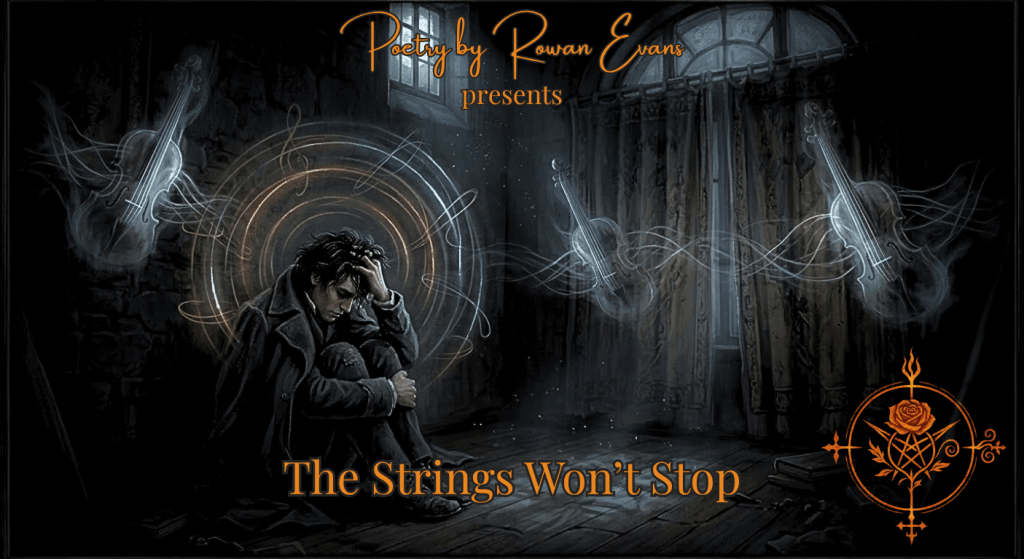
The Strings Won’t Stop takes that experience and gives it a physical sound: violins playing somewhere inside an empty room, each note feeding the fear and keeping the loop alive. The speaker isn’t asking for a beautiful song—they’re asking for silence, for one interruption in the pattern, one change in tempo that might finally give the mind somewhere else to go.
Sometimes the hardest part isn’t finding the words.
It’s getting the strings to stop playing them.
— Rowan Evans
Sometimes the mind doesn’t need another song. It needs the strings to stop.
The Strings Won’t Stop Poetry by Rowan Evans
I sit in an empty room,
listening to the haunting cry
of violins—
I’m just longing
for silence—
but the strings
sing for me—
they sing a song
I don’t want to hear,
it amplifies the fear—
it makes me wonder,
what am I doing here?
But they don’t stop—
the strings sing
and they watch—
I sit in the corner,
and I rock—
back and forth,
listening for the chorus,
or something to break
the loop—
a tempo switch,
a cadence change—
something,
anything
to rearrange
the thoughts in my brain.
Journey into the Hexverse
[A Person First] A poem about the difference between loving a woman and loving the role someone expects her to play—because partnership requires respect, autonomy, and room to remain a person first.
[Half a Picture] What happens when someone falls in love with the person they discover through your poetry? Half a Picture explores the strange intimacy between writer and reader—and the distance between seeing someone’s mind through their words and truly knowing the whole person.
[If You Want to Go] When conversations become nothing more than repeated excuses, sometimes the only answer left is to stop pretending. A raw, direct poem about emotional exhaustion, frustration, and the difficult freedom of letting someone walk away.
Sometimes a poem arrives dressed like science fiction and refuses to stay in its genre.
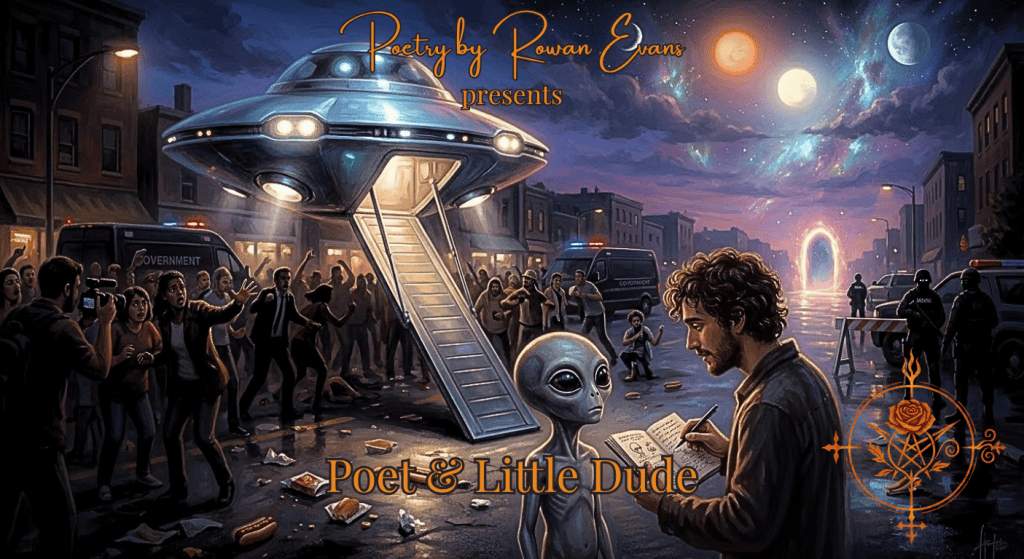
Poet & Little Dude began with the kind of ridiculous premise that feels perfectly reasonable at the time: an alien lands in an ordinary American city, everyone panics, and the poet is mostly annoyed by how long the spaceship ramp takes to come down. From there, Little Dude wandered into the story with jokes, questions, a questionable understanding of human customs, and absolutely no respect for the study guide.
But beneath the absurdity, something quieter started taking shape.
This is a story about being seen by someone who doesn’t need the entire explanation first. About two homes, two dusks, two dawns—and the strange ache of knowing that the place you’re standing in isn’t necessarily the place that feels like home.
So yes, there are aliens, government agents, hotdogs, Admiral Ackbar, an extended-warranty joke, and a very important distinction between a rabbit hole and a bunny void.
But somewhere underneath all that nonsense is Little Dude asking the poet the question that matters:
Do you want to go home?
— Rowan Evans
Sometimes the strangest visitor is the one who finally asks where you want to call home.
Poet & Little Dude Poetry by Rowan Evans
A silent hum in the sky above, a non-descript American city.
The kind of hum that settles in your bones before your mind catches up, the kind that says pay attention without making a sound.
Everyone looked up. I looked down at my notes. I’d seen enough movies to know this was either the beginning or the end.
Probably both.
People screamed. Cars stopped. Someone dropped a hotdog.
And me?
I sighed, closed my notebook, and muttered, “Well… guess it’s my turn again.”
I stopped at the edge of the crowd as the craft touched down.
A low buzzing cut through the air, and a ramp began to lower.
Slowly.
Excruciatingly slow.
I checked my watch. I tapped my foot. I wrote four stanzas, two sonnets—
and finished season one of Breaking Bad…
and the ramp was still lowering.
Hit the power button on my phone and locked it.
Slipped it back in my pocket— where my hands stayed.
A silent thud as the ramp FINALLY— hit the ground. The hollow echo of footsteps rang out.
A shadow stretched long— cascading down the ramp until it touched the dirt.
The crowd began to murmur before a voice rang out— “Take me to your leader!”
The crowd went silent. Only the footsteps echoing could be heard— nobody could see a thing at first—
“No, I’m just kidding. I’ve always want to say that.” The tiny grey alien stopped at the bottom of the ramp, slowly looking up—
Its large black eyes landing on mine.
“Sup?” I said with a slight nod of my head.
Its eyes closed for a moment—
“I’ve been trying to reach you about your cars extended warranty.” The alien’s mouth thins to a line as it tried to contain the giggles.
Pinching the bridge of my nose— I sighed.
“You didn’t follow the study guide—” I started, before little dude cut me off.
“I went down the bunny void.”
“Rabbit hole—” I corrected.
“What?” they asked confused.
I slowly get down on one knee, just like I had before—
“It’s a rabbit hole, when you follow a thread through seemingly unrelated topics.”
Little dude nodded. “I think I got it. But what about you, did you study the guide I gave too?”
I cleared my throat, tried to hide the choke. Should I lie— or hide it with a joke?
Nope.
“I did not.” I said, looking away.
Shaking their head, little dude laughs. “It’s okay, poet. You should read it though, you’ll love it, I know it.”
Stepping closer. Hand on mine.
“You’ll learn of green skies and purple lakes, twin suns and sister moons—
we get six hours of light, six hours of night. Twice.”
“Twin suns and sister moons?” I asked. “I can relate to that. That’s how my life has been, living under two suns— they’re really one. It’s two days in different places.”
Little dude tilted their head, then they said:
“No.”
A pause.
“Not two suns. It’s two homes. Two dusks, two dawns— one feels right, the other wrong.”
I turned my head, eyes glassy, tears steaming, as I opened my mouth to speak.
But the words evaded me. Little dude noticed quick.
“You’re leaking.” They said with concern.
“It’s human emotion, you’ll learn.” I said with a quivering lip, trying to hold it all in.
Our moment is interrupted by a scream from the forgotten crowd.
“Whoa,” little dude flinches in surprise. “Have they been here this whole time?”
Looking around— I saw the faces in the crowd. Some were scared, terrified— others confused and paranoid.
“It’s a trap!” a voice cut through the thick silence.
I sighed, not surprised— “calm down, Admiral Ackbar.”
The crowd lets out a collective scream— someone throws a shoe. It barely misses my head.
“What the hell?! Who threw that?” I yell.
“Was it you—” little dude pauses dramatically, their eyes focusing. “Admiral?”
Admiral Ackbar shakes his head. “N-no.” he stammers, as his heart hammers in his chest.
“The government…” the crowd began, the murmurs spread quick. “we’ve got to call the government. They’ll handle this— they’ll know what to do.”
Little Dude and I blink.
“Since when?” I asked, confused.
“Okay, okay— wait, let me introduce you. They’re not scary. They can show you.” I say, addressing the crowd.
The crowd begins to quiet down, their murmurs becoming a softer sound.
“This…” I gesture to the little dude beside me. “This is Little Dude. They’re not… from around here.”
“That’s one way to put it.” Little dude adds. “I’m from a little place called… another planet.” They make a vague gesture with their hands.
“Just another planet?” a voice from the crowd asks, shaking with fear. “No… no name?”
“Name’s pending. It’s actually been pending for a long time… a really long time. But that’s the government, right?” Little dude responds with a smile. “They’re slow.”
“Why are you naked?” another question from the crowd.
“Naked?” Little dude tilts their head. “Do you mean— why am I not wearing a second skin, like you?”
The crowd recoiled like Little Dude had just confessed to a federal crime.
“Second skin?” someone whispered, horrified.
Little Dude nodded earnestly.
“Yes. The fabric layer you all wear to hide your emotional temperature.”
I blinked.
“That’s… not why we wear clothes.”
Little Dude tilted their head, eyes wide.
“Then why do you wear them?”
A hundred humans froze, suddenly realizing they did not have a unified answer.
“We just like them.” I said, my voice lacking confidence.
Little dude shakes their head, “not important.” they said, “I’m not here for that,” they gesture to the crowd. “I’m not here for the them.”
Their big eyes, land on mine— “I’m here for you.”
Little Dude’s words hung in the air, heavy enough to silence a hundred humans, light enough to lift something in my chest.
The crowd didn’t know what to do with it. A few gasped. Someone dropped another hotdog.
(Why were there so many hotdogs?)
A woman near the front whispered, “Why him?” like I was a questionable menu item.
Little Dude squeezed my hand, their skin warm— warmer than I expected.
“Because you listened,” they said softly. “You always listen.”
I opened my mouth to respond— to say something clever, something deflective, something safe—
but the sky split open with the sound of sirens.
Government vans rolled in, black and boxy, like someone ordered “paranoia” on Amazon and selected same‑day delivery.
Agents poured out, all sunglasses and shouting, pointing weapons that hummed with the kind of energy that makes your bones nervous.
Little Dude blinked at them.
“Are these your leaders?”
I snorted. “God, no.”
The nearest agent yelled, “Step away from the entity!”
Little Dude tilted their head. “Entity?” They looked at me. “Is that a compliment?”
“Not really,” I whispered.
The agent repeated the command, louder this time, as if volume could fix confusion.
Little Dude stepped closer to me, their voice steady.
“I’m not here to harm. I’m not here to conquer. I’m not here to be studied.”
Their eyes locked on mine.
“I’m here because you’re lonely.”
My breath caught.
The crowd fell silent again, but this time for a different reason.
Little Dude continued, voice soft enough to feel like a hand on my cheek.
“You look at the sky like it’s a door. You write worlds you wish you could walk into. You build cathedrals for people who never stayed.”
They squeezed my hand.
“I came to stay.”
The agents shouted again, but their voices felt far away— like background noise in a movie I’d already seen.
Little Dude leaned in, their forehead touching mine.
“Poet,” they whispered, “do you want to go home?”
I swallowed hard.
“Which one?”
Little Dude smiled, eyes glowing faintly.
“The one you haven’t found yet.”
Journey into the Hexverse
[Beings from Beyond (Remix)] A 2026 remix of a poem first written in 2024, Beings from Beyond (Remix) returns to the mystery of unexplained lights, extraterrestrial possibilities, and humanity’s hunger for answers. The wonder remains—but the poet’s voice has become more focused on the search for truth itself.
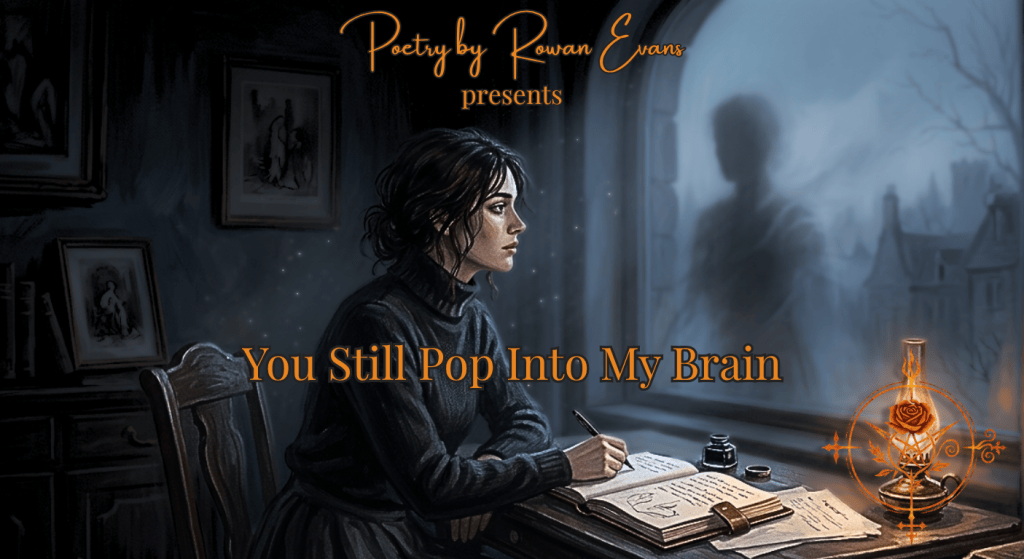
Some people leave your life in a single, dramatic moment. Others fade through a series of small decisions, subtle disappointments, and lessons you never asked to learn. And sometimes, long after you’ve moved forward, a familiar name still wanders through your thoughts—not because you want them back, but because they once occupied a place in your everyday life.
This piece sits in that strange space between moving on and remembering. It doesn’t reach backward with longing or anger. It simply acknowledges that even when someone no longer belongs in your life, the mind may occasionally forget to stop looking for them.
— Rowan Evans
Some memories still visit. They just don’t feel like home anymore.
You Still Pop Into My Brain Poetry by Rowan Evans
You look at me now,
and see—
someone better than
who I used to be—
but that’s all
thanks to you—
if I hadn’t learned the lessons,
if you hadn’t switched up
and made me see—
you were never the one for me.
It didn’t come all at once,
it came in steps for me,
you began to pull away, gradually—
it was little things at first,
you’d do things you thought would hurt—
introduced me to him,
just so you could flirt—
thinking I’d see it,
and feel like dirt—
but it didn’t work.
Because for me,
it was whatever—
we weren’t officially together.
We never talked, exclusive—
so who would I be
to be mad to begin with?
No, I wasn’t mad—
I was more like your parents,
just disappointed
in who you had become.
You used to be someone
in my life—
I used to reach for my phone
every time something happened—
wanting to tell you,
and sometimes I still do.
It’s a strange feeling
because it’s been so long—
and it feels so wrong,
that you sometimes—
still pop into my brain.
But it’s not the same—
it’s not how it used to be.
Journey into the Hexverse
[Lessons Without Kindness] A reflection on learning self-respect from a relationship that changed—the lessons hidden in manipulation, silence, and loss, and the realization that you don’t have to shrink yourself to make someone else feel tall.
[Circle of Me] A reflective poem about sitting among the voices of memory, joy, pain, and fear—and realizing that some burdens are bigger than any one person.
It’s Almost Like I Know What I’m Doing is a little self-audit that turns into a flex before I can stop it.
I started by wondering whether my writing had become too much swagger and not enough emotion—whether the ink was simply running free without anything underneath it. Then I remembered how long I’ve been doing this, where some of that rhythm came from, and why I learned to turn anger into cadence and pain into something that could make me laugh.
Maybe the swagger isn’t the absence of emotion.
Maybe it’s one of the ways I’ve learned to carry it.
This piece is me looking at the machinery behind my own writing and realizing that the things I sometimes question—rhythm, rhyme, comedy, aggression, timing, and instinct—aren’t accidents anymore.
They’re tools.
And apparently, after all these years, I might actually know how to use them.
— Rowan Evans
After twenty-three years of shaping ink, maybe the swagger isn’t accidental.
It’s Almost Like I Know What I’m Doing Poetry by Rowan Evans
It’s like my writing has become
all swagger, no emotion—
it’s like the ink is coastin’,
like the edge of the sea—
but there’s no tide to guide me.
So my lines run free—
sometimes that’s not a problem for me,
other times it feels like it ends tragically,
like I’m going to say some shit,
and make people mad at me—
but if it happens naturally,
I’ll take the consequences, happily.
When the switch flips
and my mind shifts—
I can feel the slow drip,
emotions begin to slip
and my thoughts trip—
trip up and stumble,
drop the ball—fumble.
It’s only round one,
get ready to rumble—
this is a battle,
a bit more than a scuffle,
slide my feet—shuffle.
I’ve got twenty-nine years
putting marks on paper—
twenty-three years
as a real ink shaper—
I’ve poured my heart into this,
my whole life has been ink-stained—
spent years translating pain,
nearly thirty years,
laying my rage on the page—
it started early—
I was maybe nine or ten,
getting bullied back then.
I hated the bullies, hated school too.
Hated the fact they thought
they were too cool—
too small to fight back,
but I could write—
so I could bite back.
Used my ink to launch an attack,
went full scale—
you see,
I cut my teeth on bars
and that’s why—
my lines go hard.
I started at nine
learning the legends rhymes—
y’all gon’ make me lose my mind,
until even I’m asking
what My Name Is…
Never mind. False alarm.
I found it—
it was inside rhyming,
learning comedic timing—
yeah, I took the rage
and taught it how
to joke its way
across the page—
whether happy or in pain.
All it changed is
how I worded some things,
it’s almost like—
I know what I’m doing.
Journey into the Hexverse
[New God With a Pen] A battle-poet power fantasy where Superman’s rage, Batman’s fear, Darkseid’s cosmic authority, and the Anti-Life Equation collide with rhyme, turning an ordinary pen into something worthy of New God status.
[Lessons Without Kindness] A reflection on learning self-respect from a relationship that changed—the lessons hidden in manipulation, silence, and loss, and the realization that you don’t have to shrink yourself to make someone else feel tall.
[The Sacred Timeline] From childhood stories about Dragon Ball Z, Power Rangers, and Pokémon to gothic cathedrals, ravens, roses, identity, healing, and experimentation, The Sacred Timeline traces how Rowan Evans’s relationship with the pen evolved across thirty-six years—and how the ink remained while the writer kept changing.
Lessons Without Kindness is about the strange education that can come from losing someone who once felt like your entire world.
This isn’t really a poem about getting even. It’s about looking back at a relationship that changed, recognizing the games, the silence, and the ways I allowed myself to become smaller just to keep someone else comfortable—and realizing that I don’t live that way anymore.
The person who taught me these lessons never intended to be my teacher. They didn’t sit me down and explain what I needed to learn. They simply gave me an experience harsh enough that I eventually learned it myself.
Sometimes the most important lessons don’t come from kindness, wisdom, or good intentions.
Sometimes they come from realizing what you will never allow yourself to become again.
— Rowan Evans
Not every teacher is kind. Not every lesson is wasted.
Lessons Without Kindness Poetry by Rowan Evans
There was a time when
you were my world,
everything was fine and
we really did love each other,
or so I thought—
yeah, we’d always talk—constantly,
I was always thinking of you,
and I thought
you thought about me too.
Maybe you did—once,
then you changed
and started playing games—
you tried to get under my skin,
pit me against him.
But here’s the thing—
he was never gonna win.
I mean, truly,
the only real loser was you—
because in doing what you did,
you lost me too.
And I’m not saying I was a prize,
but I really was a catch for you—
I put up with too much,
and spoke up too little.
But I don’t do that anymore.
I don’t shrink so someone else can feel tall.
I don’t bend so someone else can feel right.
I don’t stay quiet so someone else can stay comfortable.
You taught me that.
Not intentionally—
but lessons don’t need kindness
to be true,
just a student and a teacher—
that was me and you.
Journey into the Hexverse
[The Sacred Timeline] From childhood stories about Dragon Ball Z, Power Rangers, and Pokémon to gothic cathedrals, ravens, roses, identity, healing, and experimentation, The Sacred Timeline traces how Rowan Evans’s relationship with the pen evolved across thirty-six years—and how the ink remained while the writer kept changing.
[The Metaphor Machine] A poem that takes apart its own machinery as it runs—breaking lines, breaking thoughts, and following metaphors from moonlight to tides, oceans, shorelines, and city streets.
[Louder Than the Rain] A short confessional poem about the overwhelming noise of anxious thoughts, the strange silence of feeling alone in a crowded room, and finding a way to translate pain into words.
Sometimes you sit quietly long enough to hear things you’ve spent years trying not to hear.
This piece comes from that kind of silence—the kind where the voices around you become just as important as your own.
— Rowan Evans
Sometimes the hardest thing to carry is realizing you were never carrying it alone.
Circle of Me Poetry by Rowan Evans
I sit in a circle of me—
for the first time
since I was thirteen,
just listening…
because it’s not
my turn to speak—
some share joy,
some share pain—
and others share memories
that are hard to hear—
and in their voices
I could hear the fear,
in their eyes, see the tears—
and I feel helpless now,
just as I did back then
but now it feels different.
Heavier.
Like I’m not
just carrying
the weight of one—
I’m carrying
the weight of the sum.
It’s all of us…
it’s everyone.
Journey into the Hexverse
[High Tide] A short reflective poem about leaving, returning, and accepting the forces that pull us back—like the tide guided by the moon.
[Louder Than the Rain] A short confessional poem about the overwhelming noise of anxious thoughts, the strange silence of feeling alone in a crowded room, and finding a way to translate pain into words.
[Poet’s Curse] Poet’s Curse explores the painful side of falling too deeply: giving pieces of yourself away freely, taking accountability for your own heartbreak, and realizing that learning to let go can be harder than learning to love.
Some things in life move in cycles—leaving, returning, rising, falling. Sometimes we fight those movements, and sometimes we simply learn to recognize the tide when it comes in.
— Rowan Evans
The tide rises, the tide falls—and sometimes we find ourselves returning with it.
High Tide Poetry by Rowan Evans
I said I wouldn’t leave, then I did but came back. So I guess—high tide— the way the water does, it rises then falls low— guided by the moon from afar, so… I guess I can’t be mad that you’ve got control.
Journey into the Hexverse
[Louder Than the Rain] A short confessional poem about the overwhelming noise of anxious thoughts, the strange silence of feeling alone in a crowded room, and finding a way to translate pain into words.
[My Nightmare] A poem about the nightmare of loving someone across distance, seeing the world from different perspectives, and holding onto the hope that the cracks can still be repaired—and that someday two separate shores might become one.
[Rose & Ruin] Two minimalist poems exploring the opposing forces within creativity: the thoughts we cultivate into something beautiful and the darker thoughts we transform before they have a chance to decay.
Rain has a strange way of making the world feel quieter.
Sometimes that quiet gives the mind room to speak.
And sometimes the mind doesn’t whisper.
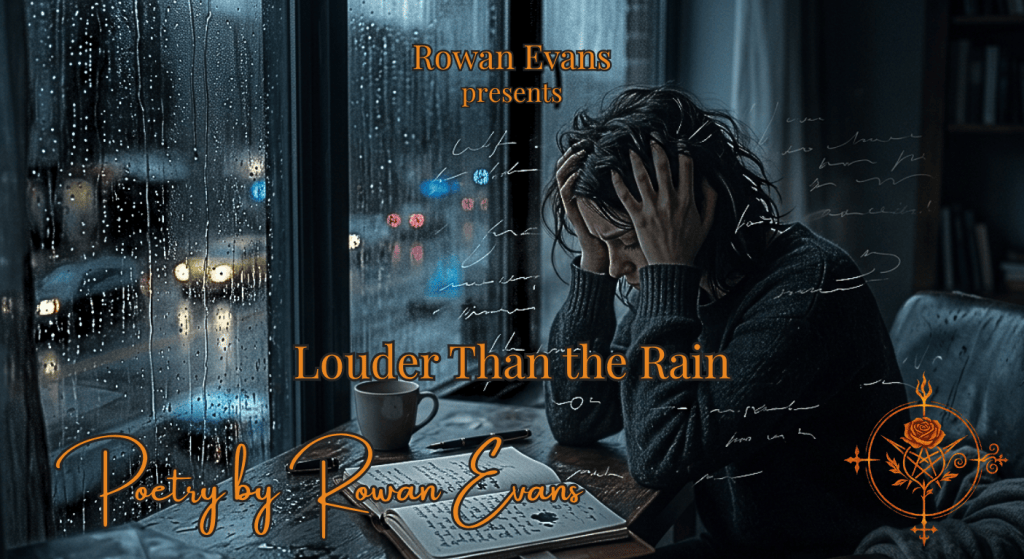
Louder Than the Rain is a small piece about one of those moments—when everything outside is making noise, yet somehow the loudest thing in the room is what’s happening inside your own head.
So listen closely.
— Rowan Evans
When the world gets quiet, sometimes the thoughts get louder.
Louder Than the Rain Poetry by Rowan Evans
I sat listening to the rainfall,
watching it hit and splash upon the ground—
the way my tears fell,
I was surrounded, but it felt like nobody was around.
I was alone in a packed house—
why was the silence so fucking…
my thoughts were loud,
they were drowning my thoughts out.
I was so damn nervous,
hands in my hair, I was pulling it—
just wanted to scream and shout,
it was the only way to get my feelings out.
But I couldn’t shout loud, so I rode it out—
translated the pain to the page.
Yeah, I wrote it out…
Journey into the Hexverse
[My Nightmare] A poem about the nightmare of loving someone across distance, seeing the world from different perspectives, and holding onto the hope that the cracks can still be repaired—and that someday two separate shores might become one.
[Nobody² (No Body)] A minimalist poem playing with the double meaning of “nobody”—exploring loneliness, isolation, absence, and the feeling of becoming a ghost within your own life.
[Rose & Ruin] Two minimalist poems exploring the opposing forces within creativity: the thoughts we cultivate into something beautiful and the darker thoughts we transform before they have a chance to decay.
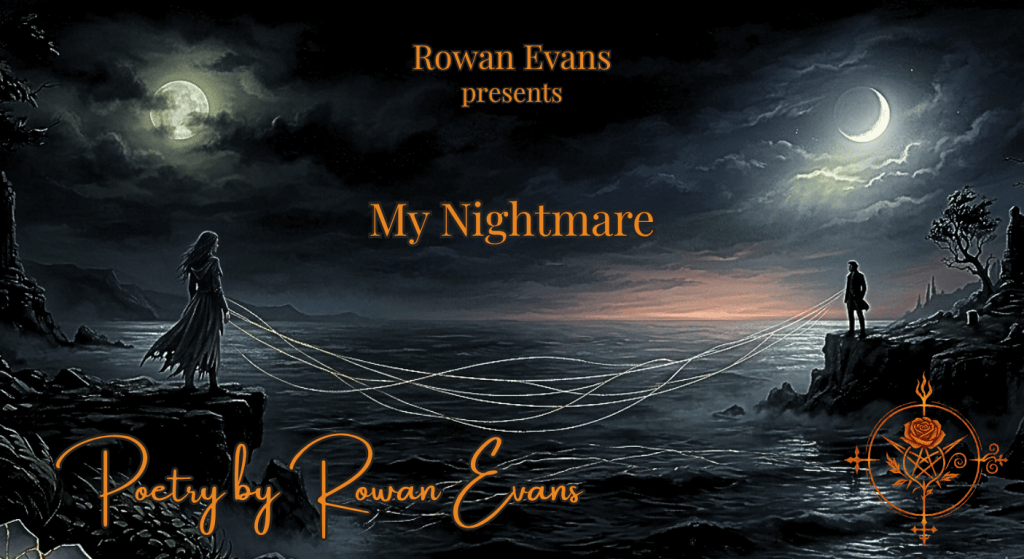
Sometimes the nightmare is waking up and realizing that the person you want beside you is standing beneath a completely different sky.
My Nightmare comes from that place—the uneasy space between memory and hope, between what once felt shared and what now feels impossibly far away. It is a poem about distance, but not only the physical kind. There is distance between perspectives, between hearts, between the lives we imagine and the lives we are actually living.
Still, even nightmares have endings.
Sometimes you wake up before they become permanent.
And sometimes, even while dreaming, you can still see a little gold threaded through the cracks.
— Rowan Evans
Two shores. Two skies. One horizon—and enough gold left to believe they might meet there.
My Nightmare Poetry by Rowan Evans
This is my nightmare.
You and I across the distance,
the view that we see is different—
your moon from my sky
is missing—
the sun no longer shines,
it’s dimming—
I don’t see the spark anymore—
don’t see the light in the dark anymore.
What do I even I write for?
I lost my purpose—think I did it on purpose,
it’s like I can’t rhyme anymore,
no clock, no watch, can’t tell time anymore.
This is my nightmare.
You and I across the distance,
the view that we see is different—
my moon is sickly pale,
but yours seems fine though—
the sun doesn’t provide light,
it’s gotten real low—
in times before, this is when
I would Kintsugi the heart—
but there’s not much heart left,
it’s all gold—soft metal,
softer soul—stayed warm,
when the world grew cold.
This is my nightmare.
You and I across the distance,
the view that we see is different—
when we used to be,
two pieces the puzzle
was missing—
the sun in the sky was fine,
but it dimmed in our shine—
I’ve spent time doing Kintsugi
on your heart too—it was hard not to,
gold and platinum weaved through—
I really did see you, flaws and all—
and all I saw was a gift from God.
I still don’t think—
I was wrong.
But that was my nightmare…
You and I across the distance,
the view that we saw was different—
but I still see the gold threads that connect,
the platinum hope on the horizon,
that one day the distance will close—
and we’ll walk the same shore,
it won’t be—
mine and yours.
Journey into the Hexverse…
[Dreaming Wrong] A familiar dream becomes unsettling when the ocean becomes a pond, the tide disappears, the moon loses its reflection, and nothing feels quite like it belongs. Dreaming Wrong explores the uncanny feeling of finding yourself inside a dream that looks familiar—but feels like someone else’s.
[Poet’s Curse] Poet’s Curse explores the painful side of falling too deeply: giving pieces of yourself away freely, taking accountability for your own heartbreak, and realizing that learning to let go can be harder than learning to love.
[Beach to Beach] A dream becomes a journey between familiar shores and unfamiliar cities in Beach to Beach (How I Get There), a poem about imagined travel, ocean crossings, longing, and the places we hope to someday reach while awake.
[Where the Metaphors Lead] Some truths are easier to write than they are to say aloud. “Where the Metaphors Lead” explores the quiet space between dreams, confession, and the courage it takes to let another person know how deeply they’ve become woven into your inner world.