Tag: belonging

  • Author’s Note

    This poem started with one of those wonderfully ridiculous thoughts that refuses to leave.

    What if I took the opening joke from an old cartoon and treated it completely seriously?

    A chicken. A cow. A father who proudly accepts both without ever asking for an explanation.

    The image made me laugh, but as I kept writing, I realized the joke was quietly carrying something much larger.

    So much of life is spent convincing people that difference is something to overcome. We flatten ourselves to fit expectations, compare our gifts to someone else’s, or assume that being different somehow means being less.
    Nature has never worked that way.

    A forest isn’t strong because every tree is identical. An orchestra doesn’t create harmony by playing the same note. Communities become richer because different people bring different strengths, experiences, perspectives, and ways of seeing the world.

    That’s what this poem slowly became.

    The cartoon setup stayed, because I think humor can open a door that seriousness sometimes cannot.

    Once the reader laughs, they’re already listening.

    And maybe they’ll leave remembering something simple:

    You don’t have to become someone else to have value.

    Sometimes the thing that makes you different is exactly what the world needs.

    Rowan Evans


    A chicken and a cow standing together in a sunlit pasture outside a red barn, symbolizing the beauty and strength found in differences.

    Difference Is How We Grow
    Poetry by Rowan Evans

    “Don’t have a cow,” they said—
    why, my mama did?
    You see—

    Mama had a chicken.
    Mama had a cow.
    Dad was proud;
    he didn’t care how.

    And I know—
    that may sound absurd to you,
    but it’s a setup for a simple truth.

    There is strength in our differences—
    so let us try and identify
    what our difference is.

    Difference is not a warning sign—
    it’s a spark.

    A start.

    A door kicked open
    to a room you didn’t know you needed.

    You see—
    my family tree
    is less a tree
    and more a barnyard free‑for‑all.

    Feathers in the branches,
    hoofprints on the roots,
    and me somewhere in the middle
    trying to make sense of it all.

    But difference is not disorder—
    it’s the rhythm of the world
    learning to harmonize.

    So what makes you different—
    what is your strength?

    A cow gives milk,
    a chicken gives eggs—
    neither tries to be the other,
    yet breakfast would be poorer
    without both.

    So what do you bring to the table—
    that no one else can,
    and why hide it?

    Because sameness is a field gone fallow,
    but difference—
    difference is how we grow.


    Journey into the Hexverse…

    [Tots, Rocks and All]
    What begins as a surreal collection of tater tots, rocks, comic book references, and runaway thoughts slowly reveals something much quieter: a poem about creativity, vulnerability, and the simple hope of finding someone willing to hold your heart.

    [Off Leash Thought]
    A reflective free verse poem exploring the mind as a living, wandering force—unpredictable, creative, and sometimes chaotic—through the metaphor of a dog off leash. It embraces mental drift not as a flaw, but as a natural part of creative thought and self-awareness.

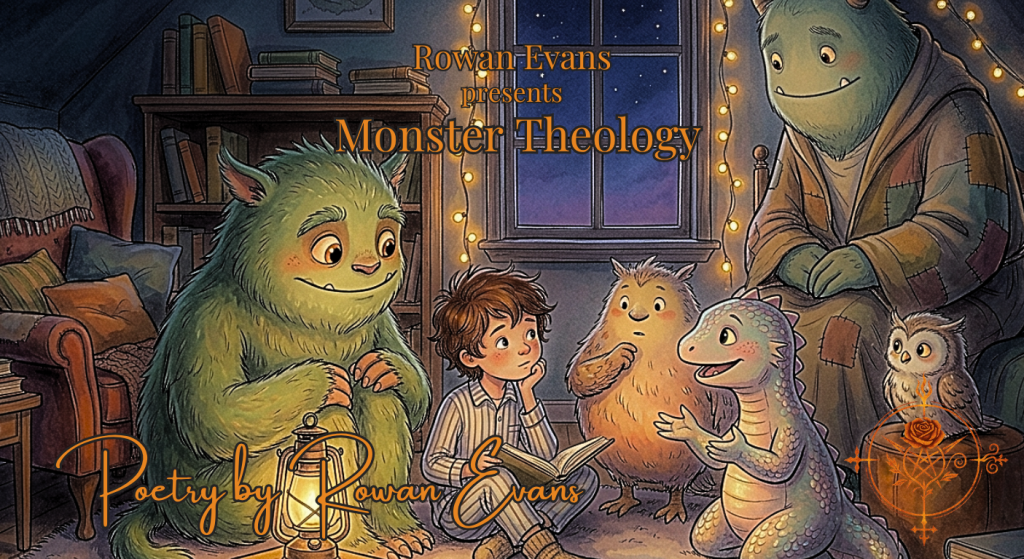
    [Monster Theology]
    What if the monsters under the bed weren’t monsters at all? Monster Theology explores difference, belonging, and the human tendency to fear what we don’t understand through a conversation with the creatures we’ve spent our lives imagining.

    [Raccoons in Silk Pajamas]
    What begins with judgmental Space Chickens quickly spirals into camels in parked cars, elephants in jam jars, raccoons in silk pajamas, and astronauts in the ocean. A playful absurdist poem about language, imagination, and what happens when you stop trying to control where the words go.

    [The Answer Is (Yes)]
    What kind of writer am I? Mythmaker, confessor, comedian, philosopher, dream-architect, romantic, storyteller, and diss-poet. This self-reflective poem explores the impossibility of fitting creativity into a single category—and embraces every version of the truth a pen can touch.

    If you’re interested in more poetry, you can find it here → [The Library of Ashes]
  • Author’s Note

    This poem became the quiet conclusion to a trilogy I never intended to write.

    Crossing the Sea was about direction.

    Only Waiting was about the reason I needed that direction in the first place.

    This piece asks a different question:

    How do you keep moving when you haven’t arrived yet?

    For me, the answer has always been dreams.

    Not because I confuse them with reality, but because they remind me that another reality is possible.

    I’ve written about dreams for years. They rarely feel random to me. They often feel like rehearsals—small glimpses of a life my mind already believes exists somewhere beyond the horizon.

    The city in this poem isn’t a specific city.

    The moon isn’t really the moon.

    Even after spending two poems trying to strip away metaphor, I found myself sitting beside it again.

    I think that’s because hope has always spoken to me symbolically.

    When I’m awake, I know where I am.

    When I’m asleep, I remember where I’m going.

    The dream doesn’t replace reality.

    It sustains me until reality catches up.

    The final image—a dream folded into my chest like a map—is probably the clearest way I’ve ever described hope.

    Hope isn’t certainty.

    It isn’t arrival.

    It’s carrying the direction with you, even when you’re still standing at the beginning of the journey.

    And maybe that’s what this trilogy has been trying to say all along.

    Sometimes home begins as a place.

    Sometimes it becomes an ache.

    Sometimes…

    it’s simply the direction you’re already walking.

    Rowan Evans


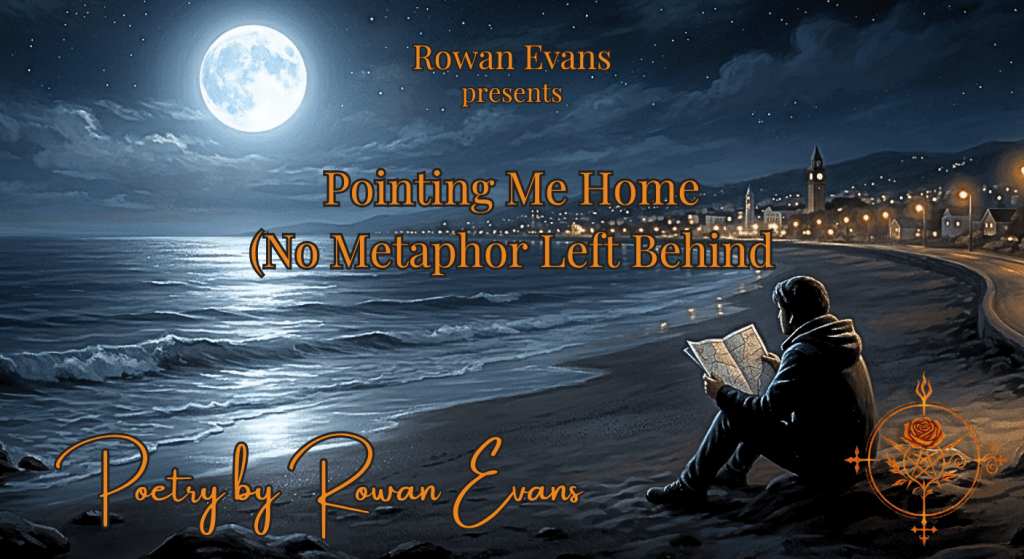
    A lone figure sits beneath a full moon where an ocean shoreline transitions into quiet city streets, holding a folded map while reflecting on hope, dreams, and the journey toward home.
    “Sometimes home isn’t where you’re standing—it’s the direction you’re already walking.” 🌙🗺️

    Pointing Me Home (No Metaphor Left Behind)
    Poetry by Rowan Evans

    Tick tock, tick tock—
    that’s the sound of the clock.
    I listen as I wait for the escape,
    a simple trip, brought on by sleep.
    Because I only feel at home
    in my dreams.

    So as I close my eyes
    and my head hits the pillow—
    I follow the moon
    to the ocean’s edge,
    I listen to the tide—
    I follow it in stride
    until I find where it’s pulling me.

    With every step,
    I move deeper in.
    Slowly sand turns to concrete
    beneath my feet,
    as the beach transitions
    into city streets.

    Streetlights flicker
    like they’re remembering
    they used to be stars.

    The hum of the city
    folds into the sound of waves,
    each echo a reminder
    of where I started
    and where I’m going.

    I walk until the moon
    hangs between buildings
    like it’s lost too—

    like it’s looking someone to talk to.

    So I sit and conversate,
    I tell the moon all about the quiet ache—
    the feeling that I need to change
    my environment to one that aligns
    more with what I feel inside.

    And the moon sits with me,
    just listening—so I talk some more.
    Out of my heart, the words just pour.
    I spill every secret, I hold nothing back
    until I feel like I might collapse.

    The moon listens,
    patient as ever,
    its light softening
    the edges of my thoughts.

    And when I finally fall silent,
    breath trembling,
    chest heavy—

    it tilts itself
    just enough
    to remind me
    I’m not alone
    in the places I wander.

    Tick tock, tick tock.

    A return to the rhythm of the clock,
    interrupting the talk—
    the moon’s light gives way
    to the sun’s rays,
    I’m still stuck in this place—

    but I’m only waiting
    until I can cross the sea,
    Pacific and the Philippine.

    Until then,
    I carry the dream like a map,
    folded in my chest—

    pointing me home.


    Journey into the Hexverse…

    [Crossing the Sea (No Metaphor Left Behind)]
    A deeply personal poem about relocation, longing, and the realization that some truths naturally arrive through metaphor—even when we try to leave it behind.

    [Only Waiting (No Metaphor Left Behind)]
    The second poem in the No Metaphor Left Behind series, exploring the quiet ache of growing up in a place that never truly felt like home—and finally saying aloud what years of metaphor had been trying to express.

    If you’re interested in more poetry, you can find it here → [The Library of Ashes]
  • Author’s Note

    Some dreams stay with me because of what happens in them.

    Others stay because of how they make me feel after I wake up.

    This poem belongs to the second kind.

    Lately, I’ve found myself dreaming about places I’ve never lived but somehow recognize. Cities that feel familiar before I arrive. Streets that carry a strange sense of belonging. When I wake, there’s often a brief moment where those places feel more like home than the room I’m actually in.

    That feeling became the heart of this piece.

    The image of a phone call arrived almost immediately. Not as a literal phone, but as the unmistakable sensation that something beyond my current life keeps trying to get my attention. The title came from asking myself what that call would look like if it appeared on a screen.

    Caller ID: Destiny.

    The final stanza is probably the most honest part of the poem.

    It’s not really about wanting to sleep.

    It’s about wanting to wake up somewhere that feels like I’m finally living the life I’ve been moving toward for years.

    Sometimes dreams aren’t an escape from reality.

    Sometimes they’re reminders that another future still feels possible.

    Rowan Evans


    A person standing alone on a quiet street at dawn holding a glowing phone that reads "Caller ID: Destiny," while a luminous dreamlike city shines in the distance.
    Sometimes the loudest call doesn’t come from a phone—it comes from the life waiting for you beyond the horizon.

    Caller ID: Destiny
    Poetry by Rowan Evans

    As the haze of sleep
    finally leaves,
    I find myself missing
    the dreams.

    In my sleep
    I walk the streets
    in the places
    that are calling me.

    It’s like my phone is ringing
    off the hook—

    caller id reads:
    Destiny.

    Message received:
    “Time to leave.”

    I’m done begging
    where I’m from—
    to notice me.

    I feel seen
    in my dreams,
    and invisible
    in my streets.

    So I’d rather sleep
    than be awake
    in this state.


    Journey into the Hexverse…

    [Crossing the Sea (No Metaphor Left Behind)]
    A deeply personal poem about relocation, longing, and the realization that some truths naturally arrive through metaphor—even when we try to leave it behind.

    [Only Waiting (No Metaphor Left Behind)]
    The second poem in the No Metaphor Left Behind series, exploring the quiet ache of growing up in a place that never truly felt like home—and finally saying aloud what years of metaphor had been trying to express.

    [Returning to My Bones]
    Some dreams fade the moment we wake. Others leave behind emotions that linger long after reality returns. Returning to My Bones explores the strange grief of leaving a dream that felt real enough to matter.

    [Before My Feet Touch the Floor]
    What happens when your dreams feel more real than your waking life? Before My Feet Touch the Floor explores the strange grief of waking up, the lingering memory of dream selves, and the quiet question of which version of us is truly real.

    If you’re interested in more poetry, you can find it here → [The Library of Ashes]
  • Author’s Note

    This poem is the second part of an experiment I started in Crossing the Sea—an attempt to write without leaning on metaphor, or at least to notice when metaphor appears even when I’m trying not to use it.

    The first piece focused on direction: the place I’m moving toward, the literal ocean I have to cross to get there. But I realized that before I could talk honestly about where I’m going, I needed to talk honestly about why I’m leaving.

    That’s what this poem is.

    It’s the part I’ve always written around instead of through.
    The part I’ve buried under tides, distance, storms, and moonlight.
    The part I’ve hinted at for years without ever saying plainly.

    The truth is simple, even if it took me a long time to say it:

    I’ve never felt at home in the country where I grew up.

    Not in childhood.
    Not in adulthood.
    Not in all the years in between.

    It’s a quiet ache—persistent, steady, familiar.
    Not dramatic, not catastrophic, just a sense of misalignment I’ve carried since I was fourteen. A feeling of being held in a place I never belonged to, waiting for a life that didn’t start here.

    I’ve called it restlessness.
    I’ve called it longing.
    I’ve called it distance.
    Eventually, I called it the ocean.

    But naming it directly felt necessary.
    Not to erase the metaphors, but to understand what they were protecting.

    This poem is that attempt.
    Not a rejection of metaphor, but a recognition of the truth beneath it.

    Rowan Evans


    A traveler stands at the edge of a familiar neighborhood looking toward a distant horizon with a suitcase in hand.
    Sometimes leaving isn’t running away. Sometimes it’s finally walking toward the place that feels like home.

    Only Waiting (No Metaphor Left Behind)
    Poetry by Rowan Evans

    Turn the page,
    I’ve got more to say.

    I’ll try again
    not to hide behind
    metaphors
    and coded lines.

    Last time—
    I talked about the destination,
    the place I’m moving toward.

    This time—
    I’m going to talk about the ache.
    The persistent empty feeling
    that I’ve been feeling since I was fourteen.

    I’ve written about it before
    woven in metaphors.
    But this time I’m going to try
    and say it plain.

    It’s the ache of living in a place
    that never felt like mine.

    Not once.

    Not in childhood,
    not in adulthood,
    not in all the years in between.

    People talk about home
    like it’s a given—

    a birthplace,
    a neighborhood,
    a country that shaped them.

    But I never felt shaped by this place.

    Only held in it.
    Only waiting.

    I learned early
    that you can grow up somewhere
    and still feel like a visitor.

    You can know every street
    and still feel lost.

    You can speak the language
    and still feel unheard.

    Since fourteen,
    I’ve carried this quiet emptiness—
    not dramatic,
    not catastrophic,
    just a steady sense
    that I was meant to be somewhere else,
    and somehow ended up here instead.

    I used to call it restlessness.

    Then longing.

    Then distance.

    Then the ocean.

    But the truth is simpler:
    I’ve never felt at home
    in the country that raised me.


    Journey into the Hexverse…

    [Crossing the Sea (No Metaphor Left Behind)]
    A deeply personal poem about relocation, longing, and the realization that some truths naturally arrive through metaphor—even when we try to leave it behind.

    [Translating What I Feel]
    A poem about the invisible process of turning emotion into imagery, imagery into language, and language into poetry. An intimate reflection on creativity, loneliness, and twenty-three years of learning to translate what the heart feels.

    [Maybe You’ll Want Me Too]
    A poem about the subtle shift from knowing someone to constantly thinking about them. Through humor, metaphor, and confession, Maybe You’ll Want Me Too explores affection, attachment, and the fragile hope that being wanted might matter more than being needed.

    [Recognizes Home]
    A free-verse poem exploring the difference between love as dependency and love as choice. It challenges the idea that love must be need-based, instead centering the quiet strength of choosing someone while still remaining whole on your own.

    [Not Rebuilding You]
    A poem about love as an act of presence rather than rescue. Through construction imagery, Not Rebuilding You explores trust, devotion, emotional safety, and the quiet work of building a foundation strong enough for healing to grow.

    If you’re interested in more poetry, you can find it here → [The Library of Ashes]
  • Author’s Note

    This poem began as an experiment in restraint.

    I wanted to see what would happen if I stopped relying on metaphor—the oceans, tides, moons, and distant imagery that so often shape the way I write—and instead said things as directly as I could.

    What I discovered is that I don’t really think in a “non-metaphorical” way.

    Even when I try to remove symbolism, my mind still reaches for it. The language of distance, direction, and crossing appears naturally because that is how I process emotional states: spatially, geographically, in motion.

    So the poem became something else.

    Not an escape from metaphor, but an awareness of it.

    A recognition that even when I say “I won’t use the ocean this time,” I still understand my life through movement across it.

    This piece lives in that tension between clarity and instinct—between what I am trying to say plainly, and the language my mind naturally returns to.

    And in the end, it admits something simple:

    Sometimes the clearest way to say the truth… is still through the shape of the thing you tried to leave behind.

    Rowan Evans


    A lone traveler stands on a Pacific shoreline looking toward distant islands across the ocean at sunrise.
    Some distances are measured in miles. Others are measured in becoming.

    Crossing the Sea (No Metaphor Left Behind)
    Poetry by Rowan Evans

    I am going to try
    something that terrifies me—
    that most of the time,
    would leave me paralyzed.

    I am going to try
    and say everything
    I hold inside—
    no metaphors
    to hide behind
    this time.

    I’m not where
    I want to be
    and part of me,
    thinks I’ll never be.

    I know that’s just
    fear and doubt—

    just because part of me
    thinks it, doesn’t make it true.

    Relocating
    is just taking
    longer than I wanted it to.

    But I know the direction.
    The destination is clear—
    I just got to get there.

    I got to leave here.

    This isn’t a new feeling—
    I’ve said this all before,
    buried in metaphors.

    Hidden behind symbolism.

    This is where
    I’d put the ocean
    and the tide,
    a way to describe
    the distance.

    Between where I am
    and where I want to be—
    and to get there,
    I have to cross the sea.

    Not a metaphor,
    I mean that literally—
    Pacific and the Philippine.


    Journey into the Hexverse…

    [Translating What I Feel]
    A poem about the invisible process of turning emotion into imagery, imagery into language, and language into poetry. An intimate reflection on creativity, loneliness, and twenty-three years of learning to translate what the heart feels.

    [Recognizes Home]
    A free-verse poem exploring the difference between love as dependency and love as choice. It challenges the idea that love must be need-based, instead centering the quiet strength of choosing someone while still remaining whole on your own.

    [Not Rebuilding You]
    A poem about love as an act of presence rather than rescue. Through construction imagery, Not Rebuilding You explores trust, devotion, emotional safety, and the quiet work of building a foundation strong enough for healing to grow.

    [The Language Her Soul Speaks]
    What if love isn’t about being understood, but learning to understand someone else? “The Language Her Soul Speaks” is a free verse poem about intimacy, communication, curiosity, and the desire to know another person beyond the limits of language.

    [Ocean Waves (1, 4, 3)]
    A moonlit shoreline, a rowboat full of ducks, a piggybank with no cents, and a confession hidden in plain sight. Ocean Waves (1, 4, 3) explores how humor, wordplay, and absurdity can become a side door to vulnerability when the truth feels too difficult to say directly.

    [L Words & Heart]
    A playful, self-aware poem about love, longing, loyalty, and the quiet ways another person can reshape our inner world. What begins as humor slowly reveals a heartfelt confession about affection, imagination, and the faces that linger in our dreams.

    [I’ll Be There to See Your Sunrise]
    Love has never come easily to me. This poem explores the fear, vulnerability, and quiet courage required to stay emotionally present when connection begins to matter deeply. “I’ll Be There to See Your Sunrise” is about choosing love despite the risk of heartbreak—and promising to remain long enough to witness someone fully.

    [Altar and Roses]
    A gothic free verse poem about poetic identity, recurring symbolism, devotion, and the quiet humanity beneath dramatic imagery.

    If you’re interested in more poetry, you can find it here → [The Library of Ashes]
  • Author’s Note

    I’ve always thought it was strange that monsters get such bad press.

    Most of them never asked to be monsters in the first place.

    They’re usually just the things we’re afraid of. The things we don’t understand. The things we refuse to look at directly.

    What would happen if I stopped fearing the monsters under the bed and actually talked to them?

    The answer surprised me.

    Because once the conversation began, the monsters behaving like monsters.

    They became neighbors.

    Parents.

    Friends.

    People with lives beyond the role they had been assigned in my imagination.

    And that’s where the poem’s real interest emerged.

    Not in monsters themselves, but in the human tendency to create them.

    We have a habit of turning difference into danger.

    A habit of mistaking unfamiliarity for threat.

    A habit of reducing people to a single trait, label, identity, or assumption until they become something easier to fear than understand.

    The monsters in this poem don’t seem to share that habit.

    They celebrate what makes them unique.

    They recognize difference without treating it as division.

    They understand something many of us spend our lives trying to learn:

    There is a difference between being different and being separate.

    That’s where the title comes from.

    Theology is simply the study of what we believe.

    And Monster Theology asks a simple question:

    What if the monsters were better at being human than we are?

    Maybe the real lesson isn’t learning how to defeat monsters.

    Maybe it’s learning how to stop creating them.

    Rowan Evans


    A child sits peacefully with a group of friendly monsters in a softly lit bedroom, symbolizing understanding and acceptance across differences.
    “Maybe the real lesson isn’t learning how to defeat monsters. Maybe it’s learning how to stop creating them.”

    Monster Theology
    Poetry by Rowan Evans

    I’ve made friends
    with the monsters—
    in my closet,
    and under the bed.

    They used to scare me,
    but I realized
    I wasn’t judging them
    fairly.

    These monsters
    have feelings,
    children and lives
    outside of my room.

    I’m not the only one
    they visit,
    I’m not the only friend
    they have.

    They tell me
    about the others
    sometimes.

    But they aren’t allowed
    to talk about that a lot.

    So we’ll stick to the difference
    between their world and ours.

    They say it’s much the same,
    many lands with many peoples—
    but they find our focus
    on differences strange.

    They don’t understand
    why we fear what makes us unique.
    They don’t understand
    why we can’t acknowledge our strengths
    without diminishing others.

    To them—
    monsters are monsters,
    they are all the same
    but not.

    They celebrate
    what makes them different,
    the things
    that make them unique.

    Celebrate.
    Not separate.

    That’s the monster motto.

    And sometimes I wish
    we lived like they do—

    less afraid
    of what makes us different,

    less eager
    to turn each other
    into monsters.


    Journey into the Hexverse…

    [Danny Phantom Theology]
    What begins as a metaphor borrowed from a childhood cartoon becomes something deeper: a reflection on existing between survival and possibility, exhaustion and hope, the life we have and the life we long for. Danny Phantom Theology explores what it means to keep moving toward a future that feels worth living.

    [Lone Wolf Theology]
    A philosophical pop-culture poem exploring freedom, identity, and self-authorship through the lens of superheroes, antiheroes, mythic archetypes, and personal rebellion. A declaration of autonomy in a world determined to write your story for you.

    If you’re interested in more poetry, you can find it here → [The Library of Ashes]
  • Author’s Note

    Some feelings don’t fade with age.

    They sharpen.

    I’ve been writing versions of this poem since I was a teenager, long before I had the language to understand what I was actually trying to say.

    Back then, people treated it like escapism. Wanderlust. Fantasy. A phase.

    But there’s a difference between wanting to travel and feeling fundamentally misaligned with the place you were born into.

    This piece isn’t about hating where I’m from. It’s about disconnection — about spending most of your life emotionally out of sync with the environment around you, while feeling an inexplicable, almost gravitational pull toward places you’ve never physically been.

    For years, I hid that truth behind metaphor. Tokyo alleyways. Neon lights. Foreign streets. Airports. Oceans. Other languages drifting through the background. It was easier to let imagery speak for me than to say the thing outright.

    This poem is me pulling the mask off a little.

    Not to be dramatic.

    Just honest.

    Because after long enough, recurring imagery stops being aesthetic and starts becoming evidence.

    And maybe that’s what poetry has always been for me:

    A compass trying to explain itself.

    Rowan Evans


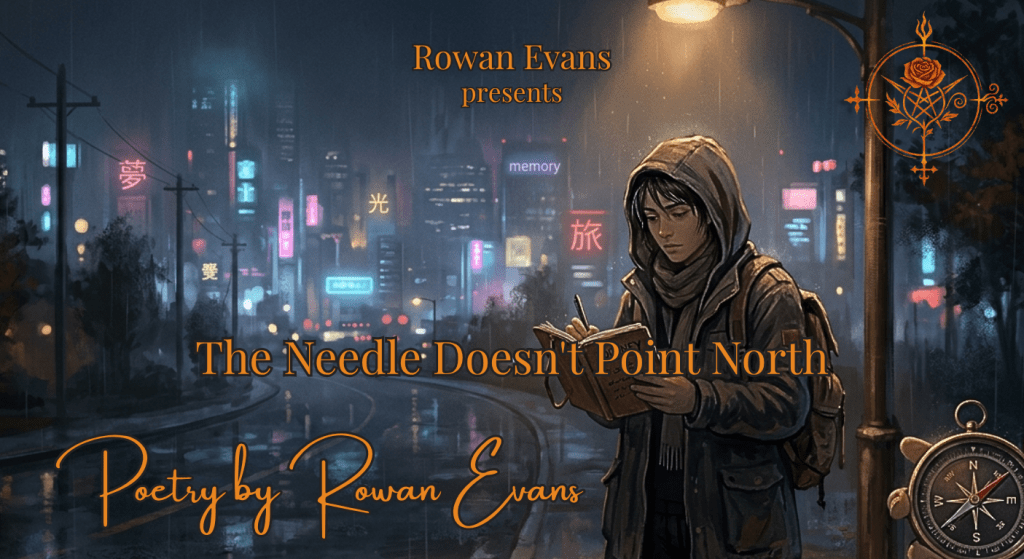
    A solitary person holding a notebook and compass stands beneath a streetlight while distant neon city lights glow on the horizon.
    I was born here.
    But somewhere along the way, my compass started pointing elsewhere.

    The Needle Doesn’t Point North
    Poetry by Rowan Evans

    I have been sitting with this
    for most of my life.

    I’ve talked about it before.

    I’ve written it,
    more times than I can count—
    since I was fourteen
    I’ve wanted out.

    I was told,
    “it’s a kid’s fantasy,”
    just a phase I’d outgrow.

    But here I am at thirty-six,
    still dreaming of distant shores.

    The soil may have shifted
    over the years,
    but the pull remained the same.

    Growing up
    with this feeling stuck
    in the pit of my gut,

    do you know what that’s like?

    To never feel like you fit,
    always out of place.

    But everyone around you
    doesn’t see it—

    they see a teen
    being difficult,
    notebook clutched
    with plans
    scribbled inside.

    These weren’t just poems—
    they were escape routes
    written in code,
    only I could read.

    I wrote about Tokyo’s streets
    and walking through alleyways—

    masked in metaphors,
    buried in similes—

    I’ve written about Beijing,
    and Shanghai,
    with nocturnal trips
    to Seoul.

    But I’ve never
    said it so plain.

    I was born here,
    so I’m from here—
    but I don’t feel connected,
    I’m not of here.

    American mouth,
    global mind—

    been this way
    since seventeen.

    Shh—
    I went quiet,
    but the fire
    wasn’t silent.

    I could hear it speak,
    it was urging me.

    Eighteen came and went,
    nineteen too.

    I could still feel
    the pull—
    but it was different now.

    Deeper.
    Stronger.
    More mature.

    Twenty, twenty-one,
    twenty-two, twenty-three—
    four more years,
    still stuck.

    Not trapped.

    New destination appeared—
    and it’s been the same since.

    I’ve said it before,
    the needle
    doesn’t point north—

    body in the west,
    puso sa silangan.


    Journey into the Hexverse…

    [Weather in My Chest]
    “Weather in My Chest” is a free verse poem about emotional hyperawareness, social tension, and the quiet experience of carrying internal storms into rooms that react before a single word is spoken.

    [Sound as a Vessel]
    “Sound as a Vessel” is a free verse poem about music as emotional architecture, exploring how international artists and soundscapes shaped identity, creativity, memory, and poetic voice.

    [Just Knowing You Has Been Enough]
    “Just Knowing You Has Been Enough” is a deeply vulnerable free verse poem about unspoken love, emotional fear, coded confessions, and the quiet truth of caring for someone without needing perfection in return.

    [The Streets I Walk When I Sleep]
    “The Streets I Walk When I Sleep” is a deeply intimate free verse poem about recurring dreams, emotional connection, longing across distance, and the strange feeling of remembering places and moments that have never happened in waking life.

    [Memories From a Life Yet to Come]
    Some dreams feel less like fantasy and more like memory. “Memories From a Life Yet to Come” is a reflective free verse poem about longing, displacement, emotional alignment, and the strange comfort of recognizing yourself more clearly in dreams than in waking life

    [Separate Timelines]
    “Separate Timelines” is a surreal and deeply introspective free verse poem about emotional distance, time zones, vulnerability, and the fear of losing a connection that already feels meaningful before the words are ever spoken aloud.

    If you’re interested in more poetry, you can find it here → [The Library of Ashes]
  • Author’s Note

    Some dreams feel less like fantasy and more like memory.

    Not literal memory—something stranger than that.

    A feeling. A pull. A version of yourself that already exists somewhere ahead of you, waiting to be caught up to.

    I’ve written a lot about displacement, longing, and feeling emotionally out of sync with the place I was born into. But this piece isn’t rooted in resentment. It’s quieter than that.

    This poem came from the feeling of seeing glimpses of alignment before you’ve fully arrived there yet.

    The strange comfort of closing your eyes and feeling more connected to yourself in dreams than you do while awake.

    Not because sleep is escape— but because sometimes dreams reveal the shape of what your heart has been reaching toward all along.

    Rowan Evans


    A solitary figure stands at the edge of the ocean at twilight, looking toward distant city lights across the water as waves roll onto the shore.
    Some places feel familiar long before we ever arrive there.

    Memories From a Life Yet to Come
    Poetry by Rowan Evans

    I close my eyes—
    hear the crashing waves,
    taste the salt on my lips,
    feel the wind in my hair.

    I feel like I’m floating—
    even lying in bed.

    When I close my eyes—
    I travel in my head.

    It’s like I remember things
    I haven’t lived yet.
    Memories from a life
    yet to come.

    I see the life
    I want to lead,
    while I live the life
    I want to leave.

    Not because I hate it.

    I’m just misaligned.
    A little off-center,
    a little out of sync.

    It’s like I follow the waves,
    because I was never meant
    for this shore.

    Awake is the nightmare,
    asleep is when I open my eyes,
    and I can see the streets—

    where my life
    will finally align.


    If you’re interested in more poetry, you can find it here → [The Library of Ashes]
  • Author’s Note

    This piece isn’t about hatred for where I’m from.
    It’s about honesty.

    For as long as I can remember, I’ve felt the pull of something beyond the shoreline I was born on. Not rebellion. Not fantasy. Just a quiet, persistent tide.

    “Drawn to Sea” is both wordplay and truth – a recognition that sometimes the call we feel isn’t about escape, but alignment. I don’t believe other people are wrong for loving where they are rooted. I simply know that my roots may be meant for different soil.

    Some of us don’t reject the shore.

    We just hear another one calling.

    Rowan Evans


    A person standing alone at the edge of the ocean at sunset, looking toward the horizon in contemplation.
    Some shores are inherited.
    Others call you by name.

    Call of the Tide (Drawn to SEA)
    Poetry by Rowan Evans

    You can call me Moana
    the way I’m drawn to SEA,
    but there is no demi-god
    helping me.

    I must face the waves alone.

    The waves of hate
    from people in the place
    they say,
    I’m supposed to call home.

    But I’m American
    in label only.
    My mind frame
    does not align
    with the anthem
    in their sentiments.

    I’m not saying
    they’re wrong.
    I’m just saying
    I don’t belong.

    This place is not home.
    This shore was never my own.
    I’ve felt the pull of tides
    since my earliest days.
    So I stand at the edge—
    watching the horizon,
    waiting for the water
    to call my name.


    If you’re interested in more poetry, you can find it here → [The Library of Ashes]
  • Author’s Note

    When I was a kid, other children wished for speed, flight, invisibility and teleportation. I wished to understand.

    This piece isn’t about wanderlust or escape. It’s about connection – the desire to meet people in the language they speak at home, in the rhythm that feels natural to them. I may not have superpowers, but I’ve spent years training my ear, listening with intention, and closing the distance in the ways I can.

    Some bridges are built with ink.
    Others are built with effort.

    Rowan Evans


    A child on a playground at sunset looking up at glowing words in different languages in the sky, symbolizing connection and fluency.
    Some wished for flight. I wished for fluency.

    The Power I Chose
    Poetry by Rowan Evans

    Let me take you back
    to playground conversations—
    when superpowers
    were the topic at hand,
    and kids were wishing
    for flight, speed or teleportation.

    Then there was me—
    I wished for connection
    and fluency, for no language
    to be new to me.

    I wanted my ears to pick-up
    language and cadence,
    and my mouth to repeat it
    perfectly. I wanted,
    no matter where
    someone was—

    I wanted to be able
    to meet ’em,
    to greet ’em
    with the language
    they spoke at home.

    I pictured traveling
    touching every corner
    of the globe,
    absorbing language,
    perfecting cadence.
    Living in a rhythm
    not my own.

    Now, the power
    may not have been real,
    but I’ve done
    what I could
    to train my ear.
    Listen with intention,
    until all language
    felt the same.
    And I may not know
    what you’re sayin’,
    but it no longer
    feels foreign.

    I’ll keep learning,
    and opening doors.
    Closing gaps,
    connecting with souls—

    As I continue to wander
    this earth, in search
    of a place to call home.
    Until I feel the pull of roots,
    I will continue to put
    earth under boots.
    I will continue to move,
    never becoming static.


    If you’re interested in more poetry, you can find it here → [The Library of Ashes]