Tag: faith and doubt

  • Author’s Note

    This piece is not about mocking faith.

    It’s about the difference between faith and certainty.

    Growing up around religion, I was often taught belief through absolutes. Questions were treated like weakness sometimes, uncertainty treated like danger. But the older I got, the more I realized that questioning was never the opposite of spirituality for me—it was part of it.

    Because if faith exists in the absence of proof, then certainty and faith cannot fully occupy the same space. Certainty closes the door. Faith leaves room for the unknown.

    That tension shaped this poem.

    Over time, I stopped seeing writing as separate from spirituality. The language changed, the framework changed, but the emotional instinct remained the same. I still seek meaning. I still seek connection. I still seek reverence. I just no longer place those things exclusively inside organized religion.

    That’s where the cathedral imagery comes from.

    When I say “I write cathedrals,” I mean that poetry became the place where I rebuilt my sense of the sacred. Not through doctrine, but through honesty. Through confession. Through empathy. Through creating spaces where brokenness doesn’t disqualify someone from belonging.

    The “sacred misfits” and “luminous heretics” in this piece are the people who exist outside easy categorization. The people who question. The people who feel spiritually displaced. The people who were told they were too much, too different, too doubtful, too strange to belong cleanly inside traditional structures.

    This poem is for them too.

    And ultimately, this piece isn’t arguing that one worldview is more beautiful than another. In fact, one of the most important lines to me is:

    “Both are beautiful.”

    Because whether someone sees divine creation or cosmic coincidence, I still think wonder itself matters.

    Wonder is sacred enough for me.

    Rowan Evans


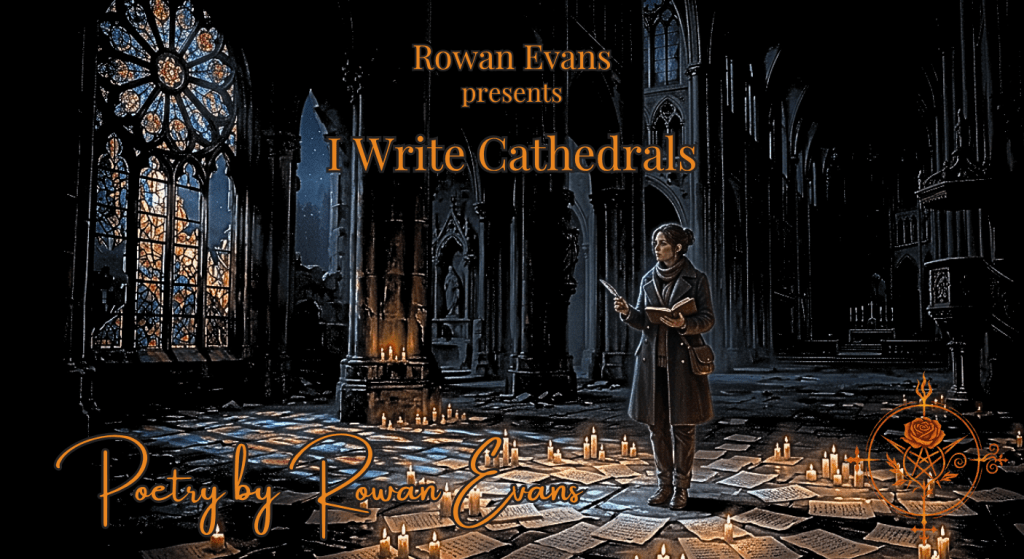
    A writer standing inside a dim Gothic cathedral surrounded by candles and handwritten poetry pages.
    If faith leaves room for the unknown, then poetry became the place where I learned to live inside the questions.

    I Write Cathedrals
    Poetry by Rowan Evans

    I used to pray in churches,
    now I write cathedrals
    with broken compass needles
    dipped in ink—
    the direction they point
    ought to make you think.

    In church they say
    faith is necessary—
    but they talked
    with such certainty.

    It never made sense to me.

    Faith is the belief
    in the absence of evidence.

    Certainty and faith,
    cannot co-exist.
    They contradict.

    I had questions—
    about faith,
    about belonging.

    Was I wrong
    for longing—
    for asking for more?

    They said I should be grateful
    for scraps on the floor.
    Miracles. Where?

    I didn’t see the proof anymore,
    didn’t have faith in what I missed.

    And if you believe?
    That’s fine—
    your journey, isn’t mine.

    Just don’t push
    your faith on me.

    You look around,
    see God’s creation.
    I look around
    at a series of
    happy accidents.

    Both are beautiful.

    You can continue
    to pray in your churches,
    I’ll continue penning cathedrals—
    building altars
    to the broken and forgotten,
    the outcast just like me.

    Sacred misfits,
    and the luminous heretics—

    all are welcome here.


    Journey into the Hexverse…

    [Drought Resistant]
    “Drought Resistant” is a confessional poem about growing up poor in California’s Central Valley—where triple-digit heat, EBT cycles, dry ramen, and hard landscapes become part of emotional memory. Blending humor, slang, and working-class reflection, the poem explores survival, regional identity, and complicated love for the place that shaped you.

    [Escaped to the Page]
    “Escaped to the Page” is a confessional meta-poem about individuality, artistic identity, and surviving through writing. Blending sharp confidence with emotional vulnerability, the poem explores the difference between shared labels and lived experience—and the ways art becomes inseparable from the life behind it.

    [Ink as a Second Mouth]
    “Ink as a Second Mouth” explores the distance between thought and speech, and the ways writing can become a form of survival, continuity, and self-translation. Through confessional imagery and reflections on growth, identity, and articulation, the poem examines what it means to keep becoming through language.0

    If you’re interested in more poetry, you can find it here → [The Library of Ashes]
  • Two confessions in ink by Rowan Evans

    “There are moments the abyss feels like home.
    So we return to the edge—not to wish for flight,
    but to see how far we fall.”
    — Rowan Evans

    These two poems were written in different hours of darkness, but they share the same marrow:
    A gospel whispered from the edge of belief.
    A confession to the sky and to the abyss alike.
    One is a prayer wrapped in doubt.
    The other, a quiet litany of almost-leaping.

    They are my sacred offerings to anyone who has ever felt broken but still breathing; to the soft-hearted heretics, the quiet survivors, the ones who keep rising even when they don’t know why.


    A solitary figure in dark clothes stands on the edge of a twilight cliff, with candlelight and distant cathedral ruins, evoking gothic melancholy and reflection.
    Liturgies whispered at the edge: devotion, decay, and the quiet rebellion of staying alive.

    The Gospel of My Decay
    (Liturgia Ruinae)

    Poetry by Rowan Evans

    “Bless me, Father, for I have bled.”
    — Rowan Evans


    I. Invocation

    It takes everything in me
    just to get out of bed lately.
    I hate this—this pain in my lungs,
    this ache in my chest.
    I sit in the dark,
    talking to God, asking why?

    Why me?
    Why do I have to bleed?
    Why do I have to bend,
    why do I have to break?

    Why is this a feeling I can’t shake?
    Don’t I deserve to be okay?
    Don’t I deserve to put a smile on my face?


    II. Confession

    Why
    the
    fuck

    did you make me this way—
    broken, alive but slowly decaying?

    And they question—
    Why don’t you believe?
    So I ask back—
    Why would I believe?

    You say God
    would never leave.
    Is that supposed to be enough?
    Is that what you call divine love?
    ’Cause it feels more like apathy to me,
    and if I could help myself, I would—happily.

    But I
    don’t see
    that happening.


    III. Benediction

    Forgive me, Father,
    for the questions I ask.
    For the softness that splinters,
    for faith that fractures.

    Still, I rise—
    not because I believe,
    but because the dawn drags me forward.

    Amen,
    even when I mean:
    I don’t know if I can.


    And yet, the night had more to confess…


    On the Edge Again
    Poetry by Rowan Evans


    I’m on the edge again,
    Standing on the ledge again—
    Overlooking the cliff, like
    I might just try and fly tonight.
    One step forward before I leap,
    Wings outstretched—
    but I don’t have them.
    So I plummet toward the earth below,
    And as I pray for peace—

    Time
    seems
    to slow.

    I watch closely—
    ground quickly approaching.
    One deep inhale,
    Eyes shut tight—
    Open them up:
    I’m in hell.

    And time,
    it moves
    so slow,
    even as I
    quickly
    approach.

    Eyes open,
    gasp for breath.
    There I am,
    still standing
    on the ledge.

    Fall to knees,
    struggling to breathe.
    Tears spill
    from my eyes
    like ink.
    So I—
    pause, rethink
    how it could have
    all ended in a blink.

    And I’m—
    on the edge again,
    standing on the ledge again.


    If these pieces spoke to your shadows, you might also find resonance in:

    13 Psalms of Falling — another prayer for the broken and the breaking.

    Litany & Tongue — where confession meets devotion.

    Vigil of the Broken Saint — standing holy and fractured at the edge.

    Or visit [About NGCR] to learn more about this movement—and if you feel called, [submit your own confessions] to be featured.

    If my words speak to you, and you’d like to help keep this flame burning — or if you’d like a custom poem woven just for you (or someone dear) — you can do so here:

    Ko-fi — Poetry by Rowan Evans