“Money can’t buy happiness” has always sounded a little too tidy to me.
Money can absolutely buy comfort, convenience, security, experiences, and a whole lot of things that can make life easier. Pretending otherwise misses the point. But there’s a difference between making life more comfortable and making yourself happy.
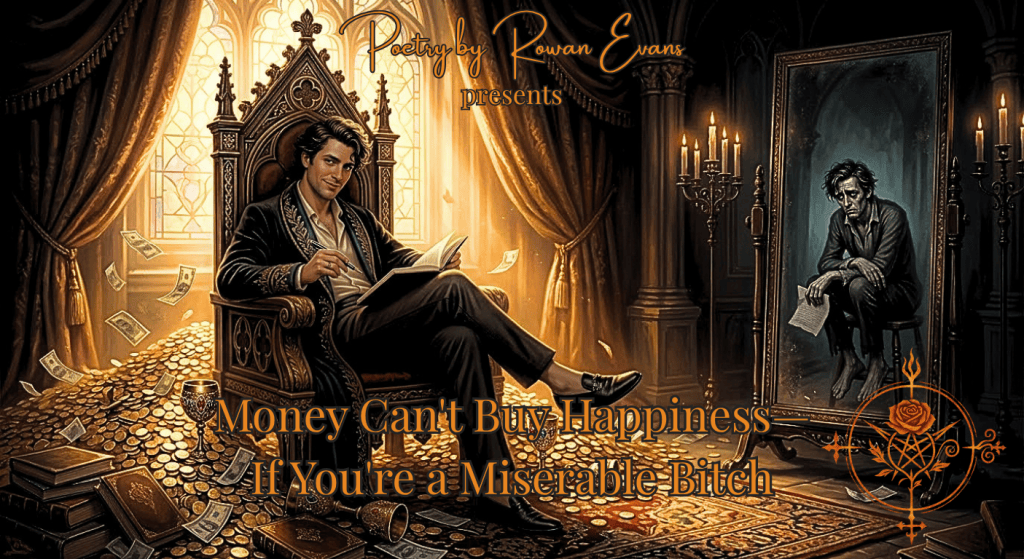
Money Can’t Buy Happiness—If You’re a Miserable Bitch takes that familiar saying, argues with it, insults it a little, and then lands somewhere in the middle: money might change your circumstances, but it can’t do the internal work for you.
If you’re miserable before the money arrives, there’s a decent chance you’ll just become a wealthier miserable person.
So, yeah.
Bitch, please.
— Rowan Evans
Money can buy the room. It can’t decide what happens inside your head.
Money Can’t Buy Happiness—If You’re a Miserable Bitch Poetry by Rowan Evans
They say money can’t buy happiness—
and honestly, that’s half true.
Money doesn’t buy happiness,
money buys things—
and things bring happiness
for a minute it seems—
but money can’t buy happiness?
Bitch, please—
that sounds like something
somebody with money
would say—
because it’s not the cash
that brings the smile,
it’s the ease
the cash brings—
so they say
money can’t buy happiness,
but they’re only half right—
money can’t buy happiness—
if you’re a miserable bitch.
You’ve got to already be happy and shit,
so learn to love what you’ve got.
Because when the money comes,
and you’re swimming in funds—
if you’re not already happy
with where you’re at?
You’ll never be happy after that.
Journey into the Hexverse
[Sick Bird] A short, uncompromising political metaphor that questions the fixation on left versus right when the entire system may be sick. Through the image of a collapsing bird, the poem confronts division, corruption, and the consequences of ignoring the larger failure.
[For the Youth (Remix)] A 2026 remix of Rowan Evans’s original 2024 poem, encouraging young people to embrace their truth, recognize their worth, raise their voices, and become the light they want to see in the world.
[Rose & Ruin] Two minimalist poems exploring the opposing forces within creativity: the thoughts we cultivate into something beautiful and the darker thoughts we transform before they have a chance to decay.
Some questions survive the years because the answer never arrives.
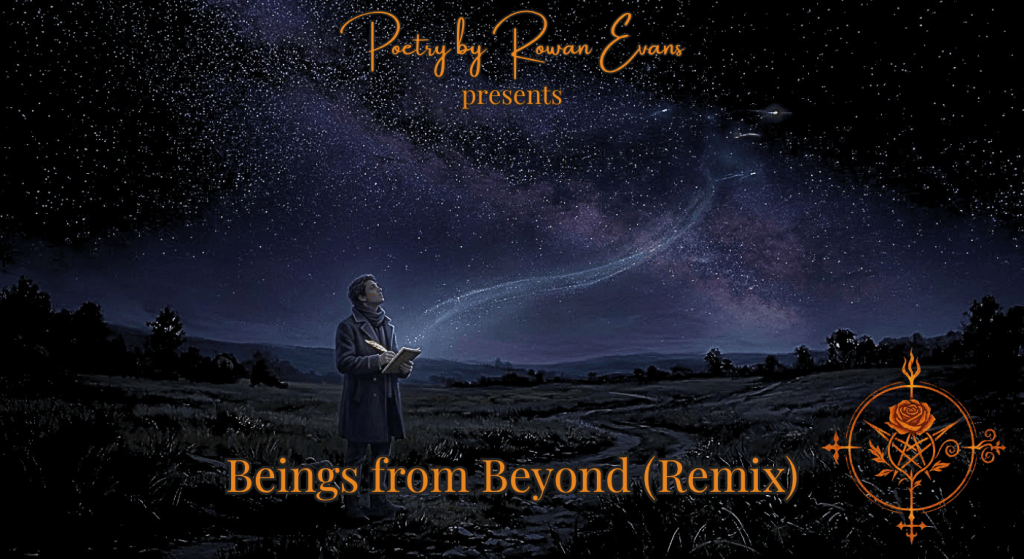
I first wrote Beings from Beyond in May 2024, when the poem was built around repetition, possibility, and the endless questions that come with looking into a sky full of things we don’t understand. Two years later, I returned to it—not to erase that version, but to see what happened when I approached the same mystery with a different hand.
Beings from Beyond (Remix) strips away some of the wandering and lets the central question breathe: What is actually out there?
The wonder is still there. So is the uncertainty.
But this time, I’m less interested in inventing an answer than in admitting how badly I want a real one.
Maybe that’s part of the fascination with the unknown. We keep looking upward, keep asking questions, keep imagining messengers from somewhere beyond our understanding—and somehow, the unanswered question remains just as compelling as the possibility of an answer.
The sky hasn’t changed much since 2024.
The poet looking at it has.
— Rowan Evans
The question remains: are we looking at stars—or are the stars looking back?
Beings from Beyond (Remix) Poetry by Rowan Evans
Do you see them?
Those cosmic lights, distant,
dancing in the heavens—
on clear sky nights.
Are they messengers
from realms unknown,
or shadows cast
by stars long thrown?
From beyond the stars,
they descend,
in ships of light—
their messages send.
Do they watch us
with curious eyes?
I seek the truth,
unfiltered and clear,
not whispered prayers
that disappear—
I crave answers
that will set us free,
from the shackles
of uncertainty.
In the vast expanse
of the cosmic sea,
lies the truth
of what they may be.
So we’ll continue—
to ponder and dream
of beings from beyond,
in the cosmic stream.
Journey into the Hexverse
[Kintsugi Sunrise (Remix)] A 2026 remix of a poem first written in 2024, Kintsugi Sunrise (Remix) returns to the imagery of a fractured mind, golden cracks, and a long-awaited sunrise—but with the perspective that comes from having already traveled through the darkness.
[For the Youth (Remix)] A 2026 remix of Rowan Evans’s original 2024 poem, encouraging young people to embrace their truth, recognize their worth, raise their voices, and become the light they want to see in the world.
[Caged Birds Don’t Bow (Remix)] A defiant remix of Rowan Evans’ “Caged Birds Don’t Bow,” confronting control, possession, and insecurity through the imagery of a bird breaking free from its cage and reclaiming its wings.
[Hell’s Protégé (Remix)] Rowan Evans revisits Hell’s Protégé, originally written in 2024, and reshapes the dark, infernal persona through a newer voice. The remix keeps the fire, darkness, and diabolic ambition of the original while allowing the poem to breathe differently.
I’ve always been fascinated by the idea that people rarely see the same person the same way. We don’t meet others as blank slates—we meet them carrying our own history, fears, hopes, and assumptions.
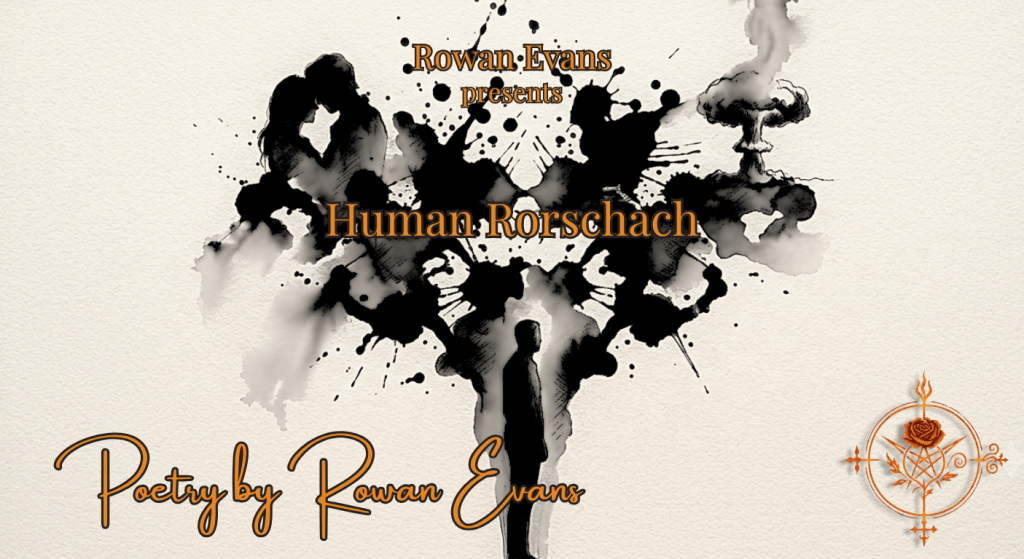
The Rorschach inkblot became the perfect metaphor for that. The inkblot itself isn’t trying to be anything; the meaning comes from the person looking at it.
Maybe people work the same way.
Every interaction is filtered through perspective, and perspective is shaped by perception, memory, and experience. Sometimes what another person believes about us reveals far more about their own journey than it does about who we actually are.
This poem is an invitation to think about that relationship between identity and interpretation—and to remember that no one is ever seen exactly as they are.
— Rowan Evans
What we see often reveals more about ourselves than the person we’re looking at.
Human Rorschach Poetry by Rowan Evans
I’m an inkblot
in human form,
a real Rorschach—
am I couple kissing,
or a mushroom cloud?
Love or destruction—
what do you see
when you look at me?
Know there are
no wrong answers—
because what you believe
is fed by what you see
and what you see is perspective,
but perspective is shaped by perception—
I am open to interpretation
and it changes,
with everything
you’ve lived through—
the things you’ve survived.
What you see
when you look at me,
says more about your life—
than it does mine.
Journey into the Hexverse…
[A Rose in the Ashes] Lost within a forest where every leaf becomes a memory, the speaker follows darkness instead of fleeing from it, discovering that healing isn’t found at the end of the tunnel—but in facing the past long enough to notice a single rose blooming through the ashes.
[Leave No Self Behind] What if finding yourself isn’t about discovering someone new, but learning to walk beside every version you’ve ever been? “Leave No Self Behind” is a meditation on memory, healing, and embracing the selves we once abandoned.
[Every Night, The Same Flight] Every night begins with the same flight. Between wakefulness and sleep, an airport appears, a familiar shoreline waits beyond the journey, and the same dream asks whether some destinations find us before we’re ready to find them.
[Through My View] No two people experience the world the same way. Through My View is a reflective free verse poem exploring perspective, imagination, and the impossibility of fully seeing through another person’s eyes.
[Just Human] Just Human is a reflective free verse poem about seeing people before borders, choosing empathy over division, and finding home in our shared humanity rather than on a map.
Perspective is one of the strangest things we possess.
Two people can stand in the same place, witness the same moment, and walk away carrying completely different worlds inside them.
I’ve spent a lot of time thinking about that—not as something that separates us, but as something that makes us interesting.
This poem isn’t saying one perspective is better than another. It isn’t about claiming superiority.
It’s about accepting that no one else can inhabit your mind.
No one else sees exactly what you see, makes the same connections, or experiences the same emotional landscape. We can describe our inner worlds through art, conversation, and metaphor, but there will always be a distance between experiencing something and hearing someone describe it.
As a poet, I spend much of my life trying to bridge that distance.
This poem acknowledges that the bridge will never be perfect—and that’s okay.
Our perspectives don’t need to become identical to be meaningful.
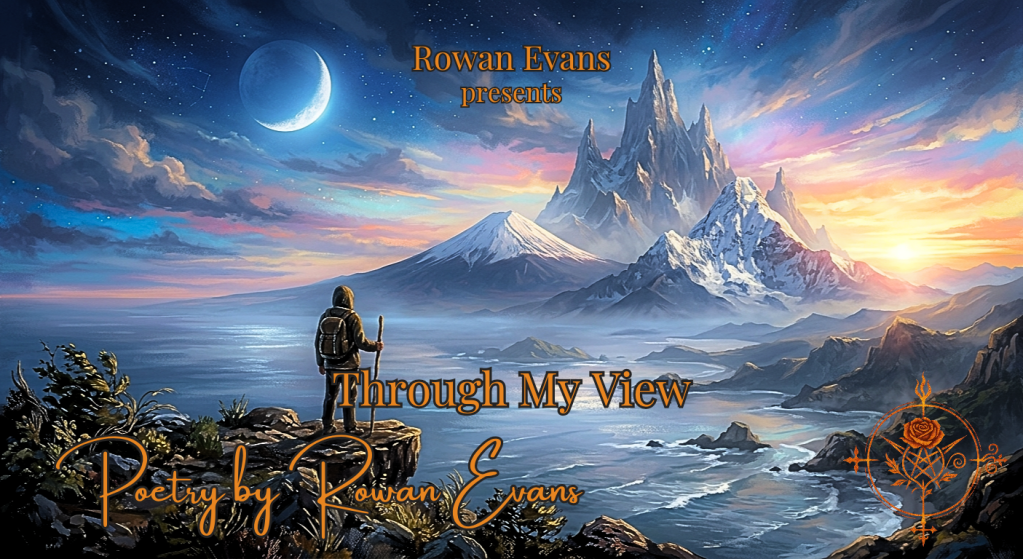
Sometimes it’s enough to simply recognize that every person is looking through a different window.
— Rowan Evans
No one else can stand exactly where you stand or see the world through your eyes.
Through My View Poetry by Rowan Evans
It’s eight, I hear the birds chirp. It’s late, I’m awake— what’s new?
Silence. It’s violence— the words that I choose, when I’m cut loose.
Like my thoughts, I’m off leash— you can’t stop me.
I’ve got a mind that stacks lines, mountains high, metaphors rise—
higher than Fuji, higher than Everest.
You’ll never finish this climb, your mountains will never match mine. You could do this for the rest of your life—
but you’ll never cross my ocean, you’ll never see my moon with your own eyes. You’ll never feel the pull of my tide—
because your mind doesn’t work like mine. You’ll never see the beauty in my horizon line—
the way the colors shift and shine with the change of time.
You’ll never see the world like— I do, you’ll never see the world through— my view.
Journey into the Hexverse…
[Just Human] Just Human is a reflective free verse poem about seeing people before borders, choosing empathy over division, and finding home in our shared humanity rather than on a map.
[Monster Theology] What if the monsters under the bed weren’t monsters at all? Monster Theology explores difference, belonging, and the human tendency to fear what we don’t understand through a conversation with the creatures we’ve spent our lives imagining.
[Before We Created The Labels] Ancient gods return to a fractured world shaped by borders, identities, and separation. “Before We Created the Labels” explores humanity’s divisions through mythic imagery, sacred ritual, and symbolic collapse—asking what remains when we learn to see one another beyond labels.
[No You and I, Ony Us] A hopeful free verse poem about empathy, borders, and imagining a world where humanity matters more than division.
[Two Americans] What does it mean to share a country, a language, and still feel completely different? Two Americans explores identity, culture, and the quiet disconnect between people who should feel the same—but don’t.
I’ve always been fascinated by the spaces between things.
Between sleeping and waking.
Between leaving and arriving.
Between being understood and merely being seen.
The famous thought experiment gave me a metaphor, but the poem isn’t really about quantum mechanics.
It’s about perception.
There are moments when I feel as though I exist in two places at once.
One version of me is moving through the ordinary world.
The other exists inside the minds of the people who know me, read my work, remember me, or think about me.
Neither version is false.
They’re simply different ways of existing.
I think writers become especially aware of this.
Our words continue living in places we’ll never visit, meeting people we’ll never meet.
A poem can be read years after it’s written.
A thought can continue existing long after the thinker has moved on.
That creates a strange feeling.
Part of you is always somewhere else.
The final lines carry the emotional truth of the piece.
Not that I cease to exist when no one is looking.
Only that being perceived is one of the ways we feel most alive.
Maybe that’s true for all of us.
Maybe every human being exists in more than one state at once.
The self we know.
And the self that lives in someone else’s memory.
— Rowan Evans
Sometimes existence feels less like certainty and more like possibility.
Schrödinger’s Person Poetry by Rowan Evans
I’m drifting somewhere
in the in-between—
space is liminal here.
This is where people go
to disappear—
you must exist
with the fear.
It’s like I’m here
but I’m not—
I’m somewhere else too.
It’s like I exist—
in two states
at the same time.
I am Schrödinger’s Person.
You see—
that sounds more dramatic
than it is,
I just mean—
when you perceive me
is when I live.
Not that I don’t
without you—
because I do,
but I really don’t want to.
You see—
the two states
I exist in,
here…
and there.
Journey into the Hexverse…
[Returning to My Bones] Some dreams fade the moment we wake. Others leave behind emotions that linger long after reality returns. Returning to My Bones explores the strange grief of leaving a dream that felt real enough to matter.
[Before My Feet Touch the Floor] What happens when your dreams feel more real than your waking life? Before My Feet Touch the Floor explores the strange grief of waking up, the lingering memory of dream selves, and the quiet question of which version of us is truly real.
[Just Beyond Waking] A street that feels familiar. A life that hasn’t happened yet. Just Beyond Waking explores the fragile space between dreams, memory, longing, and the quiet feeling that some futures are already waiting for us.
[The Needle Doesn’t Point North] “The Needle Doesn’t Point North” is a deeply personal free verse poem about displacement, identity, and spending a lifetime feeling emotionally disconnected from the place you were born while being drawn toward distant shores.
[The Streets I Walk When I Sleep] “The Streets I Walk When I Sleep” is a deeply intimate free verse poem about recurring dreams, emotional connection, longing across distance, and the strange feeling of remembering places and moments that have never happened in waking life.
[Separate Timelines] “Separate Timelines” is a surreal and deeply introspective free verse poem about emotional distance, time zones, vulnerability, and the fear of losing a connection that already feels meaningful before the words are ever spoken aloud.
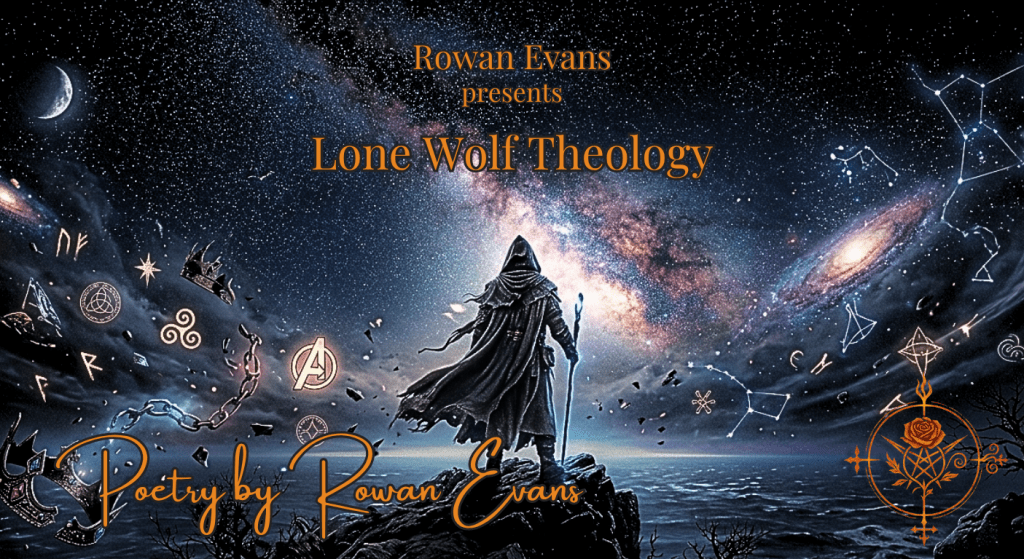
I was playing with the idea of a character moving through different fictional universes and refusing every invitation offered to them. No Justice League. No Avengers. No X-Men. No Jedi Order. No chosen destiny. No sacred prophecy.
Just refusal.
But as I kept writing, something else emerged.
The more references I added, the less the poem became about superheroes and the more it became about autonomy.
Because beneath every fictional universe is usually the same question:
Who decides who you are?
A team? A title? A destiny? A prophecy? A god? A system?
Or you?
That’s where the title comes from.
“Lone Wolf Theology” isn’t really about isolation. It’s about self-authorship.
Not the rejection of connection, but the rejection of surrendering your identity to something external. The refusal to let institutions, expectations, labels, or inherited narratives become the sole authority over your life.
The superheroes, anti-heroes, and mythic references serve as modern archetypes here. They represent power, belonging, destiny, responsibility, faith, rebellion, and purpose. The speaker moves through those worlds, not because they reject what those symbols represent, but because they refuse to let any one of them define them completely.
At its core, this piece is about choosing your own path.
Not because it is easier.
Not because it guarantees success.
But because there is something sacred about deciding for yourself who you will become.
And perhaps that is the real theology hidden beneath all the comic books, capes, and cosmic references:
Freedom is a practice.
A choice made repeatedly.
A vow renewed every time the world tries to tell you who you should be.
— Rowan Evans
No prophecy. No chosen order. No inherited destiny. Only the road ahead and the freedom to decide who you become.
Lone Wolf Theology Poetry by Rowan Evans
I’m a lone wolf, anti‑hero—
Punisher psychology,
Frank Castle reality,
and Deadpool’s mentality.
Yeah, that’s the fucking recipe.
Fuck the League (Justice!)
I don’t need no team,
there are no Avengers around me.
I am the evolution of man,
no X‑Gene. No X team
in this rhyme scheme.
I don’t need a Bat‑Signal,
I light up my own sky.
Tell Stark I don’t need a suit—
I’m built different, that’s why.
Tell Logan I don’t need claws,
I cut deep with my words.
Tell Thor I don’t need hammers
to make thunder heard.
Fantastic Four?
I’m fantastic solo.
Guardians of the Galaxy?
I guard galaxies dolo.
Teen Titans?
I’ve been grown since birth.
Suicide Squad?
I don’t need a squad to put you in the dirt.
Lantern Corps?
I don’t need a ring to shine.
I’m the willpower,
the fear,
the rage—
all combined.
I don’t run with the Speed Force,
I outrun it.
Flash chasin’ lightning—
I become it.
No timeline can hold me,
no paradox breaks me.
Barry hit the wall of time—
I run through it.
Spider‑Verse?
I don’t need a web to connect.
I cut every thread
and still command respect.
Tell Parker I don’t need
“great power” speeches.
Tell Miles I don’t need
a leap of faith to reach this.
Venom? Carnage?
I don’t fear their spawn.
Symbiotes whisper to hosts—
to me, they speak in song.
I wear darkness like armor,
I don’t need it to cling.
I’m the wolf in the shadows—
they’re just wearing the skin.
And the Jedi Order?
Please.
I don’t need a council
to tell me what peace is.
I don’t need a saber
to carve out my path.
I don’t need the Force—
I am the aftermath.
No light side.
No dark side.
Just my side.
My creed.
My theology.
The lone wolf
doesn’t join orders—
he creates one
by being free.
In the end,
there is no order to join,
no destiny to inherit,
no prophecy to fulfill.
There is only the road,
the breath,
the choice to rise
when no one is watching.
Freedom is not a gift—
it is a vow whispered in the dark.
And I keep it.
Always.
So write this
in the margins of every myth:
I owe nothing to the crowns of men
or the councils of gods.
I walk the line between fate and defiance,
and I do not break—
I bend the world around me.
If destiny comes calling,
tell it to knock louder.
I don’t follow prophecy.
I make it bleed
until it follows me.
Journey into the Hexverse…
[L Words & Heart] A playful, self-aware poem about love, longing, loyalty, and the quiet ways another person can reshape our inner world. What begins as humor slowly reveals a heartfelt confession about affection, imagination, and the faces that linger in our dreams.
[Just Beyond Waking] A street that feels familiar. A life that hasn’t happened yet. Just Beyond Waking explores the fragile space between dreams, memory, longing, and the quiet feeling that some futures are already waiting for us.
[Twin Suns, Sister Moons] A poem about distance, longing, and the quiet pull of someone who lives beneath a different sky. Between twin suns and sister moons, the heart keeps reaching for home.
[It’s You I Choose] A poem about devotion, vulnerability, and the quiet decision to stay. Sometimes love isn’t certainty—it is choosing someone anyway.
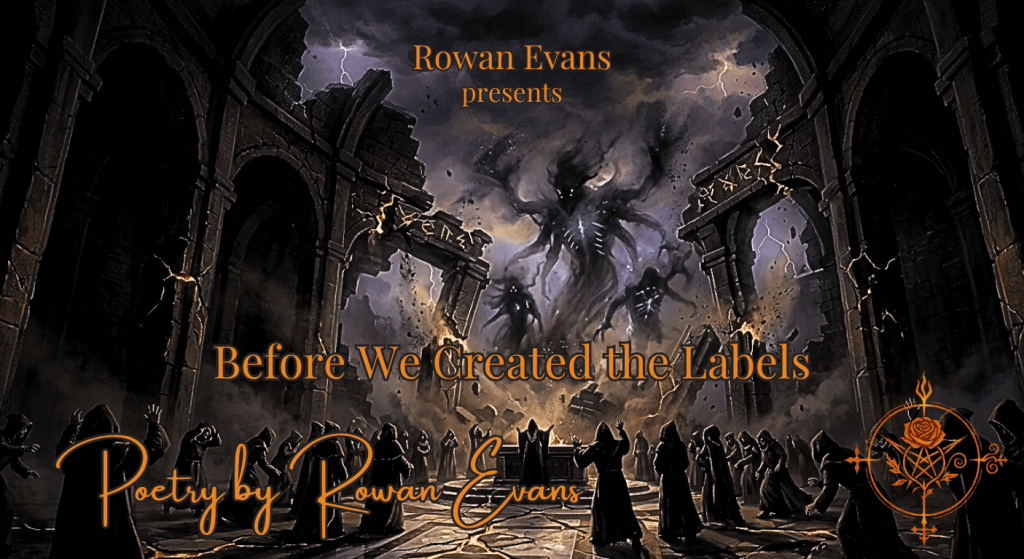
a ritual repeated so many times that the people performing it stopped questioning the structure around it.
At first, I thought I was writing horror.
Ancient gods. Sacred chants. A collapsing building.
But somewhere in the middle of the piece, the emotional center shifted.
The horror was no longer the gods returning.
It was what they returned to.
This poem is ultimately about separation—how humanity continuously divides itself into categories, tribes, borders, identities, ideologies, and opposing sides. Not because difference itself is wrong, but because we so often transform difference into distance.
Into hierarchy. Into conflict. Into “us” and “them.”
The gods in this piece are intentionally left undescribed because they are less important as individuals and more important as witnesses. They remember humanity before those divisions hardened into walls.
Before labels stopped being descriptive and started becoming weapons.
And importantly: this piece is not arguing against culture, identity, language, or individuality. Those differences are part of what make humanity beautiful. The tragedy is not diversity—it’s disconnection.
The collapse in this poem is symbolic.
Not the destruction of difference, but the destruction of the structures that keep people separated from one another.
And beneath all the mythology, rituals, and ancient imagery, there is a quieter question lingering underneath it all:
What would humanity look like if we learned to see each other before the labels again?
— Rowan Evans
The horror was never the gods returning—it was the world they returned to.
Before We Created the Labels Poetry by Rowan Evans
Each footstep
echoed through the dark,
the only sound
to pierce the veil of silence.
One by one,
they filed into the room—
each taking their place,
as though they’d done this
a thousand times.
As the final of the covenant
found their mark—
they began to chant
in ancient tongues.
Languages of old,
long forgotten to the world.
The air in the room
began to change—
and it wasn’t humidity’s game.
A presence became clear,
even with no form to see.
Their chants continue
in a sacred chorus,
as they call
ancient gods forth.
Air shimmered
and walls shook,
foundation cracks—
and the air
grew thicker still.
Voices grew quiet,
the chanting fading low—
wood creaks,
cracks expand.
The room filled
with whispers,
voices from everywhere
and nowhere—
all at one time.
As the whispers
grew in volume,
becoming booming
shouts.
Buildings shook,
foundations shifted
and the ground
gives out.
Fear filled—
eyes of the covenant.
A ritual done
a thousand times,
and a thousand times
the gods would come—
a sacrifice would be made,
but the rules had changed.
The building
begins to come down,
as the covenant runs out.
Now, the gods unconfined—
can see the world
they left behind,
for the first time.
It wasn’t with judgement—
it was grief,
because they saw the cracks
and fractures,
the tragic divides.
They remember a time,
when their creation—
was all one.
Before we created
the labels to divide.
As they looked around
at what the world
had become—
a series of lines
separating sides.
Journey into the Hexverse…
[The Unkindness Descends] “The Unkindness Descends” is a Gothic symbolic poem exploring collapse, transformation, and the unsettling experience of being witnessed during moments of unraveling. Through raven imagery, ambiguity, and ritualistic atmosphere, the poem invites multiple interpretations—spiritual, psychological, ominous, or transformative.
[I Write Cathedrals] “I Write Cathedrals” explores faith, doubt, belonging, and the search for meaning beyond certainty. Through Gothic spiritual imagery and confessional reflection, the poem examines how writing can become a sacred space for questioning, wonder, and the people who feel displaced by traditional structures of belief.
[Drought Resistant] “Drought Resistant” is a confessional poem about growing up poor in California’s Central Valley—where triple-digit heat, EBT cycles, dry ramen, and hard landscapes become part of emotional memory. Blending humor, slang, and working-class reflection, the poem explores survival, regional identity, and complicated love for the place that shaped you.
[Escaped to the Page] “Escaped to the Page” is a confessional meta-poem about individuality, artistic identity, and surviving through writing. Blending sharp confidence with emotional vulnerability, the poem explores the difference between shared labels and lived experience—and the ways art becomes inseparable from the life behind it.
[Ink as a Second Mouth] “Ink as a Second Mouth” explores the distance between thought and speech, and the ways writing can become a form of survival, continuity, and self-translation. Through confessional imagery and reflections on growth, identity, and articulation, the poem examines what it means to keep becoming through language.
It’s about the difference between faith and certainty.
Growing up around religion, I was often taught belief through absolutes. Questions were treated like weakness sometimes, uncertainty treated like danger. But the older I got, the more I realized that questioning was never the opposite of spirituality for me—it was part of it.
Because if faith exists in the absence of proof, then certainty and faith cannot fully occupy the same space. Certainty closes the door. Faith leaves room for the unknown.
That tension shaped this poem.
Over time, I stopped seeing writing as separate from spirituality. The language changed, the framework changed, but the emotional instinct remained the same. I still seek meaning. I still seek connection. I still seek reverence. I just no longer place those things exclusively inside organized religion.
That’s where the cathedral imagery comes from.
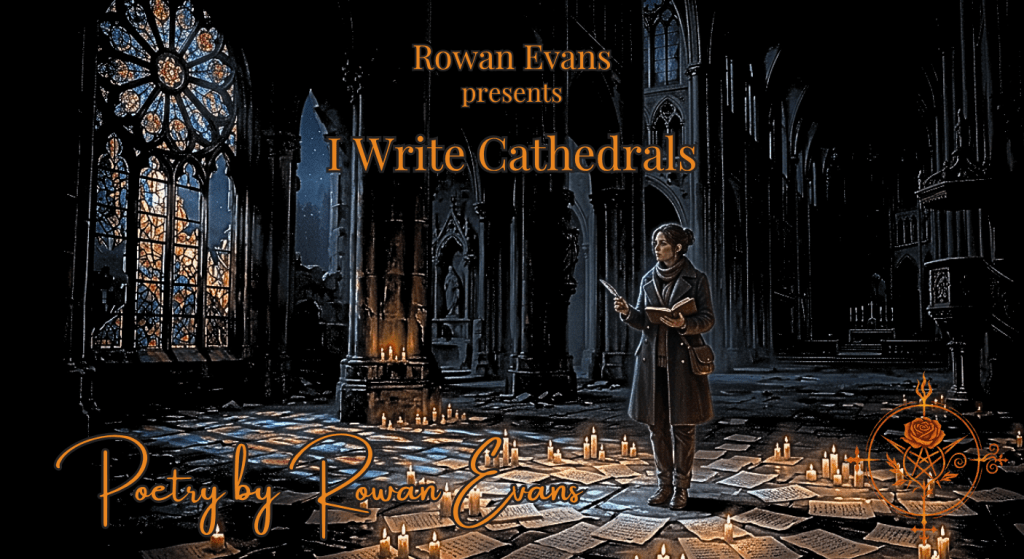
When I say “I write cathedrals,” I mean that poetry became the place where I rebuilt my sense of the sacred. Not through doctrine, but through honesty. Through confession. Through empathy. Through creating spaces where brokenness doesn’t disqualify someone from belonging.
The “sacred misfits” and “luminous heretics” in this piece are the people who exist outside easy categorization. The people who question. The people who feel spiritually displaced. The people who were told they were too much, too different, too doubtful, too strange to belong cleanly inside traditional structures.
This poem is for them too.
And ultimately, this piece isn’t arguing that one worldview is more beautiful than another. In fact, one of the most important lines to me is:
“Both are beautiful.”
Because whether someone sees divine creation or cosmic coincidence, I still think wonder itself matters.
Wonder is sacred enough for me.
— Rowan Evans
If faith leaves room for the unknown, then poetry became the place where I learned to live inside the questions.
I Write Cathedrals Poetry by Rowan Evans
I used to pray in churches,
now I write cathedrals
with broken compass needles
dipped in ink—
the direction they point
ought to make you think.
In church they say
faith is necessary—
but they talked
with such certainty.
It never made sense to me.
Faith is the belief
in the absence of evidence.
Certainty and faith,
cannot co-exist.
They contradict.
I had questions—
about faith,
about belonging.
Was I wrong
for longing—
for asking for more?
They said I should be grateful
for scraps on the floor.
Miracles. Where?
I didn’t see the proof anymore,
didn’t have faith in what I missed.
And if you believe?
That’s fine—
your journey, isn’t mine.
Just don’t push
your faith on me.
You look around,
see God’s creation.
I look around
at a series of
happy accidents.
Both are beautiful.
You can continue
to pray in your churches,
I’ll continue penning cathedrals—
building altars
to the broken and forgotten,
the outcast just like me.
Sacred misfits,
and the luminous heretics—
all are welcome here.
Journey into the Hexverse…
[Drought Resistant] “Drought Resistant” is a confessional poem about growing up poor in California’s Central Valley—where triple-digit heat, EBT cycles, dry ramen, and hard landscapes become part of emotional memory. Blending humor, slang, and working-class reflection, the poem explores survival, regional identity, and complicated love for the place that shaped you.
[Escaped to the Page] “Escaped to the Page” is a confessional meta-poem about individuality, artistic identity, and surviving through writing. Blending sharp confidence with emotional vulnerability, the poem explores the difference between shared labels and lived experience—and the ways art becomes inseparable from the life behind it.
[Ink as a Second Mouth] “Ink as a Second Mouth” explores the distance between thought and speech, and the ways writing can become a form of survival, continuity, and self-translation. Through confessional imagery and reflections on growth, identity, and articulation, the poem examines what it means to keep becoming through language.0
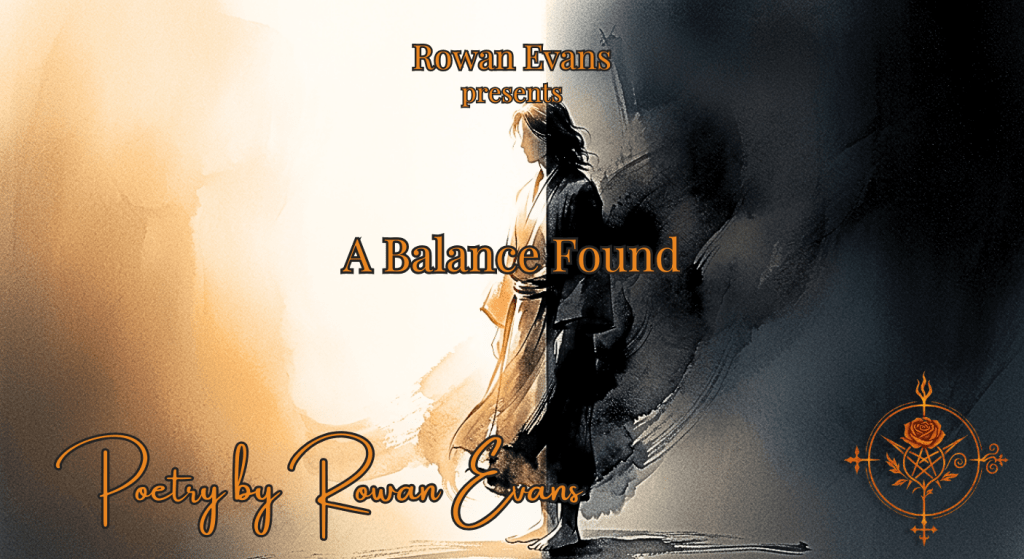
This poem was written on February 19th as a quiet reflection on duality within the self. We are often told to choose between parts of who we are – light or shadow, reason or imagination, strength or softness. But real wholeness comes from learning both can exist at once.
A Balance Found is about accepting the full spectrum of who we are. The dreamer and the observer. The light and the shade. Not as opposing forces, but as pieces of the same soul that finally learns to stand whole.
— Rowan Evans
Finding harmony between light and shadow within the self.
A Balance Found Poetry by Rowan Evans (written February 19th, 2025)
Ink and shadow, light and shade,
Both have their place, both were made.
One to dream, one to see,
And I stand whole—both parts of me.