Tag: religious trauma

  • Author’s Note

    Not the Way Jesus Did (Get Stoned, Not Crucified) is intentionally irreverent. The title is meant to make you laugh, wince, or possibly do both at once—but beneath the joke is a serious frustration with religious judgment and the way people can use faith as a weapon against those they consider outsiders.

    The poem isn’t really interested in attacking Christianity itself. It’s interested in the contradiction between preaching compassion and practicing condemnation. By placing myself alongside Jesus as someone walking with outcasts, misfits, and people pushed to the margins, I turn the accusation around: if your faith teaches you not to judge, why are you so determined to judge me?

    The language is deliberately sharp because sometimes humor is the easiest way to expose hypocrisy. Sometimes you have to throw a little irreverence into the room before anyone is willing to look at the uncomfortable truth underneath it.

    Rowan Evans


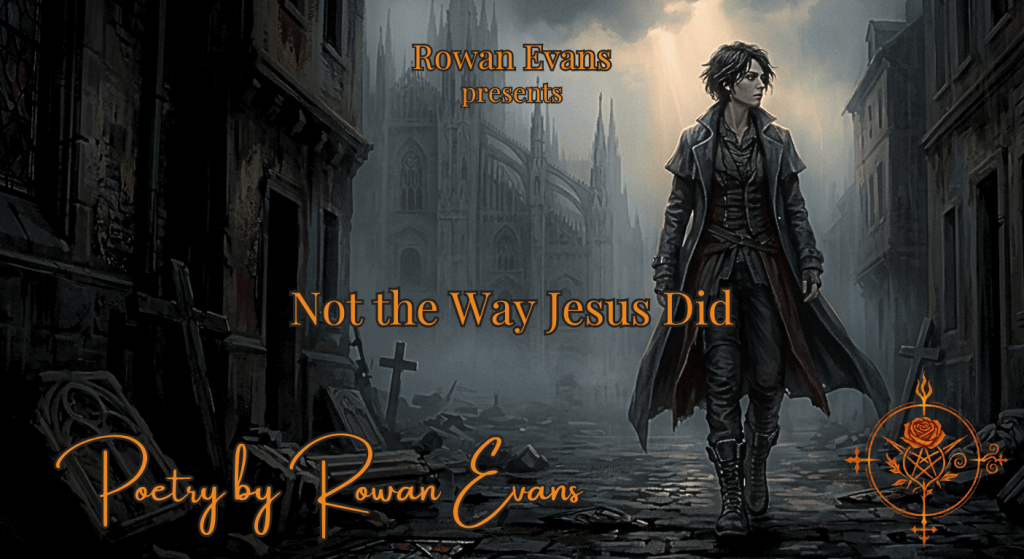
    A solitary figure walks through a dark city surrounded by stones, church imagery, and broken stained glass as light breaks through the clouds.
    Sometimes the people preaching judgment forget who they claim to follow.

    Not the Way Jesus Did (Get Stoned, Not Crucified)
    Poetry by Rowan Evans

    I’ve lived a life full of pain,
    society throwing rocks and hate—

    they think they are on the inside
    of judgement’s gate.

    I mean—

    don’t get wrong,
    I like to get stoned—

    but not the way Jesus did.

    If you’re offended by that,
    you only see the surface—
    you see the words,
    but not the purpose.

    You say you’re a Christian,
    yet here you are trying to judge?

    You know that’s not your job,
    you have to leave it up to your God.

    But it makes sense
    you would treat me like him,
    I walk the same path as he did.
    Walking with the outcasts
    and misfits—

    the black sheep
    of God’s kids.

    Don’t make me a martyr
    for the sins that he died for.

    So, you want to know why
    we don’t listen to you—

    because your book
    says not to listen to the fools,
    preaching on corners
    and praying outside of their rooms.

    You do you
    and leave us alone,
    if we’re good people—

    we’ll find our way home.


    Journey into the Hexverse…

    [Just Human]
    Just Human is a reflective free verse poem about seeing people before borders, choosing empathy over division, and finding home in our shared humanity rather than on a map.

    [No You and I, Only Us]
    A hopeful free verse poem about empathy, borders, and imagining a world where humanity matters more than division.

    [Sermon for the Fractured]
    Every poem I write is a sermon for the fractured soul. In Sermon for the Fractured, I explore divinity, imperfection, and the sacred act of rebuilding oneself, even when the world refuses your light.

    If you’re interested in more poetry, you can find it here → [The Library of Ashes]
  • Author’s Note

    This piece is not about mocking faith.

    It’s about the difference between faith and certainty.

    Growing up around religion, I was often taught belief through absolutes. Questions were treated like weakness sometimes, uncertainty treated like danger. But the older I got, the more I realized that questioning was never the opposite of spirituality for me—it was part of it.

    Because if faith exists in the absence of proof, then certainty and faith cannot fully occupy the same space. Certainty closes the door. Faith leaves room for the unknown.

    That tension shaped this poem.

    Over time, I stopped seeing writing as separate from spirituality. The language changed, the framework changed, but the emotional instinct remained the same. I still seek meaning. I still seek connection. I still seek reverence. I just no longer place those things exclusively inside organized religion.

    That’s where the cathedral imagery comes from.

    When I say “I write cathedrals,” I mean that poetry became the place where I rebuilt my sense of the sacred. Not through doctrine, but through honesty. Through confession. Through empathy. Through creating spaces where brokenness doesn’t disqualify someone from belonging.

    The “sacred misfits” and “luminous heretics” in this piece are the people who exist outside easy categorization. The people who question. The people who feel spiritually displaced. The people who were told they were too much, too different, too doubtful, too strange to belong cleanly inside traditional structures.

    This poem is for them too.

    And ultimately, this piece isn’t arguing that one worldview is more beautiful than another. In fact, one of the most important lines to me is:

    “Both are beautiful.”

    Because whether someone sees divine creation or cosmic coincidence, I still think wonder itself matters.

    Wonder is sacred enough for me.

    Rowan Evans


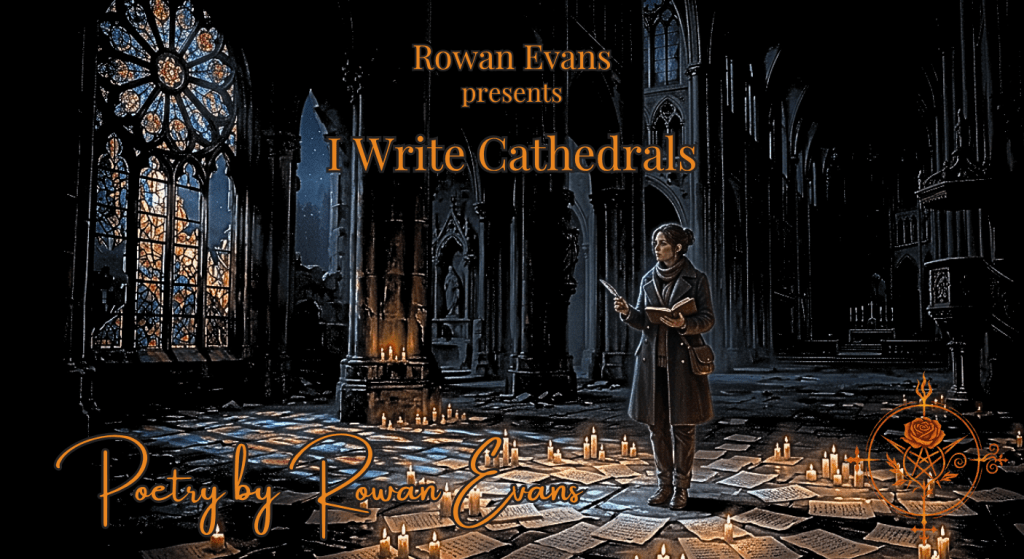
    A writer standing inside a dim Gothic cathedral surrounded by candles and handwritten poetry pages.
    If faith leaves room for the unknown, then poetry became the place where I learned to live inside the questions.

    I Write Cathedrals
    Poetry by Rowan Evans

    I used to pray in churches,
    now I write cathedrals
    with broken compass needles
    dipped in ink—
    the direction they point
    ought to make you think.

    In church they say
    faith is necessary—
    but they talked
    with such certainty.

    It never made sense to me.

    Faith is the belief
    in the absence of evidence.

    Certainty and faith,
    cannot co-exist.
    They contradict.

    I had questions—
    about faith,
    about belonging.

    Was I wrong
    for longing—
    for asking for more?

    They said I should be grateful
    for scraps on the floor.
    Miracles. Where?

    I didn’t see the proof anymore,
    didn’t have faith in what I missed.

    And if you believe?
    That’s fine—
    your journey, isn’t mine.

    Just don’t push
    your faith on me.

    You look around,
    see God’s creation.
    I look around
    at a series of
    happy accidents.

    Both are beautiful.

    You can continue
    to pray in your churches,
    I’ll continue penning cathedrals—
    building altars
    to the broken and forgotten,
    the outcast just like me.

    Sacred misfits,
    and the luminous heretics—

    all are welcome here.


    Journey into the Hexverse…

    [Drought Resistant]
    “Drought Resistant” is a confessional poem about growing up poor in California’s Central Valley—where triple-digit heat, EBT cycles, dry ramen, and hard landscapes become part of emotional memory. Blending humor, slang, and working-class reflection, the poem explores survival, regional identity, and complicated love for the place that shaped you.

    [Escaped to the Page]
    “Escaped to the Page” is a confessional meta-poem about individuality, artistic identity, and surviving through writing. Blending sharp confidence with emotional vulnerability, the poem explores the difference between shared labels and lived experience—and the ways art becomes inseparable from the life behind it.

    [Ink as a Second Mouth]
    “Ink as a Second Mouth” explores the distance between thought and speech, and the ways writing can become a form of survival, continuity, and self-translation. Through confessional imagery and reflections on growth, identity, and articulation, the poem examines what it means to keep becoming through language.0

    If you’re interested in more poetry, you can find it here → [The Library of Ashes]