Tag: ocean symbolism

  • Author’s Note

    Some poems don’t begin with an idea.

    They begin with resistance.

    This one came from that familiar place I’ve written about before: four in the morning, when the world is quiet enough that my thoughts become impossible to ignore.

    I started writing about fear, but somewhere along the way I realized I wasn’t afraid of the page.

    The page has never been the problem.

    Ink has always been brave.

    It says the things I hesitate to speak.

    The real fear has always been what happens after the words exist.

    What happens when a confession leaves the safety of metaphor.

    When it stops being “the moon,” “the tide,” or “the shore,” and simply becomes the truth.

    If you’ve read much of my recent work, you’ll probably recognize many of the images here. The moon. The bay. The ocean. The distant shoreline. Dreams that feel more like memories than imagination.

    They’re all still here.

    Only this time, the poem admits something they’ve been pointing toward all along.

    Sometimes metaphors aren’t hiding the truth.

    They’re slowly teaching us how to say it.

    Rowan Evans


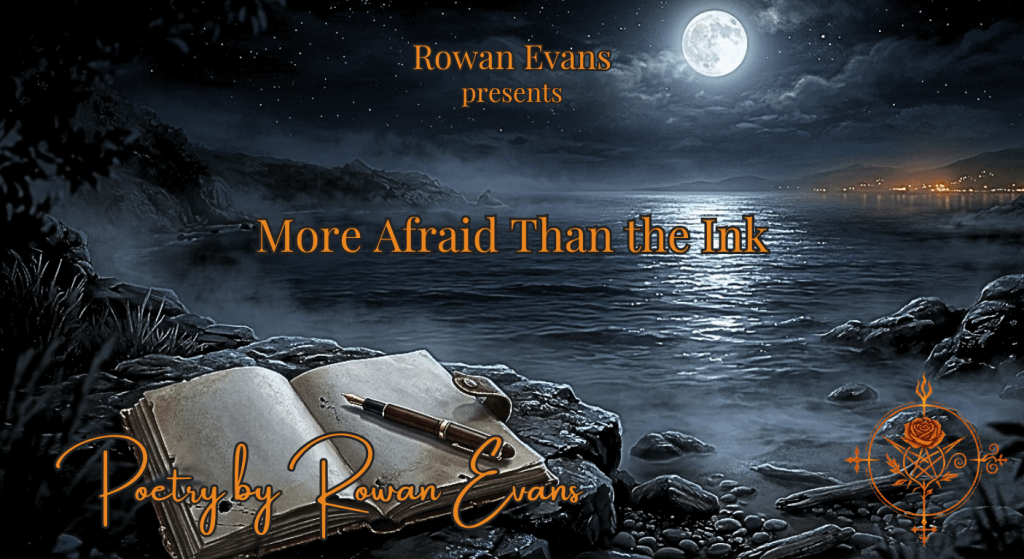
    An open journal and fountain pen beside a moonlit bay with shimmering reflections across calm water.
    Sometimes the ink is willing to tell the truth long before the poet is.

    More Afraid Than the Ink
    Poetry by Rowan Evans

    Four AM again—
    I breathe in and try to center myself,
    but it doesn’t seem to help.
    My mind wanders—
    moving from idea to truth
    and back again,
    carrying a collection of images
    and broken metaphors.

    The ink runs from my pen—
    like it’s scared of it.
    Because sometimes,
    my thoughts are dark
    and there’s no light in it.
    It trembles—
    lines becoming jagged
    as the truth hits
    a little too close to home.

    And the metaphors
    are broken for sure—
    it’s like I see the moon,
    but it doesn’t shimmer anymore.
    I don’t see the bay,
    I don’t feel the tide.

    There’s no ache,
    no longing for connection—
    across a divide
    an ocean wide.

    Okay, I lied.

    At night, when I close my eyes
    and my head hits the pillow—
    I feel the tide,
    it tugs at the heartstrings inside.
    I hear the waves, feel the ocean spray—
    and I see the familiar shimmer,
    the way the moon’s light trembles
    across dark water.

    The tide is why I dream of your shores—
    it’s why I walk your streets in sleep.
    And the moon provides the spotlight
    for every confession
    I speak with eyes closed…

    for every confession
    that I cannot say aloud,
    not outside of my dreams—not now,
    because I’m more afraid
    than the ink is.


    Journey into the Hexverse…

    [When the Veil Is Thin]
    Some truths wait until after four in the morning to make themselves known. When the Veil Is Thin explores insomnia, longing, quiet vulnerability, and the thoughts that become impossible to ignore before dawn.

    [Ocean Waves (1, 4, 3)]
    A moonlit shoreline, a rowboat full of ducks, a piggybank with no cents, and a confession hidden in plain sight. Ocean Waves (1, 4, 3) explores how humor, wordplay, and absurdity can become a side door to vulnerability when the truth feels too difficult to say directly.

    [The Language Her Soul Speaks]
    What if love isn’t about being understood, but learning to understand someone else? “The Language Her Soul Speaks” is a free verse poem about intimacy, communication, curiosity, and the desire to know another person beyond the limits of language.

    If you’re interested in more poetry, you can find it here → [The Library of Ashes]

  • Author’s Note

    Some dreams feel symbolic.

    Others feel instructional.

    This poem came from that second feeling.

    The beach, the horizon, the whispers, and the footprints aren’t meant to be frightening. They’re invitations. They represent the quiet moments when life seems to pause long enough for us to notice something we’ve been overlooking within ourselves.

    I’ve written often about dreams leading me toward places that feel like home. This time, the destination wasn’t a city or a shoreline—it was a version of myself.

    The footprints became a simple question:

    What if the person I’m trying to become has been leaving signs for me all along?

    Sometimes growth doesn’t happen by discovering somewhere new.

    Sometimes it happens by recognizing the path we’ve already been walking, even when we couldn’t see it at the time.

    This poem lives in that space between mystery and recognition, where intuition quietly whispers louder than certainty ever could.

    Rowan Evans


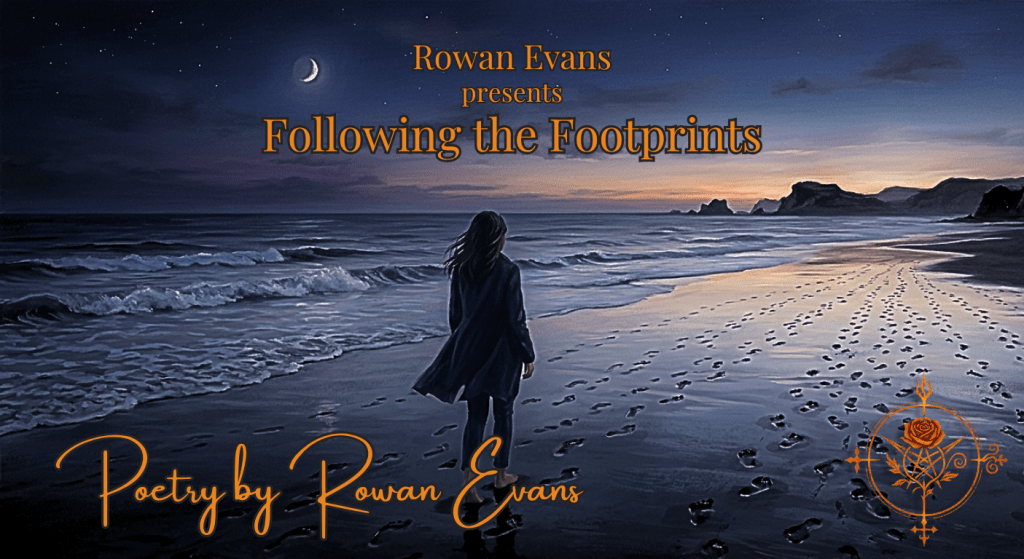
    A lone figure on a quiet beach follows mysterious footprints across the sand toward the horizon at dusk.
    “Sometimes the path we’re searching for is already beneath our feet—we only have to choose to follow it.”

    Following the Footprints
    Poetry by Rowan Evans

    I sat at the ocean’s edge,
    watching as the tide came and went—

    I was lost in thought,
    eyes locked on the horizon.
    I was watching the sun set
    as night came—

    I watched the light fade.

    I could hear the echoes
    of whispers and laughter,
    they seem to ring—
    from every direction.

    The beach was littered
    with footprints—
    but not a person in sight,
    something didn’t feel right.

    The air felt too still,
    like the world had paused
    mid‑breath.

    Even the waves moved quietly,
    as if they were trying
    not to disturb whatever
    was watching me back.

    I stood up slowly,
    not out of fear,
    but out of recognition—

    like I had been here before,
    in another dream,
    as another version of myself
    I hadn’t met yet.

    The sky darkened
    in a way that felt deliberate,
    as if the night was arriving
    for me specifically.

    The whispers grew softer,
    closer,
    almost familiar—

    like memories I’d forgotten
    were trying to find their way back.

    I turned toward the footprints,
    each one pressed deep
    into the sand,
    leading somewhere
    I couldn’t see.

    And I knew,
    without knowing how,
    that if I followed them,
    I would find the part of myself—

    I had been missing
    for years.


    Journey into the Hexverse…

    [Pointing Me Home]
    The final poem in the No Metaphor Left Behind trilogy explores dreams, hope, and belonging. Through moonlight, ocean tides, and quiet conversation, Pointing Me Home reflects on carrying hope long before reaching the place you call home.

    [Only Waiting]
    The second poem in the No Metaphor Left Behind series, exploring the quiet ache of growing up in a place that never truly felt like home—and finally saying aloud what years of metaphor had been trying to express.

    [Crossing the Sea]
    A deeply personal poem about relocation, longing, and the realization that some truths naturally arrive through metaphor—even when we try to leave it behind.

    [Caller ID: Destiny]
    Sometimes the places we visit in our dreams feel more like home than the places we wake up in. Caller ID: Destiny explores longing, belonging, and the quiet feeling that life is calling you toward somewhere new.

    [Returning to My Bones]
    Some dreams fade the moment we wake. Others leave behind emotions that linger long after reality returns. Returning to My Bones explores the strange grief of leaving a dream that felt real enough to matter.

    [Before My Feet Touch the Floor]
    What happens when your dreams feel more real than your waking life? Before My Feet Touch the Floor explores the strange grief of waking up, the lingering memory of dream selves, and the quiet question of which version of us is truly real.

    [Just Beyond Waking]
    A street that feels familiar. A life that hasn’t happened yet. Just Beyond Waking explores the fragile space between dreams, memory, longing, and the quiet feeling that some futures are already waiting for us.

    If you’re interested in more poetry, you can find it here → [The Library of Ashes]
  • Author’s Note

    Some poems arrive as declarations.

    This one arrived as an observation.

    I’ve often described myself as a witness poet—someone who pays attention, who notices the emotional weather around the people I care about, and then translates those observations into poetry.

    Sometimes that role feels like a gift.

    Sometimes it feels helpless.

    Because witnessing doesn’t always come with the ability to change what you see.

    You can recognize someone’s strength, admire their resilience, ache alongside their struggles, and still be separated by circumstances larger than either of you.

    This poem isn’t about unrequited love.

    It isn’t about sacrifice.

    It’s about accepting that love isn’t always measured by proximity.

    Sometimes love looks like paying attention.

    Sometimes it looks like quietly hoping someone feels a little less alone because, somewhere in the world, another heart witnessed their struggle with compassion instead of judgment.

    That’s the strange privilege—and responsibility—of being a witness poet.

    Not every distance is meant to be closed.

    Some are simply meant to be seen.

    Rowan Evans


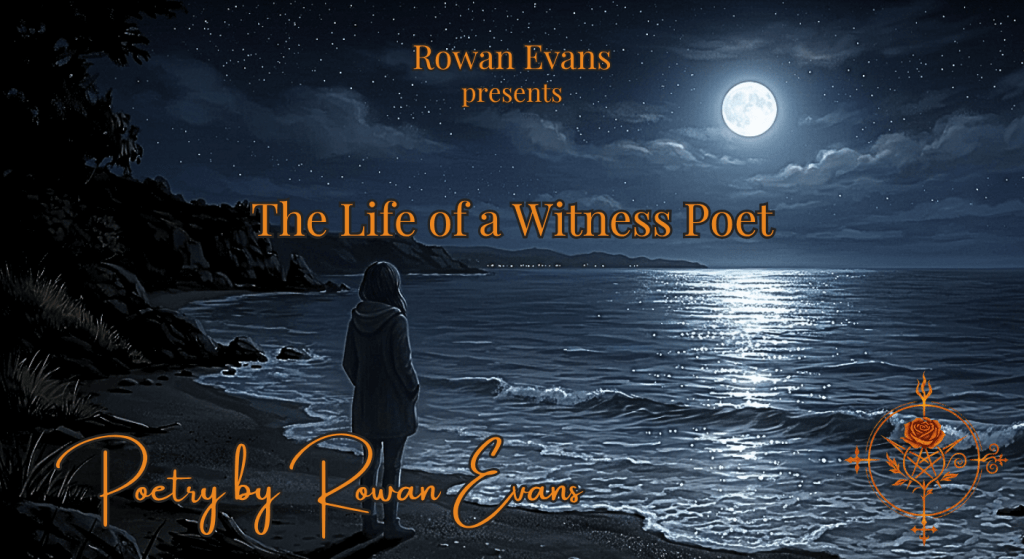
    A lone figure watching moonlight shimmer across a calm ocean toward a distant shore, symbolizing quiet love, witnessing, and emotional distance.
    “Some distances cannot be crossed—but they can still be held with compassion.”

    The Life of a Witness Poet
    Poetry by Rowan Evans

    The life of a witness poet—

    it’s harder than you think,
    when your heart bleeds in ink.
    And it only gets harder
    when you’ve fallen
    for the one you witness.

    You see the weight she carries,
    you watch from a distance—
    your hands tied by the tide,
    and the gap—an ocean wide.
    You want to be a light in her life—

    like the moon in the sky.

    You learn to glow quietly,
    hoping she’ll look up someday—

    not for you,
    but for the comfort
    you’ve been trying to give
    from a distance.

    So you learn to love in silence,
    in the spaces between her storms—

    holding what you can,
    honoring what you can’t,
    knowing some distances
    aren’t meant to be crossed,
    only witnessed.


    Journey into the Hexverse…

    [What I’m Trying to Say]
    What begins as an exaggerated promise of love slowly strips itself back until only one simple truth remains: real devotion isn’t found in grand gestures—it’s found in consistently showing up.

    [I’d Rather Try]
    Anyone can promise they’d die for someone. But love isn’t built on one dramatic moment—it’s built on showing up, trying again tomorrow, and proving your words through consistent action.

    [Pointing Me Home]
    The final poem in the No Metaphor Left Behind trilogy explores dreams, hope, and belonging. Through moonlight, ocean tides, and quiet conversation, Pointing Me Home reflects on carrying hope long before reaching the place you call home.

    [Only Waiting]
    The second poem in the No Metaphor Left Behind series, exploring the quiet ache of growing up in a place that never truly felt like home—and finally saying aloud what years of metaphor had been trying to express.

    [Crossing the Sea]
    A deeply personal poem about relocation, longing, and the realization that some truths naturally arrive through metaphor—even when we try to leave it behind.

    [I’ll Be There to See Your Sunrise]
    Love has never come easily to me. This poem explores the fear, vulnerability, and quiet courage required to stay emotionally present when connection begins to matter deeply. “I’ll Be There to See Your Sunrise” is about choosing love despite the risk of heartbreak—and promising to remain long enough to witness someone fully.

    If you’re interested in more poetry, you can find it here → [The Library of Ashes]
  • Author’s Note

    For a long time, I confused standing still with failure.

    Like if I wasn’t moving fast enough, succeeding quickly enough, becoming who I wanted to be on everyone else’s timeline—then maybe the people doubting me were right.

    But growth rarely looks clean while you’re inside it.

    Sometimes progress is just continuing to move, even when fear, uncertainty, or other people’s expectations try to keep you frozen in place.

    This piece sits in that space between doubt and momentum.

    Between hearing the warnings… and still feeling the pull forward anyway.

    Because there are moments in life where the call toward something bigger becomes louder than the voices telling you to stay where you are.

    And eventually— you either trust that pull,

    or spend your whole life wondering what would’ve happened if you did.

    Rowan Evans


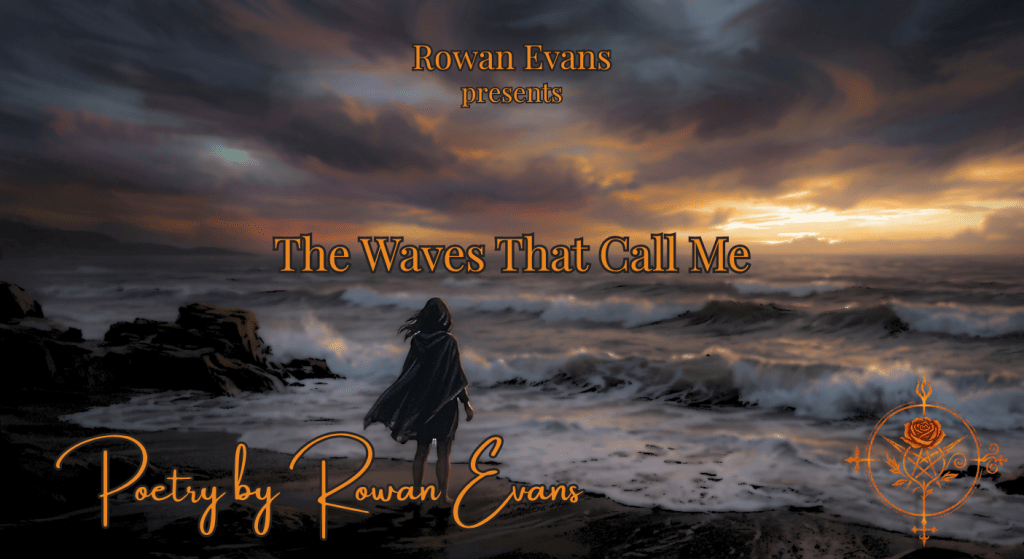
    Person standing on a shoreline looking toward ocean waves symbolizing dreams and personal transformation
    Some voices tell you to stay. The waves tell you to move.

    The Waves That Call Me
    Poetry by Rowan Evans

    I stood on the shoreline,
    eyes locked
    on ocean waves—

    pain and longing
    painted across my face.

    I feel stuck in place,
    like I forgot
    I’m trying to win
    the race.

    But I’ve got dreams
    to chase.

    One foot
    and then the other—

    even as they doubt me.

    They shout:
    “Not a snowball’s chance in—”

    Well—

    leave them puddles
    at my feet.

    I thrive in heat.

    They think
    they’ve got room
    to talk,
    trying to still
    my walk
    with warnings.

    They try
    to warn me.

    They say—
    only time will tell.

    But she’s not speaking.

    Thinking—
    I’m a failure.

    That’s what
    they said to me.

    If I’m a failure,
    then I’m glad—

    opposites attract,
    and success is coming
    down the track.

    I may have turned,
    taken the long way around—

    but I’ve got dreams,
    and I don’t plan
    to back down.

    So I stand on the edge,
    shoreline stretching
    without end—

    but it’s the waves
    that call me.


    If you’re interested in more poetry, you can find it here → [The Library of Ashes]
  • Author’s Note

    This piece isn’t about hatred for where I’m from.
    It’s about honesty.

    For as long as I can remember, I’ve felt the pull of something beyond the shoreline I was born on. Not rebellion. Not fantasy. Just a quiet, persistent tide.

    “Drawn to Sea” is both wordplay and truth – a recognition that sometimes the call we feel isn’t about escape, but alignment. I don’t believe other people are wrong for loving where they are rooted. I simply know that my roots may be meant for different soil.

    Some of us don’t reject the shore.

    We just hear another one calling.

    Rowan Evans


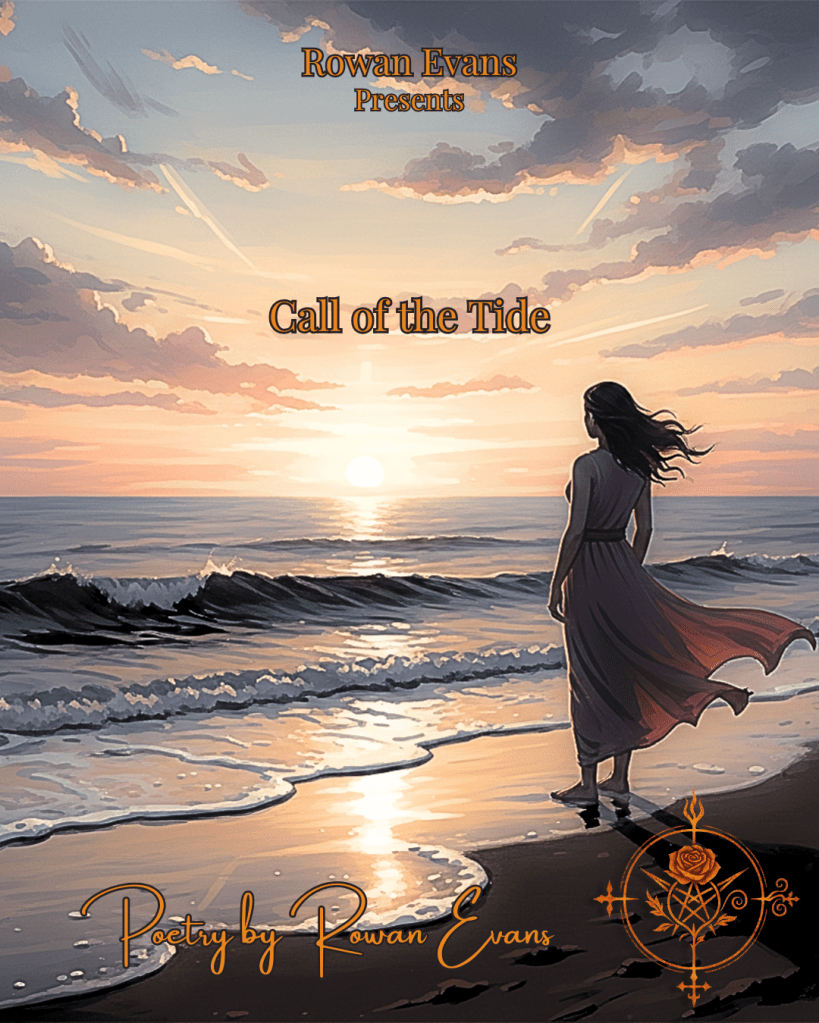
    A person standing alone at the edge of the ocean at sunset, looking toward the horizon in contemplation.
    Some shores are inherited.
    Others call you by name.

    Call of the Tide (Drawn to SEA)
    Poetry by Rowan Evans

    You can call me Moana
    the way I’m drawn to SEA,
    but there is no demi-god
    helping me.

    I must face the waves alone.

    The waves of hate
    from people in the place
    they say,
    I’m supposed to call home.

    But I’m American
    in label only.
    My mind frame
    does not align
    with the anthem
    in their sentiments.

    I’m not saying
    they’re wrong.
    I’m just saying
    I don’t belong.

    This place is not home.
    This shore was never my own.
    I’ve felt the pull of tides
    since my earliest days.
    So I stand at the edge—
    watching the horizon,
    waiting for the water
    to call my name.


    If you’re interested in more poetry, you can find it here → [The Library of Ashes]